Screening Room: Terminator: Dark Fate, Parasite, Jojo Rabbit, Harriet, Greener Grass, Where’s My Roy Cohn:, Girl on the 3rd Floor
by Hope Madden and George Wolf
We’ve said it many times, but since there may still be people who haven’t heard, we’ll say it again. If Joon-ho Bong makes a film, you should see it.
Today, make it Parasite.
The film’s opening act introduces the Kim family, folding pizza boxes in a squalid basement apartment in Seoul and scrambling from room to room in search of free WiFi after the neighboring business locked theirs down with a password.
In a single scene the film appears to articulate its title and define its central characters, but the Kims are not who you think they are. In fact, every time you think you’ve pinned this film down—who’s doing what to whom, who is or is not a parasite—you learn it was an impeccably executed sleight of hand.
Longtime Bong collaborator Kang-ho Song (Memory of a Murder, The Host, Snowpiercer) anchors the film with an endearing and slippery performance. Kim patriarch, he is simultaneously beloved head of the household and family stooge. Watching Song manipulate his character’s slide from bottom to top to bottom again without ever losing his humanity—or the flaws that go along with humanity—is amazing. It’s a stunningly subtle and powerful performance.
He’s nearly matched by Yeo-jeong Jo as the righteously oblivious Mrs. Park, who spends her days in constant search for an empty validation that comes from every new indulgence for her children.
When young Kim Ki-woo ( Woo-sik Choi from Train to Busan and Bong’s last film, Okja) is able to convince Mrs. Park he’s a suitable English tutor for her daughter Da-hye (Ji-so Jung), the Kim and Park families become connected in one of the few ways afforded by the social order: master and servant.
Methodically, the rest of the Kim clan gains employment from Mr. Park (Sun-kyun Lee) through the systematic feeding of the Parks’ ego and privilege. And then just when you think Bong’s metaphoric title is merely surface deep, a succession of delicious power shifts begins to emerge.
Think the simmering rage of Joker with a completely new set of face paint.
As the Kims insinuate themselves into the daily lives of the very wealthy Parks, Bong expands and deepens a story full of surprising tenderness, consistent laughter and wise commentary on not only the capitalist economy, but the infecting nature of money.
Bong, as both director and co-writer, dangles multiple narrative threads, weaving them so skillfully throughout the film’s various layers that even when you can guess where they’ll intersect, the effect is no less enlightening.
Filming in an ultra-wide aspect ratio allows Bong to give his characters and themes a solid visual anchor. In single frames, he’s able to embrace the complexities of a large family dynamic while also articulating the detailed contrasts evident in the worlds of the haves and have nots.
Parasite tells us to make no plans, as a plan can only go wrong.
Ignore that, and make plans to see this brilliantly mischievous, head-swimmingly satisfying dive down the rabbit hole of space between the classes.

by Hope Madden
In just her third feature film, Cynthia Erivo has quickly proven herself to be a chameleonic performer of remarkable breadth and depth.
How is she as Bad Times at the El Royale’s just-naieve-enough would-be Sixties pop singer? She owns the movie.
As Widows’ overworked and underestimated single parent? Another eye-catching performance among another stunning ensemble.
American history’s second most important figure in the abolition of slavery, runner up only to Lincoln himself?
Harriet Tubman is a big role to shoulder. The routine problem with breathing cinematic life into a figure we know only from history class is in overcoming an audience’s preconceived notions about the person. As is the case with most African American – let alone female African American -figures, this is not really a problem. Tubman is so underrepresented in our historical epics that, unlike Lincoln, she doesn’t trigger an automatic image in the audience’s mind.
So while Erivo needn’t be concerned with imitation, the more daunting challenge is to find a recognizable human inside the truly superhuman accomplishments Tubman managed during her 91 years on this earth.
Here’s where Erivo gets the most support from director Kasi Lemmons (Eve’s Bayou), whose historical biopic is heavy-handed enough in its hero worship to celebrate Tubman’s genuine, unparalleled heroism.
Harriet is also quiet enough in spots, Lemmons never making the common, gruesome slavery-saga misstep of ogling a whip-scarred back or a rape. Her restrained approach to the unimaginable horror of slavery manages never to wallow or to disregard the suffering, but focuses more clearly on the urgency and agency to end it.
Erivo repays Lemmons’s efforts, bringing to bear an otherworldly presence as the film’s enigmatic central figure. Her Harriet is not here to wallow, not here to reflect. She’s come for action.
Lemmons and co-writer Gregory Allen Howard (Ali) don’t quite fare as well elsewhere. Though they wisely narrow the story, beginning immediately before Harriet’s escape from a Maryland plantation and ending just after her astonishing Civil War battle, the film still feels a bit shallow in its telling.
Of the large ensemble around Erivo, Leslie Odom, Jr. makes the most of his limited time onscreen, animating Philadelphia abolitionist William Still with a kind of awestruck tenderness that matches the audience’s response to Tubman’s obstinance and fearlessness.
Does the film suffer from hero worship? Suffer feels like a very wrong word. What Harriet does is honor a woman whose acts of heroism are so superhuman they are truly difficult to believe.
Erivo will make you a believer.

by Hope Madden
There’s a tendency in horror cinema, after a villain has established his evil nature in a film or two, to turn the story around and find out what made him a monster. In that vein, Matt Tyrnauer’s documentary Where’s My Roy Cohn? is the madman’s origin story.
Horror fan that I am, I’ve still never been intrigued by what made Jason Jason, why Michael Myers was driven to murder, what caused Leatherface to don the mask. But it turns out, this horror story is more about the sequel, Son of Cohn.
“Where’s my Roy Cohn?” is a tantrum yelped by Donald Trump, unhappy about his attorney general at the time. And the title speaks volumes, about the kind of attack dog Cohn had been as a lawyer, and about the toxic legacy he’s left behind, right down to the oval office.
A fastidious student of the unlikely individual and his or her cultural impact, Tyrnauer made fascinating docs for years about little known citizens with big stories (Scotty and the Secret History of Hollywood and Citizen Jane among them). And though his latest certainly bears some of the markings of Tyrnauer’s previous films, the only person who saw Roy Cohn as a little guy with big ideas was Roy Cohn.
It’s tough to overstate the ruthless, amoral impact Cohn has had on American politics and culture. Though Tyrnauer shows traces of compassion when underlining Cohn’s self-hating behaviors (whether as a Jew or a homosexual), the filmmaker’s assessment of his cancerous affect is evident.
Cohn was the prosecuting attorney who pushed the Rosenbergs toward the electric chair before he became McCarthy’s advisor, mouth piece and thug. Then on to New York, where his mafia entanglements (he represented John Gotti, Tony Salerno and Carmine Galante) only aided in his close professional and personal relationship with Donald Trump.
A bizarre connector between the worlds of Studio 54, the mafia and the Archdiocese of New York, Cohn’s party photos articulate some kind of bacchanal populated by members of each of these affluent, influential and decadent groups. It would be impressive it weren’t so ominous and seedy.
He also owned the news, dictating stories to the New York Post from his kitchen table and bringing Rupert Murdoch to the oval office with his own dear friend, Ronald Reagan.
Roy Cohn is dead, but as Where’s My Roy Cohn? makes dismayingly clear is that his ghost still haunts us.

Two excellent choices for home viewing this week, both of them probably films you missed during their limited theatrical runs. Hooray!
Whether used to terrorize us or to break our hearts, dogs add something powerful to a horror movie. Unless it’s Zoltan: Dog of Dracula, because nothing, not even the most gorgeous dog, could save that piece of poo. But these dogs, these dogs are keepers.
Maybe you haven’t seen Lucky McKee’s amazing, disturbing 2011 feminist horror The Woman? Get on it! But just in case, we’re going to avoid any spoilers, which means leaving you kind of wondering why this film made the list of best dogs in horror. Suffice it to say, the dogs are mentioned throughout but meeting them … well, please see this movie.
A New England couple, struggling to stay afloat as a family, has some car trouble. This naturally leads to a rabid St. Bernard adventure.
Though the film contains many faults, once Donna (Dee Wallace) and her asthmatic son (pre-Who’s the Boss Danny Pintauro) find themselves trapped in their broken down Pinto (What? Those seem like such reliable cars!) with a rabid dog (bigger than the car) attacking, the film ratchets up the tensions and rewards you for your patience.
Profoundly claustrophobic and surprisingly tense, benefitting immeasurably by Wallace’s full commitment to the role, the film traps us in the heat inside that Pinto and quickly makes up for the entire rest of the picture.
Billie F. Whitelaw, ladies and gentlemen. Her performance as little Damien’s new nanny really took things up a notch, didn’t they? Instantly, not only was Mummy (Lee Remick) unnecessary, but Daddy (Gregory Peck) found himself in a battle for Alpha—a battle that begins over a dog.
There are actually quite a number of great, terrifying dogs in The Omen, Richard Donner’s iconic Seventies horror. The dogs in the cemetery, the bones in the casket—what, exactly, was Damien’s mother, anyway? But Mrs. Baylock’s Hound of Hell—that’s when the unflappable Robert Thorn realized there may be things to fear inside his home.
Yes, there are scary dogs in horror movies, but more often than not horror filmmakers use dogs to break our hearts. Oh, sure, kill all the people you want, but once we hear that off-screen whimper, we’re bawling.
Tell us Sam’s death in I Am Legend didn’t gut you. No? Well, stay away from us you sociopath.
Horror has done us some damage in the way they treat dogs: Jaws, Raw, Snowtown, The Babadook, It Comes at Night, Greta, Audition, The Hills H ave Eyes, The Wailing, Hounds of Love. But we not only loved Sam, we recognized Robert Neville’s (Will Smith) aloneness, his vulnerability to grief and madness, because of Sam. That dog is the only reason this movie works.
Director Marjane Satrapi’s follow up to her brilliant animated Persepolis is a sweet, moving, very black comedy about why medicine is not always the best medicine.
Ryan Reynolds is Jerry. As Jerry sees it, his house is a cool pad above a nifty bowling alley, his job is the best, his co-workers really like him, and his positive disposition makes it easy for him to get along. Jerry’s kindly dog Bosco (also Ryan Reynolds) agrees.
But Mr. Whiskers (evil cat, also Reynolds) thinks Jerry is a cold blooded killer. And though Mr. Whiskers is OK with that, Jerry doesn’t want to believe it. So he should definitely not take his pills.
Who’s a good boy?!
OK, not the new rescue dog on MacReady’s team. What a gorgeous boy he is, though. A perfect specimen, adaptable to Antarctica’s hostile climate, bred to survive. He makes those beard-tastic humans look positively vulnerable.
by Hope Madden
Horror short compilations can be tricky business. Mick Garris, far better known for being a horror fan than a horror filmmaker, collects a handful of new shorts for Nightmare Cinema.
As he did with Masters of Horror, a sometimes wonderful and generally competent cable program he produced in 2007, his latest effort pulls in the talents of a few of his pals.
The through-line “The Projectionist” ties the disparate group of shorts together as, one after another, individuals see their names on the lonely marquee of a single screen theater and wander in to sit alone in the dark and watch as their nightmare unspools, controlled by the man in the booth (Mickey Rourke—shirtless, natch).
Those nightmares boast the direction of Joe Dante (The Howling), Alejandro Brugués (Juan of the Dead), David Slade (Hard Candy), Ryuhei Kitamura (The Midnight Meat Train) and Garris himself.
Things open briskly with Brugués’s “The Thing in the Woods,” a slasher/SciFi mishmash with a bit of novelty hiding behind the mask of The Welder, the seemingly unkillable marauder stalking a group of good looking college kids in the woods.
What the short lacks in originality it mainly makes up for with humor, blood and an entirely unexplained basement full of corpses.
Important tangent: If you have not seen Brugues’s glorious 2011 caper Juan of the Dead, you should feel compelled to do so right now. Right now.
Dante’s “Mirare” plays like a particularly corporeal Twilight Zone, with a predictable outcome but a fairly wild journey.
Kitamura’s “Mashit” offers the most compelling visuals and nothing else. It’s just one more tired, lazy entry into the tedious “Catholicism is so bad” subgenre.
Slade’s “This Way to Egress” impresses. Feeling like a genuine nightmare with that same kind of illogical logic and terrifying vaguery that frustrates the dreamer, the short follows Helen (Elizabeth Reaser) through a moment of madness set in a doctor’s office that’s increasingly marred with filth and populated by disfigured janitors grunting through their endless cleanup.
A mysterious plot, Reaser’s wonderfully committed performance and some unsettling imagery combine to make this one the most intriguing of the shorts.
Garris’s own “Dead” completes the lineup with a bland “I see dead people” drama that collides with the framing “The Projectionist” to remind viewers that Garris is better at enjoying horror than he is at creating it.

by Hope Madden and George Wolf
It’s easy to fall into the trap of believing that there are no new ideas in modern film, that everything coming out is a sequel, reboot, adaptation or biopic. And then you spend an hour and 49 minutes with two men and a lighthouse.
What did we just watch?
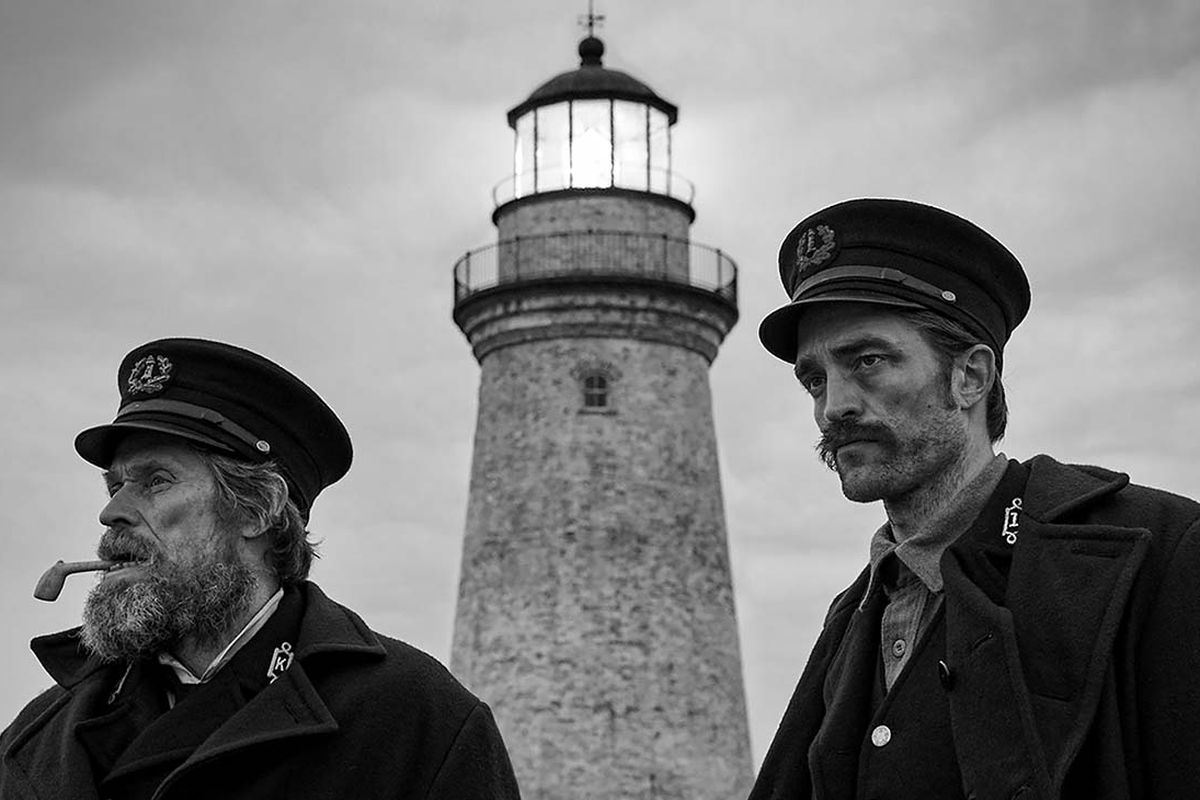
Director/co-writer Robert Eggers follows The Witch, his incandescent 2015 feature debut, with another painstakingly crafted, moody period piece. The Lighthouse strands you, along with two wickies, on the unforgiving island home of one lonely 1890s New England lighthouse.
Salty sea dog Thomas Wake (Willem Dafoe) keeps the light, mind ye. He also handles among the most impressive briny soliloquies delivered on screen in a lifetime. Joining him as second is one Ephraim Winslow (Robert Pattinson)—aimless, prone to self-abuse, disinclined to appreciate a man’s cooking.
Eggers’s film is a two-man show, a dizzying, sometimes absurd and often flatulent descent into madness.
The atmosphere is thick and brisk as sea fog, immersing you early with Jarin Blasche’s chilly black and white cinematography and a Damian Volpe sound design echoing of loss and one persistent, ominous foghorn.
For everything Eggers brings to bear, from the Bergmanesque lighting and spiritual undertones to the haunting score to the scrupulous set design to images suitable for framing in a maritime museum – not to mention the script itself – The Lighthouse works because of two breathtaking performances.
Dafoe may be one of the few actors alive who can take this manic-eyed, gimpy-legged version of the Simpson’s sea captain and force us to absorb his every eccentricity. When Winslow finally screams “You’re a parody!” it both wounds and reassures, as by then we’re eager to accept any bit of confirmation that we can trust anything we’re seeing.
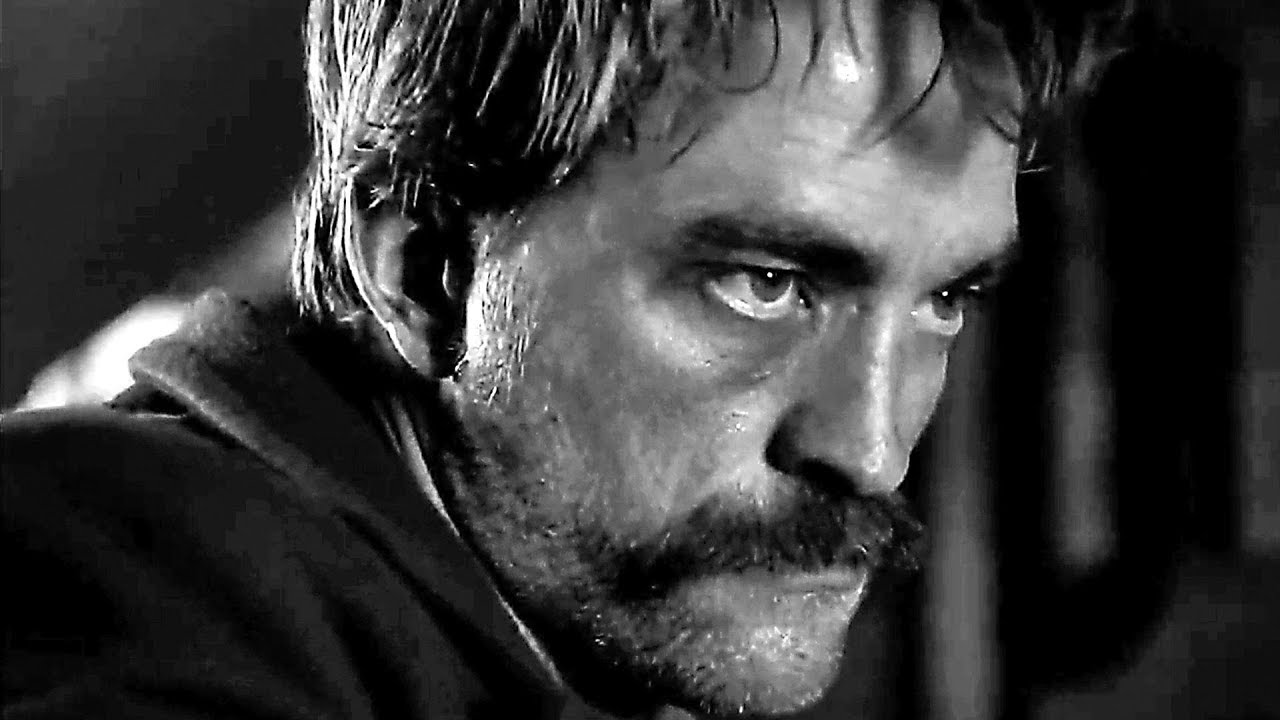
As our vessel into this waterlogged nightmare, Pattinson impresses with yet another fiercely committed performance. Winslow comes to “the rock” full of quiet dignity, only to become a soul increasingly tempted by mysterious new demons while running from old ones.
Winslow’s psychological spiral has so many WTF moments, it would crumble without the sympathetic anchor Pattinson provides from the film’s opening moments. Twilight seems like a lifetime ago, and in case you’ve missed any of the impressive indie credits he’s racked up the last few years, we’ll say it again: Pattinson is the real deal.
So is Eggers. His mastery of tone and atmosphere carries a weight that’s damn near palpable. The Lighthouse will leave you feeling cold, wet and woozy, as Eggers trades the literal payoff from The Witch for a series of reveals you’ll be struggling to connect.
This is thrilling cinema. Let it in, and it will consume you to the point of nearly missing the deft gothic storytelling at work. The film is other-worldly, surreal, meticulous and consistently creepy.
And we’ll tell you what The Lighthouse is not. It is not a film ye will soon forget.