Tag Archives: Hope Madden

Mummy Dearest

Kindred

by Hope Madden

It’s incredibly hard to make a film that feels fresh. Hell, it’s hard to get a film greenlit unless you can describe it to potential financers as a cross between something they’ve seen and something else they’ve seen. Most hope of originality is squashed early.

Writer/director Joe Marcantonio doesn’t exactly concern himself with originality in his feature debut, Kindred. He hopes a stellar cast and a thick, uneasy atmosphere can make up for some of his film’s predictability. For the most part, that does work.

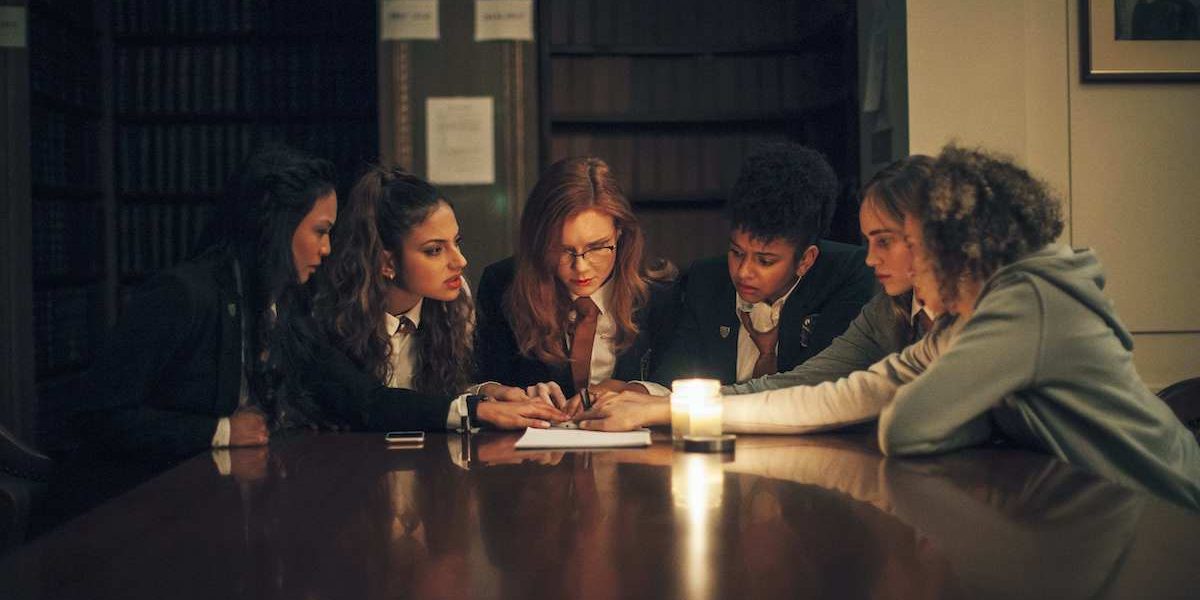
Charlotte (Tamara Lawrance) and her white boyfriend Ben (Edward Holcroft) intend to leave their isolated English village for Australia. Now it’s just telling Mum (Fiona Shaw, as formidable a presence as ever).

The first Sunday lunch with Mum and step-brother Thomas (Jack Lowden) effectively conveys all we need to know about the family dynamics, and Marcantonio tidily establishes a sense of dread that will only deepen as the moments pass until the final credits.

Charlotte, you see, is pregnant, and when Ben dies suddenly, Mum and Thomas offer hospitality that will quickly turn into an inescapable prison.

There are hints early in the film that perhaps Ben is more like his Mum—a bit controlling and manipulative, even if he doesn’t honestly realize it. This sets an intriguing conflict that will obviously balloon once Mum’s in charge.

It’s Rosemary’s Baby meets Get Out. See? Two outstanding movies that you may not want to see watered down into a terribly obvious story, but again, a great atmosphere and several fierce performances will pull you through it.

Shaw’s turn is a magnificent slice of will and bitterness, but it’s Dunkirks Lowden who steals the film. In his hands, Thomas is so eerily sincere that you never know quite what to expect. He’s simultaneously sympathetic, pathetic, and sweetly terrifying.

Lawrance works valiantly against a script that frustrates you with its lazy plotting of constant near-escape and recapture. Worse still is the way Marcantonio ignores his underlying themes of racism—something that could have given the old Gothic style fable of bit of new life.

Norwegian Would

Mortal

by Hope Madden

André Øvredal is a hard filmmaker to pin down. After his 2010 breakout Trollhunter, a giddy found footage flick concerning the impact giant trolls have on his native Norway, the writer/director got far more serious with his 2016 sophomore effort, the excellent horror show The Autopsy of Jane Doe.

Then it was all visuals and atmosphere in the more family friendly genre fare Scary Stories to Tell in the Dark. And now he abandons any hint of horror, returning to the mythology of his homeland for a superhero tale of sorts, Mortal.

Nat Wolff is Eric, a disheveled American in Norway. He keeps to the forests, isolates, but eventually runs afoul of a car full of teenage d-bags—much to the dismay of the marauding teens.

Under arrest and awaiting an American convoy, he’s befriended by Christine (Iben Akerlie) the Norwegian therapist asked to speak with him. She’s the first to recognize his burgeoning but uncontrolled powers, although the Americans who are coming for him seem to have some inkling.

What Øvredal has done here is to reimagine the superhero origin story. True to its title, Mortal examines a very human character, weighing the guilt, pressure, confusion and fear that come with this territory.

Some comic franchises—the X-Men, in particular—ask whether humankind is ready or even worthy of superior beings. Mortal does the same. In fact, it does a lot of the same things you’ve seen in other origin stories and superhero franchises. Its uniqueness may be in the afterthought about how the world would construe the existence of a superhero in terms of religious implications.

This is one of the truly interesting thoughts the film injects into the overcrowded genre. It’s not well developed, unfortunately. But there is something akin to swagger in watching this mid-budget action thriller wrangle Norway’s own mythology away from a far showier, exponentially more famous universe.

Sheep Go to Heaven, Goats Go to Hell

The Dark and the Wicked

by Hope Madden

I’ve been a Bryan Bertino fan since The Strangers because of course I have. How could I not be? That loyalty paid off in 2016 with the moving allegorical horror The Monster, and it rewards viewers again this weekend with the supernatural terror of The Dark and the Wicked.

A twisty old Southern Gothic that relies on practical effects and imagination, the film arrives somewhere in deeply rural America with Louise (a terrific Marin Ireland). She’s about a day behind her brother Michael (Michael Abbott Jr., The Death of Dick Long), back at home because of Dad’s deteriorating health.

Mom (Lynn Andrews) does not want them here.

Bertino is not a filmmaker to let his audience off the hook—if you’ve seen The Strangers, you know that. Like that effort, TD&TW is a slow burn with nerves fraying inside the isolated farmhouse as noises, shadows, and menacing figures lurk outside.

Bertino and cinematographer Tom Schraeder work the darkness in and around the goat farm to create a lingering, roaming dread. There are clumsier moments that feel like pre-ordained audience scares, and they really stand out in a film that otherwise just seeps into your subconscious. But where Bertino, who also writes, scores extra points is in crafting believable characters.

Too often in horror you find wildly dramatic behavior in the face of the supernatural. One character adamantly denies and defies what is clearly happening while another desperately tries to communicate with “it.” No one would do either, but this is the best way to serve the needed action to come in lesser films.

Here, Bertino, Ireland and Abbott give us real characters honestly grappling with something extraordinary.

The don’t want to be here. They don’t want to leave. So, they just do what they can, like the rugged folks they are.

“Well, if I’m here, I’m gonna work.”

Like Natalie James’s Relic from earlier this year, TD&TW has the long, slow, debilitating experience of parental illness on its mind. Like that film, this movie has a deeply aching center that makes the horror in the house as tragic as it is scary, and more horrifyingly, somehow inevitable.

The Beast in Me

May the Devil Take You Too

by Hope Madden

Alfie (Chelsea Islan) is a badass survivor. You can tell because she’s really mean to everyone and she and others repeatedly mention the ordeal she’s already survived.

One problem: if you haven’t seen writer/director Timo Tjahjanto’s 2018 film May the Devil Take You—and you probably haven’t—you’ll need to take this film at its word. May the Devil Take You Too (also called May the Devil Take You: Chapter Two) revisits the hero of that little known Indonesian film two years after the incidents you likely don’t know about.

Maybe I’m wrong. Maybe you totally know all about Alfie, young Nara (Hadijah Shahab) and some kind of demonic parenting issues. If you haven’t seen the original—and I haven’t, by the way—you should probably still be able to make heads or tails of this sequel’s story. More or less. Kind of.

So here’s the skinny. Meanie-pants Alfie, badass survivor, and young Nara find themselves the involuntary guests of seven foster siblings. Like Alfie, the group has some diabolical paternal concerns. It’s never at all clear why they think Alfie could help them, why Nara had to come, or why the whole thing is staged as a kidnapping.

The point is, best not to look closely at the details.

The filmmaker has his own take on religious ritual, possession and afterlife horror, although he is unafraid to wear his American influences on his sleeve. Evil Dead references are a lot less fun when delivered so humorlessly, though. (You may also detect several Nightmare on Elm Street references, and just a touch of Constantine.)

Chapter Two does a lot with a limited budget, relying mainly on old fashioned practical effects and makeup for scares—with frequently decent outcomes. There is some grisly fun to be had in Tjahjanto’s nightmare funhouse.

The filmmaker’s strength is certainly more in staging and effects than it is in writing, however. Contrived and often counter intuitive, the plot is little more than an opportunity to string together kills and the dialog is weak. Not one character makes natural decisions— mainly they stand around in a group looking shocked and screaming each other’s names while something happens.

But once it gets going, Chapter Two is pretty relentless with the bloody action. That’s probably not reason enough to see it, unless you’re a huge fan of the original. Maybe that one was good.

A Connecting Principle

Synchronic

by Hope Madden

Has it really been three years since filmmakers Justin Benson and Aaron Moorhead took us on the UFO death cult head trip that was The Endless?

It’s hard to tell with these guys. They really like to play with time.

Another riff on the same theme, Synchronic is a sci-fi fantasy about parallel dimensions and time travel—plus bath salts.

Steve (Anthony Mackie) and Dennis (Jamie Dornan) are best friends and NOLA paramedics, each facing his own existential crisis. Dennis can’t seem to move past the fear that he’s settled: for his wife, his job, his life. Meanwhile, Steve—whose existence of work, drink and women long ago ceased to have meaning—gets a medical diagnosis that has him rethinking everything.

So far so ordinary, but if you’ve seen anything these filmmakers have done (and you should see everything), you know something seriously weird is coming.

The film’s conceit is a fascinating one, and every grisly crime scene offers a curious clue that may eventually help Steve solve a mystery that gives him purpose and redirects his bestie. Benson, who writes and co-directs, offers plenty of opportunity for mind-bending action and wild set pieces.

He and co-director/cinematographer Moorhead cut back and forth through time to keep you guessing as to the mystery developing, but what’s left underdeveloped are the characters.

Two of the filmmakers’ previous three efforts focused on a pair of men linked through time and experience to the other—best friends in Resolution, brothers in The Endless. This kind of relationship has proven a beautiful anchor for their trippy plots, but Synchronic doesn’t invest enough time or attention to Steve and Dennis’s characters.

Both Mackie and Dornan are solid enough, but their chemistry is weak. The time-worn friendship is more discussed than exposed. Worse, Synchronic is the first of the filmmakers’ movies to lack a robust sense of humor. And it is missed.

The result is a sometimes dour though mainly melancholy effort that feels far less original than it really is. Synchronic is clever, to be sure, and at times quite touching. But for filmmakers who’ve until now positively dripped with inspiration, it feels like a step backward.

Fright Club: Best Animated Horror

Cartoons can be scary. Scooby Doo knew it. You can paint a nightmare in a way that no amount of CGI or practical effects can really execute. Animation frees a filmmaker from the constraints of the concrete world, allowing for more imaginative storytelling. Here are our favorite animated horror gems.

5. Vampire Hunter D: Bloodlust (2000)

Feature length, R-rated anime is so often a simple excuse for fantasy fulfillment aimed at stunted adolescents of all ages. Director Yoshiaki Kawajiri’s 1987 film Wicked City certainly is that.

But in 2000, working from a story based on Hideyuki Kikuchi’s novel, Kawajiri executed the near-impossible. He made a sequel that was better than its much beloved predecessor (1985’s Vampire Hunter D).

Gothic and futuristic, beautifully drawn and nicely paced without losing the energy of the genre, Bloodlust delivers a gorgeous, bloody time.

4. Perfect Blue (1997)

This psychosexual thriller might feel garden variety if it had been made into a live action film. A young woman trades in her innocent image to take on more suggestive roles as an actress, only to find her fans turning on her in violent ways. Or is it an internal conflict over the way men and the media need to sexualize her that’s fragmenting her own mind?

In director Satoshi Kon’s anime vision, those familiar thriller tropes take on an unseemly dreamy quality. The animation style suggests more about the way mass media consumes a sexualized idea of innocence than any live action film could muster, and the hallucinatory quality achieved in the film would never have played this well in any other style.

3. Seoul Station (2016)

An animated side story to writer/director Sang-ho Yeon’s blistering zombie flick Train to Busan, Seoul Station gives us a chance to see what’s happening in other parts of Korea while Soo-an and her dad try to make it off the train alive.

A gripping story of people on the fringe, Seoul Station also boasts some incredibly imaginative animation. Scenes teem with slaughter, salvation, and social anxiety in a film that takes anime into reaches unsought before.

2. The Nightmare Before Christmas (1993)

Tim Burton penned and produced, directed by Henry Selick (Coraline), this tale of the Halloweentown/Christmastown mash up became an instant and unbreakable Goth favorite. Jack Skellington (“What’s happenin’, bone daddy?”) just doesn’t feel the same kind of love for Halloween that’s kept him motivated lo these many years. A little melancholy, he heads into the woods, only to take a wrong turn and find himself in the land of Christmas. Naturally, he and his fellow ghouls – meaning no real harm, you see – decide to kidnap Santa and run Christmas themselves… just this once.

The story, the music (by Danny Elfman, natch), the inspired stop-action style animation, and that sweetly macabre sensibility that Burton brings to every project spoke to the Nineties generation and continues to speak to outsiders, monsters, and lovers of animation everywhere.

https://www.youtube.com/watch?v=T3xTgBED5cQ

1. Fear(s) of the Dark (2007)

A French import perfectly suited to a dark and stormy Halloween night, the film brings together some of the top graphic artists in Europe and America to present six animated vignettes that showcase some of the mind’s deepest fears.

The human mind is always more capable of true horror than any teenage slasher movie, and that is what this film is interested in exploring. shorts delve into social anxiety, sexual insecurity, sociopathic tendencies, needles, dismemberment and the good old fashioned fear of the dark to achieve an overall feel of impending doom. You’ll get goosebumps without really knowing why.

The Whole World Is Watching

The Trial of the Chicago 7

by Hope Madden

Oscar winning, much beloved and frequently frustrating writer Aaron Sorkin first ducked behind the camera for the clever if overwritten 2017 indulgence Molly’s Game.

A courtroom drama (very Sorkin) about celebrity tabloid fodder (less Sorkin-like), the film seemed an odd match for the filmmaker. He’s found a much more comfortable focus in his follow up, the tale of eight defendants, their counsel, prosecution, and a corrupt establishment: The Trial of the Chicago 7.

Chicago 7 artfully and urgently recreates the scene of the federal court hearing against eight defendants alleged to have conspired to incite the infamous riot at the 1968 Democratic National Convention in Chicago.

The film rings with historical significance as well as disheartening immediacy. It is another courtroom drama, this one benefitting from surprising restraint, as well as Sorkin’s deep well of passion for the subjects of legal processes and liberalism. Like Ave DuVernay’s 2014 masterpiece Selma, Sorkin’s new film details the past to show us the present.

He’s assembled a remarkable ensemble, each actor leaving an impression though none gets an abundance of screen time. Yahya Abdul-Mateen II is a blistering Bobby Seale while Frank Langella is infuriatingly believable as Judge Julius Hoffman. Eddie Redmayne, Joseph Gordon-Levitt and Mark Rylance are all also excellent, as you might expect.

Jeremy Strong and Sacha Baron Cohen share a comfortable, enjoyable chemistry as Jerry Rubin and Abbie Hoffman, respectively. Both appear in the film, as they did in life, as the wise-cracking comic relief in the room, but Cohen’s turn is thoughtful, wise, and slightly tragic. He’s obviously a talent, but this may be the first time we’ve seen the magnitude of his acting prowess.

An alarmingly relevant look at the power of due process, free speech, and justice, Chicago 7 is catapulted by more than the self-righteousness that sometimes weights down Sorkin’s writing. This is outrage, even anger, as well as an urgent optimism about the possibilities in human nature and democracy.

If I may quote my own review of Molly’s Game and my take on Sorkin as a filmmaker:

His are dialogue-driven character pieces where brilliant people throw intellectual and moral challenges at one another while the audience wonders whether the damaged protagonist’s moral compass can still find true north.

Still the case. But with Chicago 7, Sorkin’s struck a balance. He’s found a story and convened a cast that demand and receive his very best, because The Trial of the Chicago 7 is a story about today, this minute.

Funeral for a Friend

The Mortuary Collection

by Hope Madden

“Have you any experience in the mortuary arts?”

So begins a conversation between Raven’s End’s mysterious mortician and a young woman who’s come to answer the help wanted sign out front in writer/director Ryan Spindell’s fun and stylish horror anthology, The Mortuary Collection.

Mortician Montgomery Dark (Clancy Brown) has tales to tell of the lives and deaths in Raven’s End. His new assistant Sam (Caitlin Custer) is an eager listener, but also tough to please.

Such is the framing device for the anthology of short horrors, much like the one from Rusty Cundieff’s 1995 collection, Tales from the Hood (and just a bit like Jeff Burr’s 1987 anthology with Vincent Price, From a Whisper to a Scream).

The framing device is so often the best part.

Brown conjures a bit of Angus Scrimm (Phantasm’s Tall Man), channeling a little Tom Noonan as well, to create a spooky but somehow vulnerable master of ceremonies. Custer’s is an intriguing character, challenging her host, never squeamish or spooked. It makes for an interesting dynamic that turns more into a conversation on storytelling than you might expect.

The tales themselves are all set in and around a town where newspaper headlines speak of beasts, asylums, and missing persons. Raven’s End and its stories possess an unidentifiably vintage quality, something fictional and fanciful, modern and yet of an indeterminate past.

Characters sometimes pop up in multiple tales, each story boasting that patented twist ending you’d expect from a Tales from the Crypt episode. Some of the shorts are stronger than others (as Sam likes to point out to Mr. Dark), but the performances are all very solid, and Spindell peppers every story with fun bits of dialog.

“They won’t let me near a scalpel, and for good reason.”

There isn’t a weak short in the bunch, and though certainly some of the twists are not surprising, the execution is slick, the shorts are gorgeous and moody, and Clancy Brown is an absolute treat.

Pennies From Heaven

Faith Ba$ed

by Hope Madden and George Wolf

I have seen Faith Ba$ed and I am outraged.

People that haven’t seen it are outraged, and you know what that is?

Outrageous, but not surprising.

According to writer and co-star Luke Barnett, people are upset at just “the idea of it.” And that’s an ironic protest that actually speaks more negatively about the Christian film industry than anything in this actual movie.

Barnett and director Vincent Masciale, both Funny or Die veterans, are more interested in the goofy exploits of two lifelong friends in California who are having trouble adjusting to adulthood.

Tanner (Tanner Thomason) is a ladies man bartender whose life goals don’t extend beyond drinking and hanging out with friends. Luke (Barnett) cleans pools while peddling the weight loss tea pyramid scheme of his entrepreneurial idol Nicky Steele (Jason Alexander in a bonkers cameo).

Luke and Tanner are big movie fans, and when they discover just how profitable the faith-based market is, a plan emerges. If they can make their own “Jesus” film and sell it to ChristFlix pictures, there should be more than enough profit to stuff their pockets and help out the local Elevate Church where Luke’s father (Lance Reddick) is the pastor.

The big question: can the boys snag Butch Savage (David Koechner, bonkers himself), the action hero from their youth, for the pivotal role?

Masciale, helming his second feature, brings an irresistibly absurdist vibe to the shenanigans that practically begs you not to overthink any of it. Sometimes we get character interviews as per a mockumentary, sometimes we don’t. The continuity and internal logic gets shaky at times, all of which falls perfectly in line with the movie within this movie.

Good-natured fun is certainly had at the expense of the faith-based industry. Margaret Cho’s appearance as a ChristFlix executive running down the rules of Christian films is every bit the bullseye of the horror rules in Scream, and the big Christian yacht rock concert (pay attention to those lyrics!) is subtle perfection.

But it’s the continued success of the Christian entertainment industry that makes it ripe for satire. And while Faith Ba$ed uses the setting to great advantage, its knives are never out for the believers themselves.

Because you know what else Barnett’s script gives us? A church community that is welcoming to all, one where people missing something in their lives can and do find real fulfillment.

And it gives us plenty of laughs, memorable quotes and overall nuttiness at a time when we could use it.

Oh, the outrage.