You’ll find real horror in False Positive. There’s the plot, sure—a woman desperate to conceive, in the hands of a nefarious physician with a God complex—and all the body horror and helplessness that go along with it. But that’s not the scary part.
Indeed, co-writer/director John Lee levels a more comedic
tone to the by-the-numbers premise. Where he and co-writer/star Ilana Glazer
mine unnerving dread is in their observational honesty.
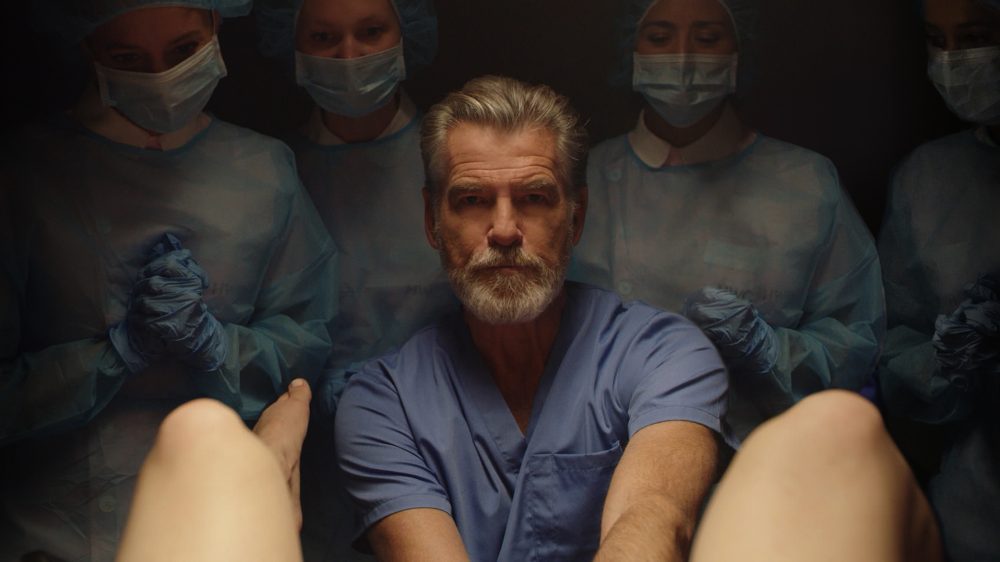
Glazer is Lucy, and she and her husband Adrian (Justin Theroux, slyly wonderful) have been trying to get pregnant for two years. As much as she wants to do this naturally, she finally caves in to Adrian’s suggestion that they visit his med school mentor, Dr. Hindle (Pierce Brosnan – perfection).
Lee’s intention is not to make you wonder whether something sinister is afoot. The Stepford-esque nursing staff and eerily meticulous clinic proclaim it. The sheer number and variety of phallic instruments to be inserted, and the volume of lubricant so very lovingly applied, plays like SNL by way of Cronenberg.
If you’ve ever seen Broad City, Glazer’s groundbreaking Comedy Central sit-com, you may not recognize the performer’s dramatic skills, but you will recognize the writer’s keen eye for everyday absurdities.
Here’s where False Positive’s horror kicks in. It’s the
authenticity, the banal realism of Lucy’s daily condescending, dismissive,
patronizing, smothering, gaslighting humiliations that really eat at you. The low-key
accuracy of it all—from the male colleagues who swear you are glowing as they
leave their lunch orders next to your laptop, to your nurse’s reassuring caresses
and terms of endearment, to your husband’s reminder whenever you’re feeling
down that we’ve been through a lot with this pregnancy.
Tensions escalate as the storyline itself dictates, although
the film is far more surefooted in its observational horror than it is in its
plot. Lucy’s pre-pregnancy character is ill-defined, which makes her descent less
satisfying. The climax is played for comedic value and the final act’s weirdness,
though welcome, holds no real meaning.
Worse of all is the under-developed character of a midwife played imposingly by Zainab Jah. Lee clearly hoped to use this character as a statement on the genre itself but the whole affair feels wrong-headed.
Those are some serious misgivings, I grant you, but there really is something subversive, honest, and horrifying worth witnessing in this movie.
Medical horror never lacks for really bad doctors: mad scientists, evil geniuses, or just people with more ambition than skill. What these particular folks can do with a scalpel, some thread, and a little imagination impresses. That is to say that it leaves an impression, often on unwilling patients. Here is our list of the best horror films about involuntary surgery.
6. The Human Centipede (First Sequence) (2009)
After a handful of middling Dutch comedies, Tom Six stumbled upon inspiration – 100% medically accurate inspiration. Yes, we mean the Human Centipede. Just the First Sequence makes the list, though.
For a lot of viewers, the Human Centipede films are needlessly gory and over-the-top with no real merit. But for some, Six is onto something. His first effort uses a very traditional horror storyline – two pretty American girls have a vehicular breakdown and find peril – and takes that plot in an unusual direction. But where most horror filmmakers would finish their work as the victims wake up and find themselves sewn together, mouth to anus, this is actually where Six almost begins.
Although the film mines something primal about being helpless in the hands of surgeons and doctors, it’s Dieter Laser and his committed, insane performance that elevates the work. That and your own unholy desire to see what happens to the newly conjoined tourists.
5. Tusk (2014)
The basic idea for this film came from one of writer/director Kevin Smith’s actual podcasts. He found online a letter from a man seeking a lodger, and read it aloud and mocked the man. But somewhere in all that, Smith found the story of a man losing his humanity.
Tusk is a comic riff on The Human Centipede. It’s also an insightful kind of stress dream, so close to home for Smith that, even with all its utter ludicrousness, it feels almost confessional.
The film’s greatest strength is a hypnotic performance by Michael Parks as the old seafarer with nefarious motives. He’s magnificent, and co-star Justin Long’s work is strongest when the two share the screen.
There is no film quite like Tusk, certainly not in Smith’s arsenal, which, I suppose, means this is not a traditional Kevin Smith Movie. And yet, there’s more Smith in this film than in anything else he’s made.
4. American Mary (2012)
Jen and Sylvia Soska have written and directed a smart, twisted tale of cosmetic surgery – both elective and involuntary.
Katharine Isabelle (Ginger Snaps) stars as med student Mary Mason, a bright and eerily dedicated future surgeon who’s having some trouble paying the bills. She falls in with an unusual crowd, develops some skills, and becomes a person you don’t want to piss off.
The Soskas’ screenplay is as savvy as they come, clean and unpretentious but informed by gender politics and changing paradigms. They also prove skilled at drawing strong performances across the board. Isabelle is masterful, performing without judgment and creating a multi-dimensional central figure. Antonio Cupo also impresses as the unexpectedly layered yet certainly creepy strip club owner.
Were it not for all those amputations and mutilations, this wouldn’t be a horror film at all. It’s a bit like a noir turned inside out, where we share the point of view of the raven-haired dame who’s nothin’ but trouble. It’s a unique and refreshing approach that pays off.
3. Excision (2012)
Outcast Pauline (a very committed AnnaLynne McCord) is a budding surgeon. She’s not much of a student, actually, but she does have an affinity for anatomy. Especially blood. Pauline really, really likes blood.
Her sister – the favorite, for good reasons, truth be told – is slowly dying. And somewhere in Pauline’s odyssey to lose her virginity, inspire her mother’s love and do the right thing, she always seems to do the wrongest possible thing.
Writer/director Richard Bates, Jr. takes an unusual course with this coming-of-age horror. I’m not sure we’ve seen it handled quite like this before, although to be fair, it’s definitely in keeping with the peculiar and beautifully realized character he and McCord have created.
2. Eyes Without a Face (1960)
The formula behind this film has been stolen and reformulated for dozens of
lurid, low-brow exploitation films since 1960. In each, there is a mad doctor
who sees his experiments as being of a higher order than the lowly lives they
ruin; the doctor is assisted by a loyal, often non-traditionally attractive
(some might say handsome) nurse; there are nubile young women who will soon be
victimized, as well as a cellar full of the already victimized. But somehow, in
this originator of that particular line of horror, the plot works seamlessly.
An awful lot of that success lies in the remarkable performances. Pierre Brasseur, as the stoic surgeon torn by guilt and weighed down by insecurities about his particular genius, brings a believable, subtle egomania to the part seldom seen in a mad scientist role.
Still, the power in the film is in the striking visuals that are the trademark of giant French filmmaker Georges Franju. His particular genius in this film gave us the elegantly haunting image of Dr. Genessier’s daughter Christiane (Edith Scob). Her graceful, waiflike presence haunts the entire film and elevates those final scenes to something wickedly sublime.
https://www.youtube.com/watch?v=1vjsU-OBBWA
1. The Skin I Live In (2011)
In 2011, the great Pedro Almodovar created something like a cross between Eyes Without a Face and Lucky McGee’s The Woman, with all the breathtaking visual imagery and homosexual overtones you can expect from an Almodovar project.
The film begs for the least amount of summarization because every slow reveal is placed so perfectly within the film, and to share it in advance is to rob you of the joy of watching. Antonio Banderas gives a lovely, restrained performance as Dr. Robert Ledgard, and Elena Anaya and Marisa Paredes are spectacular.
Not a frame is wasted, not a single visual is placed unconsciously. Dripping with symbolism, the film takes a pulpy and ridiculous storyline and twists it into something marvelous to behold. Don’t dismiss this as a medical horror film. Pay attention – not just to catch the clues as the story unfolds, but more importantly, to catch the bigger picture Almodovar is creating.
Stern, driven Enid (Niamh Algar) takes her responsibilities
seriously. Unfortunately for her, they come at a high price. Enid is a film
censor in the most punishing time and place for such an endeavor: Thatcher’s
England. It’s 1985, an era when controversial films hoping to make their way to
screens big and small found themselves more butchered than their characters.
Co-writer/director Prano Bailey-Bond takes inspiration from this notion in her feature debut, Censor—an immersive era-specific horror. It is especially immersive for Enid.
She spends long hours deliberating on exactly where the line is between danger and acceptability: rewinding, examining frame by frame, if necessary, regardless of the nonchalance and casual derision of her co-workers. Enid is convinced it is her duty to protect people from these images.
As she herself drowns in repeated viewings of the most violent
and depraved material, you have to wonder whether she might be better off
protecting herself.
Bailey-Bond has other questions in mind, like why is it that
Enid is so preoccupied with this job, how might it feed her own darkness, and
what happens when her worlds blend together?
Censor is a descent into madness film—nothing new in the genre. And moments of Censor can’t help but call to mind fellow Brit Peter Stickland’s 2012 treasure Berberian Sound Studio. But Bailey-Bond and co-writer Anthony Fletcher evoke such a timestamp with this film, not just in the look and style, but with the social preoccupation.
As coincidences pile up – a definitive family decision, a horror movie-style murder spree, a film that hits too close to home — Enid seems to suspect that her real motive has been to censor her own thinking.
When she stops doing that, look out.
Algar’s prim and sympathetic, deliberate and brittle. It’s clear from the opening frame that Enid will break. But between Algar’s skill and Bailey-Bond’s cinematic vision, the journey toward that break is a wild ride.
Random is good. Random is fun. It can be frustrating after a
while, but it certainly isn’t boring.
Writer/director Jack C. Newell takes us on a not-boring road
trip alongside Ted (David Sullivan) and his wife Laura’s (Marguerite Moreau)
ashes. He stole the ashes from Laura’s weird family who never did like him, but
they’d stolen the ashes from him in the first place so it probably wouldn’t
have become a police matter if Ted hadn’t stolen that car while he was at it.
The thing is, Ted keeps seeing—even talking with—Laura, and he
thinks she’s here to help him figure out what to do with her ashes.
So, that’s the gist: Ted does not know how to move on
without Laura and this road trip will move him toward some kind of closure. It
will also involve near-Lynchian dance numbers, shadow puppet displays, and no
real sense of direction.
The aimlessness suits the character—Ted is lost,
metaphorically and often literally. It works less well for the film. The final
moments of Monuments leave you with the sense that something has been accomplished.
Its meandering nature and basic structurelessness leave you wondering what.
Sullivan gives off a charming, goofy Nathan Fillion vibe—rarely a bad thing, and certainly the style of performance best suited to this laid-back, screw ball, existential comedy. Still, those are a lot of adjectives for one film, and they don’t necessarily fit together that well. Here’s where Newell gets himself in trouble.
There should be sadness here. Underneath all the zany moments and haphazard adventures, a rumble of grief should constantly threaten to break the surface. Without that genuine human soul, the humor doesn’t ring true and the random setups feel forced.
As solid as Sullivan is, when it does finally come time for Ted to mourn, to face his own desperate lonesome loss, the actor fails. Worse still, his insincerity feels like a joke itself, mocking what is ostensibly the entire core of Ted’s breakdown and the catalyst for his behavior.
If this irony led to some kind of absurdist “What’s really the point of it all?” theme, maybe it would have been worth it. Instead, it just feels random.
This long-lost film from the legendary George A. Romero is an awkward, clumsily-assembled metaphor with a glaring lack of subtlety.
And armed with the proper context, you should probably see it anyway.
In 1973, Romero was far from a legend. He had lost the copyright to Night of the Living Dead, and he was a nearly broke filmmaker that needed work. So he was more than happy to accept a commission from right in his own hometown. Pittsburgh-based Lutheran Services wanted a film to explore societal discrimination of the elderly, and turned to the local boy who’d hit it big a few years back.
But they weren’t at all interested in the Twilight Zone treatment that Romero and first time (only time) screenwriter Wally Cook gave the subject, so they passed. Each party put the film behind them, and it sat unreleased for nearly fifty years.
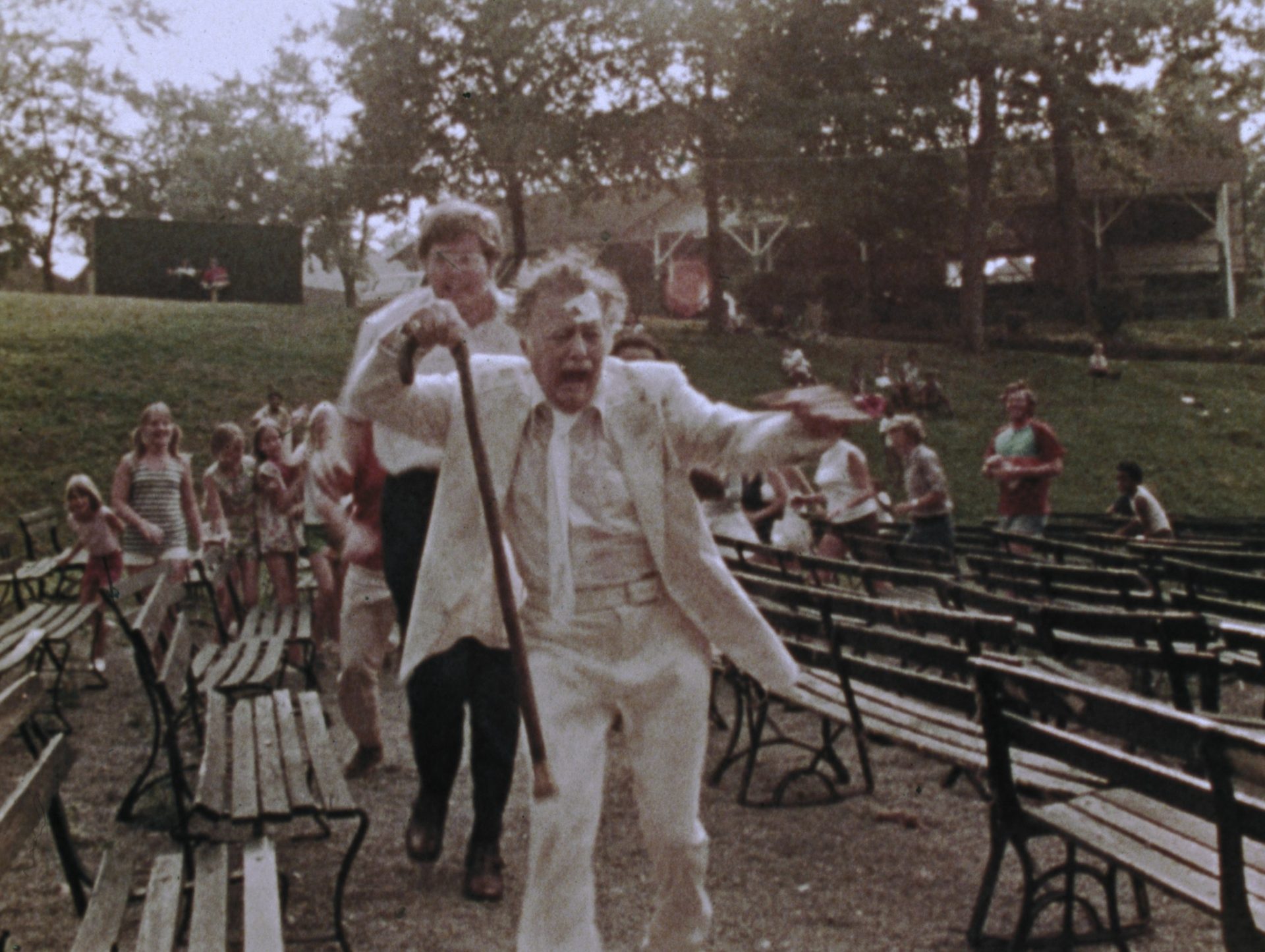
The 52-minute feature stars Lincoln Maazel (who would co-star in Romero’s classic Martin four years later) as an affable, white-suited man who greets a beaten down and disheveled version of himself in an empty waiting room. The out-of-breath Maazel advises the energetic one not to go outside.
“There’s nothing out there. You won’t like it!”
The warnings go unheeded, and the nattily-clad Maazel begins his day at the amusement park, where he is subjected to nothing but torment, ridicule and abuse.
Some of the vignettes are rooted in solid ideas. The grim reaper wandering the park and riding coasters is a striking juxtaposition, and a fortune teller’s unpleasant premonition for a couple of young lovers manages to deliver confrontational cynicism with a somewhat lighter touch.
The elderly gentleman’s metaphorical trip through the carnival of agism is flanked by footage of Maazel, as himself, explaining what we are about to see, and later, what we have seen. No doubt someone thought a late-addition prologue/epilogue would help an audience make sense of the narrative’s structureless string of abuses, but the Serling-on-steroids material is so lengthy and so at odds with the otherwise experimental nature of the core content that it only serves to make the entire film even less enjoyable.
For completists, The Amusement Park is available in select theaters and on Shudder, and merits consideration. For anyone thrilled by the idea of George A. Romero siccing amusement park horror on unsuspecting old people, be warned: you will be sorely disappointed.
Disney possesses more of the greatest villains than any other studio or property in existence, more than Marvel, more than DC, more than even Universal and its set of classic monsters. By more we don’t mean quantity necessarily, but quality: Maleficent, Cinderella’s evil stepmother, Snow White’s evil queen, Scar, Ursula, Jafar, Madam Medusa (seriously, if you haven’t seen the original 1977 The Rescuers, you need to do so at once), and of course, Cruella De Vil.
That’s a stash of villains to covet or to celebrate, so why
does Disney hate them so?
Cruella is the mouse’s latest attempt to give a villain the Wicked treatment with an origin story that offers insight into the root cause of their villainy. As these things go, Cruella does have a few really bright spots.
Emma Stone has honestly never been bad in anything. She
brings a charmingly conflicted Jekyll/Hyde to a character who is working
against her own instincts to be a good person. Joel Fry and Paul Walker Hauser
are endlessly endearing as her cohorts Jasper and Horace, respectively. But can
we talk about Emma Thompson for a second?
The definition of glorious, Thompson delivers a delightfully droll Baroness Von Hellman – the fashion icon nemesis who brings out the wicked in Cruella. Scenes between the Emmas elevate the entire project, allowing Thompson to radiate devastating narcissism and Stone to mine her character’s emotional and intellectual landscape.
And who doesn’t like to see Mark Strong? He’s one of maybe a
dozen performers in tiny, mainly pointless roles decorating the dozens and
dozens of scenes that should have been purged from a film that runs two hours
and fifteen minutes but feels twice that.
My God does this movie need trimming. You will have aged noticeably by the time it’s over. It meanders for the better part of an hour before actually hitting the catalyst for the story, then stages heist upon gala upon big reveal upon public comeuppance upon more big reveals before actually getting to the point.
Some of these are interesting and fun, but most of them serve no real purpose. Director Craig Gillespie, working from a script by committee (there are 5 credited screenwriters), belabors everything. This not only leaves his film almost structureless, but it also guarantees that nothing sticks with you, not even individual scenes that absolutely should be memorable. No scene or plot point is allowed any real emphasis or import.
It’s curious that Gillespie – who proved a master of tone with I, Tonya – can never find a consistent one here. It doesn’t help that a nearly endless parade of pop/rock hits are jammed into the soundtrack with questionable regard for cause or effect.
And still, there are fun-filled stretches that seem desperate to claw out from under all the dead weight. Cut a full 45 minutes from this film and you may have something. Instead, we get a pointless mess that can’t decide how it even feels about Cruella de Vil.