“Thanks for coming out tonight, we’re Motley Jüe..oy!”
Yes, Motley Jüe was a real band, at least for a few days. Picking the perfect band name is just a small part of the fun for the wannabe rockers at Rock and Roll Fantasy Camp. Rock Camp: The Movie takes us inside the experience that bridges the gap between stage and the Gold Circle section.
Because, let’s face it, those in the cheap seats can’t afford this, either. But for the fans that can swing it, RCTM shows us an indulgence that’s a lot less worthy of the kinds of jokes it inspired in year one.
Promoter David Fishof launched the first camp in 1997, to minimal interest. He got the idea from a practical joke played on him backstage by members of Ringo’s All-Starr Band (that home video footage is priceless), though low attendance the first year seemed to signal failure.
But after the camp was featured in various TV and commercial segments, it gained a foothold in popular culture. That brought some big rock stars into the fold, and Fishof (an interesting guy who could merit a documentary himself) suddenly had a hit.
The film is the debut feature for co-writers/directors Renee Barron and Douglas Blush, which often shows. Their focus can wander, and much of the production isn’t far removed from a marketing video. Plus, there’s no escaping that fact that much of the footage – judging by the look of some very famous faces – is clearly less than recent. The overall context of regular folk taking a chance to follow their passion, though, does help these rough edges seem appropriate.
Profiles of fewer campers might have allowed time to foster a more intimate feel, but the dreamers Barron and Blush introduce are worth knowing. We see lives uplifted, families strengthened, and true talent given the chance to grow.
Perhaps most surprisingly, we see rich and incredibly successful musicians truly moved by their students, and reconnecting with the simple joy of music that set them on their path. And some of them – Roger Daltrey, Paul Stanley and Sammy Hagar especially – seem like really nice people.
Yeah, Gene Simmons is still obnoxious. Even fantasies have their limits.
The room where it really happened was in Miami’s Hampton House. After a young Cassius Clay won the Heavyweight title from Sonny Liston on Feb. 25, 1964, he joined his long time mentor Malcolm X, NFL legend Jim Brown and soul sensation Sam Cooke at the South Florida hotel.
Writer Kemp Powers first imagined how that meeting of legendary minds might have played out, and now Regina King – who already has an acting Oscar – jumps into the race for Best Director with a wise and wonderful adaptation of Powers’s stage play. Propelled by a bold, vital script from Powers himself, King invites us into a frank discussion about the steps in the civil rights movement of the 1960s, and about each man’s role in the struggle.
Though existing mainly inside that single hotel room, One Night in Miami is in a constant state of motion, as four talented actors serve and volley through a ballet of insight and intellect.
Portraying a bigger-than life-personality such as Clay without a hint of caricature is no easy feat, but Eli Goree handles it with smooth charisma.
Clay’s braggadocio is as playful and charming as you remember, but Goree also finds authentic shades of apprehension about the societal role Clay (who would publicly join the Nation of Islam and announce his name change to Muhammed Ali just weeks after the meeting) was about to accept.
Kingsley Ben-Adir’s Malcom X is a measured voice of wisdom, but the film finds its gravitational pull in the forces of Aldis Hodge and Leslie Odom, Jr.
As Brown, Hodge is beautifully restrained power, a man of incredible strength still able to be staggered by sudden blows of racism. Brown’s path as a leader of the civil rights movement contrasts sharply with Cooke’s, and Odom, Jr. gives the singer surprising and resonant layers that include anger at the thought that he’s not all in for the cause.
The characters continually challenge each other, as King and Powers challenge us with a profundity that comes from their refusal to settle for easy answers. Each question the film raises connects past to present with committed grace, and One Night in Miami finds a beautiful dignity that shines in the face of bigotry.
Ten years ago, a Japanese teenager wrote a book that quickly became regarded as “an envoy from another world.”
With The Reason I Jump, 13 year-old Naoki Higashida expressed in poetic detail how a nonverbal autistic child sees the world.
In short, it’s “details first…then the whole thing.”
For the film adaptation, veteran documentarian Jerry Rothwell gently weaves narrated passages from the book around visits with a handful of other mostly nonverbal autistic teens from around the globe.
The wonderful cinematography from Ruben Woodin Deschamps is a perfect vessel to unveil the beautifully undiscovered country the film explores. These teens are talented, intelligent and expressive, longing for friendships that only require “peace from the world.”
And more than anything, they want to change the perception of autism by joining the conversations they’ve long been the subject of. The Reason I Jump is a touching introduction into how much we can learn by listening to them.
And please, if you have not sought it out yet, a film that made our Best of 2019 list—Devil to Pay—is finally available. So, while we won’t add it to this year’s list, please do watch it!
In the meantime, here are our picks for the ten best horror films of 2020.
10. His House
A remarkable braiding of human tragedy, global political peril and traditional ghost story, co-writer/director Remi Weekes’s His House was one of 2020’s great surprises. Two powerful lead performances from Sope Dirisu and Lovecraft Country’s Wumni Mosaku pull you into the story of South Sudanese refugees Vol (Dirisu) and Rial (Mosaku). You ache for them as they try to find a way to fit into their new life in London—a life where so many other refugees have failed.
Tension builds quietly but steadily as the two navigate
their new community and the rules good refugees must follow, but worry for them
and their security leaps to new heights as certain horrors bring about risky
behavior. You never know whether you’re more worried that they’ll be sent back
or they’ll have to stay.
Mosaku’s stare is weightier and more powerful than anything else
you’ll encounter in this film, but it’s balanced by the vulnerability Dirisu
brings to Bol. The two deliver an urgent and profound message about guilt,
tragedy and forgiveness.
9. She Dies Tomorrow
She Dies Tomorrow is a horror film that’s one part Coherence, one part The Beach House, one part The Signal (2007, not 2014) and yet somehow entirely its own. It helps that so few people have seen any of those other movies, but the truth is that writer/director Amy Seimetz (creator of The Girlfriend Experience) is simply braiding together themes that have quietly influenced SciFi horror hybrids of late. What she does with these themes is pretty remarkable.
Her film weaves in and out of the current moment, delivering a dreamlike structure that suits its trippy premise. Amy (Kate Lyn Sheil) believes she is going to die tomorrow. She knows it. She’s sure.
She calls her friend Jane (the always amazing Jane Adams), who senses that Amy is not OK but has this obligation to go to her sister-in-law’s party…whatever, she’ll stop over on her way.
By the time Jane gets to the party, she’s also quite certain she will die tomorrow. It isn’t long before the partygoers sense their own imminent deaths; meanwhile, Amy is spreading her perception contagion elsewhere.
8. Gretel & Hansel
Sophia Lillis (IT) narrates and stars as Gretel, the center of this coming of age story—reasonable, given the change of billing suggested by the film’s title. The witch may still have a tasty meal on her mind, but this is less a cautionary tale than it is a metaphor for agency over obligation.
Alice Krige and her cheekbones strike the perfect mixture of menace and mentorship, while Sammy Leakey’s little Hansel manages to be both adorable and tiresome, as is required for the story to work.
Perkins continues to impress with his talent for visual storytelling and Galo Olivares’s cinematography heightens the film’s folkloric atmosphere.
There’s no escaping this spell. The whole affair feels like an intriguing dream.
7. The Other Lamb
The first step toward freedom is telling your own story.
Writer C.S. McMullen and director Malgorzata Szumowska tell this one really well. Between McMullen’s outrage and the macabre lyricism of Szumowska’s camera, The Other Lamb offers a dark, angry and satisfying coming-of-age tale.
Selah’s (Raffey Cassity) first period and her commune’s migration to a new and more isolated Eden offer the tale some structure. Like many a horror film, The Other Lamb occupies itself with burgeoning womanhood, the end of innocence. Unlike most others in the genre, Szumowska’s film depicts this as a time of finding your own power.
The Other Lamb does not simply suggest you question authority. It demands that you do far more than that, and do it for your own good.
6. The Lodge
Several Fiala and Veronika Franz follow up their creepy Goodnight Mommy with this “white death” horror that sees a future stepmom having a tough time getting to know the kids during a weeklong, snowbound cabin retreat. Riley Keough is riding an impressive run of performances and her work here is slippery and wonderful. As the unwanted new member in the family, she’s sympathetic but also brittle.
Jaeden Martell, a kid who has yet to deliver a less than impressive turn, is the human heartbeat at the center of the mystery in the cabin. His tenderness gives the film a quiet, pleading tragedy. Whether he’s comforting his grieving little sister or begging Grace (Keough) to come in from the snow, his performance aches and you ache with him.
There’s no denying the mounting dread the filmmakers create, and the three central performances are uniquely effective. Thanks to the actors’ commitment and the filmmakers’ skill in atmospheric horror, the movie grips you, makes you cold and uncomfortable, and ends with a memorable slap.
5. The Dark and the Wicked
Bryan Bertino is not a filmmaker to let his audience off the hook—if you’ve seen The Strangers, you know that. Like that effort, TD&TW is a slow burn with nerves fraying inside an isolated farmhouse as noises, shadows, and menacing figures lurk outside.
Bertino and cinematographer Tom Schraeder work the darkness in and around a goat farm to create a lingering, roaming dread. But where Bertino, who also writes, scores extra points is in crafting believable characters.
Too often in horror you find wildly dramatic behavior in the face of the supernatural. One character adamantly denies and defies what is clearly happening while another desperately tries to communicate with “it.” No one would do either, but this is the best way to serve the needed action to come in lesser films.
4. The Wolf of Snow Hollow
Two years ago. Thunder Road was a pretty fantastic breakout for writer/director/star Jim Cummings. A visionary character study with alternating moments of heart and hilarity, it felt like recognizable pieces molded into something bracingly original.
Now, Cummings feels it’s time to throw in some werewolves.
Cummings is officer John Marshall of the Snow Hollow sheriff’s department. John’s father (Robert Forster, in his final role) is the longtime sheriff of the small ski resort town, but Dad’s reached the age and condition where John feels he’s really the one in charge.
John’s also a recovering alcoholic with a hot temper, a bitter ex-wife and a teen daughter who doesn’t like him much. But when a young ski bunny gets slaughtered near the hot tub under a full moon, suddenly John’s got a much bigger, much bloodier problem.
At its core, The Wold of Snow Hollow is a super deluxe re-write of Thunder Road with werewolves. I call that a bloody good time.
https://www.youtube.com/watch?v=OP2m2pG6Qn4
3. Werewolf
Liberation isn’t always the good time it’s cracked up to be. In his strangely hopeful tale Werewolf, writer/director Adrian Panek offers a different image of social rebuilding.
Werewolf is beautifully shot, inside the crumbling castle, out in the woods, even in the early, jarring nonchalance of the concentration camp’s brutality. Panek hints at supernatural elements afoot, but the magic in his film is less metaphorical than that.
The film is creepy and tense. It speaks of the unspeakable – the level of evil that can only really be understood through images of Nazi horror—but it sees a path back to something unspoiled.
2. Swallow
Putting a relevant twist on the classic “horrific mother” trope, writer/director Carlo Mirabella-Davis uses the rare eating disorder pica to anchor his exploration of gender dynamics and, in particular, control.
Where Mirabella-Davis’s talent for building tension and framing scenes drive the narrative, it’s Bennett’s performance that elevates the film. Serving as executive producer as well as star, Haley Bennett transforms over the course of the film.
When things finally burst, director and star shake off the traditional storytelling, the Yellow Wallpaper or Awakening or even Safe. The filmmaker’s vision and imagery come full circle with a bold conclusion worthy of Bennett’s performance.
1. Possessor
Brandon Cronenberg’s created a gorgeous techno world, its lulling disorientation punctuated by some of the most visceral horror to make it to the screen this year. There is something admirably confident about showing your influences this brazenly.
Credit Cronenberg, too, for the forethought to cast the two leads as females (Jennifer Jason Leigh playing the remarkable Andrea Riseborough’s boss). The theme of the film, if driven by males, would have been passe and obvious. With females, though, it’s not only more relevant and vital, but more of a gut punch when the time comes to cash the check.
Possessor is a meditation on identity, sometimes very obviously so, but the underlying message takes that concept and stabs you in your still-beating heart with it.
Let’s be honest, no one saw much of anything movie-wise this year. The highest grossing cinematic releases made so little they would have been considered catastrophic bombs in any other year, and streaming numbers confirmed that we were having a hard time zeroing in on new releases.
Still, there were some exceptional films that simply disappeared without even a hello. These are movies that broke new ground, broke our hearts, explored new genre hybrids, reimagined familiar tales, startled our senses, and otherwise just impressed the hell out of us. We really want to introduce you to these guys, which we list in alphabetical order because they deserve equal attention (and we argued too much about the ranking).
Black Bear
Available on Amazon Prime, YouTube, Google Play and Vudu.
As slippery as it is inviting, Lawrence Michael Levine’s Black Bear is an intoxicating trip through the inspirations and indulgences that take root in creative minds. It feels intensely personal, and yet – once Levine delivers his midstream shape shift – malleable enough to bend to myriad perspectives and interpretations. Black Bear isn’t a comedy – except when it’s funny. It’s also dramatic and slightly horrific, depending on your viewpoint.
Most of all, it’s emotional, propelled by career high performances from Christopher Abbott, Sarah Gadon, and Aubrey Plaza. The glee each performer takes in upending character expectations is evident, with Plaza seamlessly moving from a cool, casual customer to the emotionally frayed flashpoint of a volatile triangle.
Bloody Nose, Empty Pockets
Available on Amazon Prime, YouTube, Google Play and Vudu.
Similar to the hybrid reality it creates, Bloody Nose, Empty Pockets is an oddly compelling cocktail. It’s like a foul odor you step back from quickly, then find perversely comforting once you’ve had time to soak in it.
Sitting unceremoniously at the edge of Las Vegas, the bar The Roaring Twenties is down to its final day. Directors Bill Ross IV and Turner Ross drop us off before noon, when grizzled regular Michael (Michael Martin, perfect) is cleaning up in the bathroom and daytime bartender Mark is hanging up some cheap decorations for the farewell party.
As drinks are poured, ashtrays are emptied and daytime TV gives way to nighttime jukebox singalongs, we get to know the parade of souls that have come to call this dive bar home.What The Florida Project was to Disney World, Bloody Nose is to Lost Wages, eschewing tourist playgrounds for the world-weariness of an existence in exile, and of outsiders no longer bothering to look in.
Capone
Available on Amazon Prime, YouTube, Google Play and Vudu.
You’ve seen Capone on film: films about him, films containing him, films about gangsters reminiscent of him. A lot of these movies have been great – some of them classic. But you have never seen Alphonse Capone the way writer/director Josh Trank sees him.
The film focuses on the final year of the infamous mobster’s life—the adult diapers and dementia year. Tom Hardy finds the faulty humanity in this character. His depiction of Capone’s confusion is unerringly human, and in his hands Trank’s macabre humor never feels like mockery.
Trank’s loose narrative is less concerned with the scheming, criss-crossing and backstabbing from underlings trying to find the money than it is with Capone’s deterioration, and that’s what makes this film so gloriously odd.
No doubt some viewers will be disappointed—those who tuned in to see Hardy play a badass at the top of his game. My guess is the reason one of the finest actors working today was drawn to Capone was the opportunity to do something just this unexpected.
The Devil to Pay
Available on Amazon Prime, YouTube, Google Play and Vudu.
“They want nothing from you and God help you if you try to interfere.” – 2010 census worker.Welcome to The Devil to Pay, Lane and Ruckus Skye’s lyrical backwoods epic, grounded in a lived-in world most of us never knew existed.
One of the most tightly written thrillers in recent memory, The Devil to Pay peoples those hills with true characters, not a forgettable villain or cliched rube among them. The sense of danger is palpable and Danielle Deadwyler’s commitment to communicating her character’s low-key tenacity is a thing of beauty.
The Devil to Pay remains true to these fascinating souls, reveling in the well-worn but idiosyncratic nature of their individual relationships—a tone matched by sly performances across the board. And just when you think you’ve settled into a scene or a relationship, the film shocks you with a turn of events that is equal parts surprising and inevitable.
Dirty God
Available on Amazon Prime, YouTube, Google Play and Vudu.
There is an unerring authenticity about the slice of life that is Dirty God. Co-writer/director Sacha Polak sugar coats nothing, wallows nowhere, and dares you to judge Jade (a breathtaking Vicky Knight), regardless of her behavior.
The approach is provocative because Jade’s torment is almost inconceivable. Few of us could honestly imagine it. Polak doesn’t soft pedal, and she doesn’t let the viewer off the hook with a pitiable or noble character.
Dirty God—a film about self-image and the unfair reality of limitations—makes other “coming of age” style films feel like soft drink ads.
Faith Ba$ed
Available on Amazon Prime, YouTube, Google Play and Vudu.
Luke and Tanner are big movie fans, and when they discover just how profitable the faith-based market is, a plan emerges. If they can make their own “Jesus” film and sell it to ChristFlix pictures, there should be more than enough profit to stuff their pockets and help out the local Elevate Church where Luke’s father (Lance Reddick) is the pastor.
Director Vincent Masciale, helming his second feature, brings an irresistibly absurdist vibe to the shenanigans that practically begs you not to overthink any of it. Good-natured fun is certainly had at the expense of the faith-based industry. But the delightful surprise is what else Luke Barnett’s script gives us: a church community that is welcoming to all, one where people missing something in their lives can and do find real fulfillment.
And the film gives us plenty of laughs, memorable quotes and overall nuttiness at a time when we could use it.
Get Duked!
Available on Amazon Prime.
What does one homeschooled teen and three high school ne’er do wells in trouble for blowing up a lavatory have in common? Impending doom.
The four boys are making the Duke of Edinburgh Award trek across the Scottish Highlands. Dean (Rian Gordon), his daft mate Duncan (Lewis Gribben), and the future of hip-hop DJ Beatroot (Viraj Juneja) have no choice after that lav incident, while Ian (Samuel Bottomley) just earnestly wants to complete the challenge and include the award on his college applications.
But it’s a long hike and a lot could go wrong, especially now that Dean’s used the map to roll a joint. Will Ian ever be able to check off the requirements of teamwork, foraging and orienteering?
The horror is light, the comedy raucous, the fun explosive. Writer/director Ninian Doff’s Get Duked! may not change you, but it will brighten your mood.
I Used to Go Here
Available on HBO Max, YouTube, Google Play, Vudu, Amazon Prime and Hulu.
Thirtysomething Kate (Community‘s Gillian Jacobs, fantastic) is bumming over a breakup and the cancellation of the promo tour for her very first book. A phone call from her old professor David (Jemaine Clement) perks Kate right up.
Would she come back to Illinois U. as a “Distinguished Alumni” and do a reading from her novel? She would.
Even at its nuttiest, I Used to Go Here is a deceptively smart look at the complexities of accepting adulthood. It’s Noah Baumbach’s While We’re Young with a lighter touch, a film that might make the “your future starts now” message on the back on Kate’s t-shirt ring true for both filmmaker and star.
The Nest
Available on YouTube, Google Play, Vudu and Amazon Prime.
If you saw the quietly unnerving Martha Marcy May Marlene nine years ago and have had the name Sean Durkin filed away since then, you’re not alone. Good news for all of us then, as Durkin finally returns as writer and director with The Nest, another precisely crafted examination of family dynamics.
This time, though, it’s a nuclear family led by a strong Jude Law and a remarkable Carrie Coon, one that’s slowly imploding before our eyes.
Though it lacks the sinister edge of MMMM, Durkin’s storytelling here still carries a chill, assembling precise details with a subtlety that often betrays a focused narrative. With a microscope trained on the rot of wealth and the minutiae of finding a work/life balance, Durkin gives his stellar leads plenty of room to dig indelible, often heartbreaking layers.
Never Rarely Sometimes Always
Available on HBO Max, YouTube, Google Play, Vudu, Amazon Prime and Hulu.
With her 2013 debut It Felt Like Love, Eliza Hittman brought a refreshing honesty to the teen drama. At its core, Never Rarely Sometimes Always could be seen as Hittman’s kindred sequel to her first feature, as two friends (Talia Ryder and a stunning Sidney Flanagan) navigate a cold, sometimes cruel world that lies just beyond the hopeful romanticism of first love.
NRSA shows Hittman in full command of her blunt truth-telling, demanding we accept this reality of women fighting to control their own bodies amid constant waves of marginalization.
Just three films in, Hittman has established herself as a filmmaker of few words, intimate details and searing perspective. NRSW is a sensitive portrayal of female friendship and courage, equal parts understated and confrontational as it speaks truths that remain commonly ignored.
The Other Lamb
Available on YouTube, Google Play, Vudu, Amazon Prime and Hulu.
The first step toward freedom is telling your own story.Writer C.S. McMullen and director Malgorzata Szumowska tell this one really well. Between McMullen’s outrage and the macabre lyricism of Szumowska’s camera, The Other Lamb offers a dark, angry and satisfying coming-of-age tale.
Selah’s (Raffey Cassity) first period and her commune’s migration to a new and more isolated Eden offer the tale some structure. Like many a horror film, The Other Lamb occupies itself with burgeoning womanhood, the end of innocence. Unlike most others in the genre, Szumowska’s film depicts this as a time of finding your own power.
The Other Lamb does not simply suggest you question authority. It demands that you do far more than that, and do it for your own good.
The Painted Bird
Available on YouTube, Google Play, Vudu and Hulu.
If you paint the wings of a sparrow (or stitch a star to his jacket) the rest of the flock will no longer recognize him. The other birds will swarm and peck him until he plummets back to the earth. This is just one of the horrific lessons a young boy learns as he desperately searches for anywhere or anyone safe in war-torn Eastern Europe.
What follows is a brutal parade of the worst humanity has to offer. Domestic abuse, graphic violence, multiple instances of animal abuse and death, rape, child abuse and rape, and more. Then the war crimes start around hour three.
The Painted Bird is a test of endurance. It’s also a beautifully shot, well performed, and incredibly moving piece of cinema. You simply have to be willing to go where it wants to take you. And all of those places are dark and darker.
Senior Love Triangle
Available on YouTube, Google Play, Vudu and Amazon Prime.
Co-writer/director Kelly Blatz creates a minor cinematic miracle with his feature debut, Senior Love Triangle.
Inspired by co-writer Isadora Kosofsky’s remarkable longterm photo essay of the same name, the film delivers a candid look into the intimate relationship among three elderly characters: William (Tom Bower), Adina (Anne Gee Byrd) and Jeanie (Marlyn Mason).
The film is equal parts charming, frustrating and heartbreaking. More importantly, it takes its characters seriously. In an era where veteran actors entertain us via “those crazy old people!” vehicles, Senior Love Triangle feels gloriously anarchic. The magic of Blatz’s film is that it offers a character study of the sort we simply never see.
Shadow of Violence (Calm with Horses)
Available on YouTube, Google Play, Vudu and Amazon Prime.
Nick Rowland’s crime drama follows Douglas “Arm” Armstrong (Cosmo Jarvis). Once a promising Irish boxing champion, Arm left the gloves behind for the reliable income and familiar treatment offered by the Devers crime family. As their chief enforcer, Arm is feared, which often hampers his relationship with his ex Ursula (Naimh Algar) and their autistic son Jack.
The delicate co-existence of Arm’s two worlds is a constant struggle, but when family patriarch Paudi Devers (Ned Dennehy) finally orders Arm to kill, it becomes clear there is room for only one set of loyalties.
She Dies Tomorrow
Available on YouTube, Hulu, Google Play, Vudu and Amazon Prime.
With She Dies Tomorrow, writer/director Amy Seimetz (creator of The Girlfriend Experience) is simply braiding together themes that have quietly influenced SciFi horror hybrids of late. What she does with these themes is pretty remarkable.Amy (Kate Lyn Sheil) believes she is going to die tomorrow. She knows it. She’s sure.
She calls her friend Jane (the always amazing Jane Adams), who senses that Amy is not OK but has this obligation to go to her sister-in-law’s party…whatever, she’ll stop over on her way. By the time Jane gets to the party, she’s also quite certain she will die tomorrow. It isn’t long before the partygoers sense their own imminent deaths; meanwhile, Amy is spreading her perception contagion elsewhere.
A remarkable film unfurls from this simple but powerful idea.
True History of the Kelly Gang
Available on YouTube, Vudu and Amazon Prime.
Planting its flag unapologetically at the corner of accuracy and myth, The True History of the Kelly Gang reintroduces a legendary 1870s folk hero through consistently bold and compelling strokes.
Director Justin Kurzel and screenwriter Shaun Grant – the duo behind the true crime shocker The Snowtown Murders nine years ago – go bigger this time, trading spare intimacy for a tableau of grand visual and narrative ideas.
With a direct nod to the moment when “the myth is more profitable than the man,” Kurzel spins an irresistible yarn that manages to balance the worship of its hero (George MacKay) with some condemnation for his sins.
And as the road to Kelly’s guns-blazing capture unfurls, the film incorporates elements of both a tense crime thriller and a Nightingale-esqe reminder of savage colonialism.
The Vast of Night
Available on Amazon Prime.
Opening with vintage Rod Serling welcoming us to “Paradox Theatre,” director Andrew Patterson unveils an incredibly polished debut, one that’s full of meticulous craftsmanship, effective pacing and wonderfully engaging storytelling.
Peterson’s commitment to production and sound design results in a totally immersive experience. The period details – from costumes to recording equipment – are more than just historically correct. Paired with the rapid-fire, comfortably lived-in dialog from screenwriters James Montague and Craig W. Sanger, they create a throwback setting that charms without the tell of undue effort.
Peterson also flexes confidently behind the camera, moving from extended tracks to slow pans to quiet stills, all in service of the film’s wondrous tone. With Sierra McCormick and Jake Horowitz leading a stellar ensemble, what could have been a generic sci-fi time filler becomes a smart parable with an eerie grip.
Werewolf (Wilkolak)
Available on Amazon Prime.
Liberation isn’t always the good time it’s cracked up to be. In his strangely hopeful tale Werewolf, writer/director Adrian Panek offers a different image of social rebuilding.
Werewolf is beautifully shot, inside the crumbling castle, out in the woods, even in the early, jarring nonchalance of the concentration camp’s brutality. Panek hints at supernatural elements afoot, but the magic in his film is less metaphorical than that. The film is creepy and tense. It speaks of the unspeakable – the level of evil that can only really be understood through images of Nazi horror—but it sees a path back to something unspoiled.
Why Don’t You Just Die!
Available on YouTube, Google Play and Amazon Prime.
Given that 75% of writer/director Kirill Sokolov’s Why Don’t You Just Die! takes place in a single apartment—one room of that apartment, really—you might be surprised to learn that it’s an action film.
It’s pretty heavy on the action, actually, amplified by inspired framing, kinetic cinematography, sometimes hilarious but always eye-popping choreography, and blood.
Just a shit ton of blood.
This movie is a hoot!
With a spare script, visual wonder and energy to burn, Why Don’t You Just Die! promises to snatch your attention like a duffle bag of cash and hang on until exactly enough blood is spilled.
That’s a lot.
Yes, God, Yes
Available on Netflix, YouTube, Google Play, Vudu and Amazon Prime.
Natalia Dyer (Stranger Things) is Alice, a Catholic high school junior who has done absolutely nothing (regardless of one persistent rumor), but still thinks she may be a budding pervert hurtling toward eternal damnation.
It seems a lot of people may harbor that same suspicion of Alice.
Dyer is wonderfully expressive, especially in her most quiet moments. Her understated comedic energy belies a gawky sweetness that makes Alice easy to root for. Writer/director Karen Maine takes full advantage with a raunchy sex comedy that manages never to lose its sweet disposition.
During a moment in time when a TV personality megalomaniac attains unprecedented and appalling power and threatens global civilization, it’s good to find a little hope in humanity.
Or at least a diversion, so let’s watch Wonder Woman 1984,
eh?
Gal Gadot returns, lasso in hand, to defend the world from Eighties-style greed and fashion in a film that homages Reeve-era Superman while it straps some social commentary in shoulder pads, and lets loose with some thrilling fun.
Unburdened by the origin story of her 2017 original, co-writer/director Patty Jenkins is free to expand the hero’s narrative. 1984 finds Diana Prince as a Smithsonian anthropologist working with the socially awkward gemologist Barbara Minerva (Kristen Wiig, a blast) when self-help ponzi scam artist Maxwell Lord (Pedro Pascal, slimy perfection) brings Big Comic Book Villainy to the DC mall.
Lord is looking for a 4,000 year old artifact that grants wishes. But when the dream stone gives, it also takes, and Diana’s sleuthing finds that over the many centuries, entire civilizations have paid the cost.
While the last film weakened in the final third with an overly cumbersome finale, WW84 only gets better as it progresses, making that two and a half-hour running time seem much more palatable.
The story turns manage to find real hope in the face of overwhelming global selfishness and the destruction that comes with it. The Reagan-era spin is luminous—Whamtastic, even—and Jenkins displays a delightful knack for the Eighties-style action sequences.
Bigger! Bolder! With leg warmers attached to legs that ain’t afraid to kick a sexist pig where it counts.
Gadot’s easy grace creates a more wizened hero than the naieve goddess of the last go. Jenkins and her co-writers even find a perfectly reasonable and wildly welcome way to bring Steve Trevor (Chris Pine) back from the dead. The chemistry between the two actors again sparkles with endless charm while Pine’s “man out of time” deadpans fuel the funniest lines in the film.
And this film is funny, playful even. But more than anything, this episode is a bow to truth, and to the belief that the truth still means something. If it doesn’t, not even a superhero will be able to save us. And the truth is, WW84 finds a thoroughly entertaining, surprisingly touching way to point that out.
And stay during the credits for a welcome stinger.
Between sci-fi and horror, it’s sometimes hard to keep track of which genre relies more heavily on recycled ideas. Since I see more horror than anything else, I’m inclined to lean in that direction, but The Midnight Sky adds one to the science fiction tally, building its very respectable tale on some very recognizable building blocks.
Director George Clooney also turns in a gritty and understated performance as Dr. Augustine Lofthouse (nice!), a revered scientist in the year 2049. Three weeks after a cataclysmic event on Earth forces survivors underground, Augustine chooses to remain at his Arctic Circle observatory. His hope is to make contact with Aether K-23, and warn the five crew members finishing a two year mission that there is no home worth returning to.
Augustine’s simple goal gets complicated by his discovery of Iris (Caoilinn Springall), an eight year-old girl missed during the outpost’s evacuation, and by the realization that he’ll have to take her along on a treacherous journey to the only satellite antenna capable of making contact with Aether.
Clooney and writer Mark L. Smith (The Revenant, Overlord) adapt Lily Brooks-Dalton’s source novel through three rotating narratives that offer mixed results.
On board with the Aether crew, we learn Sully (Felicity Jones) and Ade (David Oyelowo) are close, Sanchez (Demián Bichir) is the quietly wise vet, Maya (Tiffany Boone) the baby-faced youngster and Mitchell is the stoic manly man we’re not surprised is played by Kyle Chandler.
There are some effectively human moments with the crew, but too much of this thread feels strangely overwritten by Smith, a tendency that only becomes more weighty during the flashbacks to a younger Augustine (Ethan Peck).
Though we learn what drives the Dr.’s frigid quest for redemption, the backstory lessons are more spoon-fed than well-earned, standing in sharp contrast to the gentler hand played between Augustine and Iris.
Remember, Clooney has a deserved Oscar nom for directing, and his latest course is steady as she goes. Many of the deep space segments, buoyed by another wonderful score from Alexandre Desplat, will make you long for a return to big screens, while two tension filled set pieces – one with a snowmobile and another sporting zero gravity blood loss – find Clooney flexing some thrill muscles to fine effect.
There’s nothing really wrong with the themes and devices here, that’s why they’re used so often. The failures of humankind and the promise of the next generation are ideas that sit comfortably in the wonders explored by science fiction. But though our current global crisis gives The Midnight Sky’s iteration some added urgency, it can’t shake the feeling we’ve boldly gone here pretty often.
The Midnight Sky premieres on Netflix December 23.
At this point, there’s nothing surprising about a terrific performance from Sienna Miller. The really curious thing is why she still seems to fly so far under the radar.
Maybe it’s the knack she has for adopting unrecognizable looks and unique personalities from role to role, making it harder to tie her to an easily recalled resume. Whatever the cause, the effect Miller has on Wander Darkly is seismic, with an award-worthy turn that gives the film much of its emotional pull.
Miller is Adrienne, a new mom who’s starting to question her relationship with Matteo (Diego Luna, also stellar). Despite a child and a new mortgage, the couple hasn’t married, and as a rare date night out turns disappointing, they’re involved in a nasty car accident.
Dazed and disoriented, Adrienne believes she has died. While her parents and friends whisper “psychiatry,” Matteo tries to convince Adrienne that she is indeed still alive and recovering in the real, physical world.
Writer/director Tara Miele’s narrative is ambitious, surreal, touching and at times even terrifying, but it’s ultimately the sheer talents of Miller and Luna that keep the film from falling prey to gimmickry.
We re-live the couple’s journey together as they do, visually drifting through transfixing waves of history where both Adrienne and Matteo pepper the flashbacks with hindsight benefitting from their current perspectives.
As they make new admissions and wonder about who may be guilty of misremembering, the couple is reminded of why they first committed to each other, even as they search their respective memories for the exact moment it started to go wrong.
Whether or not you sniff out what Miele has in mind, where the film lands doesn’t quite deliver on its promise of profundity. But the cascade of emotion required to manifest this trauma is beautifully realized by Miller, and her chemistry with Luna makes it inviting to become invested.
You care about these characters, and that opens the door to care about Wander Darkly.
In 1927 Chicago, four musicians – three vets and a brash youngster – gather in the basement of a downtown recording studio. They tune up and rib each other, waiting for the star vocalist to arrive.
That would be one Gertrude “Ma” Rainey, legendary “Mother of the Blues” and one of the first blues singers to make records. And in the late 1920s, those records sold, which meant Ma didn’t waste her time in studio basements.
That spatial divide becomes the metaphorical anchor in director George C. Wolfe and screenwriter Ruben Santiago-Hudson’s adaptation of August Wilson’s Tony Award-winning play. And thanks to the blistering adversarial performances by Chadwick Boseman and Viola Davis, the film has a show-stopping pillar on each floor.
Boseman is electric as Levee, the ambitious trumpet player who’s not only ready to give Ma’s tunes some new swing, but also to break away and record some of his own compositions.
Ma ain’t having any of that, or anything else that doesn’t smell the least bit right to Ma. And Davis, surprising no one, effortlessly embodies the blues legend with a smoldering, defiant ferocity.
Early on, the rehearsal conversations still carry the aura of the stage, but this is Wolfe reinforcing the different worlds co-existing here, a difference that will be pivotal as events escalate.
Wilson’s source work is another compelling example of his ability to explore the Black experience in America through the piercing intimacy of his characters. Ma’s records are selling, which gives her leverage over the white record producers. She exploits that leverage at every turn, but it only takes one cold, world-weary stare from the transcendent Davis to remind you how little illusions Ma has about any of it.
Boseman’s work will undoubtedly earn an Oscar nomination, which will be nothing but well-deserved. Labeling Boseman’s final performance as his finest may smack of sentimentality – at least until you experience it. Then you realize how gracefully Boseman claims this story for Levee, and for the countless real life souls he represents.
It is Levee’s arc that carries this film’s very soul, and Boseman’s chemistry with the stellar ensemble of Glynn Turman, Coleman Domingo and Michael Potts is a thing of beauty. As Levee moves from the cocky enthusiasm of the gifted to the painful cry of the oppressed, Boseman’s bittersweet goodbye becomes doubly heartbreaking.
This is an elegant, artful salute to great art, and a sobering reminder of a shameful legacy marked by exploitation and appropriation. And it is thanks to a collection of great artists that Ma Rainey comes to the screen with all of its joy and pain intact.
“Don’t make me psychotic. You wouldn’t like me when I’m psychotic.”
Okay, that’s not the exact quote, but science fiction and horror stories have been mining the conflicting personality premise since well before Bill Bixby on 1970s TV. Minor Premise ups the ante in stellar fashion, with no less than 10 identities competing for one man’s consciousness.
Dr. Ethan Kochar (Sathya Sridharan) is a scientist living in the shadow of his late father, but Ethan’s on the verge of a breakthrough that would make his spotlight quite a bit brighter.
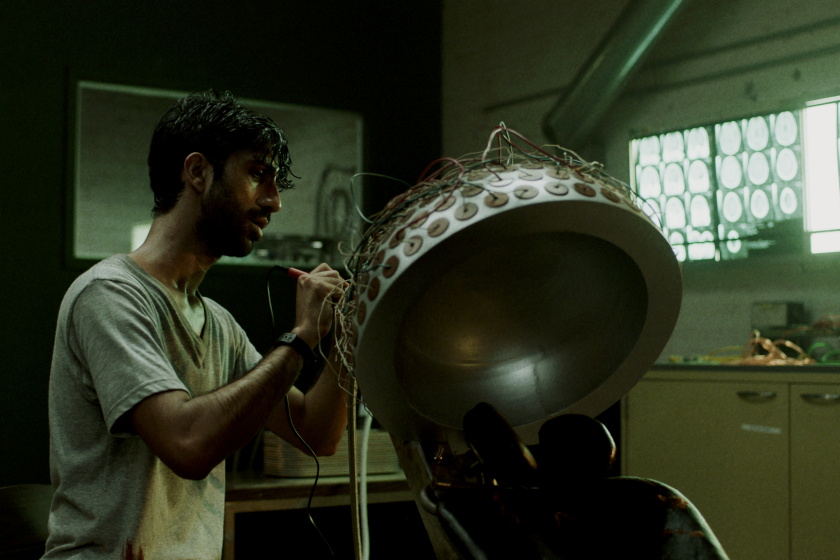
His work is centered on mapping memories as physical imprints on neural pathways. If Ethan can isolate sections of the brain, he foresees amazing possibilities such as boosting intellect, erasing Alzheimers and PTSD, maybe even constructing consciousness.
But when Ethan goes full Brundlefly and experiments on himself, his identity is fractured into 10 different emotions – ranging from euphoric to psychotic – each operating at 6 minute increments.
Anyone familiar with 2004’s wonderful Primer will feel right at home, especially after Ethan’s colleague and former flame Allie (Paton Ashbrook) drops by to help him put the pieces of his mind back together. From there, the film becomes a one setting two-hander, as director/co-writer Eric Schultz unveils a feature debut of clever intellect, stylish pacing and claustrophobic, beat-the-clock tension.
Sridharan and Ashbrook make a formidable team, anchoring their wary chemistry and heady dialogue with a “try to keep up” attitude that’s organically right for their characters. They’re brilliant scientists (Schultz, by the way, studied psychology at Harvard) and we’re not, so if you pay enough attention and suspend a little disbelief, Minor Premise crackles with some major sci-fi thrills.