Been sweating out these dog days of summer? Ready for a cool down? Well then bundle up, buttercup, because from its opening minutes, Centigrade traps you in bitter elements with the temps falling fast.
Naomi (Genesis Rodriguez) is an America novelist on a book tour in Norway with her husband Matt (Vincent Piazza). They were driving in darkness when freezing rain kicked in, and Matt suggested they pull over to wait out the storm.
Director and co-writer Brendan Walsh fades in when the couple wakes up to find they are buried under snow, and frozen inside their car.
Also, Naomi’s pregnant. Very pregnant.
In his feature debut, Walsh has the challenge of staging a tense survival thriller from the interior of a sedan. Though the leads are effective enough in communicating a growing desperation, there just isn’t enough here to keep you totally invested in it.
Casting Rodriguez and Piazza – a real life couple – was an understandable move that does pay off. Naomi and Matt’s relationship feels lived-in and comfortable from the moment they awake, which in turn makes the ways their frayed psyches affect each other seem more authentic.
But even in the age of a global pandemic that has re-set the bar on unrealistic stupidity, not all of what Centigrade is selling quite adds up. Through onscreen text that is oddly specific, we’re told the film is “inspired” by actual events, while a closer look reveals Walsh’s admission that the inspiration was “culled together” from several different stories.
And that pregnancy hangs over everything, just as it’s been in the back of your mind since I mentioned it four paragraphs ago.
Is it true life or a convenient MacGuffin? Or, as we learn more about Naomi and Matt’s relationship, will it be a literal example of a baby saving them? As the length of the ordeal moves from days to weeks, Walsh always seems to pull up just when it seems he’s getting the loose ends nailed down.
Even at 89 minutes, too much of Centigrade is uninteresting filler. The payoff, when it comes, feels like an unsatisfying layup, and though the stakes and the characters are both well-defined, somehow that primal question of survival is never truly palpable.
The store was called Other Music because it was directly across the street from a Tower Records in the East Village of Manhattan. So from day one, the message was clear: if you’re looking for other music, come in here.
For twenty years, they did. And they often came in droves, trusting recommendations from the eclectic staff, seeing great new bands such as Vampire Weekend perform live in-store, and coming to feel like they had “found their people.”
But like so many other parts of society, “the way people consume music changed,” and Other Music closed up shop in 2016.
The first directing feature from music video vets Puloma Basu and Rob Hatch-Miller is a bittersweet ode not just to a beloved record store, but to a type of community that now seems longer gone than it actually is.
This film is funny (notables such as Jason Schwartzman and Regina Spektor speak on the staff’s intimidation factor), it’s touching, and it has a good handle on how to rise above the field of similar “last day” docs by not forgetting the valuable context available outside the actual store.
You can file it under “music nerdery,” but spend some time with Other Music and you’ll find a mix of celebration and eulogy. Both are worthy, for a small business in NYC and the similar culture of community disappearing from just about everywhere else.
I remember watching that classic TV movie Duel with my mom in the early 70s. It was tense and exciting (a young Spielberg directed!), but the thing that most unnerved Mom was the fact that…SPOILER ALERT… you never find out why that truck driver was terrorizing a frazzled Dennis Weaver.
Unhinged offers no such ambiguity. Russell Crowe is just really pissed off.
Well, the unnamed driver Crowe plays is, anyway. The Man has lost his wife, and his job, and now he’s in traffic getting beeped at, passed and gestured to by a woman in a big hurry.
The Man catches up, rolls down the window and calmly explains civility to young Kyle in the back seat (Gabriel Bateman from Lights Out and the Child’s Play reboot) while asking Rachel in the front for an apology. She declines, so The Man vows to show Rachel (Slow West’s Caren Pistorius) what a bad day really is.
Things get nasty in a hurry. And though the script from Carl Ellsworth (Red Eye, Disturbia) often flirts with ridiculous, it offers more clever construction that you might expect. The premise certainly recalls Falling Down, but Ellsworth isn’t interested in darkly comic social commentary. This is an overt explosion of murderous male rage, one that also manages – almost as an afterthought – to deliver a blunt cautionary tale about smart phone addiction as effective as any we’ve seen on film.
Director Derrick Borte (The Joneses) keeps the pace moving nicely with tension and bursts of brutality, which is perfectly fine for a disposable thriller. What’s even better, he knows what the real point of all this is.
Russell on a rampage. That’s it.
You want some of that? Crowe and Unhinged deliver it, with all the when’s, why’s, and how’s right up in your face.
Take at look at some recent writing credits for Kevin Willmott: Da 5 Bloods, Black KkKlansman (which won him a deserved Oscar), Chi-Raq. Impressive. Go back to 2004, and you’ll find The Confederate States of America, which he also directed.
Without question, Willmott speaks eloquently and provocatively on the history of being Black in America. He’s back behind the camera for The 24th, a bold and clear-eyed take on the 1917 mutiny of the all-Black 24th U.S. Army infantry regiment after harassment from the Houston police department.
Willmott, co-writing with first time screenwriter Trai Byers, again shows an uncanny instinct for making history crackle with the urgency of a breaking news bulletin. Humanizing the conflict through the fictional Pvt. William Boston (Byers, also taking lead acting duties), the film builds from a slightly impatient first act into a final third full of resonant rage and tremendous emotional power.
Pvt. Boston’s education abroad and dignified air draw the ire of both his fellow soldiers and his white commanding officers, save for the thoughtful Col. Norton (Thomas Haden Church, playing impressively against type). Both Boston and Norton want the 24th to be the first Black regiment sent to the Normandy front lines, and the Col. recommends Boston for officer training.
Aspiring to lead by the example of valuing service over ambition, Boston resists the promotion, laying down the first marker in a character arc of weighty heartbreak, resignation and sacrifice.
The Jim Crow laws of Texas stop at nothing to oppress and brutalize the members of the 24th, even the private MP unit formed expressly to protect them.
As Boston prepares to give his local sweetheart (Aja Naomi King) a promise ring, the night of August 23rd, 1917 cascades into violence, leaving policemen, civilians and soldiers dead in the Houston streets.
The aftermath leaves Boston with a soul shaking choice, one made easier by an awakened and defiant resolve.
He still aspires to be an inspiration, but for a completely different reason. And it is this journey – made so deeply intimate by Byers and a superb Mykelti Williamson as Boston’s frequent adversary Sgt. Hayes – that carries the film’s early 1900s setting into the streets of today’s Black Lives Matter protests.
Making that leap with us, and not for us, is no easy trick, but The 24th is more proof of risk and reward. The ugliest corners of the mirror can be valuable teachers, and we need Willmott’s voice – as both a writer and a filmmaker – to keep us looking.
Look, I know Young Adult is not the only genre to lean on a familiar blueprint, but we’ve reached the point where finding any YA film without voiceover narration or an essay-reading finale is going to feel like gazing upon the golden wonders of Marcellus Wallace’s briefcase.
There’s little glow surrounding Words on Bathroom Walls.
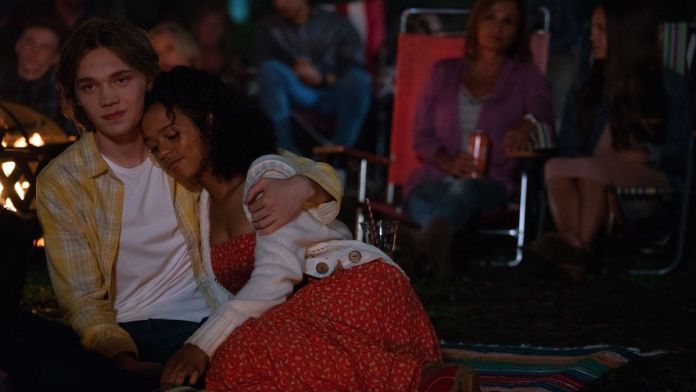
To be fair, writer Nick Naveda’s take on Julia Walton’s novel does at least try to develop an organic thread for the narration, as high schooler Adam (Charlie Plummer) talks to an unseen therapist about his struggles with paranoid schizophrenia.
Director Thor Freudenthal (Diary of a Wimpy Kid) manifests those struggles onscreen via three distinct characters (AnnaSophia Robb, Devon Bostick and the gloriously named Lobo Sebastian) whose voices are always lurking inside Adam’s head. It’s an early clue that the film’s handling of teen mental health will be an opportunity largely missed.
After a serious episode during class injures another student, Adam is expelled from his high school in the middle of senior year. On the upside, he’s accepted into a trial for a new schizophrenia drug, and into a prestigious local Catholic school which promises to be discreet.
Adam’s future plan to attend culinary college hinges on a high school diploma, which means Adam must make sure he a) takes his new meds, b) keeps his grades up, and c) passes a big exam which consists only of math questions and…..wait for it….an essay.
The obligatory tortured romance is between Adam and his math tutor, a classmate named Maya (Taylor Russell) who also has some secrets she’d rather not reveal.
And as with so many of these YA adaptations, all the narration and essay reading means the film is more tell, less show and nothing earned. Again, we get an invitation for teens to wallow in the angst of an inexperienced worldview simply by telling them what we think they want to hear.
Adam’s “you don’t understand me” posturing with his mother (Molly Parker), her new boyfriend (Walton Goggins, wasted) and an easygoing priest (Andy Garcia) serve only the manipulative and convenient use of Adam’s condition. Both Plummer (All the Money in the World) and Russell (Waves) have impressed before, but they’re given little chance to develop their characters into anything real or resonant.
All the familiar YA parts are here, and Words on Bathroom Walls keeps them comfortably close. But like those sentence-building magnets on the refrigerator door, just moving them around seldom leads to anything that makes much sense.
Aside from maybe the musical, there is no genre in film more dependent on sound for audience response. From the creaks, groans and jangling chains of old fashioned haunted house pics to the hiss and slither of modern monster movies, things can hardly go bump in the night if you can’t hear the bump. So George sat down and determined the best examples of sound design in horror.
That’s right, George is driving. Did Hope recommend any movies to consider when thinking through the best use of sound in horror? She did. Did any make the list?
They did not.
Well, turnabout is fair play and sound is definitely George’s jam. So here, friends and Fright Clubbers, are George’s picks for the best sound design in horrorl
5. It Follows (2014)
Like A Quiet Place and Us, It Follows
is a perfect example of how modern filmmakers are molding the soundtrack with
sound effects and even score to create the sound experience.
Writer/director David Robert Mitchell, working with
Disasterpeace on a score that incorporated music, ambient sound and sound
effects, develops an immersive, nightmarish environment for the imagination to
flourish. The synths reflect the film’s difficult-to-pin-down time period,
simultaneously reflecting a recent past as well as a currency. Meanwhile,
creaky doors and blowing wind call to mind old fashioned scares.
The score almost doesn’t sound like a score, and the sound
sets a different mood every time the different demon appears. Few films are
this masterful in the way it brings together sound track and sound effects.
Together they create an inescapable mood.
4. The Haunting (1963)
Director Robert Wise obviously knew the importance of sound
coming into this film, sitting, as it does, between his two biggest efforts, West
Side Story and The Sound of Music. But musicals are not the only
films that really deserve close attention to sound. What you hear is even more
important than what you see in a good old fashioned ghost story.
We wanted to make sure the list included at least one
example of old school Foley-style sound. Wise worked with AW Watkins, 4-time
Oscar nominee for sound design (Doctor Zhivago, Libel, Knights of the Round
Table, Goodbye Mr. Chips).
This is a great example of old time Foley sound effects used
to create the mood, making things you can’t see scary.
3. The Lighthouse (2019)
The atmosphere is thick and brisk
as sea fog, immersing you early with Jarin Blasche’s chilly black and white
cinematography and a Damian Volpe sound design echoing of loss and one
persistent, ominous foghorn.
For
everything Eggers brings to bear, from the Bergmanesque lighting and spiritual
undertones to the haunting score to the scrupulous set design to images
suitable for framing in a maritime museum – not to mention the script itself
– The Lighthouse works because of two
breathtaking performances.
But what a world Eggers and crew create for Robert Pattinson
and Willem Dafoe.
2. Berberian Sound Studio (2012)
Madman Peter Strickland (In Fabric) made an entire film
about sound, and it gets so much right. Not just about sound—about the era, the
equipment, giallo sensibilities and moviemaking.
Strickland, working with a sound department of 34, creates a
psychological experience through sound almost exclusively. The amazing Toby
Jones plays Gilderoy, flown in specifically to helm the sound in a horror
movie.
“This isn’t a horror movie. This is a Santini movie!”
Gilderoy’s arc is profound, and sound is our only window
into what is changing him. We don’t see what he sees, only his reaction to it
and the sound of it that makes his psychological breakdown believable.
1. Alien (1979)
The great soundman Ben Burtt, with an impressive team and
the direction of Ridley Scott, uses silence as another instrument in the
terrifying sound design for this film.
Given the tag line, that powerful use of silence is more
than evocative, it’s required. But layered in, Burtt offers plenty of aural
evidence that this spaceship is not like those we were used to seeing onscreen.
The Nostromo is no sleek vehicle. Creeks and chains, water leaks and thudding
echoes depict a dilapidated bucket of bolts, giving Alien a creaky old
house atmosphere.
From the chest bursting, Ash’s unattached vocal cord
gurgling to the hissing sound the creature makes as he announces his presence,
the sounds in this film have been copied and retooled as often as its storyline
and look. But there is only one first time.
Imagine what you get when you bring over a thousand 17 year-old boys together to play politics.
Fight Club with zits?
You get Boys State, an annual exercise into the “civil discourse” of state government. An American Legion program since 1935, Boys State (and its corresponding project for girls through the Legion Auxiliary) gives selected high school juniors the chance to build a representative government from the ground up.
From legislative sessions and deal-making to party platforms, elections and even a talent show, the kids are immersed in it all. In the Sundance Grand Jury prize-winning Boys State, directors Amanda McBaine and Jesse Moss immerse us in it, too.
The result is an endlessly fascinating and thoroughly entertaining mixture of shock and awe.
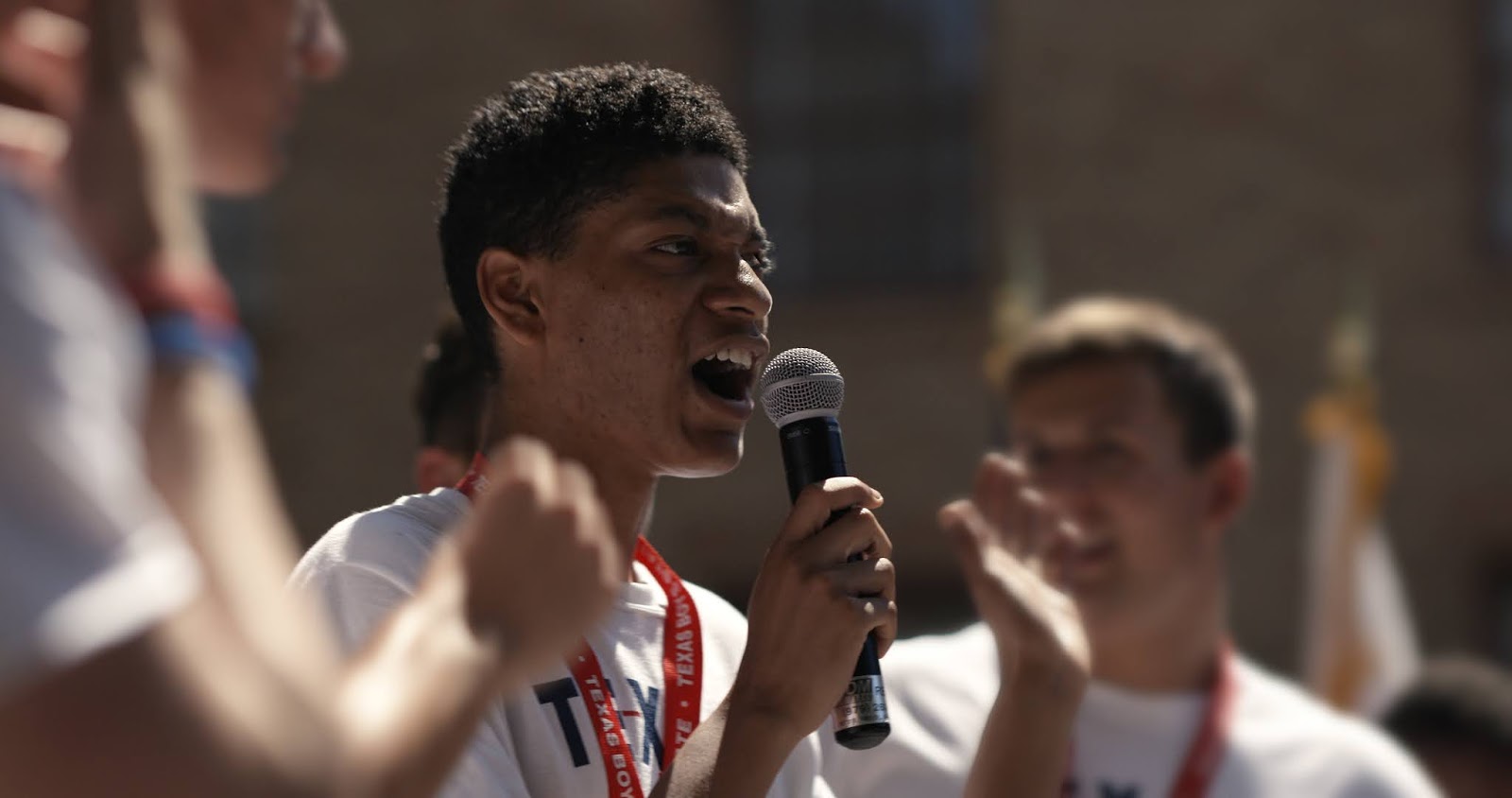
Employing a predominantly verite approach, McBaine and Moss settle on four main boys to follow throughout the weeklong experience. We see glimpses of those who just came to play (“ban pineapple pizza!”), but our quartet means business. While Ben and Rene are elected opposing party chairmen, Robert and Steven are both after the big prize: Governor of Boys State Texas.
The boys’ different backgrounds (Rene: “I’ve never seen so many white people!”) create truly compelling characters who provide just one of narrative contrasts that draw you in, slowly deepening your investment until you’re hanging on every motion and debate.
As the party members draw their platforms with an eye toward victory… check that…I mean DOMINANCE in the general election, it’s equal parts horrific and inspirational.
Boys openly betray their principles for populism, jockey to acquire more power and gleefully pounce when they smell a negative campaign that might stick. They quickly learn the well-worn lessons of a fickle and often hurtful enterprise, either adapting or falling away.
The rampant testosterone can’t go unnoticed. Neither can multiple examples of how badly more women are needed in all levels of government.
And when all is said and done, one of our principles has to admit another is “a fantastic politician.”
Is that a compliment?
That may be a complex question, but only a few of these boys will watch this film again in 20 years and feel damn proud of who they were at 17.
Or maybe they all will. Boys State fuels both the cynicism and the hope required to make either road seem possible.
You know those films that make you think, “Man, I bet this was a great book”?
The Bay of Silence is one of those. It has the intrigue, the mystery and the performances to hold your attention, but it feels as if something’s missing. Something like several pages, or even a chapter or two from Lisa St. Aubin de Terán’s 1986 novel.
Design firm exec Will (Claes Bang) and photographer Rosalind (Olga Kurylenko) are enjoying an idyllic getaway in Italy, where Will pops the question with a pull tab (don’t worry, he’s good for a real ring). An opening prologue gives us a glimpse of some trauma in Rosalind’s youth, but it seems like Will, Rosalind and her 8 year-old twin daughters can look forward to happiness as a blended family.
Months later, a very pregnant Rosalind falls from a balcony. Though baby Amedeo is delivered healthy, Rosalind has changed. She’s convinced that she actually delivered another set of twins, and that everyone involved (including Will) is in on the deception.
Ros returns to her photography and her erratic behavior continues, until Will returns home to find his wife, the children, and their nanny (Shalisha James-Davis) all gone.
Will turns to Rosalind’s mother (Alice Krige) and manager/former stepfather Milton (Bryan Cox) for answers, but the mystery of Rosalind’s past, present and future only deepens.
Are we dialing M for madness of murderousness? Director Paula van Der Oest (Oscar nominee for 2001’s Zus & Zo) nails a Hitchcock vibe in spots, but the adapted screenplay from Caroline Goodall – or an editing hachet job order from the studio – leaves too many dangling threads for a completely satisfying payoff.
Rosalind’s fascination with twins is just one of the questions nurtured and then forgotten, apparently in service of a quicker trip to the resolution which is telegraphed pretty early on.
The cast is uniformly splendid (especially Cox, natch) and the locales ooze sophistication. But while The Bay of Silence qualifies as perfectly acceptable adult fare, you can’t help wishing it would have said a little more.