For a while, less can be more in a monster movie (i.e. Jaws). Still, diving into a werewolf flick without the budget for showy CGI or well-crafted practicals is ambitious.
While Dog Soldiers proved you can make an impression without breaking the bank, so much of werewolf lore is about transformation – both the literal and the metaphorical – that as much as one layer falters, the other needs to stand that much stronger.
Unfortunately, Bloodthirsty is shaky on both grounds.
Pop singer Grey (Lauren Beatty) became a sensation with her first album, and now she’s feeling the pressure to produce a blockbuster follow-up. Grey is plagued by nightmarish hallucinations about turning into an animal, so her doctor (Michael Ironside in a distracting cameo) has upped her meds.
Plans for the second album look brighter when famed producer Vaughn Daniels (Greg Byrk) agrees to helm the project. He invites Grey and her girlfriend Charlie (Katherine King So) to stay at his lavish home/studio in the Canadian wilderness while they record, but Charlie is concerned about Vaughn’s unsavory past.
Grey isn’t, but things get weird as soon as Vaughn’s creepy housekeeper (Judith Buchan) shows the ladies to their room. Music isn’t the only reason Vaughn volunteered to work with Grey, and director Amelia Moses (Bleed With Me, which also starred Beatty) attempts a tone of Gothic seduction as the mystery unfolds.
But it’s not really much of a mystery. The script, from Wendy Hill-Tout and her daughter Lowell (who also contributes original songs) delivers pale imitations of the carnivorous temptations in Raw as their film builds to a reveal that is less than shocking.
Bloodthirsty is a werewolf film that never really feels like one, which has both up and down sides.
Ditching the focus on full moons for a lesbian artist at a creative crossroads has promise, but the characters lack the depth required for any effective metaphor to take root. Pair that with scant transformation scenes which impress more with sound than vision, and a horror fan’s thirst for blood will likely be left wanting.
With this episode we hit the big 200, so we wanted to celebrate in the most masochistic way possible. No! We wanted a really great topic (George’s choice) and a really great guest – filmmaker and co-founder/programmer of Nightmares Film Festival, Jason Tostevin.
Together we talk through the very best horror movies we could not watch a second time no matter what.
5. A Serbian Film (2010)
This is not a movie we would recommend to basically anyone. That’s not to say it’s a bad film – it’s pretty well directed, acted, and written. It’s just that the co-writer/director Srdjan Spasojevic is trying to articulate the soul-deadening effects of surviving the depravity of war. The film title is no coincidence – the film is meant to reflect the reality of a nation so recently involved in among the most depraved, horrific, unimaginable acts of war. It’s as if he’s saying, after all that, what could still shock us?
Like Pier Paolo Pasolini’s notorious 1975 effort Salo, or the 120 Days of Sodom – also a depiction of the depravity left behind after war – A Serbian Film overwhelms you with horrifying imagery.
https://www.youtube.com/watch?v=ddwrbcMmzlc
4. An American Crime (2007)
In 1966, Gertrude Baniszewski, along with three of her children and two neighbor boys, was convicted of what’s commonly considered to be the most heinous crime ever committed in the state of Indiana. The senior investigator described the prolonged abuse and murder of 16-year-old Sylvia Likens as the most sadistic case he’d investigated in his 35 years on the force.
In 2007, two films were released depicting the horror. The Jack Ketchum-penned The Girl Next Door found a larger audience, but co-writer/director Tommy O’Haver’s An American Crime is the far superior film.
Elliot Page offers a full, layered performance, making Sylvia a realistic character – someone you might have known in high school. Of course, that makes it even harder to stomach what becomes of her. The entire cast—an impressive ensemble—does stunning work, but the dark magic here is Catherine Keener. Giving one of the best performances of her already stellar career, Keener guarantees that it will be a long time before you recover from this movie.
3. The Painted Bird (2019)
If you paint the wings of a sparrow (or stitch a star to his jacket) the rest of the flock will no longer recognize him. The other birds will swarm and peck him until he plummets back to the earth. This is just one of the horrific lessons a young boy learns as he desperately searches for anywhere or anyone safe in war-torn Eastern Europe.
What follows is a brutal parade of the worst humanity has to offer. Domestic abuse, graphic violence, multiple instances of animal abuse and death, rape, child abuse and rape, and more. Then the war crimes start around hour three.
The Painted Bird is a test of endurance. It’s also a beautifully shot, well-performed, and incredibly moving piece of cinema. You simply have to be willing to go where it wants to take you. And all of those places are dark and darker.
2. Irreversible (2002)
French filmmaker/provocateur Gaspar Noe does not play well with his audience. Every film, no matter how brilliantly put together or gloriously filmed, is a feat in masochism to watch. Later efforts, like Enter the Void, spread the misery out for its full running time, but for Irreversible, he gave it to us in two horrifying scenes. While the head-bashing is tough viewing, the film centers on a rape scene that is all but impossible to watch.
Noe’s general MO is to punish you through sheer duration. The scenes last so long you feel like you cannot endure another minute, and this scene certainly does that. Not shot even momentarily for titillation, and boasting a devastatingly excellent performance from Monica Bellucci, it justifies its own horrific presence. There are other films with necessary and difficult rape scenes – Straw Dogs, I Spit on Your Grave, The Last House on the Left, Henry: Portrait of a Serial Killer – but none is harder to stomach than this.
1. Nothing Bad Can Happen (2013)
This film is tough to watch, and the fact that it is based on a true story only makes the feat of endurance that much harder. But writer-director Katrin Gebbe mines this horrific tale for a peculiar point of view that suits it brilliantly and ensures that it is never simply a gratuitous wallowing in someone else’s suffering.
Tore (Julius Feldmeier) is an awkward teen in Germany. His best friend is Jesus. He means it. In fact, he’s so genuine and pure that when he lays his hands on stranded motorist Benno’s (Sascha Alexander Gersak) car, the engine starts.
Thus begins a relationship that devolves into a sociological exploration of button-pushing evil and submission to your own beliefs. Feldmeier is wondrous—so tender and vulnerable you will ache for him. Gersak is his equal in a role of burgeoning cruelty. The whole film has a, “you’re making me do this,” mentality that is hard to shake. It examines one particular nature of evil and does it so authentically as to leave you truly shaken.
Her name is Anne Fedder. But Jakob’s Wife pretty much sums up the nearly invisible routine Anne (Barbara Crampton) is living.
Jakob Fedder (Larry Fessenden) is the well-known pastor of a small town church, and Anne is well known as his wife. Anne’s life seems to have only gotten smaller during her thirty-year marriage, and if pressed, she’d probably admit she wouldn’t mind a little shakeup.
A late-night meeting with old boyfriend Tom (Robert Rusler)? Intriguing, but his seduction skills got nuthin’ on The Master (Bonnie Aarrons, aka The Nun), who’s waiting on them both.
The next morning, Jakob gets the first clue that things will be changing.
“Did you make breakfast?” he asks.
Anne answers, “I’m not hungry.”
At least not for pancakes. After The Master’s touch, Anne is a brand new woman, sporting fresh hair and makeup, tight, low-cut dresses and provocative new appetites.
It’s no wonder this has been a passion project for Crampton (who’s also a producer), and she makes the extended feminist metaphor ring gloriously true.
Director/co-writer Travis Stevens (Girl on the Third Floor) wraps the bloodlusty tale in a fun retro vibe of ’80s low-budget practical, blood spurting gore, but it’s Crampton (and the chemistry with her fellow horror vet Fessenden) who truly elevates this beyond the standard vampire playbook.
To see a female character of this age experiencing a spiritual, philosophical and sexual awakening is alone refreshing, and Crampton (looking fantastic, by the way) makes Anne’s cautious embrace of her new ageless wonder an empowering – and even touching – journey.
Stevens revels in the B-movie underpinnings, stopping short of tackling any systemic issues inherent in a woman’s longtime restlessness. The focus stays intimate, and only on how Anne’s new freedom affects Jakob and their local community (which remains nameless, though filming was entirely in Mississippi).
But with Crampton and Fessenden so completely in their element, Jakob’s Wife is an irresistibly fun take on the bite of eternity. Here, it’s not about taking souls, it’s about empowering them. And once this lady is a vamp, we’re the lucky ones.
If all politics is local, then Our Towns is the most political film you’ll see this year.
Because authors James and Deborah Fallows had one rule as they traveled the country looking for towns with interesting stories. Never, ever talk about the national political climate.
The Fallowses, both longtime writers, reporters and academics, have lived and traveled all over the world. Their 2018 bestseller Our Towns: A 100,000 Mile Journey Into the Heart of America was based on their extensive reporting for The Atlantic on the civic and economic renewal of America’s towns.
Oscar-nominated directors Steven Ascher and Jeanne Jordan (Troublesome Creek: A Midwestern) put the gentle, reassuring authors front and center for an easygoing documentary from HBO that touts possibilities over partisanship.
From the influx of refugees in Sioux Falls, South Dakota to the twenty percent unemployment of Columbus, Mississippi; from the end of logging in Bend, Oregon to the climate change fears in Eastport, Maine, we see how these towns have adapted and thrived.
And, by the way, what we see is gorgeous, thanks to the drone footage from Bryan Harvey and the cinematography from him and Ascher.
The solutions – diversity, investment, innovation, local engagement – may not be revelations, but the surprise comes in seeing how some communities have actually been able to move these ideas from buzzwords to policy.
The film skirts specifics, as well as the deep ideological divisions that stand in the way of such progress, but even that seems true to the stated goal of locality. It never wavers, even in the face of celebrity. Because even though you clearly see actor Jeff Daniels playing guitar and singing with a band in Charleston, West Virginia, his national fame is completely ignored, as it should be.
It is not lost on The Fallowses that their book research coincided with a national recession and their film project debuts during a global pandemic. But even with such large-scale challenges, they say the building blocks for recovery are the same, and they start in our own neighborhoods.
For 97 minutes, Our Towns shows you that underneath all of our ugliness, there are success stories we can look to for examples of hope and possibility.
And now feels like a pretty good time to see them.
When I was a kid watching the Oscars, I remember always being perplexed by short film categories. How do people manage to see these shorts?
Good news, kids, it’s gotten much easier. In the last several years, all the nominated shorts have been packaged by category for theatrical showings. This year, of course, virtual screenings are available as well, making it more convenient than ever to find great films in smaller packages.
And if there was any doubt that movies are mirrors, check the pervasive theme that runs through this year’s live-action nominees. All are examples of the struggle to retain human dignity, to be seen simply as worthy. And in four of these five films, that struggle directly involves abuses by law enforcement officials.
Feeling Through 18 Mins. Writer/director: Doug Roland
A troubled teen (Steven Prescod) needs a place to stay for the night, but his search is interrupted by a deaf and blind man (Robert Tarango) who needs help crossing the street.
The fact that Tarango is the first deaf and blind actor to be cast in a film is reason enough to seek this out, but Roland has crafted a truly touching ode to the healing power of caring.
Prescod and Tarango are wonderful together, and our short time with both of them is nothing but rewarding.
Two Distant Strangers 32 mins. Writer: Travon Free Directors: Travon Free and Martin Desmond Roe
Really? Another Groundhog Day premise? Yes, but get ready, this gripping slice of activism will rock you.
Carter (Joey Bada$$) and Perri (Zaria) are still flirting the morning after their first hookup. Shortly after Carter heads home to check on his dog, an aggressive cop (Andrew Howard) incites a confrontation, and soon Carter is dead on the sidewalk…until he again wakes up in Perri’s bed.
The scenario plays over and over, with Carter trying to come up with some way to change his fate.
Free, a former Daily Show writer making his film debut, lulls you with a comfortable device before lowering the boom. It’s uncomfortable, as it should be, but you’ll want to thank Free for the experience…as soon as you catch your breath.
The Letter Room 33 mins. Writer/director: Elvira Lind
The first thing that catches your eye here is a familiar face. Yes, that is Oscar Isaac, starring as Richard, a corrections officer granted a transfer to the facility’s letter room.
Letters from Rosita (Alia Shawkat) to Death Row inmate Cris (Brain Petsos) captivate Richard’s interest, until he’s tempted to cross some questionable lines.
Lind (Isaac’s wife) mines her powerhouse cast for a beautifully subtle layer of humanity. Everyone here is flawed, in different ways and by varying degrees. But Lind lets us see just how far a little empathy can go – even in the darkest places.
The Present 24 mins. Writers: Farah Nabulsi Directors: Farah Nabulsi and Hind Shoufani
On the morning of his wedding anniversary, Palestinian Yusef (Saleh Bakri) and his young daughter (Mariam Kanj) head out to buy a gift for his wife (Mariam Basha).
But the road to celebration is littered with soldiers and segregation, cages and checkpoints. As Yusef endures humiliation in front of his daughter, rising tensions increase the chance of a deadly altercation.
It feels somewhat surprising to see the Israeli-Palestinian conflict funneled through a Palestine viewpoint. And though Nabulsi’s hand is never overly heavy, a universal power struggle emerges: authority flexes muscle against those trying to remain calm and grasp for options.
The Present offers hope that the children can one day find common ground.
White Eye 20 mins. Writer/director: Tomer Shushan
White Eye‘s search for humanity begins with a bicycle.
An Israeli man named Omer (Daniel Gad) spots his stolen bike locked up on the street. Immigrant Yunes (Dawit Tekelaeb) says he bought the bike fair and square, but Omer doesn’t want to hear it.
Once Omer alerts the police, the situation (you guessed it) escalates, and soon Yunes’s co-workers are in hiding and Omer is staring headfirst into consequences he may not have intended.
Gad carves out a 20-minute arc of awakening for Omer that feels achingly real. It’s a standout performance, and the driving force that makes White Eye linger with lasting resonance.
When I was a kid watching the Oscars, I remember always being perplexed by short film categories. How do people manage to see these shorts?
Good news, kids, it’s gotten much easier. In the last several years, all the nominated shorts have been packaged by category for theatrical showings. This year, of course, virtual screenings are available as well, making it more convenient than ever to find great films in smaller packages.
In these 5 nominated (and three bonus) treats, you’ll find charm, humor, fascination, and devastation – all a tribute to the different ways animation can touch our souls.
An excited bunny has big plans for a new home underground (maybe a disco?). But the more the bunny burrows, the more times she accidentally invades a neighbor’s place!
What to do?
Originally intended as the short subject intro to theatrical showings of Soul, Burrow is a completely charming reminder of the need for friends you can count on. And the beautiful 2D, hand-drawn animation gives it a picture book feel that’s refreshingly retro.
https://www.youtube.com/watch?v=apx1aUP3MqA
Genius Loci 16 mins. Writer/director: Adrien Merigeau
From France, Genius Loci is a surrealistic trip through “urban chaos, ” as a young loner named Reine (voiced by Nadia Moussa) takes off on a dreamlike tour through the heartbeat of her city.
Unfolding like a watercolored stream of consciousness, Loci is wonderfully stylistic, bursting with contrasts and ambiguities about Reine’s headspace that keep it constantly intriguing.
If Anything Happens, I Love You 12 mins. Writers/directors: Michael Govier, Will McCormack
Oh my, this one is heartbreaking, tender and devastatingly lovely.
A middle-aged couple is living in a fog of despair, completely unable to comfort each other or find any joy in life. A charcoal-type animation style reveals shadows depicting a former life of happiness, then leading eventually to the tragic event that broke them.
Keep the tissues handy for a soft-spoken gut punch that reframes the stakes we know only too well.
Opera 9 mins. Director: Erick Oh
9 minutes? I could watch this for 9 hours.
Billed as a “massive 8K size animation installation project which portrays our society and history,” Opera is a single frame in constant, intoxicating motion.
The eye level creeps in, then out, up and down and around a pyramid filled with scores of small figures co-existing in a constantly evolving community. Even as you fixate on one fascinating section, you’re drawn to others that are equally rewarding.
Oh has created a true animated marvel, and one that should be hard to beat in this category.
Welcome to a tenement building in Iceland, where we follow some 3D Wallace and Grommet-looking Icelanders going about their daily trials and snowy tribulations.
Most of the dialog is a well-placed exclamation of “Yow!” which adds to the goofiness and overall fun factor. With glimpses into work, school and mundane chores around the house, Yes-People becomes a light and breezy take on the small moments that make our lives.
The 2021 animated shorts program will also feature three “highly commended” animated short films
When I was a kid watching the Oscars, I remember always being perplexed by short film categories. How do people manage to see these shorts?
Good news, kids, it’s gotten much easier. In the last several years, all the nominated shorts have been packaged by category for theatrical showings. This year, of course, virtual screenings are available as well, making it more convenient than ever to find great films in smaller packages.
As usual, these nominated documentary shorts are often heart-wrenching, but able to speak necessary truths to power and our collective human experience.
A Concerto Is a Conversation 13 mins. Directors: Kris Bowers and Ben Proudfoot
Pianist and film composer Kris Bowers explains to his 91 year-old grandfather Horace (and to us) that a concerto is a conversation between a soloist and an ensemble.
But the conversation between the Bowers men is a moving work of art itself, as Horace recalls his life’s journey from a poor kid in the Jim Crow south to a successful business owner in Los Angeles.
And as Kris prepares for the premiere of his first concerto, the film becomes a beautiful expression of heritage, love, talent and courage.
Colette 25 mins. Writer/director: Anthony Giacchino
75 years after her stint as a member of the French Resistance, 90 year-old Colette Catherine is preparing to make her first journey to the concentration camp in Germany where her brother Jean-Pierre died.
She’s accompanied by the young Lucie, a history student and docent at France’s WWII museum, who regards Colette as a “national hero.”
As sobering and horrific as the subject matter suggests, Collette – the film and the hero – finds a redemptive power through defiantly shining a spotlight on an evil that still searches for dark places to take root.
Do Not Split 36 mins. Director: Andreas Hammer
Taking us to the front lines of Hong Kong’s pro-democracy protests of 2019, Do Not Split becomes a tense, indelible account of resistance against civil rights abuses that will look pretty familiar to U.S. audiences.
Hammer is blessed with a host of intimate footage, often featuring first person commentary from protesters while they are actively pushing back against tear gas and police escalation.
It’s gripping stuff. Without becoming overbearing, the film never lets you forget you are watching important and heroic history unfold.
https://www.youtube.com/watch?v=zuO71RwQp_k
Hunger Ward 40 mins. Director: Skye Fitzgerald
Part 3 of Fitzgerald’s Refugee Trilogy (along with 50 Feet From Syria and the Oscar-nominated Lifeboat), Hunger Ward‘s focus is the children – specifically those affected by the ongoing civil war in Yemen.
The images of wounded and starving children carry an understandably tragic weight, while real time footage inside a Yemeni memorial service being actively shelled is unforgettable.
And still, those committed to helping the children exhibit an unwavering and miraculous resolve.
The U.N. has labeled Yemen as home to the world’s “greatest humanitarian crisis,” and Fitzgerald’s unflinching call for action and empathy will leave your heart in your throat.
A Love Song For Latasha 19 mins. Director: Sophia Nahli Allison
A touching tribute to one victim of senseless gun violence, A Love Song…turns the focus away from the aftermath and toward the positive effect Latasha Harlins had on those around her.
In 1992, 15-year-old Latasha was killed by a store clerk in South Central Los Angeles. Framed by Allison (and Executive Producer Ava DuVernay) as a VHS tape memoir with sequences of animation, the film lets the narration from Latasha’s best friend Ty and cousin Shinise craft a warmly intimate profile.
A Love Song For Latasha wants us to know that these victims of racial injustice aren’t just statistics to be glossed over. In a short time, Latasha Harlins made a big impact. So it seems only fitting that a short film makes you glad to meet her.
So, it seems your quick, stealthy exit migrates from Irish to French when excess alcohol is not involved.
Good to know, I had to look it up.
Francis Price (Michelle Pfeiffer) certainly enjoys a good martini, but her exit plan is a bit more serious than just ducking out of the local bar unnoticed.
After years of living high as a Manhattan socialite, Francis’s inheritance is nearly gone. So after selling off what they can, Francis and her son Malcolm (Lucas Hedges) head to Paris to stay in her best friend’s empty apartment. When the last dollar is finally spent, Francis plans to kill herself.
It sounds pretty dramatic, but writer Patrick DeWitt (who also penned the source novel) and director Azazel Jacobs start peppering in the absurdity and black comedy as soon as mother and son are aboard a ship to France.
Malcolm leaves his fiancee Susan (Imogen Poots) behind, and hooks up with Madeleine (Danielle Macdonald) en route. Madeleine is a medium, and she soon becomes Francis’s conduit for summoning the late Mr. Price (Tracy Letts) when his soul returns in a cat.
Pfeiffer is cold, condescending perfection. Francis’s words for nearly everyone she encounters practically drip with contempt, and Pfeiffer is always able to keep the film’s tricky tonal balance from toppling toward either maudlin or silly.
She enjoys a wonderful chemistry with Hedges, who impresses yet again as a young man who is still coming to grips with the lack of affection in his upbringing, his mother’s icy worldview, and how they’ve both affected his ability to relate to other people.
And soon, there are plenty of other people to relate to in the Paris flat. There’s the neighbor who desperately wants to make friends (a scene-stealing Valerie Mahaffey), Madeleine the medium, a detective hunting for the runaway cat (Isaach De Bankole), ex-fiancee Susan and her new man (Daniel di Tomasso), and Joan, who actually owns the apartment (Susan Coyne)!
You’d be quick to label the entire affair a Wes Anderson knockoff if Jacobs (The Lovers, Mozart in the Jungle, Doll & Em) didn’t fill the center with such unabashed heart. The affection between mother and son is never in doubt, and Pfeiffer’s delicious turn makes sure Francis never becomes a villain, just a fascinating and darkly funny mess.
With its self-conscious quirks and surface-level satisfactions, this is a French Exit more obvious than most. But thanks to Pfeiffer and a sharply drawn ensemble, it’s never less than wicked fun.
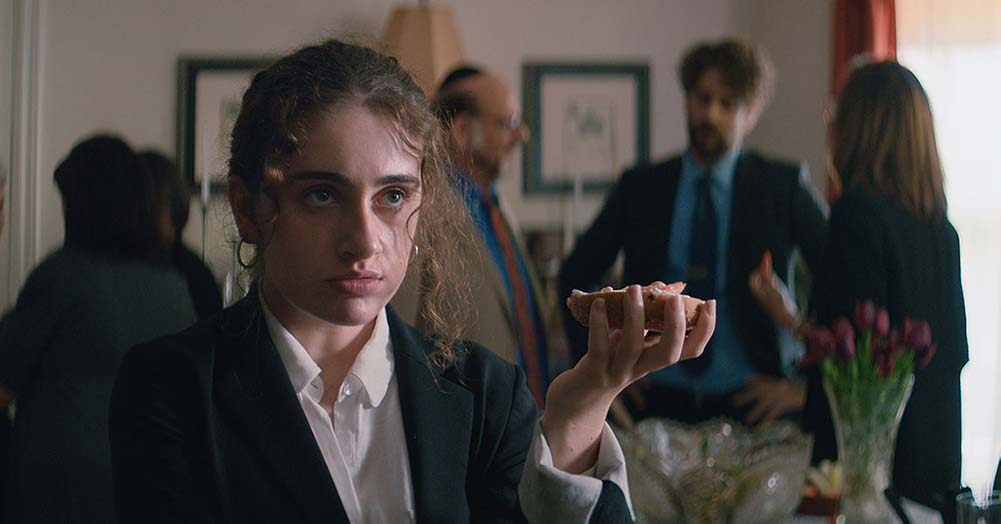
“You can’t just show up for the after party for a shiva, and like, reap the benefits of the buffet.”
Twentysomething Danielle (Rachel Sennott – irresistible) is definitely guilty of skipping the actual funeral (she doesn’t even know who died!), but if there are benefits to the after party, she isn’t reaping them. It’s awkward enough that her former flame Maya (Molly Gordon) is there, but that’s hardly the worst of it.
To her horror, Danielle sees that Max (Danny Deferarri) is there, too. Max is Danielle’s sugar daddy, and look, he brought his beautiful wife (Dianna Agron) and their cute baby daughter!
With Shiva Baby, Emma Seligman expands her 2018 short film for a feature debut full of observational comedy, mounting anxiety and a strangely appealing sexiness. Imagine the Coen Brothers rebooting Uncut Gems as a coming-of-age sex comedy, and you get an idea of the tonal tightrope Seligman is able to command.
The film’s opening finds Danielle confident and alluring. By the end of the day, she’s an unkempt, sweaty mess of beverages, blood and embarrassment. Almost all of Danielle’s arc takes place inside the home of the bereaved, and Seligman makes sure that is a hilariously uncomfortable place to be.
Danielle’s parents (the ever-reliable Fred Melamed and a scene-stealing Polly Draper) pressure her to work the room for job contacts, family friends inquire about her post-college plans, Molly wonders why Danielle ghosted her, and Max’s wife is getting suspicious.
And through it all, Seligman’s camera draws in closer and closer, making Danielle’s darkly comic claustrophobia almost palpable.
Clearly, much of Seligman’s sharp dialog comes from personal experience, and if it’s one you share this is a film that will feel like part of the family. But you didn’t have to be Greek to get caught up in that Big Fat Wedding, and you don’t have to be Jewish to see the joy in Shiva Baby.
Seligman flashes an insight that disarms you with sex and humor, keeping its hand at a subtle distance. But by the time we’re leaving that buffet, a breakout filmmaker and star have delivered a fresh, funny and intimate take on the indignities of finding yourself.