Tag Archives: George Wolf

Down With the Sickness

Totally Under Control

by George Wolf

Totally Under Control is arriving at a complicated time, making a case that exists in a contrasting space.

The film eviscerates Donald Trump’s administration mere weeks from Election Day, yet it’s presentation is miles away from inflammatory. It’s timely enough to feature a tail-end acknowledgment of Trump’s recent COVID-19 diagnosis, but feeling more outdated with each day’s increasing infection numbers.

Directors Suzanne Hillinger, Ophelia Harutyunyan and the Oscar-winning Alex Gibney present a devastating case against the government’s handling of the pandemic. From the first documented U.S. case (Jan. 20th, Washington state), the response has been fought with brazen dishonesty, stupefying incompetence, and a firm insistence on politics Trumping science.

Apparently filmed in secrecy with the aid of a portable “covid cam” to avoid in person interviews, the film unveils its step-by-step timeline with a measured and confident tone. Utilizing a series of whistleblowers, graphs, stats and archival footage, Gibney, Harutyunyan and Hillinger earnestly deconstruct the folly of treating a country like a business.

And though Trump is certainly an understood subject, the finger-pointing is never belabored. Indeed, a flow chart of malfeasance sporting this many lackeys and sycophants would usually conclude a conspiracy, but by then it’s clear that’s not among this film’s objectives.

Sadly, this crisis is probably a long way from being over. But when the history is finally written, the most nagging question will be “How in the hell did this happen in America?”

And there will be no better time for Totally Under Control.

Free As A Bird

Time

by George Wolf

I can’t remember the last time a film I was dreading made me feel so grateful that it existed.

I knew that Time was a documentary account of a man serving an outrageous prison sentence, and the wife who was working to get him released. I braced for another heartbreaking deconstruction of injustice and systemic oppression.

As effective as those films can be, what director Garrett Bradley delivers is a miracle of love, hope and superhuman perseverance. The film unfolds in a poetic, sometimes stream-of-consciousness fashion, enveloping you in the indefatigable spirit of Fox Rich.

Bradley first envisioned Rich’s story to be a bookend for her 2017 short film Alone, which focused on families effected by incarceration. But as she dug deeper into the hours and hours of Fox’s home videos, Bradley knew this was a journey that could not be denied.

In 1997, Fox was the getaway driver as her husband Rob held up a credit union in Louisiana. After Fox delivered twins, she served three and a half years in prison. Rob tried to accept a plea deal, but a series of mishandled legal maneuvers forced him to stand trial. The guilty verdict brought a sentence of sixty years with no chance of parole. Six-zero.

The respect that Bradley and editor Gabe Rhodes exhibit for the deeply personal nature of Rich’s footage is eclipsed only by the emotional power of how they present it. Concentrating more on the effects of Rob’s sentence than the background of his case, the film sings in a style that is simply transportive, carried by the voice of a true wonder woman.

We see Fox lift herself and her children to the heights of motivation and self-respect, never letting Rob’s return home seem like anything less than a coming day. And that ending…bravo. I’m tearing up just thinking about it.

Time is a stunning journey, searingly intimate with a sobering undercurrent of commonality. You wear this film like a blanket of feeling. Don’t miss the chance to wrap it around you.

Pennies From Heaven

Faith Ba$ed

by Hope Madden and George Wolf

I have seen Faith Ba$ed and I am outraged.

People that haven’t seen it are outraged, and you know what that is?

Outrageous, but not surprising.

According to writer and co-star Luke Barnett, people are upset at just “the idea of it.” And that’s an ironic protest that actually speaks more negatively about the Christian film industry than anything in this actual movie.

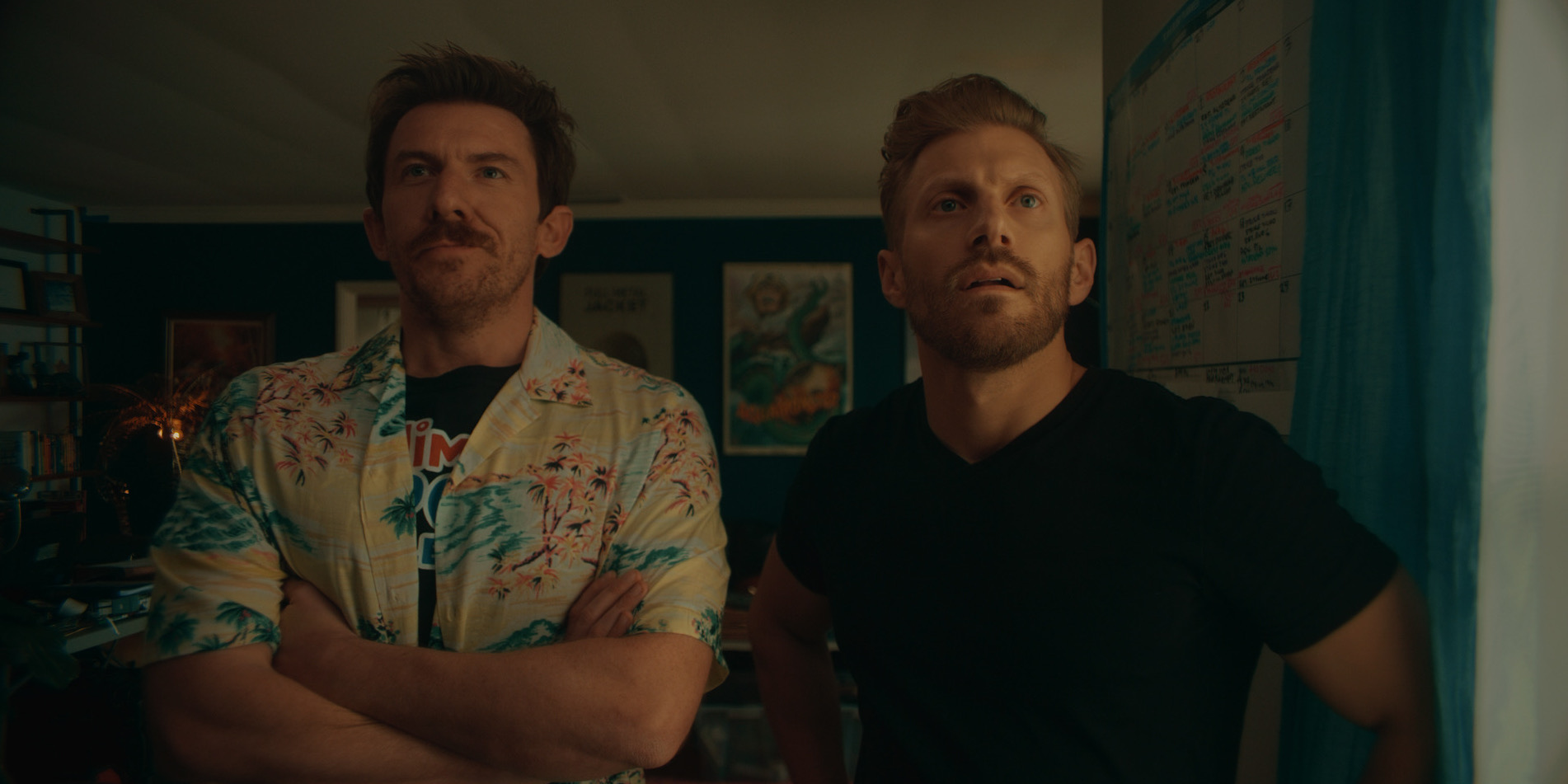
Barnett and director Vincent Masciale, both Funny or Die veterans, are more interested in the goofy exploits of two lifelong friends in California who are having trouble adjusting to adulthood.

Tanner (Tanner Thomason) is a ladies man bartender whose life goals don’t extend beyond drinking and hanging out with friends. Luke (Barnett) cleans pools while peddling the weight loss tea pyramid scheme of his entrepreneurial idol Nicky Steele (Jason Alexander in a bonkers cameo).

Luke and Tanner are big movie fans, and when they discover just how profitable the faith-based market is, a plan emerges. If they can make their own “Jesus” film and sell it to ChristFlix pictures, there should be more than enough profit to stuff their pockets and help out the local Elevate Church where Luke’s father (Lance Reddick) is the pastor.

The big question: can the boys snag Butch Savage (David Koechner, bonkers himself), the action hero from their youth, for the pivotal role?

Masciale, helming his second feature, brings an irresistibly absurdist vibe to the shenanigans that practically begs you not to overthink any of it. Sometimes we get character interviews as per a mockumentary, sometimes we don’t. The continuity and internal logic gets shaky at times, all of which falls perfectly in line with the movie within this movie.

Good-natured fun is certainly had at the expense of the faith-based industry. Margaret Cho’s appearance as a ChristFlix executive running down the rules of Christian films is every bit the bullseye of the horror rules in Scream, and the big Christian yacht rock concert (pay attention to those lyrics!) is subtle perfection.

But it’s the continued success of the Christian entertainment industry that makes it ripe for satire. And while Faith Ba$ed uses the setting to great advantage, its knives are never out for the believers themselves.

Because you know what else Barnett’s script gives us? A church community that is welcoming to all, one where people missing something in their lives can and do find real fulfillment.

And it gives us plenty of laughs, memorable quotes and overall nuttiness at a time when we could use it.

Oh, the outrage.

Mother Knows Best

Evil Eye

by George Wolf

Though they live in different countries, Usha (Sarita Choudhury) and her daughter Pallavi (Sunita Mani) talk often, and Mom always seems to have two main things on her mind.

Does Pallavi have a boyfriend yet? And is she remembering to wear her “evil eye” bracelet?

It’s been years since Usha and her husband left the U.S. for their native India, as Pallavi stayed behind with aspirations of writing a novel. Now, as her very American daughter nears thirty, the traditional Usha is getting impatient for a wedding, and trusts in the bracelet to protect Pallavi against any evil spirits preventing her from marriage.

So, when Pallavi begins a serious relationship with the dashing Sandeep (Omar Maskati), she is shocked when Mom objects, and strenuously.

You’d object, too, if you believed your daughter was dating a reincarnation of the abusive boyfriend who tried to kill you three decades before.

Originally a best-selling Audible original, Evil Eye is directors Elan and Rajeev Dassani’s contribution to Amazon’s Welcome to the Blumhouse series. With an adapted script from source author Madhuri Shekar, the film lands as a delightfully cultured mystery. As narrative layers develop, the atmosphere is more supernatural thriller than outright horror show.

Plot turns tend to rely on convenience and in the absence of any sustained tension or outright fear, the real draw becomes the mother/daughter dynamic propelled by the two lead performances.

The veteran Choudhury makes Usha a fascinating conundrum, haunted by her past, fearing for her daughter’s future and forced to question some beliefs she’s long held dear. When the script wavers, Choudhury elevates it, selling every moment with conviction.

Mani, an up-and-comer seen in Glow and the current Save Yourselves!, provides the effective contrast. Pallavi’s modern path is, at first, only mildly affected by her mother’s traditional sensibilities. But when Usha comes west to present her concerns in person, Pallavi must confront her own inner turmoil.

By the time the final twist is revealed, you’ll most likely have already guessed it. But what you’ll remember about Evil Eye has little to do with the mysterious occurrences surrounding this mother and daughter. It’s the humanity flowing between them that sticks.

And Feathered

Tar

by George Wolf

It takes a good while to get to the creature in this creature feature, but that’s hardly the most misplayed hand in Tar. It isn’t until the last few minutes that the film serves up the kind of winky-winky that would have gone a long way toward saving it.

A group of employees in an office building above L.A.’s old La Brea Tar Pits is under a tight deadline to clear out. The smarmy landlord is evicting them all with one day’s notice, and they have to be gone by 6am or face a big penalty. Then of course the building’s power is cut mid-move, but there are bigger, messier problems.

Underground construction work on the subway expansion has awakened La Brea’s Matchi Manitou, and it ain’t happy.

Director/co-writer/co-star Aaron Wolf gets Timothy Bottoms and Graham Greene to head up his cast, which is good for the poster but bad for the rest of the actors who can’t keep up.

Wolf employs a narrative structure heavy on flashback, and the moments of tension that manage to avoid that roadblock are awkward and clearly telegraphed.

The ensemble of evacuees/possible victims (including Emily Peachy, Sandy Danto, Tiffany Shepis and Nicole Alexandra Shipley) has the depth and logic to only reinforce the point of that horror spoof Geico ad. And after about 90 minutes, the film’s eureka moment makes you wonder about the Drive-In pleasure Tar might have been if it hadn’t waited so long to tap a self-aware vein.

This Was Not a Ski Accident!

The Wolf of Snow Hollow

by George Wolf

How good does a movie have to be before it can’t be improved by adding werewolves?

Don’t answer yet, let’s backtrack.

Two years ago. Thunder Road was a pretty fantastic breakout for writer/director/star Jim Cummings. A visionary character study with alternating moments of heart and hilarity, it felt like recognizable pieces molded into something bracingly original.

Now, Cummings feels it’s time to throw in some werewolves.

While The Wolf of Snow Hollow may not be exactly the same film, the road it travels is pretty thunderous, with Cummings playing a very similar character on a very similar arc.

He’s officer John Marshall of the Snow Hollow sheriff’s department. John’s father (Robert Forster, in his final role) is the longtime sheriff of the small ski resort town, but Dad’s reached the age and condition where John feels he’s really the one in charge.

John’s also a recovering alcoholic with a hot temper, a bitter ex-wife and a teen daughter who doesn’t like him much. But when a young ski bunny gets slaughtered near the hot tub under a full moon, suddenly John’s got a much bigger, much bloodier problem.

As more mutilated corpses stain the snowy landscape, John faces the wrath of scared townsfolk and the growing belief from his own deputies (especially Chavez!) that a werewolf might have come to Snow Hollow.

John doesn’t agree. “It’s a man! When do I get to be right about something?”

This script, like his last, is full of life, and has Cummings again juggling random outbursts of absurd non-sequiturs and hilarious anger with real human issues of struggle and loss. John’s afraid of losing his father, women are being preyed upon, and a drink would sure hit the spot.

And there’s a beast out there threatening the lives and livelihood of Snow Hollow. Yes, you’ll be reminded of Jaws, as well as any number of werewolf films and even Silence of the Lambs.

And if you have seen Thunder Road, you’ll quickly be struck by how much more stylish of a director Cummings is this time out. He’s got a bigger budget and it damn sure shows, with some gorgeous outdoor landscapes, frisky visuals (he must be an Edgar Wright fan) and a confident grip on his monster vision.

Forster’s mere presence brings a bittersweet authenticity to the supporting ensemble, and a stellar turn by Riki Lindhome as Snow Hollow’s most reliably steady deputy gives John’s manic nature a welcome contrast.

Cummings appears to have a gift for taking a pile of familiar, reshaping it and emerging with something endlessly interesting and effortlessly entertaining. The Wolf of Snow Hollow is all that and more.

At its core, it’s a super deluxe re-write of Thunder Road with werewolves. I call that a bloody good time.

Memory Motel

Black Box

by George Wolf

Nolan (Mamoudou Athie) needs Post-It Notes to get through the day. A car crash took his wife and his memory, and the colorful little squares give Nolan useful info while his young daughter Ava (Amanda Christine) is often forced to assume a parental role.

But there is some hope…of the experimental kind.

Dr. Lillian Brooks (Phylicia Rashad) thinks she can help Nolan regain his memory and reclaim his life through her “black box” therapy. Worn like a high-tech VR headset, it allows the patient to wander through their own subconscious, re-living past experiences until they manifest in the conscious world.

Wow, that’s amazing! What could go wrong?

Director and co-writer Emmanuel Osei-Kuffour anchors his feature debut with some recognizable inspirations, crafting another sci-fi ode to identity that flirts with horror tropes while struggling to find a unique voice.

Athie (The Get Down, Underwater) carries the load here with admirable range. The Nolan we come to know early on is not one found in his own subconscious. And as Nolan comes to fear that he is not the man he thought he was, Athie deftly balances the dual roles fighting for control.

And memories aren’t the only area full of mystery. Nolan’s friend Gary (Tosin Morohunfola), a Dr. himself, follows some suspicions to uncover disturbing information about the night of his buddy’s tragic car accident.

The note-posting and body-writing may totally recall Memento, but Black Box also swims in waters populated by iconic J-horror visuals and a touch of Get Out‘s “sunken place.”

The wonders of technology can hide a dark, malevolent side, and we can lose ourselves believing we are always in control.

It’s not a new idea, and Black Box doesn’t blaze any new trails revisiting it. But it is committed to the viability of the journey, and finds its greatest success in engagement rather than surprise.

Club Champion

If These Walls Could Talk

by George Wolf

If you’ve lived anywhere near Columbus, Ohio during the last few decades, you’ve probably got some great memories of the longest continually running rock club in America: Newport Music Hall.

Full disclosure: I tended bar right next door for two years, was lucky enough to meet many of the Newport headliners, even used the access from the shared basement storeroom to sneak behind stage a time or two.

My wife and I had our first date there at a Warren Zevon show in 1990. Years later we dropped our teenage son off to see some band I can’t remember.

Still, I instantly think of an electric James Brown concert in 1986. It was the second of two sold out shows at the Newport, and Mr. Dynamite was riding a smash with “Living in America.” He loaded the stage with about 500 band members, never letting up until we begged for mercy.

Pure funky magic.

The Newport has enjoyed countless nights of magic in the 50 years since it began hosting live shows as the Agora in 1970. If These Walls Could Talk gives the club the respectful, nostalgic salute it deserves, one full of history, some rockin’ archival footage, and plenty of damn good stories.

Ted Nugent threatening a sound man’s life. Melissa Etheridge going acoustic when the power went out. Todd Rundgren staying up all night to fix the sound system. Future O.A.R. members walking to class at Ohio State and dreaming of playing on the Newport stage. U2 live for four dollars and fifty cents.

And offstage, the tale of how Scott Stienecker saved the North High St. venue in 1984 ain’t bad, either. The short version: sorry Walgreens, hello Newport.

The film effortlessly cements how important the Agora/Newport has been not only to Columbus, but to the entire live music industry. Executive Producer Jason Corron understandably has more footage from recent concerts at his disposal, but he creates enough of an overall sense of history to make the classic moments that much more resonant.

No director is credited, and there are some moments of bumpy production values (sound mix transitions, especially) that could have benefitted from an experienced filmmaking hand.

But If These Walls Could Talk will have fans practically salivating for the return of live music. It will remind you how unforgettable the intimacy of a small club can be, and just how much of a gem we have right here in our backyard.

50 years. Here’s to 50 more.

If These Walls Could Talk airs in a free, one time event Nov. 4th at 8pm on the PromoWest YouTube channel or PromoWestlive.com.