Tag Archives: George Wolf

Contact Tracing

The Midnight Sky

by George Wolf

Between sci-fi and horror, it’s sometimes hard to keep track of which genre relies more heavily on recycled ideas. Since I see more horror than anything else, I’m inclined to lean in that direction, but The Midnight Sky adds one to the science fiction tally, building its very respectable tale on some very recognizable building blocks.

Director George Clooney also turns in a gritty and understated performance as Dr. Augustine Lofthouse (nice!), a revered scientist in the year 2049. Three weeks after a cataclysmic event on Earth forces survivors underground, Augustine chooses to remain at his Arctic Circle observatory. His hope is to make contact with Aether K-23, and warn the five crew members finishing a two year mission that there is no home worth returning to.

Augustine’s simple goal gets complicated by his discovery of Iris (Caoilinn Springall), an eight year-old girl missed during the outpost’s evacuation, and by the realization that he’ll have to take her along on a treacherous journey to the only satellite antenna capable of making contact with Aether.

Clooney and writer Mark L. Smith (The Revenant, Overlord) adapt Lily Brooks-Dalton’s source novel through three rotating narratives that offer mixed results.

On board with the Aether crew, we learn Sully (Felicity Jones) and Ade (David Oyelowo) are close, Sanchez (Demián Bichir) is the quietly wise vet, Maya (Tiffany Boone) the baby-faced youngster and Mitchell is the stoic manly man we’re not surprised is played by Kyle Chandler.

There are some effectively human moments with the crew, but too much of this thread feels strangely overwritten by Smith, a tendency that only becomes more weighty during the flashbacks to a younger Augustine (Ethan Peck).

Though we learn what drives the Dr.’s frigid quest for redemption, the backstory lessons are more spoon-fed than well-earned, standing in sharp contrast to the gentler hand played between Augustine and Iris.

Remember, Clooney has a deserved Oscar nom for directing, and his latest course is steady as she goes. Many of the deep space segments, buoyed by another wonderful score from Alexandre Desplat, will make you long for a return to big screens, while two tension filled set pieces – one with a snowmobile and another sporting zero gravity blood loss – find Clooney flexing some thrill muscles to fine effect.

There’s nothing really wrong with the themes and devices here, that’s why they’re used so often. The failures of humankind and the promise of the next generation are ideas that sit comfortably in the wonders explored by science fiction. But though our current global crisis gives The Midnight Sky’s iteration some added urgency, it can’t shake the feeling we’ve boldly gone here pretty often.

The Midnight Sky premieres on Netflix December 23.

Lost In Love

Wander Darkly

by George Wolf

At this point, there’s nothing surprising about a terrific performance from Sienna Miller. The really curious thing is why she still seems to fly so far under the radar.

Maybe it’s the knack she has for adopting unrecognizable looks and unique personalities from role to role, making it harder to tie her to an easily recalled resume. Whatever the cause, the effect Miller has on Wander Darkly is seismic, with an award-worthy turn that gives the film much of its emotional pull.

Miller is Adrienne, a new mom who’s starting to question her relationship with Matteo (Diego Luna, also stellar). Despite a child and a new mortgage, the couple hasn’t married, and as a rare date night out turns disappointing, they’re involved in a nasty car accident.

Dazed and disoriented, Adrienne believes she has died. While her parents and friends whisper “psychiatry,” Matteo tries to convince Adrienne that she is indeed still alive and recovering in the real, physical world.

Writer/director Tara Miele’s narrative is ambitious, surreal, touching and at times even terrifying, but it’s ultimately the sheer talents of Miller and Luna that keep the film from falling prey to gimmickry.

We re-live the couple’s journey together as they do, visually drifting through transfixing waves of history where both Adrienne and Matteo pepper the flashbacks with hindsight benefitting from their current perspectives.

As they make new admissions and wonder about who may be guilty of misremembering, the couple is reminded of why they first committed to each other, even as they search their respective memories for the exact moment it started to go wrong.

Whether or not you sniff out what Miele has in mind, where the film lands doesn’t quite deliver on its promise of profundity. But the cascade of emotion required to manifest this trauma is beautifully realized by Miller, and her chemistry with Luna makes it inviting to become invested.

You care about these characters, and that opens the door to care about Wander Darkly.

Upstairs, Downstairs

Ma Rainey’s Black Bottom

by George Wolf

In 1927 Chicago, four musicians – three vets and a brash youngster – gather in the basement of a downtown recording studio. They tune up and rib each other, waiting for the star vocalist to arrive.

That would be one Gertrude “Ma” Rainey, legendary “Mother of the Blues” and one of the first blues singers to make records. And in the late 1920s, those records sold, which meant Ma didn’t waste her time in studio basements.

That spatial divide becomes the metaphorical anchor in director George C. Wolfe and screenwriter Ruben Santiago-Hudson’s adaptation of August Wilson’s Tony Award-winning play. And thanks to the blistering adversarial performances by Chadwick Boseman and Viola Davis, the film has a show-stopping pillar on each floor.

Boseman is electric as Levee, the ambitious trumpet player who’s not only ready to give Ma’s tunes some new swing, but also to break away and record some of his own compositions.

Ma ain’t having any of that, or anything else that doesn’t smell the least bit right to Ma. And Davis, surprising no one, effortlessly embodies the blues legend with a smoldering, defiant ferocity.

Early on, the rehearsal conversations still carry the aura of the stage, but this is Wolfe reinforcing the different worlds co-existing here, a difference that will be pivotal as events escalate.

Wilson’s source work is another compelling example of his ability to explore the Black experience in America through the piercing intimacy of his characters. Ma’s records are selling, which gives her leverage over the white record producers. She exploits that leverage at every turn, but it only takes one cold, world-weary stare from the transcendent Davis to remind you how little illusions Ma has about any of it.

Boseman’s work will undoubtedly earn an Oscar nomination, which will be nothing but well-deserved. Labeling Boseman’s final performance as his finest may smack of sentimentality – at least until you experience it. Then you realize how gracefully Boseman claims this story for Levee, and for the countless real life souls he represents.

It is Levee’s arc that carries this film’s very soul, and Boseman’s chemistry with the stellar ensemble of Glynn Turman, Coleman Domingo and Michael Potts is a thing of beauty. As Levee moves from the cocky enthusiasm of the gifted to the painful cry of the oppressed, Boseman’s bittersweet goodbye becomes doubly heartbreaking.

This is an elegant, artful salute to great art, and a sobering reminder of a shameful legacy marked by exploitation and appropriation. And it is thanks to a collection of great artists that Ma Rainey comes to the screen with all of its joy and pain intact.

Light the Corners of My Mind

Minor Premise

by George Wolf

“Don’t make me psychotic. You wouldn’t like me when I’m psychotic.”

Okay, that’s not the exact quote, but science fiction and horror stories have been mining the conflicting personality premise since well before Bill Bixby on 1970s TV. Minor Premise ups the ante in stellar fashion, with no less than 10 identities competing for one man’s consciousness.

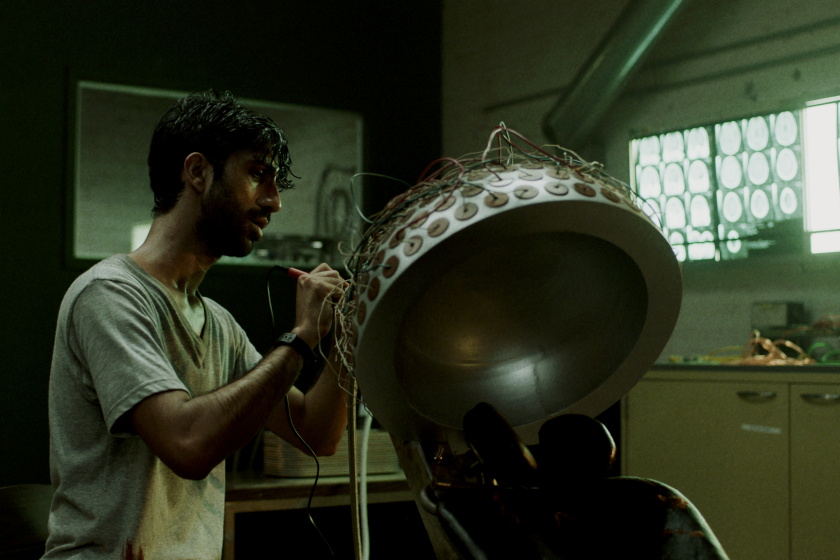
Dr. Ethan Kochar (Sathya Sridharan) is a scientist living in the shadow of his late father, but Ethan’s on the verge of a breakthrough that would make his spotlight quite a bit brighter.

His work is centered on mapping memories as physical imprints on neural pathways. If Ethan can isolate sections of the brain, he foresees amazing possibilities such as boosting intellect, erasing Alzheimers and PTSD, maybe even constructing consciousness.

But when Ethan goes full Brundlefly and experiments on himself, his identity is fractured into 10 different emotions – ranging from euphoric to psychotic – each operating at 6 minute increments.

Anyone familiar with 2004’s wonderful Primer will feel right at home, especially after Ethan’s colleague and former flame Allie (Paton Ashbrook) drops by to help him put the pieces of his mind back together. From there, the film becomes a one setting two-hander, as director/co-writer Eric Schultz unveils a feature debut of clever intellect, stylish pacing and claustrophobic, beat-the-clock tension.

Sridharan and Ashbrook make a formidable team, anchoring their wary chemistry and heady dialogue with a “try to keep up” attitude that’s organically right for their characters. They’re brilliant scientists (Schultz, by the way, studied psychology at Harvard) and we’re not, so if you pay enough attention and suspend a little disbelief, Minor Premise crackles with some major sci-fi thrills.

Beneath Was Taken

What Lies Below

by George Wolf

Eeewww – no 16 year-old girl wants to hear about her Mom’s sexcapades with the new boyfriend!

John (Trey Tucker) is kinda hot, though, and young Liberty (Ema Horvath) has caught herself staring when he traipses around the Adirondacks lake house with his shirt off – which is often.

Mom Michelle (Mena Suvari) is 42 but has told John she’s 35 – and she’s desperate for “Libs” to keep her secret so he doesn’t run off. But John seems like he’s strangely attached to Michelle – or at least to the lake. In fact, as Libs looks closer, there’s plenty about John that’s strange.

He says he’s an “aquatic geneticist” working to preserve fresh water supplies. But man, he’s really interested in parasites, especially ones that can adapt to any host available.

Writer/director Braden R. Duemmler’s feature debut unfolds like a minor league Under the Skin. There’s simmering sexual tension here – some of it metaphorical – amid dreamlike atmospherics and a few glimpses of a creature on the hunt.

Horvath (The Mortuary Collection) is great. Her mix of teenage disgust, confusion and curiosity hits just the right pitch, as does her panicked courage when Lib has to fight for her life (and her Mom’s).

Not every logical building block is water tight, and the sci-fi/horror combo sometimes feels desperately earnest. But the creep factor in What Lies Below holds steady, with Duemmler earning some water-logged points for not copping out at the finish.

Who’s Afraid of Virginia Bear?

Black Bear

by George Wolf

As slippery as it is inviting, Lawrence Michael Levine’s Black Bear is an intoxicating trip through the inspirations and indulgences that take root in creative minds.

It feels intensely personal, and yet – once Levine delivers his midstream shape shift – malleable enough to bend to myriad perspectives and interpretations.

We first meet Allison (Aubrey Plaza) as an actress and director facing a crisis of inspiration. She’s hoping to ignite the creative spark at a remote lakeside property overseen by Gabe (Christopher Abbott) and his pregnant girlfriend, Blair (Sarah Gadon).

As the three get to know each other, we learn that Gabe inherited the property from his family. Beyond that, there isn’t much Blair and Gabe seem to agree on. The couple’s little barbs become more intense, as does the attraction between Allison and Gabe, and we think we have a pretty good handle on what’s soon to be up.

And then we don’t.

The opening scene repeats, but Allison and Blair are co-stars on the set of the new film directed by Gabe, who is also married to Allison. The shoot is chaotic, Gabe’s motivational methods are questionable and now Allison is the one jealous of Gabe and Blair’s cozy relationship.

Knowing that Levine’s own history includes films with his wife (actress/director Sophia Takal) adds a layer of intimate intrigue, and knowing even a little about the workings of a movie set will add relatable humor.

But Black Bear isn’t a comedy – except when it’s funny. It’s also dramatic and slightly horrific, depending on your viewpoint.

Most of all, it’s emotional, propelled by career high performances from Abbott, Gadon, and Plaza. The glee each performer takes in upending character expectations is evident, with Plaza seamlessly moving from a cool, casual customer to the emotionally frayed flashpoint of a volatile triangle.

After such fireworks play out, Levine’s payoff may seem a bit underwhelming, but his film is more about the trail than where it ends. Black Bear‘s got plenty to say – about creativity, ego, insecurity, sexual politics and more – but its resonance comes from not demanding you take a side.

Search for Tomorrow

The Croods: A New Age

by George Wolf

At least two things have happened since we met The Croods seven years ago. One, we’ve forgotten about the Croods, and two, Dreamworks has plotted their return.

A New Age gets the caveman clan back together with some talented new voices and a hipper approach for a sequel that easily ups the fun factor from part one.

The orphaned Guy (voiced by Ryan Reynolds) has become part of pack Crood, which is fine with everyone except papa Grug (Nicolas Cage), who isn’t wild about the teen hormones raging between Guy and Eep (Emma Stone).

The nomadic gang is continuing their search for the elusive “tomorrow” when they stumble onto the Stone Age paradise of Phil and Hope Betterman (Peter Dinklage and Leslie Mann, both priceless). The Betterman’s lifestyle puts the “New Age” in this tale, and they hatch a plan to send the barbaric Croods on their way while keeping Guy for their daughter Dawn (Kelly Marie Tran).

But a funny thing happens along the way. Check that, many things happen, and plenty of them funny, in a film that nearly gets derailed by the sheer number of characters and convolutions it throws at us.

The new writing team of Kevin Hageman, Dan Hageman and Paul Fisher keeps the adventure consistently madcap with some frequent LOLs (those Punch Monkeys are a riot) and even topical lessons on conservation, individuality and girl power.

Or maybe that should read Granny Power, since it is Gran’s (Cloris Leachman) warrior past that inspires the ladies to don facepaint, take nicknames and crank up a theme song from Haim as they take a stand against some imposing marauders.

Director Joel Crawford – an animation vet – keeps his feature debut fast moving and stylish, drawing performances from his talented cast (which also includes Catherine Keener and Clark Duke) that consistently remind you how important the “acting” can be in voice acting.

By the time Tenacious D drops in to see what condition the Partridge Family’s “I Think I Love You” is in, the whole affair starts to feel like some sort of animated head trip.

Yeah, a little sharper focus wouldn’t hurt, but A New Age delivers the good time you forgot to remember to wonder where it’s been.

Frankly, My Dear

Uncle Frank

by George Wolf

Dropping right at the start of the season normally filled with relative reunions, Uncle Frank digs into the scars of family strife for an effective drama full of understated grace and stellar performances.

Writer/director Alan Bell frames his narrative through the eyes (and scattershot narration) of Betty (Sophia Lillis), a curious teenager in the summer of 1969.

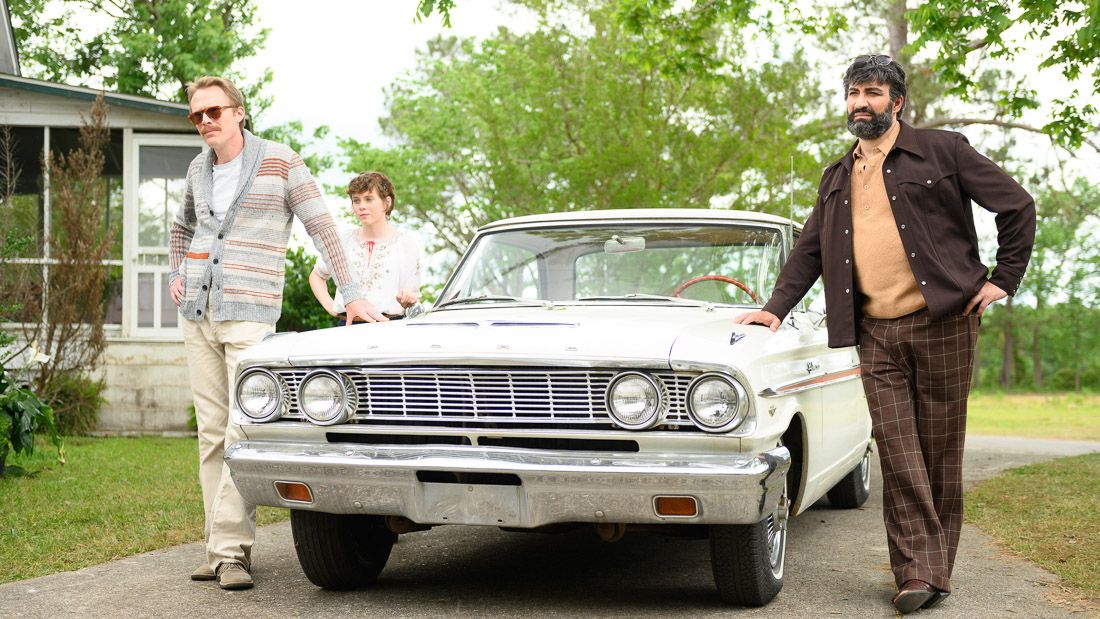
Mainly, she’s curious about life beyond tiny Creekville, South Carolina, which is a big reason Betty is always happy to visit with her Uncle Frank (Paul Bettany).

He got out of Dodge years ago, settled in New York City and now sweetly encourages Betty to look outside her backwater hometown for any kind of future she desires. A new name? Of course. Betty likes “Beth,” and Frank agrees, so that’s that.

Fast forward four years, and Beth is a freshman at NYU, where Frank teaches. Dropping by Frank’s apartment unexpectedly one night, Beth meets Wally (Peter Macdissi, terrific), and quickly finds out why Frank has long felt like an outsider in his own family.

An unexpected death in that family means Frank and Beth must travel back home for the funeral, with Wally hatching a pretty funny plan to tag along.

This time on the road becomes the bridge that connects Frank’s coming out and Beth’s coming-of-age. Ball (writer of American Beauty, creator of True Blood) isn’t blazing any trails here, but his outstanding ensemble consistently elevates even the most well-traveled terrain.

Bettany has never been better, covering Frank with a mask of easy charm that can never quite hide his self-loathing. He finds a touching chemistry with the wonderful Lillis, who brings a warm authenticity to Beth’s wide-eyed awakenings.

And check out who’s waiting at home in Creekville: Stephen Root, Margo Martindale, Judy Greer, and Steve Zahn, all seasoned talents able to keep their characters above the hicktown cliches that tempt the script.

There’s pain here, for sure, but there’s also humor and a comforting sense of hope. Uncle Frank may not be the first film to remind us how heavy family baggage can feel, but this has the cast and commitment to make you glad you unpacked for a spell.

Playing Dirty

Buddy Games

by George Wolf

Buddy Games has the smell of something that’s been sitting on a shelf for quite a while, thrown out to theaters now like a piece of rancid meat to a hungry dog.

The theaters that are still open may be starving for content, but this meal is rotten to the core.

Director/co-writer/star Josh Duhamel leads a group of lifelong friends (Dax Shepard, Kevin Dillon, Nick Swardson, Dan Bakkedahl, James Roday Rodriguez) as the “Bobfather,” rich guy ringleader of their annual brodown throwdown they call the Buddy Games. Indulging their “primal need to dominate,” the guys hit an outdoor obstacle course to compete against each other in a variety of events for a lame trophy and – most importantly – bragging rights.

But an unfortunate paintball-to-nutsack incident shuts the games down, sending Buddy Game Champ Sheldon (Bakkedhahl) into a downward spiral that leads to rehab.

So at the urging of Shelly’s mom, the boys revive the Games after five long and aimless years, this time with a $150,000 prize to the victor.

If you’re sensing a mix of Tag and Grown Ups, you’re close, just remove all the charm of the former, and add even more stupidity than the latter.

It’s a tone deaf, crass and almost completely humorless exercise in objectifying women and indulging the selfishness of entitled d-bags. The longer it drags, the more you just wonder: why? Why did Duhamel pick this for his directing debut? Why did Olivia Munn accept another role as “low cut shirt for the marketing”? Why are we seeing Nick Swardson without Adam Sandler?

But, like most of those Sandler comedies, it looks like the cast of Buddy Games had a blast making it.

I guess you had to be there.