There is something eerily beautiful about Severin Fiala and Veronika Franz’s rural Austrian horror Goodnight Mommy (Ich seh, Ich seh).
During one languid summer, twin brothers Lukas and Elias await their mother’s return from the hospital. They spend their time bouncing on a trampoline, floating in a pond, or exploring the fields and woods around the house. But when their mom comes home, bandaged from the cosmetic surgery she underwent, the brothers fear more has changed than just her face.
Franz and Fiala owe a great debt to an older American film, but to name it would be to give far too much away, and the less you know about Goodnight Mommy, the better.
Inside this elegantly filmed environment, where sun dappled fields lead to leafy forests, the filmmakers mine a kind of primal childhood fear. There’s a subtle lack of compassion that works the nerves beautifully, because it’s hard to feel too badly for the boys or for their mother. You don’t wish harm on any of them, but at the same time, their flaws make all three a bit terrifying.
The filmmakers’ graceful storytelling leads you down one path before utterly upending everything you think you know. They never spoon feed you information, depending instead on your astute observation – a refreshing approach in this genre.
Performances by young brothers Lukas and Elias Schwarz compel interest, while Susanne Wuest’s cagey turn as the boys’ mother propels the mystery. It’s a hypnotic, bucolic adventure as visually arresting as it is utterly creepy.
The film is going to go where you don’t expect it to go, even if you expect you’ve uncovered its secrets.
Listen weekly to MaddWolf’s horror podcast FRIGHT CLUB. Do it!
Does Masterminds carry the stench of death? Let’s go to the evidence.
This film has been on the shelf for over a year despite impressive comic talent, and that cast may be the only thing keeping the film from straight-to-video status. It finally opens this week, with little fanfare in a crowded field, and features a blooper reel that can’t wait to push the actual film out of the way and get going.
In other words, we doubt you laughed much for the previous 90 minutes, how ’bout some funny outtakes as you leave?
Strong case, counselor, but in the words of master litigator Jules Winfield, “Allow me to retort!”
Masterminds is not horrible.
It’s actually based on the true events of a 1997 bank heist that scored 17 million dollars (2 million of which is still missing). If you think the director of Napoleon Dynamite is an odd choice to direct this story, you’re correct, and Jared Hess delivers a very odd, haphazardly funny movie.
Zach Galifiankis is a trailer-park livin’ armored truck driver engaged to Kate McKinnon (their announcement shots are a riot) but pining for his co-worker Kristin Wiig, who becomes the bait in Owen Wilson’s scheme to get the cash. Once the job is pulled, Zach waits south of the border for Wiig to join him (“I had to get a disguise, I look like Gene Shalit!”), while Wilson dispatches hitman Jason Sudeikis to hunt Zach down in Mexico. Meanwhile FBI agent Leslie Jones looks for clues and a jealous McKinnon attacks Wiig with a giant tube of feminine cream.
Long stretches where you aren’t laughing are suddenly broken up by a randomly uproarious gag (see tube of feminine cream above), and the veteran cast always makes it watchable despite the extreme absurdity. McKinnon steals scenes with facial expressions alone while Zach and Sudeikis engage in battles of improvised strangeness.
So ladies and gentlemen of the jury consider:this film will sink quickly and quietly from the multiplex, then slowly grow once it hits the video and streaming market.
As Zach says, “Brace your boobies,” Masterminds may be a cult favorite in waiting,
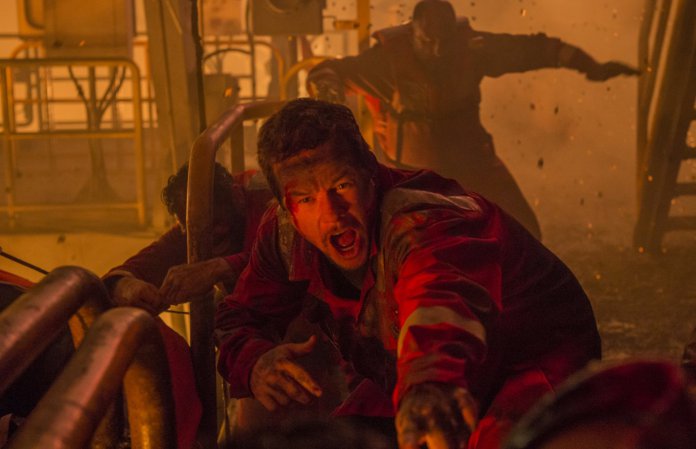
With a nice throwback vibe, crackling tension and terrific ensemble acting, Deepwater Horizon is a surprisingly compelling package. Director Peter Berg, surpassing his similar work with Lone Survivor three years ago, is again all about making sure a tragic true-life tale is told with proper respect for the heroes involved.
This tragedy was the worst in U.S. oil .drilling history, as the Deepwater Horizon rig exploded off the coast of Louisiana in 2010, killing 11 crew members and exposing a scandalous gap in safety protocols from BP.
Berg, armed with a crisp, economical script from Matthew Michael Carnahan and Matthew Sand, introduces us to the souls involved with a rapid succession of quick vignettes from their day, just hours just before boarding the rig. Mike (Mark Wahlberg, as good as he’s ever been) gets frisky with his wife Felicia (Kate Hudson), while Andrea (Gina Rodriquez from TV’s Jane the Virgin) can’t get her car started and has to hitch a ride to the airport from her boyfriend, and so on.
Snapshots of crew members’ lives crisscross each other, and the film needs minimal screen time to get us invested in multiple personalities. This is a roadblock for scores of films that Berg and his writers sweep away. They give us people to care about, and they increase the chance that events to come will resonate. Extra points for providing helpful primers on drilling practices in ways that feel organic, such as Mike’s daughter rehearsing a classroom presentation.
The tension builds steadily, with a single bubble of air escaping from an undersea drill line, and leads to a spectacularly staged string of explosions that engulf the entire structure. Berg has long shown his skill as a tactician, and here he gets us breathtakingly close to the chaos with an authenticity that’s refreshingly unencumbered by CGI effects.
You may be reminded of more recent movies (especially Wahlberg’s own The Perfect Storm), but Deepwater Horizon has a retro kinship with classic disaster films of the 70s, along with an in-the-moment humanity that salutes the real players whose lives hung in the balance.
Are these the worst movies ever? Hell no – most of the are actually quite good. This is a list of films that can’t live up to the accolades and high expectations that come with them. When we think of films that people just love too much, usually they are impressive on some level – just not impressive enough to merit all the commotion. Here’s our list of the films that best fit that bill. (And when I say “ours,” take that with a grain of salt. George highly disagrees with one choice, in particular.)
5. Saw (2004)
Did you see Saw? Because if you saw Saw, there’s really no need to see Saw 2 (or 3, 4, 5, or 6).
Saw is the gruesome tale of a madman bent on forcing those unworthy of their own lives to acknowledge their internal ugliness. He carries this out in a most unpleasant way. Body parts are usually lost.
Saw would have been an altogether decent piece of grisly filmmaking were it not for the climax – a piece of cinema that was fantastic for the three seconds it took to realize it could never have happened. Coupled with Cary Elwes’s laughable whining and director James Wan’s dreadful grasp of pacing, the film turned out to be much less than it should have been.
My favorite thing about Saw is that, right off the bat, in the opening investigation, cops claim that Jigsaw is no murderer. How’s that? Well, it’s because his victims are given a test that they could, given the masochism and tenacity, survive. This is like saying the guy who pushed someone into the shark tank isn’t a murderer, the shark is.
4. Drag Me to Hell (2009)
An inspired Lorna Raver plays Mrs. Ganush, an old gypsy woman (here and almost everywhere else in the film, Raimi will never be accused of cultural sensitivity) who curses a meek bank loan officer (an uncharacteristically bland Alison Lohman). She will spend the rest of the film trying to break the curse. It’s a pretty slight and predictable premise, but the point is simply to allow director Sam Raimi an opportunity to string together as many body fluid sight gags and creepy set pieces as possible.
His film is gleefully over-the-top, and I wonder whether Lohman’s stiff performance resulted from the nausea she must have suffered. Never have we seen one actor subjected to so many instances of projectile fluids and/or insects in the mouth. Ever.
The film is broadly comical, utterly repulsive, often clever viewing. It won’t scare you in any lingering way – don’t look for any slow-developing dread or quiet creepiness here. From the word Ganush this film is giddy with bile and mucous and blood and worms and nastiness – all that stupid fun of the Evil Dead series, but with a budget. But the storyline itself – leading to the twisty climax – is far too predictable to be effective.
https://www.youtube.com/watch?v=BUZTybLlWKI
3. Don’t Look Now (1973)
Did we need to see quite so much of Donald Sutherland?
That’s not really our complaint. Nicolas Roeg’s visually stunning rumination on parental grief follows Laura and John Baxter (Julie Christie and Sutherland) to Venice where they’ll try to recover from the accidental death of their daughter. But grief doesn’t work like that.
Roeg’s film takes on the dreamlike logic and color motifs of an Italian film – not gaillo outright, Don’t Look Now is far too subdued and elegant to fit into that category. But there’s no denying the stylistic similarities between this and Mario Bava, some Argento, even maybe a touch of Fulci. Just a touch!
The director uses dreamy visions to enhance the mystery facing John Baxter. In its best moments, the film articulates the necessarily selfish nature of grief. Otherwise, it’s a slow and graceful mystery often punctured by garish flashes and a twist ending is so ill-fitting it leaves you dumbfounded – and not in a good way.
2. Suspiria (1977)
Italian director Dario Argento is in the business of colorfully dispatching nubile young women. In Suspiria, his strongest film, American ballerina Suzy Bannion (Jessica Harper) moves to Germany to join a dance academy, but the other dancers are catty and the school is staffed with freaks. Plus, women keep disappearing and dying.
As Suzy undertakes an investigation of sorts, she discovers that the school is a front for a coven of witches. But Argento’s best film isn’t known for its plot, it’s become famous because of the visually disturbing and weirdly gorgeous imagery. Suspiria is a twisted fairy tale of sorts, saturating every image with detail and deep colors, oversized arches and doorways that dwarf the actors. Even the bizarre dubbing Argento favored in his earlier films works to feed the film’s effectively surreal quality.
But it is tough to surrender the need for decent acting or coherent story in favor of the garish style.
1. Omen (1976)
Gregory Peck brought impenetrable gravitas to this film, making everything seem very serious and worthwhile. This could be no ordinary horror flick – not with Atticus Finch in the lead.
Peck plays Robert Thorn, a rising politician and best friend to the President of the United States. He agrees to a delivery room switcheroo when he’s told his own son perished during childbirth, but another baby born simultaneously was orphaned. He brings home the tot, his loving wife (Lee Remick) none the wiser.
This mid-Seventies Oscar winner is a bit over-the-top with its self-serious approach to the coming of the antichrist. Richard Donner – who would go on to direct a couple Superman movies, a bunch of Lethal Weapons, as well as the Goonies – made a name for himself as a director with this bloated and deadly serious bible thumper.
The film’s sinister elements – Mrs. Baylock, that dog, and Jerry Goldsmith’s intensely creepy score – combine with Peck’s elegant heroism to keep the film fascinating, but all would have been for naught except for Harvey Stephens’s impish perfection as Damien.
Disagree? Keep it to yourselves. NO! What we mean is, share that enthusiasm and any suggestions with us on Twitter @maddwolf, on Facebook @maddwolfcolumbus, or comment right here.
Five missing women. Five grisly murders. A town living in fear.
Hey, let’s put on a show!
London Road takes us to the sleepy English town of Ipswitch back in 2006, when a string of murders had residents looking at each other with growing suspicion. The tale is told not only through music, but more importantly through the words of the residents themselves, exactly as they said them in interviews.
Sing: “Everyone is very, very nervous….”
It’s a fascinating clash of material, as enthralling onscreen as it apparently was as a highly successful stage show. Director Rufus Norris and writer Alecky Blythe craft a film so inviting and original, it becomes exponentially more enjoyable as it continues to exceed your expectations.
While not exactly profound, what London Road lacks in depth it makes up in sheer artistic expression. Lines are repeated and repeated again, layered over each other in rising choruses amid elaborate choreography.
That what-am-I-watching face on the person next to you? You’re probably wearing it, too.
The cast (including a Tom Hardy cameo) is uniformly perfect, led by the always-welcome Olivia Coleman as the plucky Julie. Seeking to help her neighborhood recover from the murders, Julie organizes a gardening contest, then floors you as she cheerily describes the reason she’s grateful to the “Suffolk Strangler.”
Like some bastard child of Sweeney Todd, London Road is a thoughtful, darkly funny and melodic peek into blinding self-interest, and unlike anything you’re likely to see this year.
When aren’t vacations a horror show? Remember that time the car a/c broke and your dad wouldn’t let you roll the windows down because the wind made his hearing aids whistle? God, that sucked. But our research had led us to believe that there are worse miseries than driving cross country with Mark Madden. Hundreds, actually – traveling abroad, camping, boating, island adventures. Here are a handful that will make you want to just stay home.
5. Wolf Creek (2005)
Using only digital cameras to enhance an ultra-naturalistic style, writer/director Greg McLean’s happy backpackers find themselves immobile outside Wolf Creek National Park when their car stops running. As luck would have it, friendly bushman Mick Taylor (John Jarratt) drives up offering a tow back to his camp, where he promises to fix the vehicle.
If this sounds predictable and obvious to you, rest assured that McLean has plans to burst every cliché in the genre, and he succeeds on almost every level.
His first triumph is in the acting. Jarratt’s killer is an amiable sadist who is so real it’s jarring. You find yourself hoping he’s an actor. His performance singlehandedly shames the great Tobe Hooper and Wes Craven, whose backwoods horror films relied so completely on caricatures for villains.
A horror film this realistic is not only hard to watch, but a bit hard to justify. What makes an audience interested in observing human suffering so meticulously recreated? This is where, like a true artist, McLean finally succeeds. What is as unsettling as the film itself is that its content is somehow satisfying.
4. Eden Lake (2008)
The always outstanding Michael Fassbender takes his girl Jenny (Kelly Reilly) to his childhood stomping grounds – a flooded quarry and soon-to-be centerpiece for a grand housing development. He intends to propose, but he’s routinely disrupted, eventually in quite a bloody manner, by a roving band of teenaged thugs.
Kids today!
The film expertly mixes liberal guilt with a genuine terror of the lower classes. The acting, particularly from the youngsters, is outstanding. Most impressive, Jack O’Connell’s performance as the young psychopath is chilling.
There’s the slow boil of the cowardly self-righteous. Then there’s this bit with a dog chain. Plus a railroad spike scene that may cause some squeamishness. Well, it’s a grisly mess, but a powerful and provocative one. Excellent performances are deftly handled by the director who would go on to helm The Woman in Black.
Don’t expect spectral terror in this one, though. Instead you’ll find a bunch of neighborhood kids pissed off at their lot in life and taking it out on someone alarmingly like you.
https://www.youtube.com/watch?v=_9kuMFPW0YI
3. The Descent (2005)
A bunch of buddies get together for a spelunking adventure. One is still grieving a loss – actually, maybe more than one – but everybody’s ready for one of their outdoorsy group trip.
Writer/director Neil Marshall begins his film with an emotionally jolting shock, quickly followed by some awfully unsettling cave crawling and squeezing and generally hyperventilating, before turning dizzyingly panicky before snapping a bone right in two.
And then we find out there are monsters.
Long before the first drop of blood is drawn by the monsters – which are surprisingly well conceived and tremendously creepy – the audience has already been wrung out emotionally.
The grislier the film gets, the more primal the tone becomes, eventually taking on a tenor as much like a war movie as a horror film. This is not surprising from the director that unleashed Dog Soldiers – a gory, fun werewolf adventure. But Marshall’s second attempt is far scarier.
For full-on horror, this is one hell of a monster movie.
2. Deliverance (1972)
Nine notes on a banjo have never sounded so creepy.
Deliverance follows four buddies staving off mid-life crises with a canoeing adventure in southern Georgia, where a man’s not afraid to admire another man’s mouth.
James Dickey streamlined his own novel to its atmospheric best, and director John Boorman plays on urbanite fears like few have done since. Dickey and Boorman mean to tell you that progress has created a soft bellied breed of man unable to survive without the comforts of a modern age.
The film, while steeped in testosterone, also mocks modern man’s desire to conquer nature. It does so by viewing the manly weekend through the eyes of four different types of men: Burt Reynolds’s alpha male, Ronny Cox’s open-hearted optimist, Jon Voight’s introspective intellectual, and poor, doomed Ned Beatty’s smug businessman.
Solid performances, particularly from Voight and Reynolds (this is the guy you want on your zombiepocalypse team), and startlingly effective photography fold perfectly into Boorman’s harrowing tale. This raw, unsettling authenticity helps Deliverance sidestep a hixploitation label, but you’re not likely to look at rural Southerners the same way again.
1. Funny Games (’97, ’07)
A family pulls into their vacation lake home. They are quickly bothered by two young men in white gloves. Things, to put it mildly, deteriorate.
Writer/director/genius Michael Haneke begins this nerve wracking exercise by treading tensions created through etiquette, toying with subtle social mores and yet building dread so deftly, so authentically, that you begin to clench your teeth long before the first act of true violence.
The teen thugs’ calm, bemused sadism leaves you both indignant and terrified as they put the family through a series of horrifying games. And several times, they (and Haneke) remind us that we are participating in this ugliness, too, as we’ve tuned in to see the family suffer. Sure, we root for the innocent to prevail, but we came into this with the specific intention of seeing harm come to them. So, the villains rather insist that we play, too.
His English language remake is a shot for shot repeat of the German language original. In both films, it is the villains who sell the premise. Whether the German actors Arno Frisch and Frank Giering or the Americans Brady Corbet and Michael Pitt, the bored sadism that wafts from these kids is seriously unsettling, as, in turn, is each film.
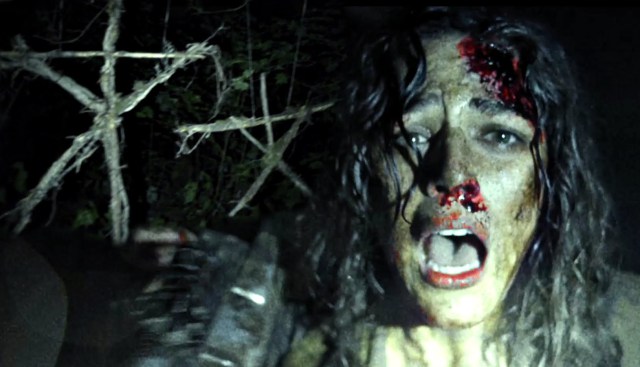
Buried now under so many years of bad found footage movies and viral marketing gimmicks, it’s easy to forget that in 1999, The Blair Witch Project was a scary sensation for good reason: it was creepy and frightening on a brilliantly primal level. It may be impossible now to view that film without the baggage nearly twenty years have added, but the main complaint from the naysayers is usually “it’s not scary…nothing happens!”
Director Adam Wingard hears you, and he has something for you.
Wingard’s Blair Witch began last year with the unassuming title The Woods, before unveiling itself as a BWP sequel (Book of Shadows is wisely ignored) a few months back. Repeating the genius of the original film’s “is it real?” firestorm wasn’t going to happen, but this rope-a-dope title switch was an early sign of Wingard’s solid instincts for both limitation and opportunity.
Remember poor Heather from BWP? Her brother James (James Allen McCune) thinks he glimpses her in a strange online video, so he tracks down the poster, Lane (Wes Robinson). Lane says he found the tape while hiking in the Black Hills Forest, the same area in Maryland where Heather, Mike and Josh went missing years before.
James’s friend Lisa (Callie Hernandez) is the budding documentarian this time, so along with friends Ashley (Corbin Reid) and Peter (Brandon Scott), they head into the forest, filming their search for the mysterious house deep inside it where, hopefully, Heather can still be found.
Wingard (You’re Next) and usual screenwriter Simon Barrett know we know some of what’s coming, so they serve it up. Strange noises at night, twigs, and piles of stones are all here (which, if this is the same witch at work, they should be) but we also get an eerie expansion of the ways time and space seem to break down inside the forest.
There are plenty more jump scares, too, and then a sly acknowledgement that this device can quickly grow tiresome, before it’s on to the main event. The tension, naturally, doesn’t feel as tight as when we first went into these woods, but Wingard, as he did with the film’s “fake” title, is confidently exploiting his chance to bring our guard down.
Once inside the house, things most definitely happen, and it’s a helluva fun ride.
The pace becomes almost breakneck, and as the point of view is mainly through a video camera, we’re scanning all corners of the screen for a light source, a way out, someone standing in the corner..or worse.
And if you have one certain phobia, expect to squirm plenty.
Blair Witch is Wingard and Barrett’s most complete film, because it understands why the original Project was scary, and how to honor that horror legacy while turning the action up a notch.
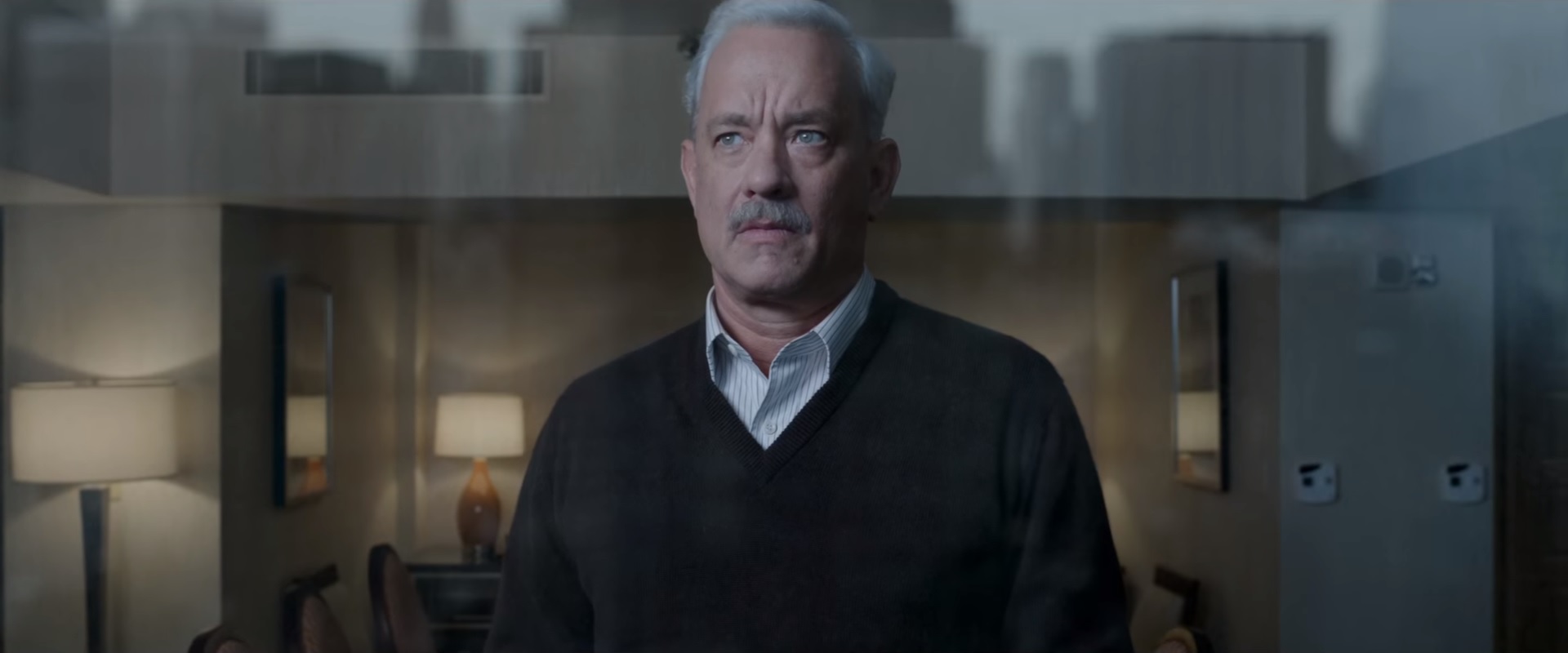
Carrying a true American icon both in front of the camera and behind it, Sully lands with a smooth craftsmanship as fitting as it is inevitable.
In January of 2009, Captain Chesley Sullenberger pulled off the Miracle on the Hudson, landing a commercial jet on the Hudson River after dual engine failure, saving the lives of all 155 souls on board. Based on Sullenberger’s own memoir, this tale of American heroism in the face of extreme circumstance probably had Clint Eastwood’s name on the director’s chair before the Captain even finished his book.
And really, who else is more suited for the helm of a vessel in peril than Tom Hanks?
Eastwood and screenwriter Todd Komarnicki rightly anchor the film with the miraculous landing, while highlighting the human drama of a conflicted hero and the lives that hung in the balance during 208 fateful seconds. We get a subtle overview of Sully’s four decades of flight experience, nicely balanced with glimpses into the lives of his passengers and the seemingly random events that brought them all together.
It’s a strange thing for an actor to reach the level Hanks has, where he is universally regarded as such a treasure that his startling performance three years ago in Captain Philips became some sort of jarring reminder that, oh yeah, he’s good. This title role bears obvious similarities, but Hanks is able to illustrate the differences with easy grace. From Sully’s nagging self-doubt, to a determined defense of his choice to bypass nearby runways, to the stifling effects of sudden fame, Hanks carves out layers that are unique and deeply felt.
Eastwood builds the tension quietly, maintaining a consistent tone of understatement that makes the spectacle of the water landing all the more breathtaking (and worth the extra dough for IMAX). Kudos, too, for the almost Rashoman-style approach to framing the tragedy, and the respectful acknowledgment to the painful memories rekindled by the image of a crippled plane in NYC.
Not every scene embraces subtlety and not every line finds its mark, but Sully does, because it approaches the story precisely the way Sully himself seemed to approach his job. It’s a film that is modest, prepared and professional, with important moments that rise to the occasion.
The evil stepmother has been a source of fear and dread for eons. The Grimm brothers knew it – they disliked stepmothers as much as they disliked wolves. Horror has picked that same scab again and again over the years, but it’s not just that mom-substitute that you need to worry over. As we discover this week, stepdads – especially the heavily bearded, axe-wielding variety – are just as problematic.
5. The Stepfather (1987)
Years before Terry O’Quinn gained a following on Lost (or West Wing or Alias or Millennium), he crafted a memorable villain out of a weakly written toss-off of a horror flick, creating, in turn, a movie worth a second look.
With an idyllic suburb-turned-nightmare hellscape, the film opens like John Carpenter’s Halloween, the camera wading through the falling leaves and quiet street before stopping on the window of one particularly unpretentious little home. Inside, O’Quinn quickly and effectively establishes character. This is an actual character, not a cookie cutter psycho, and on the strength of his performance, this bloody confection of 80s family values works.
O’Quinn’s Jerry Blake marries into fatherless homes, ever seeking the perfect family. As soon as he sees the reality of familial bliss, he decides his family is a disappointment and slaughter ensues. As the film unspools, Jerry’s new brood, including Charlie’s Angel’s Shelley Hack, as well as Jill Schoelen, as her 16-year-old daughter, show signs of fatigue already.
Stepfather explores ideas of the exclusivity of the American dream and the inexplicable popularity of shaker knit sweaters. Mostly, though, it mines that same tension that worked so well for the Brothers Grimm: the fear inherent in taking on a step parent, in that they not only represent the finality of the loss of a beloved, but the possibility that the new household head to which you must submit will actually bring you danger.
https://www.youtube.com/watch?v=HZGHTP2dH10
4. Amityville Horror (1979)
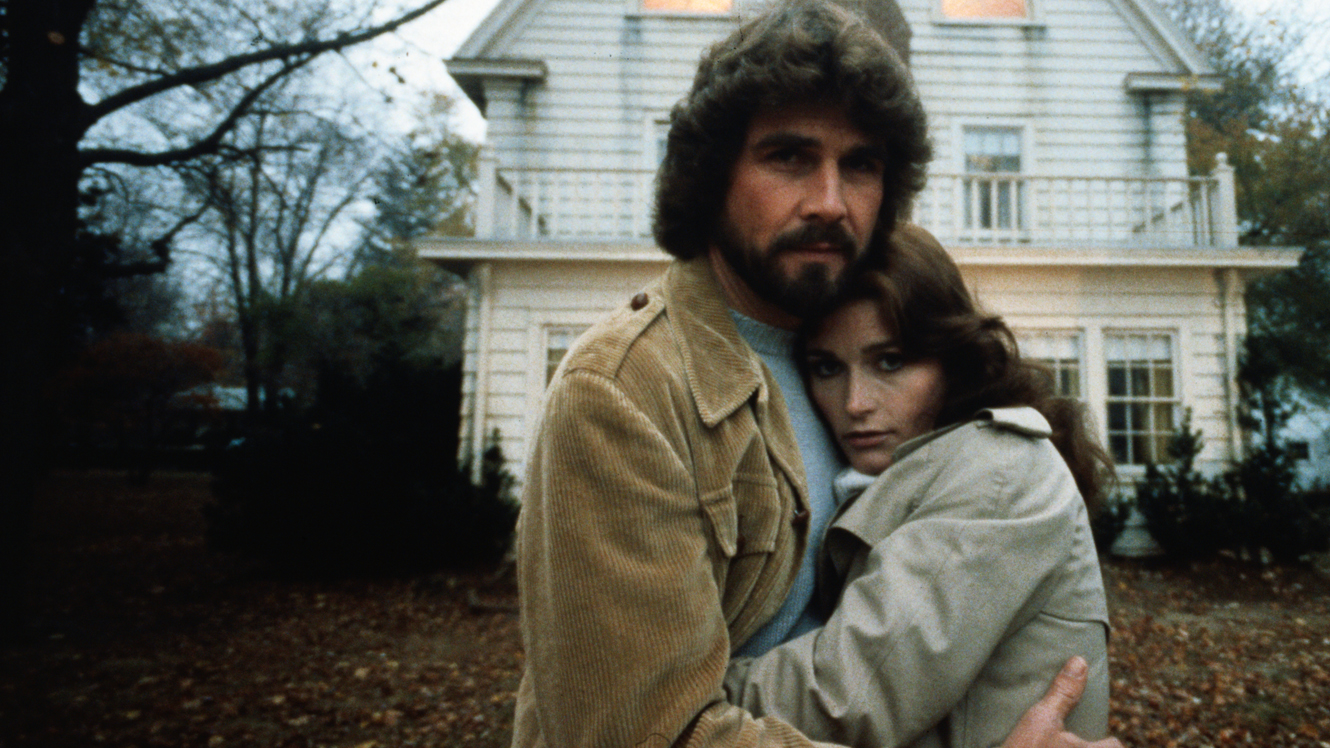
Back in the Seventies, Long Island residents Kathy and George Lutz caused quite a stir with their tale of a diabolical house that nearly killed their whole family. The cultural hysteria they stirred led to a bestselling book, at least ten feature films and a documentary. The most famous of the cinematic efforts was the 1979 flick, a picture that followed the Lutzes as they took one step inside 112 Ocean Avenue and screamed, “Oh my God, this wallpaper is hideous!”
But, the house was really cheap, what with the former tenants having all been slain by their oldest son/brother Ronald DeFeo, so the Lutzes turned a blind eye to the hideous décor and moved right in.
James Brolin and his hair star as George Lutz, newly married to Kathy (Margot Kidder), new father to her three kids, serious wood cutter. George goes a little nuts, and who can blame him? There is obviously not a single decent barber in all of Long Island, and he’s sunk his life savings into a lovely home that sits atop the gateway to hell. (Honestly, though I always thought Tiffin, Ohio was the gateway to hell, the actual gateway lies beneath Columbus, OH. It’s true. Look it up.)
The film seems like low-level exploitation for director Stuart Rosenberg (Cool Hand Luke), whose approach is more melodramatic than horrific. He rode the cultural hysteria to big box office, but his effort feels a little silly now. Maybe it’s the red-eyed pig out the window?
3. The Snowtown Murders (2011)
John Bunting tortured and killed eleven people during his spree in South Australia in the Nineties. We only watch it happen once on film, but that’s more than enough.
Director Justin Kurzel seems less interested in the lurid details of Bunting’s brutal violence than he is in the complicated and alarming nature of complicity. Ironically, this less-is-more approach may be why the movie leaves you so shaken.
An unflinching examination of a predator swimming among prey, Snowtown succeeds where many true crime films fail because of its understatement, its casual observational style, and its unsettling authenticity. More than anything, though, the film excels due to one astounding performance.
Daniel Henshall cuts an unimpressive figure on screen – a round-faced, smiling schlub. But he brings Bunting an amiability and confrontational fearlessness that provides insight into what draws people to a sadistic madman. There’s not a false note in his chilling turn, nor in the atmosphere Kurzel creates of a population aching for a man – any adult male to care for them, protect them and tell them what to do.
http://www.youtube.com/watch?v=qcoCTA2IZ7c
2. Tale of Two Sisters (2003)
A lurid Korean fairy tale of sorts – replete with dreamy cottage and evil stepmother – Jee-woon Kim’s Tale of Two Sisters is saturated with bold colors and family troubles.
A tight lipped father returns home with his daughter after her prolonged hospital stay. Her sister has missed her; her stepmother has not. Or so it all would seem, although jealousy, dream sequences, ghosts, a nonlinear timeframe, and confused identity keep you from ever fully articulating what is going on. The film takes on an unreliable point of view, subverting expectations and keeping the audience off balance. But that’s just one of the reasons it works.
The director’s use of space, the composition of his frame, the set decoration, and the disturbing and constant anxiety he creates about what’s just beyond the edge of the frame wrings tensions and heightens chills. The composite effect disturbs more then it horrifies, but it stays with you either way.
Tale masters the slow reveal, and the dinner party scene is a pivotal one for that reason. One of the great things about this picture is not the surprise about to be revealed – one you may have guessed by this point, but is nonetheless handled beautifully – but the fact that Tale has something else up its sleeve. And under its table.
1. Night of the Hunter (1955)
Robert F. Mitchum. This may be the coolest guy there ever was, with an air of nonchalance about him that made him magnetic onscreen. His world-wizened baritone and moseying way gave him the appearance of a man who knew everything, could do anything, but couldn’t care less. And perhaps his greatest role in definitely his best film is as serial killer/preacher Harry Powell in the classic Night of the Hunter.
The iconic film noir sees Mitchum as a con man who cashed in on lonely widows’ fortunes before knocking them off. He’s set his sights on Willa Harper (Shelley Winters), whose bank robber husband had been a cell mate before his execution.
What unravels is a gorgeously filmed, tremendously tense story of Depression-era terror as Powell seduces the widow and her entire town, but not her stubborn son. Many of the performances have that stilted, pre-Method tinge to them, but both Winters and Mitchum bring something more authentic and unseemly to their roles. The conflict in styles actually enhances an off-kilter feel director Charles Laughton emphasizes with over-the-top shadows and staging. It gives the whole film a nightmarish quality that, along with Mitchum’s unforgettable performance, makes Night of the Hunter among the best films of its era.
From the earliest horror films, physical disabilities have plagued characters. It’s the inherent vulnerability that makes the topic such a draw for the genre, but some films – like these five – defy your expectations.
5. Planet Terror
Losing a leg – in most horror movies, this would spell doom for a character. Not in Robert Rodriguez’s half of Grindhouse, though. Indeed, for Rose McGowan’s Cherry Baby, an amputated limb turns her to the film’s most daring badass.
A machine gun for a leg! How awesome is that?! McGowan strikes the right blend of hard knock and vulnerability to keep the character interesting – beyond the whole leg of death thing. I mean, you’d hardly call her boring.
The entire film is a whole lot of throw-back fun – gory, fun, lewd, funny, gross (so, so gross). It’s so much fun that even a lengthy Tarantino cameo doesn’t spoil things. And it makes the point that people who’ve been struck by physical disabilities can still be total badasses – not to mention hot as F.
4. Misery (1990)
Kathy Bates had been knocking around Hollywood for decades, but no one really knew who she was until she landed Misery. Her sadistic nurturer Annie Wilkes – rabid romance novel fan, part time nurse, full time wacko – ranks among the most memorable crazy ladies of modern cinema.
James Caan plays novelist Paul Sheldon, who kills off popular character Misery Chastain, then celebrates with a road trip that goes awry when he crashes his car, only to be saved by his brawniest and most fervent fan, Annie. Well, she’s more a fan of Misery Chastain’s than she is Paul Sheldon’s, and once she realizes what he’s done, she refuses to allow him out of her house until she brings Misery back to literary life.
Caan seethes, and you know there’s an ass kicking somewhere deep in his mangled body just waiting to get out. The film’s tension is generated by way of his utter helplessness as he’s trapped in that bed – on the road to recovery until…. Well, we assume you know the scene.
There is so much to be said for the sharp writing, the outstanding performances, and the way the film subverts your expectations of villains, women, men, and disability.
And mallets.
3. Don’t Breathe (2016)
Young thugs systematically robbing the few remaining upscale Detroit homeowners follow their alpha into a surefire hit: a blind man (Stephen Lang) sitting on $300k.
Unfortunately for our trio – Rocky (Evil Dead’s Jane Levy), Money (Daniel Zovatto) and Alex (Dylan Minnette) – this blind man is not the easy mark they’d predicted.
The always effective Lang cuts an impressive figure as the blind veteran with mad skills and crazy secrets. Wisely, director Fede Alvarez sidesteps easy categories. Though you may think you recognize each character as they first appear, no one is as easy to pigeonhole as you may think.
There are surprises enough to confound and amaze. You may think you have the old man’s secret figured out, but so do our hapless felons. Things get a little nuts as the tale rolls on, but thanks to the film’s breakneck pace and relentless tension, you’ll barely have time to breathe, let alone think.
2. The Texas Chainsaw Massacre (1974)
With this horror masterpiece, director Tobe Hooper sidestepped all the horror gimmicks audiences had grown accustomed to – a spooky score that let you know when to grow tense, shadowy interiors that predicted oncoming scares – and instead shot guerilla-style in broad daylight, outdoors, with no score at all. You just couldn’t predict what was coming.
Hooper also cast aside any concerns for dignity or fair play, a theme best personified by wheelchair-bound Franklin. Franklin is supremely unlikeable – whiney and selfish – ending horror’s long history of using personal vulnerability to make a character more sympathetic. Films such as Wait Until Dark and What Ever Happened to Baby Jane? and Rear Window – excellent films, all – ratcheted up tension through the sympathy they could generate toward the helpless character. These films’ anxiety and payoff both owe everything to watching the vulnerable protagonist in danger, and waiting for them to overcome the odds.
But Hooper is after an entirely different kind of tension. He dashes your expectations, making you uncomfortable, as if you have no idea what you could be in for. As if, in watching this film, you yourself are in more danger than you’d predicted.
But not more danger than Franklin is in, because Franklin is not in for a good time.
http://www.youtube.com/watch?v=eY4ldz615FA
1. Freaks (1932)
Short and sweet, like most of its performers, Tod Browning’s controversial film Freaks is one of those movies you will never forget. Populated almost entirely by unusual actors – midgets, amputees, the physically deformed, and an honest to god set of conjoined twins (Daisy and Violet Hilton) – Freaks makes you wonder whether you should be watching it at all.
This, of course, is an underlying tension in most horror films, but with Freaks, it’s right up front. Is what Browning does with the film empathetic or exploitative, or both? And, of course, am I a bad person for watching this film?
Well, that’s not for us to say. We suspect you may be a bad person, perhaps even a serial killer. Or maybe that’s us. What we can tell you for sure is that the film is unsettling, and the final, rainy act of vengeance is truly creepy to watch.