What’s your pleasure? Loads and loads of new releases to peruse at home this week. There’s one powerful cowboy movie and a whole slew of badass women. Let us help you sort it out.
One utterly amazing film and a bunch of not-so-terrible to talk through this week in the Screening Room. We love Eighth Grade! We also talk about Christopher Robin, The Darkest Minds and The Spy Who Dumped Me before turning our attention to what’s worth the effort in home entertainment. Listen in!
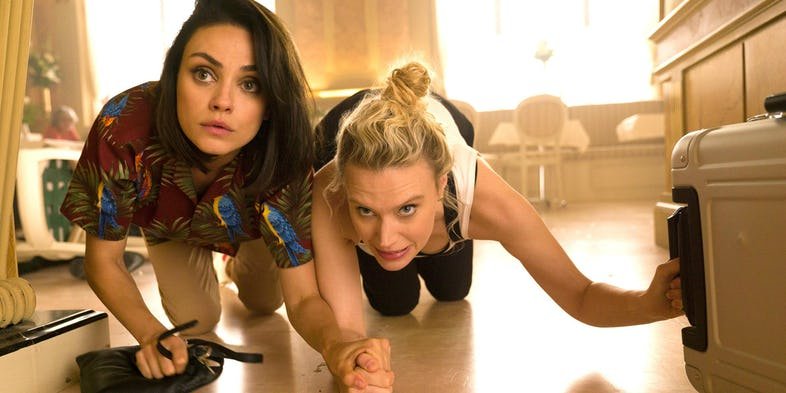
As late summer comedies go, we’ve done worse than The Spy Who Dumped Me. And like so many secret agents with a “particular set of skills,” this film has one.
It’s name is Kate McKinnon.
That’s not to throw shade on Mila Kunis, who flashes fine comic timing in the straight woman role, giving McKinnon plenty of space to do that thing she does. Be weird and funny and sometimes hilarious.
McKinnon is Morgan and Kunis plays Audrey, her longtime best friend who just got “text dumped” by boyfriend Drew (Justin Theroux). Just as the girls are setting fire to the stuff Drew left at Audrey’s place, they find out he was a spy, and that “2nd Place Fantasy Football” trophy of his is valuable enough to get them killed.
Director/co-writer Susanna Fogel cooks up the usual elements for a spy spoof, with amusing hijinx, scattershot action, globe-trotting locales, and a little touch of raunch to earn that R rating.
There’s also a couple quirky side characters (like the agent who keeps reminding everyone he went to Harvard) and some familiar faces (Jane Curtin, Paul Reiser, Gillian Anderson).
But Fogel’s MVP is McKinnon, and it’s pretty clear she knows it. McKinnon may not get a script credit, but it isn’t hard to imagine some of the pages saying little more than “have Kate do something funny.”
And she does, particularly skillful enough to make The Spy Who Dumped Me a goofy, enjoyable time-waster.
The idea felt funny to us, as well. The film has raked in buckets of cash and gotten enthusiastic high fives from most audiences.
But there’s a relatively small, yet very committed band of naysayers, eager to point out that so much of the film fails basic tests of logic.
Hey, you like what you like and nobody’s a bad person for dissing A Quiet Place, but MaddWolf Court is in session to consider the accusations.
1. “I can’t believe they let themselves get pregnant!”
When have people ever stopped fucking?
2. The nail.
So much gnashing of teeth about the nail! Much has already been written about it, and we agree with the most common defenses: these exposed nails have happened in the history of building things, removing it could be loud, and most importantly, the nail is there to mess with you.
We’d say it worked.
3. The dad is a dick.
Unlikeable characters can be okay, ambitious even.
4. You can’t step on a twig but you can scream in a basement.
The soundproofed basement? The one they soundproof through the entire film in preparation for the coming of the baby? The one that gets flooded and you realize how utterly screwed the mom is going to be now?
5. Why didn’t they just build their house by the waterfall?
Houses are hard and noisy to build, or move. The ground near a waterfall is probably not that stable. Lumber is hard to transport when you can’t start your car for fear of slaughter.
6. Everything else the parents do
This movie is about an invasion of the Giant Ear Monsters, and people are upset because the characters don’t follow the universally accepted playbook for dealing with GEMs?
It reminds us of the horrifically realistic film Compliance, which got much finger-wagging from viewers upset with characters acting so unrealistically under pressure.
“No way they would do that, I wouldn’t have done that!” Well, congrats, but the real-life case history says people did exactly that.
Point being: you may think you know just what’s appropriate when the GEMs come, but you don’t. You’re overthinking, just enjoy the taut, well-executed ride.
And in closing, we propose that the chorus of voices eager to prove themselves smarter than A Quiet Place is actually a testament to how intelligent the film really is. It entertains us, scares us, and it also challenges us, which can be uncomfortable.
But countless nubile young women, making idiotic choice after illogical choice, on their way to a braless slaughter? Who cares? Classic slasher!
It’s also curious why the one line in the film that invites a closer inspection seems to be overlooked.
“Who are we if we can’t protect them?”
As a timely, tense metaphor for parenting in an increasingly terrifying and uncertain world, we think A Quiet Place…..nails it.
What’s new in home entertainment? Charlize Theron reminds us that she’s not just an ass kicker in another wonderful performance. Also, somebody remade Overboard. Huh.
When we first started this podcast, one hundred thirtysomething episodes ago, we devoted specific shows to the best horror movies by the decade. We started with the Sixties, but we got called on that at one point by a listener who wanted to know what we thought were the best horror movies of the Fifties.
We have finally responded to that (hopefully) very patient listener, and enlisted the help of our old friend Phantom Dark Dave. Together, we wander through the cold war movies that scared a generation.
5. Godzilla (1954)
Is Godzilla the best film on this list? No. But, more than any other film in the genre, it spoke directly to global anxieties, became a phenomenal success, and changed the face of horror.
As Japan struggled to re-emerge from the 1945 bombings of Hiroshima and Nagasaki, director Ishiro Honda unleashed that dreaded kaiju—followed quickly by a tidal wave of creature features focused on scientists whose ungodly work creates global cataclysm.
Far more pointed and insightful than its American bastardization or any of the sequels or reboots to follow, the 1954 Japanese original mirrored the desperate, helpless impotence of a global population in the face of very real, apocalyptic danger. Sure, that danger breathed fire and came in a rubber suit, but history shows again and again how nature points out the folly of man.
4. Invasion of the Body Snatchers (1956)
Director Dono Siegel was the first filmmaker to bring Jack Finney’s Cold War nightmare to the screen. He wouldn’t be the last, maybe not even the best, but what he did with this eerie alien tale tapped into a societal anxiety and quickly became one of the most influential and terrifying films of its time.
Doc Miles Bennell (Kevin McCarthy) is just home from a short trip when he’s inundated by patients swearing their loved ones are not their loved ones at all. Sure, they look the same and have all the same skills and memories, but there’s no warmth, no passion.
With this, the fear that our very nation could be overtaken by an outside force – Russians, say, for terrifyingly immediate sake of argument – working its way through not by force, but by quietly taking over each and every person in one town, then spreading from town to town to town.
It’s the kind of insidious evil that fuels contagion horror, infestation horror, even demonic horror. But Invasion of the Body Snatchers spoke to a society’s deepest fears and became a touchstone for all SciFi to follow it.
3. Dracula (Horror of Dracula) (1958)
In 1958, Hammer Films began its long and fabulous love affair with the cloaked one, introducing the irrefutably awesome Christopher Lee as the Count.
Their tale varies a bit from Stoker’s, but the main players are mostly accounted for. Peter Cushing steps in early and often as Van Helsing, bringing his inimitable brand of prissy kick-ass, but it’s Lee who carries the film.
Six foot 5 and sporting that elegant yet sinister baritone, Lee cuts by far the most intimidating figure of the lot as Dracula. Director Terence Fisher (what?!) uses that to the film’s advantage by developing a far more vicious, brutal vampire than what we’d seen previously.
Still, the film is about seduction, though, which gives Lee’s brute force an unseemly thrill. Unlike so many victims in other vampire tales, it’s not just that Melissa Stribling’s Mina is helpless to stop Dracula’s penetration. She’s in league. She wants it.
Ribald stuff for 1958!
2. The Bad Seed (1956)
The minute delicate Christine’s (Nancy Kelly) husband leaves for his 4-week assignment in DC, their way-too-perfect daughter begins to betray some scary behavior. The creepy handyman Leroy (Henry Jones) has her figured out – he knows she’s not as perfect as she pretends.
You may be tempted to abandon the film in its first reel, feeling as if you know where the it’s going. You’ll be right, but there are two big reasons to stick it out. One is that Bad Seed did it first, and did it well, considering the conservative cinematic limitations of the Fifties.
Second, because director Mervyn LeRoy’s approach – not a single vile act appears onscreen – gives the picture an air of restraint and dignity while employing the perversity of individual imaginations to ramp up the creepiness.
Enough can’t be said about Patty McCormack. There’s surprising nuance in her manipulations, and the Oscar-nominated 9-year-old handles the role with both grace and menace.
1. Diabolique (1955)
Pierre Boileau’s novel was such hot property that even Alfred Hitchcock pined to make it into a film. But Henri-Georges Clouzot got hold if it first. His psychological thriller with horror-ific undertones is crafty, spooky, jumpy and wonderful.
And it wouldn’t work if it weren’t for the weirdly lived-in relationship among Nicole (Simone Signoret) – a hard-edged boarding school teacher – and the married couple that runs the school. Christina (Vera Clouzot) is a fragile heiress; her husband Michel (Paul Meurisse) is the abusive, blowhard school headmaster. Michel and Nicole are sleeping together, Christine knows, both women are friends, both realize he’s a bastard. Wonder if there’s something they can do about it.
What unravels is a mystery with a supernatural flavor that never fails to surprise and entrance. All the performances are wonderful, the black and white cinematography creates a spectral atmosphere, and that bathtub scene can still make you jump.
Welcome to the Big Action Broadcast, where we do our own stunts and talk Mission Impossible: Fallout, Teen Titans Go! to the Movies, Blindspotting and Don’t Worry, He Won’t Get Far on Foot. We also cover what’s new in home entertainment and take a quick peek at what’s in store for next week.
A film with plenty of things to say and plenty of ways to say them, the biggest knock against Blindspotting might be timing.
It comes on the heels of Sorry to Bother You, sharing some of the same social concerns and brash exuberance, but sometimes wearing its message like an overly heavy coat.
The ambitious script is a promising debut for writers Daveed Diggs and Rafael Casal, who also star. Diggs (Tony and Grammy Award-winner for Broadway’s Hamilton) plays Colin and Casal (in his first feature) is Miles, two longtime buddies in Oakland working for a neighborhood moving company.
After a stint in county jail, Colin has three days left on his year-long probation, and is desperate not to F it up while hopeful he can maybe get back together with Val (Janina Gavankar). Just when it seems the hot-headed, unpredictable Miles will be Colin’s biggest threat to independence, fate comes calling.
Colin becomes the one eyewitness to a fatal police shooting, which forces him to re-evaluate everything, and everyone, in the life he wants to start over.
Director Carlos Lopez Estrada is also helming his first feature, and this rookie filmmaking trio finds a tighter bullseye than STBU‘s takedown of capitalism itself. Focusing on its two main characters and their longtime home, Blindspotting fires some sharply effective arrows toward police brutality, gentrification, racism, stereotypes and rap.
The director’s tone is sometimes a struggle, moving from stoner comedy a la Jay and Silent Bob to heavy drama and back again, and Estrada’s hand on a few of those dramatic moments can get heavy.
But by the time Diggs unveils the film’s soul in a showstopping, rage-filled finale, Blindspotting reaches a memorable height, becoming both an urgent social comment and an exciting filmmaking debut.
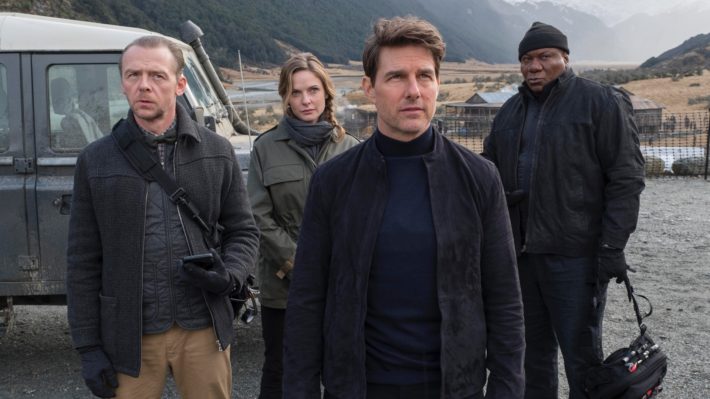
Tom Cruise’s next mission – and he’ll most likely accept it – is to try and outdo the stunts he pulls in this latest Mission: Impossible entry. Good luck with that, because Fallout delivers the GD mail.
It’s an action film that hits on nearly every cylinder, thrilling enough to elevate the value of the other five films in the franchise.
Writer/director Christopher McQuarrie (a frequent Cruise collaborator) returns from 2015’s MI: Rogue Nation, leaning on that solid foundation while he ups every ante, delivering not only his most impressive work as a director, but his most complete screenplay since The Usual Suspects.
Cruise’s Ethan Hunt draws the ire of his IMF boss (Alec Baldwin) and his boss’s boss (Angela Bassett) by choosing the lives of his team (Ving Rhames, Simon Pegg) over a stash of rogue plutonium. To keep that payload from the highest bidder, they have no choice but to accept help from agent August Walker (Henry Cavill and the ‘stache that ate DC), a “kill now-ask questions later” bruiser.
It can’t go unnoticed that Fallout marks the third blockbuster this year to feature a villain whose goals are more societal than financial.
Coincidence? Clearly no, but McQuarrie’s script keeps the social commentary smart, subtle and out of the way.
Familiar allies (Rebecca Ferguson’s Ilsa), old foes (Sean Harris as Solomon Lane) and new femme fatale “White Widow” (Vanessa Kirby) dot the landscape of double and triple crosses, with McQuarrie being careful not to overplay the genre elements.
Sly, self-aware references ground the film when it’s in danger of reveling in any Bond-ish excess, with plenty of well-placed surprises that, even when they’re not that surprising, help ease the bloat of a 2 and 1/2 hour running time.
But let’s not kid ourselves, that’s all just spy game gravy.
These stunts – from rooftop to mountaintop, crowded streets to midair and beyond – are showstoppers, with Cruise so electric a t-shirt proclaiming “movie star” would not be out of place under Hunt’s endless supply of tight black jackets.
Cruise’s insistence on doing these stunts himself got him a broken ankle, but there is plenty of gain for his pain. You cannot deny the added authenticity his stuntwork brings to these set pieces, with McQuarrie’s nimble camerawork and some luscious landscapes sealing the deal.
Say what you what about the summer movie season so far, Fallout is here to make you remember how breathlessly fun it can be.
Well, if you’ve made it through the bounty that the home entertainment gods bestowed upon us last week and you are looking for just one more movie, well, that’s exactly what you’ve got this week.