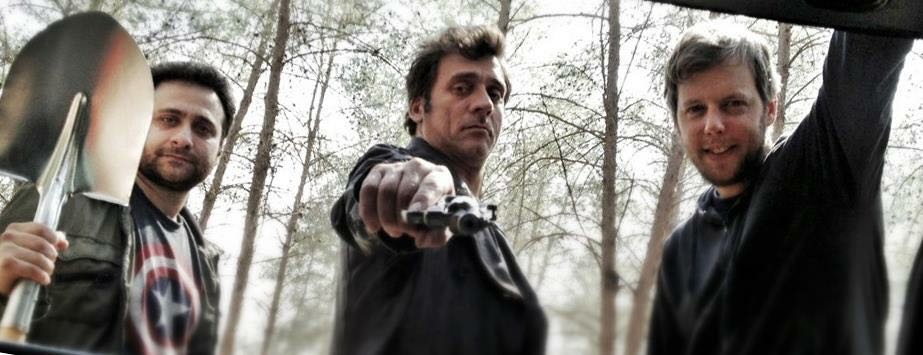
Jordan Peele loves horror movies. How cool is that?
It’s evident from the strangely terrifying opening moments of Us, when a little girl watches what is probably MTV from her suburban couch, the screen flanked by stacks of VHS tapes including C.H.U.D., and you’re pulled in to an eventful birthday celebration for this quiet, wide-eyed and watchful little girl (Madison Curry).
From a Santa Cruz carnival to a hall of mirrors to a wall of rabbits in cages—setting each to its own insidious sound, whether the whistle of Itsy Bitsy Spider or Gregorian chanting— Peele draws on moods and images from horror’s collective unconscious and blends them into something hypnotic and almost primal.
Then he drops you 30 years later into the Wilson family truckster as they head off for summer vacation. The little girl from the amusement park, Adelaide (Lupita Nyong’o – beyond spectacular) is now a protective mom.
And that protective nature will be put to a very bloody test.
A family that looks just like hers – doppelgängers for husband Gabe (Wnston Duke), daughter Zora (Shahadi Wright Joseph), son Jason (Evan Alex) and Adelaide herself – invade the Wilson’s vacation home, forcing them to fight for their lives while they wonder what the F is going on.
Even as Peele lulls us with familiar surroundings and visual quotes from The Lost Boys,Jaws, then Funny Games, then The Strangers and Night of the Living Dead and beyond, Us is far more than a riff on some old favorites. A masterful storyteller, Peele weaves together these moments of inspiration not simply to homage greatness but to illustrate a larger, deeper nightmare. It’s as if Alice’s Adventures in Wonderland turned into a plague on humanity.
Loosely based on an old episode of Twilight Zone (which, not surprisingly, Peele is rebooting), Us is a tale full of tension and fright, told with precision and a moral center not as easily identifiable as Get Out‘s brilliant takedown of “post racial America.”
Do these evil twins represent the darkest parts of ourselves that we fight to keep hidden? The fragile nature of identity? “One nation” bitterly divided?
You could make a case for these and more, but when Peele unveils his coup de grace moment (which would make Rod Serling proud), it ultimately feels like an open-ended invitation to revisit and discuss, much like he undoubtedly did for so many genre classics.
While it’s fun to be scared stiff, scared smart is even better, a fact Jordan Peele has clearly known for years.
Songwriter Jim Steinman, best known for baroque and dramatically verbose musical epics often belted out by Meat Loaf, has said in interviews that he would love to write 3-minute pop toe tappers, he just doesn’t know how.
Filmmaker S. Craig Zahler can probably relate. Dragged Across Concrete is his third feature as writer/director, and he’s still clearly invested in the long game. Like Bone Tomahawk and Brawl in Cell Block 99, Zahler’s latest is full of strangely indelible characters and memorable dialogue, a film anchored in creeping dramatic dread that finally explodes with wonderfully staged brutality.
Brett (Mel Gibson) and Anthony (Vince Vaughn), street-smart cops in a fictional urban jungle called Bulwark, get popped when a bystander captures one overly zealous interrogation on video. A suspension without pay is something they’re forced to accept, but it isn’t long before Brett has a plan to make up for the lapse in funds with a little “proper compensation” on the side.
But of course, they’re not the only ones looking for a score.
Henry (a terrific Tory Kittles) is fresh out of the joint and needs money for his family. His old friend Biscuit (Michael Jai White) hooks them both up as drivers for a lethal bank robber (Thomas Kretschmann), and the long fuse to a standoff is lit.
This is Zahler’s slowest burn yet, but he keeps you invested with a firm commitment to character, no matter the screen time. From a new mother with near-crippling separation anxiety (Jennifer Carpenter) to a loquacious bank manager (Fred Melamed) and a shadowy favor-granter (Udo Kier), nothing in the film’s 159 minutes feels superfluous.
In fact, quite the opposite.
As Zahler contrasts the cops with the robbers, the sharply-defined supporters orbiting the core conflict only add to its gravity, despite a few moments than seem a bit too eager for Tarantino approval.
Gibson is fantastic, drawing Brett as the real bulwark here, defending what he feels is his with a savage, unapologetic tenacity. Vaughn, re-teaming with Zahler after a standout turn in Cell Block 99, again shows how good he can be when pushed beyond his default setting of “Vince Vaughn.”
Finally, the steady march of battered souls, desperate measures and eclectic soundtrack choices comes to a bloody, pulpy head, staged with precision and matter-of-fact collateral damage.
Zahler’s command of his playbook is hard to ignore. Though the glory of Concrete‘s payoff never quite rises to the breathtaking heights he’s hit before, his confident pace and detailed observations make for completely absorbing storytelling.
A couple of excellent options this week in home entertainment. The year’s best super hero movie expands its home release to DVD, and the strangely underappreciated Mary Poppins Returns comes home (so get that bedroom cleaned up!)
This week in the Screening Room we run through the many little movies that come out the week after Captain Marvel: Climax, Captive State, Five Feet Apart, Wonder Park, Birds of Passage, Ruben Brandt Collector plus everything new in home entertainment.
Haley Lu Richardson is a very talented young actress. Director Justin Baldoni seems to have very good intentions. Neither can save Five Feet Apart from crawling through the heap of Young Adult angst as the unholy love child of Nicholas Sparks and Lars von Trier.
Richardson is Stella, an optimistic cystic fibrosis patient who vlogs about her experiences with an encouraging smile. Hospitalized for a new drug trial, she meets fellow “CF’er” Will, a dreamboat with an attitude and a darker prognosis.
Fears of bacteria bring strict orders for Stella and Will to always remain at least six feet apart. But when love blooms…..
Stories of young forbidden love have been sprouting since the Capulets and Montagues, but the biggest surprise in Five Feet Apart is that it didn’t start as a YA novel. Screenwriters Mikki Daughtry and Tobias Iaconis wear the hats, here, working through as many formulaic and manipulative opportunities as possible.
Though many health care issues are conveniently skirted, some honest moments about the struggles of CF patients find a mark, thanks mainly to some warm chemistry between Richardson (Columbus, The Edge of Seventeen, Split) and Sprouse (Big Daddy, TV’s Riverdale). But as the overly orchestrated suffering continues to mount, the entire CF storyline starts smelling of the easiest path to teenage tears.
Baldoni, whose My Last Days web series benefits a variety of charities, may have his heart in the right place. And there is certainly talent in this cast, which Richardson leans on to deliver the line “Thank you for saying something real!” without a trace of irony.
But the boxes for plaintive music, closing narration, and the gay best friend are all checked. Plus, the life lessons that are dictated to us because that’s easier than building a story that resonates strongly enough to let us realize things on our own. So much YA drama is anchored by this cheap enlightenment, and there is plenty here to wallow in.
So depending on your side of that fence, the bar may have been raised. Or lowered.
The Law figures heavily in horror films. Most of them depict crimes. Bloody, bloody crimes. So, in many cases, the authorities must be brought in. And there are some outstanding genre films depicting a law enforcement officer as hero—Jaws and Slither spring to mind. They are also villains as often as bumbling side characters (we’re looking at you Inside and Last House on the Left).
Today we want to celebrate the films that dive into the police work, that focus squarely on The Law and its investigators. And, again, bloody, bloody crimes.
6. Baskin (2015)
Welcome to hell! Turkish filmmaker Can Evrenol invites you to follow a 5-man police squad into the netherworld, where eye patches are all the rage, pregnancy lasts well under the traditional 40 weeks, and you don’t want to displease Daddy.
The serpentine sequencing of events evokes a dream logic that gives the film an inescapable atmosphere of dread, creepily underscored by its urgent synth score. Evrenol’s imagery is morbidly amazing. Much of it only glimpsed, most of it left unarticulated, but all of it becomes that much more disturbing for its lack of clarity.
The further along the squad gets, the more often you’ll look in horror at something off in a corner, that sneaking WTF? query developing along with your upset stomach.
The central figures in this nightmare are one eye-patch wearing helper who enjoys tossing his or her hair over one shoulder, and the breathtaking father figure played by Mehmet Cerrahoglu. There is no one quite like him.
Cerrahoglu’s remarkable presence authenticates the hellscape. Evrenol’s imaginative set design and wise lighting choices envelope Cerrahoglu, his writhing followers, and his victims in a bloody horror like little else in cinema.
5. Se7en
Serpentine and dark as the sin it depicts, David Fincher’s Se7en marked him as a director willing to work your subconscious and take you to unseemly places. The film compares the strict and merciless justice of an old school God with the rotting corpse of NYC police work as two homicide detectives – one a grizzled veteran (Morgan Freeman), one a hot headed rookie (Brad Pitt) – try to keep up.
Fincher shrouds the mystery in some of the most memorably horrific images set to film. Who can forget that first victim, facedown in his spaghetti? How about Lust? “Get it off me! Get it off me!”
Let’s not even discuss Sloth. Still trying to recover from that, and the film came out in 1995.
Great performances and sleight of hand keep the story itself breathless as you work toward the now legendary climax.
What’s in the box?!!!
4. The Wailing
“Why are you troubled,” Jesus asked, “and why do doubts arise in your hearts? Look at my hands and my feet. It is I myself. Touch me and see — for a spirit does not have flesh and bones, as you see I have.”
Though the true meaning of this quote won’t take hold until the final act, it presents many questions. Is this film supernatural? Demonic? Or, given the corporeal nature of the quote, is it rooted in the human flesh?
Yes.
That’s what makes the quote so perfect. Writer/director Hong-jin Na meshes everything together in this bucolic horror where superstition and religion blend. The film echoes with misery, as the title suggests. The filmmaker throws every grisly thing at you – zombies, pustules, demonic possession, police procedural, multiple homicides – and yet keeps it all slippery with overt comedy.
3. I Saw the Devil (2010)
Min-sik Choi (Oldboy) plays a predator who picks on the wrong guy’s fiancé.
That grieving fiancé is a police investigator played by Byung-hun Lee (The Magnificent Seven), whose restrained emotion and elegant good looks perfectly offset Choi’s disheveled explosion of sadistic rage, and we spend 2+ hours witnessing their wildly gruesome game of cat and mouse.
Director Jee-woon Kim (A Tale of Two Sisters) breathes new life into the serial killer formula. With the help of two strong leads, he upends the old “if I want to catch evil, I must become evil” cliché. What they’ve created is a percussively violent horror show that transcends its gory content to tell a fascinating, if repellant, tale.
Beneath the grisly violence of this unwholesome bloodletting is an undercurrent of honest human pathos – not just sadism, but sadness, anger, and the most weirdly dark humor.
If you can see past the outrageously violent images onscreen, you might notice some really fine acting and nimble storytelling lurking inside this bloodbath.
2. Big Bad Wolves (2013)
A mixture of disturbing fairy tale and ugly reality, Israel’s Big Bad Wolves takes you places you really don’t want to go, but damn if it doesn’t keep you mesmerized every minute.
The particularly vulgar slaughter of several little girls sets events in motion. One teacher is suspected. One cop is driven. One father suffers from grief-stricken mania. It’s going to get really ugly.
Filmmakers Aharon Keshales and Navot Papushado (Rabies) implicate everyone, audience included. They create intentional parallels among the three men, pointing to the hypocrisy of the chase and making accusations all around of a taste for the intoxicating bloodlust that comes from dominating a weaker person.
Their taut and twisty script keeps surprises coming, but it’s the humor that’s most unexpected. Handled with dark, dry grace by Lior Ashkenazi (the cop) and Tzahi Grad (the father) – not to mention Doval’e Glickman (the grandfather) – this script elicits shamefaced but magnetic interest. You cannot look away, even when the blowtorch comes out. And God help you, it’s hard not to laugh now and again.
1. The Silence of the Lambs (1991)
It’s to director Jonathan Demme’s credit that Silence made that leap from lurid exploitation to art. His masterful composition of muted colors and tense but understated score, his visual focus on the characters rather than their actions, and his subtle but powerful use of camera elevate this story above its exploitative trappings. Of course, the performances didn’t hurt.
Hannibal Lecter ranks as one of cinema’s scariest villains, and that accomplishment owes everything to Anthony Hopkins’s performance. It’s his eerie calm, his measured speaking, his superior grin that give Lecter power. Everything about his performance reminds the viewer that this man is smarter than you and he’ll use that for dangerous ends.
Demme makes sure it’s Lecter that gets under our skin in the way he creates a parallel between Lecter and FBI investigator Clarice Starling (Jodie Foster). It’s Clarice we’re all meant to identify with, and yet Demme suggests that she and Lecter share some similarities, which means that maybe we share some, too.
For a while, anyway, but if that’s all you’re expecting from Climax, you don’t know your Noe.
2015’s Love showed the boundary pusher’s tender side via some graphic 3D porn. But now writer/director Noe is back in sensory-pummeling mode, pulling from his usual playbook for a balls-out psychedelic bacchanal soaked in body fluids, drugs and EDM.
After a mysterious opening mix of bloody snow angels and claims of “true events,” Noe showcases audition interviews for a French dance troupe before jumping ahead to the group’s transfixing final rehearsal.
Selva (Sofia Boutella) and the crew are ready for the show, so now it’s time to let off some steam as only they can. DJ Daddy (Kiddy Smile), drop some beats!
Noe’s usual reliance on extended takes, stationary cameras and overhead shots makes the dance sequences utterly intoxicating, the performers’ energy creating exciting visual beauty and a palpable exuberance for their art. These seductive odes to dance are interspersed with sometimes graphically sexual conversations between the dancers, sharpening character edges and laying down an interpersonal framework that will soon be turned on its head.
“What is wrong with you all?”
In what seems like an instant, suspicion, mob rule and primal desire overtakes the company. The dancers’ movements become monstrosities bathed in pulsating rhythms, visual disorientation, wanton violence and illicit sex.
What spurred this sea change, and who is to blame? Noe turns that mystery into a greater conversation about the opportunity of birth, the impossibility of life and the extraordinary experience of death, and as is his wont, batters your senses while doing it.
He is also again wearing his heart on his screen, with a stacked movie collection directly calling out influences from Possession to Suspiria. But Climax is unforgettably a Noe vision, one of his most concise, streamlined and clearly inspired.
It is 97 minutes of can’t-look-away intensity, a bold experience that may leave you asking “what just happened?” while you look for a nice place to lie down.
Not just a smash-and-grab hack, either, but the leader of four notoriously slippery bandits specializing in priceless works of art. All are patients of psychotherapist Ruben Brandt (voiced by Ivan Kamaris), and each offers their talents in his time of need.
Ruben is suffering from violent nightmares inspired by legendary works of art from masters such as Manet and Hopper. Ruben comes to believe possessing these works is his only hope for relief, and his thieving patients believe they can help with that.
As the art world is shaken by the brazen thefts, the identity of the ringleader dubbed “The Collector” remains a mystery.
In his feature debut, writer/director Milorad Krstic displays a wonderful eye and a frisky wit, filling his film with the familiar fun of a big screen heist, unexpectedly winning soundtrack choices and a rich, textured animation style worthy of the high art setting.
The caper itself is a wry, understated hoot, with intellectual asides to subliminal psychology and plenty of homages to iconic artworks. But, as only seems fitting, the constantly engaging animation is the true centerpiece here.
From the shadows that follow a thief along his clandestine wall climb, to the uneasy confines of a van struggling to navigate some dangerous curves, Krstic’s animation fills nearly every scene with rewards for close inspection, and a promise of more frivolity to any willing accomplices.
Like a pop-up book full of highbrow surprises, Ruben Brandt, Collector is never less than delightful.
Man, remember the boon of movies released for home viewing last week?! Well, don’t get greedy, I guess. This week contains a fun little psycho-sexual thriller plus two bloated SciFi blunders. Here is the skinny.
Big week in theaters and crowded week in home entertainment. In this week’s Screening Room we talk (spoiler free!) about Captain Marvel, Apollo 11, The Hole in the Ground and I’m Not Here. Then we hit the lobby to give you a sense of what’s worth your while in home video.