Tag Archives: Fright Club

Fright Club: Amusements in Horror

A perversion of childhood innocence in an attempt to create anxiety and fear—that, basically, is the definition of carnivals, circuses, theme parks. Maybe that’s why the amusement park and its inhabitants make for such excellent horror movie fodder. Let’s discuss.

5. Zombieland (2009)

Writers Rhett Reese and Paul Wernick (Deadpool) take the tried-and-true zombiepocalypse premise and sprint with it in totally new and awesome directions. An insane cast helps: Woody Harrelson, Jesse Eisenberg, Emma Stone, Abigail Breslin, Bill Murray. That’s eight Oscar nominations and one win, that’s what that is. Plus, I cannot imagine a better cameo in a film than Murray’s in this one.

I give you, a trip to a loud and well-lit amusement park is not a recommendation Max Brooks would make during the zombiepocalypse. Still, you’ve got to admit it’s a gloriously filmed piece of action horror cinema.

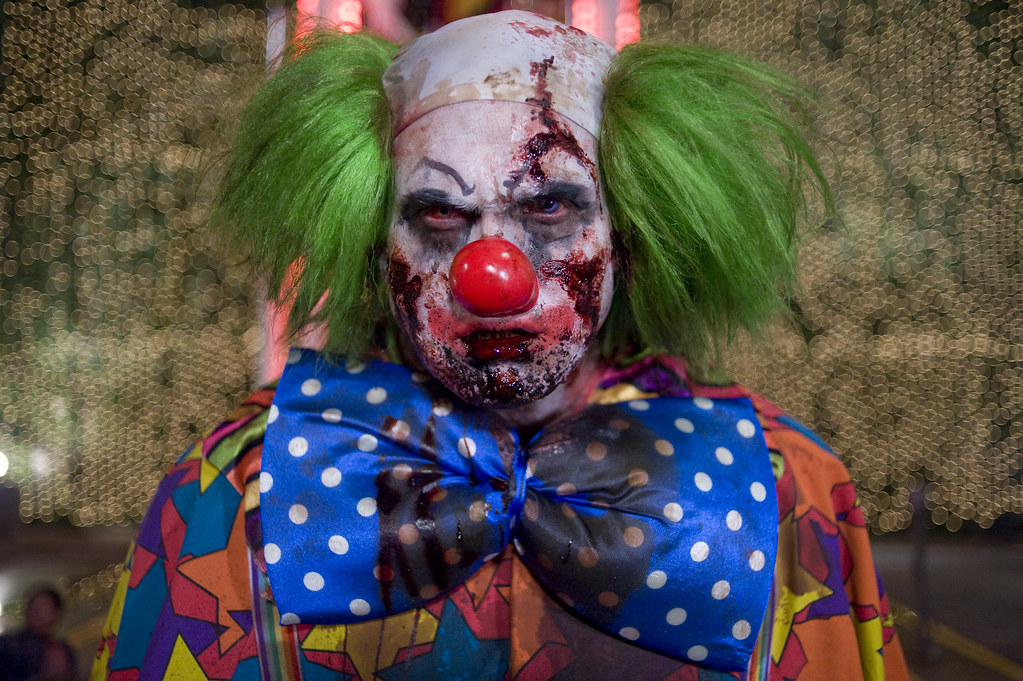
Between the sisters trapped on a ride slowly lowering them toward hungry mouths (good thinking on those boots, ladies!), Columbus’s rule breaking heroism with that effing clown, and the all-time great Tallahassee shoot out, director Ruben Fleischer directs the hell out of the amusement park portion of this movie.

4. It (2017)

Clowns are fun, aren’t they?

The basic premise of It is this: Little kids are afraid of everything, and that’s just good thinking.

Bill Skarsgård has the unenviable task of following a letter-perfect Tim Curry in the role of Pennywise. Those are some big clown shoes to fill, but Skarsgård is up to the challenge. His Pennywise is more theatrical, more of an exploitation of all that’s inherently macabre and grotesque about clowns.

Is he better than the original? Let’s not get nutty here, but he is great.

Director Andy Muschietti shows great instinct for taking advantage of foreground, background and sound. Yes, It relies heavily on jump scares, but Muschietti’s approach to plumbing your fear has more depth than that and he manages your rising terror expertly.

3. The Last Circus (2010)

Who’s in the mood for something weird?

Unhinged Spanish filmmaker Alex de la Iglesia returns to form with The Last Circus, a breathtakingly bizarre look at a Big Top love triangle set in Franco’s Spain.

Describing the story in much detail would risk giving away too many of the astonishing images. A boy loses his performer father to conscription in Spain’s civil war, and decades later, with Franco’s reign’s end in sight, he follows in pop’s clown-sized footsteps and joins the circus. There he falls for another clown’s woman, and stuff gets nutty.

Like Tarantino, Igelsia pulls together ideas and images from across cinema and blends them into something uniquely his own, crafting a film that’s somewhat familiar, but never, ever predictable.

The Last Circus boasts more than brilliantly wrong-minded direction and stunningly macabre imagery – though of these things it certainly boasts. Within that bloody and perverse chaos are some of the more touching performances to be found onscreen.

2. Us (2019)

From a Santa Cruz carnival to a hall of mirrors to a wall of rabbits in cages, writer/director Jordan Peele draws on moods and images from horror’s collective unconscious and blends them into something hypnotic and almost primal.

But Us is far more than a riff on some old favorites. It’s as if Alice’s Adventures in Wonderland turned into a plague on humanity.

And it all starts innocently enough with a family outing to the carnival—an environment that has always been a perversion of innocence, a macabre funhouse mirror of the playthings and past times of children. Peele takes advantage, using this stage to create an even wilder and more bewildering look at who we are.

1. Freaks (1932)

Short and sweet, like most of its performers, Tod Browning’s controversial film Freaks is one of those movies you will never forget. Populated almost entirely by unusual actors – midgets, amputees, the physically deformed, and an honest to god set of conjoined twins (Daisy and Violet Hilton) – Freaks makes you wonder whether you should be watching it at all.

This, of course, is an underlying tension in most horror films, but with Freaks, it’s right up front. Is what Browning does with the film empathetic or exploitative, or both? And, of course, am I a bad person for watching this film?

Well, that’s not for us to say. We suspect you may be a bad person, perhaps even a serial killer. Or maybe that’s us. What we can tell you for sure is that the film is unsettling, and the final, rainy act of vengeance is truly creepy to watch.

Logo Gear

We’ve had a few people ask where we got our sweet logo gear, so in case you were interested, we get it at www.logoup.com. And now they’ve set up special MaddWolf custom pages so you can stay frightful more often!

For the MaddWolf logo, CLICK HERE

For the Fright Club dark logo (black embroidery for light colored stuff) CLICK HERE

For the Fright Club alternate logo (white embroidery for dark colored stuff), CLICK HERE

Thanks!!

Fright Club: Gas Stations in Horror

You think the price of gas will kill you! What about those creepy gas attendants?

Gas stations, for one reason or another, have become a staple in horror films – especially slashers and those backwoods thrillers. Jenny Raya of Dave’s Pop Culture Podcast joins us to count down the films that make the most of the spooky service station.

5. Tucker and Dale Versus Evil (2010)

Because Eli Craig’s comedic upending of the hillbilly horror sub-genre is nearly perfect, there had to be a pivotal scene set in a gas station.

Two backwoods buddies (an endearing Tyler Labine and Alan Tudyk) head to their mountain cabin for a weekend of fishing. En route they meet some college kids on their own camping adventure. A comedy of errors, misunderstandings and subsequent, escalating violence follows as the kids misinterpret every move Tucker and Dale make.

In the tradition of Shaun of the Dead, T&DVE lovingly sends up a familiar subgenre with insightful, self-referential humor, upending expectations by taking the point of view of the presumably villainous hicks. And it happens to be hilarious.

4. Splinter (2008)

Road kill, a carjacking, an abandoned gas station, some quills – it doesn’t take much for first time feature filmmaker and longtime visual effects master Toby Wilkins to get under your skin. One cute couple just kind of wants to camp in Oklahoma’s ancient forest (which can never be a good idea, really). Too bad a couple of ne’er-do-wells needs their car. Then a flat (what was that – a porcupine? No!!) sends them to that creepy gas station, and all hell breaks loose.

Contamination gymnastics call to mind the great John Carpenter flick The Thing, but Splinteris its own animal. Characters have depth and arcs, the danger is palpable, the kills pretty amazing, and the overall aesthetic of that old highway gives everything a desperately lonesome quality where you believe anything could happen and no rescue is in sight.

3. The Hills Have Eyes (1977)

Wes Craven’s original Hills – cheaply made and poorly acted – is a surprisingly memorable, and even more surprisingly alarming flick. Craven’s early career is marked by a contempt for both characters and audience, and his first two horror films ignored taboos, mistreating everyone on screen and in the theater. In the style of Deliverance meets Mad MaxHills was an exercise in pushing the envelope, and it owes what lasting popularity it has to its shocking violence and Michael Berryman’s nightmarish mug.

The nightmare begins (and for a lot of people, ends) at Fred’s Oasis – the last gas station before hitting an unforgiving stretch of desert.

The Hills Have Eyes is not for the squeamish. People are raped, burned alive, eaten alive, eaten dead, and generally ill-treated. You can’t say Fred didn’t warn them.

2. Deliverance (1972)

Nine notes on a banjo have never sounded so creepy.

Deliverance follows four buddies staving off mid-life crises with a canoeing adventure in southern Georgia, where a man’s not afraid to admire another man’s mouth.

They stop off, as travelers must, at a service station. No one warns them, no one delivers ominous news, but come on, no one had to. One look at the locals spending their days at that gas station should have been enough to convince them to turn back.

James Dickey streamlined his own novel to its atmospheric best, and director John Boorman plays on urbanite fears like few have done since. Dickey and Boorman mean to tell you that progress has created a soft bellied breed of man unable to survive without the comforts of a modern age.

https://www.youtube.com/watch?v=gsC4kf6x_Q0&t=128s

1. The Texas Chain Saw Massacre (1974)

Who wants barbeque?

Jim Siedow’s under-appreciated performance as de facto patriarch begins at Last Chance Gas.

First is the classic “you don’t want to go there” warnings, a long tradition in backwoods and slasher horror. But Hooper has something fun up his sleeve with this one, introducing Siedow as a likable weirdo, a concerned older Southern gentleman.

So when Sally Hardesty makes it away from the carnage all the way back to the service station, the tension, betrayal and sadism that follows feels that much more awful and unseemly.

Plus they had bought barbeque earlier! Eeeewww!

https://www.youtube.com/watch?v=ID77MV6g8dc

Fright Club: Missing Persons

There is something primally terrifying in the idea of missing persons – losing someone or being lost. Where are they and what is happening to them? No mater which side of that question you are on, the imagination conjures terrifying images.

Listen to the full podcast, including a special interview with Hounds of Love director Ben Young.

5. The Poughkeepsie Tapes (2007)

John Erick Dowdle’s film is a difficult one to watch. It contains enough elements of found footage to achieve realism, enough police procedural to provide structure, and enough grim imagination to give you nightmares.

Edward Carver (Ben Messmer) is a particularly theatrical serial killer, and the film, which takes you into the police academy classroom, asks you to watch his evolution from impetuous brute to unerring craftsman. This evolution we witness mainly through a library of videotapes he’s left behind—along with poor Cheryl Dempsey (Stacy Chbosky)—for the police to find.

Cheryl is Carver’s masterpiece, the one victim he did not kill but instead reformed as his protégé. It’s easily the most unsettling element in a film that manages to shake you without really showing you anything.

4. Berlin Syndrome (2017)

Aussie photographer Clare (Teresa Palmer, better than she’s ever been) is looking for some life experience. She backpacks across Europe, landing for a brief stay in Berlin where she hopes to make a human connection. Handsome Berliner Andi (Max Riemelt) offers exactly the kind of mysterious allure she wants and they fall into a night of passion.

What follows is an incredible combination of horror and emotional dysfunction, deftly maneuvered by both cast mates and director Cate Shortland. The mental and emotional olympics Palmer goes through from the beginning of the film to the end showcase her instincts for nuanced and unsentimental performance. Clare is smart, but emotionally open and free with her own vulnerability. The way Palmer inhabits these characteristics is as authentic as it is awkward.

Even more uncomfortable is the shifting relationship, the neediness and resilience, the dependency and independence. It’s honest in a way that is profoundly moving and endlessly uncomfortable. Riemelt matches Palmer’s vulnerability with his own insecurity and emotional about-faces. The two together are an unnerving onscreen pairing.

3. The Vanishing (Spoorloos) (1988)

Back in ’88, filmmaker George Sluizer and novelist Tim Krabbe adapted his novel about curiosity killing a cat. The result is a spare, grim mystery that works the nerves.

An unnervingly convincing Bernar-Pierre Donnadieu takes us through the steps, the embarrassing trial and error, of executing on his plan. His Raymond is a simple person, really, and one fully aware of who he is: a psychopath and a claustrophobe.

Three years ago, Raymond abducted Saskia (Johanna ter Steege) and her boyfriend Rex (Gene Bervoets) has gone a bit mad with the the mystery of what happened to her. So mad, in fact, that when Raymond offers to clue him in as long as he’s willing to suffer the same fate, Rex bites. Do not make the mistake of watching Sluizer’s neutered 1993 American remake.

https://www.youtube.com/watch?v=fcA10H-85×4&t=36s

2. The Blair Witch Project (1999)

Blair Witch may not date especially well, but it scared the hell out of a lot of people back in the day. This is the kind of forest adventure that I assume happens all the time: you go in, but no matter how you try to get out – follow a stream, use a map, follow the stars – you just keep crossing the same goddamn log.

One of several truly genius ideas behind Blair Witch is that filmmakers Daniel Myrick and Eduardo Sanchez made the audience believe that the film they were watching was nothing more than the unearthed footage left behind by three disappeared young people. Between that and the wise use of online marketing (then in its infancy) buoyed this minimalistic, naturalistic home movie about three bickering buddies who venture into the Maryland woods to document the urban legend of The Blair Witch. Twig dolls, late night noises, jumpy cameras, unknown actors and not much else blended into an honestly frightening flick that played upon primal fears.

1. Hounds of Love (2018)

Driven by a fiercely invested and touchingly deranged performance from Emma Booth, Hounds of Love makes a subtle shift from horrific torture tale to psychological character study. In 108 grueling minutes, writer/director Ben Young’s feature debut marks him as a filmmaker with confident vision and exciting potential.

It is the late 1980s in Perth, Australia, and at least one young girl has already gone missing when the grounded Vicki (Ashleigh Cummings) sneaks out her bedroom window to attend a party. This isn’t nearly as dumb a move as is accepting a ride from Evie White (Booth) and her husband John (Stephen Curry).

As the couple dance seductively and drink to celebrate, Young disturbingly conveys the weight of Vicki’s panicked realization that she is now their captive. It is just one in a series of moments where Young flexes impressive chops for visual storytelling, utilizing slo-motion, freeze frame, patient panning shots and carefully chosen soundtrack music to set the mood and advance the dreadful narrative without a spoken word.

Fright Club: Body Fluids in Horror Movies

Viscosity! That’s the name of the game today, and it’s a messy, messy game to play.

Today we slip and slide through the sloppiest movies we could find as we count down the most inspired use of body fluids in horror. The whole mess is recorded live at Gateway Film Center, so please listen.

And don’t forget to bring a towel!

5) Don’t Breathe (2016)

Fede Alvarez’s magnificent home invasion horror made this list, beating out the projectile vomit of The Exorcist, the melting bums of Street Trash, the medical what-not of Re-Animator and the viscosity of other films. How did it do it? It was not because of volume.

It’s really just the one scene.

The one with a turkey baster.

The one with the single hair.

Ew.

4) Dead Alive (1992)

The list doesn’t exist without Peter Jackson, let’s be honest. Any old horror director can work with blood. Jackson certainly can. That party scene? The arterial spray poor Lionel Cosgrove causes with his lawnmower is truly a site to behold.

But what Jackson can do with pus and a bowl of custard? Chef’s kiss right there.

3) We Are the Flesh (2016)

Emiliano Rocha Minter loves him some taboos. No one bursts through taboos like him – well, Takashi Miike, maybe.

He also really loves body fluids. We mean all the body fluids. His 2016 social commentary swims them all. All all all.

Taboos and body fluids. Sloppy!

2) Evil Dead (2013)

Peter Jackson’s Dead Alive held the record for most blood in a film – 1000 gallons – until 2013.

It’s a record Sam Raimi’s earlier Evil Dead franchise efforts had once held, but Fede Alvarez (making his second appearance on this list!) drenched all records when he poured out 50,000 gallons of fake blood in a single scene.

Allegedly It Chapter 2 tops that, but I don’t know how you out-soak a torrential downpour of blood.

Gozu (2003)

Who’s not afraid of taboos? Well, the great and prolific Takashi Miike has no fear of body fluids, either. Hell, Ichi the Killer’s title screen is done in semen and one of Audition’s most memorable moments sees a multiple amputee eating his mistress’s vomit.

But with Gozu, Miike’s not holding back: blood, urine, semen, lactation, pus and other discharges I’m not sure how to even categorize. Gozu is an inspired, viscous mess.

https://www.youtube.com/watch?v=4YD7Tz36wyo

Ghouls

The Dead Don’t Die

by Hope Madden

Indie god and native Ohioan Jim Jarmusch made a zombie movie.

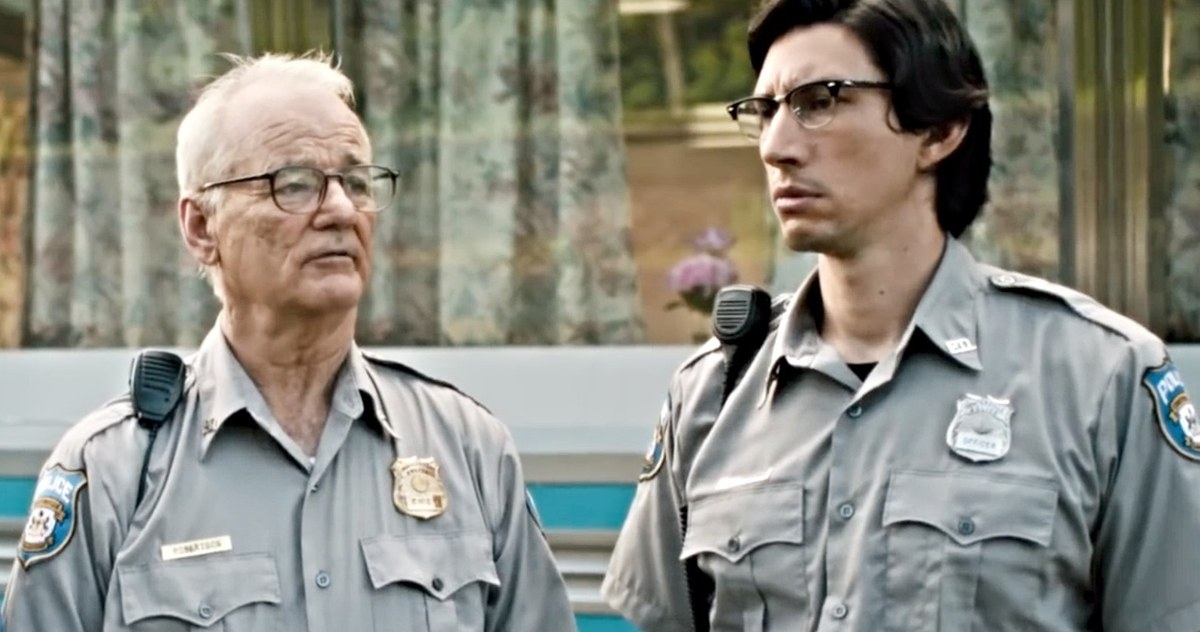
If you don’t know the filmmaker (Down by Law, Ghost Dog, Only Lovers Left Alive, Paterson and so many more jewels), you might only have noticed this cast and wondered what would have drawn Bill Murray, Adam Driver, Tilda Swinton, Chloe Sevigny, Steve Buscemi, Rosie Perez, RZA, Caleb Landry Jones, Danny Glover, Tom Waits, Iggy Pop and Selena Gomez to a zombie movie.

It’s because Jim Jarmusch made it.

Jarmusch is an auteur of peculiar vision, and his latest, The Dead Don’t Die, with its insanely magnificent cast and its remarkably marketable concept, is the first ever in his nearly 30 years behind the camera to receive a national release.

Not everybody is going to love it, but it will attain cult status faster than any other Jarmusch film, and that’s saying something.

He sets his zombie epidemic in Centerville, Pennsylvania (Romero territory). It’s a small town with just a trio of local police, a gas station/comic book store, one motel (run by Larry Fassenden, first-time Jarmusch actor, longtime horror staple), one diner, and one funeral home, the Ever After.

Newscaster Posie Juarez (Rosie Perez – nice!) informs of the unusual animal behavior, discusses the “polar fracking” issue that’s sent the earth off its rotation, and notes that the recent deaths appear to be caused by a wild animal. Maybe multiple wild animals.

The film never loses its deadpan humor or its sleepy, small town pace, which is one of its greatest charms. Another is the string of in-jokes that horror fans will revisit with countless re-viewings.

But let’s be honest, the cast is the thing. Murray and Driver’s onscreen chemistry is a joy. In fact, Murray’s onscreen chemistry with everyone—Sevigny, Swinton, Glover, even Carol Kane, who’s dead the entire film—delivers the tender heart of the movie.

Driver out-deadpans everyone in the film with comedic delivery I honestly did not know he could muster. Landry Jones also shines, as does The Tilda. (Why can’t she be in every movie?)

And as the film moseys toward its finale, which Driver’s Officer Ronnie Paterson believes won’t end well, you realize this is probably not the hardest Jim Jarmusch and crew have ever worked. Not that the revelation diminishes the fun one iota.

Though it’s tempting to see this narrative as some kind of metaphor for our current global political dystopia, in fairness, it’s more of a mildly cynical love letter to horror and populist entertainment.

Mainly, it’s a low-key laugh riot, an in-joke that feels inclusive and the most quotable movie of the year.

Fright Club: Gateway to Hell Horror

Our friend is looking to buy her first home and our only advice was probably the same advice she got from everyone: check the basement for the gateway to hell. That always causes trouble for new homebuyers, doesn’t it?

Indeed, these netherworld exits and entrances don’t exist only in suburban basements. Nope, you can find them anywhere. In fact, you can even create your own. No idea why you would want to do that, but (assuming horror films are how-tos), it can be done. Which are the best gateway to hell horror movies, you ask? Luckily, we’ve done the math.

5. The Ninth Gate (1999)

A bunch of films nearly had this fifth slot: Amityville 3D (mainly so we could make fun of Laurie Laughlin), The Gate and its Harryhausen influences, Event Horizon’s blackhole to hell. But we landed on The Ninth Gate because we love Frank Langella and Lena Olin.

Johnny Depp plays a sleazy rare books dealer in Roman Polanski’s adaptation of Arturo Perez-Reverte’s novel. Depp’s Dean Corso falls into a mysterious adventure of finding and appraising three volumes allegedly co-authored by Satan himself (or herself?).

Maybe the element of this film that makes it more interesting than it might be is that, while the humans longing for the knowledge in these volumes are terrible people, the film doesn’t seem to find Satanism (the real worship of an actual Satan, not today’s activism branch) a potentially worthwhile activity. Satan (Emmanuelle Seigner, Polanski’s wife) is also an interesting character—in concept, anyway.

Plus, black masses! Love those!

4. The Beyond (1981)

Lucio Fulci was really preoccupied with the gateway to hell. He produced an entirely worthwhile trilogy on the topic. And while City of the Living Dead and House by the Cemetery have their charms (well, for one of us), The Beyond is by far the most entertaining of the three.

As is always the case in Fulci films, the dubbing is half the fun, here unintentionally aiding in the overall surreal quality of the picture. Liza Merrill (Catriona MacColl, who stars as different characters in each of the three Gateway films) has inherited an old Louisiana hotel from her dead uncle.

Guess what’s in the basement?!

Silly, gory as hell, hypnotic and oh-so-Fulci, The Beyond is a dreamy peek into hell. The clashing accents and lack of logic only strengthen the vibe.

3. Insidious (2010)

Yes, technically this one takes place in “The Further” – but we don’t buy that this creepy red guy plays organ in limbo or purgatory. We’re going with hell.

Director James Wan and writer (and co-star) Leigh Whannell launched a second franchise with this clever, creepy, star-studded flick about a haunted family.

Patrick Wilson (who would become a Wan/Whannell staple) and Rose Byrne anchor the film as a married couple dealing with the peculiar coma-like state affecting their son, not to mention the weird noises affecting their house.

But what makes this particular film so effective is that we get to go into The Further to reclaim the lost soul. It’s a risky move, but these filmmakers do what few are able to: they show us what we are afraid of.

2. The Sentinel (1977)

Journeyman writer/director Michael Winner helmed this weird little gem about a damaged young woman and her journey toward the only destiny that can save her.

It starts, as these things so often to, with the search for a new place to live. New York model Alison (Cristina Raines) is offered an incredibly great rate for a gorgeous NY brownstone apartment.

Is it the gateway to hell? Yes, but NY real estate being what it is, she takes it.

Look at this cast: Burgess Meredith, John Carradine, Christopher Walken, Ava Gardner, Jerry Orbach, Jose Ferrer, Beverly D’Angelo and Chris Sarandon, mainly playing the various and fascinating demons hoping to throw poor, fragile Alison off her path.

Meredith in particular is a magnificent Satan.

1. Baskin (2015)

Welcome to hell! Turkish filmmaker Can Evrenol invites you to follow a 5-man police squad into the netherworld, where eye patches are all the rage, pregnancy lasts well under the traditional 40 weeks, and you don’t want to displease Daddy.

The serpentine sequencing of events evokes a dream logic that gives the film an inescapable atmosphere of dread, creepily underscored by its urgent synth score. Evrenol’s imagery is morbidly amazing. Much of it only glimpsed, most of it left unarticulated, but all of it becomes that much more disturbing for its lack of clarity.

As is always the case, the real kicker is the Satan character. Here, central figure Mehmet  Cerrahoglu’s remarkable presence authenticates the hellscape. Evrenol’s imaginative set design and wise lighting choices envelope Cerrahoglu, his writhing followers, and his victims in a bloody horror like little else in cinema.

Fright Club: Sea Beasts

Why fear the sea? The same reason to see menace in the deep, dark unknown of space or the dense and dizzying claustrophobia of the forest: because it’s really hard to see what’s in there.

That leaves us to our imagination, and when is that ever a good idea? Here, then, are some of the most imaginative ways horror filmmakers terrorized us with tales of what lies beneath.

5. Godzilla (Gojira) (1954)

Up from the depths, 30 stories high, breathing fire…you know the rest. Surely we had to have a Fifties science run amok beastie on this list, and while there was some stiff competition, nothing really bests Godzilla.

As Japan struggled to re-emerge from the 1945 bombings of Hiroshima and Nagasaki, director Ishiro Honda unleashed that dreaded kaiju—followed quickly by a tidal wave of creature features focused on scientists whose ungodly work creates global cataclysm.

Far more pointed and insightful than its American bastardization or any of the sequels or reboots to follow, the 1954 Japanese original mirrored the desperate, helpless impotence of a global population in the face of very real, apocalyptic danger. Sure, that danger breathed fire and came in a rubber suit, but history shows again and again how nature points out the folly of man.

4. Open Water (2003)

Jaws wasn’t cinema’s only powerful shark horror. In 2003, young filmmaker Chris Kentis’s first foray into terror is unerringly realistic and, therefore, deeply disturbing.

From the true events that inspired it to one unreasonably recognizable married couple, from superbly accurate dialog to actual sharks, Open Water’s greatest strength is its unsettling authenticity. Every element benefits from Chris Kentis’s control of the project. Writer, director, cinematographer and editor, Kentis clarifies his conception for this relentless film, and it is devastating.

A couple on vacation (Blanchard Ryan and Daniel Travis) books a trip on a crowded, touristy scuba boat. Once in the water, they swim off on their own – they’re really a little too accomplished to hang with the tourists. And then, when they emerge from the depths, they realize the boat is gone. It’s just empty water in every direction.

Now, sharks aren’t an immediate threat, right? I mean, tourist scuba boats don’t just drop you off in shark infested waters. But the longer you drift, the later it gets, who knows what will happen?

https://www.youtube.com/watch?v=F4fxtHQtt4Y

3. The Lure (2015)

Here’s a great Eastern European take on reimagined Eastern European fairy tales, like Norway’s Thale (2012) and Czech Republic’s Little Otik (2000).

Gold (Michalina Olszanska) and Silver (Marta Mazurek) are not your typical movie mermaids, and director Agnieszka Smoczynska’s feature debut The Lure is not your typical – well, anything.

The musical fable offers a vivid mix of fairy tale, socio-political commentary, whimsy and throat tearing. But it’s not as ill-fitting a combination as you might think.

The Little Mermaid is actually a heartbreaking story. Not Disney’s crustacean song-stravaganza, but Hans Christian Andersen’s bleak meditation on the catastrophic consequences of sacrificing who you are for someone undeserving. It’s a cautionary tale for young girls, really, and Lure writer Robert Bolesto remains true to that theme.

The biggest differences between Bolesto’s story and Andersen’s: 80s synth pop, striptease and teeth. At its heart, The Lure is a story about Poland – its self-determination and identity in the Eighties. That’s where Andersen’s work is so poignantly fitting.

https://www.youtube.com/watch?v=vxhi_3hDUPE

2. The Host (2006)

Visionary director Joon-ho Bong’s film opens in a military lab hospital in 2000. A clearly insane American doctor, repulsed by the dust coating formaldehyde bottles, orders a Korean subordinate to empty it all into the sink. Soon the contents of hundreds of bottles of formaldehyde find its way through the Korean sewer system and into the Han River. This event – allegedly based on fact – eventually leads, not surprisingly, to some pretty gamey drinking water. And also a 25 foot cross between Alien and a giant squid.

Said monster – let’s call him Steve Buscemi (the beast’s actual on-set nickname) – exits the river one bright afternoon in 2006 to run amuck in a very impressive outdoor-chaos-and-bloodshed scene. A dimwitted foodstand clerk witnesses his daughter’s abduction by the beast, and the stage is set.

What follows, rather than a military attack on a marauding Steve Buscemi, is actually one small, unhappy, bickering family’s quest to find and save the little girl. Their journey takes them to poorly organized quarantines, botched security check points, misguided military/Red Cross posts, and through Seoul’s sewer system, all leading to a climactic battle even more impressive than the earlier scene of afternoon chaos.

1. Jaws (1975)

What else – honestly?

Twentysomething Steven Spielberg’s game-changer boasts many things, among them one of the greatest threesomes in cinematic history. The interplay among the grizzled and possibly insane sea captain Quint (Robert Shaw), the wealthy young upstart marine biologist Hooper (Richard Dreyfuss) and the decent lawman/endearing everyman Brody (Roy Scheider) helps the film transcend horror to become simply a great movie.

Perhaps the first summer blockbuster, Jaws inspired the desire to be scared silly. And in doing so it outgrossed all other movies of its time. You couldn’t deny you were seeing something amazing – no clichés, all adventure and thrills and shocking confidence from a young director announcing himself as a presence.

Spielberg achieved one of those rare cinematic feats: he bettered the source material. Though Peter Benchley’s nautical novel attracted droves of fans, Spielberg streamlined the text and surpassed its climax to craft a sleek terror tale.

It’s John Williams’s iconic score; it’s Bill Butler’s camera, capturing all the majesty and the terror, but never too much of the shark; it’s Spielberg’s cinematic eye. The film’s second pivotal threesome works, together with very fine performances, to mine for a primal terror of the unknown, of the natural order of predator and prey.

Jaws is the high water mark for animal terror. Likely it always will be.

Fright Club: Lesbians in Horror Movies

Lesbians in horror have come a long way since Jesus DeFranco’s bloodthirsty nymphettes. In fact, we are now at the glorious point in history in which story leads can be lesbians for no particular reason—their sexual orientation not a metaphor for anything at all. They’re just characters. Nice!

There are so many great options that we had to leave many off. What were we looking for? Main characters whose sexuality is not showcased simply for titillation or as a twisted mark of the sinister. That doesn’t mean we’ve abandoned the villain, but if you’re looking for hot girl-on-girl action, well, yes, we have a bit of that, too, but who wouldn’t make out with Catherine Deneuve?

5. The Hunger (1983)

Director Tony Scott’s seductive vampire love story has a little bit of everything: slaughter, girl-on-girl action, ’80s synth/goth tunage, David Bowie. What more can you ask?

Actually the film’s kind of a sultry, dreamily erotic mess. Oh, the gauzy curtains. Catharine Deneuve is the old world vampire Miriam Blaylock—an inarguably awesome name for a vampire. David Bowie is her lover. But he suddenly begins aging, and she needs to find a replacement. Enter Susan Sarandon and her mullet as a medical specialist in unusual blood diseases and a fine actress who’s not above smooching other girls.

There are three reasons people will always watch this film: Bowie, Catherine Deneuve’s seduction of Susan Sarandon (classy!), and the great dark-wave Bauhaus number Bela Lugosi’s Dead. Together it’s a Goth Trifecta! And Goths do love them some vampires.

4. Thelma (2017)

We follow Thelma (Eili Harboe) through the uncomfortable, lonely first weeks of college we gather that her parents are very Christian and very protective.

Things could have gone all predictable and preachy from there, but co-writer/director Joachim Trier knows what you’re thinking and he plans to use it against you.

Thelma is a coming-of-age film at its cold, dark heart. The horror here lies in the destructive nature of trying to be something you are not, but here again, nothing in Thelma is as simple or cleanly cut as the beautiful framing and crystal clear camera work suggest.

Like Julia Ducournau’s magnificent coming-of-age horror Raw, Thelma dives into the issues swirling around post-adolescent freedoms and taboos in daring and insightful ways.

Thelma takes its time and lets its lead unveil a fully realized, deeply complex character full of contradictions—inconsistencies that make more sense as the mystery unravels. Though the result never terrifies, it offers an unsettling vision of self-discovery that’s simultaneously familiar and unique.

3. The Haunting (1963)

This may not seem like an obvious choice, but Theo (Claire Bloom) is a lesbian. And a great, badass character at that. That may not have been a widely held opinion when the great Shirley Jackson penned the novel in the fifties, or when the great Robert Wise directed the spooky and wonderful adaptation in 1963. But Mike Flanagan, director of the Netflix series based on the book, understood Jackson’s nuance and Wise’s subtlety and decided Theo would be out and proud. Good on ya, Flanagan.

In Wise’s original work, there is no overt mention of Theo’s sexuality, but there wouldn’t be, would there? It was 1963. Theodora is unmarried but refers to an “us” when discussing her home life. Her style, her confidence, her disinterest in being demure with the males, and the fact that Eleanor refers to her as “unnatural” all quietly make the case for us.

What’s great, though, is not just that a lead character is a lesbian, but that she’s a powerful and positive presence, and that she and Eleanor form a deep and supportive friendship. The Haunting (and Jackson’s magnificent novel) is about identity, and the fact that Theo is so very comfortable with hers is what makes this film an important addition to the list.

2. The Handmaiden (2016)

Director Park Chan-wook (Oldboy) mesmerizes again with this seductive story of a plot to defraud a Japanese heiress in the 1930s.

Weird is an excellent word to describe this film. Gorgeous and twisty with criss-crossing loyalties and deceptions, all filmed with such stunning elegance. Set in Korea, the film follows a young domestic in a sumptuous Japanese household. She’s to look after the beautiful heiress, a woman whose uncle is as perverse and creepy as he is wealthy.

Smart and wicked, stylish and full of wonderful twists, The Handmaiden is a masterwork of delicious indulgence.

1. Daughters of Darkness (1971)

Seduction, homoeroticism, drowsy lustfulness – this one has it all.

Countess Bathory—history’s female version of Dracula—checks into an all-but-abandoned seaside hotel. The only other guests, besides the Countess’s lover, Ilona (Andrea Rau), is a honeymooning couple.

Effortlessly aristocratic, Delphine Seyrig brings a tender coyness, a sadness to the infamous role of Bathory. Seyrig’s performance lends the villain a tragic loveliness that makes her the most endearing figure in the film. Everybody else feels mildly unpleasant, a sinister bunch who seem to be hiding things. The husband (John Karlen), in particular, is a suspicious figure, and a bit peculiar. Kind of a dick, really— and Bathory, for one, has no time for dicks.

Caring less for the victims than for the predator—not because she’s innocent or good, but because her weary elegance makes her seem vulnerable—gives the film a nice added dimension.

The accents are absurd. The outfits are glorious. The performances are compellingly, perversely good, and the shots are gorgeous. Indulge yourself.

https://www.youtube.com/watch?v=sFRuSbykaV0


Finished with Final Girls

by Hope Madden

I am done with the final girl.

You know why? Because it’s a diminishing title.

Laurie Strode, Ellen Ripley and Sidney Prescott were not final girls. They were heroes.

Laurie Strode, Ellen Ripley and Sidney Prescott were the point of view characters for their films, not random females we were surprised to see survive. Had any of these three perished, that would have been the surprise.

The phrase “final girl” suggests that, from a smorgasbord of victims, one female emerges victorious. How does she do it?

1. She is smarter than the rest and outwits the killer.
2. She is more virtuous than the rest, so fate is on her side.
3. She endures pain, grief, terror and hardship and comes out the other side a stronger person.

If those are not the steps in a hero’s quest, I don’t know what are. (No, seriously, I don’t know what the steps are in a hero’s quest. I should probably have looked it up, but still, I feel confident they’re similar.)

The characteristics of the final girl are simply the characteristics of the hero, and her perspective is the audience’s perspective.

She’s the lead.

To disregard this and assume that this would-be victim didn’t die because she holds in her bosom certain character traits is to actually belittle the character. John McClane outwitted terrorists, showed integrity and grit, and endured a ton of hardship in his bare feet. Is he not the hero?

What about Schwarzenegger in Predator? Not a lot of dudes made it out the other side of that one – does that make Arnold the Final Boy?

And how about Captain America? Smart, virtuous, endurance – hell, he’s probably even a virgin.

Are you here to tell me The Cap is not a hero?

So what’s the difference? Why label the badass who sends Pinhead back to hell nothing more than the last girl onscreen? Why does’t she get to be the hero? Hasn’t she proven herself? I’d like to see you try your luck with Pinhead.

I’m overgeneralizing, you think. Are there heroes who do not carry with them these vital characteristics, you wonder.

No. Those damaged, dangerous and layered leads are anti-heroes. Someday when the slutty Goth girl with a heroin jones is the last one standing, then the slasher will finally have its anti-hero. But for now, Jason and Pinhead and Leatherface and Michael Myers and all of them are undone by the hero.

Of course.