Tag Archives: film

Girl, You’ll Be a Woman Soon

The Worst Person in the World

by George Wolf

The older you get, four years can pass in what seems like a whirlwind weekend. But to a twentysomething like Julie (Renate Reinsve), that same slice of life can end up being monumental in shaping the course of her life.

For The Worst Person in the World (Verdens verste menneske), Norwegian writer/director Joachim Trier uses understated insight and a revelatory performance from Reinsve to effectively fuse coming-of-age sensibilities with romantic drama. 

In that pivotal 4-year time span, we see Julie move through multiple career choices and two long-term relationships. Despite a 15 year age gap with established comic book artist Aksel (Anders Danielsen Lie), Julie moves in with him while adamantly proclaiming she doesn’t want children.

As the relationship begins to grow stale, Julie’s head is turned by the younger, more impulsive Eivind (Herbert Nordrum), who is also in a committed relationship.

Choices will be made and harsh realities will be dealt, all in a poignant, surprisingly funny and quietly engrossing package that strikes a fine balance between finding romance and finding yourself.

Even when Julie is at her most selfish, naive or indecisive, Reinsve makes sure she’s always sympathetic and, above all, relatable. Her performance delivers a wonderfully layered reminder that most of us surely recognize this road Julie is traveling.

As one woman navigates what she wants in a career, in a relationship, and ultimately what she wants out of life, Trier and Reinsve craft small, indelible moments that bind together for a refreshingly honest look at how, as John Lennon once said, life happens when you’re busy making other plans.

Forever Is a Long Time

Jackass Forever

by George Wolf

Jackass.

Forever.

How does that hit you? Like a promise, or a threat?

Your answer is really all you’ll need to decide whether this sixth big screen installment of the Jackass franchise is for you.

After opening with a fairly inspired monster movie spoof that features a penis, Johnny Knoxville, his crew (Steve-O, Wee Man, Chris, Jeff, etc.) and celebrity guests (Machine Gun Kelly, Eric Andre, Tony Hawk) settle into what they do best: a parade of pranks, stunts, and hidden camera gags that also frequently involve the male nether regions and/or bodily fluids from both man and beast.

And oh, yes, some of their antics go straight to the funny bone.

One of the best, entitled Silence of the Lambs, throws some dudes into a pitch dark room with a venomous snake while giving us the Buffalo-Bill-with-heat-vision-goggle-eye view of how they react.

Hey is that a naked guy tucking his sack back? Maybe.

Other segments, like Knoxville adopting his Bad Grandpa makeup to check out a big sale on furniture, seem to wrap up just when you want them to amp up. The hits and the misses keep coming, equally likely to leave you laughing, wincing, or checking your watch.

But you can’t deny the bonds of friendship are still strong among these idiots, and after twenty-some odd years of insanity, a distinct whiff of sentimentality is in the air.

Or maybe that’s the dump someone just took in a store showroom. Hard to tell.

Altar Noise

Confesssion

by George Wolf

These pandemic times have given us plenty of films with small casts and minimal settings. But add in the overly talky nature of Confession, and you’ve got a film that must have been inspired by a play, right?

Actually, no, which makes its construction that much more curious.

Writer/director David Beton’s thriller plays out in real time, starting when the bleeding, gun toting Victor Strong (True Blood‘s Stephen Moyer) stumbles into Father Peter’s (Colm Meaney) church with some sins to absolve.

They talk, and we start to learn a little about what brought Victor to this desperate moment. His wife was murdered years earlier and now, before Victor’s own imminent death, he needs his 18 year-old daughter to be set free with the truth of his past.

But Victor is a hunted man, and soon Willow (Clare-Hope Ashitey from Children of Men) joins the congregation with her gun, her badge, and a very different side of the story.

So far, so pretty good, as Beton’s pace makes time feel precious and the performances set effective hooks for tension and mystery. But once things start unraveling…things start unraveling.

You’ve got two versions of the truth to sort out, plus some secrets that Father Pete’s been keeping. But instead of simple flashbacks or a more ambitious Roshomon-style of reveal, Beton is content to just tell us things.

While that approach can work (see last year’s Mass), it undercuts the very nature of a visual medium. And when some of the excessive dialog is both unlikely and unnecessary (like someone saying “Come on, come on!” into a ringing phone even though they’re hiding), it chips away at the strength of your coming payoff.

Beton eventually does add a couple new faces and a weak flash of action at the finale, but by then the tension built early on has been wasted. Much like a troubled mark facing dwindling options and a ticking clock, Confession just ends up saying too much.

The Story of My Life

Flee

by George Wolf

Like so many other headlines of numbing enormity that we regularly scroll past, stories of the worldwide refugee crisis rarely come with an intimacy that makes the stakes feel palpable. Flee brings an animated face to the discussion, using one man’s incredible story to re-frame the issue with soul-stirring humanity.

Director and co-writer Jonas Poher Rasmussen identifies the man as Amin Nawabi. Amin’s on the verge on marriage, a life change that seems to compel him to reveal the secrets of his life story for the very first time. Despite happy plans for the future, the fact that the name Amin Nawabi is a pseudonym comes as a bittersweet reminder of how the past continues to haunt this soul’s present.

Amin’s earliest memories are of his native Kabul in the early 1980s when the Mujahideen took charge in Afghanistan and the dangers began. Amin’s father was deemed a “threat” and arrested. While his older brother was able to escape the bloody battles with U.S. troops, Amin and the rest of his family begin years of attempts to flee the country.

But even under such a harrowing veil, Rasmussen finds a sweet innocence to propel Amin’s coming-of-age story. Bedroom posters of Jean-Claude Van Damme and Chuck Norris wink back at the young Amin, as his gentle adult voice recounts an ever-present realization that he was attracted to men, and that he had one more reason to always be on guard.

A successful cross into Russia only changes the specifics of oppression, leaving Amin under constant threat of discovery, deportation and corrupt police. (One incident where Amin manages to escape their greed leaves a lasting scar on him, and on us.)

The animated wartime recollections — punctuated with scattershot live action moments — do bring the Oscar-nominated Waltz with Bashir to mind, but Rasmussen may well have preferred a completely live action narrative if he did not have an identity to protect. Using Amin’s actual voice in their conversations adds startling depth to the reenacted memories, and as our childlike comfort with animated scenes clashes with the uncomfortable scenes depicted, Flee‘s bracing resonance only intensifies.

And after all that Amin endures, as the horrors in his story gradually diminish and we see his fiancé Kaspar gently nudging Amin to accept the peace in the next stage of their lives, the full weight of the struggle emerges.

We yearn for Amin to let go of the past even as we know it is what defines him. He lives each day as a testament to those whose sacrifices enabled him to finally find something that feels like home.

What’s left is a hope that giving voice to his burdens may finally set him free, and lead to a greater understanding of the many voices yet unheard.

Royal Scam

The King’s Daughter

by George Wolf

If The King’s Daughter seems like an uninspired title, keep it mind it does roll off the tongue a bit better than “Just Release It in January and Get It Off the Books Already!”

Because after nearly seven years in limbo, the film’s arrival has the distinct smell of rushed opportunism in a very quiet week of openers.

Vonda McIntyre’s source novel “The Moon and the Sun” beat out George R.R. Martin’s “A Games of Thrones” for the Nebula Award (best science fiction/fantasy novel) in 1997, and a film adaptation was set to begin two years later. But years of studio and cast changes pushed filming to 2014, only to have the planned 2015 release pulled at the last minute for vague reasons about more time for special effects work.

Well, whoever’s been working on these effects for the last several years should be arrested for stealing, right alongside those responsible for turning a thoughtful sci-fi allegory into a weak-sauced YA reimagining of The Princess Diaries.

Yes, that is the voice of Julie Andrews, narrating the picture book introduction to the story of young Marie-Josephe (Kaya Scodelario), a talented musician who’s living in a convent unaware that she’s really the daughter of King Louis XIV of France (Pierce Brosnan).

Then, under the guise of needing a new royal composer, Dad summons Marie to where there’s a makeover waiting, along with the promise of an arranged marriage to a man Marie doesn’t love (Ben Lloyd-Hughes), adventure with a swashbuckling sailor she does (Benjamin Walker), and a heartless plan to cut the life force from a captured mermaid (Bingbing Fan under some terrible CGI) so it can make the king immortal.

Director Sean McNamara (Soul Surfer) and veteran screenwriter Ronald Bass (Rain Man, The Joy Luck Club, Waiting to Exhale) paint it all with the broadest of brushes and an impatient, illogical pace that begs you not to think much at all.

Scodelario is a charismatic presence, both Brosnan and William Hurt (as the Court’s High Priest) seem to enjoy elevating the material, and some of the interior set pieces are lovely and lavishly presented. So what gives with the outdoors? What action there is boasts all the authenticity of a live-action theme park show and some not-nearly-ready-for-prime-time underwater effects.

But hey, Scodelario and Walker met while filming, and now they’re married with two kids! So take it away legendary Julie Andrews:

“And they live happily ever after….”

Like Red But Not Quite

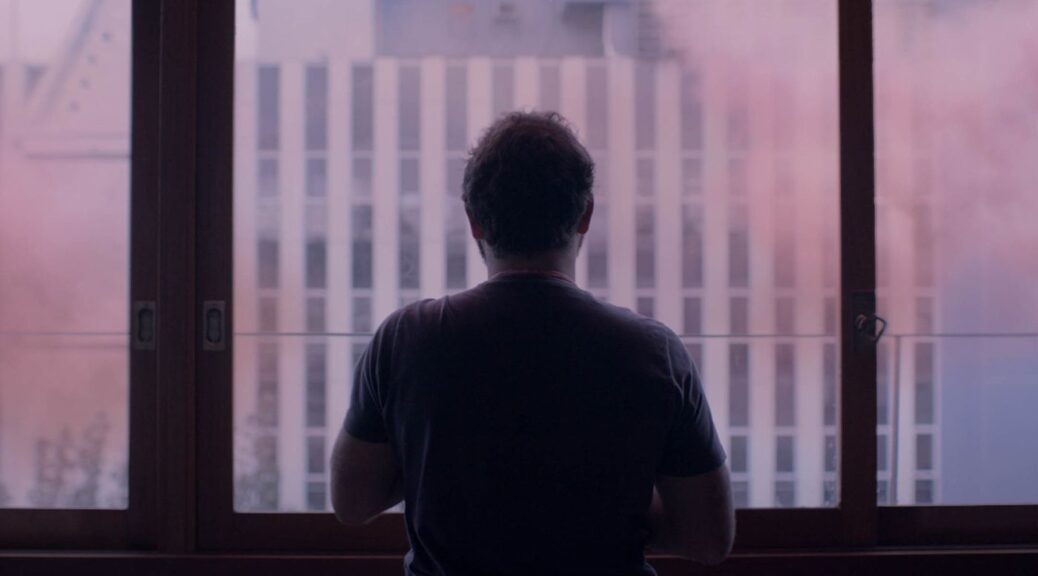
The Pink Cloud

by George Wolf

Want to know tomorrow’s lottery numbers today? Check in with filmmaker Iuli Gerbase, because if The Pink Cloud (A Nuvem Rosa) is any indication, she’s got a window to the future.

And the first of many fascinating aspects in the film comes right up front, when a disclaimer lets you know that Gerbase wrote the script for her debut feature in 2017, filming it two years later.

The timeline may not seem like much at first, but soon you’re wondering how your perception of the film might change if that disclaimer was placed at the end, or perhaps not even placed at all.

Giovana (Renata de Lélis) and Yago (Eduardo Mendonça) are a Brazilian couple waking up on a terrace after what appears to be a one-night stand when a government warning orders them inside. There’s a strange pink cloud in the sky, and it’s lethal after just ten seconds of exposure.

Welcome to a new world of quarantine.

Except in 2022 that premise is anything but new, which instantly gives the film an ironic prescience that’s just as likely to attract an audience as it is to repel it.

As the days of lockdown turn to weeks and then to years, Gerbase crafts a quietly unsettling clash of the complex intimacies seen in The Woman in the Dunes and Room with a more universal rumination on how the seams of a population react to forced isolation.

And while our shared experience the last two years will reveal some of Gerbase’s internal logic to be a bit unsteady, she hits an eerie amount of bulls-eyes, including one bit of dialog that lands as much more of a reveal than Gerbase could have possibly imagined.

On a video chat with Giovana, a desperate friend tearfully pleads for any salvation from the crippling loneliness, leading the film to a Twilight Zone moment that dramatically re-frames the arrogance driving one of today’s biggest flashpoint issues.

Lélis and Mendonça both deliver wonderfully insightful performances, as their characters try their best to make a go of a relationship never meant to be long term. The cloud works on Giovana and Yago in different ways, leading to some extreme measures as they drift away from each other and then slowly back again.

Disclaimers aside, The Pink Cloud is an absorbing peek inside the delusions that hide our frailties. But viewing it through the lens of our recent history reveals a filmmaker finely tuned to human nature who should command more attention in the future.

Life Is a Highway

Drive My Car

by George Wolf

Adapting a short story into the three-hour class on storytelling that is Drive My Car (Doraibu mai kâ), writer/director Ryûsuke Hamaguchi turns a seemingly simple premise – a visiting theater director begrudgingly accepts a chauffeur from festival organizers – into a sprawling study of the human soul.

The key word here is seemingly, because there is nothing simple about the way Hamaguchi structures a screenplay.

Yasuke Kafuku (Hidetoshi Nishijima) is a Japanese stage actor and director who shares an unusual method of creative inspiration with his playwright wife Oto (Reika Kirishima). But just when you think this is a film about their complex relationship, it’s not.

Jumping ahead two years after a sudden tragedy, Kafuku travels to a Hiroshima theater festival to direct an adaptation of Chekov’s Uncle Vanya. Though he cherishes thinking through his projects alone in the car during long commutes, Kafuku is forced to accept a chauffeur during his time in Hiroshima.

Casting and rehearsals get underway, and Kafuku’s art begins to imitate his life, and vice-versa. Just as one of his star actors gradually reveals long held feelings for Oto, Kafuku slowly learn to trust his driver Misaki (Tôko Miura), a stoic young woman with a complex past of her own.

Hamaguchi’s resume includes both four hour and five-hour films, and he has become a master at layering long form narratives so skillfully that there isn’t one minute that seems self-indulgent, or the slightest of human interaction that doesn’t weigh heavy with meaning.

The performances from Nishijima and Miura are equally understated and affecting. They peel away their characters’ defenses with a deep sense of purpose, cementing Hamaguchi’s use of those long drives as a metaphorical journey.

As secrets are revealed and burdens lifted, Drive My Car becomes a soaring treatise on grief and trauma, of forgiveness and moving on.

Not to mention the unending lure of a fine automobile.

Face of the Nation

France

by George Wolf

France is the setting for this movie called France about a woman named France. So, subtle it’s not. But the latest from writer/director Bruno Dumont does manage to deliver some stylish eye candy with a fluffy middle that tastes plenty familiar.

Léa Seydoux is mesmerizing as France de Meurs, a celebrity journalist and host of “A View of the World,” one of the most popular talk shows in all of France. She’s juggling fame, her career, and family life with a blasé attitude about it all.

Her home life seems to bore her, the fame is satisfying only when it feeds her ego, and the integrity of her profession never seems to cross her mind. But a sudden traffic accident delivers the overdue wake-up call, and France begins to question if the person she’s become is the person she wants to be.

In the opening minutes, when some nifty editing has France asking pointed questions during an actual press conference with French President Emmanuel Macron, Dumont sets the stage for an over-the-top satire that never emerges.

Instead, it settles into a very repetitive, 133-minute groove that questions the increasingly blurry line between news and entertainment. But as France continually stages her pre-recorded reports, you realize the breezy nature of the opening has given way to an overwrought narrative that spends 30 minutes belaboring a point that Broadcast News made in 5.

Dumont is clearly speaking to his homeland first, though the message will be instantly relatable to U.S. audiences. It’s the film’s tone that becomes more curious in translation.

Seydoux is almost enough to forgive it all, with Dumont making sure his lens loves her as much as the TV cameras love France herself. And while that might not seem a difficult task when the luminous Seydoux is involved, it’s a crucial element that goes a long way toward helping the film resonate as much it does.

Women of the World

The 355

by George Wolf

Apparently, Jessica Chastain pitched the idea of an all-female Bond/Bourne hybrid to director Simon Kinberg while they were making Dark Phoenix together.

Now three years later The 355 is here, and while it’s more memorable than their X-Men installment, the project can never give the duo’s ambitious vision its own identity.

Chastain is “Mace,” a CIA agent sent to Paris with her partner (and maybe more?) Nick (Sebastian Stan). The job is to get their hands on a new cyber weapon that serves as an untraceable master key – and instant entry into any closed system on the planet.

But surprise, Mace and Nick aren’t the only agents hot for that drive, so after 45 minutes of chases and exposition, Germany’s Maria (Diane Kruger), MI6’s Khadijah (Lupita Nyong’o) and Columbia’s Graciela (Penelope Cruz) agree to team up and fight for the future. Then after another 15 minutes or so, China’s Lin Mi Sheng (Bingbing Fan) joins the world party.

Actually, Gracie’s a reluctant guest, as she’s really a psychologist and not trained for combat. So while her secret agent sisters do get to be the impressive badasses, it’s Cruz who brings the film some welcome fish-out-of-water levity.

Kinberg, who also co-wrote the script, pushes all the buttons you’d expect from a mixtape full of Bond’s high-style sexy, Bourne’s lethal brooding, and some Danny Ocean misdirection. And most of it – from Chastain in this role to the cybercrime stakes to the moments of telegraphed action and even the girl power makeover – feels pretty familiar, and that familiarity breeds discontent with the two-hour run time.

Events finally escalate in the third act, and as the globe-trotting and the double-crosses mount, Kinberg does deliver one nicely orchestrated set-piece that truly grabs your attention with tension and bloodshed.

Is it enough to merit that next adventure the finale hints at? Not really, but it’s just enough to make one three-year-old conversation worthwhile.

Holding Out

A Hero

by George Wolf

If you’re familiar with Asghar Farhadi films such as The Past, A Separation and The Salesman, you already know what to expect from his latest. The Iranian writer/director’s calling card has become the intimate drama of complex moralities and lasting impact, wonderfully layered stories that probe the societal strife of his homeland while ultimately revealing universal insight.

Farhadi does not disappoint with A Hero (Ghahreman), a film that finds him questioning the increasingly blurred lines of truth and perception.

When we first meet Rahim (Amir Jadidi), he is coming home on a two-day leave from prison. Locked up for failing to repay a debt, Rahim is hoping to use his brief amnesty to talk his creditor into withdrawing the complaint in exchange for partial payment.

It doesn’t look promising, until Rahim finds a lost handbag full of gold coins – and returns it instead of selling the coins to pay his debt.

Suddenly, Rahim is a hero. But today’s hero is tomorrow’s milkshake duck, and it isn’t long before distrust of Rahim’s story begins to threaten the promise of freedom and a new job.

Is resisting temptation even worthy of such celebration, and how far will Rahim go to retain his perceived nobility? Is it possible to recognize the moment when the best of intentions can no longer justify a possible deception? Is “the truth” even a realistic goal in the social media age of constantly manipulated realities?

Jadidi crafts Amir with a deeply sympathetic balance of earnestness and suspicion, and the terrific ensemble cast helps cement a sharp morality play that often crackles with the tension of a thriller. Farhadi seems more than comfortable moving further from his stage roots than ever, illuminating Amir’s journey with a realism that patiently waits until the final shot to get showy.

Farhadi makes sure that separating the good guys from the bad guys won’t be easy. The moral high ground of A Hero is constantly shifting, which proves to be the perfect anchor for a gifted filmmaker’s latest examination of modern life’s often messy ambiguities.