American Siege is already the fourth film that writer and/or director Edward Drake has done with Bruce Willis in just the past two years.
And if you’ve seen any of these projects (Breach, Apex, Cosmic Sin), you know the business model: give Willis a limited role he can shoot in a day while you fill the running time with limp action, painful performances and hackneyed dialog. It’s an assembly-line approach that gets cheers for efficiency, but jeers for quality control.
This time out, Willis is Ben Watts, a former NYC cop enjoying the quiet life as a sheriff in smalltown Georgia. But his lazy days canoodling with his deputy (a Janet Jones sighting for the first time in nearly ten years) are interrupted by a hostage situation.
A small gang of baddies has taken the town doctor (Cullen G. Chambers) hostage, and they have an unusual request: reopen the case of a local woman’s disappearance, or else.
Okay, give Drake credit for a somewhat interesting setup, but it’s one that quickly gets buried under ridiculous plot turns, lazy execution and heavy-handed declarations.
The town is run by one of those Ben-Gazarra-Road House guys (Timothy V. Murphy) who can can summon a goon squad at a moment’s notice. And this one does, because there are secrets in the good doctor’s place that must be protected.
We know this because of the warning Doc gives his captors about opening that household vault with a door right out of Ocean’s Eleven.
“Some things can’t be unseen!’
But don’t be too concerned with the doctor’s realization that “I’ve already said too much!” He’ll be blurting out Not Ben Gazarra’s evil plan in no time, while making sure to blame the entire bloody mess on “coastal elites.”
Mess is right. Even the shoot-em-up payoff is lackluster, while the film’s prevailing worldview is simplistic and pandering, and the ensemble’s forced emoting makes Willis’s latest sleepwalk feel like Daniel Day-Lewis.
But, after about 90 minutes, just remember Drake and Willis already have two more of these gems in post-production, so one of them has to be better than American Siege.
Looking back, what will we remember about the 2021 year in film? Musicals, black and white palettes, smoking, ensembles and impressive debuts are the trends we’ll think of first. But more specifically, we’ll remember these 25 favorites:
1. Licorice Pizza
Paul Thomas Anderson’s latest is loose, forgiving, and along for the ride as 15-year-old entrepreneur Gary Valentine (Cooper Hoffman) woos life, Hollywood and, in particular, Alana Kane (Alana Haim), his much older paramour.
Danger edges but never fully punctures the sunshine of youth that brightens every scene of the movie. But that darkness is there, looming like the creepy guy staring at your office window, or the cops who arrest you mistakenly, or the volatile Hollywood producer who may or may not smash your window (or your head) in with a crowbar. (Thank you, Bradley Cooper, by the way, for that brief but unforgettable performance.)
It’s nostalgic. It’s uproarious, dangerous, just-this-side-of-innocent fun. It’s a near-masterpiece.
2. The Power of the Dog
Even if you haven’t read the celebrated source novel by Thomas Savage, director Jane Campion’s adaptation unfolds with enough subtle poetry to convince you that it must be a wonderful read. Onscreen, the Oscar-winning Campion (The Piano) contrasts the vast majesty of the American West (kudos to cinematographer Ari Wegner) with delicate details that shift the nature of love, trust and strength within a family.
Kodi Smit-McFee, Jesse Plemmons, Kirstin Dunst and a particularly brilliant Benedict Cumberbatch bring her story to life. The Power of the Dog finds its own power in what it shows but never truly tells. It’s a film that is hauntingly lyrical and masterfully assembled, with a beauty that lingers like an echo in the Montana wilderness.
3. The Tragedy of Macbeth
Coen brother Joel delivers a vision that’s both decidedly theatrical and profoundly cinematic with his solo directorial effort. Filmed in Bergman-esque black and white to glorious ends, Denzel Washington and Frances McDormand play the Lord and his Lady and this, friends, is a dream team. Two of the most celebrated and talented actors of modern cinema square off, and the veterans give an inconic relationship a depth that tinges the eventual madness with touching grief.
A uniformly brilliant ensemble (kudos in particular to Kathryn Hunter’s inspired turn as the witches) gives this dreamy take on the Bard its life.
Coen’s venture into Shakespeare, though it strips away the humor and quirk you may associate with Coen Brother filmmaking, stands as a strikingly Coen film. And that has never one time been a bad thing.
4. Summer of Soul
According to director Amir “Questlove” Thompson, the first time he saw some of the digitized footage from the 1969 Harlem Cultural Festival concerts, he nearly wept.
You might, too.
From the gospel of Mahalia Jackson to the blues of B.B. King, from the 5th Dimension’s smooth pop to Sly Stone’s psychedelic funk, the musical styles blend gloriously in the summer sun and the goosebump moments mount. But even more impressive than Thompson’s musical direction is the way he frames the entire festival through a deeply effective context of time, place, and population.
5. West Side Story
Right from the opening minutes, Steven Spielberg’s camera seamlessly ebbs and flows along with the street-roaming Sharks and Jets. From one musical set-piece to the next, Spielberg’s touch is smoothly precise, starting wide to capture the breadth of Justin Peck’s homage to Jerome Robbins’s iconic choreography, zooming in for intimacy, and then above the dancers and rumblers for gorgeous aerials set with pristine light and shadow.
It just looks freaking fantastic.
And in bringing his own vision to a classic story, Spielberg gently adds a perspective that makes Tony and Maria’s quest soar with a renewed, more universal vitality.
Just like most everything else in this West Side Story.
Christie Robb’s favorite film of 2021: Luca
Pixar/Disney’s Luca fosters self-acceptance and bravery in kids who were in the process of transitioning back to in-person school.
6. Flee
Like so many other headlines of numbing enormity that we regularly scroll past, stories of the worldwide refugee crisis rarely come with an intimacy that makes the stakes feel palpable. Flee brings an animated face to the discussion, using one man’s incredible story to re-frame the issue with soul-stirring humanity.
Using that man’s actual voice in the conversations with director Jonas Poher Rasmussen adds startling depth to the reenacted memories, and as our childlike comfort with animated scenes clashes with the uncomfortable scenes depicted, Flee‘s bracing resonance only intensifies.
7. Nightmare Alley
What director Guillermo Del Toro brings to this remake of a 1947 noir classic, besides a breathtaking cast and an elegantly gruesome aesthetic, is his gift for humanizing the unseemly. As usual, Del Toro wears his feelings proudly on his sleeve, with unmistakable but organic foreshadowing that ups the ante on the stakes involved. Anchored by another sterling performance from Bradley Cooper as Stan, the journey rises to biblical proportions. An actor whose gifts are often deceptively subtle, Cooper makes sure Stan’s pride always arrives with a layer of charming sympathy, even as it blinds him to the pitfalls ahead.
For Del Toro fans, the most surprising aspect of Nightmare Alley might be the lack of hopeful wonder that has driven most of his films. As the title suggests, this is a trip to the dark corners of the soul, where hope is in damn short supply. As much as this looks like a Del Toro film, it feels like a flex just from taking his vision to the sordid part of town. But what a vision it turns out to be – one of the year’s best and one of his best.
8. Drive My Car
Adapting a short story into a three-hour class on screenwriting, writer/director Ryûsuke Hamaguchi turns a seemingly simple premise – a visiting theater director begrudgingly accepts a chauffer from festival organizers – into a sprawling study of the human soul.
As secrets are revealed and burdens lifted, Drive My Car becomes a soaring testament to grief, forgiveness, moving on and the unending lure of a fine automobile.
9. Riders of Justice
Men will single-handedly gun down an entire biker gang rather than go to therapy. That’s the premise from prolific writer-director Anders Thomas Jensen, as he reunites with Mads Mikkelsen in this dark comic revenge fantasy.
But Jensen isn’t nearly as interested in the physical mayhem as the emotional wreckage his oddball characters are all coping with. Riders of Justice treats its characters with such forgiving empathy that it’s easy to forget that the group is also almost certainly responsible for the most murders in Denmark since the Vikings.
Matt Weiner’s favorite film of 2021: Riders of Justice
It’s the feel-good Christmas comedy that brings the whole family together with good cheer, redemption, philosophical detours on the meaning of life and a body count that puts Die Hard to shame.
10. Wild Indian
As angry a movie as you’re likely to see, Wild Indian pushes you to hope compassion and tenderness come to the most unlikeable man onscreen.
Writer/director Lyle Mitchell Corbine Jr. refuses to lean on stereotypes that would make the central performance more comfortable viewing. Makwa (a stunning Michael Greyeyes) is neither victim nor noble wiseman. Not entirely a villain, he’s nonetheless ill-suited as antihero or, God forbid, hero. He’s a survivor bound up in his own guilt and shame, taking advantage of whatever he can and hating himself and everyone around him because of it.
It’s a desolate world Corbine Jr. creates, but no less remarkable for its bleakness. A character study unlike anything else on screen this year, Wild Indian gives longtime character actor Greyeyes the opportunity to command the screen and he more than rises to the occasion.
11. Pig
This touching film—a tale of love, loss, authenticity and a good meal— is essentially the anti-John Wick. And we are better for it.
Nicolas Cage is almost always the center of attention in every film he’s in. It’s tough to look away from him because you’re afraid you’ll miss some insane grimace or wild gesture, but also because filmmakers love him and never pull away. Here, co-writer/director Michael Sarnoski asks you to wait for it. He gives Cage time to pause, breathe, and deliver his most authentic performance in ages.
Brandon Thomas’s favorite film of 2021: Pig
Pig is a beautiful commentary on grief while also serving as a reminder that Nicolas Cage never stopped being one of our finest actors.
12. Passing
Making her feature debut behind the camera, Rebecca Hall adapts Nella Larsen’s 1929 novel about women unable to find a place to truly belong. Hall mines Larsen’s insight and longing to produce a visually stunning, melancholy period piece.
The languid beauty and comment on class play like a more delicate take on Gatsby, Hall subtly drawing attention not only to the racial divide but to the socioeconomic divide within Irene’s (Tessa Thompson) home and life. Never showy, never heavy-handed, the film’s themes prick at the audience just as they slowly, cumulatively wound Irene.
Thompson delivers an introspective performance unlike anything thus far in her impressive career. Likewise, Ruth Negga is superb as Irene’s friend/nemesis Clare, just incandescent and haunting as a damaged, elegant survivor.
13. Belfast
Belfast is a man’s reminiscence of his own childhood, informed by the movies and songs that bleed together with memory and saturated in the wonder of youth.
Director Kenneth Branagh has yet to make a film with such precise visual purpose or style. Every black and white frame, every movement or lack of movement from the camera carries the vision of the film.
It is sentimental. It is nostalgic. It is unapologetically sincere. But by taking the perspective of a 9-year-old boy (a magnificent Jude Hill) trying to make sense of a suddenly and profoundly confusing and frightening world, the film gets away with it.
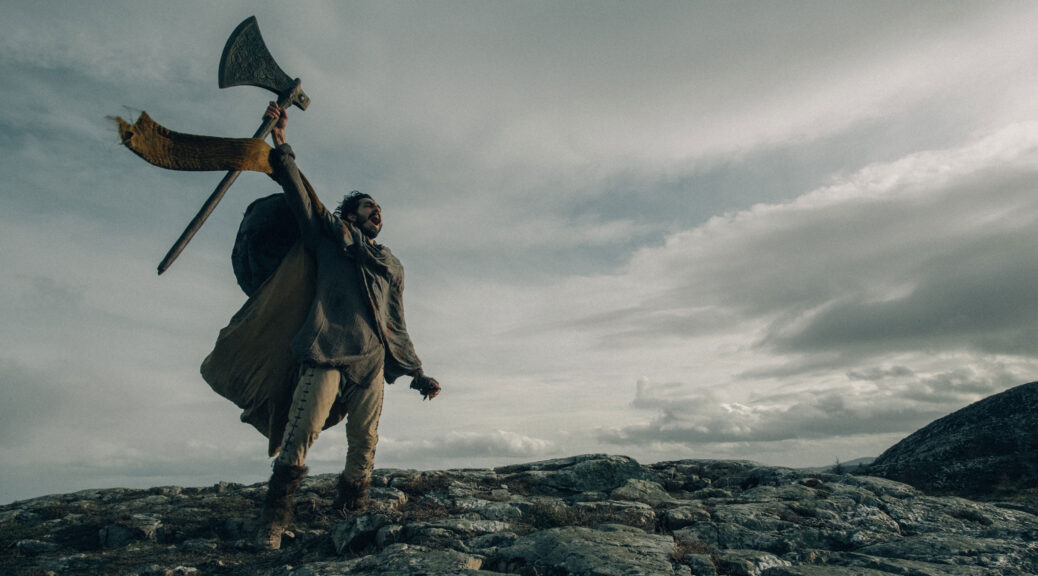
14. The Green Knight
Lutes and mead, chainmail and sorcery—director David Lowery’s Camelot is just as rockin’ as ever in his trippy coming-of-age style The Green Knight. The story itself may be more than 700 years old, but credit Lowery, who adapted the old ballad for the screen, with finding fresh intrigue in the old bones. He’s slippery with symbolism and draws wonderful performances from the ensemble.
His visual storytelling has always been his greatest strength as a director and this tale encourages his most fanciful and hypnotic style to date. The Green Knight is gorgeous. The color and framing are pure visual poetry. Together with a never-better Dev Patel and an exceptional ensemble, Lowery’s created a magical realm where you believe anything could happen.
Cat McAlpine’s favorite film of 2021: The Green Knight
The Green Knightis a visual spectacle that matches the scale of journeying within oneself, masterfully portrayed by a wide-eyed and constantly wet Dev Patel.
15. C’mon C’mon
A man’s changing relationship with his young nephew mirrors his deepening bond with his estranged sister. That man, Johnny, is played by Joaquin Phoenix, particularly endearing in this film. Nine-year-old Woody Norman soars as the nephew, his chemistry with Phoenix couldn’t be more charming or genuine. Gaby Hoffmann is wonderful as well as Norman’s mom, Johnny’s sister Viv.
C’mon C’mon wraps the messy, awkward, disappointing realities of being human in a blanket of hope. As cloying as that sounds, the film is so sincere it’s hard to deny its warmth.
16. The Lost Daughter
Unnerving intimacy marks Maggie Gyllenhaal’s debut as a feature director. Luckily for all of us, Gyllenhaal’s uniformly subline cast meets the challenge.
Adapting Elena Ferrante’s novel, Gyllenhaal challenges romantic preconceptions about motherhood (sometimes quite bitingly, thanks to lines delivered with acidic precision by the remarkable Olivia Colman). The film acknowledges what is given up, what is lost, when you essentially transfer ownership of yourself—your time, your attention, your future—to someone else, to your children. The theme is deeply and honestly felt, and that, too, is unnerving.
17. The Humans
Two of 2021’s most prominent film themes – impressive debuts and stellar ensembles – come together in rookie writer/director Stephen Karam’s The Humans.
Adapting his own stage play, Karam displays wonderful instincts for how his story of a family reunion could move from stage to screen with relevant new layers. Buoyed by a first-rate cast including Richard Jenkins, Steven Yeun, Amy Schumer, Beanie Feldstein and Jayne Houdyshell, The Humans slowly revels itself as a domestic horror show, with familiar tensions and deep-seeded fears becoming more frightful than anything going bump in the night.
18. The Worst Person in the World
Led by a revelatory performance from Renate Reinsve, the latest from Norwegian writer/director Joachim Trier effectively fuses coming-of-age sensibilities and romantic drama.
As one woman navigates what she wants in a career, in a relationship, and ultimately what she wants out of life, Trier crafts small, indelible moments that bind together for a refreshingly honest look at how, as John Lennon once said, life happens when you’re busy making other plans.
19. Zola
Is it surprising that movies are now born from Twitter threads? Maybe, for a minute. But you’ll find good stories on Twitter, and with Zola, director/co-writer Janicza Bravo tells a ferociously good story, even if some of it may not be exactly true.
Bravo, Taylor Paige and Riley Keough (with solid support from Colman Domingo, Nick Braun and Jason Mitchell) all bring indelible talent to Zola, and the sheer buzz of this wild ride becomes irresistible.
Is it truth? Fiction? A bit of both?
It matters only in that it doesn’t matter at all. Because whatever truth still exists in the digital age, Zola speaks it.
Rachel Willis’s favorite film of 2021: Adventures of a Mathematician
Adventures of a Mathematician offers devastating insight into why some of the world’s most brilliant scientists lent their skills to the creation of the deadliest weapons in history.
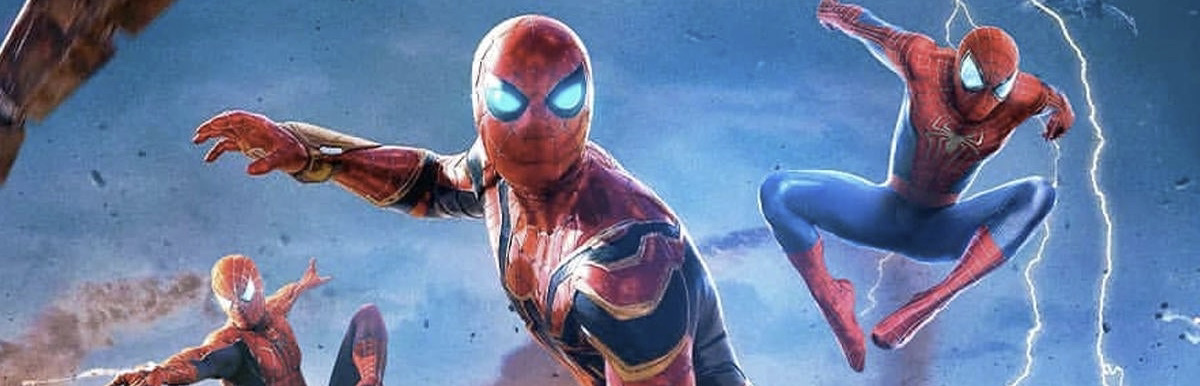
20. Spider-Man: No Way Home
This third installment of Jon Watts’s Spidey franchise showcases the naïve optimism and youthful sweetness that has made his first two episodes such a great time, that are so perfectly embodied by star Tom Holland.
Rather than feeling like those Marvel overreaches in defining their own universe, No Way Home uses the opportunity of pulling in other movies to celebrate the hero, his roots, and what he stands for as an icon of comics, heroes, and childhoods the ‘verse over.
Oh, sure, it’s nostalgic. It panders. It also spills over with joy.
21. Spencer
The opening credits of Spencer include a declaration that the film is “a fable from a true tragedy.” Indeed, this look at the final weekend in the marriage of Princess Diana and Prince Charles is draped in sadness and longing, but it’s one that uses what you already know about its subject to its advantage, completely enveloping you in an otherworldly existence.
If you haven’t been keeping up with Kristin Stewart’s string of fine performances since the Twilight films, don’t be surprised when she starts collecting the award nominations this performance richly deserves.
Filmmaker Pablo Larrain chooses the word “fable” at the start for a reason. This film is no fairy tale, but Larraín’s committed vision and an achingly poetic turn from Stewart make Spencer a completely fascinating two hours of story time.
22. Saint Maud
Maud (an astonishing Morfydd Clark) has some undefined blood and shame in her recent past. But she survived it, and she knows God saved her for a reason. She’s still working out what that reason is when she meets Amanda (Jennifer Ehle), a former choreographer now crumbling beneath lymphoma. Maud cannot save Amanda’s body, but because of just the right signs from Amanda, she is determined to save her soul.
As a horror film, Saint Maud is a slow burn. First-time writer/director Rose Glass and crew repay you for your patience, though, with a smart film that believes in its audience. Her film treads the earth between mental illness and religious fervor, but its sights are on the horror of the broken-hearted and lonesome.
23. Candyman
This new Candyman is the most delicious brand of horror sequel. Thanks to the startling vision of director/co-writer Nia DaCosta, it is a film that honors its roots but lives so vibrantly in the now that it makes you view the 1992 original from an urgent new angle.
DaCosta’s savvy storytelling is angry without being self-righteous. Great horror often holds a mirror to society, and DaCosta works mirrors into nearly every single scene in the film. Her grasp of the visual here is stunning—macabre, horrifying, and elegant. She takes cues from the art world her tale populates, unveiling truly artful bloodletting and framing sequences with grotesque but undeniable beauty. It’s hard to believe this is only her second feature.
By the time a brilliant coda of sadly familiar shadow puppet stories runs alongside the closing credits, there’s more than enough reason for horror fans to rejoice and…#telleveryone.
24. The Last Duel
This is a brooding, brutal, violent and sexually violent film, one that utilizes a Rashomon-style narrative to frame an often debated moment in history around a centuries-old struggle that continues today.
Director Ridley Scott presents the tale with exceptional craftsmanship and spectacle, getting big assists from Dariusz Wolski’s gritty, expansive cinematography and Michael Fentum’s detailed sound design. Scott’s remarkable cast — Jodie Comer, Adam Driver, Matt Damon and Ben Affleck — digs in to these old ideas to find startling relevance.
The Last Duel aims for more than just a gripping history lesson. It’s ultimately able to use that history to remind us that the way society treats women generally – and women’s sexuality specifically – has changed little since the freaking Middle Ages.
25. No Time to Die
Opening with a tense and expansive 26-minute prologue, Cary Joji Fukunaga unveils thrilling set-pieces and gorgeous visuals that beg for a big-screen experience. Aided mightily by a soaring, throwback score from Hans Zimmer, Fukunaga infuses Daniel Craig’sfinalBond film with a respectful sense of history while it marches unafraid into the future.
The one-liners, callbacks and gags (like Q’s multi-piece tea set) are well-placed and restrained, never undercutting the nearly three-hour mission Fukunaga clearly approached with reverence.
Where does James Bond go from here? Hard to say, but this 007 doesn’t care. Five films in 15 years have changed the character and the franchise for the better, and No Time to Die closes this chapter with requisite spectacle and fitting emotion.
Daniel “Schlocketeer” Baldwin’s favorite film of 2021: No Time to Die
No Time to Die is a fantastic action adventure epic, a pitch-perfect ending to the Daniel Craig era of James Bond and a wonderful modern encapsulation of the writings of Ian Fleming.
Look past the tabloid fodder and you’ll see that onscreen, Ben Affleck is having a fine second act. Last year’s impressive turn in The Way Back showed him more than comfortable in his older skin, and his standout support in The Last Duel is generating some Oscar buzz for this year’s best supporting actor race.
This focus on substance over leading man style is a smart one, but while Affleck digs into his pivotal role in The Tender Bar, the film itself struggles to find anything truly relevant to say.
Based on J.R. Moehringer best-selling memoir, it’s an account of his journey from a poor, dysfunctional household to a Yale education and a career in writing. Guided by voiceover narration from adult JR (Ron Livingston), we’re introduced to little JR (Daniel Ranieri) when he and his mother (Lily Rabe) are moving back into the Manhasset, New York home of Grandpa (Christopher Lloyd), Grandma (Sondra James) and Uncle Charlie (Affleck).
JR’s violent, alcoholic father (Max Martini) is a radio deejay who’s rarely around, so 11 year-old JR looks to Uncle Charlie as a role model, often soaking up life lessons found at “The Dickens,” the Long Island bar where Charlie works. Young adult JR (Tye Sheridan) continues the barstool education until it’s time for the Ivy League, new friends, and a hard-to-really-get new girlfriend (Briana Middleton).
Director George Clooney and screenwriter William Monahan craft a respectful and well-meaning adaptation, but it’s sadly lacking any hint of why they found the source material so moving. From Charlie’s advice to JR’s awakenings, the messages are broadly drawn, well worn and self-satisfied, too generic for even the Oscar-winning Monahan (The Departed) to polish into inspirational shape.
And where is the eye for vibrant period detail that helped bring Clooney that well-deserved directing nomination for Good Night and Good Luck? Here, soundtrack choices and costume design blur the stated timeline, while the young actor playing JR at 11 looks closer to 8 and shockingly unlike Sheridan. Even the “golden voice” we’re told that JR’s deejay dad possesses never materializes when he finally speaks.
A film such as this needs authenticity to resonate, but this true story never feels like one, and the chance for us to really connect with JR is derailed at multiple turns. While Affleck adds another fine showing to his current winning streak, there’s not much else in The Tender Bar to convince you the book was worth a big screen adaptation at all.
Director Jon Watts, working again with writers Chris McKenna and Erik Sommers, uses the third in their Spider-Man series to remind us why we all hope for the best whenever we watch a comic book movie.
Peter Parker (Tom Holland) was found out in the previous installment, Spider-Man: Homecoming. And what he’s learned is that life is more complicated for you and more dangerous for your loved ones when your true identity is known. It’s a lesson most all Spider-Men and most superheroes have to contend with at one time or another. (Except Iron Man. Narcissists, amirite?)
Things have gotten so bad for him, his girlfriend MJ (Zendaya) and his bestie Ned (Jacob Batalon) that he asks for help from a wizard with responsibility issues (Benedict Cumberbatch, having one hell of a year).
What happens next? We see lessons learned from the profound (and rightful) popularity of 2018’s animated treasure, Spider-Man: Into the Spider-Verse. Portals open and Spider-Man characters come pouring in from across the multiverse.
So do other people, inside jokes, and constant opportunities to strengthen themes Spider-Man has spun since Stan Lee and Steve Ditko.
Oh, sure, it’s nostalgic. It panders. It also spills over with joy. This third installment showcases the naïve optimism and youthful sweetness that has made Watt’s first two episodes such a great time, that are so perfectly embodied by Holland.
Rather than feeling like those Marvel overreaches in defining their own universe, Watts’s film uses the opportunity of pulling in other movies to celebrate the hero, his roots, and what he stands for as an icon of comics, heroes, and childhoods the ‘verse over.
It’s a blast spending time with memorable characters, and each of these actors bring something charming to the screen. Watts and his writers fondly recall what’s gone before, even when ribbing some minor shortcomings.
When a superhero franchise gets far enough in that it requires a multitude of villains to one-up its prequel, things usually go south. Watts, on the other hand, gets stronger with each episode. Between his savvy filmmaking and his lead’s endless charm, he’s easily crafted the best set of superhero films in the Marvel (or Sony) universe. Given the excitement around Spider-Man: No Way Home, Peter Parker may not just save the multiverse. He may save the multiplex.
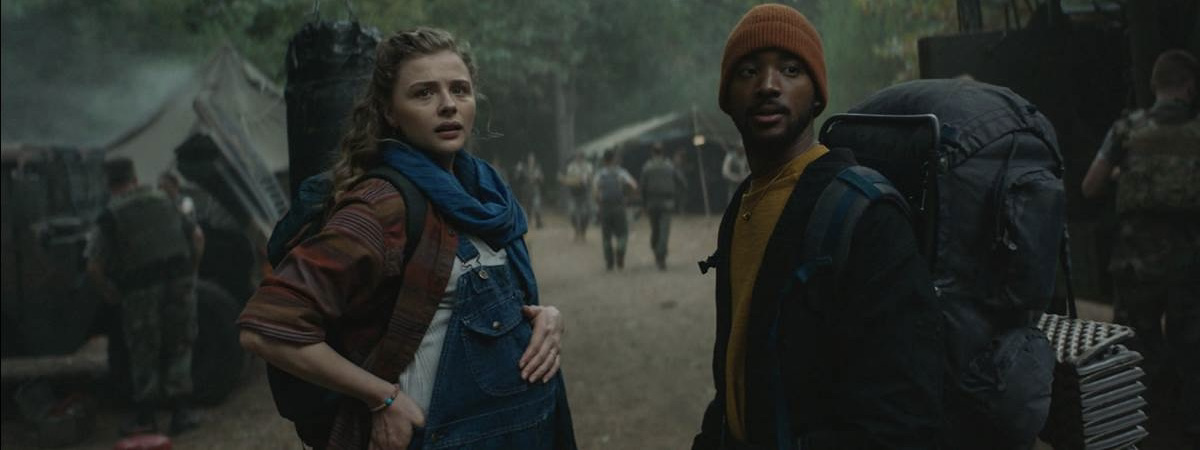
You think you’ve got a good handle on Hulu’s Mother/Android pretty quickly. Take some zombie basics that we’ve seen from Romero through The Walking Dead, replace the undead with some renegade robots, and away we go.
But while there is plenty here that’s familiar, give writer/director Mattson Tomlin credit for finding sly ways to surprise you, and ultimately subvert your expectations with an nifty metaphorical finale.
Chloë Grace Moretz stars as Georgia aka “G,” a young woman struggling to enjoy a party after the shock of finding out she’s pregnant. Her boyfriend Sam (Algee Smith) is saying all the right things, but she’s unsure about their future.
As A.I. servants dutifully attend to the party guests, G and a friend head to the bathroom for a private chat. But in an instant, a painful sonic blast drops the humans to their knees while rebooting the bots to a default “kill” setting.
Fast forward nine months, and Tomlin’s got a standard setup (survivors running toward a rumored safe haven while being pursued by a relentless menace) with the always convenient “savior” trump card (very pregnant woman).
Tomlin’s storytelling appears workmanlike but uninspired, often rehashing ideas and set pieces you’ll remember from Terminator, The Descent, A Quiet Place, and even The Empire Strikes Back. But when G and Sam get separated, and G meets up with a fellow survivor (Raúl Castillo) who once helped create the Android serving class, Tomlin finally gets around to rewarding all who stick it out for Act 3.
With foreshadowing that is effectively subtle and an affecting turn from Moretz that crafts G as both tortured and courageous, the film reveals its first twist in finely organic fashion while keeping you distracted from the true motive ahead. Once revealed, it arrives as a plea for global empathy that lands with some unexpected emotional pull.
The best science fiction tales succeed when their glimpses of the future help us reassess the present. Mother/Android gets there, eventually, with a measured pace that seems much more confident when the party’s over.
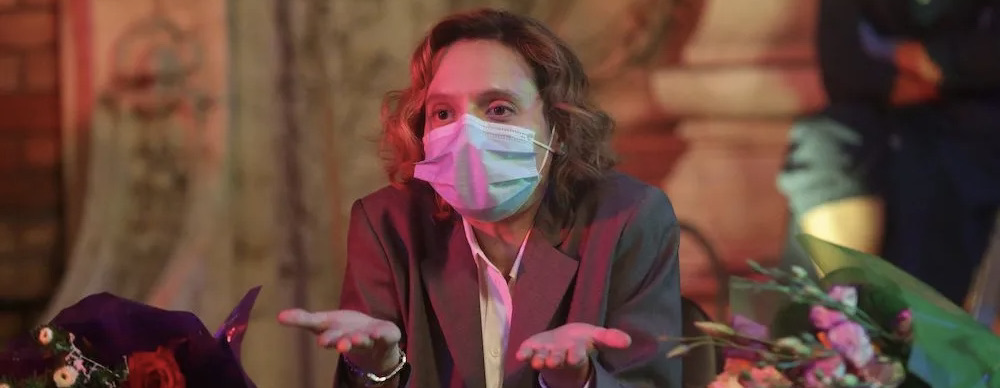
If you think the word “porn” in the title is just for effect, the first few minutes of Bad Luck Banging or Loony Porn will be a hardcore surprise.
We first meet Romanian married couple Emi (Katia Pascariu) and Eugen (Stefan Steel) as they’re ignoring knocks on the bedroom door to record their spirited relations on home video. They’re consenting adults, so fair enough.
Well, maybe not so fair enough. Emi is a teacher at a prestigious school in Bucharest and when her frisky business footage winds up online, some parents loudly cry foul. But Emi is defiant, and as she’s subjected to a public hearing about her “sins,” writer/director Radu Jude makes it the centerpiece of a wildly audacious, funny and free-flowing diatribe against hypocrisy and the rise of meanness.
Jude divides the narrative into chapters, and doesn’t waste much time in Part 1 worrying about how the tape became public in the first place. Emi’s plight is more a situation than a story and for Jude, the point is the aftermath.
But before Emi faces her critics, Jude breaks away for “a short dictionary of anecdotes,” filling his second act with a series of definitions, archival reels, and meme-worthy examples of everything from racism to explicit oral sex. Subtle, it isn’t, which Jude readily acknowledges by following the word “metaphor” with a child’s game that essentially grabs toy fish from a barrel.
And by the time Emi’s hearing plays out as an Act 3 “sitcom” with multiple endings going off various rails, you’ll be amazed by how much this Romanian import reminds you of any number of heated arguments here at home. Subjects such as FOX News and George Soros are thrown around while the matter at hand quickly devolves into wild conspiracy theories and whataboutism where “the more idiotic the opinion, the more important it is.”
Jude has some strong views of his own, about modern life and how cinema should best reflect it. He doesn’t hold much back in Bad Luck Bangingor Loony Porn, a film that leans into its absurdity for a boldly extreme and worthwhile declaration.
This week on Twitter, director Edgar Wright reminded anyone doubting Steven Spielberg’s way around a musical number to revisit “Anything Goes” from Indiana Jones and the Temple of Doom. Okay, point taken, but West Side Story? That’s a big step up.
It is, and he makes it in stride.
Right from the opening minutes, Spielberg’s camera seamlessly ebbs and flows along with the street-roaming Sharks and Jets. Their threats of violence are more palpable this time, as Riff (Mike Faist, an award-worthy standout) and his New York boys want to settle their turf war with Bernardo (David Alvarez) and the Puerto Ricans once and for all.
At the dance that night, the first meeting between tragic lovers Tony (Ansel Elgort) and Maria (Rachel Zegler, a newcomer with an amazing voice who beat out thousands in open auditions) now happens under the gym bleachers, the first in a series of subtle and not-so-subtle updates that Spielberg and screenwriter Tony Kushner (Lincoln, Munich, Angels in America) employ to deepen the narrative impact.
“Dear Officer Krupke” seems more organic in the station house, “America” (led by an irresistible Ariana DeBose as Anita) is given more room to move across the west side city streets, while a department store full of mannequins depicting white suburban dreams proves an ironically joyful setting for Maria and her co-workers’ buoyant reading of “I Feel Pretty.”
And from one musical set-piece to the next, Spielberg’s touch is smoothy precise, starting wide to capture the breadth of Justin Peck’s homage to Jerome Robbins’s iconic choreography, zooming in for intimacy, and then above the dancers and rumblers for gorgeous aerials set with pristine light and shadow. Stellar efforts from cinematographer Janusz Kaminski and production designer Adam Stockhausen turn the everyday drab of hanging laundry and fabric remnants into an elegant playground for Spielberg’s camera eye.
In short, it looks freaking fantastic.
It sounds pretty great, too, even beyond the genius of Bernstein’s melodies and Sondheim’s lyrics. Because Spielberg couples his appropriate and welcome diversity of cast with a complete lack of subtitles, rightly putting the opposing cultures on equal narrative footing, and bringing more depth to the cries of “speak English!”
And as the gang fight turns deadly, all of the stakes are embraced more tightly. The offhand bigotry of Lt. Schrank (Corey Stoll, terrific as always) is more casually cruel, the identity conflict of Anybodys (Iris Menas) feels more defined, while Anita’s fateful visit to Doc’s store – now run by Valentina (expect another Oscar nod for the incredible Rita Moreno) – plainly calls it like it always was.
Then, as his (almost) parting shot, Spielberg unveils his grandest revision, a move nearly as bold and risky as the one Richard Attenborough face-planted with in 1985’s A Chorus Line.
By altering the context of one of the most emotional songs, Attenborough showed he didn’t know, or didn’t care, about what the show was trying to say. Spielberg, though, gently adds a perspective that makes Tony and Maria’s quest soar with a renewed, more universal vitality.
Just like most everything else in this West Side Story.
“Do you have a story to tell? Do you have something to say? Then spit it out!”
That’s solid advice from a veteran director to an aspiring filmmaker named Fabietto (Filippo Scotti, completely charming). But in The Hand of God, it sounds more like writer/director Paolo Sorrentino reaching out to his teenaged self.
Fabi’s life in 1980s Naples is filled with a steady array of colorful family members, neighbors, friends and passersby. They laugh, they argue, pull pranks on each other and cheer fanatically for Diego Maradona in the 1986 “Hand of God” World Cup. Fabi soaks it all in happily, his headphones constantly draped around his neck while his wandering teen eyes fall often on his voluptuous Aunt Patrizia (Luisa Ranieri).
Though there’s much drama in and around the household (including a sister who never leaves the bathroom), there’s never a shortage of love or laughter, which makes the tragedy that comes in the film’s second act land that much harder.
This is clearly a very personal project for Sorrentino (Il Divo, The Great Beauty). And it often feels like a series of rather testosterone-heavy vignettes pulled from his memory, strung together with the majesty of architecture and landscapes that he continues to showcase so beautifully.
Though the overall tapestry flirts with self-indulgence before the young Fabi finds his calling, Sorrentino has crafted a warm and often wonderful homage to the people, places, and twists of fate that make us what we are.
Since Adam McKay shifted into “political” comedy with The Big Short and Vice, it’s become most convenient to label him a satirist. But Don’t Look Up, his latest as writer/director, is more proof that pure satire isn’t quite McKay’s forte.
Not that his work isn’t funny, or astute, or politically charged – it’s all of that. But what McKay does best is his own special blend of outrage, farce, skit-based comedy and yes, moments of satire. The best of the modern satirists – Armando Iannucci, for example – are almost always commenting on one thing by talking about something else. McKay, though, fires slings and arrows that are so often on-the-nose they toe the line between shedding light and making it.
Climate change and disinformation are in McKay’s sights this time, and it isn’t hard to imagine Don’t Look Up being inspired by some exasperated bit of conversation.
“What if some giant, cataclysmic comet were heading straight for Earth? Would that get somebody’s attention?”
Astronomy PhD candidate Kate Dibiasky (Jennifer Lawrence) discovers just such a comet, and along with her anxiety-prone professor Randall Mindy (Leonardo DiCaprio), calculates it will destroy the Earth in precisely 6 months and 14 days.
Sounding the alarm proves harder than they realize.
President Orlean (Meryl Streep, a bit too SNL) and her chief of staff son (Jonah Hill, in pitch perfect Don, Jr. mode) want to “sit tight and assess,” so Kate and Randall take their message to the people. But after an appearance on vapidly positive morning cable news chat, Kate is vilified for her severe bangs and shrill warnings while Randall gets tagged as a PILF and starts getting cozy with TV host Brie Evantee (Cate Blanchett, glorious).
Meanwhile, weird tech CEO Peter Isherwell (Mark Rylance) determines the comet could really be a good thing! It’s composition could be worth billions, so he pushes the administration toward a Star Wars-worthy plan to break it up in pieces small enough to harvest, as uber-angry broadcaster Dan Pawketty (Michael Chiklis) instead wants to focus on the real problem of topless senior caregivers.
What’s left for the little people to do except take sides?
With the clock ticking and the comet now visible overhead, the anti-science crowd preaches “don’t look up” while pop diva Riley Bina (Ariana Grande) belts out a soaring (and surprisingly tuneful) plea to “get your head out of year ass, just look up, turn off that shitbox news.”
The fertile ground of current pandemic disinformation makes McKay’s mash of Dr. Strangelove and Mars Attacks! seem a little extra urgent. And while Don’t Look Up never matches the satirical majesty of Kubrick, McKay is able to nicely cop the disinformation industry’s circular strategy of reframing evidence against it as evidence supporting it. He knows how his film’s worldview will be attacked, but also how some calculated ridiculousness can be a pre-emptive strike.
But is McKay’s film going to change anyone’s mind? Seriously? No, no it’s not, but he knows that, too.
Hey, if you think our current situation is too dire to have fun with, that’s understandable. But if you can relate to Grande singing, “Celebrate or cry or pray, whatever it takes,” then this is funny stuff. Just don’t mistake the laughs in Don’t Look Up – and there are plenty of them, including a priceless running gag about expensive snacks – for a lack of outrage or conviction. McKay and one of the year’s best ensembles find space for all three.
Sit tight for mid-credits and after-credits stingers, too. And trust me on the snacks thing.
After Agnes, some disgruntled horror fans may end up checking the credits for the stamp of A24. Don’t get me wrong, I consistently love A24’s brand of spooky, but I can’t deny that some of their trailers write a visceral check that the films themselves don’t always cash.
So don’t come to Agnes for some standard demonic possession fare, cause it ain’t here. But what director/co-writer Mickey Reece has in store ends up being bold and weird, funny and captivating, and in the end, even sweetly hopeful.
Opening with a convent birthday gathering that gets out of hand fast, Reece then introduces us to Father Frank Donaghue (Ben Hall), whose knowledge of the rite of exorcism earns him a meeting with the Bishop. Back at Santa Teresa, young sister Agnes (Hayley McFarland) seems to have the Devil in her. Church elders want Father Frank and his neophyte Benjamin (Jake Horowitz) to cast it out.
Things don’t go well, leading Father Frank to call in reinforcement from the renegade Father Black (Chris Browning), a cocky, chain-smoking padre who puts Agnes through a hilarious bit of exorcising straight out of Airplane!
If you saw Reece’s Climate of the Hunter, you won’t be surprised by the layer of dark humor running through his latest. But what might surprise you is realizing that what happens to Agnes isn’t really the point here. The point is what happens to Mary (Molly C. Quinn).
Sister Mary committed to the convent after a tragic loss in her life but abandons the order following those clumsy attempts at driving the Devil from her friend. From there, Reece also leaves the convent behind to focus on Mary’s attempts at re-adjusting to “normal” life.
The film’s tone takes a major shift, establishing a clear contrast between nunnery silliness and real-world struggles that reinforces an early observation made by Father Frank.
Belief in evil is on the rise, so where is the increased belief in Godly things?
Quinn (Mrs. Grady in Doctor Sleep) invites both curiosity and sympathy as Mary wanders wide-eyed and often expressionless, looking for a reason to believe. She proves a wonderful vessel for both Mary’s crisis of faith and Reece’s unconventional methods for raising worthwhile questions.
Follow its admittedly jarring path and Agnes just might make you find comfort in your next ham sandwich.