Tag Archives: documentary reviews

Mission Control

Desert One

by Rachel Willis

It has been nearly 41 years since 52 American diplomats and citizens were taken hostage in Tehran, Iran. Coming on the heals of the Iranian revolution, in which the Ayatollah Khomeini took power from the U.S.-backed Shah, the hostage crisis was perhaps the single biggest catastrophe of the Carter presidency.

Five months after the hostages were taken prisoner, in April of 1980, President Carter authorized a rescue mission, the subject of director Barbara Kopple’s (Harlan County, USA) latest documentary, Desert One.

Drawing on previously unreleased audio recordings, extensive interviews with those involved in the operation, and archival footage, Kopple’s film is one of the most compelling you’ll see this year.

Viewers may not be aware of the details of the Iranian Hostage Crisis, so a brief but informative overview of the situation in Iran paints a vivid picture. What led to the crisis is laid-out in clear detail. Interviews with many of the diplomats who were later held hostage help the audience understand the mood in D.C. as Khomeini came to power. Interviews with Iranian citizens further develop the picture of their attitude toward U.S. policy.

The most remarkable aspect of Desert One is the sheer number of interviews conducted for the film. Kopple interviews hostages and hostage takers, Delta Force members, as well as former president, Jimmy Carter, and his vice president, Walter Mondale.

Though the film is heavily skewed toward the American perspective, there is an attempt at balance by allowing some of the Iranians involved to share their perspective on the situation. However, as with most of history, memories of the incident vary wildly – prisoners describe being tortured; translator Hossein Sheikholeslam describes friendly relationships with the hostages. Hostage taker Faizeh Moslehi says the hostages were treated with respect, yet revels in the memory of seeing Americans defeated in brutal ways.

Animations serve to emphasize the words of the interviews and as reenactments for events not recorded. However, the most effective aspects are the pictures and archival footage – at times, almost too gruesome to bear. It emphasizes the sheer tragedy of the situation, as well as the mounting pressure on the U.S. to resolve it.

Removed from the situation by nearly half a century, it is still a critical moment in American history and not one to be forgotten. Kopple ensures it will remain fresh in our minds a little longer with her riveting piece of filmmaking.   

Erotic City

Love Express: The Disappearance of Walerian Borowczyk

by Darren Tilby

Walerian Borowczyk – a writer/director of unparalleled sensuality, unequalled in the 1970s for his work on sexual freedom, but later labelled an erotic filmmaker, had a short but undeniably impactful career. By interviewing long-time collaborators, peers and fans of his work, Kuba Mikurda offers rare insight into Borowczyk’s art, which poses questions on society’s relationship with love and hate and the boundaries of artistic freedom, in a celebration of Borowczyk’s enigmatic and often controversial career.

Unlike Borowczyk himself, Love Express follows a fairly conventional (documentary-film) formula: it’s constructed from archival footage of Borowczyk at work and in interview, as well as contemporary interviews from those who knew him or his work. It’s a safe choice, one that works well, but still, I feel more could have been done here to differentiate it a little.

Long-time collaborator Noël Véry – who acted as a camera operator in many of Borowczyk’s films and was one of the people closest to him – leads and stays with us throughout the movie, which, at only 70-minutes in length, flows nicely and never outstayed its welcome.

From Borowczyk’s time as an animator (an identity which he never truly shed) manipulating and fetishizing objects, to live-action director (now manipulating and fetishizing his actors as he once did his animations), to his unfortunate and eventual pigeonholing as a pornographer, Mikurda takes us through it all.

Throughout the film’s five chapters (each detailing particularly important years and movies) we hear from an eclectic mix of people, all with varying interests in Borowczyk’s work: Terry Gilliam, Bertrand Bonello, Neil Jordan, Andrzej Wajda and Patrice Leconte to name but a few.

The interviews themselves are incredibly well-conducted—informative, absorbing, well-shot and with excellent sound quality. Small, almost playful, visual flourishes serve to illustrate the voiced opinion, in addition to keeping the viewer entertained.

More importantly, the film’s entirely successful in bringing to light the unique and often misunderstood talent of one of cinema’s most infamous and enigmatic filmmakers. I knew very little about Borowczyk or his process going into this movie, having seen only a couple of his films. I left feeling enlightened and determined—determined to find his older works.

And in the end, isn’t that the point?

Year of the Woman?

Represent

by Hope Madden

We make up 50% of the earth’s population and 23% of the House (which is, disappointingly, an all-time high). Why is it so hard for women to take our statistically rightful place in representation?

Hilary Bachelder’s sly doc Represent eyeballs that struggle for three Midwestern women: Detroit’s indefatigable Myya Jones; Evanston, Illinois’s beleaguered Julia Cho; and Granville, Ohio’s very own Bryn Bird.

All three women are looking to make a difference in local politics. All three face more obstacles than simply their sex: Jones is only 23-years-old at the end of filming; Cho is a Republican in a highly Democratic area; Bird’s the only progressive ever to run in her township. And then there are the more obvious hurdles: Jones is a Black woman; Cho is Korean American.

It is fascinating to witness which of these particular concerns the voting populace feels most comfortable overtly reacting to and which require veiled swipes and sideways glances. When a woman at one of Cho’s stump speeches tells the politician that her children don’t mind Common Core because they are “Oriental, and all Orientals do well in school,” it’s hard not to gasp aloud.

Bechelder’s footage never glamorizes its leads. Their candor, idealism and even their missteps and shortcomings as politicians are on display, giving the film a transparency and authenticity.

Represent is most fascinating when it quietly unveils the final and most insurmountable obstacle, which is the candidates’ own parties. Is she the good kind of progressive? A real Republican? The right kind of Black woman?

And if you have to change who you are to be heard, do you really have anything left to say that’s worth hearing?

Cho, Jones and Bird are up for the battle.

“Democracy requires engagement,” Bird tells Bachelder. “We need people to fight for it.”

https://www.youtube.com/watch?v=9YCzqEy5KHs

Detroit Rock City

Creem: America’s Only Rock ‘n’ Roll Magazine

by Hope Madden

Documentarian Scott Crawford has an interest in location-specific counter culture. His 2014 doc Salad Days recounted a decade of unsurpassed DIY punk rock transforming the underground of Washington, DC.

Now he turns his attention to Detroit.

Creem: America’s Only Rock ‘n’ Roll MagazIne documents the inner dysfunction and outward impact of the Motor City’s “screw you” to the rock establishment. (Lookin’ at you, Rolling Stone.)

Launched in 1969 by Detroit head shop entrepreneur Barry Kramer, the magazine immediately defined itself among rock mags as the most personal, most irreverent, least sophisticated and most vital. Like the decaying, even dangerous city it represented, Creem Magazine existed outside the mainstream.

Boasting a litany of groundbreaking rock writers and more women on the editorial and writing staff than nearly any other magazine at the time, the magazine pushed boundaries. It didn’t just cover punk rock, it was punk rock. And like punk rock (or Detroit, for that matter), it was basically doomed.

Crawford’s gift is in establishing the period, time stamping the singular moment in rock history he wants to unveil. Archival footage and behind the scenes photos illustrate the hard core, nearly derelict quality of the working conditions. Kramer’s commitment was almost blind, and the untested staff—many of whom would reveal themselves to be rock writing geniuses—attacked their assignments with equal self-destructive passion.

We hear directly from many of them: Dave Marsh, Cameron Crowe, Jaan Uhelzski (who co-writes the film). We also hear from the rock stars that were covered (Alice Cooper, Gene Simmons, a very testy Joan Jett), as well as those modern day musicians whose young minds were warped by Creem’s pages (Michael Stipe, Kirk Hammett, Chad Smith).

The film’s production design does justice to its source material. Scott Gordon’s animated sequences are an inspired avenue into reenactments. Between the cartoons, stories, photos and excerpts of his writing, a provocative image of Lester Bangs emerges. And who could be more fitting to provide all the movie’s original music than MC5’s Wayne Kramer?

The film, produced by publisher Barry Kramer’s son JJ, is absolutely a mash note to rock’s most rebellious rag. For many it will be a lesson on the significance of Detroit, even after Motown, in the evolution of American music. More than anything, though, Crawford’s film is a testament to the legacy of America’s Only Rock ‘n’ Roll Magazine.  

No Rest for the Weary

The Fight

by Matt Weiner

No disrespect to taut legal thrillers, but after watching The Fight it’s safe to say nothing will stack up to the real thing during the Trump administration. What began outside a New York court just days after the inauguration in 2017—the night the ACLU scored an early victory against the administration’s first version of what would become the “Muslim ban”—inspired documentary filmmaker Elyse Steinberg (Weiner) to follow the legal organization’s urgent and frequent races against the clock to challenge the administration’s advances on just about every key issue the group defends.

Surprisingly, given the marquee cases the group has been involved in over the years, this is the first time they allowed access inside their offices. Much less surprisingly, that turned out to be a smart move under this administration: the filmmakers (Steinberg, along with co-directors Eli Despres and Josh Kriegman) have no shortage of legal battles to follow.

Steinberg knows how to humanize her subjects. (She made Anthony Weiner almost sympathetic, after all.) The ACLU lawyers followed in the film are big names in their practice area, and recognizable faces to cable news watchers or the kind of person who has a favorite vice president. But it’s the less guarded moments that reveal the full gravity of this work: Dale Ho flubbing the lines in front of a mirror that he’ll later deliver to the Supreme Court, or Brigitte Amiri celebrating a major win with “train wine” on the Northeast Corridor. It’s equal parts grim and joyful.

To both the filmmakers’ and the ACLU’s credit, there’s acknowledgement that the headline wins are tempered by the reality of the American legal system. Even the wins might only be temporary, as the administration endlessly finds ways to retool the laws in ways that pass muster with a sympathetic Supreme Court.

In these moments, the film’s main players seem to tiptoe up to a line of nihilism. But only just up to that line. We hear lawyers sigh that arguing the merits of a case doesn’t always matter in front of the nation’s highest court. And then there’s the criticism from those within the organization itself over their role in Charlottesville, and what free speech and democracy look like in this era.

Ultimately though, this cri de coeur isn’t looking to dismantle the entire system… yet. (Let’s see how disheveled they look if there’s another four years of this.) The film’s subjects refuse to jettison small-d democratic values, or a belief in the foundation on which these laws are built. It’s inspiring, in the way that Charlie Brown thinking he’s going to get that football this time is also a testament to the human spirit or something.

The filmmakers are aware of this contradiction too, though. It’s why the most powerful moments don’t take place in august courtrooms like the generic biopics these cases are bound to spawn some day. Instead, it’s with the individual people at the heart of the cases—the lawyers, eschewing private practice to go from airport to airport forever in search of a phone charger, but especially the anonymous people who found themselves in life or death situations with their fate hanging on the decision of a handful of judges.

For one of these cases, “Ms. L” v. ICE, the camera crew is present when the asylum-seeking mother reunites with her daughter after being separated by the government. She sheds tears of joy, but also lets out a shocking, endless wail. These cases might have good endings, but not happy ones.

Rising from the Ashes 

Rebuilding Paradise

by Brandon Thomas

It’s an indisputable truth that we’re living at a time when the effects of human civilization are having a massive impact on the environment. Climate change is all around us. From stronger hurricanes and cyclones in our oceans, to half of Australia burning, the catastrophic change we’ve caused is something that’s become impossible to ignore. 

While climate change and humans’ impact on it continues to be a political lightning rod, there are real people all over the world suffering the effects. Rebuilding Paradise tells the story of one such town and its residents. 

On November 8th, 2018, an enormous wildfire overtook the small northern California town of Paradise. The Camp Fire, as it became known, destroyed most of Paradise and much of the surrounding area. Many residents were left without homes and jobs. Most of the city’s schools were either destroyed entirely or severely damaged. Eighty-five residents lost their lives that day.

A lot of people would’ve left and never looked back. For many of the residents of Paradise, turning their backs on their community wasn’t an option.

Finding Paradise opens with a harrowing series of videos shot by Paradise residents. As they flee, the footage shows nothing short of an absolute hellscape. Propane tanks explode in the distance as panicked families try to decide the safest route. At one point a resident asks another, “Are we going to die?” As a viewer, this devastating footage makes it all the easier to understand the PTSD that residents felt in the weeks and months following. 

In the last decade, director Ron Howard (Apollo 13, A Beautiful Mind) has started to dabble more and more in the documentary field. His first two efforts, Made In America and Pavarotti, showed an already confident filmmaker finding his groove in a new genre. With Rebuilding Paradise, Howard’s confidence is solidified. 

It would’ve been easy to make Rebuilding Paradise an exercise in tragedy porn. Instead, Howard builds the film as a tribute to the strength and the resiliency of the people of Paradise. The utter devastation at the beginning of the film is beautifully bookended by extraordinary acts of kindness. A community bends over backwards to make sure the few graduating Paradise seniors get to walk across the football field at their own high school. People open their doors to estranged family members who lost everything in the conflagration.

Howard’s insistence on focusing on the people of Paradise allows the film to stay deeply personal. Some of the worst that nature has to offer allows us to see just how decent, hardy, and inspiring people can be when pushed.


Manhood

Father Soldier Son

by George Wolf

If Boyhood showed us how deeply affecting it can be to watch actors age with their character arcs, Father Soldier Son keeps it even more real.

In what amounts to a condensed version of Michael Apted’s Up documentary series, directors Leslye Davis and Catrin Einhorn follow a military family over a nearly ten year period of pain, hope and personal growth.

We first meet 13 year-old Isaac Eisch and his eight year-old brother Joey waiting for their father Brian – a third generation soldier – to come home from Afghanistan in 2011. The boys are staying with their Uncle during Brian’s tour, but are eagerly awaiting Dad’s two-week return to their Wisconsin home.

Three years later, things have changed.

Brian has lost his lower left leg to a battle wound but has gained Maria, an endlessly supportive and understanding girlfriend. As Brian deals with his anger and feelings of inadequacy, his boys are watching. Despite an earlier vow to remain unchanged by war, he has changed, and his sons are changing, too.

On the surface, this is an immersive and highly effective documentary on the commitment and sacrifice of military families. But the inescapable and important thread underneath is the complex bond of masculinity passed between fathers and sons.

Davis and Einhorn, in their feature debut, give us incredibly revealing moments with the Eisch family. From the simple joys and sweet affection to the missed opportunities and immeasurable pain, the film’s view is clear-eyed but without judgement, often speaking to themes of manhood and patriotism with a sobering honesty.

The point is a purpose in life, and how hard it can be not only to find it, but to feel like you’ve found it. We ache with this family and cheer for them, even when their choices might disappoint us.

The Other Woman

My Darling Vivian

by George Wolf

Imagine if the world thought your father was one half of an all-time great love story, but the other half wasn’t your mother.

You’d probably want people to know her story, too.

Director Matt Riddlehoover lets the four daughters of Johnny Cash and Vivian Liberto remove the shadow that has long obscured their mother’s life. In the endlessly endearing My Darling Vivian, we’re introduced to a woman of great strength and grace, and an intimate story that reinforces both the power and pain of love.

Johnny and Vivian met as teenagers in Texas, writing passionate letters while he was away as an Air Force cadet, then marrying young and immediately starting a family before his legendary music career exploded.

Whether by necessity or choice, Riddlehoover interviews Rosanne, Tara, Kathy and Cindy Cash separately, and the result is a wonderful mix of memory and perspective. Rosanne’s remark that the sisters had “four different mothers” rings true as their recollections of youth often bounce off one another with a charming Roshoman-style variety.

The stream of still photos, home movies and excerpts from the nearly one thousand letters (!) Vivian saved presents incredible insight into the sweetness of young love and the increasing demands on the shy and anxiety-prone wife of a superstar.

While Johnny’s constant touring left Vivian alone to care for four children under six years old, the pressures of fame, Cash’s drug use and the shameful accusations about Vivian’s ethnicity all added to the toxic atmosphere. As rumors swirled about Johnny’s involvement with June Carter, news of their parents’ divorce actually came as a relief to the oldest of the Cash sisters.

The memories are often presented with aching detail – coming home from school and seeing fresh dry cleaning meant their mother had not committed suicide that day – and the openness of the family archives is breathtaking. And still, Vivian’s own voice remains absent, haunting much of the film until Riddlehoover plays that hand for maximum effect.

My Darling Vivian is essential to understanding the complete legacy of a cultural icon. But even beyond the celebrity trappings, it is a bittersweet testament to love, to family, and to scars that never quite fade.

And, most of all, it’s a record-straightening ode to a woman well worth knowing.

Marathon Man

Runner

by Seth Troyer

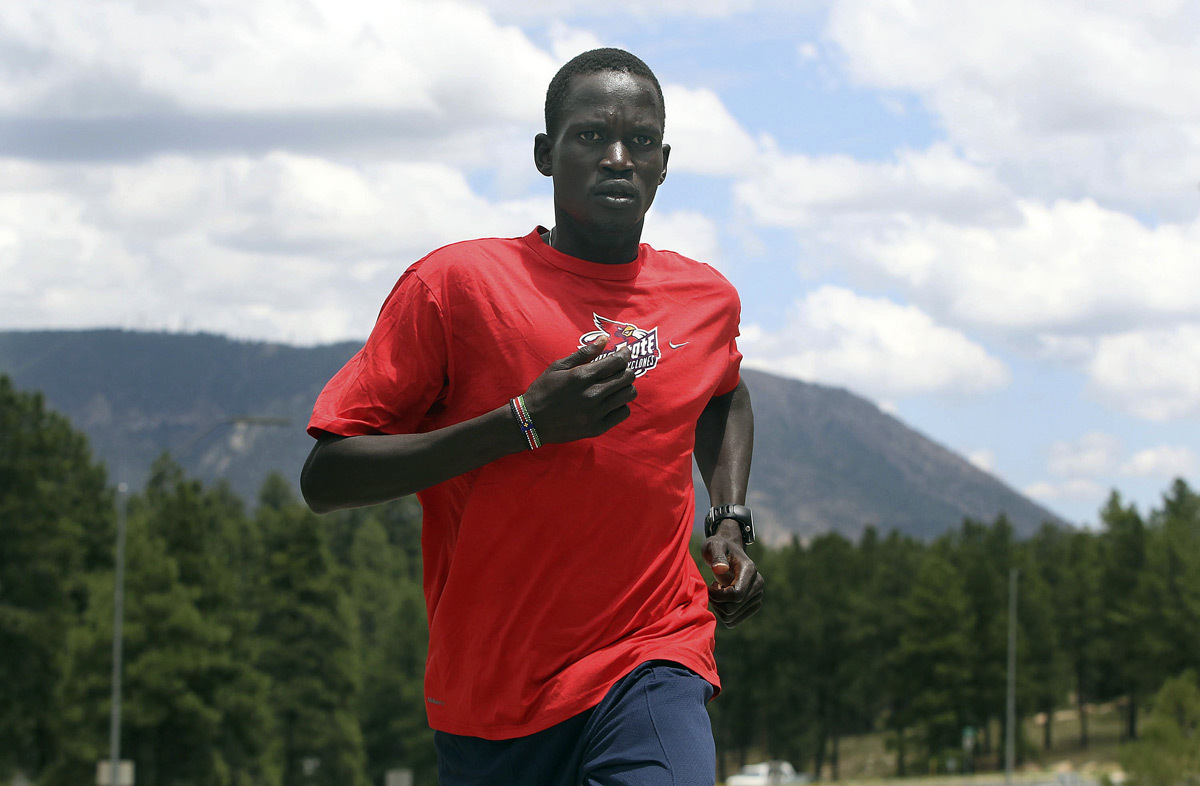
I am basically still on the verge of tears as I write this. Bill Gallagher’s emotional documentary Runner opens with sports coverage of a marathon and slowly zooms in on one man in particular. “Now this particular runner,” says a dorky sportscaster, “has an unbelievable story.”

He doesn’t know the half of it. This is the story of Guor Marial, a Sudanese refugee who went on a journey to become an Olympian. 

As a young boy, Marial runs from hardship to hardship, eventually getting separated from his family, and ultimately finding himself in America. It’s wild to hear Marial’s initial confusion at the absurdity of it all, that something he did to survive in Sudan is something westerners do as a sport. Marial hits the high school track field and metamorphosizes. From there we watch the harsh juxtaposition of this high school dream athlete winning medals while simultaneously struggling with the fact that his family members in Sudan are dying. 

My reservations about macho corporate sports went out the window as I watched this boy running in the name of his faraway home. It’s also a wonderful thing to see journalists, coaches and politicians (mostly white, privileged Americans) one by one lay down their false crowns in awe before this kid who has gone through actual hell and is using his power to reach for nothing less than the Olympic games. 

This is the rare documentary that truly does justice to its incredible hero. It is cinematic to the point where your first reaction might be to think you are watching staged reenactments, but no, this is all real. They have footage of seemingly every moment of Marial’s journey, as well as animation and news footage depicting the hell of war and starvation in Sudan. 

Arguably the film’s most emotional moment occurs when Mrial returns to South Sudan to be reunited with his parents, who he has not seen in years. The moment when his mother, who lost so many of her children, collapses to the ground at the sight of her long lost son is one of the most powerful moments I have ever seen captured by a camera.

This is still only the beginning of the story of the first Olympian from South Sudan: a beautifully human story that is about nothing less than what makes us go, what makes us try, and what makes us run. 

You’ve Got a Friend in Me

Jack & Yaya

by Brandon Thomas

LGBTQ youth often find themselves at the receiving end of family and friend abandonment. The people who are supposed to support them through the coming out simply walk away. The story at the heart of Jack & Yaya is about what happens when two childhood friends go through the same life-changing events, and how those closest to them stick around to champion their lives.

Jack and Yaya grew up as next-door neighbors in south New Jersey. From early on, they both saw who the other truly was, a girl and a boy, even if the rest of their family and friends did not. 

In her directorial debut, Jennifer Bagley wisely lets the film’s two subjects be front and center. Jack and Yaya share a genuine openness about their lives. Absent is any kind of hubris when the two of them talk about their struggles or their successes. This honest, matter-of-fact nature feels immediately welcoming.

The focus on day-to-day struggles for transgender people is real and evident even in this sunnier-than-normal documentary. Jack struggles with running into discrimination even in a city as large as Boston. Yaya worries about the constant financial stress around obtaining hormones. It’s a needed dash of reality. 

As the colorful cast of characters who revolve around Jack and Yaya are introduced, it’s not hard to see how these two became the people they are. Bagley naturally captures the warmth and love that flows between all of them. Amidst the alcohol and ‘70s rock, Yaya’s uncle Eddie spills to the camera how much love he has for both Yaya and Jack. “All you need is frickin’ love!” bellows Eddie. 

Jack & Yaya works exceptionally well at being a celebration of these two people as they figure out their ever-changing lives. This isn’t a film interested in making a grand social statement. Bagley lets these two tell their story, and show us who they really are through their own words and actions.

Jack & Yaya beautifully shows how good we all can be when we prop each other up. Jack and Yaya’s lives could’ve gone so much differently. But they had each other and a support system that evolved into a deep friendship of genuine acceptance and caring. 

“All you need is frickin’ love!” indeed.