An Intimate Battle


by George Wolf


Rarely has the Battle of the Sexes been more confined than in Neil LaBute‘s Some Velvet Morning.

In fact. in writer/director LaBute’s latest look at the subject, all of the drama occurs at the tastefully decorated residence of one young woman.

Velvet (Alice Eve) is surprised one morning when Fred (Stanley Tucci) appears at her door, with several pieces of luggage in tow.  After four years, Fred has finally left his wife, he says, and he wants to again explore the chance of a life with Velvet.

Over the next 83 minutes, we learn about all the dark corners of their relationship. History is relived and ugly acusations are unfurled as Fred and Velvet take turns wielding the power in their exchanges.

That Tucci is wonderful should comes as no surprise, but it is Eve’s performance that should open some eyes to the depth of her dramatic talent.  Velvet is a young woman with secrets, and Eve strings us along deliciously in the emotional dance with her old flame.

At its core, the film is a return to LaBute’s early roots as a playwright, as his favorite theme of the dark, cynical nature of relationships is explored using just two characters, but from rotating perspectives that constantly surprise.

As the meeting escalates toward the ending you think you know, LaBute throws the ace he’s been holding back since Fred rang the doorbell, but it doesn’t result in quite the jackpot he may have been seeking.

Often absorbing and sporting two fine performances, the final reveal in Some Velvet Morning ultimately leaves you wondering if LaBute’s destination was worth the journey.

 

Verdict-3-0-Stars


Countdown: Best in Horror, 2013


At one point, it looked like 2013 was going to be a bloody banner year for horror. Remember that time? We’d already seen the magnificence of the Evil Dead remake as well as the spooktacular glory of the original The Conjuring, and we still had You’re Next, The Purge, Insidious: Chapter 2 and Carrie to go? Too bad those last few couldn’t live up to expectations.

The year did produce a handful of really excellent horror flicks, though. Here is our Top 5.

5. Byzantium

Director Neil Jordan returned to the modern day/period drama vampire yarn this year. Thanks to two strong leads, he pulls it off. Saoirse Ronan is the perfectly prim and ethereal counterbalance to Gemma Arterton’s street-savvy survivor, and we follow their journey as they avoid The Brotherhood who would destroy them for making ends meet and making meat of throats. Jordan’s new vampire drama attempts a bit of feminism but works better as a tortured love story.

4. Simon Killer

The effortlessly creepy Brady Corbet plays the title role in Simon Killer, a college kid alone in Paris after a messy break up. He’s loathsome and  cowardly and impossible to ignore as he hatches a plan with his new prostitute girlfriend – a wonderfully tender Constance Rousseau – to make some quick cash. The film draws you in like a thriller before morphing into a sinister character study that will leave you shaken.

3. We Are What We Are

Not enough people saw this gem, and even fewer saw the brilliant Mexican original, but both are essential horror viewing. The reboot takes a very urban, very Mexican tale and spins it as American gothic, with wildly successful results. From the same writing/directing team that brought forth Stake Land (if you haven’t seen it, you really should), this is one of the few Americanized versions of foreign horror to satisfy – although you may not be hungry again for a while.

2. Evil Dead

Naming #1 was a tough call because of this one, among the all time best reboots in horror history. Fede Alvarez (with some help from the Oscar winning pen of Diablo Cody) respects the source material while still carving out his own vision. Goretastic, scary, and unexpectedly surprising given how closely it aligns itself to its predecessors, the movie has it all – including more gallons of blood than any film in history. Seriously.

1. The Conjuring

James Wan mixes the percussive scares of modern horror with the escalating dread of old fashioned genre pieces, conjuring a giddy-fun spookhouse ride guaranteed to make you jump. And he did it all without FX. A game cast helped, but credit Wan for the meandering camera, capturing just what we needed to see at the exact second that it would do the most damage.

BiggerLouderFasterMore


by George Wolf

So, how rich do you want to be?

In the opening minutes of The Wolf of Wall Street, 26 year old Jordan Belfort (Leonardo DiCaprio) tells us making 49 million dollars in a year only pissed him off, because he really had his heart set on a million a week.

How did he ever pay the phone bill?

Belfort, the real life stock market wizard who hit it big in the 1990s and wrote the memoir the film is based on, was more concerned with paying for drugs, hookers, yachts and lavish parties, as well as staying one step ahead of the Feds who were looking to bring him down.

No doubt, the man has an incredible story to tell, and director Martin Scorsese tells it perfectly, uncorking a terrifically frenzied, wickedly funny three hour showcase of unchecked hedonism.

This is no hand-wringing reflection on the wages of sin, just a swaggering, appropriately superficial and completely entertaining lesson in the American dream.

DiCaprio is nothing short of electric, giving perhaps the most can’t-take-your-eyes-off-him performance of his career. He takes Belfort from a wide-eyed Wall Street rookie (under the unhinged tutelage of Matthew McConaughey in a priceless cameo) to a drug-addled zillionaire with the perfect blend of vanity and paranoia, always leaving you anxious for his next move.

As Belfort’s partner-in-crime Donnie Azoff, Jonah Hill again delivers a terrific supporting turn, and one particular scene with he and DiCaprio wrestling over a telephone, both characters locked in a quaalude stupor, is alone worth the price of admission.

Scorsese and screenwriter Terence Winter strike just the right tone with the story of Belfort’s rise and fall. They invite comparisons to both Gordon Gekko’s “greed is good” speech and Scorsese’s own Goodfellas, then remind you this is another era entirely as DiCaprio breaks the fourth wall, speaking asides directly to the audience as if we were accomplices. Which, of course, we are.

The ridiculous degree to which America worships the uber-rich deserves the riotous, foot on the gas, keep up or get out approach Scorsese employs.  Belfort and his ilk knew only one credo:  bigger, louder, faster, more. That’s exactly what TWOWS delivers.

Sit down, shut up, and get ready for a helluva ride.

Verdict-4-0-Stars


You’ll Hold a Grudge

Grudge Match

by Hope Madden

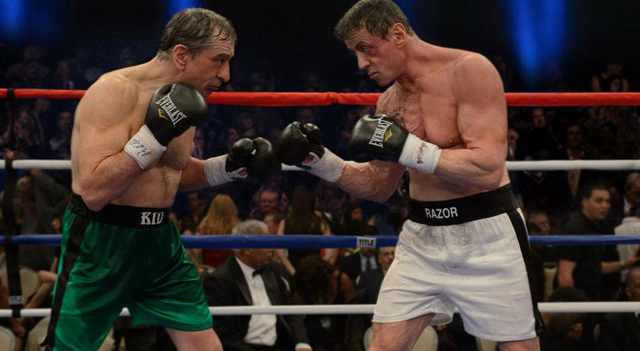
It’s a tough battle. The late-life Sylvester Stallone and Robert De Niro battle hard. They sweat! They flail! They struggle against the stiff competition – I mean, do you remember RIPD? What about After Earth or Grown Ups 2? But, at long last, De Niro and Stallone walk out of that ring triumphant, in that they succeeded in crafting the worst film of 2013. Good on ya, guys!

De Niro has been whoring out – I mean, lampooning – his own image for decades, but it’s a row Stallone only accidentally began hoeing recently with his inadvertently comical The Expendables. Here, the two articulate the real tragedy of their waning professional years by reminding us all just how fine Raging Bull and Rocky really are.

In case you missed its countless ads, Grudge Match casts De Niro and Stallone as aging boxers lured into a rematch by Kevin Hart, who is actually funny. He’s not funny here, but there’s only so much a person can do.

Alan Arkin also tries really hard to salvage his scenes with his talent and solid comic timing. Unfortunately, he shares these scenes with Stallone, who is to comedy what Fox News is to journalism. The nine of us who saw Stop or My Mom will Shoot can attest to this – those of us unscarred enough by the experience to speak of it.

De Niro makes you weep for the glory of Raging Bull and the tragedy of lost artistic integrity. Meanwhile Stallone – whose artistic integrity was always pretty suspect – punch-jogs around urban Pennsylvania, trains with a curmudgeonly old man, drinks raw eggs. You see where this is going. It ain’t good.

But how can he go wrong with this script? Two old guys fighting! They don’t know what YouTube is – isn’t that hilarious? They probably have rotary phones and listen to 8 tracks, too. Comedy gold.

If 90 minutes of ridiculing our elderly isn’t entertainment enough for you, you will need to look elsewhere. In fact, the only reason you should be looking here is if you really hate Robert De Niro and/or Sylvester Stallone and ache to see them embarrass themselves for a paycheck, playing two men willing to embarrass themselves for  a paycheck.

So, I suppose you really could call Grudge Match the case of life imitating art, which is absolutely the only way the word “art” makes it into a description of this movie.


Verdict-1-0-Star


Life As He Dreams It


by George Wolf


The closing credits of The Secret Life of Walter Mitty inspired some immediate soul searching.

Why didn’t I hate this movie?

With generalized themes of empowerment strategically layered with soaring music, it has all the trappings of a shallow, follow-your-dreams retirement fund commercial that airs during the Super Bowl.

And yet, director Ben Stiller supplies enough visual style and unabashed earnestness to make his new adaptation of James Thurber’s classic story a surprising success.

Stiller also takes the lead role as the legendary daydreamer.  This Walter Mitty works in the photo department of Life magazine and secretly pines for co-worker Cheryl (Kristen Wiig) For years, Walter has handled the submissions from prized photographer Sean O’Connell (Sean Penn), but as layoffs mount and the last issue of Life draws near, the image that O’Connell has earmarked for the final cover goes missing.

Leaving his mundane schedule behind, Walter embarks on an around-the-world search for the elusive photographer and the lost photo. Through the terrain of Afghanistan to the wilds of Iceland and beyond, Walter follows O’Connell’s trail, racking up incredible life experiences with each new day.

Setting a film about seizing the fullness of life inside the waning days of Life magazine sounds obvious and cheesy, right? Right, and left to its own devices, Steve Conrad’s script would keep the film comfortably in that neighborhood.

Credit Stiller for the vision to see the bigger picture. On the surface, it might seem more natural for Stiller, who brought a wonderful edge to Zoolander and Tropic Thunder, to return to the satirical tone of Thurber’s original story. Instead, he fully embraces the larger than life quality of this treatment, filling the screen with glorious on-location sequences and truly sublime visuals.

Stiller the actor follows suit with a restrained lead performance. The antics of Danny Kaye’s 1947 film version are long gone, as Stiller’s Walter is a true introvert learning to embrace change. Wiig also dials it down, replacing her trademark quirkiness with a quiet sweetness while Penn, in what amounts to little more than a cameo, has some subtle fun with his rogue persona.

Yes, Walter Mitty stages a calculated assault on your feel good bone, but with tactics this good-natured and timely, it doesn’t hurt a bit.


Verdict-3-5-Stars


Too Superficial to Satisfy

Mandela: Long Walk to Freedom

by Hope Madden

In offering the world a glimpse of the phenomenal life of Nelson Mandela, director Justin Chadwick wisely relied on the words of the man himself, adapting Mandela’s autobiography for his film. Chadwick’s vision is grand, the performances strong, and the story not only compelling, but tragically timely. So why does Mandela: Long Walk to Freedom feel unsatisfying?

The fault is certainly not with the film’s leads. Idris Elba’s performance is alive with exploration. You can see his temperament adapt and change along with Mandela’s experiences. Elba finds a depth of character not provided on the page of William Nicholson’s screenplay, and his maturing characterization allows the film, which suffers from Cliffs Note-idis, a bit of depth it would otherwise lack.

Likewise, Naomie Harris deftly handles the far more radical change in character demanded from a depiction of Winnie Mandela. From idealist to radical, Harris nails the metamorphosis, but because of the way we simply check in with Winnie every few years, the role lacks much opportunity for nuance.

The film simply covers too much ground. It does so with sumptuous set design, a convincing ensemble, and a directorial hand that respects the source material enough to uncover flaws as well as triumph. But what Chadwick needed to do was narrow his vision.

Long Walk to Freedom offers perhaps the most compelling depiction of the relationship between Nelson and Winnie Mandela yet brought to the screen, aided by performances that ache with tenderness. Elba commands the screen with a smoldering charisma worthy of a portrait of Mandela, while Harris treats Winnie Mandela with respect and compassion without sugar coating her behavior.

Had Chadwick and Nicholson plumbed this rich relationship a bit more, or simply chosen any smaller slice of Mandela’s life to examine more fully, their film – with the gifts it has to offer – could have become a magnificent memorial for mourners and a fascinating introduction for those only drawn to the story of the leader because of his recent passing.

Instead, the filmmakers settled for a superficial treatment, hitting all the high points without examining the depth or complexity of anything. It’s an unfortunate compromise, both because all the needed ingredients were in place for a truly grand biopic, and because Mandela deserved a more memorable send off.


Verdict-3-5-Stars


http://www.youtube.com/watch?v=hmm-aazQQKA

Quintessentially Disney


by George Wolf


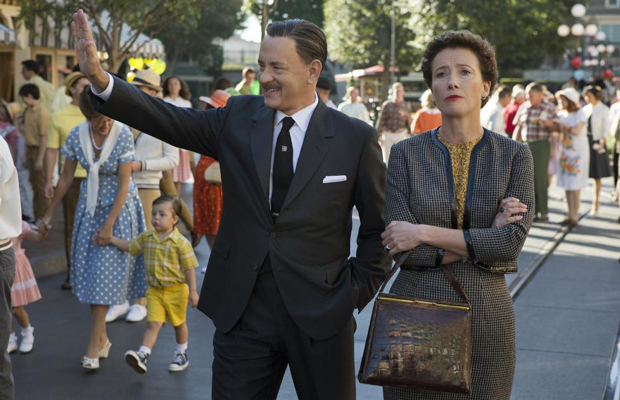
The God of Irony must be smiling on Saving Mr. Banks, the “Disneyfied” account of a legendary author afraid the film version of her greatest work would get… Disneyfied.

Leave it to a pair of reliably great actors, and the memories of one of Disney’s most treasured classics, to make sure the whole affair turns out much better than a black fly in your Chardonnay.

Emma Thompson brings wit and humanity to the role of P.L. Travers, who for years rebuffed all offers from Walt Disney himself to turn her Mary Poppins stories into a movie. Tom Hanks plays Mr. Disney with the charming twinkle you’d expect, and from their first scenes together, he and Thompson exhibit a playful, unmistakeable chemistry that buoys the film.

The fact that Saving Mr. Banks is as enjoyable as it is feels like an underdog snatching victory from sure defeat.

The script, from Kelly Marcel and Sue Smith, takes (according to numerous accounts) many “feel good” liberties with the story of how Mary Poppins came to fruition. Even worse, the director is John Lee  Hancock, the man behind The Blind Side, a downright criminal piece of whitewashing if ever there was one.

Together they fill the backstory of Travers’ troubled childhood with force-fed melodrama, attempting to pull every manipulative heartstring available. Though given less screen time, the treatment of heartbreak in Walt Disney’s own past is equally subtle.

But, in addition to the sublime lead performances and a strong supporting cast, Saving Mr. Banks has a powerful trump card:  Poppins!

Each time the music and writing team (Jason Schwartzman, Bradley Whitford and B.J. Novak-all stellar) show Travers a proposed storyboard or play her a new song, you can’t help but smile. Finish up with classic footage from the 1964 film and still pics from the actual premiere, and it’s pretty hard not to surrender to the guilty pleasures.

Those without an affinity for the source material may not get the same warm feelings, but adding schmaltz to their own story of schmaltz-adding is perverted Disney genius. That, along with the well-played nostalgia for one of their greatest achievements, just might make Saving Mr. Banks the quintessential Disney film.


Verdict-3-0-Stars


Do the Hustle!

American  Hustle

by Hope Madden

David O. Russell can direct the shit out of a movie, can’t he? He startled his way into our consciousness in ’94 with the unbelievable Spanking the Monkey, followed by a smattering of well-crafted, unmarketable, endlessly watchable films. Then he took a few years off and came back wearing his shootin’ boots.

The Fighter in 2010, followed by Silver Linings Playbook in 2012 racked up a grand total of 3 Oscars and another 13 nominations. That’s the way to shake off the artistic rust.

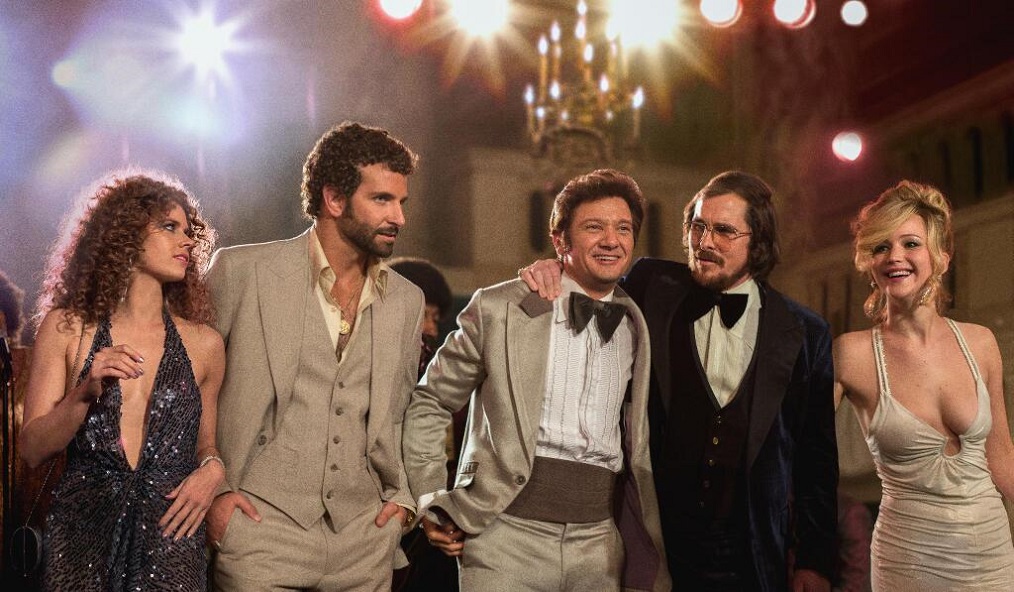
For his latest, American Hustle, Russell wisely cherry-picks castmates (a couple of Oscar winners among them) from his last two efforts to populate the world of 1978 and Abscam – the FBI sting that took down some corrupt public officials. And, as the screen announces just before the first disco-tastic image, “Some of this actually happened.”

One desperately ambitious FBI agent (an unhinged and glorious Bradley Cooper) pinches two con artists (Christian Bale, Amy Adams – both outstanding) and insists they help him finger other white collar criminals. But his dizzying hunger for significance pushes their con to untenable extremes, and soon these low-flying hustlers are eyeball deep in politicians, Feds and the mafia.

Russell orchestrates con upon con, braiding loyalty with opportunism with showmanship, and providing his dream cast with everything they need to erupt onscreen.

Joining the stellar performers mentioned are the always reliable Jeremy Renner and the reliably brilliant Jennifer Lawrence. As an unpredictable spitfire, Lawrence is right at home. She excels, and Russell teases the absolute most out of her every moment of screen time (it makes no sense now but trust me, you’ll never call a microwave oven by its correct name again).

Louis CK – in his second strong cinematic turn this year (alongside Blue Jasmine) – is a great onscreen curmudgeon, and he offers such a perfect foil for Cooper’s combustible lead that their scenes together are a scream.

Honestly, with the electricity on screen whenever Lawrence or Cooper appear, it’s almost possible to overlook Bale and Adams, but what a mistake that would be! Bale crawls into this character, as he does every character, and convinces us of the sleazy but good-hearted schlub inside this grifter.

Likewise, Adams – a performer so expressive with just a look – keeps you on your toes. It’s her flawless work as Edith (or is that Sydney?) that keeps all the cons spinning at once, and you never know exactly where her loyalties lie. In fact, you’re pretty sure she isn’t certain. Unless she’s just playing you.

While Russell’s fondness for Goodfellas colors the entire running time, there’s no question that his creation finds its own way and becomes something unique and fantastic. The writing is exceptional, the performances volcanic, and the result is the sharpest and most explosively funny movie in Oscar contention.


Verdict-4-5-Stars


The Brothers’ Soulful Look Inside

Inside Llewyn Davis

by Hope Madden

In some circles, a new Coen brothers‘ film is more hotly anticipated than the next Batman. Those are my people. Joel and Ethan Coen have crafted among the most impressive set of movies of any American filmmakers. Though there are certain thumbprints that mark a film as theirs, they never cease to surprise in the art they produce – which, as often as not, is art for art’s sake. And this is the very theme of their latest effort, Inside Llewyn Davis.

An immersive experience that takes you directly to the heart of the 1961 Greenwich Village folk scene, the film shadows the titular, beleaguered artist for just a few days as he tries to survive both winter and his chosen field.

The film opens onstage, as Llewyn (a fantastic Oscar Isaac) sings in the smoky Gaslight Club. It’s an intensely intimate segment, and Isaac performs not a snippet, but an entire number. His performance is exceptional, and it tells you more about Llewyn than the next 90 minutes are bound to share.

Isaac and the brothers offer a superbly nuanced character study, so understated as to be almost hypnotic. Isaac’s world-wearied stare and infrequent songs do the majority of the work, but his adventure – as brilliantly written as anything you’d expect from the Coens – captures your attention.

Enough can’t be said about Isaac’s performance, both as an actor and as a musician, because the role requires much from both. He shoulders nearly every second of screen time, offering enough self-destructiveness, tenderness and ego to keep you believing in his trials and almost reluctantly rooting for him.

He’s aided by enigmatic performances in wonderfully odd roles. Coen regular John Goodman adds color as an aging jazz man, while Carey Mulligan spits inspired insults, and Justin Timberlake plays convincingly against type as the group’s square.

It’s not just the performances or the writing that make this film so languidly watchable, but the magically depicted setting – so unerringly authentic that you feel you’re inside a Bob Dylan album cover. Between that and the music – so, so many points made simply with the music – the film shines.

But what sets Llewyn Davis apart from the rest of the Coen stash is its lack of cynicism. Sure, with some battered years under his belt as a musician, not to mention his deeper scars and struggles, Llewyn holds a defensively cynical outlook. But he’s hopelessly true to his art. Can’t imagine where he got that.


Verdict-4-5-Stars


The ‘Stache Takes Manhattan


by George Wolf


According to facebook comments, there are humans out there who don’t think Will Ferrell is funny, and say they don’t understand all the fuss about Anchorman 2, and you know what was really funny? Delta Farce.

I am not one of those people.

Look, I’m not going to tell you The Legend Continues is as funny as the original, because , Great Odin’s Raven!, you’d know I was lying. But it is funny, sometimes downright eye-wateringly hilarious.

The swinging 70s have given way to 1980, as Ron Burgundy (Ferrell) and his news team move to New York to join GNN, the very first 24 hour news network. After finding themselves on the graveyard shift, Ron, Brick (Steve Carell), Brian (Paul Rudd) and Champ (David Koechner) set their sights on moving into primetime and taking down the network golden boy (James Marsden).

Ferrell and co-writer Adam McKay (who also directs) get more pointed in their satire of TV news in round two, which seems a natural progression. Occasionally, things get a tad too obvious, but the overall subject of the sad state of broadcast journalism is still so ripe for ridicule that the film is always able to recover pretty quickly.

Two curious plot points hold this new Burgundy adventure back from striking ratings gold, one involving Ron’s health and another concerning his strange choice of new pet (don’t worry, Baxter’s still around). Both subplots fall flat, bloating the film by at least twenty self-indulgent minutes that were better relegated to the deleted scenes section of the DVD.

The other 100 minutes, though, are chock full of nutty goodness. The four core actors again excel at this rapid fire, improv-heavy brand of comedy (especially Koechner, who jumps up a notch this time) and the new faces (Kristin Wiig, Meagan Good, Greg Kinnear) blend in well. Expect some inspired sight gags (keep an eye on that news ticker), well-played homages to the best moments from part one, a litany of welcome cameos, and a small reprise at the end of the credits.

While this Anchorman lamp may not be quite as lovable, you’ll like this lamp, you’ll really like this lamp.


Verdict-3-5-Stars


Hope Madden and George Wolf … get it?