Fright Club: Coming of Age Horror

For many – perhaps most – coming of age is a horror in and of itself, full of confusion, embarrassment, personality change, even blood. Which is why it is ripe fodder for horror, a genre that has plumbed the depths of adolescent despair for any number of monster movies, slashers, camping horrors, and nasty prom dates. Today we celebrate the unmitigated horror of burgeoning adulthood with our list of the five best Coming of Age horror films, with the help of Get It Together podcasters Pete Stroup and David Huff.


5. Ginger Snaps

Sisters Ginger and Bridget, outcasts in the wasteland of Canadian suburbia, cling to each other, and reject/loathe high school (a feeling that high school in general returns).

On the evening of Ginger’s first period, she’s bitten by a werewolf. Writer Karen Walton cares not for subtlety: the curse, get it? It turns out, lycanthropy makes for a pretty vivid metaphor for puberty. This turn of events proves especially provocative and appropriate for a film that upends many mainstay female cliches.

Walton’s wickedly humorous script stays in your face with the metaphors, successfully building an entire film on clever turns of phrase, puns, and analogies, stirring up the kind of hysteria that surrounds puberty, sex, reputations, body hair, and one’s own helplessness to these very elements. It’s as insightful a high school horror film as you’ll find, peppered equally with dark humor and gore.


https://www.youtube.com/watch?v=Zoa1A987A_k


4. Let the Right One In

In 2008, Sweden’s Let the Right One In emerged as an original, stylish thriller – and the best vampire flicks in years. A spooky coming of age tale populated by outcasts in the bleakest, coldest imaginable environment, the film breaks hearts and bleeds victims in equal measure.

Kare Hedebrant‘s Oskar with a blond Prince Valiant cut falls innocently for the odd new girl (an outstanding Lina Leandersson) in his shabby apartment complex. Reluctantly, she returns his admiration, and a sweet and bloody romance buds.

This is a coming of age film full of life lessons and adult choices, told with a tremendous atmosphere of melancholy, tainted innocence, and isolation. Plus the best swimming pool carnage scene ever.

The unsettling scene is so uniquely handled, not just for horrifying effect (which it certainly achieves), but to reinforce the two main characters, their bond, and their roles. It’s beautiful, like the strangely lovely film itself.


3. Carrie

The seminal film about teen angst and high school carnage has to be Brian De Palma’s 1976 landmark adaptation of Stephen King’s first full length novel, the tale of an unpopular teenager who marks the arrival of her period by suddenly embracing her psychic powers.

Sure the film opens like a ‘70s soft core porno, with images created by a director who has clearly never been in a girls’ locker room and therefore chose to depict the one in his dirty, dirty mind. But as soon as the bloody stream punctures the dreamlike shower sequence, we witness the definitive moment in Mean Girl Cinema. The “plug it up” refrain, coupled with Sissy Spacek’s authentic, even animalistic portrayal of panic, sets a tone for the film. Whatever Carrie may do, we (the voyeurs, no doubt more like the normal kids than like Carrie) are to blame.

This film exposes a panic about the onslaught of womanhood. The same panic informs <em>The Exorcist</em> and dozens of others, but De Palma’s version offers more sympathy than most. Spacek is the perfect balance of freckle-faced vulnerability and awed vengeance.


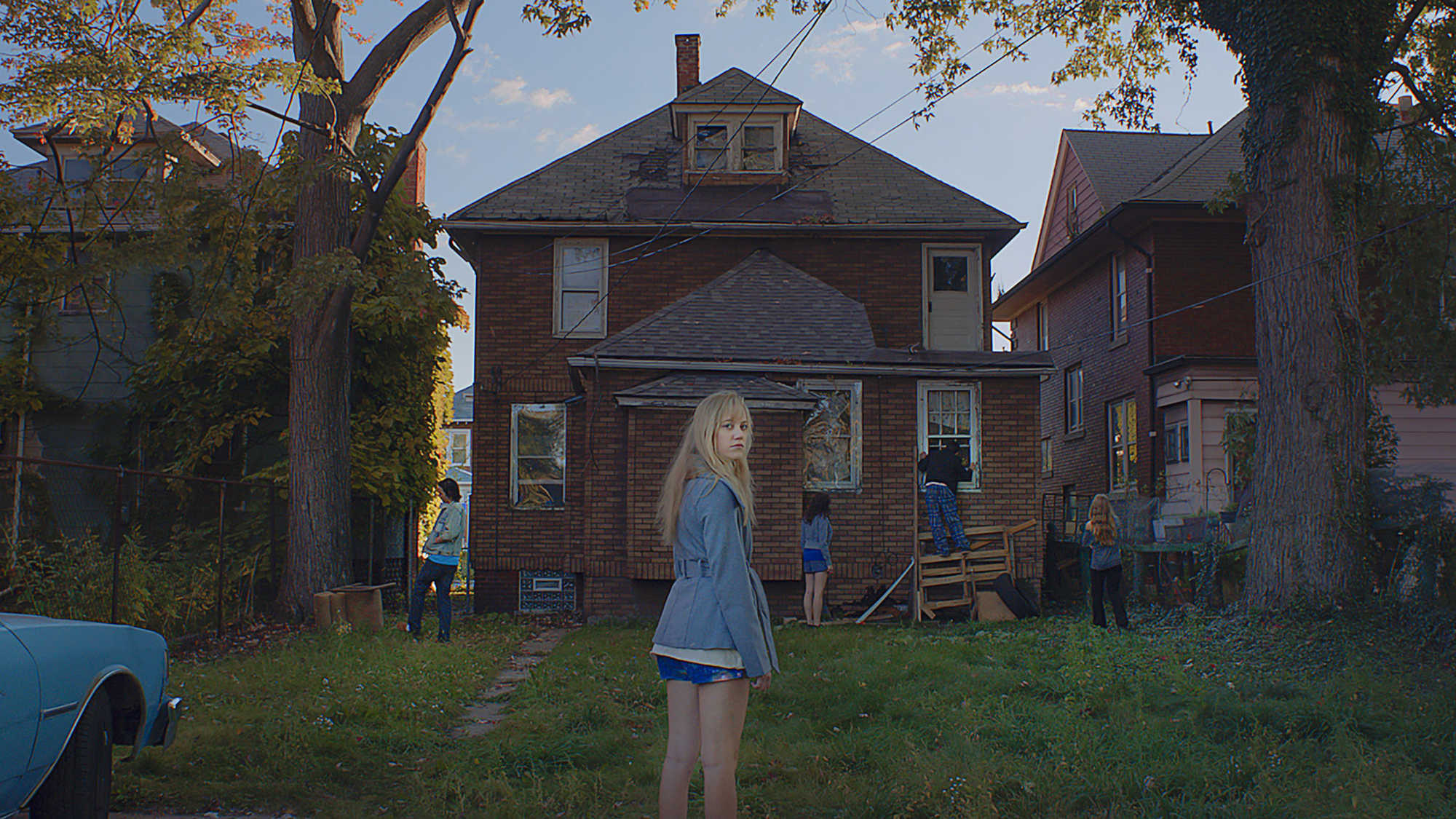
2. It Follows

It Follows is a coming of age tale that mines a primal terror.  Yes, it’s the STD or horror movies, but don’t let that dissuade you. Writer/director David Robert Mitchell understands the anxiety of adolescence and he has not simply crafted yet another cautionary tale about premarital sex.

Mitchell has captured that fleeting yet dragging moment between childhood and adulthood and given the lurking dread of that time of life a powerful image. There is something that lies just beyond the innocence of youth. You feel it in every frame and begin to look out for it, walking toward you at a consistent pace, long before the characters have begun to check the periphery themselves.

Mitchell borrows from a number of coming of age horror shows, but his film is confident enough to pull it off without feeling derivative in any way. The writer/director takes familiar tropes and uses them with skill to lull you with familiarity, and then terrify you with it.


1. The Witch

Ideas of gender inequality, sexual awakening, slavish devotion to dogma, and isolationism roil beneath the surface of this film, yet the tale itself is deceptively simple. One family, fresh off the boat from England in 1630 and expelled from their puritanical village, sets up house and farm in a clearing near a wood.

There William (Ralph Ineson) and Katherine (Kate Dickie) will raise their five children: the infant Samuel, young twins Mercy (Ellie Grainger) and Jonas (Lucas Dawson), nearly adolescent Caleb (Harvey Scrimshaw), and the eldest, Tomasin (Anya Taylor-Joy), nearly a woman now.

As a series of grim catastrophes befalls the family, members turn on members with ever-heightening hysteria. The Witch creates an atmosphere of the most intimate and unpleasant tension, a sense of anxiety that builds relentlessly and traps you along with this helpless, miserable family.

As frenzy and paranoia feed on ignorance and helplessness, tensions balloon to bursting. You are trapped as they are trapped in this inescapable mess, where man’s overanxious attempt to purge himself absolutely of his capacity for sin only opens him up to the true evil lurking, as it always is, in the woods.

 

Nice Nice Baby

The Nice Guys

by Hope Madden

Tell me you’ve seen any of the countless trailers for Shane Black’s new action comedy The Nice Guys. Funny! I haven’t had such high expectations for a new film yet this year.

Ever since Black announced his presence with authority, penning ‘87’s iconic buddy cop action flick Lethal Weapon, he’s been one to watch. Kiss Kiss Bang Bang, his directorial debut, suggested he might even be keeping his best stuff for himself. But after a while, his tics and tendencies grow tiresome.

The Long Kiss Goodnight, anyone?

And though his newest effort absolutely revisits most of the filmmaker’s by-now obvious predilections, his craftsmanship and casting have never been better.

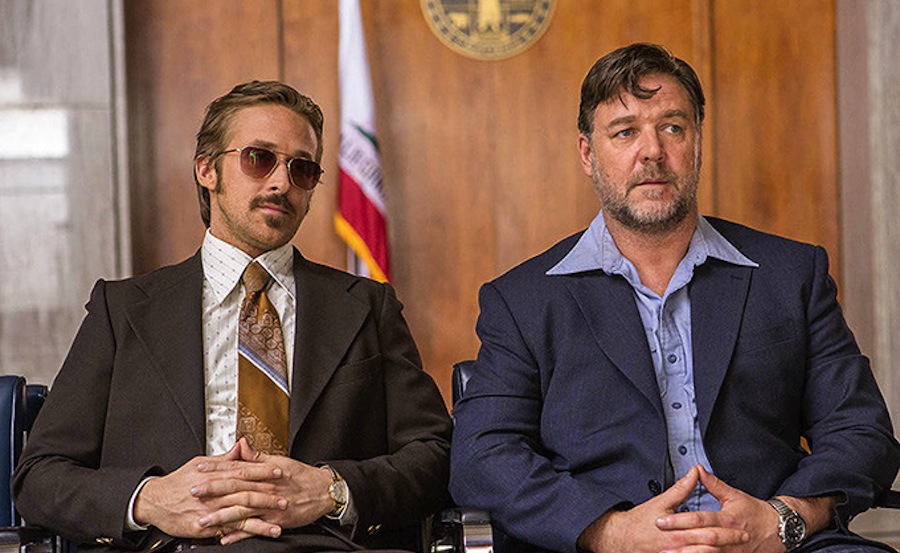
Hey girl, guess what – Ryan Gosling is a hoot! No, no, I didn’t say he’s hot (as that goes without saying). He’s a hoot. And if you found his scene-stealing performance in last year’s gem The Big Short a refreshing and joyous change of pace for the award-bedecked actor, you will surely enjoy this masterpiece of comic timing and physicality.

Gosling plays Holland March, an alcoholic PI with questionable parenting skills who reluctantly teams up with muscle-for-hire Jackson Healy (Russell Crowe). What begins as a low-rent missing persons case snowballs into an enormous conspiracy involving porn, the government, and the all-powerful auto industry. (It is 1977, after all.)

Aah, 1977 – when everybody smoked, ogled women, and found alcoholism a laugh riot. Black puts this time machine quality to excellent use in a film that would have felt stale and rote during his Eighties heyday, but today it serves as an endlessly entertaining riff on all that was so wrong and so right about the Seventies.

A brightly lit (if smog-choked) Southern California noir-turned-buddy-action comedy, The Nice Guys does a surprisingly good job at finding its tone. All the lurid, twisty plot fodder could easily weigh the film down in gritty drama, but Shane’s heart is in the budding, unsanitized bromance.

Gosling’s impeccable hilarity is custom-made for Black’s machine gun fire dialog, but Crowe also manages to get comfortable in the script, allowing both the conversation and action to breathe and take shape. The pair’s chemistry is a joy to watch, and is aided immeasurably by Angourie Rice’s flinty, intelligent turn as March’s disappointed daughter, Holly.


Fight for Your Right

Neighbors 2: Sorority Rising

by George Wolf

So, sororities aren’t permitted to have parties in their houses? Is that a real thing?

Obviously, I didn’t go Greek in college, but what kind of bullshit is that?

Neighbors 2: Sorority Rising not only finds it a teachable moment, but the perfect springboard for a funny, and dare I say, socially conscious sequel.

College freshmen Shelby (Chloe Grace Moretz) and her new friends Beth (Kiersey Clemons) and Nora (Beanie Feldstein – younger sister of Jonah Hill) don’t appreciate the “super-rapey” nature of frat bashes, so they decide to start Kappa Nu, an independent sorority dedicated to the high life. Guess where they find a perfect home base?

It’s the old Delta Psi house from four years earlier, right next door to the home Mac and Kelly Radner (Seth Rogen, Rose Byrne) have just put in escrow. The buyers have 30 days to think it over, so the desperate Radners turn to an old frenemy, former Delta Psi president Teddy Sanders, (Zac Efron), to help them drive the Nu neighbors out before their ragers tank the sale.

Director Nicholas Stoller and the writing team led by Rogen and frequent partner Evan Goldberg are all back, so expect more of what made the first film such a down and dirty treat. Byrne’s return is also integral, and not just because she’s proven to be a true comic talent.

Kelly’s spirited participation in the sex, drugs and body fluid-based gags made part one a refreshingly equal offender, and Neighbors 2 spreads similar wealth throughout the ladies of Kappa Nu. There’s a clear feminist undercurrent here, even if it is presented with the occasional awkwardness you might expect from a team of male filmmakers.

Moretz is a worthy new adversary for “the old people,” as she seems to relish the chance at digging in to comic edges we haven’t yet seen. Efron is even better, rising above another beefcake role to add sympathetic layers to Teddy’s struggle with life as an aging bro.

Though not quite as riotous as the original, Neighbors 2 still lands as one of the better comedy sequels. The laughs are familiar but they are steady, finding a comfort zone where raunchy charm and admirable conscience co-exist just fine thank you.

Verdict-3-0-Stars


Dance with the Devil

Belladonna of Sadness

by Hope Madden

Who’s looking for a psychosexual acid trip? Well, it’s your lucky day because Belladonna of Sadness – Eiichi Yamamoto’s 1973 animated cult flick – gets new theatrical life thanks to a 4K restoration.

Based on Satanism and Witchcraft – a 19th Century text by Jules Michelet about seduction, witchcraft, and female empowerment – the film tells the story of a newly married couple and their troubles in feudal Europe.

Jean and Jeanne attempt to sidestep the law of the land allowing a baron to deflower a bride, but their pleas fall on sadistic ears. Yamamoto’s vivid depiction of the gang rape that follows is not only a sudden visual eruption in the dreamy watercolor style that precedes the scene, but a hint at the unsettling imagery that will punctuate the entire balance of the film.

The story pits feminine power against the systemic misogyny of the time as an allegory of modern feminism – well, modern in 1973. Jeanne slowly comes to the realization that embracing Satan to break from the repressive nature of bureaucratized Christianity may be her only road to personal power.

On one hand, this particular theme of revolution is older than Michelet’s work and as contemporary as Robert Eggers’s modern genre masterpiece The Witch. And yet, it’s a startling revelation, subversive in many ways, most of which are depicted in this film with wild abandon. As genitalia morphs into lion mouths and giraffe heads during extended, orgiastic sequences, Yamamoto equates sexual liberation with personal empowerment.

And yet, this is a Nineteenth Century text penned by a man, which has been reimagined and rendered – animated, written, directed, and scored – by men. It may be less than surprising to find that Satan (the empowerer) is depicted as a small but growing anthropomorphic penis.

Though Belladonna of Sadness finds tragedy in the repression and objectification of women, the film seems at a loss as to how to express its themes without objectifying Jeanne.

The film certainly can’t be dismissed entirely because of its somewhat conflicted sense of female empowerment, though. Yamamoto’s hypnotic yet jarring visual style, rupturing panoramic still drawings with bursts of movement and color, looks like nothing else onscreen. The aesthetic meshes with Masahiko Sato’s psychedelic score to create the trippiest film to open on national screens since the Age of Aquarius.

It’s a fascinating, disturbing, imaginative piece of animation that looks and feels like nothing else.

Verdict-3-5-Stars


Anger Mismanagement

The Angry Birds Movie

by Rachel Willis

There have been a number of movies based on video games. From 1993’s Super Mario Brothers to the upcoming Tomb Raider movie, Hollywood has not shied away from mining video games as source material for film.

One of the latest in the video game to movie genre is The Angry Birds Movie, a film that seeks to explain why those birds who love to launch themselves at green pigs with enormous slingshots are so angry.

The focal character of the movie is Red, voiced by Jason Sudekis, an already angry bird living in a community of happy birds. Red’s anger gets him in trouble and he finds himself placed in anger management where he meets Bomb, Chuck, and Terence.

The arrival of a large number of green pigs to the birds’ island sets off warning bells for Red, but the other birds are happy to welcome the newcomers and chastise Red for his quickness to antagonism.

The major problem with Angry Birds is the lack of story. At 97 minutes, the movie has a lot of time to fill, and in the first half, the audience has to sit through quite a few montage sequences that are boring even for the youngest viewer. It isn’t until the second half of the movie, when the pigs reveal their true motives for landing on the birds’ island, that the movie starts to pick up. Where the first 45 minutes of the movie drag, the second 45 minutes make up for it with the action we know and love from the video game. The plot comes together, and children and their parents can both find something to enjoy.

The voice actors are myriad and lend their talents well to the film. Danny McBride as Bomb, and Peter Dinklage as Mighty Eagle, both stand out in their roles, providing much needed humor throughout. Jason Sudekis manages to carry a lot on his shoulders as the leading angry bird, but far too often the jokes he’s given to work with fall flat.

It’s unfortunate that the film isn’t 20 minutes shorter, as it might have been more appealing to both young and old had the screenwriters recognized the limitations of their source material.

Verdict-2-5-Stars


Fright Club: Best Horror/Non-Horror Double Features

There’s always reason to be proud when one of he most established and respected directors decides to dabble in horror, and likewise, when one of our own makes it big in the mainstream. It put us in the mood for some double features: great directors, one horror movie, one non-horror movie. And the possibilities are endless. How about Scorsese’s Cape Fear/Taxi Driver? Or something a little more contemporary – maybe Jeremy Saulnier’s Green Room and Blue Ruin (if you’re feeling colorful)? Oh, what fun! Let’s get started!

5. Ben Wheatley: Kill List (2011)/ High Rise (2015)

Kill List
Never has the line “Thank you” had a weirder effect than in this genre bender. Without ever losing its gritty, indie sensibility, Ben Wheatley’s fascinating film begins a slide in Act 2 from crime drama toward macabre thriller. You spend the balance of the film’s brisk 95 minutes actively puzzling out clues, ambiguities and oddities.

For those looking for blood and guts and bullets, Kill List will only partially satisfy and may bewilder by the end. But audiences seeking a finely crafted, unusual horror film may find themselves saying thank you.

High-Rise
Set inside a skyscraper in a gloriously retro London, Ben Wheatley’s adaptation of J.G. Ballard’s High-Rise is a dystopia full of misanthropic humor.

Laing (Tom Hiddleston) narrates his own story of life inside the “grand social experiment” – a high rise where the higher the floor, the higher the tenant’s social status. Performances range from slyly understated (Hiddleston, Elizabeth Moss) to powerful (Sienna Miller, Luke Evans) to alarmingly hammy (James Purefoy), but each contributes entertainingly to this particular brand of dystopia. Still, the wicked humor and wild chaos will certainly keep your attention.

4. Peter Jackson: Dead Alive (1992) / Heavenly Creatures (1994)

Dead Alive
This film is everything the early Peter Jackson did well. It’s a bright, silly, outrageous bloodbath. Lionel Cosgrove (Timothy Balme), destiny, a Sumatran rat monkey, an overbearing mother, a prying uncle, and true love are bathed in gore in the Kiwi director’s last true horror flick – a film so gloriously over-the-top that nearly anything can be forgiven it.

Jackson includes truly memorable images, takes zombies in fresh directions, and crafts characters you can root for. But more than anything, he knows where to point his hoseful of gore, and he has a keen imagination when it comes to just how much damage a lawnmower can do.


Heavenly Creatures
Jackson’s first non-horror film still follows rather horrific circumstances – New Zealand’s infamous Parker-Hulme murder case. Even fans of the director’s work to this point couldn’t have suspected he (and writing partner/write Fran Walsh) had anything this elegant and fantastical in them.

Certainly, spellbinding performances from young Kate Winslet and Melanie Lynskey didn’t hurt. Jackson and Walsh received their first Oscar noms for the screenplay in a film that eschews the trial, barely witnesses the crime, and focuses instead on the intense friendship that went horrifyingly wrong. It respects its source material and every person involved in the historical event, but it also understands the delirium of adolescence in a way few films do. Hobbits be damned, this is Jackson’s masterpiece.

3. David Cronenberg: Scanners (1981) / Eastern Promises (2007)

Scanners
The film that made Cronenberg an international name in the genre is about mind control – a very sloppy version of it – and that societal fear of being dominated by a stronger being. At its heart, this is another government conspiracy film wherein an agency foolishly believes they can harness an uncontrollable element for military purposes. Scanners is hardly the best of these (Alien is, FYI). But it’s gory fun nonetheless. What makes the effort undeniably Cronenberg (besides the exploding heads) is that connection between human tissue and technology.

The acting is silly, the technology is comically dated, and the computer nerd toward the end of the film inexplicably boasts a band aid on his face. But Michael Ironside is on fire and the movie ratchets up tension by keeping you wondering when the next head will explode.

Eastern Promises
In 2005, Cronenberg produced his most acclaimed and most mainstream film to date, A History of Violence. That success spawned more than an interest in non-genre fare, but also a fruitful collaboration with the underappreciated and versatile actor Viggo Mortensen.

Two years later, Mortensen would join an impeccable cast including Vincent Cassel, Armin Mueller-Stahl, and Naomi Watts in what would be the Canadian auteur’s finest film. Eastern promises is Cronenberg’s characteristically off kilter, visceral take on the mafia movie.

https://www.youtube.com/watch?v=dWC-ECjNqxo

2. Stanley Kubrick: The Shining (1980)/ 2001: A Space Odyssey (1968)

The Shining
A study in atmospheric tension, Kubrick’s vision of the Torrance family collapse at the Overlook Hotel is both visually and aurally meticulous. It opens with that stunning helicopter shot, following Jack Torrance’s little yellow Beetle up the mountainside, the ominous score announcing a foreboding that the film never shakes.

What image stays with you most? The two creepy little girls? The blood pouring out of the elevator? The impressive afro in the velvet painting above Scatman Crothers’s bed? That freaky guy in the bear suit? Whatever the answer, thanks be to Kubrick’s deviant yet tidy imagination.

2001: A Space Odyssey

After a less than enthusiastic reception from both audiences and critics in 1968, 2001 persevered, establishing its legend as perhaps the most magnificent science fiction film ever made.

Kubrick and legendary sci-fi author Arthur C. Clarke adapt Clarke’s short story with ambitious vision, epic scope, precise execution. More than a film, 2001 transcends the screen to become a mind-bending look at “first contact” that elicits levels of awe and wonder reserved for timeless pieces of art.

Very simply. 2001 is essential cinema of the highest order.

https://www.youtube.com/watch?v=E8TABIFAN4o

1. William Friedkin: The Exorcist (1973)/ Killer Joe (2011)

The Exorcist
Thanks to an intricate and nuanced screenplay adapted by William Peter Blatty from his own novel, the film boasts any number of flawed characters struggling to find faith and to do what’s right in this impossible situation.

Friedkin balanced every scene to expose its divinity and warts, and to quietly build tension. When he was good and ready, he let that tension burst into explosions of terrifying mayhem that became a blueprint for dozens of films throughout the Seventies and marked a lasting icon for the genre. Even after all this time, The Exorcist is a flat-out masterpiece.

Killer Joe
Following a long, fairly quiet period, in 2011 Friedkin returned with something bold and nasty:Killer Joe. Matthew McConaughey plays the titular killer, a predator in a cowboy hat making deals with some Texas white trash. The deal goes haywire, and some crazy, mean, vividly depicted shit befalls those unthinking trailer folk.

Subdued, charming, merciless, weird, and oh-so-Southern, Joe scares the living hell out of any thinking person. Unfortunately, that doesn’t really describe the Smiths – an exquisitely cast Emile Hirsch, Juno Temple, Thomas Hayden Church, and a flawless Gina Gershon. This is an ugly and unsettlingly funny film about compromises, bad ideas, and bruised women. And it is the best thing Friedkin has done since The Exorcist.


Not Much Better in the Light

The Darkness

by Hope Madden

Back in 2005, Aussie filmmaker Greg McLean set the genre world ablaze with his merciless Outback horror Wolf Creek. An amazingly disturbing and well-crafted film, it seemed to mark a strong new presence in horror.

Nearly a dozen years later, McLean hasn’t been able to reproduce that success, although he tries once again with this PG-13 terror starring Kevin Bacon.

Bacon is Peter Taylor, and while Pete and his family were vacationing in the Grand Canyon, his autistic son picked up a handful of ancient Anasi demons and brought them home.

Back at the ranch, family members turn on each other while the dog next door barks incessantly, and a once promising director falls back on tired clichés and unconvincing FX. All this in an attempt to lead us to the conclusion that something supernatural is afoot.

Once the drama in the house sets in, The Darkness becomes a wearisome riff on Poltergeist.

Since it is now mandatory in all “is it evil or am I crazy” storylines, you can expect close-ups of computer screens as the concerned and beleaguered google ridiculous phrases and uncover incredible evidence. The mom (McLean favorite Radha Mitchell) googles “strange smells” and finds a link between autism and the spirit realm. I swear to God.

This is the filmmaker who once taught us that we do not want to play “head on a stick,” and he is now contenting himself with diluted, formulaic, toothless scares? WTF?

That’s not to say that you can’t make a good horror movie without an R-rating. The Ring was the scariest movie of 2002, PG-13 tag and all. Hell, the MPAA gave Jaws a PG and that film scared every person who saw it.

It can be done, and ten years ago I would have believed a talent like McLean would be the next filmmaker to succeed.

I would have been wrong.

Verdict-2-0-Stars


Stocks and Barrels

Money Monster

by George Wolf

Hard to believe it’s been 7 years since Jon Stewart reduced CNBC’s Jim Cramer to a pile of mush on The Daily Show, taking him to task for a brazenly reckless attitude toward the consequences of overly confident stock tips.

Money Monster is built on the premise of Stewart’s outrage, as the desperate Kyle Budwell (Jack O’Connell) hijacks the set of a money management show and takes its high-flying host Lee Gates (George Clooney) hostage on live TV. Kyle was one of the countless investors burned by Gates’s confidence in Ibis Clear Capital, which somehow lost $800 billion overnight. Kyle wants answers, and confessions.

Director Jodie Foster sets up the hostage drama quickly, then does her best to effectively polish the frequently clumsy attempts at social commentary.

The closed-circuit communication between Gates and his trusted director Patty (Julia Roberts) keeps the standoff intriguing, but it never feels as if Gates is in any real danger. There’s little shading to Kyle’s sympathetic nature, and little doubt that Gates and Patty will take up his cause to root out the mystery of the $800 billion “glitch.”

The script, from a team sporting lowlights such as Dear John and National Treasure on its resume, seems more ready for prime time than the big screen. Its points about financial corruption and weak journalism are well-intentioned but already well known, and while the film doesn’t pretend there are easy answers, it tries to satisfy the need for them with a crowd-pleasing finale that falls into place much too easily.

There are moments, such as Foster’s handling of Kyle’s mid-standoff conversation with his girlfriend, that reach a nicely subtle level of humanity. The performances, Roberts in particular, are customarily solid and Foster’s direction is crisp, but Money Monster emerges as much too blunt an instrument.

It wants us to think it’s mad as hell, when it really just wants to entertain.

Verdict-2-5-Stars


To Infinity, Not Beyond

The Man Who Knew Infinity

by Hope Madden

If you think a movie about math can’t be thrilling, well, The Man Who Knew Infinity won’t prove you wrong.

Writer/director Matt Brown’s painfully earnest biopic of Indian mathematical genius Srinivasa Ramanujan (Dev Patel) seeks to tackle divine inspiration, institutional racism, culture clash, colonialism, and mathematical proof against the backdrop of WWI Britain. Unfortunately, the film feels far more hemmed in by cinematic tradition than inspired by historical events.

Brown’s approach is certainly by-the-numbers, and a stifling respect for the subject hamstrings the effort. Ramanujan is never more than an utterly wholesome, godlike presence. A lead turn by Patel does nothing to burst through the clichés. As has been the case in each of his films, Patel’s performance is broadly drawn and lacking depth.

He isn’t given much to work with, truth be told. Brown’s screenplay offers little more than saintly suffering. Look how nobly he endures taunts, cultural misunderstandings, loneliness, illness!

The scenes at home in India are even more appallingly respectful, everything quaintly simple and yet admirable. It’s as if Brown distrusts the audience with any complexity or information on Ramanujan they might deem offensive. (Like, for instance, that his wife was a 10-year-old when they married.)

As Ramanujan’s Cambridge mentor G.H. Hardy, Jeremy Irons, of course, shines. A veteran of the melancholy Englishman role, Irons inhabits this academic with emotional rigor mortis, occasionally lapsing into the most charming flashes of vulnerability and ardor. The subtlety and sly tenderness of his performance suggests a longing that nearly revives the film from its terminal anemia.

A handful of supporting turns – Toby Jones, Jeremy Northam – almost add layers, but Brown’s screenplay relies so heavily on the rote of Traditional British Cinema that the film never gets the chance to breathe.

I’m willing to bet that Srinivasa Ramanujan was a flawed and fascinating person – geniuses so often are. Too bad Brown is content to see him as a romantic mystery.

Verdict-2-0-Stars


Lipstick Promises

Viva

by George Wolf

It’s fitting that Viva carries a subplot with ties to the boxing ring. The film is assembled with the familiar themes from any number of underdog sports movies, and overflowing with the heart needed to avoid drowning in cliche.

Much of that heart comes from the touching performance of Hector Medina as Jesus, a young man who works doing hair and makeup for a troupe of drag performers in Havana. Though he’s merely part of the crew, Jesus naturally dreams of the spotlight, finally getting his chance onstage as “Viva” when there’s a rare opening in the cast.

Viva’s first performance is met with a punch in the face from a man at the bar. That man is Jesus’s long lost father Angel (Jorge Perugorria – also terrific), a former boxer who’s only too happy to start crashing at Jesus’s place and dictating his life. These conflicts set by screenwriter Mark O’Halloran are obvious and formulaic, yet Viva sells them with charm and authenticity.

Director Paddy Breathnach (Blow Dry) grounds the film with gritty, crumbling Havana backdrops. He finds resonance in desolate moments that ultimately bring new depth to the escape Jesus finds onstage with Viva and her unique selection of torch songs.

There’s never any doubt if Angel will come to accept his son’s lifestyle or if Viva will shine in the spotlight, but you gain a rooting interest anyway.

Early on, Jesus’s mentor at the club tells him any performance has to be more than just lip syncing, it has to “mean something.” Viva‘s tune is far from new, but the film does find a beautiful meaning within it.

Verdict-3-5-Stars


Hope Madden and George Wolf … get it?


