So, there’s this great animated movie that no one saw. It probably isn’t entertaining enough for the littlest kids, but everyone else should see it. There’s also a middling action flick and a sad, sad reboot.
Entrancing, Kirill Serebrennikov’s Leto layers a variety of stylistic flourishes over the relatively simple plot—a love triangle between a rising rock star, his mentor, and the mentor’s wife. Set in 1980s Leningrad, I was thrown off-balance from the first.
When it comes down to it, I don’t know all that much about
rock and roll. I know even less about the Soviet Union.
So, it was a bit of a surprise to see OG hipsters playing a
show to a crowd of fans. But then I noticed that the fans were sitting politely
in their seats and that men in suits patrolled the performance hall ready to
put down any display of unruly behavior—piling on a sweet-faced girl who
sedately held up a small poster with a hand-drawn heart on it.
This is a country where, if you are going to play, you first
have to have your lyrics analyzed for ideological appropriateness.
The rising star Viktor Tsoi (Teo Yoo) and his mentor Mike
Naumenko (Roma Zver) were both real people fronting the influential bands Kino
and Zoopark, respectively. A statement
contained within the credits informs that the plot was based on Naumenko’s wife
Natalia’s (Irina Starshenbaum) memories. However, there is also a character
credited as “sceptic” who often breaks the fourth wall to explain to the viewer
that “Sadly, this did not happen.”
Shot in moody black
and white, with emotional pops of color, periodically animation creeps in to
punctuate the more fraught moments. There’s also the occasional song and dance
number in what is roughly a biopic—featuring covers of Talking Heads’ “Psycho
Killer,” Iggy Pop’s “The Passenger”, and Lou Reed’s “Perfect Day.”
Weird, occasionally wandering, Leto, provided a glimpse into the experience of artists living in a gritty, austere world that I’ve not thought much about before, but probably will now.
Lots going on this week in theaters. We talk through Crawl, Stuber, Darlin’, Wild Rose, and Toni Morrison: The Pieces I Am. We also cover what’s new in home entertainment.
This humiliating exchange happens between Casey (Jesse Eisenberg) and Sensei (Alessandro Nivola) as Casey excitedly signs up for karate lessons. Casey suffers from a severe lack of confidence. He leads a drab, boring life. His house? Boring. His job? Boring. Even his dog is boring. No one respects Casey. His coworkers barely register his existence. The final demeaning moment is the night he’s viciously attacked while walking home from the store. Karate seems like the perfect antidote for this life of mediocrity.
Eh – not really.
Watching The Art of Self-Defense made me think of Fight Club. A lot. Fight Club overflows with masculinity. Brawny men beating each other to a pulp while waxing philosophical is the film’s bread and butter. Fincher’s movie definitely comments on the toxicity of masculinity, but it also spends a heck of a lot of time glorifying it, too.
The Art of Self Defense is interested in what it means to be a “real man.” Outside of Casey, the men in this dojo operate through sheer brute force. Violence, intimidation and blackmail are how they make their world work. Casey’s gravitational pull to these figures is a tale as old as time. Writer/director Riley Stearns isn’t interested in reveling in this world Sensei has created, he’s more interested in pushing the audience to share in Casey’s horror as he experiences it.
It’s easy to look at many of Eisenberg’s roles and lump them into the same narrow category. Yes, he plays a lot of isolated losers that stammar and shuffle around, but he also plays those roles with varying degrees of nuance. There’s a level of fear and anxiety he brings to Casey that feels different from his other loveable nerds. Casey is a rubber band about to snap at any moment, and Eisenberg does a fantastic job of keeping the audience guessing as to when that will happen.
Nivola’s Sensei has an air of false machismo to him at all times. He speaks in a low, gruff voice, and his words feel precisely selected, but fake. Nivola gets that this movie is a stark black comedy, and he completely goes for broke. He is able to walk this fine line of playing a scene straight, yet has it come off as a comedic masterstroke.
Armed with biting satire, excellent performances, and more on its mind than cheap laughs, The Art of Self Defense delivers a bold, original dark comedy. Minimal flexing involved.
Viscosity! That’s the name of the game today, and it’s a messy, messy game to play.
Today we slip and slide through the sloppiest movies we could find as we count down the most inspired use of body fluids in horror. The whole mess is recorded live at Gateway Film Center, so please listen.
And don’t forget to bring a towel!
5) Don’t Breathe (2016)
Fede Alvarez’s magnificent home invasion horror made this list, beating out the projectile vomit of The Exorcist, the melting bums of Street Trash, the medical what-not of Re-Animator and the viscosity of other films. How did it do it? It was not because of volume.
It’s really just the one scene.
The one with a turkey baster.
The one with the single hair.
Ew.
4) Dead Alive (1992)
The list doesn’t exist without Peter Jackson, let’s be honest. Any old horror director can work with blood. Jackson certainly can. That party scene? The arterial spray poor Lionel Cosgrove causes with his lawnmower is truly a site to behold.
But what Jackson can do with pus and a bowl of custard? Chef’s kiss right there.
3) We Are the Flesh (2016)
Emiliano Rocha Minter loves him some taboos. No one bursts through taboos like him – well, Takashi Miike, maybe.
He also really loves body fluids. We mean all the body fluids. His 2016 social commentary swims them all. All all all.
Taboos and body fluids. Sloppy!
2) Evil Dead (2013)
Peter Jackson’s Dead Alive held the record for most blood in a film – 1000 gallons – until 2013.
It’s a record Sam Raimi’s earlier Evil Dead franchise efforts had once held, but Fede Alvarez (making his second appearance on this list!) drenched all records when he poured out 50,000 gallons of fake blood in a single scene.
Allegedly It Chapter 2 tops that, but I don’t know how you out-soak a torrential downpour of blood.
Gozu (2003)
Who’s not afraid of taboos? Well, the great and prolific Takashi Miike has no fear of body fluids, either. Hell, Ichi the Killer’s title screen is done in semen and one of Audition’s most memorable moments sees a multiple amputee eating his mistress’s vomit.
But with Gozu, Miike’s not holding back: blood, urine, semen, lactation, pus and other discharges I’m not sure how to even categorize. Gozu is an inspired, viscous mess.
Even as a child, Bill Perks felt the need to be a pack rat., saving and categorizing mementos from throughout his life. Usually, the interest for such an archive is limited to friends and family. Not this time.
After a trouble relationship with his father, Bill Perks created a new identity for himself as Bill Wyman, and The Quiet One opens his vaults for a look inside the life of the original bass player of The Rolling Stones.
Wyman has quite a collection to show you, and director Oliver Murray assembles it all dutifully. Anchored by Wyman himself as the wistful curator in an office full of artifacts, it’s not long before we understand a youthful Keith Richards remarking to the camera, “If I want to know what I did yesterday, I have to ask Bill Wyman.”
Wyman’s devotion to documenting his life becomes both a blessing and a curse for Murray”s documentary. For Stones aficionados (like myself, admittedly) the videos, photos, interviews and memories create a true insider’s tour through the history of one of the greatest rock bands of all time.
For anyone else, the film might resemble an unassuming tour guide pointing things out at the Rock and Roll Hall of Fame.
In a band with Mick and Keith (and later, even Ron Wood), Wyman’s nickname was never going to be the Charismatic One. But now, at 82 and retired, he’s like the weary grandfather proudly showing you his keepsakes.
They are some pretty amazing keepsakes, no doubt. But only at the end of the film, when Wyman recounts a backstage meeting with his hero Ray Charles, does Wyman really let you in.
It’s only a rock and roll doc, but a little more of that honest insight and we could love it.
Do you know Alice Guy-Blaché? Documentarian Pamela B. Green thinks you should.
She is clearly right.
Guy-Blaché’s groundbreaking career has not been celebrated in the same way as her historical counterparts. She was not only the first female filmmaker, she was among the first four filmmakers, period. She boasts an output of around 1000 films, among them the first narrative film, the first color tinted, and one of the first two films with synchronized sound.
And yet, of the dozen or so filmmakers and actors Green interviews in the opening montage, including Geena Davis, Peter Farrelly, Catherine Hardwicke, Peter Bogdanovich and Ava DuVernay, only DuVernay recognizes the name.
Says Bogdanovich, “I’ve spent my life making films and have
written for years about film and I’ve never even heard of her.”
Well, clearly Peter Bogdanovich never took a Women in Film
class at Ohio State.
Whether you have or have not heard of Alice Guy-Blaché, Green’s film is bound to be informative, showcasing a figure with remarkable aptitude not only in business (she ran her own studio and produced her own films) but amazing artistic vision, pioneering much of the comedic and dramatic form we now take for granted.
Jodi Foster lends respectful narration (and spot-on French pronunciation!) to an earnest and loving—if sometimes tedious—exploration.
Green’s film is at its best during rare interview footage of the filmmaker, at the time nearing the end of her life and taking a wistful, reflective posture. Between that, footage from Guy-Blaché’s canon, and responses from modern filmmakers on that footage, Green pieces together some engaging and illustrative moments.
Her film gets sidetracked too easily, though, answering questions from those very filmmakers who did not recognize Guy-Blaché’s name, “I would like to see inside her studio,” “I’d love to hear how she managed to be a filmmaker and a mother during that time period…”
These offshoot moments feel disjointed, lessening the
intimacy with the subject the more successful moments nearly reach.
Green’s biggest misstep as a filmmaker is her preoccupation with her own sleuthing, some of which feels endearing in its enthusiastic amateurishness, but too often comes off as needlessly self-congratulatory.
Though Green herself struggles to create a film artistically worthy of the pioneering filmmaker, her heart is in the right place and her quest to help Guy-Blaché reclaim her own place in cinematic history is laudable.
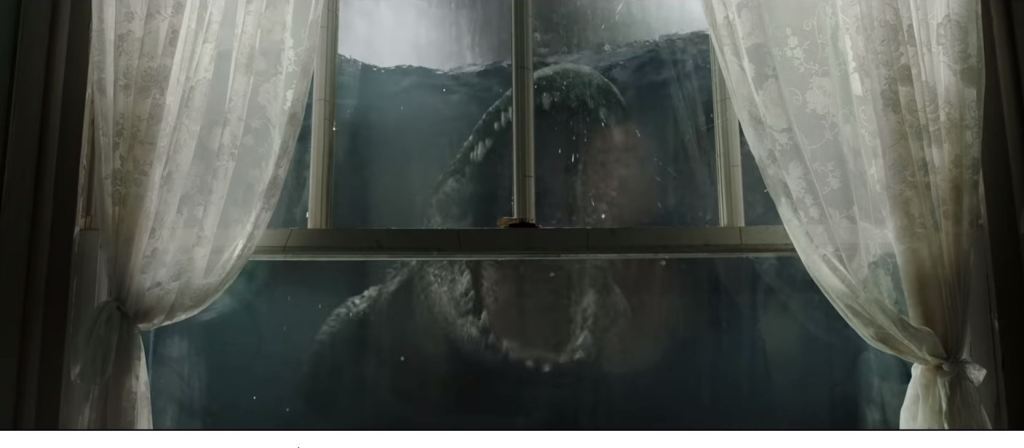
Just when you thought it was safe to explore your Florida crawlspaces during a Category 5, here comes Crawl to remind us that while Sharknadoes put tongues in cheeks, Gatorcanes are looking to remove the whole head.
Haley Keller (Kaya Scodelario) is a University of Florida swimmer (a Gator!), which comes in pretty handy when she ignores evacuation orders to look for the father that always challenged her to do better in the pool.
Dave Keller (Barry Pepper) is lying injured in a soggy basement, and even before Haley finds him, she finds that they are not alone.
Director Alexandre Aja (High Tension, Piranha 3D, The Hills Have Eyes remake) utilizes the confines of the flooding house to fine effect. Walls, pipes and tight corners create natural barriers between gator and bait, but as the water level keeps rising, Aja finds plenty of room for simmering tension and effective jump scares.
Plus plenty of bloodletting. Oh, yes, people do get eaten.
This survival tale doesn’t worry too much about suspending disbelief. It just keeps the water rising, the obstacles mounting (Haley’s “You gotta be fucking kidding me” speaks for all of us) and the visual effects nimble and nifty.
Writers Michael and Shawn Rasmussen get a bit too enamored with the father/daughter estrangements and swim team parlance (“You’re faster than they are! Swim!”), but Scodelario provides a capable anchor, giving Haley authentic layers of toughness and grit.
Aja and the effects team do the rest, enough to make Crawl an often entertaining creature and bloody fun summer feature.
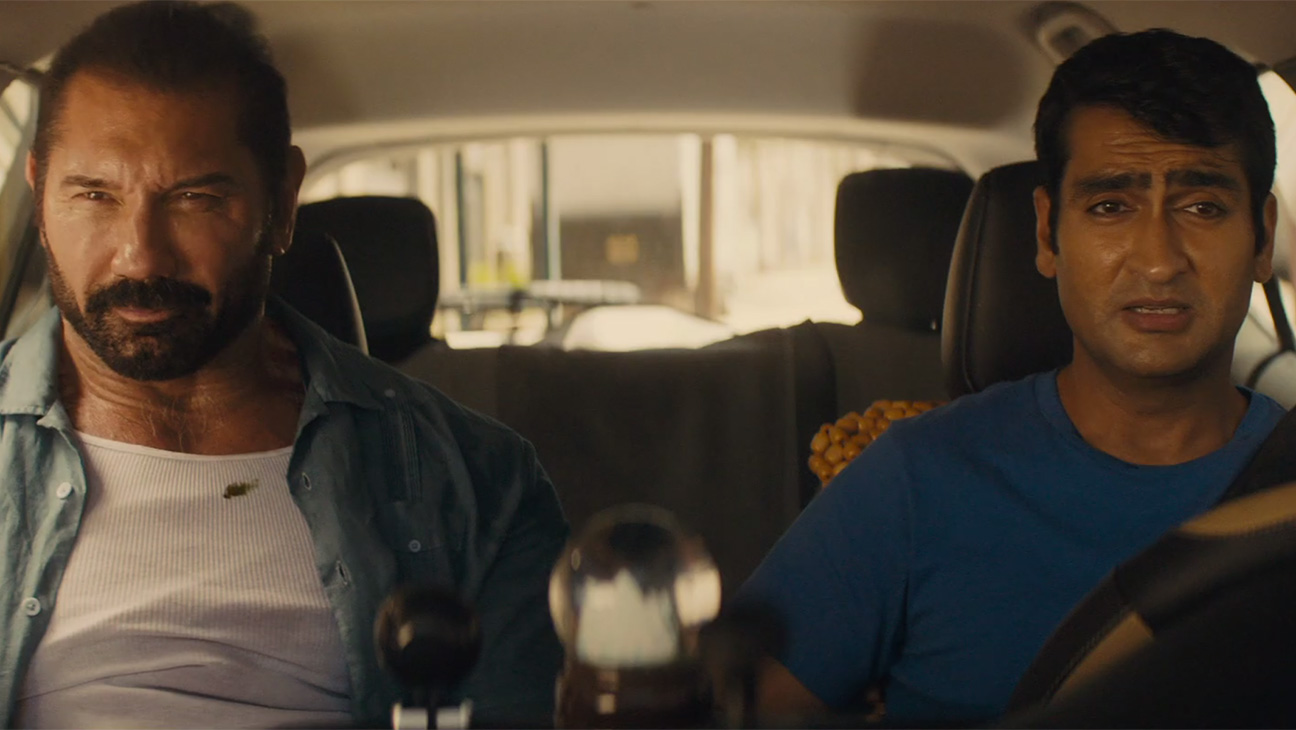
Dave Bautista and Kumail Nanjiani actually have more in common than you might think. Both are charming, funny, likable oddballs and both are outstanding on Twitter.
That last bit is less meaningful as they team up in the bromance romp Stuber.
Bautista plays Vic, a weirdly muscular LA cop. Nanjiani’s Stu is an Uber driver. Vic has eye surgery the same day he gets a tip on a big drug deal going down. Unable to drive, he presses his Uber driver into involuntary service.
Hijinks…oh the hijinks.
The main problem with this movie is that it’s idiotic.
A handful of other actors, including Natalie Morales and Mira Sorvino, sleepwalk through the most rote buddy cop movie you’ve ever seen basically to create a backdrop for Nanjiani to make being the voice of reason sound so funny.
He’s basically playing Kumail Nanjiani, which is, of course, the role he was born to play.
Bautista has a tougher row to hoe. He can’t sell the physical comedy, which is the point of his giant, bumbling, near-blind-and-yet-still-driving-and-shooting-weapons character.
Think Mr. Magoo meets Dirty Harry meets a bunch of steroids.
Dude, that should be comedy gold, especially in the hands of director Michael Dowse, whose classic hockey comedy Goon understood the charm of the blundering, violent dumbass.
Writer Tripper Clancy (that’s a name!) doesn’t help, as the only interesting ideas he has—the one he’s hung his entire screenplay on—he stole outright from Deadpool.
Hey! You know what was funny? Deadpool.
It’s too bad because both Nanjiani and Bautista deserve a lot better than this low-aiming and forgettable mess.
“Three chords and the truth” is the driving spirit that runs
throughout Wild Rose. It’s the reason aspiring country singer Rose-Lynn Harlan
(Jessie Buckley) doesn’t just love the genre, she lives it. She has it tattooed
on her arm, and her dream of Nashville superstardom buoys her otherwise dreary
working-class life in Glasgow.
It’s also an apt quote to hang the movie on. From the
opening setup, you already know the notes and you know the progression. But darned if Buckley doesn’t still have
something to say, and in a voice that can’t be ignored.
Buckley (Taboo, Beast) animates every frame as
Rose-Lynn, fresh from a year in jail for drug charges and defiant at anyone and
anything that comes between her and the country fantasy world she has built her
life around.
This includes her long-suffering mother and two young
children. Far more supportive is her new employer, the posh Susannah (Sophie
Okonedo), who hears Rose-Lynn singing while cleaning her house and encourages
her to send a recording to the BBC.
Of course Susannah’s support comes at the expense of
Rose-Lynn hiding pertinent background details, and it’s this central tension
between following your dreams and making a life of what you already have that concerns
most of the drama.
But even if Rose-Lynn’s path is a familiar one, the movie (written by Nicole Taylor and directed by Tom Harper) still imbues her arc with touching consideration and naturalistic ups and downs. Thanks in large part to Buckley, who brings a gut-wrenching humanity to each inevitable screw-up, it’s a journey that is compelling and well-earned—no small feat for the kind of story where at least some cathartic triumph is the payoff we expect for all those bumps along the road.
Wild Rose raises some truly thorny questions about
the pursuit of art and the expectations surrounding that. While Rose-Lynn’s
story arrives at an answer a bit too neatly, it’s no less catchy of a refrain.
There’s a reason that Nashville sound churned out so many hits.