Category Archives: New In Theaters

Reviews of what’s out now

Does Anybody Who Remembers Laughter Still Have Their Ticket Stub?

Led Zeppelin Played Here

by George Wolf

So, what’s your I-saw-them-before-they-were-famous concert story?

For me, it was a young INXS opening for Men at Work and blowing them off a stage in Cleveland. Men at Work?? I know, I know, but it was my high school National Honor Society field trip, whataya gonna do?

Some people have a better story than any of us. They will tell you they were one of the 50 or so in attendance when a brand new band called Led Zeppelin played a small suburban rec center in January of 1969.

That’s a great story. It might even be true. Led Zeppelin Played Here is director Jeff Krulik’s entertaining attempt to settle it once and for all.

The small gymnasium/youth center in Wheaton, Maryland actually has a decent history of rock shows, including Iggy and the Stooges (“he smeared peanut butter all over the walls!”) and the Faces with a nearly unknown Rod Stewart. There are old photos and ticket stubs still around from those shows…but for that legendary Zeppelin show?

Nope.

Trying to prove the existence of a rock history Bigfoot is a fun premise, but doesn’t really provide enough material to keep a full length documentary afloat. Krulik shows solid instincts for what makes good filler, taking us back to the early days of rock concert promotion before, as one promoter puts it, “Woodstock turned $5,000 acts into $100,000 acts.”

And, without belaboring the point, there’s an undercurrent in the film about how human nature can play havoc with memory. Are these phantom concert-goers remembering laughter simply because they want to? Could be.

Though there are some classic moments of archival sound and video, the production values in LZPH can be rough. Krulik’s film gets by more on heart than technical expertise, but give him props for tracking down an impossibly polite Jimmy Page and asking about the mysterious concert face to face.

So, did Zeppelin rock Wheaton or not?

I know what I think.

I think Men at Work sucked.

Beyond Aging Gracefully

Beyond the Reach

by Hope Madden

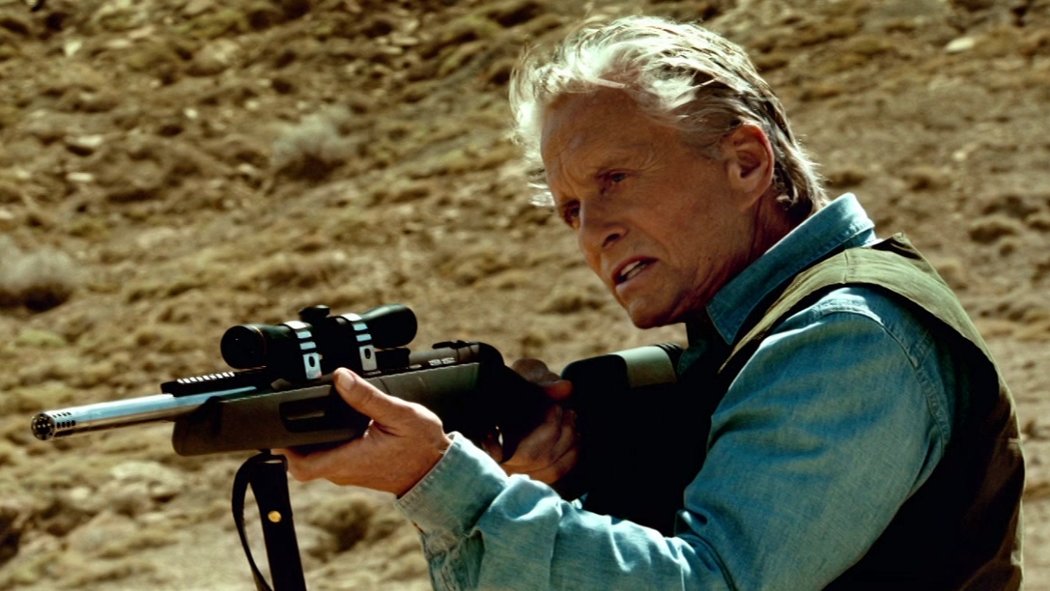
Michael Douglas continues to find intriguing ways to evolve as an actor. Now into his 7th decade on the planet, the actor has taken more and more interesting roles, generally succeeding. His Liberace in 2013’s Beyond the Candelabra marked a high point in his long career, and for his latest, the thriller Beyond the Reach, he reimagines a role originated by Andy Griffith, of all people.

Douglas plays a multi-millionaire named Madec, a man who collects trophies, buying his way out of red tape and problems, no matter how dire. He finds himself in hot water when an expensive but unlicensed hunt for “big horns” goes wrong. When he suspects that his young guide may not be as easily bought as he’d hoped, he devises a particularly nasty Plan B.

Jeremy Irvine (War Horse) is Ben, Madec’s wholesome but potentially corruptible young guide. What emerges is more than a sadistic cat and mouse game, mostly because Douglas patiently unveils layers to the character that feel at once horrifying and utterly natural.

It’s a straight forward thriller wisely adapted by Stephen Susco from a novel by Robb White. White was the source writer for many an exploitation flick back in the day (House on Haunted Hill, The Tingler, 13 Ghosts), and while Susco maintains the same type of urgency and thrill, his taut script is as interested in character as terror.

There is something so genuine about Douglas’s performance – he’s a shark, a man who’s amassed enormous wealth through charm, savvy, and cut-throat maneuvering. His sense of entitlement is based on decades of success, success that has encouraged him to see the world exactly as he sees it here. As ugly as his behavior is, it isn’t necessarily personal. It’s survival. It’s business.

Irvine handles his task capably, but it’s Douglas who makes the film worth watching. What begins as simply the clearest (if most heartless) strategy toward achieving a goal becomes, as time wears on, an old buck’s attempt to dominate the young challenger to his alpha status.

Beyond the Reach is a simple premise and a simple film that could very easily have become another throwaway thriller, and though it’s certainly no masterpiece, it transcends its exploitation trappings thanks to a veteran actor who knows what it means to be a survivor.

Verdict-3-0-Stars


Come and Watch Us Sing and Play

Monkey Kingdom

by Hope Madden

Earth Day rears its smiling, nervously optimistic head once again with Disneynature’s latest eco-doc Monkey Kingdom.

Directors Mark Linfield and Alastair Fothergill have carved an impressive career of environmental documentaries, for both the large and small screen. Monkey Kingdom boasts the same skillful mixture of environmental grandeur and character-driven intimacy, and the film is as visually glorious as any in this series. Still, you have to wonder how many hours of wildlife footage is accrued before the filmmakers can impose a storyline on the proceedings.

That is not to suggest the tale is entirely make believe. Monkey Kingdom rolls cameras in the jungles of South Asia, capturing the complex social structure of a macaque monkey troop. What unfolds is a kind of Cinderella story of the low-born Maya and her efforts to fend for herself and her newborn.

As we’ve come to expect from Disney’s doc series, Monkey Kingdom sheds light on the intricate social workings of the subject, and macaques turn out to be fascinating creatures with the kind of structured social order that begs for exactly this treatment. At first we watch as lowly Maya sleeps in the cold and eats from the ground while the alpha and other high born monkeys nap in sunlight and feast on the ripe fruit at the top of the tree. Can she ever hope for more? (At least we can rest assured that there’s no make-over coming.)

The intricate pecking order sets the perfect stage for an underdog film full of scrap, perseverance and triumph.

Narrator Tina Fey’s smiling, workaday feminism gives the film personality and relates it to humanity without having to even try.

While the film keeps your attention throughout, Monkey Kingdom lacks some of the punch of other Disney Earth Day flicks. Linfield and Fothergill’s 2012 film Chimpanzee had the 5-year-olds at my screening sobbing breathlessly, whereas Monkey Kingdom might elicit a compassionate frown.

Between the built-in drama of the “overcoming adversity” storyline and the occasional giddy monkey hijinks (the bit where the troop crashes a birthday party is particularly enjoyable), the film compels attention as it shares eco-savvy information kids may even remember.

Documentary purists will balk at the anthropomorphized story, but families will enjoy this thoroughly entertaining film.

Verdict-3-5-Stars


Talkin’ Bout My Generation

While We’re Young

by George Wolf

So far, Hollywood’s attempts to address the social media revolution have fluctuated between lackluster and downright embarrassing (Men, Women and Children? Yikes). While We’re Young gets it more right than most, thanks to less of the usual microscope and more of a layered, universal narrative.

Writer/director Noah Baumbach is able to weave the contrasts between older technology “immigrants” and the younger tech “natives” into a larger, utterly charming overview of shifting generations and the humor in realizing you’re not so young anymore.

Josh (Ben Stiller) and Cordelia (Naomi Watts) are a happy, childless couple in New York who suddenly become friends with Jamie (Adam Driver) and Darby (Amanda Seyfried), a pair of hipsters about twenty years younger.

In an instant, Cordelia and Darby are taking hip hop dance classes and Josh is shopping for fedoras with Jamie, then cranking “Eye of the Tiger” to get pumped up for a business meeting (even though he admits listening to the same song back “when it was just bad”). They ditch their longtime friends who now have young children, and convince each other they are free spirits blessed with limitless opportunity.

As Josh slowly begins to look a bit deeper into Jamie’s motives for hanging with him, their interplay comes to resemble Baumbach confronting his younger self, along with the futile anxieties of growing old “gracefully.” Baumbach seems perfectly comfortable in this new skin, crafting a film that is often smart, funny, and bittersweet all at once. His work has never been more accessible.

The characters are all sharply drawn and relatable, fleshed out by a talented cast that lets Baumbach touch on a variety of serious topics with a confident blend of laughter and nuance. The performances are all dead on, with Driver shining in the film’s most complex role.

Baumbach does risk a cop out with the convenient plot turn that comes near the finish, but it’s not nearly enough to derail the knowing smile that While We’re Young is bound to leave you wearing.

And that looks better than a fedora on almost all of us…of a certain age.

Verdict-3-5-Stars


A Blood Simple Plan for Old Slingblade Men in Fargo

Cut Bank

by George Wolf

Pulpy from the get go, Cut Bank is an oddly interesting crime drama, seemingly inspired by several recent genre classics and held together by a well-seasoned cast having fun with some classic film noir archetypes.

It starts with the restless Dwayne (Liam Hemsworth) and his spunky girlfriend Cassandra (Teresa Palmer), who are out standing in a Cut Bank, Montana field with a camcorder. She’s practicing her speech for the upcoming Miss Cut Bank pageant and he’s filming it when suddenly, Dwayne also captures the murder of longtime town mailman Georgie (Bruce Dern).

Wouldn’t you know it, there’s a big reward for evidence in the murder of any postal worker, and Cassandra’s surly father (Billy Bob Thorton) sniffs out the plan right quick. So does local recluse Derby Milton (Michael Stuhlbarg, stealing the film), who really wants a certain package that is still in Georgie’s stolen mail truck. From there, things begin unraveling in an increasingly bloody fashion, much to chagrin of the folksy Sheriff Vogel (John Malkovich).

Both director Matt Shakman and writer Robert Patino are television vets moving to the big screen, and it’s easy to imagine their film springing from notes taken while watching Fargo, A Simple Plan, No Country for Old Men or even Sling Blade. Those are some high aspirations to be sure, and it would have been advisable to make the homages a little less transparent.

Even the cast provides an ironic catch-22. The charisma-free Hemsworth aside, these are veteran talents going toe to toe and it’s a kick to watch, so that’s good. But collectively they provide very few degrees of separation from any of the films Cut Bank resembles, making it even harder for the film to measure up.

Still, it might have beaten the odds had Shakman been able to find a consistent tone. Though always watchable, it isn’t clear if Cut Bank wants to be a dark comedy or a true noir thriller, so it’s never urgent enough to be compelling. Solid footing always seems just out of reach, leaving the film in that murky middle that is seldom satisfying.


Verdict-2-5-Stars


Furiouser and Furiouser

Furious 7

by George Wolf

So, I went to a car racing movie and the next Avengers broke out. And that’s okay.

After six installments of Fast & Furious, a savvy new director is smart enough to go all in and take number seven to the superhero playground that the previous installments were yearning for.

The entire premise puts the “donk” in redonkulous anyway, so why not go..ahem, full throttle? Remember, these are street racing criminals that have “won” their freedom and are now working for the Feds to take down drug lords and mercenaries. Up to now, the films were just too earnest about what they were shoveling. Credit director James Wan for a welcome “let’s just have fun and do some cool stunts” attitude.

Wan (The Conjuring, Insidious, Saw) lets you know this is a different sort of ride even before the first credits, with a fluid opening full of action and style. After that, we learn that ex-British black ops killing machine Deckard Shaw (Jason Statham) has come to avenge his brother from part 6, which means Dominic (Vin Diesel) and his gang have to take Shaw out first.

That mission is sidetracked by Mr. Nobody (Kurt Russell), a covert intelligence honcho who offers Dominic a deal. Track down a hacker who has invented the world’s best surveillance program (“God’s Eye”!), and get the the full support of U.S. black ops in return.

Ooh, it’s on!

Turns out, though, the hacker gave her program to some guy in Dubai, so it’s off to the UAE so she can sport a bikini and Letty (Michelle Rodriguez’) can fight Ronda Rousey and Dom can fly a super car between two…check that…three skyscrapers!

Wan makes sure that stunt and many others, both car and fist related, look fantastic. In particular, the sequence with Brian (Paul Walker) escaping as a bus falls over cliff is likely to bring roars of gleeful approval.

Dwayne Johnson is still huge, Vin Diesel is still as wooden as his dialogue, and the plot is much more convoluted than necessary, bloating the film by at least thirty minutes. A faster Furious is a leaner, meaner, better Furious.

But there’s fun here. As the gang fights a terrorist and blows up half of downtown LA in the process, just think of these cars as Iron Man’s newest super suit, and go with it.


Verdict-3-0-Stars


Team Bunzo

Kumiko, The Treasure Hunter

by Hope Madden

Films based on true stories are a dime a dozen. Kumiko, the Treasure Hunter is, appropriately enough, based on confusion.

In 2001, Japanese travel agent Takako Konishi’s body was found in the snow of North Dakota and, through a series of misunderstandings, the urban legend developed claiming that she’d made the trip from Tokyo in search of the money Carl Showalter (Steve Buscemi) buried in the snow in the film Fargo.

In 2003, Paul Berczeller made a documentary short to sift through the truth and the myth of Konishi’s death, but Kumiko co-writer/director David Zellner is more interested in the legend. With the help of a magnificent Rinko Kikuchi (Oscar nominee for Babel), he weaves a dreamy dark comedy that’s both visually stunning and hypnotic.

In the wrong hands, Kumiko could easily have fallen into caricature: socially withdrawn, delusions of grandeur, general misanthropy. But that would have undermined the lilting melancholy of Zellner’s script (writing again with his brother Nathan), and would have tiptoed far too close to mocking the honest tragedy on which this film is loosely, imaginatively based.

Luckily, Kikushi’s were the right hands, and it’s hard to imagine anyone doing more right by this character. With no real friend besides her bunny Bunzo, Kumiko’s world is so utterly internal that she remains a fascinating if awkward enigma throughout the film. Through a mostly physical performance Kikushi both articulates the off-kilter logic that drives this character and shows off the most bittersweet comic timing.

Like a little red-hooded Don Quixote, the more desperately invested Kumiko becomes in her fantasy the tenderer we feel for her, which is a great contrast to the way a film like this often works – the deeper into the zany adventure, the nuttier and nuttier the protagonist becomes. Zellner and Kikushi pull the opposite direction, giving the film an honest emotional tug.

Zellner’s inspiration is the work of the Cohens almost as much as it is the myth surrounding Takako Konishi’s death. While his cinematic style can’t quite touch that of those masters, with the help of a phenomenal central performance and his peculiar flair for storytelling, he’s created a truly memorable film.

Verdict-4-0-Stars


Inspiring or Exploitative?

Farewell to Hollywood

by Christie Robb

In Farewell to Hollywood, documentary filmmaker Henry Corra presents us with the last two years in the life of co-director Regina Nicholson, a young woman struggling against osteosarcoma for the second time.

The movie is troubling. And not just because of the cancer.

Originally diagnosed just after her sixteenth birthday, Regina “Reggie”was an aspiring filmmaker that met the much older Henry at a film festival. Her life’s goal was to make a full-length feature. She sets out to do this with Henry, but early into the project her cancer returns.

The resulting film is an arty home movie of the end of Reggie’s life.

In the film, Reggie’s family initially seems to welcome Henry, excited that he’s taking an interest in their daughter’s dreams. But, as the cancer becomes more aggressive, relations between the grown-ups becomes strained. Reggie’s parents tell Henry to back off. Attached to the point of obsession, Henry presses on Reggie to give him more of her time. Her parents threaten to cut off Reggie’s medical insurance and Henry finds her a home in South Pasadena, taking over as her medical caretaker.

To what extent does Henry exacerbate the family drama? To what extent does he provide essential support?

Because the narrative is given to us through Henry’s editing, it’s difficult to say whether Henry has crossed the line into Perv Town. (There are moments that provoke a major sense of unease.) Or whether Reggie’s parents are smothering and emotionally manipulative to the point of denying her the chance to live in the limited time she has left. Or both.

There’s little input Reggie seems to have on the film. At no point does she clearly turn the camera on Henry. Her chops as a filmmaker are glossed over. We see her bedroom, her stacks of DVDs, her walls plastered with movie posters. We see scenes from her favorite movies, but despite her co-authorship credit, she comes across as more subject than author.

But as a subject, what we do see is a driven, resilient young woman following her dream, joking her way through medical procedures while dealing with excruciating pain and needy adults—interspersed with lots of clips from Pulp Fiction.

In the end, Reggie shares her death beautifully and it was a privilege to know that for 19 brief years she was a part of this world.

Verdict-2-5-Stars


It Has Sprung

Spring

by Hope Madden

In 2012, Justin Benson and Aaron Moorehead made their filmmaking debut with the smashing Resolution – an intriguing rewrite of familiar “cabin in the woods” genre tropes. Surprising the audience even inside a well-worn genre by weaving into the story equal amounts of humdrum realism and bizarreness, the directorial duo offered a fresh and provocative flick. They took those same skills and showed off some new ones with their next effort, Spring.

Like Resolution, Spring looks and feels familiar but the filmmakers’ approach is anything but straightforward.

Evan (a spot-on Lou Taylor Pucci) has hit a rough patch. After nursing his ailing mother for two years, Evan finds himself in a bar fight just hours after her funeral. With grief dogging him and the cops looking to bring him in, he grabs his passport and heads to the first international location available: Italy.

It’s a wise set up, and an earnest Pucci delivers the tender, open performance the film requires. He’s matched by the mysterious Nadia Hilker as Louise, the beautiful stranger who captivates Evan.

The less said about the plot the better. Like Resolution, this film walks between two different genres, blending the two masterfully with a result that is not exactly horror. At its core, Spring is a love story that animates the fear of commitment in a way few others do.

On display here is a prowess behind the camera that Resolution did not predict. The look of the Mediterranean seaside is imposingly beautiful – appropriately enough. The film’s entire aesthetic animates the idea of the natural world’s overwhelming beauty and danger. It’s a vision that’s equally suited to a sweeping romance or a monster movie, and since you’ll have a hard time determining which of those labels best fits Spring, it’s a good look.

There are some missteps – a vulgar American tourist side plot rings very false after the authenticity of the balance of characters. Louise’s backstory sometimes feels slightly forced, and the film takes on an unusual comic flavor toward the end that doesn’t quite fit. But there is something so lovely about the way the filmmakers approach the dangerous but compelling glory of love and nature that sets this apart from other genre efforts and keeps you thinking.


Hard to Take

Get Hard

by George Wolf

A lump of coal on Christmas Day. Ten thousand spoons when all you need is a knife. The movie Get Hard.

What are huge disappointments, Alex?

Correct.

Will Ferrell and Kevin Hart are two of the funniest people around, and it’s easy to see the potential in an onscreen teamup. The problem is the project that brought them together should have died in the idea phase.

Ferrell is James King, a high-rolling hedge fund manager who lives in luxury but still can’t please his trophy girlfriend (Alison Brie). At their lavish engagement party, right in the middle of jamming on guitar with John Mayer, James is hauled away by the Feds and charged with securities fraud.

Ignoring his lawyers advice to take a plea deal, James is found guilty and sentenced to 10 years in San Quentin. Given 30 days to report, James turns to Darnell (Hart), the guy who details his car, to teach him how to survive inside.

See, Darnell is black, so James just assumes he’s been in prison, and that’s just one of the stereotypes the film tries, and fails, to have fun with. In the right hands, race, class and sexuality can be fertile ground for sharp comedy. Those hands never touch Get Hard.

Ferrell and creative partner Adam McKay (who gets a story credit) have been on target before, even managing to work some scattered moments of social commentary into their hilarious lunacy. The mistake may have been relying too much on director/co-writer Etan Cohen, who shows no instinct for restraint. The film is overplayed on all fronts, giving it a crass, borderline nasty and often humorless air.

With the “revenge of the common man” storyline you get the feeling the intention here may have been an updated Trading Places. It isn’t long, though, before you wished they’d have just done a straight-up remake, and spared us the buzzkill that is Get Hard.


Verdict-2-0-Stars