Category Archives: New In Theaters

Reviews of what’s out now

Animal Planet

The Jungle Book

by George Wolf

Much like the “man-cub” Mowgli prancing gracefully on a thin tree branch, director Jon Favreau’s new live action version of Disney’s The Jungle Book finds an artful balance between modern wizardry and beloved tradition.

The film looks utterly amazing, and feels nearly as special.

Impossibly realistic animals and deeply nuanced landscaping completely immerse you in the jungle environment where the young Mowgli (a wonderfully natural Neel Sethi), after being rescued as an infant by pragmatic panther Bagheera (voiced by Ben Kingsley), lives happily among the wolf pack of Akela (Giancarlo Esposito) and Raksha (Lupita Nyong’o).

But after threats on the man-cub’s life by the fearsome tiger Shere Khan (Idris Elba), Bagheera decides it is time to lead the boy back to the “man village” for good.

Based on the stories of Rudyard Kipling, Disney’s 1967 animated feature showcased impeccable voice casting and memorable songs to carve its way into the hearts of countless children (myself included). Clearly, Favreau is also one of the faithful, as he gives the reboot a loving treatment with sincere, effective tweaks more in line with Kipling’s vision, and just the right amount of homage to the original film.

And this group of voices ain’t too shabby, either.

Kingsley is perfectly elegant, Elba commanding and scary, while Scarlett Johansson gives Kaa the snake a hypnotic makeover oozing with seduction. Then, in the heart of the batting order, along comes Bill Murray to fill Baloo the bear full of sarcastic gold and Christopher Walken to re-imagine King Louie as an immense orangutanian Godfather.

All the elements blend seamlessly, never giving the impression that the CGI is just for flash or the cast merely here for star power. The characters are rich, the story engrossing and the suspense heartfelt. Credit Favreau for having impressive fun with all these fancy toys, while not forgetting where the magic of this tale truly lives.

Verdict-4-0-Stars


RSVP Required

The Invitation

by Hope Madden

Dinner parties are the worst.

This is especially true when said party is thrown by your ex and her new man in the house that used to be yours. So, why go?

Curiosity – which is what will or will not keep you invested in director Karyn Kusama’s new film The Invitation.

Will (Logan Marshall-Green) and his new girlfriend Kira (Emayatzy Corinealdi) tough it out. They drive out to the LA hills to join Will’s ex Eden (Tammy Blanchard) and all the friends Will has forgotten about since his son accidentally died in this very house a couple years back.

The party marks Eden’s return to the fold and an introduction to the new man in her life, David (Michiel Huisman), another grief survivor who, like Eden, owes his very sanity to the life-changing vision of Dr. Joseph.

Oh, God. Have they unwittingly submitted themselves to the one thing worse than a time-share opportunity gathering – a religious conversion attempt?

Kusama’s slow build mines societal tensions well. Besides the obvious ex-lover friction and the fear of cult propaganda, many in this once tight circle of friends have avoided the grief-stricken parents since the accident. It’s all very uncomfortable, though the film slowly turns the discomfort toward paranoia as Will begins to wonder where missing buddy Choi (Karl Yune) may be, why Eden has a bottle of barbiturates in her bedroom, and why David keeps all the partygoers locked inside.

Is something amiss, or is Will just dealing with those damaging issues of grief that Eden and David were able to overcome thanks to Dr. Joseph?

As The Invitation slowly evolves from tense drama to thriller to horror, Kusama is always throwing uncomfortable moments and unsettling clues at you. Were it not for the often tediously stilted dialog penned by Phil Hay and Matt Manfredi – whose track record includes the Ride Along series, if that tells you anything – The Invitation would have a consistently nightmarish, hypnotic quality that keeps you uncomfortably captive.

You know, just like that last dinner party you went to.

How ‘Bout You?

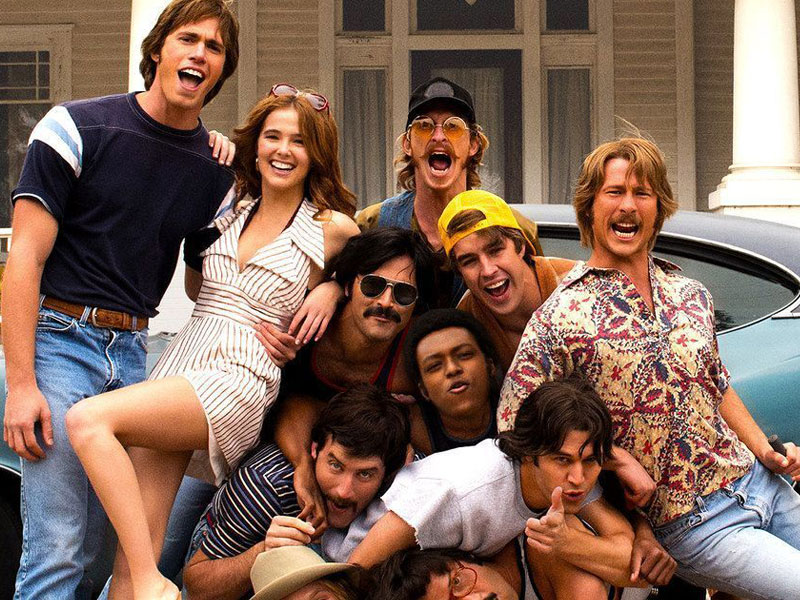
Everybody Wants Some!!

by Hope Madden

Of all filmmakers in the world, few – if any – can do slice-of-life as well as Richard Linklater. Never weighed down by plot structure or the rigid expectations of modern cinema, Linklater’s the master of fluid, easygoing, day-in-the-life filmmaking. His latest exercise in the craft, Everybody Wants Some, is a charmer.

You’re invited to a 3-day bender in the late summer of 1980 – the long weekend before the first day of classes – and Linklater’s meandering camera makes you feel like you’re just wandering through the party.

Everybody Wants Some is, without question, too forgiving. A South Texas university baseball team settles into the new year by scoping out the female action on and off campus. They’re adaptive – disco one night, urban cowboys the next, punk rockers on a random Sunday. Linklater not only nails 1980, but pinpoints the almost invisible moments of import in a person’s life.

This is a consequence-free zone that smells a bit of nostalgia and self-congratulations. And yet, thanks to a slew of utterly charming performances, the film still works exceptionally well.

Linklater has assembled an outstanding ensemble – not a false note in the lot, from the quiet everyman Jake (Blake Jenner) to the hypercompetitive McReynolds (Tyler Hoechlin) to the philosophical ladies’ man Finnegan (Glen Powell) to the ranting wacko Jay (Juston Street) – and basically the entire team. The first thing Linklater does is establish each ballplayer’s type, just to quietly destroy your preconceived notions of character.

Billed as the “spiritual sequel” to 1993’s coming of age classic Dazed and Confused, Everybody Wants Some is even more laid back, decidedly more masculine, and quite a bit more existential. Linklater’s more existential films tend toward the bittersweet – some more bitter, this one more sweet.

Like Dazed, the new film litters its fluid storyline with hijinks and casually perceptive dialog.

“It’s all so damn tribal.”

“Embrace your inner strange.”

It’s a film about competition and identity, the battle between self-discovery and authenticity, but with Linklater’s light, affectionate touch, nothing ever feels heavy. The writing is as good as anything Linklater has produced, positively glowing with “unsolicited wisdom and fuckwithery.” And all of it leads to an absolutely perfect ending.

Verdict-4-0-Stars


Walking Disaster

Demolition

by Hope Madden

No way this film should work.

Jean-Marc Vallee’s symbolism quirkfest Demolition is as burdened by identity crises and analogy as perhaps any film ever made. Populated by the confused but authentic in one corner, one-dimensional frauds in another, and one guy trying to go from one extreme to the other, it offers nary a single believable character as it tries to deconstruct its hero and build a better man. And yet, somehow, Vallee and his savvy cast make it damn near fly.

Jake Gyllenhaal is Davis, a recently widowed Wall Street protégé going through a bit of life transition. He doesn’t feel anything concerning his wife’s death, which makes him realize that he isn’t sure he has felt anything at all in some years.

This realization corresponds with a frustrating experience with an ER vending machine, and so he begins a series of missives to the sole customer service rep for the vending company, Karen Moreno (Naomi Watts). These are not angry letters, but in an attempt to be thorough, Davis gives the as-of-yet anonymous vending recipient a very, very full picture of his life.

A weird but sweetly platonic relationship blossoms between the directionless Davis and the stagnant Karen, but it’s Davis’s relationship with her on-edge teen son Chris (Judah Lewis, in an impressive turn) that leads to the film’s most unpredictable and interesting moments.

Self-discovery, that seems to be the name of the game here as Davis begins dismantling everything: a leaky fridge, a squeaky bathroom stall door, appliances, lighting figures, his house. He says in one letter that everything has become a metaphor, but he isn’t honestly sure what each metaphor might be. Is he the uprooted tree by the highway? The storm that felled the tree? The cold front that collided with another front to create the storm? Hell if he knows.

It’s an interesting line in a film that throws symbols at the screen with wild abandon, and yet can’t seem to decide what kind of film it is. More to the point, writer Brian Sype (The Choice) doesn’t seem to know what motivates Davis or what he may be underneath it all. And while Gyllenhaal offers another solid performance surrounded by oddly interesting work from a highly talented cast, it’s hard to see a point to all this.

Third act revelations and resolutions only make things worse, ringing as nothing if not false and needless. And yet, Vallee’s sleight of hand, Sype’s surprises, and the cast’s cagey performances make this one an off kilter experience that somehow works.

Verdict-3-0-Stars


Eyes Without a Face

Hardcore Henry

by George Wolf

We wake up with Hardcore Henry underwater in a Russian laboratory. A hot woman in a lab coat gets us up to speed as she attaches our new arm and leg. She tells us she’s our doctor, and our wife, and though our memory will come back in time, right now we have to run from the endless parade of people who want us dead.

And so we are off on a journey of mayhem and discovery, as writer/director Ilya Naishuller crafts a technically savvy “first person” action fest where every shot is framed through Henry’s eyes.

The lab is raided by a gang of baddies, with Henry and wife Estelle (Haley Bennett) making their escape as she pleads with him to understand what he’s capable of and to fight back accordingly. He does, with continually timely assistance from the mysterious Jimmy (Sharlto Copley), whose answers only lead to more questions about Henry’s identity, bio-engineering and the evil plans of warlord Akan (Danila Kozlovsky).

The action is often relentless, sometimes brutally violent, and eventually tiresome. The film essentially becomes a first person shooter game set to autopilot, much more successful as a technical achievement than resonant narrative.

Naishuller deserves ample credit for his vision, and for getting it on film with impressive precision.  There’s hardly a dent in the integrity of his first person device, with set pieces that run from dazzling (a shootout set to Queen’s “Don’t Stop Me Now” chief among them), to downright weird (Copley’s song and dance routine), and the entire production well-earning its advisory for viewers prone to motion sickness.

For all the technical merits, seeing through Henry’s eyes doesn’t connect us to the character or pull us any deeper into the action. Ironically, the effect is just the opposite, and Hardcore Henry becomes as fun and captivating as watching someone else play a video game.

Verdict-2-5-Stars


Like a Boss

The Boss

by Rachel Willis

The Boss is a comedic story of one woman’s fall from the top and her struggle to regain her position in the world.

Melissa McCarthy is Michelle Darnell, a high powered executive who writes a brand of self-help books. Her fall comes at the hands of former lover and business rival, Ronald (Peter Dinklage).

Kristen Bell is Michelle’s long suffering assistant, Claire, who is forced to find a new employer when Michelle is incarcerated for insider trading. The early setup foretells the redemption of Michelle, though the ways in which it happens are unpredictable and provide the bulk of the movie’s many jokes.

As a vehicle for Melissa McCarthy, The Boss has a number of laughs. Sharp wit, foul language, and bodily humor combine to offer an appealing repertoire of McCarthy’s talents. However, the movie itself falls flat. The supporting cast is underutilized. Kristen Bell, herself a witty and capable actress, is lackluster against McCarthy. The chemistry is non-existent, and the two characters never seem to foster a believable relationship.

The screenplay doesn’t know what to do with anyone other than McCarthy. Though a decent portion of the film revolves around Bell’s character, her scenes independent of McCarthy are mildly tedious.

Peter Dinklage, another actor with an incredible range of talent, has a woefully small amount of screen time, and though he plays Michelle’s former lover who both hates and still wants her, he has no sexual chemistry or tension with McCarthy. The interaction between the characters frequently feels forced.

The only actor who plays well of off McCarthy’s humor is Cedric Yarbrough, the “yes man” Tito, who appears briefly in the beginning of the film, but sadly, doesn’t return after Michelle’s release from prison.

On the whole, the film is disjointed. What could be a cohesive story of Michelle’s fall and attempted rise back to the top is unfortunately punctuated with scenes that don’t really fit the narrative: a comic book style slow motion fight scene between girls from two warring Girl Scout-like troops, a scene where Michelle has a bad reaction to puffer fish, and others.

Despite the movie’s flaws, it’s not without appeal. Ella Anderson who plays Claire’s daughter, Rachel, is a delightful foil to Michelle’s brash and sarcastic nature. Her emotions based on Michelle’s actions come across as genuine. Her joys and pains are felt by the audience. McCarthy’s humor and flair carries the film in places where in another’s hands it might suffer.

It’s a shame so many of the other characters are without appeal, as The Boss could have been a much stronger comedy.

Verdict-2-5-Stars

NOTE: NSFW trailer (but funny!)


Everlovin’ Light

Midnight Special

by Hope Madden

Get to know Jeff Nichols. The Arkansas native is batting 1000, writing and directing among the most beautiful and compelling American films being made. His latest, Midnight Special, is no different. But then again, it is very, very different.

You should know as little as possible going into this film because Nichols is the master of slow reveal, pulling you into a situation and exploiting your preconceived notions until you are wonderfully bewildered by the path the story takes.

Suffice it to say, Nichols mainstay Michael Shannon, as well as Joel Edgerton, are armed men in a seedy motel. They have a child in tow (Jaeden Lieberher – wonderful). Local news casts a dark image of the trio, but there’s also a Waco-esque religious community looking for the boy, not to mention the FBI. So, what the hell is going on?

Nichols knows, and he invites your curiosity as he upends expectations. The film toys with the clash between logic and the supernatural, not unlike the themes of Nichols’s masterpiece Take Shelter (also starring a magnificent Shannon). While moments of Midnight Special will feel more reminiscent of memorable films in the SciFi vein, what this filmmaker does with his subject is beautifully novel.

The film, like all of Nichols’s work, is deeply rooted in traditions and atmosphere specific to the American South, and the filmmaker boasts a deep and easy skill as a storyteller. He’s also truly gifted with casting.

Lieberher, who showed amazing natural talent in 2014’s St. Vincent, again offers a beautifully restrained central figure. Edgerton and Kirsten Dunst are likewise wonderful, both turning in nuanced performances that reflect Nichols’s uncanny way of dealing with the extraordinary in the most naturalistic way.

But Michael Shannon, a remarkable talent no matter what film he graces, anchors the film with a heartbreaking, award-worthy performance.

Midnight Special is just another gem of a film that allows Nichols and his extraordinary cast to find exceptional moments in both the outlandish and the terribly mundane, and that’s probably the skill that sets this filmmaker above nearly anyone else working today. He sees beyond expectations and asks you to do it, too.

You should.

Verdict-4-5-Stars


Scenes from the Overlook

Darling

by Hope Madden

Long on style, short on plot, Mickey Keating’s Darling benefits from meticulous sound design, craftful framing, a strong lead performance, and your patience.

Darling – the closest thing to a name we ever get for the film’s lead – will be caretaker for the oldest brownstone in town. The enigmatic mistress of the house, played with icy skill by Sean Young, shouldn’t even be telling the new caretaker about the troubles with the last girl…

Yes, this sounds familiar, but Keating is not attempting to hide from comparisons to Stanley Kubrick’s 1980 classic The Shining. From Darling’s insistent score to its long, narrow hallways and more, this film embraces and celebrates its Overlook inspiration.

The tale itself is nothing if not artfully ambiguous. Darling’s descent into madness begins within moments of the fade in, and Keating’s screen titled chaptering (Chapter 1: Her; Chapter 2: Invocation; etc.) draws conspicuous attention to one way to read his film – as that of a house haunting its guest. Or was the guest mad all the while? Are there demons afoot, or did Darling bring the crazy with her?

This waffling between what may be happening onscreen works as well as it does because of the pliability of Keating’s lead, Lauren Ashley Carter (The Woman). Carter carries the film in its entirety with a performance that oscillates between wide-eyed terror and brittle rage. It’s an impressive turn from a performer who is becoming a true genre talent.

Carter and Keating mine the solo female going mad angle to conjure memories of Polanski’s Repulsion, and Carter’s unreliable point of view character rings a few of the same notes as Debra Kerr’s letter perfect performance in 1961’s The Innocents.

If atmosphere and style aren’t enough to carry a film for you, however, Darling will wear thin. Keating feels no compulsion to satisfy your curiosity, nearly overwhelming his film in ambiguities.

Stylish, visually resplendent in black and white, though not especially satisfying, Darling is more of an introduction to two strong new voices in the genre – Keating and Carter – than a memorable horror effort, but it’s definitely worth a look.

Verdict-3-0-Stars


To Hell and Back

Baskin

by Hope Madden

“Hell is not a place you see. You carry Hell with you at all times.”

Cheery stuff, that! If you’ve ever wondered what hell might look like, first time feature director Can Evrenol has some ideas to share. They are vivid. You’ll swear they even have an odor.

Evrenol’s Baskin is a loose, dreamily structured descent into that netherworld in the company of a 5-man Turkish police unit. (Baskin is Turkish for “police raid.”) The serpentine sequencing of events evokes a dream logic that gives the film an inescapable atmosphere of dread, creepily underscored by its urgent synth score.

We are trapped along with this group of somewhat detestable, somewhat sympathetic men as they respond to a call for backup in an “off the map” nearby area. What they find is deeply disturbing.

Unless you really like frogs. If so, then – hooray! Frogs!

The rest of it, though? Horrifying.

Evrenol’s imagery is morbidly amazing. Much of it only glimpsed, most of it left unarticulated, but all of it becomes that much more disturbing for its lack of clarity.

The cast is uniformly solid with the exception of Mehmet Cerrahoglu, who may leave you speechless. The director has taken to calling him the new Michael Berryman – a name genre fans will recall as the haunting, hulking, hairless menace in Wes Craven’s The Hills Have Eyes and their nightmares.

Cerrahoglu’s remarkable presence authenticates the hellscape of these characters’ descent. Evrenol’s imaginative set design and wise lighting choices envelope Cerrahoglu, his writhing followers, and his victims in a bloody horror like little else in cinema.

There are moments when Baskin feels like a classier, more stylishly made Nightbreed, but there’s no camp factor here. Just a surreal exploration of the corruptibility of the human soul, and its final destination.

Baskin may infuriate viewers looking for a tidy package, and it may underwhelm gorehounds intrigued by reports of audience walk outs. Be that as it may, the film represents a vital new voice in the genre (Evrenol), not to mention a potentially iconic new face in horror and bad dreams (Cerrahoglu).


Video Massacre Volume 1 Comes to Gateway

If the title Video Massacre Volume 1 conjures the image of some Eighties VHS compilation of B-horror, then perfect. You’re ready for the viewing.

An assortment of 20 shorts filmed by Brooklyn filmmakers, the series boasts a nice mix of polish and camp, all surrounded by the joyously self-referential framing story of demon-ghost Belfy and the hostages he’s forcing to watch the shorts.

Humor – frequently of the toilet variety – gives the film its tone, and the individual shorts are sequenced to offer the experience a good pace. While a handful of the films feel too amateurish, most of them boast excellent production values. It’s clear these were made on tight budgets, but the filmmakers across the board know how to match cinematic technique to the tone of the short.

One animated piece and the fake trailer for “The Shitting” rank among the most entertaining, and two “experiments gone awry” efforts are the most fun. You can also expect a lot to go wrong in the woods.

More than anything, the film feels like a mash note to the genre, right down to the twist ending. (Pay close attention to the credits inside the film. Priceless!)

Join us as we host a Midwest premier of Video Massacre Volume 1 at Gateway Film Center this Saturday, 4/2, at 9:30pm and stick around after for a Q&A with some of the directors:

Grier Dill, director: Trashed, Fungus Adventure
Brett Glass & Grier Dill, director: Brood X
Brett Glass, director: frame story
Joseph Colmenero, director: The Coffin
Winnie Cheung, director: Exit Interview
Suzi Sadler, director: The Retreat
Cale Hughes, director: Jackolantern