Category Archives: New In Theaters

Reviews of what’s out now

The Loud American

Mile 22

by Matt Weiner

Equal parts John le Carré and John Carpenter if both men were lobotomized and then let loose with typewriter and camera, Mile 22 spends most of its brief running time trying to figure out if it has something meaningful to say. All the while, it stacks a public body count up so high that it’s impossible to see how the clandestine force responsible is going to stay secret long enough to become a film franchise.

And while the movie has ambitions at creating new intellectual property around the paramilitary Overwatch program introduced in the film, it’s a bit of a head fake for this first outing. For all its spy vs. spy setup and technobabble, director Peter Berg uses espionage as window dressing for a simple action setup that’s all about brute force.

Mark Wahlberg heads up the CIA team as James Silva, a prickly leader whose instability is used as a stand-in for self-effacing humor. Silva’s team springs into action when a local source Li Noor (Iko Uwais) surrenders to a U.S. Embassy claiming to have information that can help stop a nuclear attack. Silva’s team of elite operatives are tasked with escorting Noor safely out of the country, which becomes a lethal mission when Noor’s own intelligence agency works to stop the extraction at any cost.

To call Silva’s team ragtag would do a disservice to stereotype—it actually would’ve been nice if anybody rose to some level of quirkiness, or any distinction apart from fungible cannon fodder. Ronda Rousey comes close to having a compelling hook, which is: look, it’s Ronda Rousey! But the main emotional labor falls to The Walking Dead star Lauren Kerr as Alice, whose defining character trait is that she has a daughter waiting for her back home.

Thankfully, the team—and the film—have a secret weapon in Uwais. The Indonesian martial artist and choreographer best known for The Raid series gets to show off his captivating fighting style that’s a ballet of bone dislocation. The downside is that he goes underused for so long that his breakout set pieces serve mainly as a reminder that you’d be better off watching The Raid.

There’s a ludicrous nihilism underpinning the film that is almost refreshing for a Berg/Wahlberg pairing. But the script (written by Lea Carpenter) is so humorless it’s genuinely difficult to make out how much of this is Berg and company trying to make a statement about the War on Terror and how much is just the inevitable byproduct of a tight 90-minute cut that only comes alive during the brutal one-on-one fight scenes. John Malkovich’s arch turn as an anonymous and ultimately meaningless government agent, for example, is far more vital—and still relevant—under the direction of the Coen brothers in Burn After Reading than it is here, even though the two roles share an uncanny echo.

Mile 22 doesn’t offer up much replay value as anything more than a fun but forgettable live-action video game level. Although as far as meta-commentary on espionage thrillers goes, this strange blend of individualism and irrelevance might be all we have to look forward to for a while.



Money Changes Everything

Crazy Rich Asians

by Rachel Willis

When Nick Young (Henry Golding) asks Rachel Chu (Constance Wu) to be his date to a wedding in Singapore, she expects a nice, but simple trip to her boyfriend’s home. She’ll meet his family, and they’ll take an important step forward in their relationship. It’s what Rachel doesn’t know – that Nick is a member of a family known as “Singapore royalty” – that sets up the comedy and drama of Crazy Rich Asians.

Director Jon M. Chu’s adaptation of Kevin Kwan’s novel is an entertaining look at the culture clash that happens when Rachel attempts to fit in with Nick’s family.

“Crazy rich” is an accurate descriptor for Nick’s family and their class of friends. Born and raised in New York by a single, working mother, Rachel isn’t prepared for the ostentatious wealth that surrounds Nick’s family. Though proud of her life and career – economics professor at NYU – she realizes that she’s seen as an unremarkable outsider in this world of wealth and power, especially by Nick’s mother, Eleanor (Michelle Yeoh – outstanding as always). Efforts to sabotage their relationship begin before Rachel even leaves New York.

There are a lot of characters in the movie. Too many, really, and the important side characters suffer a lack of necessary development. A second narrative thread involving Nick’s cousin, Astrid (Gemma Chan), and her husband, Michael (Pierre Png), never hits the stride it deserves.

But there’s a lot to like about the movie. Nick and Rachel rank among the best – and most realistic – rom-com couples. As Rachel’s friend Peik Lin, Awkwafina provides the film’s funniest moments. She’s also the dose of reality Rachel needs when dealing with the crazy rich. And despite being 120 minutes, long for a romantic comedy, the film never drags.

Crazy Rich Asians is the kind of fluffy, fun, romantic summer fare that will leave almost everyone satisfied.

God Save McQueen

McQueen

by Rachel Willis

The life of iconic fashion designer Alexander McQueen is the subject of director Ian Bonhôte’s documentary, McQueen. With writer and co-director Peter Ettedgui, Bonhôte creates a richly artistic dive into the controversial designer’s life and art.

Dividing his portrait into sections, Bonhôte uses home videos, archival footage, interviews with family and friends, and scenes from the catwalk to highlight McQueen’s unique—and oftentimes controversial—work.

As Bonhôte highlights with sensitivity and warmth throughout the film, fashion is an expression of McQueen’s experiences. It’s clear McQueen puts his feelings into his designs, and his collections become deeply personal. “I would go to the far reaches of my dark side and pull these horrors out of my soul and put them on the catwalk,” he says of his art.

The fondness with which people speak of McQueen in the documentary’s many interviews offers a picture of someone who made an impact beyond his creative output. His friends, many of whom were part of his design team, speak of the dedication and drive behind his designs. There is a love for McQueen that shines throughout the film.

However, the darkness in McQueen, at first kept to the catwalk, begins to come through in his personal life. As his success grows, the energy behind his work grows darker. Some of his long-time collaborators end their working relationship with him, something he takes personally. For McQueen, there was no such thing as a work-life balance.

It’s clear through the course of the film that the world of haute couture is a stressful one, and no one seemed to take on more than McQueen. In an interview, he mentions assembling 14 collections a year. It’s a staggering number given how much time, energy, and effort must go into each piece of clothing, not to mention the hair, makeup, and set design that made up McQueen’s unique and stunning exhibitions. What’s unclear is if McQueen’s inner turmoil drove him to work nonstop or if it was the work that fueled his inner chaos.

Bonhôte and Ettedgui produce a mesmerizing narrative. From McQueen’s early apprenticeships with tailors to his meteoric rise as one of the most sought-after designers, the filmmakers cultivate an interest in a subject that many may be unfamiliar with. They highlight the art in fashion design, utilizing footage from many of McQueen’s collections to show this artistry.

Coupling the fashion world and McQueen’s creativity with a captivating score, the documentary pulls the viewer in from the first moment and never lets go. It’s a fascinating, compassionate portrait of an imaginative genius.


He Deserves Better

Slender Man

by Hope Madden

It’s the end of the summer! Quick, what lackluster genre trash can we tidy up with a PG-13 rating to cash in on kids’ free time before they have to go back to school next week?!

That’s the theme for this week at the movies, a period in which a 70-foot prehistoric shark movie contains no blood-not one drop. Also, a super creepy, tall, faceless but nattily clad monster terrorizes teens.

I love a good villain, and this film has an opportunity. Slender Man is a cool character. Born online in a meme contest in 2009, the elongated, pale, bald and faceless man in a black suit who beckons children was immediately embraced by a horror community who apparently has no idea what to do with him.

Sylvain White’s film positions him as an urban legend. Four girls watch a video to conjure the beastie. Bad things happen.

Do you know why bad things happen? Because kids today aren’t shown the classics, like The Ring. That movie knew how to maneuver a PG-13 rating.

So, the supernatural being haunts the woods. Or your phone. He’s electrical, you see. So, the woods. No, wait…

And therein lies the problem. We have a villain, born a meme. He has no real backstory, but he’s cool and he deserves a proper horror show. Screenwriter David Birke was absolutely not up to the task of creating that story. And even if he had done a proper job of it, White can’t manage to move scene to scene with any sense of dread or even narrative logic.

Boxes are checked with zero thought about why. Is there a scene in a library where one character stumbles upon some important background information? Why, yes, although it doesn’t make sense and leads nowhere.

Is there another scene of googling where a previous victim turns out to be in an asylum? Indeed! And again, this goes nowhere. Do they find her? Do they visit the asylum? Is she ever brought up again? Nope.

More than anything, Slender Man is just boring. And he shouldn’t be.

Man Bites Shark

The Meg

by George Wolf

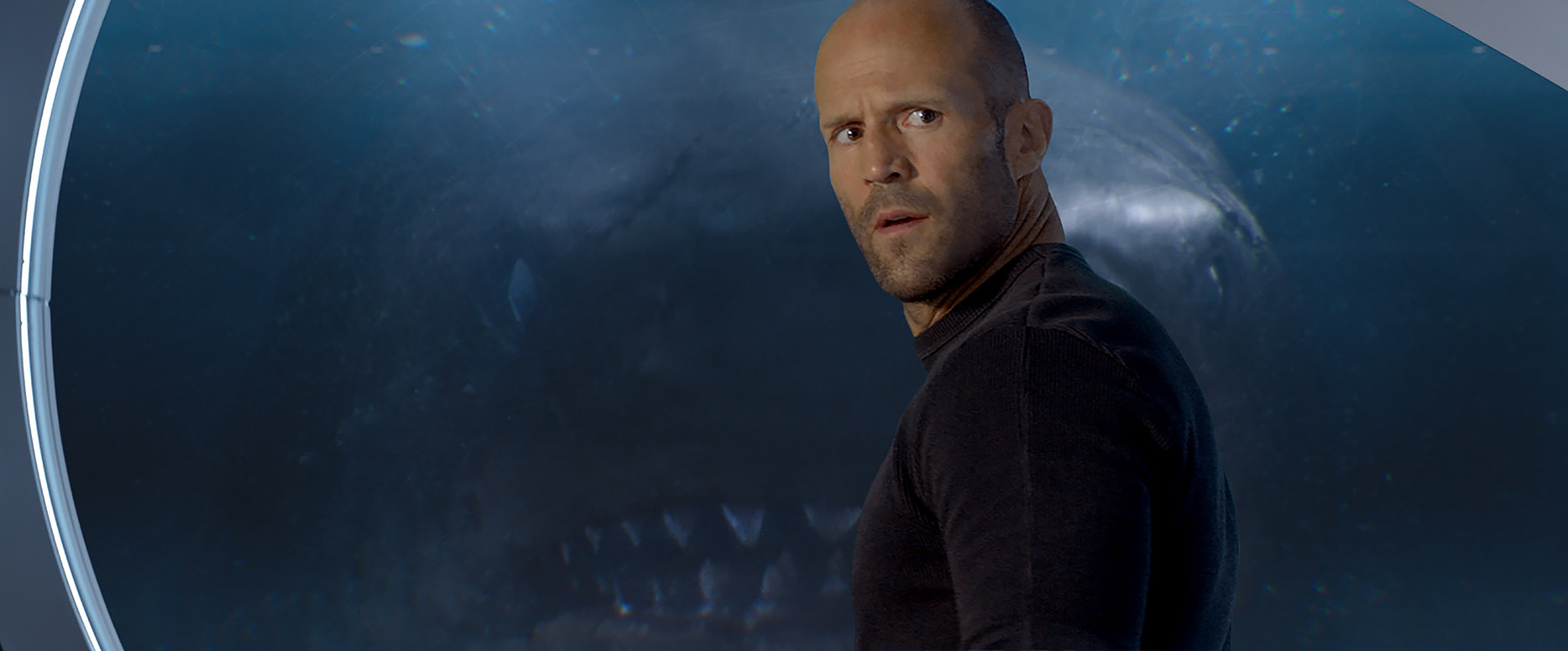
You didn’t think Great White-invested tornados meant the pool of shark movie premises was running dry, did you? Not so long as someone is just conscious enough to mumble “Statham fights a shark” in a drunken pitch meeting!

The Meg brings that premise to 3-D life, with Statham wet-suitting up as Jonas, the reluctant hero with a haunted past. After a tragic encounter with a giant underwater beast, Jonas hangs up the scuba mask to drink away his days in the bars of Thailand.

But five years later, his ex-wife is part of an undersea research team at the mercy of the legendary Megaladon, a 70-foot long “living fossil” of a shark thought to be extinct for over 200 million years. Jonas, of course, knew it wasn’t, and now he must tell everyone “I told you so” with his most steely glare, go back on his vow to never dive again, and take everything much too seriously.

And that’s the biggest misstep weighing down the entire film. You get the feeling that with a knowing, “Kong: Skull Island” type of monster vibe, this could have been fun, but director Jon Turteltaub (National Treasure) can’t settle on one charted course.

Turteltaub and his team of writers adapt the first of Steve Allen’s “Meg” novels with a host of changes, presumably meant to bolster Statham’s damaged hero quotient. The dramatics are overdone by nearly all involved (though Rainn Wilson, as the billionaire behind the research, finds a mark), and when a nicely subtle hat-tip to Jaws opens the gates for all out scene stealing, The Meg becomes a water-logged mess.

A Chinese co-production with a clear eye on international markets, the film has moments of promise that are quickly snuffed out by exposition that’s neither needed, wanted or interesting. Where’s the fun, sharky nonsense promised by the trailer? That movie might have been a guilty pleasure.

The Meg is just guilty.

Ball of Confusion

BlacKkKlansman

by Hope Madden

Welcome back, Spike Lee!

It’s not like he’s really been gone. He’s made a dozen or more TV episodes, documentaries, short films and basement-budget indies since his unfortunate 2013 compromised vision Old Boy. But BlacKkKlansman is a return to form—to the envelope-pushing enjoyment that showcases his skills as storyteller, entertainer and activist.

Earmarks of his most indelible marks on cinema—Do the Right Thing, Jungle Fever, Malcolm X—these three elements have rarely joined forces since 1992. You might get one (Get on the Bus) or two (Inside Man, Chi-Raq), but not all three.

Why now? Lee isn’t the first filmmaker to realize how painfully relevant historical tales of systemic racism are at the moment. But it wasn’t until 2014 that Ron Stallworth published the book detailing how he, a black cop in Colorado Springs in 1979, infiltrated the KKK.

You see how it all comes together?

If you don’t, you really should. Lee balances unexpected shifts between humor and drama, camaraderie and horror, entertainment and history lesson, popcorn-muncher and experimental indie with a fluidity few other directors could muster.

The story itself is beyond insane—a zany, hair-raising misadventure destined for the big screen. Stallworth (John David Washington), a rookie in Colorado Springs’s intelligence office, stumbles upon an ad in the newspaper, makes a call, and joins the Klan.

Of course, he’ll need a second officer to actually show up. Enter Flip Zimmerman (Adam Driver—perfect), who sounds about as much like Stallworth as he looks, plus he’s Jewish, which could further complicate his face-to-face relationship with the hate group.

Much sit-com-esque absurdity and dramatic police procedural thrills follow, but it’s the way Lee subverts these standard formats that hits home. The insidious nature of the racism depicted in 1979 echoes in both directions—in the history that brought our country to this moment in time, and in the future Ron Stallworth undoubtedly hoped he could prevent.

Yes, there are laugh out loud moments in this film, but there are far more rallying cries.

A Not So Simple Plan

The Third Murder

by Matt Weiner

“He changes his story every time.”

This early warning might be the only straightforward point made in The Third Murder, a new film from Hirokazu Kore-eda that goes from courtroom procedural to riveting thriller to heady exploration of truth and objectivity in rapid succession.

Defense lawyer Shigemori (Masaharu Fukuyama) takes the lead in re-investigating a murder committed by Takashi Misumi (Kôji Yakusho), with an eye toward helping his client avoid the death penalty. A few small tugs at loose ends cause the official description of the case to unravel, presenting an entirely new take on the crime—and Misumi’s motivations in particular.

Kore-eda’s austere settings and still, unflinching direction for the legal proceedings suggest an air of impartiality at first. But the deeper Shigemori delves into what happened, and the more everyone’s stories start to come into conflict, it becomes clear that Kore-eda’s setup has been as misleading as the characters within it.

Balancing Shigemori’s dogged pursuit for the truth are his fellow lawyers, including his world-weary older boss and a bright-eyed new lawyer. The team reaches out to the family of Misumi’s victims, while also trying to learn more about their unhelpful client.

As with a typical legal thriller, the ideals of truth and justice are on trial along with the crime itself. Unlike lesser genre entries, however, Kore-eda’s characters are cursed with a hyperawareness that the parts they are playing are bigger than the justice system.

For all the lofty discussions of capital-T truth, the actors all keep their monologues from drifting into melodrama. As Misumi, Yakusho is especially compelling as a cipher for much of the movie (or “vessel,” as his lawyers might say). The inconsistent narratives only work if they’re believable, and frustration is rarely as delightful as watching everyone try to get a straight answer out of Misumi.

Learning that the legal system isn’t there to get people to tell the truth is punishing enough for even the most jaded lawyers in The Third Murder. Kore-eda’s methodical prodding offers a glimmer of hope that while easy resolutions might forever escape us, there’s a moral victory to be had in the examination, however pyrrhic.


Terrible Thing to Waste

The Darkest Minds

by Hope Madden

Let me not be misleading. I did not want to see this movie.

Not just because The Darkest Minds is yet another cinematic adaptation of a dystopian young adult novel.

No, wait. That is why. And if you think you already know every moment of this film, you are correct. The Darkest Minds = X-Men + Divergent + The Girl with All the Gifts. (Haven’t seen that last one? You should!)

Ruby (Amandla Stenberg) is one of the very few children in America who have survived a virus, but survivors have been left with super powers. Deemed threats by the US government, they are rounded up, placed in internment camps and quarantined.

That right. Within moments of “fade in,” the president of the United States is ordering that children be caged. I swear to God. The dystopian future is now.

But the horrifying reality of our day-to-day world is not novelist Alexandra Bracken’s point, nor is it the point of screenwriter Chad Hodge or director Jennifer Yuh Nelson (Kung Fu Panda 2 & 3). No, their point, as is required by their genre, is that our protagonist is so very special. So very special. She just doesn’t know it.

It’s also about evolution. It’s basically the youth of the world recognizing that they are the future and wondering why the hell they should wait to take over, seeing as how the adults are screwing things up to such a degree that we all may be dead before the youngsters can straighten things up.

That checks out.

To be perfectly honest, The Darkest Minds is nowhere near as awful as the trailer made it out to be. Yes, it is predictable to a fault, but the performances aren’t terrible. There are also shades of moral ambiguity here that are uncommon in this type of film.

Stenberg is a veteran of YA cinema—she’s Katniss’s beloved Rue from the original The Hunger Games, for God’s sake. That’s like ‘tween royalty. She’s exactly as awkward, angsty and unaware as she needs to be to become the vehicle for the “she’s so special” storyline. She’s surrounded by a capable cast of children and veterans that keep the story engaging and moving.

The action is adequate at best, the villain obvious and bland, and the climax will leave most people a bit underwhelmed.

And yet, I think these mutant kids may be right. They’ve convinced me. It’s time we just hand them the keys. They couldn’t do any worse, right?

Katie Galore

The Spy Who Dumped Me

by George Wolf

As late summer comedies go, we’ve done worse than The Spy Who Dumped Me. And like so many secret agents with a “particular set of skills,” this film has one.

It’s name is Kate McKinnon.

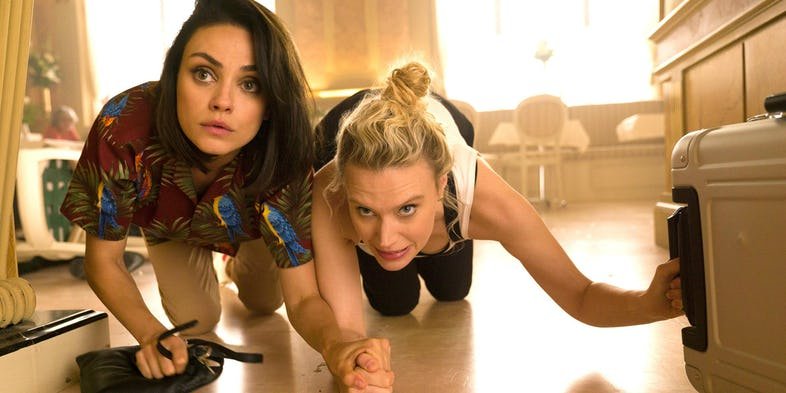
That’s not to throw shade on Mila Kunis, who flashes fine comic timing in the straight woman role, giving McKinnon plenty of space to do that thing she does. Be weird and funny and sometimes hilarious.

McKinnon is Morgan and Kunis plays Audrey, her longtime best friend who just got “text dumped” by boyfriend Drew (Justin Theroux). Just as the girls are setting fire to the stuff Drew left at Audrey’s place, they find out he was a spy, and that “2nd Place Fantasy Football” trophy of his is valuable enough to get them killed.

Director/co-writer Susanna Fogel cooks up the usual elements for a spy spoof, with amusing hijinx, scattershot action, globe-trotting locales, and a little touch of raunch to earn that R rating.

There’s also a couple quirky side characters (like the agent who keeps reminding everyone he went to Harvard) and some familiar faces (Jane Curtin, Paul Reiser, Gillian Anderson).

But Fogel’s MVP is McKinnon, and it’s pretty clear she knows it. McKinnon may not get a script credit, but it isn’t hard to imagine some of the pages saying little more than “have Kate do something funny.”

And she does, particularly skillful enough to make The Spy Who Dumped Me a goofy, enjoyable time-waster.


Sweeter Than Hunny

Christopher Robin

by George Wolf

Pooh! Who doesn’t love him?

Winnie T. Pooh and the gang from the Hundred Acre Wood have endured for decades, and now the second Pooh film is less than twelve months brings all the furry friends to live-action life.

Last year’s Goodbye, Christopher Robin was a bittersweet and uneven origin story, focusing on the inspirations for A.A. Milne’s Pooh tales.

Christopher Robin drops both the goodbye and the bitter in becoming a grown-up fantasyland with an easily digestible, greeting card-ready sentimentality.

Mr. Robin (Ewan McGregor, charming as always) has put the Hundred Acre Wood long behind him, with a wife (Hayley Atwell), a young daughter (Bronte Carmichael – great name!) and a working-class job as an efficiency expert at a London luggage company.

He’s lost sight of the joy in life, and when a crisis at work means Christopher will miss another weekend family getaway, fate intervenes with a much-needed Pooh crew reunion.

The CGI effects that bring the animals to life are wonderful, the voice work  (including Brad Garrett, Toby Jones, Sophie Okonedo, Dr. Who‘s Peter Capaldi and voice acting veteran Jim Cummings) is spot on, the humor warm and the message fuzzy.

What’s missing is depth. There’s no real attempt to find any, and that’s a bit surprising with the filmmaking talent involved.

The director is Marc Forster, and the writing team includes Tom McCarthy and Alex Ross Perry. Between them, those three have some serious depth on their resumes, including Spotlight, Up, Listen Up Phillip, Queen of Earth, Monster’s Ball, Stranger Than Fiction, The Kite Runner and more.

The result is similar to David Lowery’s live-action take on Pete’s Dragon two years ago, where a filmmaker skilled at nuance within serious themes took on a children’s classic and struggled with when to stop simplifying.

Christopher Robin is sweeter than the “hunny” jars Pooh dives into, but nearly as empty as he leaves them. In trying to showcase the need for simple wonders, the film settles awkwardly between a child’s fable and wistful remembrances from grandparents.

There’s plenty to like, but little to love.

https://www.youtube.com/watch?v=0URpDxIjZrQ