Category Archives: New In Theaters

Reviews of what’s out now

What Big Feet You Have

Dawn of the Beast

by Rachel Willis

Seriously, who still thinks camping in the woods is a good idea?

There’s something about the woods that haunts us, so it’s the perfect setting for many a horror movie.

In director Bruce Wemple’s latest film, Dawn of the Beast, it’s the ideal locale for a group of cryptozoology students on the hunt for Sasquatch.

Wemple likes the creature feature – a look at his past work uncovers another film about Bigfoot (Monstrous), as well as one about the mythological Wendigo. Writer Anna Shields must also enjoy the ‘Squatch, as she not only penned Monstrous, but Dawn of the Beast as well. You’d think with two movies about Sasquatch under their belts, these two would have something new to say about Mr. Foot.

And in a way, they do, but unfortunately, what they have to say about their monster is buried beneath a run-of-the-mill ‘cabin in the woods’ horror trope.

There is some fun in Dawn of the Beast. There are a few jokes, characters you root for, as well as one or two you root against, but there’s also a lot of drudge here. You find yourself sitting through too much filler while you wait for the more interesting moments.

Shields also co-stars in the film as Lilly, but her talents seem better suited to writing. There are some genuinely creepy moments – yellow lights (are those eyes?) drawing you into the woods, one or two effective jump scares, and some funny dialogue. And what Lilly and her classmates find in the woods is a lot more terrifying than the legendary Bigfoot.

However, the film’s best aspect is – far and away – the creature effects. They add a degree of tension and fear that would be otherwise absent without such convincingly scary monsters. In some films, the addition of a monster removes the tension; seeing too much destroys the mystery. But in this case, it really works.  

It’s around the film’s third act that Dawn of the Beast begins to hit its stride, embracing the funnier elements and dropping the attempts to inject a seriousness to the film that it largely doesn’t need. A funny horror movie can still be scary, so anything too serious in this movie (a kidnapping, for example) is time wasted for the audience.

Perhaps if Wemple and Shields attempt a third Sasquatch film, it’ll be the charm that lands them a horror film that hits all the right notes.

https://www.youtube.com/watch?v=t_CStrAZZWI

The Not-So-Friendly Skies

Embryo

by Brandon Thomas

Good old alien horror doesn’t come around as much as I’d like. Outside of the occasional Alien or Predator sequel, this subgenre is pretty much stagnant or banished to the realm of mico-budget dreck. Embryo might skirt the line of microbudget, but this eerie alien tale is anything but dreck. 

The bulk of Embryo follows campers Kevin (Domingo Guzman) and Evelyn (Romina Perazzo) as they venture into the woods of southern Chile. Their camping getaway turns into a nightmare after Evelyn is abducted by extraterrestrials, leaving her in a state of shock. As the effects of her alien abductors take hold, Evelyn becomes increasingly more bloodthirsty, leaving a trail of bodies in her wake.

Director Patricio Valladares approaches alien abduction as a blend between Fire in the Sky’s creeping dread and Cronenberg body horror. Evelyn’s descent into other-worldly terror reveals itself in visceral, extreme violence. We’re talking lots of blood and guts here. However, the explanation of her metamorphosis is kept an enigma. The guessing game surrounding the aliens themselves is left to the deepest levels of the audience’s subconsciousness. It’s an act of omission probably born out of budgetary concerns, yet it ends up aiding the film more than the filmmakers could have foreseen. 

Valladares throws a curveball when constructing the film’s narrative. There’s an occasional break in Kevin and Evelyn’s story where Embryo attempts to open up the world a bit more. This allows the filmmakers to weave together other tales of close encounters in this small Chilean town. Not only are the stories different, but so is the style of filmmaking. By switching to found footage, Valladares is able to emphasize suspense and dread over the fantastical gore that oozes through the main segment.

Despite telling three individual tales, Embryo clocks in at a scant 72 minutes. Even with the different stories, the film threatens to run out of steam on multiple occasions. There’s a repetitiveness to the Kevin and Evelyn segment especially that starts to detract from its overall effectiveness. I can’t believe I’m saying this, but there are only so many times Kevin can lose Evelyn only to find her feasting on a biker, doctor, or other camper. 

Embryo doesn’t quite cross the finish line at full speed, but through deft tone management and a willingness to get gross, the film leaves an overall positive impression.

It’s People!!!

Roe V Wade

by Christie Robb

Cathy Allyn and Nick Loeb’s film Roe v. Wade is an unnuanced slog through the events leading up to the landmark 1973 Supreme Court decision.

The directors (who share writing credit with Ken Kushner) frame the court case with the conversion narrative of Dr. Bernard Nathanson (Loeb). According to the film, Nathanson, “the Abortion King” aka “the Scraper,” claims to have been swept up in the wave of 70s women’s liberation and performed seventy thousand abortions until he was confronted with fetal development by way of the advent of ultrasound technology. This results in a breakdown that is unmistakably similar to Charlton Heston’s in Soylent Green—“It’s a person! God forgive me! What have I done?!”

The choice to cast Loeb, whose dialogue delivery bears an eerie similarity to an unsure elementary school student asked to read a passage aloud, in such a pivotal role is but one example of the missteps taken in the film.

The hammy acting is a trait shared among many of the cast members. Jamie Kennedy (Scream), for example, as Larry Lader (co-founder of NARAL Pro-Choice America) all but twirls an imaginary handlebar mustache as he explains how liberals seed the uncritical news media with statistics conjured from thin air. Stacey Dash (Clueless) as Dr. Mildred Jefferson (president of the National Right to Life Committee) fairly vibrates with indignation when her eyes aren’t filled with tears at the equating of abortion to slavery or in polite reference to her own infertility issues.

Even if the acting was better, all the emotion would seem misplaced given how much time is devoted to characters debating constitutional law. There is not enough room in a two hour movie to detail the establishment of the Pro-Life and Pro-Choice movements plus the evolution of the Roe court case and still deliver the kind of emotional character development that Allyn and Loeb are shooting for.

The political arguments are underdeveloped, the nuances of the court proceedings are difficult to follow, and there are too many characters to keep track of. Joey Lawrence’s (Blossom) character could have easily been cut as his purpose in the film seems to be delivering supporting quotes by founding fathers.

The film’s stated goal is to tell the true story of Roe vs. Wade. However, this is something it cannot really achieve. Missing is any coverage of the personal, economic, social, or medical reasons why a woman might seek an abortion in the first place. It’s a pro-life persuasive essay masquerading as a soap opera/civics lecture and it’s not particularly good at being any of those things.

Exit Stage Gauche

French Exit

by George Wolf

So, it seems your quick, stealthy exit migrates from Irish to French when excess alcohol is not involved.

Good to know, I had to look it up.

Francis Price (Michelle Pfeiffer) certainly enjoys a good martini, but her exit plan is a bit more serious than just ducking out of the local bar unnoticed.

After years of living high as a Manhattan socialite, Francis’s inheritance is nearly gone. So after selling off what they can, Francis and her son Malcolm (Lucas Hedges) head to Paris to stay in her best friend’s empty apartment. When the last dollar is finally spent, Francis plans to kill herself.

It sounds pretty dramatic, but writer Patrick DeWitt (who also penned the source novel) and director Azazel Jacobs start peppering in the absurdity and black comedy as soon as mother and son are aboard a ship to France.

Malcolm leaves his fiancee Susan (Imogen Poots) behind, and hooks up with Madeleine (Danielle Macdonald) en route. Madeleine is a medium, and she soon becomes Francis’s conduit for summoning the late Mr. Price (Tracy Letts) when his soul returns in a cat.

Pfeiffer is cold, condescending perfection. Francis’s words for nearly everyone she encounters practically drip with contempt, and Pfeiffer is always able to keep the film’s tricky tonal balance from toppling toward either maudlin or silly.

She enjoys a wonderful chemistry with Hedges, who impresses yet again as a young man who is still coming to grips with the lack of affection in his upbringing, his mother’s icy worldview, and how they’ve both affected his ability to relate to other people.

And soon, there are plenty of other people to relate to in the Paris flat. There’s the neighbor who desperately wants to make friends (a scene-stealing Valerie Mahaffey), Madeleine the medium, a detective hunting for the runaway cat (Isaach De Bankole), ex-fiancee Susan and her new man (Daniel di Tomasso), and Joan, who actually owns the apartment (Susan Coyne)!

You’d be quick to label the entire affair a Wes Anderson knockoff if Jacobs (The Lovers, Mozart in the Jungle, Doll & Em) didn’t fill the center with such unabashed heart. The affection between mother and son is never in doubt, and Pfeiffer’s delicious turn makes sure Francis never becomes a villain, just a fascinating and darkly funny mess.

With its self-conscious quirks and surface-level satisfactions, this is a French Exit more obvious than most. But thanks to Pfeiffer and a sharply drawn ensemble, it’s never less than wicked fun.

My Normal Size Jewish Funeral

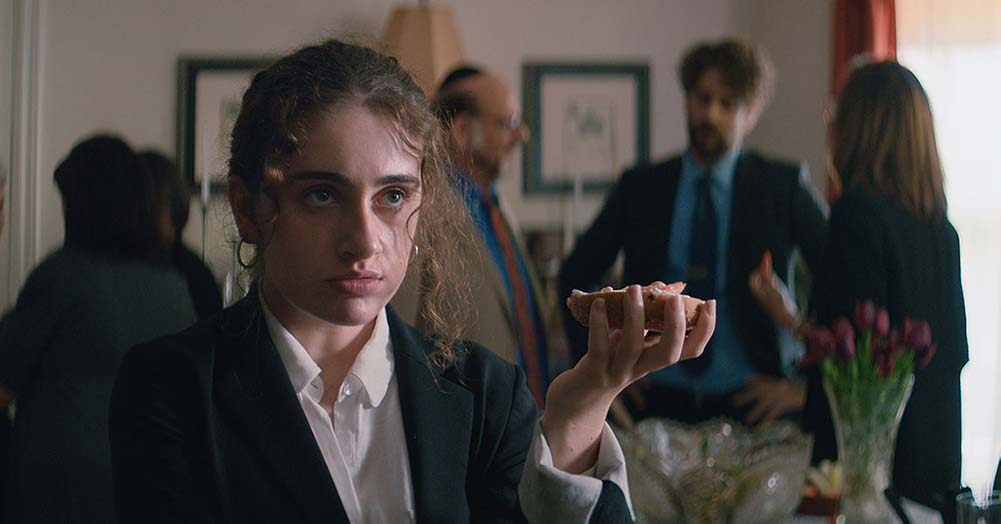
Shiva Baby

by George Wolf

“You can’t just show up for the after party for a shiva, and like, reap the benefits of the buffet.”

Twentysomething Danielle (Rachel Sennott – irresistible) is definitely guilty of skipping the actual funeral (she doesn’t even know who died!), but if there are benefits to the after party, she isn’t reaping them. It’s awkward enough that her former flame Maya (Molly Gordon) is there, but that’s hardly the worst of it.

To her horror, Danielle sees that Max (Danny Deferarri) is there, too. Max is Danielle’s sugar daddy, and look, he brought his beautiful wife (Dianna Agron) and their cute baby daughter!

With Shiva Baby, Emma Seligman expands her 2018 short film for a feature debut full of observational comedy, mounting anxiety and a strangely appealing sexiness. Imagine the Coen Brothers rebooting Uncut Gems as a coming-of-age sex comedy, and you get an idea of the tonal tightrope Seligman is able to command.

The film’s opening finds Danielle confident and alluring. By the end of the day, she’s an unkempt, sweaty mess of beverages, blood and embarrassment. Almost all of Danielle’s arc takes place inside the home of the bereaved, and Seligman makes sure that is a hilariously uncomfortable place to be.

Danielle’s parents (the ever-reliable Fred Melamed and a scene-stealing Polly Draper) pressure her to work the room for job contacts, family friends inquire about her post-college plans, Molly wonders why Danielle ghosted her, and Max’s wife is getting suspicious.

And through it all, Seligman’s camera draws in closer and closer, making Danielle’s darkly comic claustrophobia almost palpable.

Clearly, much of Seligman’s sharp dialog comes from personal experience, and if it’s one you share this is a film that will feel like part of the family. But you didn’t have to be Greek to get caught up in that Big Fat Wedding, and you don’t have to be Jewish to see the joy in Shiva Baby.

Seligman flashes an insight that disarms you with sex and humor, keeping its hand at a subtle distance. But by the time we’re leaving that buffet, a breakout filmmaker and star have delivered a fresh, funny and intimate take on the indignities of finding yourself.

Come On, Get Happy

Funny Face

by Hope Madden

Though writer/director Tim Sutton’s latest is more a collection of images and moments than a strictly plotted narrative, the story that unfolds is kind of a bittersweet wonder.

An isolated youngish man (Cosmo Jarvis) rails against the impending destruction of his neighborhood, a community he haunts wearing a happy Halloween mask. An act of kindness at a nearby convenience store, though, brings about a surprising and really lovely friendship.  

Jarvis, who was so good in last year’s Calm with Horses, convinces again as an outsider with a lot of pent-up anger but an otherwise sweet heart. There’s a mixture of brutality and vulnerability in the portrayal that calls to mind Tom Hardy or even Brando – although, given a particular preoccupation in the film, he may be aiming for James Dean.

Newcomer Dela Meskienyar matches him step for step as another outsider, also angry at circumstances that feel beyond control, also hiding her face. It’s a remarkable and never forced kind of parallelism Sutton develops–a lost quality that he sees in every character. He uses this thread to braid disparate lives together and to create a sense of empathy, even toward the most loathsome among us.

Sutton is no stranger to tales of white male alienation, bruised masculinity, and an almost childlike struggle with our primal nature. Both his first feature Dark Night (which deals with the 2012 Aurora shooting), and his follow up, Donnybook (about bare knuckle brawls in addiction-riddled Ohio) illustrate his interest.

Funny Face, though, marks a step toward something more stylish. The film has a retro vibe, like a long-lost Seventies indie set in Brooklyn. Given the of-the-moment storyline, this offers his film the timeless quality of a fairy tale—a theme he develops with imagery of equal parts urban realism and magical whimsy.

A sense of mourning fuels Funny Face. While Sutton’s film is intimately linked to its Brooklyn setting, that exact same mourning informs Lesotho’s beautiful This Is Not a Burial, It’s a Resurrection, also releasing this week. Unchecked capitalism is a global cancer, it would seem.

All of Sutton’s films contextualize human struggle within the context of community. This has never been truer than it is with Funny Face, a comment on the way greed destroys history and the sense of place, leaving nothing in that emptiness, even for those who profit.

Not even a smile.  

A Sort Of Homecoming

Like a House on Fire

by Rachel Willis

Is there ever a good reason for leaving your family? And if you come home, can you expect them to welcome you with open arms?

Writer/director Jesse Noah Klein examines what happens to a family when a mother who left them behind wants to return in Like a House on Fire.

When the film opens, we’re not sure why Dara (Sarah Sutherland, Veep) has left her family. But we know from the beginning she wants to be let back in, and that she wants to see her daughter. Her husband, Danny (Jared Abrahamson), isn’t sure he wants that to happen, especially since their almost 4-year-old daughter, Isabel (an unspeakably adorable Margaux Vaillancourt), doesn’t remember mama.

Dara’s backstory, as it unfolds, helps the audience sympathize with her disenchantment upon finding her family hasn’t waited for her. But there’s also sympathy to be had for Danny, and particularly, Isabel. This is not a situation with a clear villain, but a nuanced look at the ways in which families can fall apart.

The film’s best moments come from Sutherland. She conveys the desperation of a woman who needs to reconnect with her daughter, as well as the hope that things will turn out the way she wants. Whenever her efforts are thwarted, we feel her devastation. Dara’s initial meetings with Isabel are touching. Dara’s joy and disappointment commingle whenever she’s with her daughter.

It’s the rest of the film that doesn’t always live up to its character.

There are some needless character conflicts that detract from the story’s focus. Dara’s stepmother (Amanda Brugel – a fabulous actress) is a thorn in her side – but the reasons why are unclear. There’s a stepsister (perhaps a half-sister?) who comes and goes without much to do except provide another reason for the stepmother’s animosity. It doesn’t seem as if much thought went into these two characters.

The college boy that Dara meets and befriends at the park is the film’s messiest issue. The time Dara spends with him would have been better devoted to digging into the larger family issues surrounding Dara – both with her husband and daughter, as well as her father and his family.

As it is, a lot of the issues and relationships in the film putter out. There’s an imbalance that sways the film one way and another, but never lands the audience on solid ground.

Which is perhaps how Dara feels all along.

Like One to the Head

Witness Infection

by Samantha Harden

What would you do if everyone in your small town turned into a bloodthirsty zombie after eating sausage from an esteemed food truck? 

Witness Infection is the story of three friends Carlo (Robert Belushi), Gina (Jill-Michele Melean) and Vince (Vince Donvito), who try to save themselves and the people they love from the zombie infection rapidly spreading through their hometown. 

Writers Carlos Alazraqui and Jill-Michele Melean deliver humor, but the emotion is lacking. There are so many perfectly placed references from classic movies like Raiders of the Lost Ark, Pulp Fiction and The Godfather. Carlo’s dad (Carlos Alazraqui) even makes a reference to Miller’s Crossing, telling his sons to “always leave one in the head.” Still, Witness Infection misses the mark when it comes to creating a unique and unforgettable screenplay. 

It does, at times, add to the film. Andy Palmer’s direction only seems to cancel it out. Palmer chooses camera angles that don’t make sense and create noticeably unnatural transitions. So unnatural that it takes away from the focus of the movie, and it’s hard to maintain interest when so little of the film surprises. 

Zombie apocalypse movies have been done countless times. Witness Infection is too similar to every other zombie movie to be remembered. Nothing really stands out until we get to see Rose (Monique Coleman) dominate the screen. 

The heroic trio finds Rose at one of the few bars in town, still defending herself and the bar. She refuses to be the black character that dies before the end of the movie. Declaring that she isn’t going to give up, Rose claims the most memorable quote from the film: “I am not Samuel L. Jackson in Jurassic Park. I am not Yaphet Kotto in Alien, nor am I Dwayne mother fucking Johnson.”

Unfortunately, after that amazing performance, we don’t see her again. 

Palmer cut out the one thing that kept me interested in his film and left me instead with three of the most stale and even at times frustrating characters in the movie. 

https://www.youtube.com/watch?v=9jVUrXIEtxk

Undead Again

Train to Busan: Peninsula

by Hope Madden

Back in 2016, filmmaker Sang-ho Yeon made the most thrilling zombie film since 28 Days Later. Sometimes funny, sometimes shocking, always exciting and at least once a heartbreaker, Train to Busan succeeded on every front.

You can’t chalk it up to newness, either. Busan was actually a sequel to Yeon’s fascinating animated take on Korea’s zombie infestation, Seoul Station. So the guy was 2 for 2 in gripping zombie thrills.

Can he make it a hat trick?

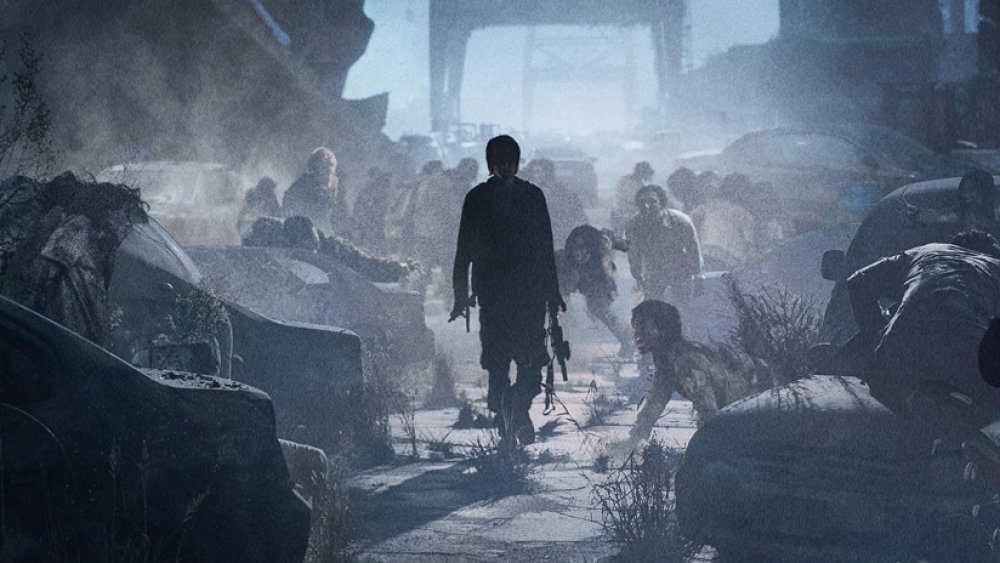
Train to Busan: Peninsula begins on that same fateful day that South Korea falls to the zombipocalypse. Those fleeing Korea by ship are turned around for fear of global contamination, so all survivors descend upon Hong Kong. Four years later, the city’s overrun, survivors are living in poverty, and a rag tag bunch is so desperate, they’re willing to go back to the Korean peninsula to pull a job that will make them rich.

But if Hong Kong looks bad, wait til they see what’s happened since they left the peninsula.

Things feel much more borrowed this time around. Peninsula plays like a mash up of Friedkin’s 1977 adventure Sorcerer (or Clouzot’s 1953 Wages of Fear) and the 4th in George Romero’s line of zombie adventures, 2005’s Land of the Dead. There’s also a little Dawn of the Dead, plus one scene lifted wholesale from 28 Days Later. And you cannot miss a great deal of a great number of Mad Max flicks.

Both the claustrophobia and the relentless forward momentum of the 2016 film are gone, replaced with tactical maneuvering around a fairly stagey looking city scape and military compound. And while you have to believe Yeon had a bigger budget to work with based on the success of his previous effort, Peninsula’s zombie effects are weaker here.

That’s not to say the film is bad, just a letdown. Dong-Won Gang makes for a serviceable quietly haunted hero. Scrappy Re Lee and adorable Ye-Won Lee infuse the film with vibrance and fun, and both Gyo-hwan Koo and Min-Jae Kim create respectably reprehensible villains. (Although the high water mark in zombie villainy was reached with Train to Busan.)

The story is tight, if highly borrowed, and the action scenes are plentiful. Compare it with nearly every other zombie film to come out in the last two decades and it’s a creepy way to spend a couple of hours. Compare it to Yeon’s last two movies, though, and it comes up lacking.  

Place Your Bets

Godzilla vs. Kong

by George Wolf & Hope Madden

Here’s a sampling of the things we yelled at the screen during Godzilla vs. Kong:

“Boom! In the face!”

“Kyle Chandler is a terrible father.”

“Skull f**k him!”

“It’s just a flesh wound, get up!”

So you could say we were engaged in this battle, the one that’s been brewing since the end credits stinger from the excellent Kong: Skull Island four years ago. GvK can’t quite match that film’s tonal bullseye, but it easily lands as second best in the “Titan” Monsterverse that was reborn with 2014’s Godzilla.

Picking up three years after the tedious Godzilla: King of the Monsters, the film finds Kong contained on Skull Island under the respectful eye of Ilene Andrews (Rebecca Hall).

Meanwhile, Godzilla attacks APEX’s Florida headquarters – seemingly unprovoked. Mansplaining Mark Russell (Kyle Chandler) says Godzilla’s changed his hero stripes, but his daughter Madison (Millie Bobby Brown) and “Titan Truth” podcaster Bernie Hayes (Brian Tyree Henry, committing grand theft scenery) think there’s got to be more to the story.

There’s plenty more, and Dr. Nathan Lind (Alexander Skarsgård) believes Kong could be the key to proving his Hollow Earth theory about the Titans. Ilene agrees to allow the heavily sedated Kong to be transported by sea, but far from Godzilla’s favorite swimming holes, of course.

Riiiight.

Director Adam Wingard (You’re Next, Blair Witch) clearly realizes that monster mashes aren’t compelling if you can’t tell who’s fighting, and the technical aspects of GvK bring the Titan battles to vibrant life. Pristine cinematography, detailed CGI effects and a wonderfully layered sound design elevate the thrills early and often.

And that is what we’re here for, isn’t it?

That’s a familiar refrain when the human arcs in these films are so woeful, but screenwriters Eric Pearson and Max Borenstein toss the overwrought melodrama of King of the Monsters and add a frisky sense of welcome fun.

Yes, there’s another cute kid (Kaylee Hottle) with negligent guardians, and more than enough characters, locations and theories to keep up with. But even if you fall behind, you’ll catch up when these two Titans throw hands and tails, because they mean business.

They’re timing ain’t bad, either, as this is the kind of cinematic spectacle that could mean very good business for newly reopened theaters that badly need it. It’s a PG-13 return to form for a legendary franchise, with plenty to reward your popcorn munching and ringside commentary (keep it clean at the multiplex, please).

Just pick your screen size, and get ready to rumble.