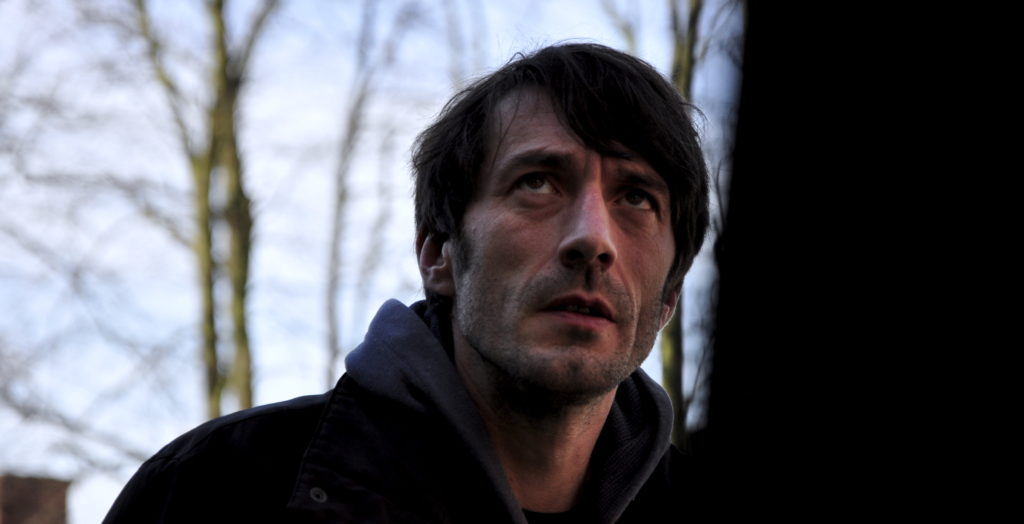
Two years ago, Krisha served as a stunning feature debut for writer/director Trey Edward Shults. Gripping in the intimate nature of its truths, it heralded Shults as a new filmmaker with tremendous potential.
That potential is realized with It Comes at Night.
He may have bigger stars and a larger budget this time out, but Shults shows storytelling instincts that are already well-seasoned. Resisting any pressures to mainstream his scope and “go bigger,” Shults get even more intimate. While Krisha showed a very tangible threat infecting a family, It Comes at Night is more abstract, an intensely personal take on fear and paranoia.
Deep in the woods, Paul (Joel Edgerton, solid as always), Sarah (Carmen Ejogo) and their teenage son Travis (Kelvin Harrison, Jr.) have established a cautious existence in the face of a worldwide plague. They have boarded their windows, secured their doors, and enacted a very strict set of rules for survival.
At the top of that list: do not go out at night.
This rigid domestic order is tested when the desperate Will (Christopher Abbott) breaks in. He has a wife, Kim (Riley Keough) and toddler to protect, and is offering all they have in exchange for refuge.
It Comes at Night has been on horror fans’ radar for some time, but it will test the patience of those satisfied with cheap jump scares or spoon-fed explanations. As with Krisha, Shults builds the film around his own experiences, using Travis to often mirror how Shults himself dealt with a death in the family. Through Travis’s nightmares, we are kept off balance, questioning just what is real and who can be trusted.
Shults explores the confines of the house with a fluid camera and lush cinematography, slyly creating an effective sense of separation between the occupants and the dangers outside.
But what are those dangers, and how much of the soul might one offer up to placate fear itself?
In asking those unsettling questions, It Comes at Night becomes a truly chilling exploration of human frailty.
Remember the first time you saw the trailer for the new Tom Cruise flick The Mummy, and you thought, “My God, that looks awful”?
Dude, you were so right.
Part Tomb Raider, part Suicide Squad – with huge bits stolen whole cloth from the immeasurably superior An American Werewolf in London – The Mummy lacks even a solid thirty seconds of fresh thought. It is as dusty and lifeless as its namesake.
But, because it’s some sort of artistic imperative that every movie we see for the next decade is planned out in huge corporate clusters – I mean cinematic universes – the Universal monsters are being revived. Aging leading men will be tapped for butts-in-seats duties as Dark Universe tries to create a series of nostalgic family(ish) fare neutered beyond recognition with CGI.
First up, Cruise.
A prologue riddled with plot holes leads to one wildly offensive piece of cultural flippancy, as Cruise Indiana Joneses his way into Iraqi insurgent territory in search of unnamed treasure.
He finds an Egyptian sarcophagus. In Iraq. It’s just one geographic discrepancy mentioned but never clearly explained. Part and parcel of a script-by-committee that hopes you’ll overlook its incessant nonsense.
Cruise, as Nick Morton, is Cruise – all superficial charm and charisma. He’s joined by one-note Annabelle Wallis as the archeologist in a white shirt that’s bound to get really wet at some point, and Sofia Boutella as a mummy with strategically placed wrappings.
And Russell Crowe as Dr. Henry Jekyll.
Will he turn into Hyde? Will it be among the film’s weakest, saddest, most pathetic scenes? No spoilers here.
Director Alex Kurtzman bandages together secondhand ideas, weak writing and an absence of onscreen chemistry with CGI aplenty. Sandstorms! Birds! More sand! And mummy/zombies that look like they should be gettin’ down with Michael Jackson.
If only!
Kurtzman’s impressive lack of instinct for pacing, tone and atmosphere match perfectly with the script’s hodgepodge of stolen ideas. And now we can wait for Hollywood execs to bring other moldering horror corpses back to life. Sigh.
There was a time when, for at least a second or two, my boss thought I might have a severed human appendage in a filthy Kroger bag under my desk.
How did get myself into this mess?
I blame the mushrooms.
Each fall and spring I look into my yard to find that everything’s coming up fungi. During the moist, temperate seasons my lawn becomes home to the most heinous mushrooms you have ever seen. Their white 5 – 6 inch shafts end with a helmet-like, purplish brown tip.
Sound like anything to you?
Picture it, if you will.
Yes, it’s that bad.
And then picture a few dozen standing at attention throughout my lawn.
I never have seen this particular brand of fungus anywhere else on earth but in my yard. Lucky me.
They are upsetting to look at. Their unseemly appearance drives my neighbor kids crazy. One boy – normally sweet and smiley – cannot abide them. The minute he sees a bloom he gives it a swift kick.
Do you know what looks worse than a yard full of erect mushrooms?
A lawn littered with amputees.
I’m surprised the mailman will even deliver to our house.
I’ve tried to find out what type of mushroom they might be, hoping in vain to eliminate the fungus without killing my lawn. But they’re hard to describe if you’re looking for a serious answer.
The internet is no help at all. Type “mushrooms” into Google and you’ll come up with 15.1 million possible links. Narrow the search terms and you’ll likely get descriptions like “sexy science,” which, at first blush, looks like it actually might have the information you seek, until you realize the mushroom they’re talking about is only two inches long.
My mushroom is bigger than your mushroom.
Meanwhile, my husband, George, was doing his own sleuthing. He works for a radio station and, at that time, the station ran a gardening show on Saturday mornings. George emailed a picture of the plant to the show’s host for an explanation.
The host sternly responded, “I do not do that type of counseling. Try Dr. Ruth.”
I once had a colleague who believed, sight unseen, that these were the pre-bloom stage of a spectacular orchid. She advised me to dig them up and keep them in clear glass jars in my basement.
I appreciated the suggestion, but I feared what would happen on the holidays when all our nieces and nephews go downstairs to play ping pong and find a large collection of these severed appendages on my cellar shelves.
Merry Christmas, kids!
I’m creepy enough as it is.
Another colleague had run a landscaping business years ago and offered to take a look. She thought she’d dealt with the same lawn care menace once in a Dublin neighborhood. I bet it went over really well there.
So I dug up a sample and put it in a plastic bag to bring to work. But the stench! I hadn’t known about the odor – this is not the kind of plant you bend down to sniff – until I had one in hand.
It smelled exactly as I would imagine a severed body part left too long in a filthy plastic bag might.
My colleague was late to work and I simply couldn’t tolerate the odor, so I grabbed the bag to take it to the restroom garbage. Unfortunately, I ran into my boss.
“What have you got there?”
I wasn’t sure what would be more jarring and inappropriate, describing it or showing it to him.
I decided the least suspicious thing I could do was dash past him to flee to the ladies’ room, leaving behind a hideous stench. His horrified expression suggested that he got a glimpse of the package.
If you’re looking for a light hearted, talky romp, Bas Devos’s Violet is not for you. If, on the other hand, you’d like to see a thoughtfully delivered meditation on grief – and who doesn’t? – seriously, you should give this film a chance.
At thirteen minutes into the film, I’d yet to hear 20 words of dialog. But the sounds are hypnotic. It might be the click and whir of office machinery as the screen itself contains CCTV footage from mall security, capturing without notice the stabbing death of a teenage boy.
Or it could be the clatter of BMX bike wheels as Jesse (Cesar De Sutter) tries to resume normal life with his buddies after surviving the attack that ended his friend Jonas’s life.
Maybe it’s the airplanes overhead, the rain on awnings, or the sudden explosion of noise about 42 minutes in as Jesse and his friends attend the very heavy Deafheaven concert.
Whatever you’re hearing, it’s not an explanation of what happened, not details about how Jesse is coping. Devos has confidence that you can suss that out without hand holding.
His dreamlike work, often recalling Gus Van Sant, sits with mourning. The delayed reaction, the inability to focus, the hypersensitivity and numbness that collide. Why didn’t Jesse do anything to help Jonas?
It’s a question you can see on Jesse’s father’s face, on the faces of townies. With barely a word spoken, Devos offers insight into disappointment, masculinity, shock and the awkward, undramatic reality of day to day grief.
It’s a lovely effort, heavy with symbolism (sometimes too heavy). Devos is as confident with his visual storytelling as he is with sound design. Little touches – blue handlebars and peddles that match a BMX tee shirt, two dogs tearing at a trash bag on a corner – lead up to a quiet climax that matches symbol with reality in one overwhelming, terrifying and beautiful close.
It’s as insightful and respectful a representation of trauma and grief as you’ll find, but don’t expect tidy explanations or epiphanies. Devos is as patient with his subject as the theme requires.
“Who hasn’t had the impulse to put their life on hold for a moment…just vanish completely?”
Howard Wakefield (Bryan Cranston) gives in to that impulse, and his moment of resignation becomes months in a self-imposed exile, wallowing in self-pity and watching his family from an attic window.
Sure, Howard has a nice job, beautiful family and sweet home in suburban New York, but he’s been lulled into a stupor by the whole domestic routine. After yet another trying day, Howard ventures up to the attic above his separate garage…and decides to stay there.
Writer/director Robin Swicord adapts E.L. Doctorow’s short story with a workmanlike precision, dutifully providing all the building blocks for this high-concept parable, but never finding the depth or profundity she seeks.
Cranston, here’s a shocker, is fantastic, digging commendably deep in a search for the humanity his character badly needs. Howard has some first-world problems, as he labels suburbia a place people can feel “protected from what’s wild,” but can’t challenge his privilege with anything more dire than dumpster diving or poor hygiene. Howard is far from likable, and though Cranston is all in, finding a reason to root for his quest is tough sledding indeed.
As he spies on his wife (Jennifer Garner) and two daughters, Howard fancies himself the veritable wise old hermit, observing the folly of modern life and dispatching simple truths. It’s well-meaning, but these truths are of the standard greeting card variety, rendered even less impactful from the film’s inherent need to tell (through voiceover narration or talking-to-himself musings) instead of show.
At times, Wakefield has the feel of a one-man show. With Cranston, the man makes it worth watching, even when the show can’t quite keep up.
The plot of The Wedding Plan would give one the impression that it’s a standard entry into the rom-com genre. When Michal (Noa Koler) is left by her fiancé, Gidi, thirty days before their wedding, she decides to go ahead with it anyway. While you could expect a comedic series of dates with random men while Michal tries to fill the groom void, what we get in writer/director Rama Burshtein’s film is something with much more depth.
While we do get scenes of awkward first dates, set up for Michal by her matchmaker, Burshtein is more focused on letting us know who Michal is and what she wants. While she wants to marry, the driving force behind her desire is a weariness with dating and a fear of being alone. When she decides to go ahead with her wedding, she gives herself over to God, believing that he will send her the “man of her dreams”.
As expected, the people in Michal’s life approach her plan with bemusement, incredulity, and sometimes outright aggression. However, the strength of Michal’s faith is what keeps us pulling for her. As Burshtein employs the romantic comedy tropes in her script, she manages to make them feel fresh by rooting Michal’s journey deeply in her faith. Though many characters see Michal as arrogant, the audience sees her as a women who believes so strongly in God’s plan that we can’t help but be awed by her sincerity.
Noa Koler is extraordinary. From the first moment she’s on screen, she brings a touching sweetness to Michal – we want her to be happy and find love. When her fiancé ends the engagement, the audiences feels genuine sorrow, even though we’ve spent a very short time with her.
At times, Burshtein takes on too much within the story. While most of the characters have depth, some of them are flat, only existing to push the story forward. When so many of your characters are so well-rounded, those that serve as pawns stand out roughly against the others.
Despite the flaws, Burshtein’s film is a endearing exploration of love and faith.
What with rumors of recuts, controversies over costuming and the recent hubbub caused by all-female screenings, Wonder Woman has caused quite a stir.
Of course, she’s been causing a stir since 1941.
In the hotly anticipated film directed by Patty Jenkins (Monster), the Amazon princess is compelled to leave her peaceful paradise when WWI American spy Steve Trevor (Chris Pine) crash lands. Learning for the first time about the global destruction, she sees it as her duty to try to end the war.
Gal Gadot returns, after a brief turn as the highlight in Batman V Superman, this time shouldering lead duties in the role she seemed destined for. Her action sequences are convincing – two years in the Israeli military will do that. Playing a newcomer to “civilized” society, Gadot finds an appropriate balance of naiveté and self-sufficiency.
Jenkins and screenwriter Allan Heinberg (in his film debut after an arc of WW comics and years in TV) also strike an effective balancing act with the multiple elements at work in their film: period war drama, sweeping romance, action film and superhero origin story.
That origin story, with an inherent freshness unburdened by multiple reboots, is part coming of age, part fish out of water. As it introduces a new hero and questions if the world deserves her, Wonder Woman benefits from a bit of easy charm and the deft handling of some touchy items.
Chris Pine is the charm. As the dashing Capt. Trevor, he carries self-aware good humor and comfortable chemistry with the lead, and he delivers a few of the film’s best lines.
As for Jenkins’s handling, there’s much to be said for the minefield she inherited with this project: the costume, the lasso – hell, the cartoon Wonder Woman has an invisible jet. There’s plenty to ridicule here, or, for a fanboy, to revere.
Jenkins, finding middle ground between Marvel’s wisecracking and DC’s weighty seriousness, inserts light humor, occasionally reverses traditional comic book gender roles with success, and still manages to simply craft a solid superhero movie.
She can’t escape the genre penchant for excess, and by the third act, Wonder Woman starts feeling every bit of its two-hour and twenty-minute running time. But there is definite hope here, not only for humanity, but the future of the DC film universe.
Lean, mean futuristic science fiction that feels unsettlingly like reality, The Survivalist ranks among the best dystopian films in recent memory. And as writer/director Stephen Fingleton creates an utterly plausible and devastatingly grim future, the film marks a first time filmmaker with an awful lot to say.
A solitary figure (Martin McCann – amazing) ekes out an existence in a shack hidden in the woods of Northern Ireland. His small field of crops is fertilized by the bodies of interlopers who happen upon him. He spends his days tending his vegetables and reinforcing his traps, but a haunted past and his own isolation are starting to wear at him.
Enter two hungry women: Kathryn (Olwen Fouere) and her daughter, Milja (Mia Goth).
His first inclination is to do with them what we’ve seen him do with others who come too close to his holdout. But he’s tempted, made an offer for something not necessary for survival. Something he wants more than he needs.
For Milja and her mother, this is still nothing more than survival, which is what puts the three people on different planes of existence. The survivalist (for we never do know his name) has entered the treacherous and vulnerable area of want, and then the even more dangerous ground of hope.
The shifting power and landscape of the relationships is fascinating, made all the more powerful for lack of dialog. Who is in control? The answer varies scene by scene.
The title could stand for any of the three, and this trio of performances consistently impresses.
Fingleton lingers on glances and body language to reinforce the pitiless practicality that has taken the place of civilization. McCann’s silent chemistry with each character offers more insight into his character than pages of dialog could, and he’s matched in his efforts – particularly by Fouere.
The film, like its protagonists, is unapologetically efficient. But Fingleton and his director of photography Damien Elliott occasionally offer a glimpse of the beauty left in this dystopia – a beauty that existed long before and will persist long after man’s involvement.
Together, cast and crew trap you in slow-boil of primal instincts with an explosion the inevitable consequence.
You want to know the fears and anxieties at work in any modern population? Just look at their horror films.
There are certain anxieties that plague us no matter the era. It Follows, for instance, brilliantly brought horror’s long obsession with underage promiscuity into modern focus. Unfriended, #Horror, Rings, The Den and dozens of others touched on our loss of control in a digital age. You could even read The Witch as a comment on the power of radicalization.
What horror films had their fingers most firmly on the elevated pulse of their respective times?
6. Hostel (2005)
In April of 2004, photos and videos from Abu Ghraib detention center created a previously unimaginable public dialog about the appropriateness of torture. And we knew that what we were seeing on the news had to be far less graphic and horrific than what we didn’t see.
The sudden realization that there were so many more people on earth who believed there were appropriate uses for torture – and that there were others who could so easily be provoked to indulge their bloodlust – sparked a real, palpable discomfort in the US.
Writer/director Eli Roth created a new subgenre with this his meditation on that very bloodlust. As his tourists hit Slovakia in search of wild times, they become the fodder for someone else’s hedonistic indulgence. Graphic and provocative, Hostel is hardly a masterpiece or even a classic, but there is no question that it touched a nerve.
5. The Wolf Man (1941)
By 1939, the second great war had begun. The tale of shadowy European villainy turning a good hearted American man into a monster felt somehow compelling to an audience seeing yet another generation of soldiers facing and contributing to the real horror of war.
Like most of the films on this list, The Wolf Man created a mythology many would copy. But writer Curt Siodmak’s take on the monster that lurks inside a good man differs from many because he pulled on his own experience with Nazi Germany to create an atmosphere. He’d seen firsthand what it looks like when apparently good people turn suddenly savage.
Lon Chaney, Jr.’s sympathetic performance only drove home the point that it could be anybody. You want badly for this decent-hearted man to somehow be saved, but you know that he’s done too much. There is no redemption left for him now.
4. Rosemary’s Baby (1968)
The late Sixties saw cultural change like few eras before or since. Roman Polanski’s adaptation of Ira Levin’s tale mined more than a few, but it was the sexual revolution that most fed this picture’s dread.
The Pill was first approved for use in America in 1960. This led to some happy people, yes, but also a lot of worry. Whenever science steps into God’s territory, people get anxious. This tension fueled many horror films, but the way Polanski represents the female body as a reproductive tool entirely outside her own control is endlessly terrifying.
It helps that Mia Farrow is the picture of vulnerability, trying desperately and without success to regain power over her own body and future. Doctors are no help – they’re in on it. She can’t look to her husband because he benefits from this perversion of her biology as much as anybody. It’s a fascinating observation, filmed so that we can’t help but feel that we are voyeurs in her struggle.
3. Get Out (2017)
What took so long for a film to manifest the fears of racial inequality as smartly as does Jordan Peele’s Get Out.
Peele writes and directs a mash up of Guess Who’s Coming to Dinner, Rosemary’s Baby and a few other staples that should go unnamed to preserve the fun. Opening with a brilliant prologue that wraps a nice vibe of homage around the cold realities of “walking while black,” Peele uses tension, humor and a few solid frights to call out blatant prejudice, casual racism and cultural appropriation.
Peele is clearly a horror fan, and he gives knowing winks to many genre cliches (the jump scare, the dream) while anchoring his entire film in the upending of the “final girl.” This isn’t a young white coed trying to solve a mystery and save herself, it’s a young man of color, challenging the audience to enjoy the ride but understand why switching these roles in a horror film is a social critique in itself.
https://www.youtube.com/watch?v=A2JbO9lnVLE
2. Night of the Living Dead (1969)
Romero’s first zombie film – the first proper zombie film – hit upon cultural anxieties aplenty. The generation gap that accompanied the era of social change had people seeing those of the other generation as aliens – or maybe zombies?
The war in Vietnam – televised almost constantly, and for the first time – was reflected in Romero’s onscreen broadcasts of unimaginable horror. He depicts the changing paradigm of the generations in the power struggle going on inside the besieged house.
More than anything, though, Romero hit a nerve with his casting. The filmmaker has long said that African American actor Duane Jones got the part as the lead because he was simply the best actor in the cast. True enough. But his performance as the level headed, proactive, calm-under-pressure alpha male – followed by Romero’s gut-punch of a finale – spoke volumes and is one of the main reasons the film remains as relevant today as it was when it was released.
1. Godzilla (1954)
Is Godzilla the best film on this list? No. But, more than any other film in the genre, it spoke directly to global anxieties, became a phenomenal success, and changed the face of horror.
As Japan struggled to re-emerge from the 1945 bombings of Hiroshima and Nagasaki, director Ishiro Honda unleashed that dreaded kaiju—followed quickly by a tidal wave of creature features focused on scientists whose ungodly work creates global cataclysm.
Far more pointed and insightful than its American bastardization or any of the sequels or reboots to follow, the 1954 Japanese original mirrored the desperate, helpless impotence of a global population in the face of very real, apocalyptic danger. Sure, that danger breathed fire and came in a rubber suit, but history shows again and again how nature points out the folly of man.
From The Omen‘s Mrs. Baylock to Rocky Horror Picture Show‘s domestic and handyman, you’ll find questionable help aplenty in horror (and not quite horror). Chan Wook Park’s The Handmaiden explored the dual sized anxiety of having a stranger living in your house – or being the stranger living in someone else’s house.
Good horror directors know how to pick that scab, because having a stranger inside the household is unnerving, but being that stranger can be even worse.
6. Estranged (2015)
Going home again can be a drag, but it proves especially tough for January (Amy Manson) in director Adam Levins’s Estranged. Recovering from a near-fatal accident, she’s wheelchair-bound and stricken with amnesia. Even so, something feels completely wrong about the stately mansion and doting family she returns to for her recovery.
Estranged pulls you slowly through the twisty mystery of January’s recuperation and the unusual family she’s found herself a part of. So much of what Levins is working with could easily feel stale – amnesia? Wheelchair-bound invalid in a spooky, isolated manor? There’s even a butler in full gear. All you need are Scooby and the Mystery Machine and we’d have some real sleuthing on our hands.
The film offers an appealing blend of familiar and novel, repellent and elegant – forever playing with the idea that there is something foul and festering beneath the surface of this lovely home. His eye for detail and his cast’s natural ability help pull the whole ordeal together into a satisfying, if understandably unpleasant, product.
5. I Am the Pretty Thing that Lives in the House(2016)
Writer/director Osgood Perkins (Blackcoat’s Daughter) spins an effective ghost story with this one.
Lily (Ruth Wilson) has been hired to nurse famous New England author Iris Blum during her final months. Blum made her name writing spooky books Lily’s too afraid to open, and she regularly mistakes Lily for someone named Polly.
Polly is the main character in Blum’s most famous novel, about a beautiful bride who dies in an old New England home – not unlike the home Lily now finds herself rattling around with no company but the bedridden and mainly catatonic old woman.
A feat of atmosphere, very smartly written and quietly observed, the film generates tension early and builds on it masterfully for the full 87 minutes. Old fashioned but never dated, it’s a throw-back spook fest that can’t help but pull you in.
4. The Others (2001)
Co-writer/director Alejandro Amenabar casts a spell that recalls The Innocents in his 2001 ghost story The Others. It’s 1945 on a small isle off Britain, and the brittle mistress of the house (Nicole Kidman) wakes screaming.
She has reason to be weary. Her husband has still not returned from the war, her servants have up and vanished, and her two children, Anna and Nicholas, have a deathly photosensitivity: sunlight or bright light could kill them.
The new servants seem to understand their roles – maybe too well.
With the help of cinematographer Javier Aguirresarobe and supporting actress Fionnula Flanagan, Amenabar introduces seemingly sinister elements bit by bit. It all amounts to a satisfying twist on the old ghost story tale that leaves you feeling as much a cowdy custard as little Nicholas.
https://www.youtube.com/watch?v=0bMEGtUxajY
3. The Shining (1980)
You know who you probably shouldn’t hire to look after your hotel?
Jack Nicholson.
A study in atmospheric tension, Kubrick’s vision of the Torrance family collapse at the Overlook Hotel is both visually and aurally meticulous. It opens with that stunning helicopter shot, following Jack Torrance’s little yellow Beetle up the mountainside, the ominous score announcing a foreboding that the film never shakes.
The hypnotic, innocent sound of Danny Torrance’s Big Wheel against the weirdly phallic patterns of the hotel carpet tells so much – about the size of the place, about the monotony of the existence, about hidden perversity. The sound is so lulling that its abrupt ceasing becomes a signal of spookiness afoot.
Nicholson outdoes himself. His early, veiled contempt blossoms into pure homicidal mania, and there’s something so wonderful about watching Nicholson slowly lose his mind. Between writer’s block, isolation, ghosts, alcohol withdrawal, midlife crisis, and “a momentary loss of muscular coordination,” the playfully sadistic creature lurking inside this husband and father emerges.
He’s not the caretaker management expected, but really, was Grady? Like Grady and Lloyd the bartender, Jack Torrance is a fixture here at the Overlook.
2. The Innocents (1961)
Little Miles and Flora – orphaned nephew and niece of a selfish London bachelor – need a new governess. Uncle hires the clearly brittle Miss Giddens (Deborah Kerr) based on her letter confessing that more than anything, she loves children.
The ease with which he charms her into taking the position, and the first of the film’s regular mentions of imagination as a gateway to the truth, predict quite a lot.
Quietly desperate and delicately high strung, Kerr’s performance is the perfect central image in The Innocents, the best of many screen adaptations of Henry James’s The Turn of the Screw. Is Kerr’s hypersensitive governess turning delusional as she spirals toward spinsterhood, or are her angelic charges in danger of becoming possessed by the spectral lovers who seem to haunt the property?
Thanks to Kerr, the wickedly cherubic turn by Martin Stephens (the most popular child actor in England’s Fifties and Sixties) as young Miles, and Freddie Francis’s gorgeous black and white photography, this eerie ghost story is a glorious study in the shadowy line between reality and imagination.
1. Get Out (2017)
When white Rose (Alison Williams) takes her black boyfriend Chris (Daniel Kaluuya) home to meet the fam, she assures him race will not be a problem. How can she be sure? Because her Dad (Bradley Whitford) would have voted for Obama’s third term “if he could.” It’s the first of many B.S. alerts for writer/director Jordan Peele, and they only get more satisfying.
Rose’s family is overly polite at first, but then mom Missy (Catherine Keener) starts acting evasive and brother Jeremy (Caleb Landry Jones) gets a bit threatening, while the gardener and the maid (Marcus Henderson and Betty Gabriel, both black – whaaat?) appear straight outta Stepford.
Peele is clearly a horror fan, and he gives knowing winks to many genre cliches (the jump scare, the dream) while anchoring his entire film in the upending of the “final girl.” This isn’t a young white coed trying to solve a mystery and save herself, it’s a young man of color, challenging the audience to enjoy the ride but understand why switching these roles in a horror film is a social critique in itself.
Get Out is an audacious first feature for Jordan Peele, a film that never stops entertaining as it consistently pays off the bets it is unafraid to make.