Whether it’s true or not, dogs make us feel like their sole purpose in life is to fill us full of happiness. Dancing at the front door when you come home from work… a sneak attack of kisses that always ends with you in a fit of giggles…nice long naps together on the couch. More than just making us feel good, dogs can serve a greater purpose in the lives of people with visual impairments. That journey to find this purpose is where Pick of the Litter takes us.
The documentary opens with the birth of Labrador pups Patriot, Potomac, Phil, Primrose and Poppet. They are the newest arrivals on the campus of Guide Dogs for the Blind, and their training will start on only their second day of life. The training to become a guide dog isn’t easy; out of the 800 dogs born there each year, only 300 become actual guides. The process is time-consuming, strict and unemotional… but it’s never, ever boring.
Directors Don Hardy, Jr. and Dana Nachman give us plenty of cute puppy footage, but never shy away from the seriousness of what a guide dog will end up doing. Bonds immediately form between the puppies and their “raisers,” who will work to socialize them. They can be quickly pulled away from those same raisers if it’s felt that the dogs can benefit more from being in another home. It’s that pull between emotion and dedication that gives Pick of the Litter its ultimate strength.
The urge to root for these pups is there from the beginning. Pick of the Litter doesn’t get too clinical in its approach to the dogs. We’re allowed to get to know them and pick out those distinct personalities. It also stings when one of them isn’t able to make the cut.
The stories of the people involved are just as important. The frustration felt by the trainers when the dogs don’t pass is palpable. Of course, the end game is for these dogs to end up with someone who will rely on them as their guides. Those stories are thankfully not lost, and give the audience that light at the end of the tunnel for our pup stars.
It’s easy to forget that dogs can do more than fetch, roll over and shake. They can give some people their independence back.
Screenwriter Bryce Kass has some interesting thoughts on the case of Lizzie Borden, the American woman suspected in the 1892 ax murders of her father and stepmother. In director Craig William Macneill’s hands, those intriguing ideas receive a proper, historical treatment.
Whether they have merit or not is mainly beside the point.
Lizzie (Chloe Sevigny) was a spinster of 32 when her parents died. She was home at the time, as was the family’s Irish immigrant servant, Bridget Sullivan (Kristen Stewart).
The film does not create a whodunit atmosphere, instead painting a historically realistic picture of some of the details that may have driven Borden to commit the crimes—likelihoods that wouldn’t have been considered in 1892 and have, therefore, rarely been taken into account over the years.
The struggle facing a single woman—economic and otherwise—is handled throughout this film with a desperate grace that elevates most scenes. Sevigny’s wily, lonesome outsider role plays to her strong suit. She shows here, as she did in 2016’s Love & Friendship, a capacity with the delicate language of the entitled.
Kristen Stewart continues to impress, even with a brogue. Yes, she is again morose, conflicted and put-upon, so maybe her range isn’t as strong as I’m suggesting, but she really knows her niche.
The way Macneill and Kass piece together the well-known pieces to this puzzle, this time considering how each may impact and be impacted by the fact that Lizzie was an unmarried woman, is consistently compelling.
Do the filmmakers take their somewhat subversive approach a step further than necessary, moving from honest if overlooked likelihood to vague possibility to “are they doing this just to be lurid”?
They do.
It doesn’t sink the film, though, mainly because Stewart and Sevigny commit to the direction and keep it from feeling exploitive. Plus, it is a fresh and believable take on a very old, oft-told story, so that counts for something.
There is a great deal to find frustrating in the life story of 96-year-old Japanese artist Yayoi Kusama, and even more to celebrate.
A maverick visual artist, Kusama is now the most financially successful female artist of all time. Given her years of struggle and the history of artists who languish during their lifetimes only to find success long after death, there is something supremely satisfying in seeing this uncommon talent live long enough to enjoy global success, both financial and critical.
The fact that she sees it from the voluntary confines of a mental institution is all the more curious and remarkable.
Co-writer/director/producer Heather Lenz’s biography follows Kusama’s story chronologically. Through interviews with the artist. and input from curators, gallery owners and friends, we’re privy to an unpleasant, and even scarring childhood. Naturally, it’s this very struggle that informed not only Kusama’s work but her work ethic, as well.
Driven and unimaginably brave, Kusama moved to the United States alone in the late 1950s seeking success. Unsurprisingly, her ambition was seen as brash and self-serving; meanwhile, her ideas were being lifted by better known (read: white, male) avant-garde artists of the era.
She created repetitive wallpaper before Warhol, who is just one of the icons of pop art to have robbed Kusama’s vision for their own inspiration.
Obviously, there is a light at the end of the tunnel and after many years of frustration followed by ostracism, Kusama has finally found global popularity.
Mirroring the tale she’s telling, co-writer/director/producer Heather Lenz’s film contains elements that frustrate, but what she celebrates more than makes up for it.
If you’re looking for clarity concerning Kusama’s biography, you’ll find little here. Whether vague stories of the artist’s childhood, brief but inarticulate tales of Kusama’s her early years in New York, or fascinating but disconnected images of relationships, Kusama: Infinity drops biographical ideas as soon as it picks them up.
What the film does convey well is the relationship between Kusama’s work and her mental state. Whether the OCD that refuses to let go of an image—hence the netting, polka dots and other repetitions in the work—to her depression and suicidal tendencies, Kusama’s mental health and art have always been tied.
The other great selling point is the sheer amount of Kusama’s artwork Lenz spills across the screen. Few artists render work so vivid, images benefitting from the very largest available canvas. Lenz piques your interest with the story of this unusual, fierce talent, but the payoff is in the color and spectacle of the art.
Bigger, badder (like seriously badder) dinosaurs and a pleasantly off-kilter take on the Western both available this week. We’d say go with the Western, but you know, if you have a thing for dinosaurs…
As a documentary, American Chaos is in want of a natural constituency.
It arrives far too late to offer anything more meaningful than the endless series of “Trump country” news features, all of which confirm the noncontroversial point that the Republican base still supports its Republican candidate.
And the brief talking head interstitials with subject matter academics are both too pat to be targeted at Trump voters and too superficial to provide anything new for liberals that doesn’t confirm things they’ve already argued about back and forth on family Facebook threads.
As for the film itself, it’s similarly competent but trivial. Filmmaker and card-carrying liberal James Stern sets out in the months before the 2016 election to meet with Donald Trump supporters, hoping to discover for himself why so many people supported his candidacy. A fair number of the interviews offer genuine insight into the lives of apolitical voters—that is, the vast majority of people (on both sides) who don’t really care about following politics or policy as much as they have vaguely formed ideas around personalities and parties, and that’s enough to get by.
But we’ve had months of media profiles and years of political science research to tell us all this before. And Stern can’t help but inject himself into the debate, which takes the form of Sorkinesque appeals to hypocrisy and reason. It’s not that Stern is technically wrong when he pushes back—it’s that if he hasn’t learned by this point from his own interviews that there’s something else driving these voters than pithy speeches and fact checking and who “won” a debate, it makes you question just how much he’s been listening to the very people he claimed to want to hear out.
Stern’s documentary is an illuminating anatomy of what went wrong from a liberal perspective, but it’s probably not the one he intended to make. As the chronology races toward Stern’s one-two gut punch of Trump’s election and inauguration, he attempts to contextualize what’s happening to his worldview in light of the people he spent months interviewing.
One of his subjects sums up her political platform by exclaiming, “If the left is unhappy, that means I’m happy.” This is a more honest and accurate breakdown of the election and beyond in 2018 than anything explored by Stern, who spends his months traveling the country in a state of perpetual naivete and hashtag resistance outrage, unmoored and bereft of meaningful solutions from his party’s own milquetoast elite who, it turns out, were just as slow to adapt to a world where cultural grievance has subsumed political interests.
Tugging on that string and filming the visceral id that spills out would have had more to say about who we are as a country than the extended personal therapy session we wound up with instead.
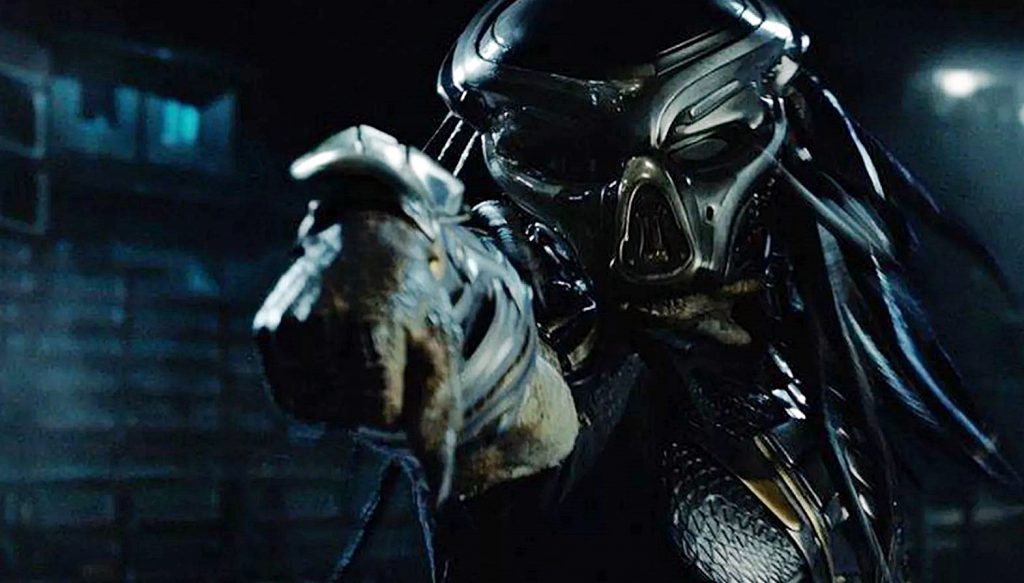
Shane Black loves him some Eighties, doesn’t he? The over-the-top machismo, the sentimentality, the tasteless and insensitive one-liners—the writer/director revels in every opportunity to splash those (and some blood and entrails) on the screen as he reboots The Predator.
This is the sixth installment, if you count the Alien vs. Predator films, so Black has his hands full finding a fresh perspective. First things first: a damaged, hyper-masculine male lead who uses humor to mask his pain. Enter Quinn McKenna (Boyd Holbrook, Logan).
A US Army sniper, McKenna and his men are in Mexico after some baddies and some hostages when a predator ship crashes. McKenna faces off with the nasty before making off with some of his gear. Then he’s in a bar/post office in Mexico. Then he’s in custody.
How did he go from A to B to C? Nevermind that! There are predator dogs this time!
There are a lot of those odd gaps in action logic, but since when is narrative clarity the point of a Predator movie (or a Shane Black movie, for that matter)? In many ways, Black is the ideal candidate to reawaken the sport-hunting franchise.
He clearly loves it, and he should, having played the small role of Hawkins in the 1987 original. Black takes pointed but affectionate shots at the source material and celebrates much of what made it (and most of Schwarzenegger’s 80s output) so fun.
Holbrook is a serviceable lead that Black quickly surrounds with a team of soldiers (Trevante Rhodes, Keegan-Michael Key, Thomas Jane). What kind of bunch are they? Rag and tag!
Olivia Munn jumps in as a scientist who drops f-bombs, Jacob Tremblay is inarguably cute, and Sterling K. Brown (characteristically mesmerizing) plays the villainous military dude.
The story touches on humanity’s path to extinction, as well as our own evolution. That last part leads to some questionably respectful commentary on folks on the Autism spectrum. (Folks with Tourette’s can expect the same level of respect you might find in an Eighties action film. Or a Norm MacDonald interview.)
The FX are good. Not War for the Planet of the Apes good, but way better than the Aquaman trailer that rolled pre-film. The action is fun and sometimes imaginative, but the rest of the film is largely lacking in imagination.
There’s a lot of coasting going on in The Predator. A lot of boxes being checked—sometimes checked with flair, but they’re still the same old boxes.
Stephanie is a suburban single mom who keeps an “oopsie” jar for swearing and volunteers for everything at her son’s elementary school.
Emily is passionately married, drops frequent f-bombs and has a painting of her vajayjay hanging in the living room.
But a play date for their sons leads to an unlikely friendship in A Simple Favor, a crazy fun mystery with plenty of surprises up its sassy sleeveless number.
The first may be seeing the director is Paul Feig, who made his name with blockbuster comedies such as Bridesmaids and Spy.
So, he’s doing dark thrillers, now? Nope, he’s doing a satirical comedy with strong women, nice diversity and a pretty sharp bite.
Perky Stephanie (Anna Kendrick – perfect) and glamorous Emily (Blake Lively – ditto) share martinis and secrets until Emily turns up missing. Steph provides case updates on her Mommy vlog (“cookies and origami” help to ease the strain!) while spending more and more time watching Emily’s son and “comforting” her husband (Henry Golding from Crazy Rich Asians).
You’ll guess some of what comes next, but there’s plenty you won’t, unless you read Darcey Bell’s source novel. Screenwriter Jessica Sharzer (Nerve) shapes it for the big screen as a Gone Girl for the gaslight age, where ridiculousness is a default setting, all information is equally true/false and irony is a security blanket never far out of reach.
There are plenty of black comedic laughs to be found here, as well as clever plot twists and knowing nods to the expectations that come with roles of “wife,” “mother,” “career woman” and “friend.”
The running time starts to feel bloated by the third act, and the film flirts with joining the mundane fray it had been so giddily rising above. But it rallies for the win with a satisfying finale of comeuppance and LOL updates on how some characters have moved on.
A Simple Favor is not what the trailer makes you think it is – which turns out to be the perfect setup for a film with plenty of head fakes that lead to a mischievous good time.
Nothing scared me as a child the way the story of Hansel and Gretel did. Do you know why? Because it’s fucking scary. But that’s the thing about fairy tales, isn’t it? There was always something—a big, bad wolf or a witch or a wicked stepmother—intended to frighten children. No wonder fairy tales make such rich fodder for horror movies.
Here are our picks for the best fractured fairy tale horror—either those films that reimagine an old fairy tale or those that are clearly inspired by them—recorded live at the Gateway Film Center.
5. Hansel & Gretel (2007)
This is a straightforward reimagining of a classic fairy tale. We’d compare it to Snow White: A Tale of Terror (1997), Deadtime Stories (1986), The Red Shoes (2005) and Tale of Tales (2015).
Director Pil-sung Yim’s reimagining of Grimm’s classic “into the woods” horror upends expectations by putting adults in the vulnerable position and giving children the power.
A young man facing impending fatherhood gets into a car accident next to a deep, dark and mysterious woods. He loses himself and is rescued by a lone little girl with a lantern.
From here, Yim’s sumptuous visuals and eerily joyful tone create the unshakable sensation of a dream—one that looks good but feels awful.
As our protagonist unravels the surreal mystery that’s swallowed him, Yim offers a parable—as fairy tales often do—about the value of children. But don’t let that dissuade you from this seriously weird, visually indulgent gem.
4. Black Swan (2010)
Based on the ballet Swan Lake, which itself is inspired by German folktales The White Duck and The Stolen Veil, Black Swan takes a dark turn.
The potent female counterpoint to Darren Aronofsky’s 2008 gem The Wrestler, Black Swan dances on masochism and self-destruction in pursuit of a masculine ideal.
Natalie Portman won the Oscar for a haunting performance—haunting as much for the physical toll the film appeared to take on the sinewy, hallowed out body as for the mind-bending horror.
Every performance shrieks with the nagging echo of the damage done by this quest to fulfill the unreasonable demands of the male gaze: Barbara Hershey’s plastic and needy mother; Winona Ryder’s picture of self-destruction; Mila Kunis’s dangerous manipulator; Vincent Cassel’s other dangerous manipulator.
The mind-bending descent into madness and death may be the most honest look at ballet we’ve ever seen at the movies.
3. The Lure (2015)
Here’s a great Eastern European take on reimagined Eastern European fairy tales, like Norway’s Thale (2012) and Czech Republic’s Little Otik (2000).
Gold (Michalina Olszanska) and Silver (Marta Mazurek) are not your typical movie mermaids, and director Agnieszka Smoczynska’s feature debut The Lure is not your typical – well, anything.
The musical fable offers a vivid mix of fairy tale, socio-political commentary, whimsy and throat tearing. But it’s not as ill-fitting a combination as you might think.
The Little Mermaid is actually a heartbreaking story. Not Disney’s crustacean song-stravaganza, but Hans Christian Andersen’s bleak meditation on the catastrophic consequences of sacrificing who you are for someone undeserving. It’s a cautionary tale for young girls, really, and Lure writer Robert Bolesto remains true to that theme.
The biggest differences between Bolesto’s story and Andersen’s: 80s synth pop, striptease and teeth. At its heart, The Lure is a story about Poland – its self-determination and identity in the Eighties. That’s where Andersen’s work is so poignantly fitting.
https://www.youtube.com/watch?v=vxhi_3hDUPE
2. Der Samurai (2014)
This film is influenced heavily by fairy tales, especially the concept of the big, bad wolf, as are The Company of Wolves (1984), Big Bad Wolves (2013), and Freeway (1996).
Writer/director Till Kleinert’s atmospheric Der Samurai blends Grimm Brother ideas with Samurai legend to tell a story that borders on the familiar but manages always to surprise.
Jakob, a meek police officer in a remote German berg, has been charged with eliminating the wolf that’s frightening villagers. Moved by compassion or longing, Jakob can’t quite make himself accomplish his. But a chance encounter with a wild-eyed stranger wearing a dress and carrying a samurai sword clarifies that the wolf is probably not the villagers’ – or Jakob’s – biggest problem.
Pit Bukowski cuts a peculiar but creepy figure as the Samurai – kind of a cross between Iggy Pop and Ted Levine. As the cat and mouse game gains momentum, it appears the Samurai is here to upend all of Jakob’s inhibitions by eliminating anyone keeping him from embracing to his primal urges.
Kleinert’s sneaky camera builds tension in every scene, and the film’s magnificent sound design echoes with Jakob’s isolation as well as that of the village itself. And though much of the imagery is connected in a way to familiar fairy tales or horror movies, the understated approach gives it all a naturalism that is unsettling.
1. Pan’s Labyrinth (2006)
Guillermo del Toro’s masterpiece is Influenced visually and logically by fairy tales. It takes us to a fairy tale land but is not set on any existing fairy tale, not unlike Argento’s greatest work, Suspiria (1977), and Jee-woon Kim’s brilliant Tale of Two Sisters (2003).
But honestly, there is nothing on earth quite like Pan’s Labyrinth. A mythical cousin to del Toro’s beautiful 2002 ghost story The Devil’s Backbone, Pan’s Labyrinth follows a terrified, displaced little girl who may be the reincarnation of Princess Moanna, daughter of the King of the Underworld. She must complete three tasks to rejoin her father in her magical realm.
A heartbreaking fantasy about the costs of war, the film boasts amazing performances. Few people play villains—in any language—as well as Sergi Lopez, and Doug Jones inspires terror and wonder in two different roles. But the real star here is del Toro’s imagination, which has never had such a beautiful outlet.
Detroit’s economic blight has offered a powerful backdrop to many a film—Only Lovers Left Alive and Don’t Breathe spring to mind. But for White Boy Rick, this decrepitude does not simply serve a fictional horror. It created a real one.
Rick Wersche Sr. peddled guns to Detroit lowlifes. Feds preyed upon his 14-year-old son with an offer: become an FBI informant or the old man goes to prison. Things escalated, Rick Jr. made some questionable decisions (as teens are wont to do), the Feds took advantage, and by the time he was 17, White Boy Rick was facing a lifetime prison sentence with no hope for parole. This for his first conviction, a nonviolent crime.
Making his acting debut, Richie Merritt cuts a believably affable street kid. He’s like a puppy, a mutt, with moppy hair and a bad teenage mustache. The characterization helps to clarify how he so easily ingratiates himself into dangerous gangs, or why he’s trusted by the same, but it’s a tougher sell when Rick turns kingpin.
Bel Powley nails the role of sister and more obvious victim of the family’s circumstances, while both Bruce Dern and Piper Laurie are a hoot in small roles. But it’s Matthew McConaughey who most impresses.
McConaughey hits not one false note as the self-deluded optimist, Rick Sr. All resilient façade and pathetic underpinnings, desperate to create a healthy future for his family even as his own illicit gun sales compound Detroit’s problems, Rick Sr. is a study in contradictions. McConaughey approaches the task with nuance and empathy, and the result amazes.
In its best moments, White Boy Rick laments the circuitous nature of poverty and urban decline. When it’s really on point, it even illuminates the infrastructure that perpetuates the tragedy.
In its off-moments, though, it tries too hard to present Rick Wersche Jr. as a good kid who didn’t deserve his fate. There is no doubt that Wershe did not deserve his fate, nor did countless other nonviolent felons convicted during the US’s dubious war on drugs. But there’s something about the way director Yann Demange (’71) differentiates the white boy from the rest of the criminals that is unsettling.
The racial dynamics of the film lack much of the nuance afforded the family drama. Demange invites us into the world that’s so appealing to Rick Jr.—a lure that’s far more compelling than just money—but he can’t follow through.
It’s too bad, because as a showcase for performances, White Boy Rick excels. It just can’t entirely decide what it wants to accomplish with its story.
How does one make a film that’s uniquely South African yet still feels like an American western? Director Michael Matthews and writer Sean Drummond answer that question with the stunning Five Fingers for Marseilles.
From the beginning, Matthews evokes Sergio Leone’s A Fistful of Dollars trilogy. Four boys stand facing each other, hands at the ready, waiting for a sign to fire their slingshots. When it comes, Tau, The Lion, stands victorious. It’s a scene that sets the tone for a film that not only calls up classics like Leone’s, but also Yojimbo.
Tau is described as ruthless and mean, but he’s also filled with an anger that makes him reckless. In apartheid-era South Africa, small enclaves such as Railway – a district within the city of Marseilles – are at the mercy of their oppressors. As Tau and his friends argue about how to resist the police that fleece them, he insists on using more than sticks. His brother, Zulu, demands he exercise caution.
However, when a friend is threatened with brutality, Tau’s anger leads to a careless decision. When he flees the scene of his crime, he not only leaves behind his friends but his responsibility. Those left behind suffer because of “The Lion”‘s heedless anger.
Decades pass before Tau returns to Railway. The town seems the same though apartheid has ended. Police still shake down the citizens, but another sinister element has also descended on the town, a gang led by a fearsome man known as The Ghost. Though Tau seeks to return untroubled, he is inevitably called to his former role as protector.
It’s a familiar story, and the political backdrop of a South Africa trying to find its way after apartheid lends itself well to the retelling. As Tau, Vuyo Dabula is a perfect representation of the man with no name. Though he is The Lion, a man with a past full of brutality, he seeks to start anew as Nobody. It’s the sinister nature of the world around him that draws him back into a world of ferocity and lawlessness.
There are few villains as perfect as Sepoko, also known as The Ghost. Every moment Hamilton Dhlamini is on screen, the tension escalates. The masterful score only magnifies this malevolent figure.
With desolate landscapes, brutal violence and characters with questionable moral compasses, Five Fingers for Marseilles is not only a magnificent Western, but an exquisite film.