From sublime to interesting to tired and predictable, this week’s home entertainment offerings certainly vary. Here is our take on each one.
Click the film title for the full review.
Gloria Bell

JT Leroy

A Madea Family Funeral

From sublime to interesting to tired and predictable, this week’s home entertainment offerings certainly vary. Here is our take on each one.
Click the film title for the full review.
Our friend is looking to buy her first home and our only advice was probably the same advice she got from everyone: check the basement for the gateway to hell. That always causes trouble for new homebuyers, doesn’t it?
Indeed, these netherworld exits and entrances don’t exist only in suburban basements. Nope, you can find them anywhere. In fact, you can even create your own. No idea why you would want to do that, but (assuming horror films are how-tos), it can be done. Which are the best gateway to hell horror movies, you ask? Luckily, we’ve done the math.
A bunch of films nearly had this fifth slot: Amityville 3D (mainly so we could make fun of Laurie Laughlin), The Gate and its Harryhausen influences, Event Horizon’s blackhole to hell. But we landed on The Ninth Gate because we love Frank Langella and Lena Olin.
Johnny Depp plays a sleazy rare books dealer in Roman Polanski’s adaptation of Arturo Perez-Reverte’s novel. Depp’s Dean Corso falls into a mysterious adventure of finding and appraising three volumes allegedly co-authored by Satan himself (or herself?).
Maybe the element of this film that makes it more interesting than it might be is that, while the humans longing for the knowledge in these volumes are terrible people, the film doesn’t seem to find Satanism (the real worship of an actual Satan, not today’s activism branch) a potentially worthwhile activity. Satan (Emmanuelle Seigner, Polanski’s wife) is also an interesting character—in concept, anyway.
Plus, black masses! Love those!
Lucio Fulci was really preoccupied with the gateway to hell. He produced an entirely worthwhile trilogy on the topic. And while City of the Living Dead and House by the Cemetery have their charms (well, for one of us), The Beyond is by far the most entertaining of the three.
As is always the case in Fulci films, the dubbing is half the fun, here unintentionally aiding in the overall surreal quality of the picture. Liza Merrill (Catriona MacColl, who stars as different characters in each of the three Gateway films) has inherited an old Louisiana hotel from her dead uncle.
Guess what’s in the basement?!
Silly, gory as hell, hypnotic and oh-so-Fulci, The Beyond is a dreamy peek into hell. The clashing accents and lack of logic only strengthen the vibe.
Yes, technically this one takes place in “The Further” – but we don’t buy that this creepy red guy plays organ in limbo or purgatory. We’re going with hell.
Director James Wan and writer (and co-star) Leigh Whannell launched a second franchise with this clever, creepy, star-studded flick about a haunted family.
Patrick Wilson (who would become a Wan/Whannell staple) and Rose Byrne anchor the film as a married couple dealing with the peculiar coma-like state affecting their son, not to mention the weird noises affecting their house.
But what makes this particular film so effective is that we get to go into The Further to reclaim the lost soul. It’s a risky move, but these filmmakers do what few are able to: they show us what we are afraid of.
Journeyman writer/director Michael Winner helmed this weird little gem about a damaged young woman and her journey toward the only destiny that can save her.
It starts, as these things so often to, with the search for a new place to live. New York model Alison (Cristina Raines) is offered an incredibly great rate for a gorgeous NY brownstone apartment.
Is it the gateway to hell? Yes, but NY real estate being what it is, she takes it.
Look at this cast: Burgess Meredith, John Carradine, Christopher Walken, Ava Gardner, Jerry Orbach, Jose Ferrer, Beverly D’Angelo and Chris Sarandon, mainly playing the various and fascinating demons hoping to throw poor, fragile Alison off her path.
Meredith in particular is a magnificent Satan.
Welcome to hell! Turkish filmmaker Can Evrenol invites you to follow a 5-man police squad into the netherworld, where eye patches are all the rage, pregnancy lasts well under the traditional 40 weeks, and you don’t want to displease Daddy.
The serpentine sequencing of events evokes a dream logic that gives the film an inescapable atmosphere of dread, creepily underscored by its urgent synth score. Evrenol’s imagery is morbidly amazing. Much of it only glimpsed, most of it left unarticulated, but all of it becomes that much more disturbing for its lack of clarity.
As is always the case, the real kicker is the Satan character. Here, central figure Mehmet Cerrahoglu’s remarkable presence authenticates the hellscape. Evrenol’s imaginative set design and wise lighting choices envelope Cerrahoglu, his writhing followers, and his victims in a bloody horror like little else in cinema.
Big, bold, oversized weekend in movies. We talk through Godzilla: King of the Monsters, Rocketman and Ma and hit on all that’s worth a look in new home entertainment.
Listen to the full podcast HERE.
by George Wolf
So, Elton John won’t be singing in the movie about Elton John?
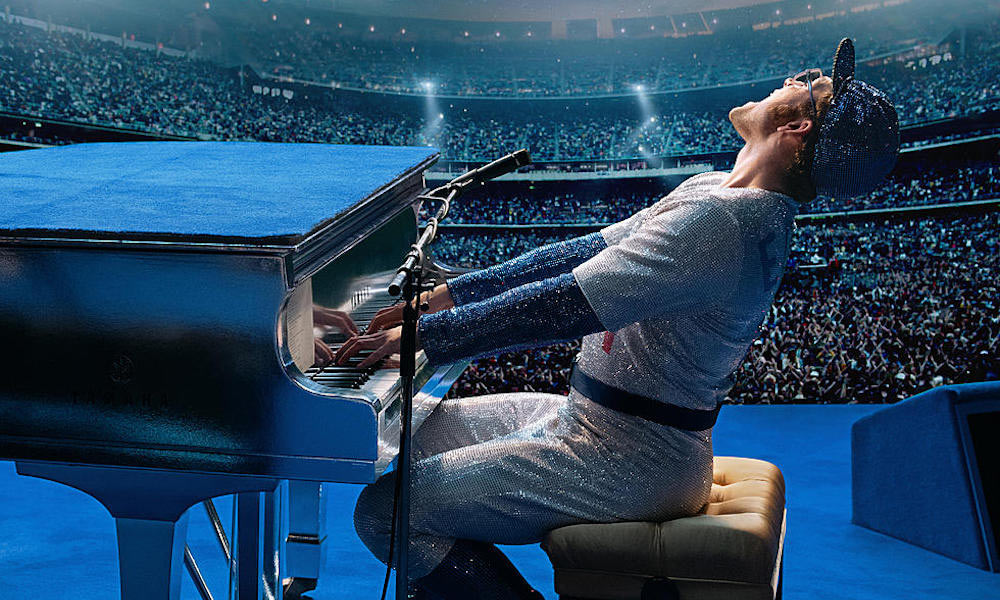
Seems weird, until you see how well Rocketman incorporates decades of indelible music into one vastly entertaining portrait of the iconic rock star who stands second only to Elvis in career solo hits.
Driven by a wonderfully layered performance from Taron Egerton – who also handles his vocal duties just fine – the film eschews the standard biopic playbook for a splendid rock and roll fantasy.
Kudos to writer Lee Hall and director Dexter Fletcher for knowing we’ve seen this rise/drugs/fall arc before, and knowing how to pool their talents for an ambitious take.
Hall wrote Billy Elliot and Fletcher is fresh off co-directing Bohemian Rhapsody. Their vision draws from both to land somewhere between the enigmatic Dylan biopic I’m Not There and the effervescent ABBA glitter bomb Mamma Mia.
Narratively grounded in Elton’s first visit to rehab, Rocketman cherry-picks the hits for resplendent musical set pieces that accompany the blossoming of a shy English youngster named Reginald Kenneth Dwight into the flamboyant global superstar known as Elton Hercules John.
Wounded by an uninterested father (Steven Mackintosh) and an adversarial mother (Bryce Dallas Howard – never better) Reggie sought acceptance through his musical talent. A happenstance introduction to lyricist Bernie Taupin (a quietly effective Jamie Bell) brought unexpected success and then, the obligatory wretched excess.
Even without Fletcher’s involvement, comparisons to Bohemian Rhapsody (now the most successful music biopic to date) were inevitable, but Rocketman leaves the stage as a vastly superior film.
While the close-to-the-safety-vest nature of Queen’s trajectory rendered every artistic license ripe for scrutiny, Rocketman‘s R-rated frankness and fantastical tapestries leave ample room for crowd-pleasing maneuvers.
Of course the kickers-clad schoolboy didn’t pound out “The Bitch is Back” on his living room piano, the aspiring songwriter didn’t sing “Sad Songs” at a 1960s audition, and the overnight sensation didn’t “Crocodile Rock” at his legendary 1970 stint at The Troubadour.
But in the world of Rocketman, anything is possible. And even with all the eccentric flights of fancy, the film holds true to an ultimately touching honesty about the life story it’s telling.
And, oh yeah, the songs are still pretty great, too (no matter who’s singing them).
by Hope Madden
Oh my God, you guys. Did you know Tate Taylor directed the new Octavia Spencer horror flick, Ma?
You know, Tate Taylor. Girl on a Train. Get On Up. The effing Help – that Tate Taylor.
No wonder Octavia Spencer is in it, and God bless her for it because she commits to a role that, in other hands, could have been utterly, laughably predictable.
In fact, were it not for a breathtakingly better-than-this-material cast, Ma would have devolved quickly into every other “get back at the popular kids – oh, wait, maybe let’s vilify and re-victimize the unpopular instead” horror.
Spencer’s Sue Ann, or Ma, as the kids call her, is just an easy mark for teens wanting alcohol. Yes, she’ll buy it as long as you drink it at her house where she knows you’re safe.
Does she have nefarious motives?
She does.
For her part, the Oscar-winner (for Taylor’s The Help) convinces, drawing both sympathy and fear. She’s joined in small roles by another Oscar winner (an almost jarringly funny Allison Janney) and an Oscar nominee (Juliette Lewis) as well as Luke Evans and a set of talented young actors led by Booksmart’s Diana Silvers.
How on earth did this by-the-numbers outsider/don’t trust the lonely older lady horror flick draw this cast?!
I do not know, because Ma has nothing really new to say, so it relies in its entirety on this cast to entertain. But there are two reasons that this story and this particular cast are actually Ma’s problems.
One is something that still surprises me about horror. On the whole, horror appeals to outcasts. And yet, from Carrie White to the coven in The Craft to Sue Ann in Ma, horror films reestablish the status quo by putting outcasts in their place. Sure, they get that grand few moments of terrorizing the beautiful, popular kids, but things end badly in horror movies for the outcast.
Here’s what troubles me even more about Tate Taylor, and to a degree, Octavia Spencer films. (Note that Spencer executive produced the racially problematic and utterly mediocre Green Book.)
Ma is racially tone deaf. I have no idea why this wealthy Southern white man insists on telling stories exclusively about African Americans, but he truly should not. A story that vilifies the lonely middle aged woman, seeing her as a broken psychotic based on her generally pathetic nature, is misogynistic. When this villain is also the only African American woman in the film, that problem is heightened dramatically.
Don’t get me wrong—I am a fanatical horror fan, and when an Oscar -winner (and multiple nominee) chooses to star, let alone star as the villain (the most important character) in a horror film, I am all in.
But this was the wrong movie.

by Hope Madden and George Wolf
Must we destroy everything that challenges us, or is humanity’s only salvation an intentional and aggressive thinning of our herd?
Or is there another way?
Nope, this is not the plot of the last two Avengers movies. Well, I mean, it is, but it’s also the basic underpinning of the monster movie that has always had societal anxieties on its mind.
Born in 1954 of a society reeling from nuclear annihilation, Godzilla was a parable of a world in need of a new god to save it from war and science. Sixty five years later, Godzilla: King of the Monsters recognizes that it’s not just the military and scientists who are destroying us. It’s all of us.
Columbus, Ohio’s own Michael Dougherty (Trick r’ Treat) takes the reins of the king of all kaiju franchises, grounding tensions in family drama and bombarding the audience with monsters, explosions, nuclear monsters, nuclear explosions, good-sized leaps of logic and so much nonsensical dialog.
Kyle Chandler is the handsome, damaged, underwhelming white guy at the center of things. Lucky, because the rest of the cast—primarily women and people of color—can’t quite figure out how to move forward without him to articulate the plan for them.
They talk about it a lot, though. Even when machines are in the midst of exploding, someone has the good sense to tell us, “Something’s wrong!”
When people aren’t droning on with exposition and explanation, we’re treated to plenty monster on monster action—exactly what Gareth Edwards’s 2014 Godzilla did so well. Unfortunately, for all the very cool Titans that director/co-writer Dougherty has to work with, he can’t create a thrilling fight sequence. There are lots of loud noises, plenty of toothy close ups and bright lights galore, but as for distinguishable monster bodies following a logical battle trajectory – nope.
In fact, repeated mentions of activity on “Skull Island” only remind you of the tonal and visual bullseye of Kong: Skull Island, a comparison that does not work in this Godzilla‘s favor.
Longtime kaiju aficionados should appreciate Dougherty’s clear respect for genre history – as well as Bear McCreary’s wonderfully retro score – but this new King is just treading water.
A handful of decent and underseen flicks coming home this week. Which to watch? We’re here to make the choosing easy.
Click the film title for the full review.

A veritable smorgasbord of films available this weekend – something for every appetite. We run through Aladdin, Booksmart, Brightburn, Shadow, Non-Fiction, The White Crow and all that’s new in home entertainment.
Listen to the full podcast HERE.
by Hope Madden
Sort of a mash up of Superman and The Bad Seed, Brightburn wonders what would happen if that special little guy you found in the crashed space ship turned out to be a super villain rather than a super hero.
But this comic book-esque origin story plays more like a straight up horror flick than an evolution of Josh Tank’s underappreciated 2012 SciFi gem Chronicle.
Elizabeth Banks stars as Tori, blue collar Kansasian. (Look it up.) She and homespun farmer husband Kyle (David Denman) always knew the day would come when they had to explain some things to their “adopted” son Brandon (Jackson A. Dunn).
While Brightburn echoes Superman in many ways, it’s far more deeply rooted in coming of age horror. It is on Brandon’s 12th birthday that he begins to change. He’s broody, more aggressive—here is where director David Yarovesky (The Hive) and Brian and Mark Gunn (brother and cousin, respectively, of producer James Gunn) abandon SciFi and dive headlong into horror.
And what we find is that, removed of their comic book splash and super hero protagonists, super villains don’t really make much of an impression in horror. Yes, Brandon has basically the same qualities as Superman—heat vision, flight, super strength—and he seems only vulnerable to his own ship (or perhaps any trace of his home planet?)—but the question is, would Evil Superman be that much more destructive than an immortal killing machine who visits you in your dreams? Or a demon from hell? Meh.
That’s is not to take too much away from Brightburn. It’s a fun B-movie with plenty of blood and gore. (It earns its R rating.) Banks is characteristically strong and Dunn does a fine job of moving from sweet boy to flat-affect sociopath.
There are definitely a couple of moments of inspired gore.
Brightburn is a capably made, well-acted piece of semi-schlock horror. It’s also the third film this year to follow a put-upon mother deciding what to do with a son whose grown almost overnight from precious baby boy to burgeoning psychopath.
And while this is a staple in the genre, Brightburn certainly taps an immediate social preoccupation with that moment that toxic masculinity ruins a boy. The film also mines the guilt that fuels insecure parents who had no real role models of their own.
The film doesn’t wind up being as clever a conceit as you might hope—again, Chronicle did it better. It’s not an entire waste of time, either.
by George Wolf
There was a brief interruption, but we now return to the usual mastery of Yimou Zhang.
While 2016’s The Great Wall (Zhang’s first English language film) stood less than tall, the return to his native tongue results in yet another rapturous wuxia wonder, one nearly bursting with visual amazements and endlessly engrossing storytelling.
Taking us to ancient China’s “Three Kingdoms” era, director/co-writer Zhang (Hero, House of Flying Daggers, Raise the Red Lantern) creates a tale of martial artistry, lethal umbrellas and political intrigue gloriously anchored in the philosophy of yin and yang.
After generations of warfare, the cities of Jing and Yang have been peacefully co-existing in an uneasy alliance. Now, thanks to a brilliantly devious plan for revenge that’s been years in the making, that fragile peace is threatened.
While the tragedies and backstabbings recall Shakespeare, Dickens and Dumas, Zhang rolls out hypnotic tapestries filled with lavish costumes, rich set pieces and thrilling sound design, all perfectly balanced to support the film’s dualistic anchor.
Working mainly in shades of charcoal grey with effectively deliberate splashes of color, Zhang creates visual storytelling of the grandest spectacle and most vivid style. There’s little doubt this film could be enjoyed even without benefit of subtitles, while the intricate writing and emotional performances combine for an experience that entertains and enthralls.
But seriously, you will never look at an umbrella the same way again.