All posts by maddwolf

All In

Family

by Hope Madden

On occasion, film reps send us links to preview their film for review. Often, these links are password protected. Once, the password was bouncehouse.

Yes, please.

The film in question is called Family, writer Laura Steinel’s directorial debut, and it plays like a fun update of Uncle Buck with Juggalos.

That’s right!

We open on an uptight executive sprinting, face painted, through an Insane Clown Posse gathering and reflecting, “It’s kind of like a fun county fair where you could also, potentially, be stabbed.”

That reflective exec is Kate, and Kate is maybe Taylor Schilling’s best cinematic character. She takes to Steinel’s dialog with a flat affect that’s entirely, awkwardly enjoyable.

Kate is Uncle Buck, basically. Only she’s not. She’s a driven businessperson who actually got where she is because she has literally nothing else in her life to draw her attention or energy. And then she has to babysit her 11-year-old niece Maddie (Bryn Vale, spot on) and next thing you know—right, life lessons. We’re all familiar with the John Hughes handbook, but Steinel updates it with less schmaltz and more belief in nonconformity. And juggalos.

When Maddie says, “Magic is my passion,” I had to hit pause because I was afraid my snorting would drown out the next piece of comedy gold.

There are problems with Family (besides that inanely generic title). It is funny, and its comical scenes are delivered by an entirely winning cast (which includes the unreasonably hilarious Kate McKinnon and the unreasonably talented Brian Tyree Henry). That’s not the problem.

Steinel also inverts and subverts the tropes of the genre. There are two upended “makeover” scenes that are both funny and insightful. It’s also just a savvy look at being socially awkward.

No, the problem here is that the many colorful and fun scenes are strung together more than they are foundational to a whole. And the keen insight Steinel uses to sharpen individual jokes softens when the time comes to finish the story.

She John Hugheses it.

But a well-placed “sorry for your loss” is surprisingly funny and there are at least a dozen scenes here that I kind of love. Family is smart, R-rated comedy that ultimately caves to the pressure to conform, but its struggle to be itself is laudable.

Plus, those juggalos. They have hearts of gold.

PS, this is what all my sisters thought I would be like as a parent. And I wasn’t. Entirely.

https://www.youtube.com/watch?v=M7_oMbzymUA

Sympathy for the Devil

Stockholm

by Hope Madden

It’s amazing to think that a film has never been made of the heist that created the term “Stockholm Syndrome.”

Well, writer/director Robert Budreau has rectified this situation with his Ethan Hawke-led semi comedy, Stockholm.

Hawke, who starred in Budreau’s 2015 Chet Baker biopic Born to Be Blue, plays Lars Nystrom. A bewigged bandit, Nystrom concocts a 1973 bank heist with different goals than your traditional smash and grab.

By taking a couple of hostages, Lars hopes to win the freedom of his best friend, imprisoned bank robber Gunnar Sorensson (Mark Strong).

The always-welcome Strong creates a tender and level-headed counterpoint to Hawke’s endearing, idealistic dumbass. The lead wheel to the film’s cinematic tricycle comes from the quietly powerful work of Noomi Rapace (the original Girl with the Dragon Tattoo).

Playing Bianca Lind, one of Nystrom’s hostages, Rapace’s plaintive performance suggests a character who relies on observation and personal judgment. Never showy, Rapace becomes the gravitational force that tethers flighty characters and wild antics to a realistic foundation.

Budreau seems to be asking himself how it’s possible for captives to choose to side with their captors. Credit the filmmaker for avoiding the pitfall of casting the authorities as one-dimensional bullies or buffoons. Christopher Heyerdahl is particularly effective as Chief Mattsson, a good man who’s n a bit over his head.

Stockholm’s greatest strength, besides the understated playfulness of its cast, is the light touch Budreau brings to presenting the two sides of the standoff. And yet, in the end, he ensures that we the audience do, indeed, feel more compelled by the outlaws.

It’s a subtle act of manipulation perpetrated by Budreau, but not so terrible as to sink the film. The filmmaker’s real miss is in his superficial look at the environment within the vault that brought the captives and captors together.

Thanks to a fine cast that’s able to toe Budreau’s unusual line between comedy and drama, though, you’ll find yourself strangely fond of everyone involved.

Star Child

High Life

by George Wolf

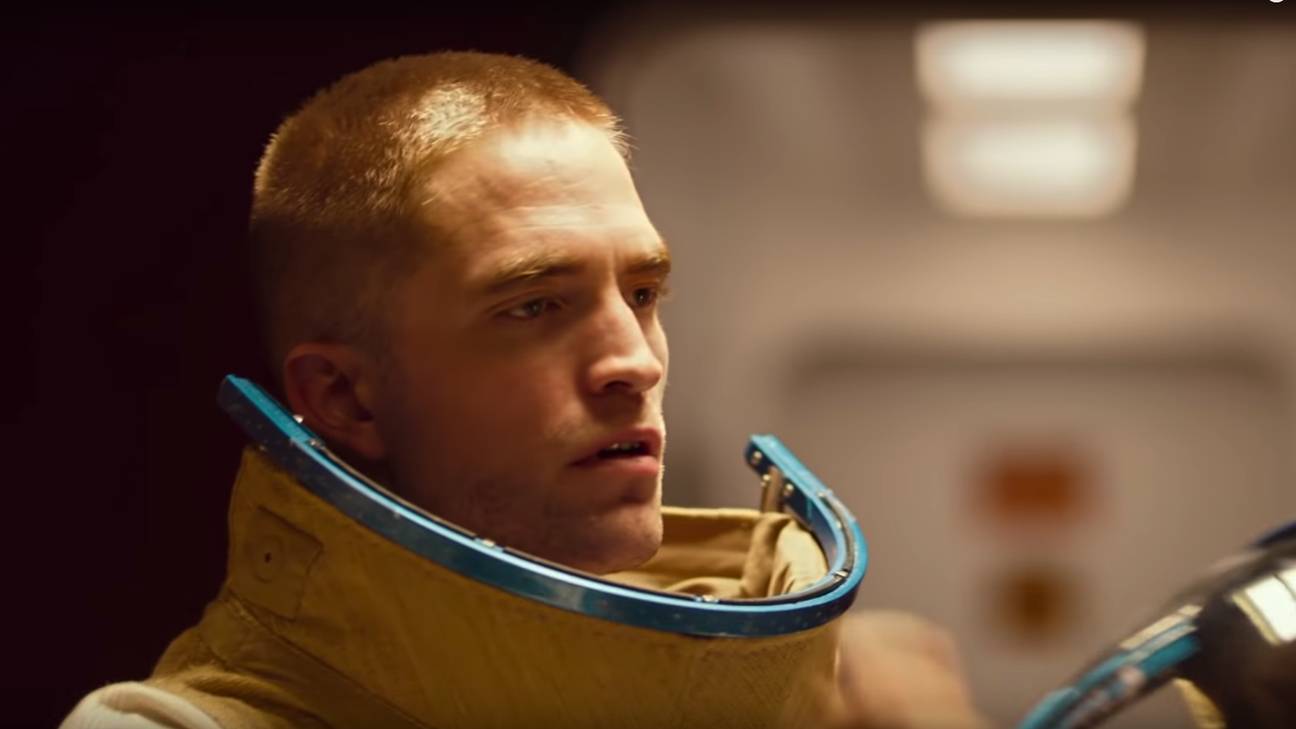
In tackling the final frontier, it’s not surprising that unconventional filmmaker Claire Denis shows little interest in the usual themes that dominate the sci-fi genre. High Life floats very deliberately in its own headspace, touching down somewhere between enlightened consciousness and acid-blooded killing machines.

Monte (Robert Pattinson) appears to be the last survivor of a spacecraft’s crew, but he’s not alone in deep space. He has baby Willow to care for, tending to her needs while he performs his duties and files the regular progress reports that feel increasingly futile.

The infant is one of many general questions director/co-writer Denis casually raises before playing with the film’s timeline to address them, all the while picking at the scabs of deeper insights into the primal desires and self-destructive instincts we cannot escape.

Denis is more than aware of her genre playground (there is a character named Chandra, after all), and while you may be reminded of other sci-fi institutions, High Life lives in the uncomfortable places even the best of these films gloss over. It is bleak and often surreal, draped in the stifling desperation of a crew seemingly controlled by Dr. Dibs (Juliette Binoche – a terrific model of subtle menace).

There is sex (Binoche’s solo sequence is damn near unforgettable) but no affection, reproduction reduced to its most clinical nature and an element of body horror that Denis’s close-up camerawork demands you acknowledge. Though the deep space effects may not be big-budget worthy, succinct visual storytelling is always in play.

In the latest of many challenging indie roles he’s been choosing post-Twilight, Pattinson is again impressive. In a succession of unlikable characters, he gives Monte a gradually sympathetic layer, an element that becomes critical to making the film’s third act as effective, and ultimately hopeful, as it is.

To her credit, Denis has always shown little regard for standard convention. While there is much to be gleaned from the opening and closing shots of her latest, it is the ride in between that makes High Life such a different animal.


Game of Stones

Avengers: Endgame

by MaddWolf

“How many of you have never been to space before?”

There is a lot to resolve in Avengers: Endgame, but it’s the film’s commitment to character and character relationships as articulated by fun, throwaway lines like that, that continue to elevate this series above its single-hero franchisees.

The Avengers who haven’t yet done space travel put up their hands, and it instantly rings true, underscoring a pillar of the MCU.

In every group setting, the different heroes don’t fight for opportunities to remind viewers who they are—the angry one, the sarcastic one, the winsome one. Instead, each reacts to another character; duos and trios bicker or riff, and true character dynamics emerge.

Directors Anthony and Joe Russo, and writers Christopher Markus and Stephen McFeely, Marvel vets all, return to reap what they’ve been sowing for years. With that veteran cast bringing instant investment to their respective roles, the filmmakers cultivate relationships Joss Whedon sparked back in 2012 when he first put Tony Stark, Steve Rogers, Bruce Banner and Thor at the same table.

You may have heard, Endgame goes to new lengths in the MCU: three hours and one minute, to be precise. While you might skip the jumbo soda to avoid restrooms trips, you won’t begrudge this film its time. In fact, give Marvel props for not splitting it into two separate blockbusters that would have diluted the impact of such an apt, respectful and yes, emotional capper to the saga.

There’s plenty of humor here, as well, but never at the expense of the drama or action developing. Rather, it’s the natural ribbing born of well worn, familial relationships. (One Lebowski comment and another about “America’s ass” both land really well.)

On the other hand, we still cannot get behind where this series has taken the Hulk. These developments may have comic-book roots, we won’t pretend to know, but outside of a memorable scene with The Ancient One (Tilda Swinton) this Hulk is no smash.

Thematically, the film thinks big: time, love, loss, sacrifice. It moves impressively from ruminating on a post-9/11 reality to the importance of cherishing your own time and place, even while you accept the challenge of fighting for a better world.

There is plenty of fighting. The action is well-placed and well-presented, delivering fireworks without the dizzying, rapid-fire editing which can often reduce battles royale to battles of patience.

And we need to clearly see who is doing what when these Avengers assemble, because, let’s be honest, Thanos (Josh Brolin) and his Infinity Stones are a tough out, and it’s going to take all hands on deck to take him down.

For any upset fanboys who might still be wondering, that does include female heroes, a fact the film makes inescapably clear with a sequence that’s well-intentioned but maybe a tad pointed (or tardy?) in its parting defiance.

In the months since Infinity War, there have been plenty of theories about how Marvel will address that mountain of a cliffhanger they dumped on us.

Maybe you’ll guess some of it, maybe you won’t (you probably won’t), but wherever the MCU goes from here, Endgame is character capital well-spent,

As long goodbyes go, this one is satisfying and …pretty marvelous.


Screening Room: La Llorona, Penguins, Breakthrough, Amazing Grace & More

Damn, there are lot of movies to talk about this week. Join the conversation about The Curse of La Llorona, Amazing Grace, Hagazussa, Little Woods, Peterloo, Stuck, Penguins, Breakthrough, Teen Spirit and everything new in home entertainment. Whew!

Listen to the full podcast HERE.

Miracle on Ice

Breakthrough

by George Wolf

As the faith-based genre has grown in recent years, many of the films have suffered from a frustrating lack of respect for their target.

Just hammer home a message for the believers, and they won’t mind if we really don’t worry too much about the rest of it, right?

Breakthrough gives that trend a refreshing buck, surrounding its incredible true story with solid performances, steady direction and more than a few moments of thoughtful, nuanced writing.

In January of 2015, Missouri teen John Smith fell through thin ice on a local lake. After an hour with no vital signs, he suddenly showed faint signs of life.

His doctor’s notes read: “Mother prayed.”

But beyond just a testament to the power of prayer, Breakthrough works as well as it does thanks to a commitment to the strength of John’s mom, Joyce Smith, and the touching lead performance from Chrissy Metz (TV’s This Is Us).

Though the Smith’s close-knit neighborhood is presented in broad strokes of idealism, Breakthrough hits a nice groove with the relationship between Joyce and her pastor (an engaging Topher Grace).

Wary at first of his haircut and attempts to bring “hip” to the church, mother and pastor bond as John (Marcel Ruiz) struggles for life, creating a nice parallel to how the film itself seeks to broaden the faith-based reach.

Director Roxanne Dawson and writer Grant Nieporte (both TV veterans) can’t entirely keep the heavy-handedness at bay, but they are able to find some genuine moments of authenticity. Even a late nod to the “Why him?” crowd, while not fully explored, lands as a worthy ambition.

It truly is an incredible survival story, and by grounding it in the spirit of a distraught mother, Breakthrough finds some solid ground.

The Mancunian Candidates

Peterloo

by Matt Weiner

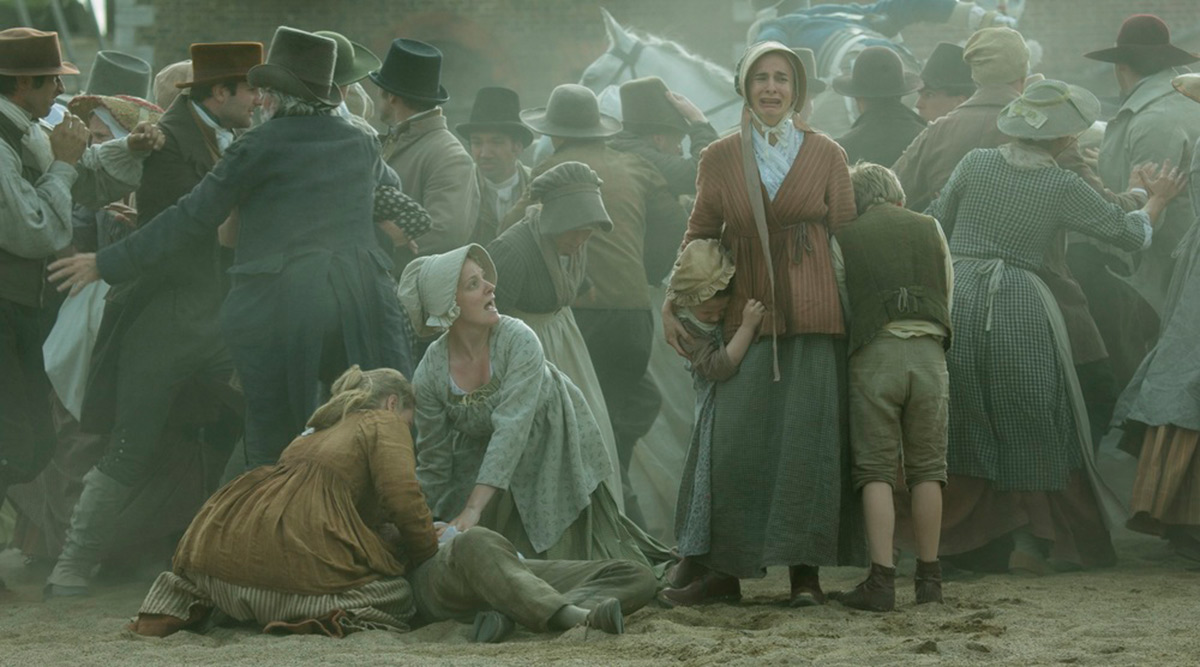
It should be a match made in heaven: British director Mike Leigh channeling an uprising that pitted reactionary government leaders against a working-class population with radical demands for reform.

And for a historical drama that revolves around grain tariffs as a pretty important plot point, Leigh succeeds on one key front: Peterloo abounds with righteous indignation, from start to finish. This comes at the cost of Leigh’s usual nuanced character sketches, though.

The radical reformers, journalists and magistrates inhabiting 1819 Manchester still benefit from Leigh’s verbal fireworks. On one side, there are the aristocrats and rulers living in real fear that even the British triumph at Waterloo might not be enough to quell the spirit of the French Revolution. And then there is the unruly mob: disparate factory workers, reformers and women’s groups seeking a number of Parliamentary reforms and representation.

Agitators are literally read the Riot Act. Harrumphs and harangues come in equal measure. There’s even an impassioned debate about the merits of centrism vs. proto-Antifa at political rallies. Peterloo isn’t wanting for passion, but where the whole thing falls short isn’t that it’s a polemic—Leigh is still a formidable talent when it comes to making a period piece feel relevant, even urgent.

Which makes it all the more frustrating to see the film so weighed down by its singular, bluntly fired message that much of the cast doesn’t get a chance to inhabit their roles as much as they mostly bluster through them. Real-life figures Henry Hunt (Rory Kinnear) and Samuel Bamford (Neil Bell) are among the more memorable orators, but it is Karl Johnson who looks like he’s having the most fun as the cruelly indifferent Lord Sidmouth, the Home Secretary.

The cast of characters to keep straight is large but they’re drawn in absurdly broad strokes so you can easily track who’s under the boot and who’s wearing it. For all the impassioned speeches, it’s ironic that Peterloo winds up feeling far less humane than Leigh’s other historical masterpieces, especially 2014’s Mr. Turner. (That film owes much to Timothy Spahl’s tour de force lead, but Leigh’s generous script also balanced grace with uncompromising characters in a way that’s sorely missed in Peterloo.)

Long-time Leigh cinematographer Dick Pope comes back along for the ride, but his presence is also missed for much of the 150-minute runtime. I assume the working-class Manchester milieus are sufficiently gritty, but it doesn’t really matter. Most of the (copious) meeting scenes feel as perfunctory as the characters themselves.

Thankfully, the film at least delivers on the rage that has been set to a nonstop boil for so long. Leigh captures the confusion and senselessness of the tragedy. It’s just a shame that the massacre itself is the only thing in the film that ever really takes on any dimension.


Is That What I Smell?

Teen Spirit

by Hope Madden

Three years ago, Elle Fanning starred in The Neon Demon, Nicolas Winding Refn’s take on the soul devouring business of show. She played an innocent hoping her natural talent would be enough to carry her far away from her one-horse town.

It’s a threadbare storyline and Refn couldn’t find the same inspiration that drove his earlier efforts Drive and Bronson to such dizzying heights. And yet, for its faults, The Neon Demon is a bold, imaginative and bracingly fresh take on a familiar song.

Writer/director Max Minghella is no Nicolas Winding Refn.

Minghella’s Teen Spirit sees Fanning as Violent, raw singing talent wasting away on the Isle of Wight. When an American Idol-style singing competition hosts auditions on the island, Violet sees her opportunity.

Awash in daddy issues, blatantly judgmental of showmanship (God forbid a girl wear makeup or wigs) and too dependent on Fanning’s mediocre voice, Minghella’s look at the dark side of the entertainment industry can’t find its groove.

Teen Spirit is not a complete misstep. Fanning’s acting is characteristically spot on. Rather than casting Violet as the bashful townie, Fanning presents a sullen, unlikeable character whose aloneness has as much to do with her own adolescent misanthropy as anything.

Equally appealing in his unappealing way is Zlatko Buric playing Vlad, the unsightly mess of a drunk that an underaged Violet drafts into posing as her guardian so she can audition.

The crusty sympathy the two form creates a welcome change to the ordinary—which is what the rest of Teen Spirit bathes in. Catty divas, soulless and posh record execs, temptation, disloyalty, pop songs—all of it’s here in some neutered form or other.

Teen Spirit not only plays like a toothless version of Neon Demon, it also bears an eerie resemblance to Leap, the 2016 animated adventure in which Fanning plays an orphan who longs to dance in the Paris ballet.

She’s also an alien turned punk rocker—with far more interesting performance sequences—in John Cameron Mitchell’s How to Talk to Girls at Parties from 2016.

No wonder Teen Spirit feels so derivative. You haven’t just seen this movie before, you’ve seen Elle Fanning in this movie before.


La La La La Llorona

The Curse of La Llorona

by Hope Madden

The Conjuring Universe loves the Seventies, doesn’t it? And why not? So many patterns to distract attention from your evil, so many bell bottoms to hide beneath. It’s also a time period before Catholicism became a horror movie unto itself, which makes it a safer space to depict a more wholesome view of the Church.

Not that Anna (Linda Cardellini, Green Book) would know. Her late husband was more of the religious one. But as Fr. Perez (Tony Amendola, Annabelle) points out, “You don’t have to be religious to have faith.”

Ah, yes, Michael Chaves’s The Curse of La Llorona is burdened by some seriously obvious dialog. That’s to be expected. The two people who wrote the film (Mikki Daughtry and Tobias Iaconis) are the same two people who wrote Five Feet Apart, the latest teen tragedy porn to wheeze its Boy in a Plastic Bubble riff into the hearts of Kleenex-clutching youth everywhere.

And yet, there is something of the old school charm that marks the best films in the Conjuring universe on display here. Simple fun house scares, primarily practical effects, kids in peril—these are all invoked in a quickly paced if somewhat nonsensical and conveniently plotted ghost story.

There is also a quick Scooby-Doo reference (this being 1976). Have you ever wondered why Cardellini always looks so familiar? Because she was Velma in the film series—making her sort of my own personal hero—and I, for one, was thrilled that LLL shouted that out. Plus, good parenting.

The story unfortunately skirts the real tensions to be drawn from questioning her parenting skills. Not that  LLL had a shot at reaching the terrifying heights of The Babadook, but for a moment it takes us down the path of calling a single parent’s fitness for the job into question.

This is quickly abandoned for the safer territory of a fierce mother protecting her cubs, which is too bad because Cardellini’s understated and graceful performance could probably have carried a more challenging script.

Instead we get bits and pieces of other films in the series, stitched together by a folk tale about a murderous mother. This is not inspired horror, but it’s not ridiculous, either.

It’s a spooky time waster.