All posts by maddwolf

Every Rose Has Its Thorns

Paradise Hills

by Cat McAlpine

We open on an extravagant wedding scene that could be mistaken for the 1920s were it not for the quick cut to a hover car. Welcome to the future!

A whimsical sequence features Uma (Emma Roberts, “American Horror Story,” “Scream Queens”) singing a promise of fealty to her new husband. This is the first of Paradise Hill’s three small singing performances, all of which you’ll wish had been either cut or dubbed.

The newly wed groom coos to his wife, “It’s as if that girl never existed.”

Wow, that sure sounds like a hint. We soon meet the girl he means in a time jump to “Two Months Earlier.” At this point I have decided not to hold the hover car against Paradise Hills, but there is only so much you can forgive in 95 minutes.

Uma (Roberts) awakens in a behavioral facility for young women, where girls are sent by their families to be convinced to be thinner, more socially acceptable, or well mannered. The mysterious circumstances of her arrival and the elaborate setting point to something much more nefarious under the surface.

Director Alice Waddington, in her feature debut, is best known as a fashion creative and photographer and it shows. The film itself has a dreamy aesthetic that interweaves holograms and LEDs with manicured gardens and all-white corseted ensembles.

The complexity of this film ends with its costumes and set. The line delivery is awkward and stilted despite a promising cast. The setting and dialog allude to a kind of Oscar Wilde repartee, where members of proper society throw witty jabs while holding tiny tea cups. But the script is tragically lacking and the stage is set only for the weak writing to fall flat.

More than an hour is spent navigating a dreamy, floral landscape before anything interesting really surfaces. Writing team Brian DeLeeuw, Nacho Vigalondo, and Waddington can’t decide which threads to pull. There’s another love interest, the tragic death of a family member, the crushing pressures of fame, and the strength and importance of female friendships all to be explored.

Paradise Hills could have been an interesting delve into the ways that the solidarity of sisterhood allow us to rise above our circumstances and pasts. Instead it’s a weak nod to an old idea: “You don’t need to change to be accepted.”  

Your teen daughter might enjoy this movie, but you should challenge her with something better.

Hello, Old Friends

Terminator: Dark Fate

by George Wolf

I know it’s sounds about as insightful as “feel good movie of the year,” but Dark Fate really is the Terminator sequel we’ve been waiting for. Its fast- paced and thrilling, surprisingly funny, and manages to honor our investment in two classic characters while it carves out a damn fine blueprint for updating a warhorse.

After re-connecting us with T2: Judgment Day via some crazy good de-aging technology that apparently wasn’t shared with Gemini Man, Dark Fate gives us a future savior that must be protected.

She’s Dani (Natalia Reyes from Birds of Passage), a Mexico City factory worker being hunted by the latest and greatest Terminator, the Rev 9 (Gabriel Luna). But Dani has Grace (Tully‘s Mackenzie Davis, terrific), an “augmented” human from the year 2042 to protect her, plus a new friend with a long history of battling Terminators.

With the most badass entrance since Ripley wore the loader, Linda Hamilton is back as Sarah Connor, instantly giving Dark Fate enough juice to send all the sequels without her to a time of wind and ghosts.

But director Tim Miller is just getting started. The action-filled set pieces keep coming, each one surpassing the last and bursting with the stylized energy he brought to Deadpool.

Need to catch your breath? Oh, look it’s Arnold.

We knew he’d be back, but we didn’t expect him as a T-800 model living a quiet family life as “Carl,” and selling high quality draperies at rock-bottom prices. He’s a stone-faced hoot, and when Carl and Sarah get back in their guns blazing, side by side saddles, just try to keep the nostalgic smile off your face.

But even with all this surface level fun, the film’s secret weapon is a script from David S. Goyer, Justin Rhodes and Billy Ray that’s heady enough to wonder if they got an early look at Rambo: Last Blood and thought a 2019 franchise revival that wasn’t offensively tone deaf might be nice. Each character has an arc to anchor it, and while the film is always mindful of how the future can be rewritten, the topical nods to border security and valuing women as more than birthing vessels are unmistakable.

OK, fine, there are a few clunky spots, some lower-grade CGI on the hyper-jumps and an (understandable) overconfidence in how much we want this to work.

But we do, and damn near all of it does, enough to make you hope they won’t be back.

Flip or Flop

Girl on the Third Floor

by Hope Madden

DIY Don is probably not a nickname Don Koch (C.M. Punk, aka Phil Brooks) has ever heard. Nonetheless, he has some free time, a pregnant wife in the city (Trieste Kelly Dunn) and a bruised ego, so he undertakes the restoration of the new suburban fixer upper on his own.

He has no idea what he’s up against.

The feature directing debut of longtime indie horror producer Travis Stevens (Cheap Thrills, We Are Still Here, Starry Eyes), Girl on the Third Floor takes the haunted house theme in directions that are both toxic and masculine.

So did The Amityville Horror, but Stevens and his team of writers (Trent Haaga, Paul Johnstone and Ben Parker) aren’t concerned with a good man infected by a bad house.   

Stevens most impresses in lensing the film. Phil and cast regularly look directly into the camera to deliver lines or just to ask WTF? as goo and other assorted nastiness tumble and/or ooze from walls. It’s as if the audience has the house’s point of view, and since the majority of the film is “house versus Don” (and Don is clearly an asshole), it’s an intriguing and suitable perspective to take.

So the haunted house is, in fact, the protagonist in this haunted house flick. Nice.

In another wise and satisfying move, Stevens underscores the hero’s star qualities with beautiful, wide interior shots that emphasize the house’s elegant and forbidding nature while appearing to trap the ever-foregrounded Don.

In his first film, WWE performer Punk mainly impresses or at least holds his own, shouldering at least 50% of the film entirely alone. Well, him, some power tools, a handful of marbles, a lot of ejaculate—still, it’s mainly Punk.

Stevens’s message is not entirely fresh, and the camera that ogles Dunn as well as co-star Sarah Brooks suggests the film may not be as woke as it pretends to be. (Haaga has penned some great horror flicks, but his Deadgirl confirms that a feminist he is not.)

Like any good haunted house movie—The Haunting, The Innocents, The Shining, even the Stevens-produced We Are Still Here, where the horror was in the basement rather than the third floor—it’s the unsettling, otherworldly images and mystery that bring chills. Third Floor makes the mistake of the third act exposition, revealing the source of the mystery all Scooby Doo like.

It’s a too-tidy end to a decent spook show—nothing especially scary or daring or original, but an atmospheric thriller that looks good and entertains.

Many Mansions

Parasite

by Hope Madden and George Wolf

We’ve said it many times, but since there may still be people who haven’t heard, we’ll say it again. If Joon-ho Bong makes a film, you should see it.

Today, make it Parasite.

The film’s opening act introduces the Kim family, folding pizza boxes in a squalid basement apartment in Seoul and scrambling from room to room in search of free WiFi after the neighboring business locked theirs down with a password.

In a single scene the film appears to articulate its title and define its central characters, but the Kims are not who you think they are. In fact, every time you think you’ve pinned this film down—who’s doing what to whom, who is or is not a parasite—you learn it was an impeccably executed sleight of hand.

Longtime Bong collaborator Kang-ho Song (Memory of a Murder, The Host, Snowpiercer) anchors the film with an endearing and slippery performance. Kim patriarch, he is simultaneously beloved head of the household and family stooge. Watching Song manipulate his character’s slide from bottom to top to bottom again without ever losing his humanity—or the flaws that go along with humanity—is amazing. It’s a stunningly subtle and powerful performance.

He’s nearly matched by Yeo-jeong Jo as the righteously oblivious Mrs. Park, who spends her days in constant search for an empty validation that comes from every new indulgence for her children.

When young Kim Ki-woo ( Woo-sik Choi from Train to Busan and Bong’s last film, Okja) is able to convince Mrs. Park he’s a suitable English tutor for her daughter Da-hye (Ji-so Jung), the Kim and Park families become connected in one of the few ways afforded by the social order: master and servant.

Methodically, the rest of the Kim clan gains employment from Mr. Park (Sun-kyun Lee) through the systematic feeding of the Parks’ ego and privilege. And then just when you think Bong’s metaphoric title is merely surface deep, a succession of delicious power shifts begins to emerge.

Think the simmering rage of Joker with a completely new set of face paint.

As the Kims insinuate themselves into the daily lives of the very wealthy Parks, Bong expands and deepens a story full of surprising tenderness, consistent laughter and wise commentary on not only the capitalist economy, but the infecting nature of money.

Bong, as both director and co-writer, dangles multiple narrative threads, weaving them so skillfully throughout the film’s various layers that even when you can guess where they’ll intersect, the effect is no less enlightening.

Filming in an ultra-wide aspect ratio allows Bong to give his characters and themes a solid visual anchor. In single frames, he’s able to embrace the complexities of a large family dynamic while also articulating the detailed contrasts evident in the worlds of the haves and have nots.

Parasite tells us to make no plans, as a plan can only go wrong.

Ignore that, and make plans to see this brilliantly mischievous, head-swimmingly satisfying dive down the rabbit hole of space between the classes.

Greatest American Hero

Harriet

by Hope Madden

In just her third feature film, Cynthia Erivo has quickly proven herself to be a chameleonic performer of remarkable breadth and depth.  

How is she as Bad Times at the El Royale’s just-naieve-enough would-be Sixties pop singer? She owns the movie.

As Widows’ overworked and underestimated single parent? Another eye-catching performance among another stunning ensemble.

American history’s second most important figure in the abolition of slavery, runner up only to Lincoln himself?

Harriet Tubman is a big role to shoulder. The routine problem with breathing cinematic life into a figure we know only from history class is in overcoming an audience’s preconceived notions about the person. As is the case with most African American – let alone female African American -figures, this is not really a problem. Tubman is so underrepresented in our historical epics that, unlike Lincoln, she doesn’t trigger an automatic image in the audience’s mind.

So while Erivo needn’t be concerned with imitation, the more daunting challenge is to find a recognizable human inside the truly superhuman accomplishments Tubman managed during her 91 years on this earth.

Here’s where Erivo gets the most support from director Kasi Lemmons (Eve’s Bayou), whose historical biopic is heavy-handed enough in its hero worship to celebrate Tubman’s genuine, unparalleled heroism.

Harriet is also quiet enough in spots, Lemmons never making the common, gruesome slavery-saga misstep of ogling a whip-scarred back or a rape. Her restrained approach to the unimaginable horror of slavery manages never to wallow or to disregard the suffering, but focuses more clearly on the urgency and agency to end it.

Erivo repays Lemmons’s efforts, bringing to bear an otherworldly presence as the film’s enigmatic central figure. Her Harriet is not here to wallow, not here to reflect. She’s come for action.

Lemmons and co-writer Gregory Allen Howard (Ali) don’t quite fare as well elsewhere. Though they wisely narrow the story, beginning immediately before Harriet’s escape from a Maryland plantation and ending just after her astonishing Civil War battle, the film still feels a bit shallow in its telling.

Of the large ensemble around Erivo, Leslie Odom, Jr. makes the most of his limited time onscreen, animating Philadelphia abolitionist William Still with a kind of awestruck tenderness that matches the audience’s response to Tubman’s obstinance and fearlessness.

Does the film suffer from hero worship? Suffer feels like a very wrong word. What Harriet does is honor a woman whose acts of heroism are so superhuman they are truly difficult to believe.

Erivo will make you a believer.

Brace Yourself

Greener Grass

by George Wolf

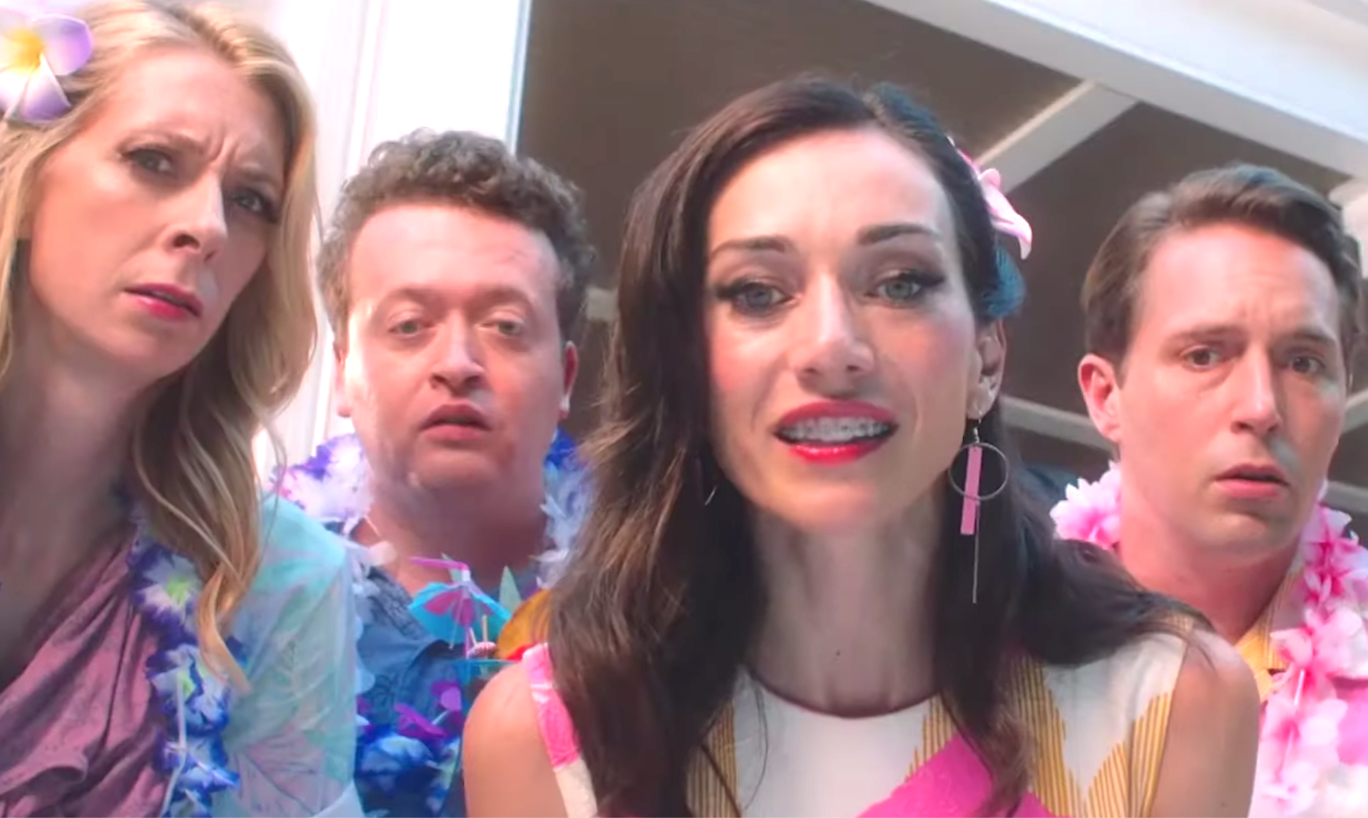
Two married couples are paired off beside each other, everyone smooching their respective spouse. They all sport gleaming braces and garish pastel-on-steroids outfits, swapping emotionless saliva until a voice breaks the moment.

“Wait a second, wrong husbands!”

Welcome to the so-wrong world of Greener Grass, the feature length adaptation of Jocelyn DeBoer and Dawn Luebbe’s award-winning short from 2015. DeBoer and Luebbe return as screenwriters and stars, plus this time add directing duties to ensure complete realization of the absurdist suburban hellscape they imagine.

Jill (DeBoer – so good in Thunder Road last year) and Lisa (Luebbe) are soccer mom besties whose sun-drenched days of gossip, golf carts and competition are thrown into upheaval when Jill gives Lisa her new baby, only to have the nerve to ask for the baby back when Jill’s young son Julian turns into a dog!

This is a late night sketch stretched to the point of no return, played with a desert-dry commitment by the game ensemble (which, appropriately enough, includes SNL’s Beck Bennett).

The end result is an over-the-top John Waters visual pastiche that’s constantly running headlong into a cheek defiantly dismissing its tongue as fake news. When DeBoer and Luebbe do bullseye their targets – with their vigil for a dead neighbor or a TV show called “Kids With Knives” – the laughs are uproarious, but the time between these winners can sometimes get lengthy.

For most people, the same joke five times is tiresome. But for some, that same joke fifteen times can become an absurd delight, and that is the space where this film plants roots that can only become deeper with time.

Because sometime in the near future, a parent will refer to their child’s teacher as “Miss Human,” and Greener Grass will have arrived. A smartly silly expose on the shallowest end of the suburban pool, this is a cult classic just waiting to happen.

Triumph of the Kiwi

Jojo Rabbit

by Brandon Thomas

Fargo and No Country for Old Men director Joel Coen has described directing movies as “tone management.” New Zealand filmmaker Taika Waititi obviously feels the same way as his new film Jojo Rabbit walks a tonal tightrope between irreverent, melancholy and playful.

Few other filmmakers would be able to deliver a Nazi dramedy that opens with a German cover of The Beatles’ “I Wanna Hold Your Hand” over the opening credits. 

Young Jojo Betzler (Roman Griffin Davis) is a bright and excitable boy. More than anything in the world, Jojo wants to be a good little Nazi. His dream is to eventually become best friends with the Fuhrer himself. Due to his inability to wring the neck of a cute little bunny, Jojo finds himself on the outs with the rest of the young Nazi trainees. Thankfully, Jojo’s imaginary friend, Adolph Hitler himself (played by director Waititi), is there to reassure him, indulge his worst musings, and generally crack wise. 

Jojo’s carefree reality, where the war lacks any kind of seriousness, is suddenly changed when he finds that his mother (Scarlett Johannson) is hiding a young Jewish girl (Leave No Trace‘s Thomasin McKenzie) in their home. As the indoctrination of the Third Reich begins to wear off, Jojo comes to realize that the world around him is larger and more complex than he ever knew.

Waititi’s ease at telling stories about the difficulties of growing up isn’t new. His previous works, Boy and The Hunt for the Wilderpeople, dealt with young men coming to terms with life’s hard lessons, and Waititi’s inherent playfulness again allows him to recall the wonder the world holds when you’re young. Anything and everything is possible. Waititi’s same understanding of our humanity grounds the characters inside of these silly worlds he concocts.

Jojo Rabbit asks a lot of its audience. Nazis aren’t supposed to be funny. Anything that even touches how the Jewish people were treated during World War II must be handled with the utmost care. This is the fine line Waititi walks through the entire film, as he manages to acknowledge the horrors of the past while making fun of the perpetrators in the same breath. It’s an amazing feat.

The stacked cast helps carry so much of the film’s burdon. Young Roman Griffin Davis is tasked with making us care about a blonde-haired, blue-eyed Nazi. His fervor is icky, to be sure, but his compassion overwhelms everything else. Likewise, Johannson amazes as Jojo’s mother. She hasn’t played a character this spirited in a long time, and her connection with Jojo serves as the film’s moral center. She abhors what her son wants to be, but also sees through the facade he’s constructed.

Jojo Rabbit, like all good satire, doesn’t pull punches. The film firmly places its finger right in the eye of Europe’s troubling past, but it also manages to show that even amongst the death, bombardment and xenophobia, not everyone gave up their soul to hate. 

Insidious

Where’s My Roy Cohn?

by Hope Madden

There’s a tendency in horror cinema, after a villain has established his evil nature in a film or two, to turn the story around and find out what made him a monster. In that vein, Matt Tyrnauer’s documentary Where’s My Roy Cohn? is the madman’s origin story.

Horror fan that I am, I’ve still never been intrigued by what made Jason Jason, why Michael Myers was driven to murder, what caused Leatherface to don the mask. But it turns out, this horror story is more about the sequel, Son of Cohn.

“Where’s my Roy Cohn?” is a tantrum yelped by Donald Trump, unhappy about his attorney general at the time. And the title speaks volumes, about the kind of attack dog Cohn had been as a lawyer, and about the toxic legacy he’s left behind, right down to the oval office.

A fastidious student of the unlikely individual and his or her cultural impact, Tyrnauer made fascinating docs for years about little known citizens with big stories (Scotty and the Secret History of Hollywood and Citizen Jane among them). And though his latest certainly bears some of the markings of Tyrnauer’s previous films, the only person who saw Roy Cohn as a little guy with big ideas was Roy Cohn.

 It’s tough to overstate the ruthless, amoral impact Cohn has had on American politics and culture. Though Tyrnauer shows traces of compassion when underlining Cohn’s self-hating behaviors (whether as a Jew or a homosexual), the filmmaker’s assessment of his cancerous affect is evident.

Cohn was the prosecuting attorney who pushed the Rosenbergs toward the electric chair before he became McCarthy’s advisor, mouth piece and thug. Then on to New York, where his mafia entanglements (he represented John Gotti, Tony Salerno and Carmine Galante) only aided in his close professional and personal relationship with Donald Trump.

A bizarre connector between the worlds of Studio 54, the mafia and the Archdiocese of New York, Cohn’s party photos articulate some kind of bacchanal populated by members of each of these affluent, influential and decadent groups. It would be impressive it weren’t so ominous and seedy.

He also owned the news, dictating stories to the New York Post from his kitchen table and bringing Rupert Murdoch to the oval office with his own dear friend, Ronald Reagan.

Roy Cohn is dead, but as Where’s My Roy Cohn? makes dismayingly clear is that his ghost still haunts us.

Fright Club: Dogs in Horror

Whether used to terrorize us or to break our hearts, dogs add something powerful to a horror movie. Unless it’s Zoltan: Dog of Dracula, because nothing, not even the most gorgeous dog, could save that piece of poo. But these dogs, these dogs are keepers.

6. The Woman (2011)

Maybe you haven’t seen Lucky McKee’s amazing, disturbing 2011 feminist horror The Woman? Get on it! But just in case, we’re going to avoid any spoilers, which means leaving you kind of wondering why this film made the list of best dogs in horror. Suffice it to say, the dogs are mentioned throughout but meeting them … well, please see this movie.

5. Cujo (1983)

A New England couple, struggling to stay afloat as a family, has some car trouble. This naturally leads to a rabid St. Bernard adventure.

Though the film contains many faults, once Donna (Dee Wallace) and her asthmatic son (pre-Who’s the Boss Danny Pintauro) find themselves trapped in their broken down Pinto (What? Those seem like such reliable cars!) with a rabid dog (bigger than the car) attacking, the film ratchets up the tensions and rewards you for your patience.

Profoundly claustrophobic and surprisingly tense, benefitting immeasurably by Wallace’s full commitment to the role, the film traps us in the heat inside that Pinto and quickly makes up for the entire rest of the picture.

4. The Omen (1976)

Billie F. Whitelaw, ladies and gentlemen. Her performance as little Damien’s new nanny really took things up a notch, didn’t they? Instantly, not only was Mummy (Lee Remick) unnecessary, but Daddy (Gregory Peck) found himself in a battle for Alpha—a battle that begins over a dog.

There are actually quite a number of great, terrifying dogs in The Omen, Richard Donner’s iconic Seventies horror. The dogs in the cemetery, the bones in the casket—what, exactly, was Damien’s mother, anyway? But Mrs. Baylock’s Hound of Hell—that’s when the unflappable Robert Thorn realized there may be things to fear inside his home.

3. I Am Legend (2007)

Yes, there are scary dogs in horror movies, but more often than not horror filmmakers use dogs to break our hearts. Oh, sure, kill all the people you want, but once we hear that off-screen whimper, we’re bawling.

Tell us Sam’s death in I Am Legend didn’t gut you. No? Well, stay away from us you sociopath.

Horror has done us some damage in the way they treat dogs: Jaws, Raw, Snowtown, The Babadook, It Comes at Night, Greta, Audition, The Hills H ave Eyes, The Wailing, Hounds of Love. But we not only loved Sam, we recognized Robert Neville’s (Will Smith) aloneness, his vulnerability to grief and madness, because of Sam. That dog is the only reason this movie works.

2. The Voices (2014)

Director Marjane Satrapi’s follow up to her brilliant animated Persepolis is a sweet, moving, very black comedy about why medicine is not always the best medicine.

Ryan Reynolds is Jerry. As Jerry sees it, his house is a cool pad above a nifty bowling alley, his job is the best, his co-workers really like him, and his positive disposition makes it easy for him to get along. Jerry’s kindly dog Bosco (also Ryan Reynolds) agrees.

But Mr. Whiskers (evil cat, also Reynolds) thinks Jerry is a cold blooded killer. And though Mr. Whiskers is OK with that, Jerry doesn’t want to believe it. So he should definitely not take his pills.

1. The Thing (1982)

Who’s a good boy?!

OK, not the new rescue dog on MacReady’s team. What a gorgeous boy he is, though. A perfect specimen, adaptable to Antarctica’s hostile climate, bred to survive. He makes those beard-tastic humans look positively vulnerable.