Not a bad week in home releases. One absolute gem that you likely missed is our strongest suggestion, although there is a toothy grin waiting for your Halloween enjoyment. Plus Stuber, which has at least two funny jokes.
We homaged another topic! Thanks Paul for talking us into doing a podcast on vehicles in horror. So many to choose from!
5. Twilight Zone: The Movie (1983)
We don’t want to leave out airplanes—that terrifying vehicle
of the sky, the tight metal tube of death hurtling you thousands of feet above
ground to a somewhat likely death. Here were our thoughts:
Red Eye
Final Destination
Quarantine 2
Snakes on a Plane
We landed (ha! Get it?) with John Lithgow on George Miller’s visceral, claustrophobic segment of Twilight Zone: The Movie, “Nightmare at 20,000 Feet.” Lithgow’s John Valentine’s so much more posh, more vulnerable, more priggish than scene-chewing Shatner of the 1963 TV episode. He’s hard to root for, but that thing on the wing—slimy, aware, goading—he’s reason enough to stay on the ground.
4. Christine (1983)
Obviously we needed to include a film about a killer car. Our
options:
Death Proof
The Hearse
The Car
A diabolical beauty seduces a young outcast, killing anyone
who infuriates her. A fondness for Fifties culture, a solid performance from Keith
Gordon, and John Carpenter’s thumbprints make this Stephen King adaptation a goofy
bit of fun.
3. Road Games (2015)
We also wanted at least one car chase movie, and there were
a lot of great possibilities:
Jeepers Creepers
Duel
Joy Ride
Road Games (the 1981 Stacy Keach/Jamie Lee Curtis one)
Race with the Devil
That’s a good looking crop of movies!
We liked Abner Pastoll’s Road Games for the list because not enough people have
seen it, it keeps you guessing from beginning to end, and, like you, we love Barbara
Crampton.
2. Transsiberian (2008)
It turns out, an awful lot of great or bizarre or awful-but-endlessly-watchable
horror has been made aboard a train. We narrowed down our list to:
Creep
Midnight Meat Train
Terror Train (a George Wolf favorite)
Beyond the Door III (Amok Train – which I think is really set aboard a boat)
Night Train to Terror (insane, just insane)
Horror Express
And somehow
we wound up choosing a thriller more than horror, and you’re asking yourself why.
Because Transsiberian is a nailbiter from writer/director Brad Anderson
(Session 9, The Machinist), it’s clearly a superior film than the
rest of those on this list, and we want you to watch it. Woody Harrelson,
totally unaware that his wife (Emily Mortimer) is unsatisfied in their
relationship, keeps introducing her to the wrongest possible people on this
train. Where is his head? Goes scary, wild, tense places.
1. Train to Busan (2016)
We are always, always interested when a filmmaker can take the zombie genre in a new direction. Very often, that direction is fun, funny, political—but not necessarily scary. Co-writer/director Sang-ho Yeon combines the claustrophobia of Snakes on a Plane with the family drama of Host, then trusts young Su-An Kim to shoulder the responsibility of keeping us breathlessly involved. It works. Sometimes funny, sometimes shocking, always exciting and at least once a heart breaker, Train to Busan succeeds on every front.
We’re on our phones too much. We’re failing to take in the
beauty around us. We’re not making human connections. We’re more comfortable
isolating ourselves. The online world we create is false and sad.
Jon Lucas and Scott Moore, the insightful filmmaking team skewering society with cultural commentaries like Bad Moms and Bad Moms Christmas, wants to help you see the absurdity of living this phone-dependent life. They drag poor Adam Devine, Alexandra Shipp and Rose Byrne down with them.
Devine is socially isolated Phil—good guy, smart, but
incredibly uncomfortable socially. He’d rather cozy up afterwork with take-out
and Netflix, all of it brought up via voice commands. Then he meets gorgeous
Cate (Shipp) who works with her hands, likes the outdoors, owns a brick-and-mortar
shop and finds Phil’s cowardly self-deprecation charming. He’s so distracted he
breaks his phone.
The defective operating system on the new phone promptly ruins his life, thereby setting him free. Jexi is like Spike Jonze’s 2013 masterpiece Her, only dumb.
Devine gives his all to a minor twist on his familiar
character, the lovable dumbass. As the lead in the film, his edges are softened
this go-round, and he settles into a nicely amiable schlub you can root for.
Shipp doesn’t get to do much beyond be the girl you wish you were or you wish
you were dating, but Byrne delivers some laughs.
Rose Byrne is one of the most reliable comic actors working today. Here she’s basically a jealous, controlling, psychotic Siri and her deadpan delivery is priceless. It’s just not enough to salvage the film.
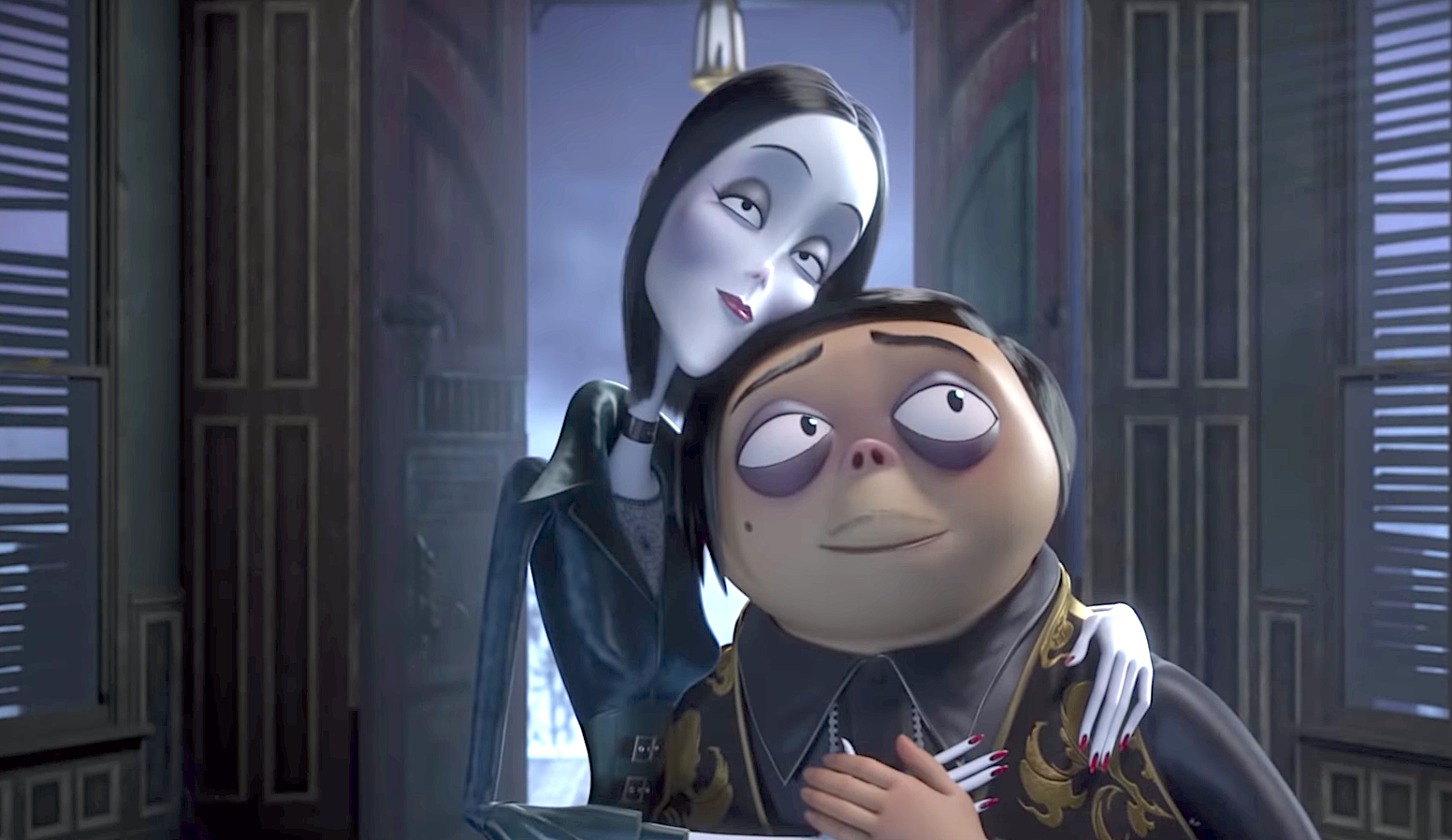
Has anything ever embraced the outcast narrative with as
much macabre panache as Charles Addams’s single-panel cartoons, The Addams
Family?
Their pride in themselves and obliviousness to the reaction of those around them continue to offer opportunity to pick at society’s weakness for sameness. Rooting a story of individuality versus conformity with the two pre-adolescent characters (Addams children Wednesday and Pugsley) makes good sense.
This should totally have worked.
The voice talent ensemble is a thing of envy: Charlize Theron, Oscar Isaac, Chloe Grace Moretz, Bette Midler, Allison Janney, Finn Wolfhard, Nick Kroll, Elsie Fisher, Martin Short, Catherine O’Hara and Snoop Dogg. That’s two Oscars, three nominations and one Snoop.
The standouts here are Janney and Moretz, each the funhouse mirror opposite image of the other. Janney’s zealous believer in conformity, Margaux Needler, is a home improvement guru with a reality TV show and a motto: “Why be yourself when you can be like everyone else?”
Moretz delightfully counters that energy with an entirely deadpan
Wednesday. Moretz’s every line is delivered with the emotion of a month old
corpse. She’s perfect.
Wednesday chooses public middle school, Pugsley (Wolfhard) preps for a family ritual of manhood, Margaux plots to rid her perfect neighborhood of that eyesore mansion on the hill in time for her TV show’s big season finale. The collision of those three stories bogs and slogs, though, each of the subplots championing individuality.
Which is fine. And that’s what this film is. It’s fine.
Kroll gets a funny bit about where his Fester is and is not
allowed to travel. Lurch is reading Little Women. Thing has a foot
fetish—that bit’s kind of priceless, actually. But on the whole, the film just
kind of lays there. Like a cadaver, but not in a good way.
Co-directors Greg Tiernan and Conrad Vernon (who also lends
his voice) proved they could envision a highly irreverent cartoon with 2016’s Sausage
Party, but have trouble finding solid ground between fornicating lunch
meats and Thomas the Tank Engine (Tiernan’s claim to fame).
Co-writer Pamela Pettler (writing here with The Christmas Chronicles’ Matt Lieberman) offers a resume more in line with the concept: The Corpse Bride, Monster House, 9. Yes, she has her goth bona fides. But she struggles to give the story any bite.
The Addams Family is unlikely to charm longstanding fans and will likely bore young moviegoers. It might entertain a slim swath of tweens, but this family deserves better than that.
In 2013, a little-seen flick called The Congress glimpsed a future world where Robin Wright (as Robin Wright) didn’t have to act anymore, she just sold the rights to her likeness.
Barely six years later, Gemini Man shows us that day is coming more sooner than later. Trouble is, it shows us little else.
Will Smith is Henry Brogan, a master government assassin who wants to retire. He apparently hasn’t seen movies like the one he’s in, or he’d know that won’t sit well with villainous villain Clay Verris (Clive Owen).
Henry has barely taken that first fishing trip before he and Danny (Mary Elizabeth Winstead), the younger agent assigned to watch him, are globe-trotting for their lives.
Who wants them dead? And why?
Both those questions, though, have to get in line behind the big one: why does that hot new assassin look just like a young Henry?
So it’s Will vs. Will, as Oscar-winning director Ang Lee employs the latest de-aging CGI (somewhat impressive-but the mouth is still the final frontier) for a completely pedestrian black ops yarn overrun with standard issue spy game dialog, heavy-handed daddy issues and soggy sentiments on mortality.
There’s obvious talent involved here, and the film is certainly a showcase for the latest in tech wizardry. Much beyond that, though, and this Gemini Man’s biggest mystery is the very meaning of existence.
On a mountaintop that rests among the clouds, eight child soldiers guard an American hostage and a conscripted milk cow.
They play what games they can manufacture and train for battle under the exacting eye of The Messenger (Wilson Salazar), whose visits bring supplies, decisions on permitted sexual “partnerships” among the group, and orders from the commanding Organization on how to carry out an ambiguous mission.
While The Messenger is away, one bad decision creates a crisis with no easy solution, becoming the catalyst for Alejandro Landes’s unconventional and often gut-wrenching Spanish-language thriller.
Yes, you’ll find parallels to Lord of the Flies, even Apocalypse Now, but Landes continually upends your assumptions by tossing aside any common rulebooks on storytelling.
Just whose story is this, anyway?
The Doctora (Julianne Nicholson)? She’s the hostage with plenty of clever plans for a jungle escape, and a sympathy for some of her captors which may be used against her.
What about Bigfoot (Moises Arias, impressive as usual)? He’s got plenty of ideas on what’s best for the group, but without Messenger’s blessing as squad leader, limited power.
Wolfie, the “old man” of 15? Shy, baby-faced Rambo? Lady? Boom Boom?
Landes never gives us the chance to feel confident about anything we think we know, as the powerful score from Mica Levi (Under the Skin, Jackie) and an impeccable sound design totally immerse us in an atmosphere of often breathless tension and wanton violence.
While Monos has plenty to say about how survival instincts can affect the lines of morality, it favors spectacle over speeches. Even the gripping final shot, containing some of the film’s most direct dialog, conveys its message with minimal force, which almost always hits the hardest.
It does here. Landes, in just his second narrative feature, crafts a primal experience of alienation and survival, with a strange and savage beauty that may shake you.
Some of my befuddlement has to do with Gary Oldman’s
involvement.
Is it just me, or is there a part of everyone’s brain that
says, “Wait, Gary Oldman’s in this? I will definitely watch it!”
Gary Oldman is a tremendous talent. You know what he’s not?
Choosy.
Here Oldman plays David, an aging boat captain carting
tourists around for a fishing company. He has big dreams, though—dreams of
owning his own craft. So naturally, when a ghost ship washes ashore, he cashes
in everything he owns to buy her at police action. Then he promptly loads his
squabbling family and a couple of deckhands aboard and sails toward the Bermuda
triangle.
Of course he does!
What exactly happens once he sets sail is a mystery David’s
wife (Emily Mortimer) explains throughout the film’s running time from an
interrogation room.
The police interrogation framework is very tired at this
point. It’s lazy. As are dream sequences and voiceover narration. They’re cinematic
crutches, ways of telling the audience what should be coming organically from
the narrative.
Director Michael Goi (Megan Is Missing) relies on these devices to explain what the action should detail, just as he falls back on ominous music to create dread or signal character development. I’m not sure this script gave him loads of options, though.
Writer Anthony Jaswinski (The Shallows) sketches characters, action and a ghost story, but clarifies very little. His script is an unfocused mess and Goi’s pacing does not help. We skip CliffsNotes style through the family’s crisis, none of it feeling authentic, before discovering the hidden facts about Mary (the ship and, presumably, the ghost) sitting in a box in the hallway.
What’s this, ship ledgers and newspaper clippings? How
convenient!
At 84 minutes (including credits), Mary feels simultaneously rushed and bloated. It’s a remarkable waste of both Mortimer and Oldman’s talent and the only true mystery—left unsolved, by the way—is how it drew these actors in the first place.
Few directors can consistently surprise you, can show such control and create such chaos, as Takashi Miike.
Miike makes Yakuza movies, he makes samurai movies, he makes horror movies, he makes kids movies. But it’s when he makes a mashup of a couple of those that he really defies expectations.
First Love is Miike’s tenth collaboration with writer Masa Nakamura. Their shared vision takes us through one night in Tokyo with a prostitute, a boxer, a cop, a mobster who wants out, and two warring gangs.
As one wistful participant of the evening’s adventure points
out, nothing’s ever simple.
Masataka Kubota (Tokyo Ghoul S) cuts a forlorn, otherworldly figure as Leo, the lonesome boxer. He fights for pay, but has no greater purpose. That actually puts him ahead of everyone else he’ll meet tonight because they all serve the wrong purpose.
As Leo stumbles headlong into an action flick in progress, Miike does what he does best. He zigs when you think he’ll zag, jukes when you expect jive. In First Love, Miike paint-by-numbers a romance film into the Jackson Pollack of a gangster shoot out.
Silly in its own way, as many of Miike’s greatest films are, First Love feels like an off-handed goodbye to the Yakuza drama. In between absurdities and viscera, the filmmaker’s tone feels pensive as characters look to their undetermined future in a profession that’s changing, even probably ending as they know it.
And then he switches to anime.
Because, honestly, if you’re willing to suspend disbelief enough to buy these gun fights, sword fights, fist fights and hallucinations, why not a one-time transition to comic book art?
In another filmmaker’s hands, this jarring one-off nuttiness might seem contrived or off-putting, but not on Planet Miike. His profession may be shifting sand beneath some feet, but Takashi Miike flies wherever he wants to go.
If you didn’t think Tim Heidecker’s Mister America had much in common with Downton Abbey, you’d be right…mostly. But like the big screen edition of that British saga, Mister America expands on a story in progress, superserving those that are already on board.
Fans of Heidecker’s antics may not be as numerous the Abbey faithful, but they may feel even more validated with this film, as he revisits a viral bit from 2017 that had him on trial for the murder of 20 people at a music festival.
Now, star and co-writer Heidecker re-connects with director Eric Notarnicola from their On Cinema and Decker TV projects for a mockumentary treatment of Heidecker’s attempt to unseat the San Bernardino DA who tried to lock him up.
If you know Heidecker for more than his higher profile roles (Us, Ant-Man & the Wasp), you know what’s coming, and you’ll be delighted. He can play it so straight, you start to wonder if some of this nuttiness is actually real.
Then, he goes into a barbershop to embrace racial profiling and propose a ban on rap music.
Sure, he’s riffing on the nature of today’s political climate, but the film often seems caught in between Borat-style bravado and Christopher Guest understatement.
Plenty of the bits land, but plenty others don’t, and those not already in on the joke may be left grasping for a narrative anchor and, much like newcomers to the Crawley saga, just plain bored.