All posts by maddwolf

Fright Club: Best Sound Design in Horror

Aside from maybe the musical, there is no genre in film more dependent on sound for audience response. From the creaks, groans and jangling chains of old fashioned haunted house pics to the hiss and slither of modern monster movies, things can hardly go bump in the night if you can’t hear the bump. So George sat down and determined the best examples of sound design in horror.

That’s right, George is driving. Did Hope recommend any movies to consider when thinking through the best use of sound in horror? She did. Did any make the list?

They did not.

Well, turnabout is fair play and sound is definitely George’s jam. So here, friends and Fright Clubbers, are George’s picks for the best sound design in horrorl

5. It Follows (2014)

Like A Quiet Place and Us, It Follows is a perfect example of how modern filmmakers are molding the soundtrack with sound effects and even score to create the sound experience.

Writer/director David Robert Mitchell, working with Disasterpeace on a score that incorporated music, ambient sound and sound effects, develops an immersive, nightmarish environment for the imagination to flourish. The synths reflect the film’s difficult-to-pin-down time period, simultaneously reflecting a recent past as well as a currency. Meanwhile, creaky doors and blowing wind call to mind old fashioned scares.

The score almost doesn’t sound like a score, and the sound sets a different mood every time the different demon appears. Few films are this masterful in the way it brings together sound track and sound effects. Together they create an inescapable mood.

4. The Haunting (1963)

Director Robert Wise obviously knew the importance of sound coming into this film, sitting, as it does, between his two biggest efforts, West Side Story and The Sound of Music. But musicals are not the only films that really deserve close attention to sound. What you hear is even more important than what you see in a good old fashioned ghost story.

We wanted to make sure the list included at least one example of old school Foley-style sound. Wise worked with AW Watkins, 4-time Oscar nominee for sound design (Doctor Zhivago, Libel, Knights of the Round Table, Goodbye Mr. Chips).

This is a great example of old time Foley sound effects used to create the mood, making things you can’t see scary.

3. The Lighthouse (2019)

The atmosphere is thick and brisk as sea fog, immersing you early with Jarin Blasche’s chilly black and white cinematography and a Damian Volpe sound design echoing of loss and one persistent, ominous foghorn.

For everything Eggers brings to bear, from the Bergmanesque lighting and spiritual undertones to the haunting score to the scrupulous set design to images suitable for framing in a maritime museum – not to mention the script itself – The Lighthouse works because of two breathtaking performances.

But what a world Eggers and crew create for Robert Pattinson and Willem Dafoe.

2. Berberian Sound Studio (2012)

Madman Peter Strickland (In Fabric) made an entire film about sound, and it gets so much right. Not just about sound—about the era, the equipment, giallo sensibilities and moviemaking.

Strickland, working with a sound department of 34, creates a psychological experience through sound almost exclusively. The amazing Toby Jones plays Gilderoy, flown in specifically to helm the sound in a horror movie.

“This isn’t a horror movie. This is a Santini movie!”

Gilderoy’s arc is profound, and sound is our only window into what is changing him. We don’t see what he sees, only his reaction to it and the sound of it that makes his psychological breakdown believable.

1. Alien (1979)

The great soundman Ben Burtt, with an impressive team and the direction of Ridley Scott, uses silence as another instrument in the terrifying sound design for this film.

Given the tag line, that powerful use of silence is more than evocative, it’s required. But layered in, Burtt offers plenty of aural evidence that this spaceship is not like those we were used to seeing onscreen. The Nostromo is no sleek vehicle. Creeks and chains, water leaks and thudding echoes depict a dilapidated bucket of bolts, giving Alien a creaky old house atmosphere.

From the chest bursting, Ash’s unattached vocal cord gurgling to the hissing sound the creature makes as he announces his presence, the sounds in this film have been copied and retooled as often as its storyline and look. But there is only one first time.


Lonely Hearts Club

We Die Alone

by Hope Madden

We Die Alone—writer/director Marc Cartwight’s award-winning short horror/thriller—prizes both character and story. It benefits from committed performances that develop textured characters you feel for.

Baker Chase Powell is effective as Aidan. Cripplingly anxious about women, Aidan is also far too handsome to believe his issues are insurmountable. Surely someone will fall for this dangerously isolated young man if given the chance, right?

Likewise, the tenderness and insecurity shining from Ashley Jones’s performance—along with just a handful of ostensibly throwaway lines from her co-stars—cement her as a believable lonely heart you hope can turn things around.

And of course, there is the catalyst for their developing storyline, Chelsea (a perfectly cynical Samantha Boscarino). The filmmaker brings together characters, makes you root for them, makes you anxious for their emotional wellbeing, and then delivers on a promise you didn’t realize he made.

Cartwright understands how story develops and uses this expertise to subvert expectations. His film plays with your preconceptions but never substitutes clever gimmick for story. The result is a sly, entirely satisfying journey into love, loneliness and how little we understand each other.

Teen Titans

Boys State

by George Wolf

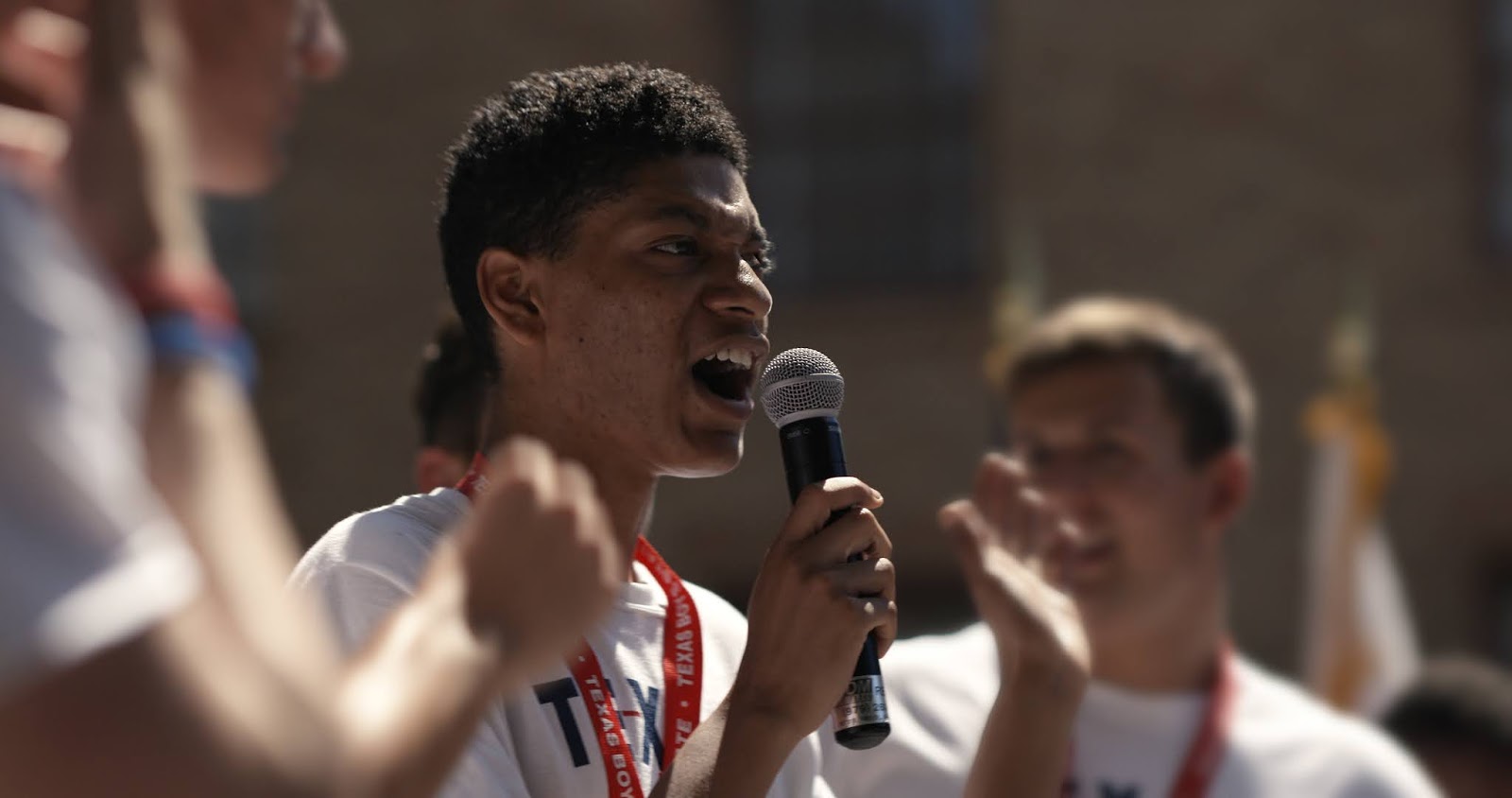
Imagine what you get when you bring over a thousand 17 year-old boys together to play politics.

Fight Club with zits?

You get Boys State, an annual exercise into the “civil discourse” of state government. An American Legion program since 1935, Boys State (and its corresponding project for girls through the Legion Auxiliary) gives selected high school juniors the chance to build a representative government from the ground up.

From legislative sessions and deal-making to party platforms, elections and even a talent show, the kids are immersed in it all. In the Sundance Grand Jury prize-winning Boys State, directors Amanda McBaine and Jesse Moss immerse us in it, too.

The result is an endlessly fascinating and thoroughly entertaining mixture of shock and awe.

Employing a predominantly verite approach, McBaine and Moss settle on four main boys to follow throughout the weeklong experience. We see glimpses of those who just came to play (“ban pineapple pizza!”), but our quartet means business. While Ben and Rene are elected opposing party chairmen, Robert and Steven are both after the big prize: Governor of Boys State Texas.

The boys’ different backgrounds (Rene: “I’ve never seen so many white people!”) create truly compelling characters who provide just one of narrative contrasts that draw you in, slowly deepening your investment until you’re hanging on every motion and debate.

As the party members draw their platforms with an eye toward victory… check that…I mean DOMINANCE in the general election, it’s equal parts horrific and inspirational.

Boys openly betray their principles for populism, jockey to acquire more power and gleefully pounce when they smell a negative campaign that might stick. They quickly learn the well-worn lessons of a fickle and often hurtful enterprise, either adapting or falling away.

The rampant testosterone can’t go unnoticed. Neither can multiple examples of how badly more women are needed in all levels of government.

And when all is said and done, one of our principles has to admit another is “a fantastic politician.”

Is that a compliment?

That may be a complex question, but only a few of these boys will watch this film again in 20 years and feel damn proud of who they were at 17.

Or maybe they all will. Boys State fuels both the cynicism and the hope required to make either road seem possible.

Your move, Girls State.

Year of the Woman?

Represent

by Hope Madden

We make up 50% of the earth’s population and 23% of the House (which is, disappointingly, an all-time high). Why is it so hard for women to take our statistically rightful place in representation?

Hilary Bachelder’s sly doc Represent eyeballs that struggle for three Midwestern women: Detroit’s indefatigable Myya Jones; Evanston, Illinois’s beleaguered Julia Cho; and Granville, Ohio’s very own Bryn Bird.

All three women are looking to make a difference in local politics. All three face more obstacles than simply their sex: Jones is only 23-years-old at the end of filming; Cho is a Republican in a highly Democratic area; Bird’s the only progressive ever to run in her township. And then there are the more obvious hurdles: Jones is a Black woman; Cho is Korean American.

It is fascinating to witness which of these particular concerns the voting populace feels most comfortable overtly reacting to and which require veiled swipes and sideways glances. When a woman at one of Cho’s stump speeches tells the politician that her children don’t mind Common Core because they are “Oriental, and all Orientals do well in school,” it’s hard not to gasp aloud.

Bechelder’s footage never glamorizes its leads. Their candor, idealism and even their missteps and shortcomings as politicians are on display, giving the film a transparency and authenticity.

Represent is most fascinating when it quietly unveils the final and most insurmountable obstacle, which is the candidates’ own parties. Is she the good kind of progressive? A real Republican? The right kind of Black woman?

And if you have to change who you are to be heard, do you really have anything left to say that’s worth hearing?

Cho, Jones and Bird are up for the battle.

“Democracy requires engagement,” Bird tells Bachelder. “We need people to fight for it.”

https://www.youtube.com/watch?v=9YCzqEy5KHs

My Back Pages

The Bay of Silence

by George Wolf

You know those films that make you think, “Man, I bet this was a great book”?

The Bay of Silence is one of those. It has the intrigue, the mystery and the performances to hold your attention, but it feels as if something’s missing. Something like several pages, or even a chapter or two from Lisa St. Aubin de Terán’s 1986 novel.

Design firm exec Will (Claes Bang) and photographer Rosalind (Olga Kurylenko) are enjoying an idyllic getaway in Italy, where Will pops the question with a pull tab (don’t worry, he’s good for a real ring). An opening prologue gives us a glimpse of some trauma in Rosalind’s youth, but it seems like Will, Rosalind and her 8 year-old twin daughters can look forward to happiness as a blended family.

Months later, a very pregnant Rosalind falls from a balcony. Though baby Amedeo is delivered healthy, Rosalind has changed. She’s convinced that she actually delivered another set of twins, and that everyone involved (including Will) is in on the deception.

Ros returns to her photography and her erratic behavior continues, until Will returns home to find his wife, the children, and their nanny (Shalisha James-Davis) all gone.

Will turns to Rosalind’s mother (Alice Krige) and manager/former stepfather Milton (Bryan Cox) for answers, but the mystery of Rosalind’s past, present and future only deepens.

Are we dialing M for madness of murderousness? Director Paula van Der Oest (Oscar nominee for 2001’s Zus & Zo) nails a Hitchcock vibe in spots, but the adapted screenplay from Caroline Goodall – or an editing hachet job order from the studio – leaves too many dangling threads for a completely satisfying payoff.

Rosalind’s fascination with twins is just one of the questions nurtured and then forgotten, apparently in service of a quicker trip to the resolution which is telegraphed pretty early on.

The cast is uniformly splendid (especially Cox, natch) and the locales ooze sophistication. But while The Bay of Silence qualifies as perfectly acceptable adult fare, you can’t help wishing it would have said a little more.

Back in the USSR

Sputnik

by Hope Madden

For low-key, throwback sci-fi horror, Sputnik is a fine time.

A Russian film, Sputnik takes us back to Soviet Union circa 1983 in all its concrete walls, dirty snow and drab greys. Comrade Tatyana Klimova (a formidable Oksana Akinshina) is brought to a secret military facility to consult on a strange case: Cosmonaut Konstantin Veshnyakov (Pyotr Fyodorov) has partial amnesia and can’t fully explain his mission’s failure.

First of all, I love that these guys always call each other by their entire first and last names, usually with the prefix Comrade. It requires that they get right to the point, otherwise conversations would become just too long.

Little details like these, along with a convincingly oppressive set design and performances of understated perfection, convey the repressive, even terrifying conditions of the time. It’s a fascinating atmosphere to evoke when introducing something as wondrous and horrific as the film’s little monster.

That’s right, Cosmonaut Konstantin Veshnyakov did not return from space alone, but separating the Soviet hero from the alien visitor is proving very difficult.

Part Venom, part Alien and all manner of Russian, the film pulls in images and ideas that feel familiar—sometimes too familiar—but the execution maintains your interest.

Akinshina’s stoic and unimpressed doctor is at the center of a film concerned with heroism and adaptability. Comrade Tatyana Klimova carries with her an unerring and unemotional sense of what’s right, which is often at odds with the sense of purpose that drives this mission. It’s a solid emotional center for the film, but let’s be honest, who wants to see a monster movie unless there’s a cool monster?

There is! Director Egor Abramenko, working with FX and puppetry, creates something almost del Toro-esque. All phalanges, tail and teeth where teeth ought not be, the creature’s creepy design scores Sputnik plenty of points.

As true to the period as the subdued tone feels, it also robs the movie of a sense of urgency. But Abramenko weaves in elements of an indie drama that work better than they should to round out this picture of Soviet heroes and monsters.

Detroit Rock City

Creem: America’s Only Rock ‘n’ Roll Magazine

by Hope Madden

Documentarian Scott Crawford has an interest in location-specific counter culture. His 2014 doc Salad Days recounted a decade of unsurpassed DIY punk rock transforming the underground of Washington, DC.

Now he turns his attention to Detroit.

Creem: America’s Only Rock ‘n’ Roll MagazIne documents the inner dysfunction and outward impact of the Motor City’s “screw you” to the rock establishment. (Lookin’ at you, Rolling Stone.)

Launched in 1969 by Detroit head shop entrepreneur Barry Kramer, the magazine immediately defined itself among rock mags as the most personal, most irreverent, least sophisticated and most vital. Like the decaying, even dangerous city it represented, Creem Magazine existed outside the mainstream.

Boasting a litany of groundbreaking rock writers and more women on the editorial and writing staff than nearly any other magazine at the time, the magazine pushed boundaries. It didn’t just cover punk rock, it was punk rock. And like punk rock (or Detroit, for that matter), it was basically doomed.

Crawford’s gift is in establishing the period, time stamping the singular moment in rock history he wants to unveil. Archival footage and behind the scenes photos illustrate the hard core, nearly derelict quality of the working conditions. Kramer’s commitment was almost blind, and the untested staff—many of whom would reveal themselves to be rock writing geniuses—attacked their assignments with equal self-destructive passion.

We hear directly from many of them: Dave Marsh, Cameron Crowe, Jaan Uhelzski (who co-writes the film). We also hear from the rock stars that were covered (Alice Cooper, Gene Simmons, a very testy Joan Jett), as well as those modern day musicians whose young minds were warped by Creem’s pages (Michael Stipe, Kirk Hammett, Chad Smith).

The film’s production design does justice to its source material. Scott Gordon’s animated sequences are an inspired avenue into reenactments. Between the cartoons, stories, photos and excerpts of his writing, a provocative image of Lester Bangs emerges. And who could be more fitting to provide all the movie’s original music than MC5’s Wayne Kramer?

The film, produced by publisher Barry Kramer’s son JJ, is absolutely a mash note to rock’s most rebellious rag. For many it will be a lesson on the significance of Detroit, even after Motown, in the evolution of American music. More than anything, though, Crawford’s film is a testament to the legacy of America’s Only Rock ‘n’ Roll Magazine.  

License to Kill

Spree

by Rachel Willis

I am about as unplugged as one can be in this hyper-connected world. I have zero social media profiles and visit around five websites regularly (this one included). Considering my lack of presence online, I may as well not exist.

At least, according to Kurt Kunkle (Joe Keery, Stranger Things).

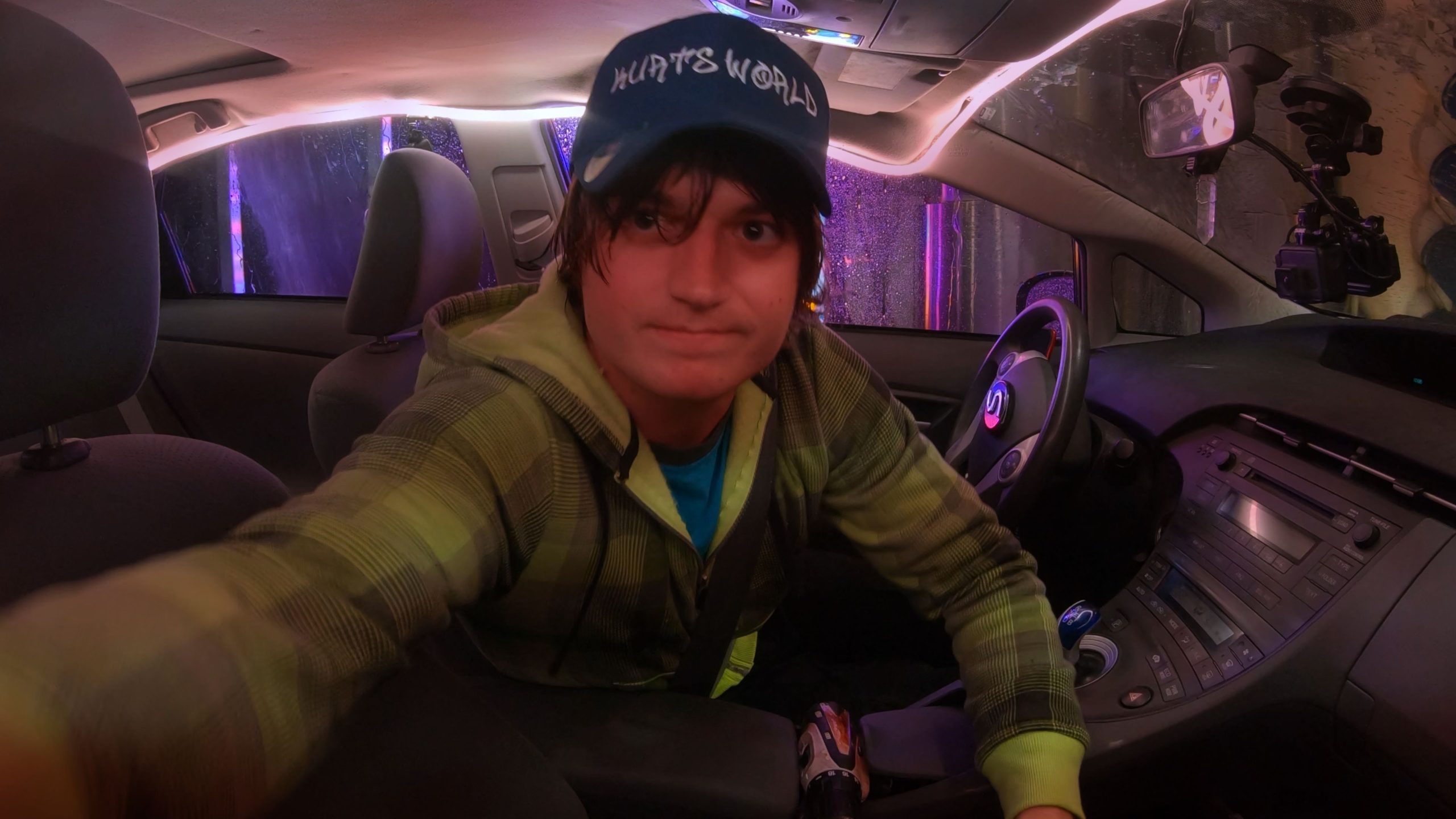
Kurt is the wannabe viral sensation at the center of director Eugene Kotlyarenko’s latest film, Spree. Deciding to live stream his evening as a driver for the ride-share company, Spree, Kurt – star of @KurtsWorld96 – has a lesson to share and knows this is his ticket to fame in the digital world.

Kotlyarenko, co-writing with Gene McHugh, wants to deliver a comedic observation of the effects of the digital world on the real one. It’s not a bad idea. It’s too bad the movie isn’t funny nor especially profound.

There are multiple cameras on Kurt throughout the movie – phone camera, dash cam, window cam, security cam, body cam – at times, the cinematography piles on the footage, using split screens to show us multiple views. A running commentary is sometimes seen at the bottom of one or two of the screens. This lets us know that everyone in cyberspace viewing Kurt’s night – which involves several crimes – thinks it’s staged. Occasionally, someone chimes in wondering if it’s real, but for the most part, they can’t discern fact from fiction.

It’s exhausting. Aside from one, blink-and-you’ll-miss-it shot that I couldn’t account for, every scene is delivered through a handheld or portable device. Watching the movie, it’s hard to imagine anyone consumes anything this way. If this is the way of the world, our attention spans will surely dwindle closer and closer to that of a goldfish (if they haven’t already).

The movie’s only plus is Sasheer Zamata (The Last O.G., Saturday Night Live). Her character, Jessie Adams, runs across Kurt early in his night and is everything he wants to be. Zameer delivers the right amount of comedy in a few spots that, had the movie matched her efforts, might have helped its appeal.

While the attempt at commentary on the larger culture does not go unnoticed, as one of Kurt’s followers says to him of his attempts to go viral, it’s “boring and awkward.”

Same goes for Spree.

Screening Room: An American Pickle, The Go-Gos, I Used To Go Here, The Burnt Orange Heresy, Waiting for the Barbarians, Made In Italy, The Tax Collector, Senior Love Triangle, Out Stealing Horses, Spinster, Red Penguins, River City Drum Beat, You Never Had It, She Dies Tomorrow, Limbo, La Llorona

CLICK HERE for our reviews of this week’s new releases plus a studio news update!