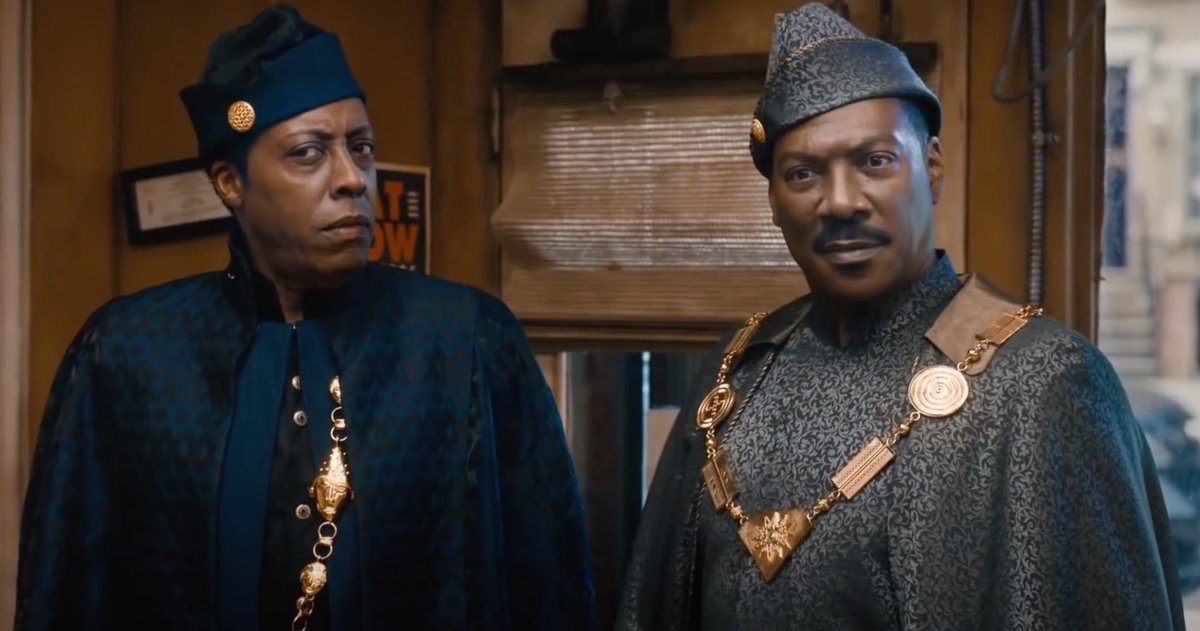
A quip about unnecessary sequels is just one of several “wink-wink” gags you’ll find running throughout Coming 2 America. And though the original was heavy in sexism (even for 1988) and light on LOLs, there’s little doubt that the film’s huge fan base has been anxious for a follow-up.
Eddie Murphy teams again with director Craig Brewer, which is reason for optimism, since Brewer helmed one of Murphy’s career highs – 2019’s Dolemite Is My Name. But screenwriters David Sheffield and Barry Blaustein return from the original film, and while they thankfully update the sexual politics, the humor is again scattershot at best.
Most of the cast is back, including 90 year-old James Earl Jones as King Jaffe of Zamunda. He’s ready to pass the throne to Prince Akeem (Murphy), but is worried that Akeem and Lisa (Shari Headley) only have daughters, and tradition calls for a male heir.
What’s this? The loyal Semmi (Aresenio Hall) has been keeping a very big secret all these years, which means Akeem and Semmi must return to New York to find Akeem’s long lost son.
That would be Lavelle (Jermaine Fowler), who makes the trip to Zamunda for royal training with his mom (Leslie Jones) and uncle (Tracey Morgan) in tow. The additional family is good for Lavelle, and for us, as Jones and Morgan’s “fish out of Queens” antics give the film its most consistently fresh and funny moments.
They’re just aren’t enough of those moments to pump real life into part 2. The girl power is overdue and and love lessons are generic, each as predictable as getting more insults from the barbershop guys and more R&B stylings from Randy Watson.
Buy hey, you go to see Sexual Chocolate, you want to hear the hits. And if you’ve been waiting for Coming 2 America for reminders of what you liked the first time, you’ll get them.
What’s the greatest moment in Asian-American history?
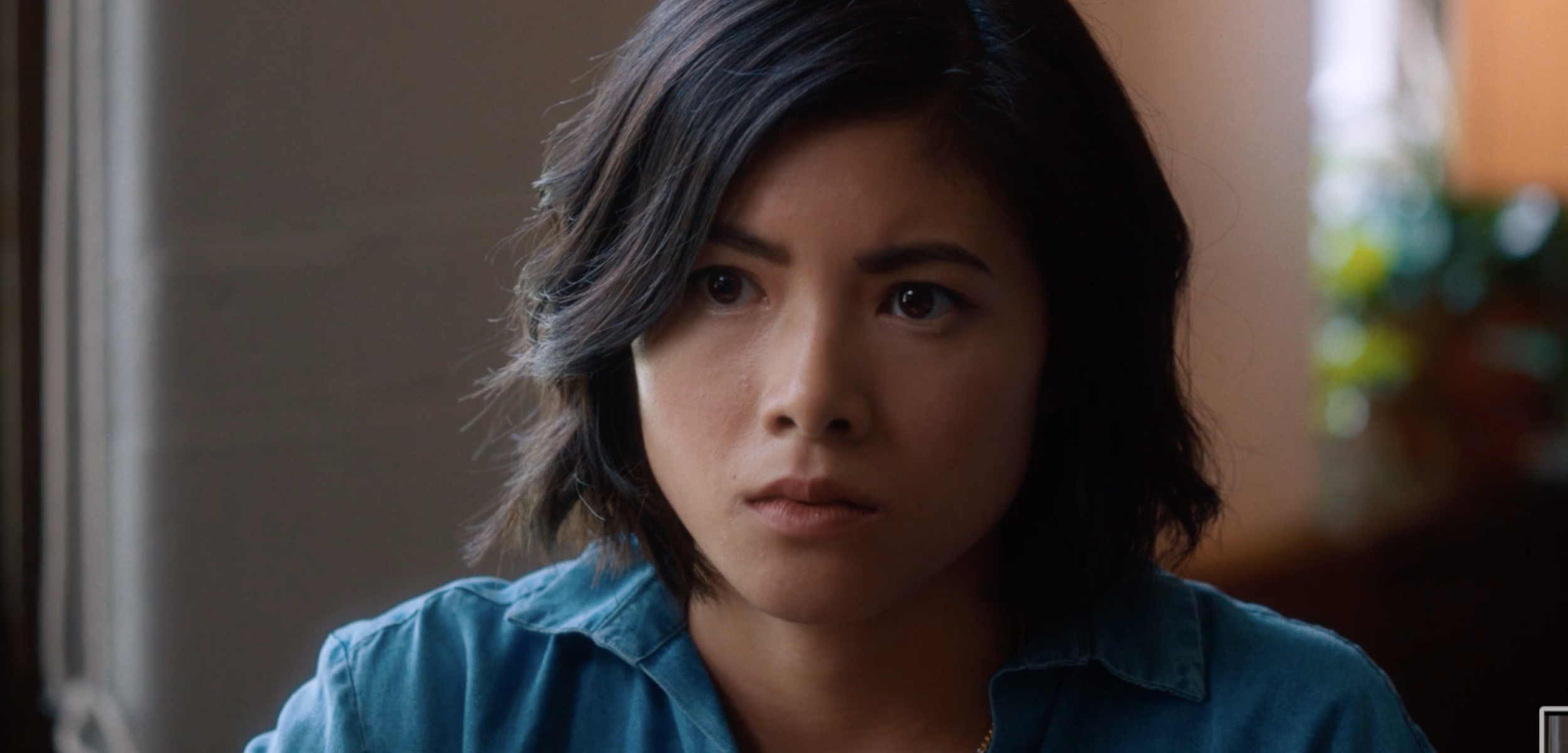
According to Alfred “Boogie” Chin’s father, it’s Micheal Chang’s upset of Ivan Lendl in the 1989 French Open final. And though Boogie’s sport is basketball, the Chin family is hoping some similar court magic will take them all the way to the NBA.
And that’s the first trouble sign with writer/director Eddie Huang’s first feature. From what we see on the court, the idea that Boogie (Taylor Takahashi in his screen debut) is good enough to play in college – let alone the NBA – is laughable.
Wisely, Huang keeps the in-game action to a minimum, focusing instead on the pressures of an Asian teen who must shoulder the burden of being his family’s savior while coming of age in Queens, New York.
Boogie transferred to City Prep High School, so a high-profile showdown with Brooklyn phenom “Monk” (rapper/musician Pop Smoke, is his last role before his tragic murder last year) would help land a college scholarship. But so far, the scouts aren’t promising anything more than walk-on opportunities.
The opportunities with Eleanor (Taylor Paige, so good in Ma Rainey’s Black Bottom and the clear standout in this cast) are looking much brighter. As the big game draws near and the “manager” Mom hired makes things even more tense at home, Boogie leans on Eleanor for a quiet sense of comfort.
Huang (creator of TV’s “Fresh Off the Boat”) throws out some solid ideas, but his attempts to develop them stop at vague generalities. Much like the hooping talent, the cultural struggle of the Chin family is told more than shown, never giving us a reason to get emotionally involved.
And if you’re going to cast a completely inexperienced actor as your lead, why not someone who’s actually a basketball talent? Takahashi was apparently a high school standout, but that doesn’t translate here. Still, even without the inexplicable basketball charade, the coming-of-age drama is only G league material. Huang may yet prove he got game, but it’s going to take some work in the film room.
The music world and the horror world have a simpatico relationship. The Rocky Horror Picture Show and The Phantom of the Paradise are quintessential cool horror rock operas. More recently, Deathgasm – the New Zealand love letter to metal – has gained momentum as a cult classic with its fun mix of gory carnage and shredding guitars.
Where does the world of underground DJing fit into this legacy? Well, if Dreamcatcher is any indication, any legacy might be over before it starts.
Pierce (Niki Koss) and her friend, Jake (Zachary Gordon), tag along to a hot-ticket underground music fest with Pierce’s sister, Ivy (Elizabeth Posey), and her friend, Brecken (Emrhys Cooper). As the show winds down, tragedy strikes and the friends are thrust into a world of deceit and violence.
It’s hard to get excited about slasher flicks these days. Heck, it was hard to get excited about them by the mid-80s. These are movies built on tropes – it’s what the fans expect – and Dreamcatcher is no exception, despite a few clumsy attempts to be something different. The film swings big, trying to be more character-focused. This approach does nothing but put a spotlight on the incredibly weak script, and pad the running time to an excruciating hour and 48 minutes.
The parts of the movie that are your standard stalk-and-slash clash with the other side that wants to be something more akin to a 90s thriller (think Kiss the Girls or other Silence of the Lambs wannabes). Director Jacob Johnston handles the slasher elements well. These scenes are shot in a more grounded and brutal fashion. When the story starts to dip its toe into character motivation or anything resembling drama, the suspense falls apart.
The characters in Dreamcatcher run the gamut from unlikeable to downright loathsome. Scene after scene of Pierce, Jake, and Ivy airing their petty grievances wear out fast. Dreamcatcher lacks even one character for the audience to latch onto as a surrogate. This ends up making the horror shallow and meaningless.
Dreamcatcher might satisfy die hard fans of the slasher genre, but those looking for something a little more challenging will find themselves checking their watches on more than a few occasions.
Well, it’s still a princess, unfortunately, so not that different.
But Raya and the Last Dragon marks an impressive step forward in a
number of ways.
Raya (Kelly Marie Tran) opens the film Mad Max style, riding some alien vehicle through a post-apocalyptic landscape, her face covered, her eyes darting to and fro in search of something–predator? Prey?
The apocalypse itself happened just six years earlier, and
Raya had a hand in the world’s undoing. Now here she is, at the beginning of
the journey that could put the pieces back together.
Tran delivers a heroine you can genuinely understand. She is logical, and when she tends to lean toward head and away from heart to make decisions, it’s hard to fault her.
Her sidekick, in grand Disney fashion, is the shapeshifting
but fantastically colorful dragon Sisu, voiced by Awkwafina. The comic’s brand
of endearingly self-effacing humor punctures the film’s preciousness at all the
right moments.
There is a central emotion, a powerfully executed conflict
in Raya and the Last Dragon that never feels as if it’s been watered
down or softened for younger viewers. The conflict speaks of the courage to
believe in people even when they have proven themselves untrustworthy.
It’s a notion that flies in the face of logic, really, but the
point of the film—and possibly of life—is that you cannot build a whole
community if all you have are fractured segments unwilling to take that leap.
There’s just so much stuff here.
The film runs a full two hours, and you feel it. The first
twenty minutes is burdened with piles of exposition, and the mostly magical
second act journey is overstuffed as well. Too many characters to keep track
of, let along get attached to, muddy the overall picture. Losing maybe half a
dozen characters and trimming 20 minutes from the film would have done wonders
for it.
There are problems with the execution, but not with the animation. Raya and the Last Dragon is breathtaking, its world building as gorgeous as it is meticulous. Animators deliver each South Asian-inspired community with its own unique look and feel—from a glinting desert wasteland to a torchlit floating city to a lushly forested community and more. The film is simply stunning and should be viewed on the biggest screen available.
But for all the Raya puts in the win column, it can’t shake the feeling that all four directors and the team of ten (10!) that built its script and story were culling from plenty of pre-owned parts. The Disney formula still has princesses, they’re just warrior princesses now.
That evolution may have been overdue, but it’s already starting to show some age.
Lucky takes a well-known horror trope – the masked killer whose “dead” body vanishes when you turn your back – and puts it in a freshly relevant light.
A gaslight, if you will.
May (Brea Grant, who also wrote the screenplay) is a self-help author living in the California suburbs with her husband Ted (Dhruv Uday Singh). They are working to get past a rough patch in their marriage when a strange, persistent threat presents himself.
Every night, a masked man (Hunter C. Smith) tries to break in and kill May. She fights him off – sometimes spilling plenty of blood in the process – but he always seems to get away. The police are on the case, but they’re more interested in why Ted doesn’t appear to be around anymore.
And they’d really like her to calm down.
Grant’s script is often smart and timely, and director Natasha Kermani peels enough layers successfully to hit a number of societal bullseyes. But an extended metaphor such as this is tough to keep constantly afloat, and some gaps of logic in the narrative work against the film’s subtlety and in turn, its overall power.
Grant and Kermani end up walking an entertaining line between subversive humor and metaphorical slasher. Lucky works best in that center, when May becomes a living example of that internet meme comparing what men and women do each day to avoid becoming a victim.
This is the final girl in a modern world of gaslighting and victim-shaming, where women form common bonds overs fears too often dismissed.
Opening on a man
sprawled on the beach, a crashed motorcycle and a wallet floating into the
ocean, Sometime Other Than Now is immediately intriguing. Written and
directed by Dylan McCormick, this is a quickly-paced drama that will just as
quickly hook you.
The pacing of the film is the first thing that stands out. It’s faster than you might expect. Characters pop up and interact rapid fire. In the age of the slow-burn, it takes a minute to adjust. But it’s rewarding to watch as instant attractions pay off, as we come to know the characters and their situations. Not every question is answered immediately, but you’ll enjoy yourself as you wait for the solutions.
The dialogue is the next element setting this film apart from similar stories. It’s realistic, funny, no bullshit talk that draws you in and makes you care for characters you haven’t known long.
As the man on the
beach, Sam, Donal Logue shows off his talent for drama. Both endearing and
frustrating, you want to know where he’s been and to see where he’s going.
Playing off Logue with near equal talent, Kate Walsh brings depth to her
character, Kate.
The rest of the cast isn’t given same level of attention. Characters pop up in the beginning that are given some weight, making you think they’ll come up again as a larger part of the story. While they do appear later on, they don’t receive the resolution you might expect. Everyone who plays a role in the film does a fine job, but when compared to the two main characters, they feel hollow.
McCormick is also
partly responsible for the film’s score, and it pales in comparison to his
writing/directing talent. There’s nothing exactly wrong with the score; it’s
just not the right music for the film. Although, there is a particularly lovely
song that plays over the end credits that’s worth a listen.
This is only McCormick’s second film (and his first came out 15 years ago), and it’s a bit rough around the edges – a lot like its main character. But that’s part of what gives it its charm.
Authenticity is certainly the main differentiator between
Chad Crawford Kinkle’s latest horror and others of the genre.
It’s been eight years since the filmmaker released his
underseen backwoods gem Jug Face. He once again pits a tenacious female
against the unrelenting pressure of an unholy presence, but Kinkle has a more
personal kind of dread in store with Dementer.
Katie (Katie Groshong), looking for a fresh start, applies for a job at a skills training facility that works with adults who have special needs. She’s hired, working with clients two days a week in the facility, then spending two nights in a group home with three of them.
Katie is especially concerned with Stephanie (Stephanie
Kinkle, the filmmaker’s sister).
Kinkle’s sister is an adult with Down Syndrome, which not
only elevates the reality of the situation but also the tenderness and anxiety
around the character’s safety. You can almost feel the filmmaker’s own personal
dread over his sister’s vulnerability in an untrustworthy world.
Aside from Larry Fessenden, who appears briefly, Groshong is
the only professional actor in the film. Kinkle, working with a skeleton crew,
films in an actual skill center. The majority of the staff and clients
represented in the film are, indeed, staff and clients.
The approach gives the film a verité style often seen in
horror films, rarely if ever seen in a horror film with a main character who
has special needs. Dementer lacks any of the sheen or noble heroism you
often find in films centered around a character with a disability. The realism
adds a level of discomfort, a sense that vulnerable adults who need care could
easily find themselves in a precarious situation.
Dementer also offers an uncomfortably realistic look
at working poverty.
Kinkle mines these anxieties as Groshong begins to see and hear signs that suggest Stephanie may be in real danger. As she races against the clock to save her, Kinkle slyly upends plenty of horror tropes.
It’s an often fascinating deconstruction of a particular
subgenre of horror, an approach that usually benefits from the verité style.
But too much of the loose narrative feels like filler. We watch Katie buckle
her seat belt no fewer than five times.
Unanswered questions can strengthen a film, but Dementer feels underwritten. Still, you get the sense that Kinkle made the best of what he had on hand and told a deeply personal story in the most authentic way he could.
Google has meant a lot of changes, perhaps the most tragic is the end of the old library scene in horror. While we find ourselves settling for the new cliche of the quick online search to uncover the hidden history behind a haunted home or town tragedy, this never used to be the case. Countless horror films led invariably to the Act 2 discovery in the old library. Either a helpful librarian carried large, impressive volumes to our hero at their tidy, green lamp lit library table, or a plucky sleuth scrolled their way through the old microfiche via the big microfilm machine.
How much do we miss those days? Enough to look into the very best in library horror.
Big thank you to Jennifer Snoek Brown of Reel Librarians for dropping loads of knowledge.
5. Se7en (1995)
Countless horror films begin Act 2 with a trip to the library. Act 1 has something creepy happening that puts our hero (or, more often than not, heroine) on edge and there’s nothing that can put them at ease except a little information search.
But David Fincher is not like other directors. While the beats are all here: big books stacked on an elegant desk, green lamps illuminating pen-and-ink drawings of the macabre and unsavory, a montage of pages being copied. But here, by flashing back and forth between Somerset (Morgan Freeman) doing the research and Mills (Brad Pitt) simultaneously studying case files, we learn a great deal more about what has happened and – don’t overlook all those decapitation images – what will happen.
The music gives the whole affair am appropriately religious fervor. This is how you make that cliche library scene work.
4. It (2017)
Poor Ben. It’s not enough that he pines in poetic silence for the lovely Beverly. It’s not enough that he’s the lonely new kid without even a posse of losers to hang out with (yet, anyway).
Nope, now he’s got intel and he doesn’t even have anyone to talk to about it.
This is the traditional “digging up big ol’ books about my spooky new hometown” scene, complete with a very creepy librarian. (Keep an eye on her in the background while Ben’s reading.)
But then comes the balloon. I have come to learn that a red balloon is never a welcome sight in a small town library.
3. It (1990)
Normally, we don’t include TV horror, but this scene is just so good! The Nineties TV miniseries is inferior to the later big screen adaptation (Part 1, anyway) in many ways, but not here.
Part of the credit goes to the fact that this film does not recreate that same, tired library scene. No microfiche, no big books on the history of Derry. Not in this scene. Just lunacy, Prince Albert in a Can jokes, and exploding, blood-filled balloons.
Plus Tim Curry, who improves any scene.
https://www.youtube.com/watch?v=cmOLwrvH-Ag
2. Behind the Mask: The Rise of Leslie Vernon (2006)
Another film that takes what you know to expect and serves it up to you in the most delightful way, Behind the Mask is among the greatest of all horror comedies and satires.
This particular scene points out the inevitability of that library research scene in horror movies. That would be reason enough to appreciate it, but Zelda Rubenstein (of Poltergeist, obviously) is the icing on the cake. Ever the dramatic, weirdly helpful librarian that the genre relies on for all its historical towny gossip, Rubenstein shines as a woman who really wants to shine in the spotlight.
Just one more reason this film is such a treasure.
1. Ghostbusters (1984)
No, it’s not horror – but it is a scary scene! In fact, for most people it is the scariest scene in Ivan Reitman’s comedy classic.
What makes it perfect is the tension it generates before the jump scare because we know Pete Venkman (Bill Murray, perfection) is going to get in trouble. You just can’t keep talking like that in the library.
Senior April Chen (Celine Tsai) is days away from graduating
from DuPont University, and she already has a lucrative job waiting for her in
Silicon Valley. All she has to do is get through her academic misconduct
hearing. But her TA, Keith Ward (Jonathan Keltz), is determined to pin her for
plagiarism and as the hearing wears on tensions rise and secrets are unearthed.
In a mockery of a courtroom, Stealing School analyzes the personalities and egos that run rampant in academia, criticizing its self-importance, bureaucracy and institutional racism. A particularly good running gag is various character’s introduction of their thesis titles. If you’ve ever had a brush with higher education, you’ll recognize all the archetypes that writer and director Li Dong cross-examines.
Particularly brutal is the Canadian school’s PR policy which
seems to rely entirely on “being better than American schools.” Their only
answer to accusations of racism and misconduct is that at least they aren’t
like the institutions to their south.
Stealing School has good pacing, and a delicious unfurling of tensions between various characters during breaks and in flashbacks. The film analyzes how important it is to be likable, rather than right or good. Keltz is absolutely loathsome and delivers the best performance of the film, being too eager, too righteous, too vindictive. Tsai matches him with a subtler performance, walking a moral gray area that has you unsure of her innocence until the final moments of the film.
The rest of the supporting cast matches their archetype well, all either jaded by the academic world or still obsessed with its ability to give them better opportunities. But Stealing School’s criticisms don’t stop at academia. Dong also explores racism in broad strokes and the toxic culture of tech that only asks that you provide good code.
Stealing School is a tight hour and 14 minutes, which keeps its mostly single setting from feeling claustrophobic. With good pacing and a satisfying end, this is a great watch for your evening, especially if you regret your degree.