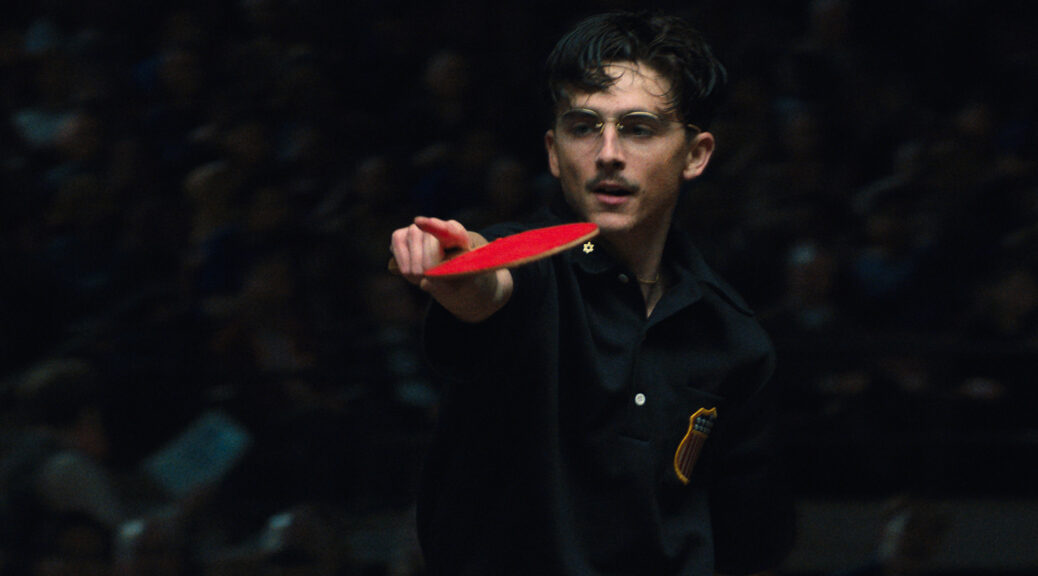
It’s been six years now, have we recovered from the panic and palpitations brought on by Josh Safdie’s Uncut Gems?
Better towel off and grab hold of something, because Marty Supreme serves up another harried drama set at a breakneck pace.
Served up, see what I did there? Marty “The Mouse” Mauser is a table tennis phenom looking to cement his name as the best in the world.
But when we first meet him, Marty (an absolutely electric Timothée Chalamet) is working in a shoe store in 1950s New York. He’s a born salesman, but makes it clear he’s only there to make enough money to finance his next trip to a big tournament. And in that opening few minutes, Safdie and Chalamet gives us a clear glimpse into the Marty Mauser worldview that will grab us by the throat for the next two and a half hours.
Everyone and everything is a means to an end. And Marty is relentless.
It could be an adoring young woman who’s already married (Odessa A’zion), a rich ink pen tycoon (Shark Tank‘s Kevin O’Leary in another bit of Safdie stunt casting) or his bored actress wife (a terrific Gwyneth Paltrow), or even a man out to find his lost dog. It doesn’t matter, Marty will size you up and instantly start working the angle he thinks is most likely to make you an asset.
The entire film, loosely based on Jewish-American table tennis champ Marty Reisman, is a fascinating character study and Chalamet is in mesmerizing, career-best form. Safdie (co-writing again with Ronald Bronstein) might as well just shoot Marty out of a cannon when he leaves that shoe store, and Chalamet makes you afraid to miss anything by looking away.
Like everything else here, the table tennis action is fast, furious and intense, and after an early loss to an unknown, Marty’s singular mission becomes avenging that upset and proving his greatness. But Marty Supreme could be about any type of American unafraid to dream big. It’s another intoxicating ride from Josh Safdie, with an award-worthy Chalamet digging soul deep into a man’s journey toward finding something he values more than himself.
I admit it, I didn’t pay enough attention to the trailer and I really thought Song Sung Blue was a Neil Diamond biopic. And from what I did notice from the trailer, it looked like a pretty bad Neil Diamond biopic.
Wrong on all counts.
The latest from writer/director Craig Brewer leans on terrific performances from Hugh Jackman and Kate Hudson for an unabashed feel good salute to the dreamers who won’t be derailed from following their joy.
Jackman and Hudson are Mike and Claire Scardina, a Milwaukee couple who built up quite a following in the 80s and 90s as Lightning and Thunder, a Neil Diamond “tribute experience.” Starting out playing restaurants and small clubs, they worked their way up to bigger venues around the Midwest – even opening for Pearl Jam! – before a terrible accident put the future in doubt.
Brewer (Hustle and Flow, Black Snake Moan, Dolemite is My Name, Coming 2 America) adapts Greg Koh’s 2008 documentary with committed earnestness. There isn’t a cynical note to be found about the Scardinas, the nostalgia circuit they love or the ways any of these people measure success. The moments of joy, pain and perseverance are proudly displayed on all their sleeves, and the film is able to pull you in pretty quickly.
Expect plenty of Neil Diamond music, and a reminder that the man has a ton of hits. Yes, the rehearsal and performance set pieces are too perfectly polished, but even that fuels the vibe of dreams-coming-true that the Scardinas are living. And also yes, Jackman and Hudson do their own singing and both sound terrific, while the ensemble cast (including Jim Belushi, Fisher Stevens, Michael Imperioli and Ella Anderson) carves out some unique support characters.
The leads also make Mike and Claire two people that are easy to root for. Off stage, the two bring hardscrabble pasts and children of various ages to their new relationship. They come to believe they were truly meant for each other, and the blended family dynamic offers many relatable beats that run from tender to tragic.
And ironically, it’s those narrative successes that make the missteps in Act III more disappointing. Brewer ends up veering from true events pretty dramatically, adding twists of high melodrama that land as overly contrived.
They also feel unnecessary for a film so committed to the worth of these people and their journey. Song Sung Blue is unapologetic feel-good filmmaking. It plays the heartstrings, the greatest hits and even the cheesy gimmicks so earnestly that the whole show becomes pretty damn hard to resist, even if sequins aren’t exactly your thing.
Few directors working today wield the craft as masterfully as Park Chan-wook. He combines genres and slides from tone to tone effortlessly, mingling humor and tension, satire and tenderness, mystery and pathos and blood like no one else. Though his style is unmistakable, somehow each Park film is wildly original, entirely its own.
No Other Choice may, in fact, be more unusual than the others, although there’s something familiar in its opening. Man-su (Lee Byung-hun) celebrates a gift from his paper company’s American owners with a barbeque in the back yard. He loves his home, he loves his family, his dogs, the greenhouse where he tinkers, the dance lessons he takes with his wife, Miri (Son Ye-jin). Man-su is happy.
This being a movie, and this scene being its opening, we know Man-su will not be happy for long. The filmmaker does nothing to hide the cinematic artifice of his prelude, introducing the buoyant corporate satire of reinvention, or the refusal to reinvent.
That gift of expensive eel was a going away present, and Man-su is about to be out of work, along with a lot of other local middle aged middle managers in the paper business.
There’s not a weakness in this cast, but both Lee and Son are flawless. Each character takes a proactive yet romantic approach to navigating this setback, both guided by their own internal logic. Her logic looks a little more logical: cut back on luxuries like Netflix and dance classes, sell the house, carpool.
Man-su’s plan is a little bigger: create an opening that fits his skills and eliminate all competition for that job. So, murder.
Park’s crafted a seething satire on capitalism but manages to edge the biting farce with strange moments of deep empathy—just one example of the tonal tightrope Park doesn’t just walk, he prances across.
No Other Choice is complicated but never convoluted, constantly compelling and almost alarmingly funny. Between the intricate detail of the thriller and the gallows humor of the comedy, Park crafts a wondrously entertaining film.
What writer/director Dalila Droege does really well with her pandemic thriller, No More Time, is capture the fear, paranoia, and rage that comes with a viral outbreak.
Hilarie (Jennifer Harlow) and her husband, Steve (Mark Reeb), flee Texas for Colorado in hopes of finding some kind of escape. They seek to disappear, leaving everyone they know behind and hiding in a vacation town in the mountains.
A radio announcer (voiced by Jim Beaver) embodies the rage that can breed from the conflicting information that comes with a viral pandemic. Beaver’s broadcaster falls into the trap of thinking that if information changes on daily basis, that makes it suspect. The vocal performance captures the blind anger that comes from a place of deep fear and distrust.
However, that doesn’t mean that, within this world, the radio is entirely wrong. There is something very disturbing about the virus.
Droege effectively captures the ways in which our society can easily fall apart when faced with an external, existential threat. The idea of mean-world syndrome permeates nearly every moment that Steve and Hilarie interact with the people around them.
To juxtapose the deep schisms growing among the human population, Droege peppers peaceful scenes of the ecosystem throughout. The environment glows in opposition to the violence brewing in the human world.
Droege’s instinct for dialog is not as strong. At times the lines are so heavy handed as to be unbelievable.
But the overall effect of the film is deeply unsettling and familiar. Though the virus at the heart of No More Time is vastly different than the one we endured, the emotions are the same. We can learn from past mistakes, or fall into the same fear, paranoia, and anger that crippled us in the past and permeates the world of No More Time.
I am generally down for a pulpy thriller where unreasonably attractive humans behave like lunatics. The Housemaid is one such film, and though I was somewhat skeptical, seeing Paul Feig at the helm instilled optimism.
Feig’s 2011 comedy Bridesmaids is an all-time great, but it was his 2018 twisty comedy/thriller A Simple Favor that gave me hope. Sure, The Housemaid’s trailer seemed boilerplate enough. A stunning thirty-something (Amanda Seyfried), wealthy beyond reason, wants to hire a down-on-her-luck twenty-something (Sydney Sweeney) for a live-in housemaid. A gorgeous husband (Brandon Sklenar) looks on. An equally gorgeous groundskeeper (Michele Morrone) looks on, just from out in the lawn.
The fact that both women are gorgeous, curvy blondes with enormous eyes suggests something doppelganger-y afoot, but beyond that, there are really only a few directions this can take. With Feig on board, I felt confident it wouldn’t be misogyny masquerading as a cat fight.
Seyfried’s always reliable, and the trailer put me in the headspace of her star turn in Atom Agoyan’s 2009 thriller, Chloe. Except now Seyfried’s in Julieanne Moore’s place, and Sweeney’s in Seyfried’s.
Or is she? Maybe I was assuming too much.
Rebecca Sonnenshine (who co-wrote one of my favorite zombie films, American Zombie) adapts Freida McFadden’s novel with enough sly scene craft to keep you interested. Every scene is a sleight of hand, and Feig’s assured direction flirts with potboiler so often that you’re seduced away from confident guesswork.
It’s a long game Feig is playing, but still, The Housekeeper takes too long getting there. Act 3, which is a ton of fun, feels too abrupt given the lead time to get to it. And everything post-climax is anything but airtight.
The Housemaid is an enjoyable thriller, a savvy reimagining of a tired plot we’ve seen dozens of times. The cast is solid, performers delivering sharp drama while Feig delivers pulp, the balance off kilter enough to be fun.
Krampus is the anti-Santa, St. Nick’s mean sidekick of lore from the Alpine region of Europe. He accompanies Santa on his rounds, and while Santa hands out treats to good kids, Krampus beats them or bags them and hauls them off to hell. I swear! If you’ve tired of the regular old traumatized youth who grows up to don the red suit and murder townsfolk, then Krampus might deck your log this season. Here are some of our favorites.
5. Mother Krampus 2: Slay Ride (2018)
Who is Mother Krampus? Technically, she’s Frau Perchta, a real legend, also from the Alpine region of Europe, also likely to beat and maim idle or misbehaved youth around Christmastime. And while you’ll find about a dozen micro-budget Krampus slashers to choose from, only a couple give Frau her due. We recommend Mother Krampus 2: Slay Ride.
A few Clevelanders are serving out their community service on Christmas Eve. These include KateLynn E. Newberry as good-as-gold Victoria, and Roger Conners gloriously portraying Lady Athena Slay. Conners’s every moment on screen is a hoot.
The film boasts some effective blood fx, solid performances, and a villain you can get behind.
4. Saint (2010)
What is every child’s immediate reaction upon first meeting Santa? Terror. Now imagine a mash-up between Santa, Krampus, a pirate, and an old-school Catholic bishop. How scary is that?
Well, that’s basically what the Dutch have to live with, as their Sinterklaas, along with his helper Black Peter, sails in yearly to deliver toys and bag naughty children to kidnap to Spain. I’m not making this up. This truly is their Christmas fairy tale. So, really, how hard was it for writer/director Dick Maas to mine his native holiday traditions for a horror flick?
Allegorical of the generations-old abuse against children quieted by the Catholic Church, Saint manages to hit a few nerves without losing its focus on simple, gory storytelling.
3. Krampus (2015)
Hometown boy Michael Dougherty, whose 2007 directorial debut Trick ‘r Treat is a seasonal gem, returned to the land of holidays and horror with his second effort behind the camera, Krampus.
When family dysfunction pushes young Max (Emjay Anthony) too far, he tears up his letter to Santa, unwittingly inviting in his stead, the evil shadow-Santa, Krampus.
The ancient demon and his anti-merrymakers get a fantastic design, and the entire film looks great. Plus an ensemble stacked with A-listers (Toni Collette, Adam Scott, David Koechner, Conchata Ferrell) elevates a script that might feel lacking otherwise.
2. A Christmas Horror Story (2015)
A trio of Canadian directors – Steve Hoban, Brett Sullivan, and Grant Harvey – pull together a series of holiday shorts with this one. Held together by Dangerous Dan (William Shatner), the small-town radio announcer who’s pulling a double shift this Christmas Eve, the tales vary wickedly from three teens trapped in their own wrong-headed Nativity, to a family who accidentally brought home a violent changeling with their pilfered Christmas tree, to a dysfunctional family stalked by Krampus, to Santa himself, besieged by zombie elves.
Yes, there is a second film out this holiday season with Krampus in it. You know what? This one’s better – in fact, it’s almost patterned after Krampus director John Dougherty’s cult favorite Trick r’ Treat and it offers more laughs and more scares.
Plus Shatner! He’s adorably jolly in the broadcast booth, particularly as the evening progresses and his nog to liquor ratio slowly changes. This is a cleverly written film, well-acted and sometimes creepy as hell. Merry f’ing Christmas!
1. Rare Exports (2010)
It’s not just the Dutch with a sketchy relationship with Santa. That same year Saint was released, the Fins put out an even better Christmas treat, one that sees Santa—or is it his evil counterpart, Krampus?—as a bloodthirsty giant imprisoned in Korvatunturi mountains centuries ago.
Some quick-thinking reindeer farmers living in the land of the original Santa Claus are able to separate naughty from nice and make good use of Santa’s helpers. There are outstanding shots of wonderment, brilliantly subverted by director Jalmari Helander, with much aid from his chubby-cheeked lead, a wonderful Onni Tommila.
Rare Exports is an incredibly well-put-together film. Yes, the story is original and the acting truly is wonderful, but the cinematography, sound design, art direction and editing are top-notch.
I saw someone post a question recently, asking when Avatar: Fire and Ash would hit streaming.
He might as well have been asking when he could plan to unload some time and money, because seeing this anywhere else but the big screen is a waste of both.
Right from the opening sequence, writer/director James Cameron pushes us one notch closer to a VR experience. The film’s sensory phaser is set to stun, even as Avatar installment number three suffers from the same narrative misfires that hampered the first two.
The timeline has moved ahead one year, with Jake (Sam Worthington) and Neytiri (Zoe Saldaña) settling in as members of the Metkayina clan. Neteyam’s death has left Neytiri grief-stricken and bitter, particularly toward Spider (Jack Champion), who is a constant reminder of the humans who killed her son.
The clone of Colonel Quaritch (Stephen Lang) is still out for revenge on Jake and his family, only this time he has some hot-tempered help.
Varang (Oona Chaplin) is the leader of the volcano-dwelling Mangkwan clan (aka the “Ash People”), a battle-tested warrior who not only gives Quaritch a valuable ally, she alone makes the film more interesting than The Way of Water.
Chaplin digs into Verang’s talents as a Black Magic Woman, and thanks to her, the film’s complete lack of humor is offset by layers of voodoo, dark arts and the conjuring of fire. Cool.
And again, the 3D IMAX whizbangery is pretty spectacular. The human and avatar worlds blend as seamlessly as the land-to-water transitions, with battle sequences that are more detailed and thrilling than ever.
But also again, Cameron and his writing team can’t hold themselves back from bland excess. Cameron borrows from his own films (The Abyss, especially), story beats are repeated and repeated again while dialog is often awkward and sometimes unintentionally funny – unless he was trying to recall Anchorman?
More than anything, Fire and Ash is out to just batter you with its sheer experience-ness. The running time bloats to an unnecessary three hours and fifteen minutes with unrelenting attempts at crescendo moments that rarely allow any time to breathe.
I mean, come on, if every day was like Christmas, then Christmas Day wouldn’t mean that much, would it? Fire and Ash brings over all the best new toys and throws them at you until you’re feeling both exhilarated and wondering what just happened.
Unless you wait until it streams. Then you’re just watching while your neighbor rides his sweet new bike past your house.
This week in the Screening Room, Hope & George review Ella McCay, Goodbye June, Dust Bunny, Sirat, Silent Night Deadly Night, Influencers—with a clip from our Fright Club interview with filmmaker Kurtis David Harder— & Vision.
Unsettling close-ups of eyes and haunting music opens director Yann Gozlan’s thriller, Visions.
Estelle (Diane Kruger) is a successful commercial pilot who lives a seemingly idyllic life with her husband, Guillaume (Mathieu Kassovitz). However, it’s clear early on that Estelle keeps herself under strict control. Small details show how tightly wound she is.
Her ordered life is upended when she is reunited with an old friend, Ana (Marta Nieto). As Estelle’s opposite, Ana’s disorder is a little too on the nose. In one scene, Estelle is as rigid in her stance as Ana is fluid. Because of how heavy-handed they’re presented as foils, the two characters feel hollow.
As many women coiled too tightly, Estelle unravels rapidly. Violent dreams leave marks on her body. She begins to see eyes peeping in on her in various situations. There are several tense moments between Estelle and her husband, as well as between Estelle and Ana.
Kruger is impeccable, carrying the bulk of the film’s emotional weight. It’s unfortunate that the story can’t match her intensity. The film is often frustratingly opaque, leaving the audience with little to try to unravel as Estelle’s visions haunt her. Too many pieces seem smashed together with little narrative cohesion.
The overall effect is tedious. It’s hard to care about characters that are never fully realized. Each person in Estelle’s orbit is mere shadow. And the mystery at the heart of Estelle’s “visions” is less interesting than certain extreme moments she spends in the cockpit of a plane.
The focus on eyes is one of the more compelling features of Visions, but on the whole, it doesn’t succeed in keeping our eyes glued to the screen.