Tag Archives: Shudder

Bzzz

Mosquito State

by Hope Madden

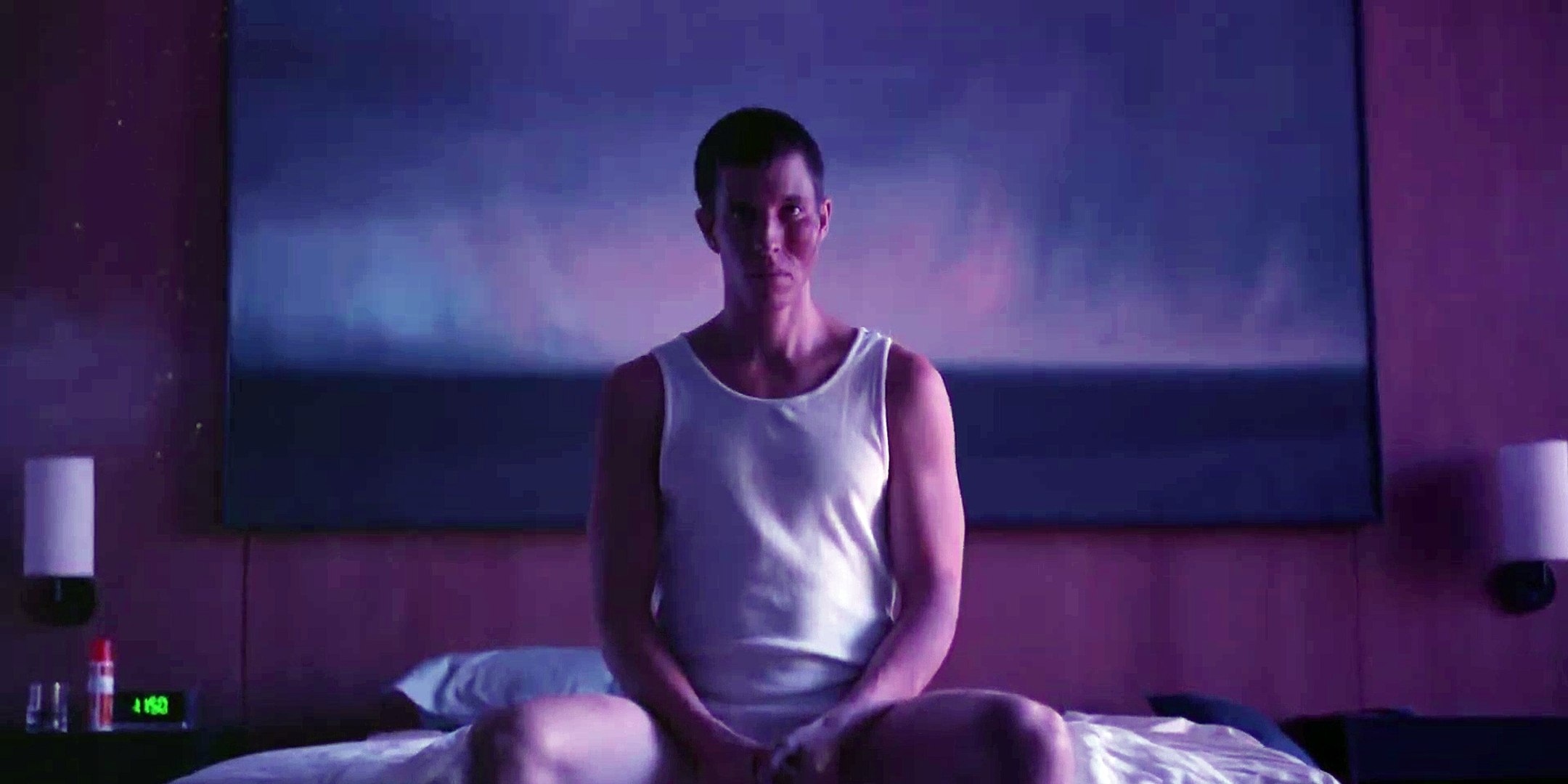
Right from its scientifically precise and profoundly unsettling opening, Filip Jan Rymsza’s Mosquito State is almost unwatchable. The film, about Wall Street analyst Richard Boca (Beau Knapp) and the 2008 financial collapse, takes on an upsetting metaphor.

Richard, brilliant and socially awkward in equal measure, brings two bodies home with him one evening: the poised and lovely Lena (Charlotte Vega) and a thirsty mosquito. Thanks to Richard’s intimacy ineptitude, things don’t go well with Charlotte, but that mosquito gets all she came for.

Though the buzzing of the bloodsuckers that soon breed in Richard’s apartment may suggest those Wall Street parasites whose appetites will soon collapse the market, Rymsza has something less obvious on his mind.

Any underlying themes about benevolence versus predation serve the filmmaker’s somewhat confounding allegory, but his aesthetic is as pointedly horrific as they come. My god, that whining buzz! The sound threatens to overwhelm you as certainly as the insects themselves overwhelm Richard, who becomes utterly submissive, offering his naked body to the unholy swarm.

Rymsza orchestrates a certain ghastly beauty, but first he has to immerse you in sounds and sights that trigger an automatic, primal revulsion and need to swat and flee.

Knapp’s performance suggests a bloodless Nicolas Cage as Elephant Man — bloodless not just because he’s made Richard the mosquitos’ feast, but because Knapp drains his character of charisma and flamboyance. Richard’s as unpredictable and difficult to enjoy as the film itself, but that makes him —and Mosquito State — no less distressingly intriguing.

Rymsza’s anticlimactic finale will leave many unsatisfied with his film. But for a wild combination of revulsion and beauty, Mosquito State is worth a look.

Somebody’s Knocking

The Boy Behind the Door

by Hope Madden

Filmmakers David Charbonier and Justin Powell know how to do a lot with a little.

Earlier this year Shudder premiered their tightly packaged little horror story, The Djinn—very nearly a one-man, one-set show. Their latest to hit Shudder, The Boy Behind the Door, is slightly more expansive. A cast of about five knocks around one big, old farmhouse in the middle of an isolated, wooded area.

Two of those five are Bobby (Lonnie Chavis) and Kevin (Ezra Dewey, The Djinn), best friends who were kidnapped on their way to a little league game. Bobby wakes up in the trunk of a car without Kevin. He breaks free and makes his way clear of the house, but he can hear Kevin’s terrified cries and he circles back to try and save him.

The filmmakers leave it to Bobby’s sleuthing—and yours–to figure out what’s going on and how to end it. They make tremendous use of the hallways, floors and doors throughout their set, plus a well-placed wristwatch unnervingly ups the ante in a way the audience understands but Bobby does not.

There are times when the writing here hits too hard. I’m not sure the boys have to say they’ll always stick together quite so often; their actions speak to that. But the conundrums the filmmakers throw at Bobby as he tries to figure out what’s going on and how to get to his friend are believable.

More importantly, Chavis handles them with honest, childlike panic and courage. His performance would be enough to carry the film, but the adults around him offer supremely creepy turns.

Dewey’s less effective in this than he was in The Djinn, but it’s not enough to sink the film. The movie’s solid structure, paired with Charbonier and Powell’s gift for dropping clues and following up on threads make for a satisfying but never lurid horror show.

Mr. Nice Guy

Vicious Fun

by Hope Madden

Even serial killers need someone to talk to. Just hope it’s not you.

That, in a nutshell, is the premise of Cody Callahan’s latest, Vicious Fun.

In this 80s-era horror-comedy, sad sack Joel (Evan Marsh in kind of a Jon Cryer role) is a nice guy. He’s just kind of an idiot who can’t take a hint.

One evening he drowns his sorrows, passes out, and sobers up to find himself in a late-night support group for serial killers. He’s not a member—a fact the others sniff out pretty quickly—and shit goes south post haste.

Callahan’s script winks with a kind of embarrassed affection toward the horror nerd. Joel’s a screenwriter wannabe and is perhaps too proud of his position as horror journalist for a fan magazine.

The serial killers here are not so much your garden variety psychos as they are typical horror movie monsters. Vicious Fun shows no end of self-deprecating charm, and Callahan’s solid cast is in on the joke.

Earlier this year, Callahan impressed with the boozy Canadian hillbilly noir The Oak Room, where he took advantage of Ari Millen’s versatility and peculiarity. Here Millen dives more fully into his peculiar side, throwing shades of McConaughey at his most unhinged for a character who’s never quite what he seems but is always attention-getting.

The enormous Robert Maillet (Becky) fits his character, physically and emotionally, to a tee, while Julian Richings (Anything for Jackson) surprises in a dual role. Amber Goldfarb cuts an impressive presence as the film’s badass, and David Koechner is David Koechner, but when isn’t that fun?

There aren’t enough nice guys in horror movies. Hats off to Callahan for not only finding a unique and fun premise in an overcrowded genre but for appreciating the precious jewel that is the nice guy.

Goregasm

Skull: The Mask

by Hope Madden

Practical effects, hallucinatory sequences and a throwback exploitation vibe keep Skull: The Mask interesting enough to watch.

The film’s opening is its strongest segment, a grainy video portrayal of a 1944 political bloodbath with the goal of enacting an ancient pre-Columbian ritual. Directors Armando Fonseca and Kapel Furman bring a retro violence to the effort that makes the most of limited resources.

Flash forward 60 years or so and we move from the Amazon to Sao Paulo and a convoluted police procedural led by a one-note performance from Natallia Rodrigues as Det. Beatriz Obdias. She’s bad news! Damaged goods!

She also has no idea how to treat a crime scene, but there’s a lot of questionable policework going around, with no real leads to connect these corpses strewn from one end of town to the other. All of their hearts are missing. Sometimes their guts. Once in a while their faces.

The best thing about Skull: The Mask is Furmam’s extensive background in gore effects. You’ll find plenty of it here, some of it inspired, all of it bloody. The goregasm is in support of a story of a marauder in a stone skull mask, the same cursed mask from the 1944 massacre.

Brought to Sao Paolo by nefarious men with nefarious intentions, it falls into the wrong Goth girl’s hands early on and soon there’s a housecleaner ripping the hearts and guts out of club kids, drug dealers and priests all over town.

Does it make sense? Not really. Does it have to? Probably not. The film is a callback to a style and brand of movie that didn’t need an airtight plot or convincing performances as long as it did very nasty things in novel ways to the human body.

Skull: The Mask is a pretty dumb movie. Hell, even the title is dumb. But it knows where to invest its energy and money, and you cannot say it skimps on the goods.

In Search of Hunky Boys

Psycho Goreman

by Hope Madden

How much fun is this movie?!

Tons. Endlessly quotable and boasting inspired creature design and a twisted Saturday Morning Kidventure tone, Psycho Goreman is a blast

Mimi (a wrong-headed and glorious Nita-Josee Hanna) and her loyal (OK, cowering) brother Luke (Owen Myre) inadvertently summon—nay, control—an intergalactic evil so dastardly it can bring out the end of worlds.

But they totally control him, so they make him learn their favorite games, wear cowboy hats and do assorted hilarious and embarrassing things.

Fans of writer/director Steven Kostanski’s 2016 breakout The Void (a perfect blend of Lovecraft and Halloween 2) might not expect the childlike lunacy and gleeful brutality of Psycho Goreman (PG for short), but they should. His 2012 gem Father’s Day (not for the easily offended) and his 2011 Manborg define not only his tendencies but his commitment to tone and mastery of his material.

Kostanski’s films—The Void aside—fall on the intersection of silly and gory, most of them with a bold VHS aftertaste. I mean all those things in a good way. The tone here is more live-action children’s programming (gone way, way wrong)–perhaps a tad Turbo Kid in its execution.

There is so much joy here, not only in the lunacy of the story or of the creature design (PG’s nemeses from Planet Gigax make an appearance, natch, and they are a riot to look upon).

Will Mimi’s unphased cruelty and selfishness be curbed by friendship? Or will it save the day? Neither? Oh, ok, well then at least it makes for one fiercely funny central character.

Hanna’s command of this unruly heroine may be what sets the film above others in Canadian production company Astron 6’s arsenal. She’s not alone. Astron regular Adam Brooks steals scenes as the kids’ layabout dad, with Alexis Kara Hancey showing off deadpan delivery as his put-upon spouse.

The ensemble works wonders together, each hitting the comedic beats in Kostanski’s script hard enough that the goretastic conclusion feels downright cheery.

This movie could not be more fun.

This Old House

The Banishing

by Hope Madden

Filmmaker Christopher Smith has repeatedly proven a knack for horror.

Whether he locks us up in the tunnels beneath London with Franka Potente (2004’s Creep), transports us to the Dark Ages with Sean Bean and Eddie Redmayne (2010’s Black Death), or forces us on a weekend corporate team building of death (the sublime 2006 horror comedy Severance), Smith takes an audience somewhere we probably shouldn’t go.

The Banishing drops us in rural England, just days before WWII. Marianne (Jessica Brown Findlay, Downton Abbey) and her young daughter arrive at a beautiful-if-creepy estate where Marianne’s husband Linus (John Heffernan) has just been appointed Vicar.

Naturally, the house is haunted. The Church says one thing, but this odd redhead from town (Sean Harris, the picture of subdued weirdness) whispers another.

The Banishing is really the first Smith film to walk such familiar ground. His screenplay, co-written with David Beton and Ray Bogdanovich, takes inspiration from England’s infamous Borley Rectory—allegedly the nation’s most haunted house.

The direction that inspiration leads is rarely in question. Smith trots out a lot of familiar ideas, though he does package them well. Some incredibly creepy images accompany Marianne’s deepest fears, and Smith puts horror’s beloved old mirror prop to exceedingly spooky use.

Performances are solid as well. Findlay, in particular, finds depth and genuineness in the frequently portrayed role of the woman to be deemed insane in lieu of dealing with the supernatural.

Smith sometimes crosses over effectively into the inner working of the mind, and these scenes feel freshest and most engaging. They are overwhelmed, unfortunately, with stale plot devices.

The result feels very un-Christopher Smith-like (if there is such a thing). He’s been a tough filmmaker to pinpoint because each of his movies varies so wildly from the last. The Banishing looks and feels unlike anything else he’s done. Too bad it feels so much like what everyone else has.

Hot Pants

Slaxx

by Hope Madden

Does anybody remember those old Shrink to fit only you 501 jeans ads? They are creepier now.

Absurdism meets consumerism in co-writer/director Elza Kephart’s bloody comedy, Slaxx.

Brightly lit and colorful CCC clothing store—offering high priced garments that are sustainably sourced without sweatshops, GMOs, or any other unsightly thing—is on shutdown to prep for the 8am onslaught as their new line of jeans finally hits the market.

It’s not just any jeans. This denim adjusts to your body and makes you look even more glorious than you already do. And these jeans fit every single figure, from 5 pounds underweight to 5 pounds overweight. It’s a dream come true.

Also, they kill you. Their zipper might bite your hand off, the legs might slip around your neck like a noose, or the waist might just slice you in two.

Kephart is not the first filmmaker to animate bloodthirsty clothing. Peter Strickland’s 2018 treasure In Fabric followed a red dress wantonly slaughtering its wearers, while Yong-gyun Kim gave us murderous shoes in 2005’s The Red Shoes. And who can forget Martin Walz’s 1996 glory Killer Condom? (Well, no, they’re not clothes, but you do wear them.)

CCCis the type of trendy clothier that uses terms like ecosystem to define different sections of the store. Kephart’s message is that this kind of establishment is as dedicated to capitalism as any other form, and therefore it enslaves those working at the store, those working for the store before product makes it to their shelves, and even those who show up in hordes to purchase those wares.

Where Romero mainly pointed fingers at the hordes mindlessly drawn to stores like CCC, Kephart sees the villains as those perpetuating clean corporate hypocrisy. Still, it’s their customers and workers she murders—by the pantload.

Profoundly typical in its structure, Slaxx still has fun with its kills and characters. Romane Denis is likeably earnest as the teen on her first night at work, while Brett Donahue’s broad stroke sycophant boss fits into the general tone of the film.

Sehar Bhojani steals every scene as the cynical Shruti, but the jeans are the real stars here. Kephart finds endlessly entertaining ways to sic them on unsuspecting wearers.

Kephart can’t overcome tonal confusion once she and co-scribe Patricia Gomez uncover the source of the jeans’ power. The filmmakers are unable to balance the serious nature of this curse with the brightly colored bloodbath of the previous 80 minutes.

But it was fun while it lasted.

Bad Influence

Shook

by Hope Madden

People really hate social media influencers.

I mean, somebody must love them or who is it they influence? But horror definitely does not love them. Influencers have become the go-to objects of horror in recent years, seen as the vacuous product of a narcissistic culture that doesn’t value—or even make—human connections.

Meet Mia (Daisye Tutor). The rising makeup influencer has way more followers than her two besties and her boyfriend, so they’re unhappy when she pulls out of their livestream event this Saturday to dog sit for her sister.

But being selfless is totally on brand for Mia, and another makeup influencer just died trying to protect her own dog from a canine killer. Is it guilt? Is it opportunism?

Neither. It’s a setup for the premise of Shook. Mia is home alone with Chico (the dog, who’s awfully cute). But she’s never unplugged and soon someone is playing life or death games with her.

Writer/director Jennifer Harrington’s film really begins with a plot as old as the genre. It could be the babysitter and the escaped lunatic, the point is to have a vulnerable (and acceptably stupid) young woman alone, trying to protect those in her charge from an unseen and menacing force.

So, it doesn’t start out fresh, but movies have made a go of this plot. Harrington layers in newer cliches derived from our collective, plugged-in anxieties. The result is When a Stranger Calls meets Scream meets Unfriended.

It feels exactly that derivative, a fact that doesn’t entirely sink the film. It definitely never lives up to its opening, though.

Harrington makes her most incisive comment about the performance art that is influence culture as she pans back from a glamorous, opening red carpet photo shoot to show the bleaker reality of the staged event. It’s a smart, cinematic revelation that works on two levels.

Thematically, it underscores the film’s point about the artifice of Mia’s life. As a horror movie, we’re suddenly aware that someone is watching – someone who sees all of it.

Watching Shook, you’ll find solid filmmaking followed by two acts of uninspired, sometimes idiotic, sometimes enjoyable horror.

Queen of Mean

The Queen of Black Magic

by Hope Madden

Filmmaker Kimo Stamboel resurrects 70s exploitation horror with The Queen of Black Magic. Not a remake or really a sequel or reboot of the Indonesian cult classic, Stamboel’s film is more inspired by its namesake.

Fun throwbacks to Liliek Sudjio’s original over the end credits do more to remind you how comparably tame this one is.

Not that it is without merit. Or gore.

Hanif (Ario Bayu) returns to the orphanage where he grew up. The man who raised him is dying, and now Hanif and his two childhood friends reunite, families in tow, having come home to pay their respects.

But bad things haunt the old orphanage.

Of course they do! What are you, new?!

Stamboel and writer Joko Anwar can’t come up with anything particularly new when deciding what, exactly, is the problem with this orphanage. But they populate their scenes of carnage with actors who generate some empathy, and put those actors into scenes that are pretty compelling. Especially if you have a thing about crawly creatures. Or a sensitive gag reflex.

Anwar is a master of conjuring nightmarish environments, complete with nightmare logic. His 2017 remake Satan’s Slave and his 2019 original Impetigore throw narrative logic aside in favor of a denseness of dread punctuated with unseemly carnage.

The Queen of Black Magic makes more narrative sense, but somehow that seems to flatten it out a little. It feels less magically horrific and unsettling as the films Anwar directs. But strong, dimensional performances elevate every scene.

And both filmmakers know gore. They know what sounds make you wince, what sights make you look away. Between that, the performances, and a tight enough screenplay to keep your interest, they’ve pieced together a tough little horror flick worth a genre fan’s time.  

Tale from the Hood

Hunted

by Hope Madden

It’s hard to tell a new story. People have been telling stories since the beginning of people, and eventually – probably millennia ago – we realized we were just recycling the same dozen or so tales.

This week’s Shudder premiere, director Vincent Paronnaud’s Hunted, feels especially familiar. He knows that, presumably, or the woman being chased through a massive forest wouldn’t be wearing a red hooded coat.

It’s clear in every aspect of the telling of this story that the filmmaker (and a team of writers including Paronnaud, Lea Pernollet and David H. Pickering) want you to understand how familiar this is.

Indeed, Paronnaud’s tale of a man chasing a woman is so ordinary that no matter how outlandish the circumstances, onlookers barely register it as more than a moment’s blip in their day.

Hunted opens with a fairy tale, spun by fireside in a deep, dark woods, of a group of men who turn on a woman. In this ancient lore, things don’t turn out so well for the men, not because a savior steps in but because of something more primal.

And so, eons later, the aptly named Eve (Lucie Debay) is dealing with a boss who underestimates her and a husband who can’t stop calling. She goes out for a drink. That might have been the last we ever heard from Eve.

Instead, after a series of events that escalate beyond the point of realism to something bordering on the absurd, the whole damn forest hears her.

Debay’s transformation is also marked very obviously and very visually, underscoring the cartoonish nature of this particular enactment. She does a wonderful job of evolving from something in Act 1 that feels garden variety for horror into something surprising and fierce.

Arieh Worthalter equals her as the psychopath, often lensed to give him the look of an animated wolf charming villagers.

Paronnaud’s background is in animation—he co-directed Marjane Satrapi’s sublime black and white wonder Persepolis. His move to horror benefits from his visual flair. While the red coat stands out as an obvious nod (not to mention terrible camouflage), a later splash of blue feels simultaneously insane and warrior-like.  

Or a fresh coat of paint.

