Tag Archives: Screen Wolf

Fright Club: Dolls in Horror

Hard to believe we’ve been doing this so long and have never gotten into creepy doll horror! Well, with help from our friend Phantom Dark Dave, we do just that. Here is our salute to creepy-ass dolls!

Our focus is on the best movies with creepy dolls (rather than the creepiest dolls themselves), and we have a bunch to cover! Dave brings his list, we have ours, and of course, there are also-rans and left-overs. Take a listen!

5. Dead Silence (2007)

Somewhere between their career-defining Saw and their even leggier Insidious and Conjuring franchises, director James Wan and writer Leigh Whannell dropped a plastic-headed thud with this ventriloquism horror.

It’s kind of a shame because although the story meanders in and out of consciousness, the actual dolls are creepy as hell.

Mary Shaw (Judith Roberts) had all 100 of her “children” buried with her. So why does Buddy keep showing up? And why does Donnie Wahlberg insist on this weird Columbo impression?

No matter. We somehow end up crossing a moat into a gloomy old haunted house filled to bursting with ventriloquist dummies of every shape and description. Dead Silence pays tribute to their own Jigsaw doll as well as that creepy clown in Poltergeist while predicting Goosebumps and Toy Story 4 scares.

Are all those movies better than this one? Yes, but it gets points anyway.

https://www.youtube.com/watch?v=D4lnaNy0nmI

4. Pin (1988)

Who wants something weird? Because, man, does Pin deliver on weird.

Leon and Ursula have always felt close to their dad’s anatomically correct anatomical dummy. Sure, he uses it for doctor’s office stuff (and his nurse uses it as she sees fit!), but to the kids, he’s kind of a member of the family.

He means an awful lot to lonely recluse Leon (David Hewlett), who’s no hit with the ladies. It doesn’t help matters that Ursula (Cynthia Preston) is his favorite lady. I wonder what kind of advice Pin might have? He’s got a real knack with Dad’s nurse…

The point is, people die, people have sex with medical dolls, and Terry O’Quinn (The Stepfather) is again really not showing any natural paternal instincts.

3. Annabelle Comes Home (2019)

Writer Gary Dauberman, who’s penned every installment (as well as It, which seriously amplifies his credibility), takes on directing duties for the first time with the third film in the standalone franchise.

From that opening gag by the cemetery, the movie brings the high-spirited, popcorn-munching goods. It is fun, with generous writing that does not ask us to root against any of the kids, and performances that are far superior to the content. Plus a couple of real laughs, mostly thanks to a randomly hilarious pizza delivery guy.

2. Magic (1978)

Anthony Hopkins has made more horror movies than you realize, and no matter how much you may assume that a ventriloquist horror will be dumb, Magic is actually pretty creepy.

It helps that Hopkins is so effortlessly creepy. It also helps that the film was penned by William Goldman (Marathon Man, The Stepford Wives, All the President’s Men) and directed by Richard Attenborough (Gandhi).

It’s still goofy as all hell. Burgess Meredith sees to that. But Hopkins is fully on board, Ann-Margret was still a dream, and there is just something not right about Fats.

1. Child’s Play (1988)

Let’s be honest, it could probably have been any of the films in the original series, but Chucky had to be on this list. Hell, he had to be #1.

We went with Tom Holland’s original because that’s what it was—original. Brad Dourif and writer Don Mancini evolved the character over the next half dozen installments, but the original benefits from newness as well as Holland’s focus on the peril of little Andy (Alex Vincent). With a maniacal doll on one side and an unrelenting cop (Chris Sarandon) on the other, this kid’s in big trouble.

Still, it all begins and ends with that freckle-faced devil.

Brother’s Keeper

Blast Beat

by George Wolf

The most effective way a film can lead us to look at a complex issue from a new angle – or look at it at all – is to narrow the focus. Introduce the issue through characters worth caring about, and suddenly individuals make the stakes more tangible than memes and hot takes.

In his feature debut, Blast Beat director/co-writer Esteban Arango shows fine instincts for just this type of socially aware storytelling.

It is the summer of ’99, and brothers Carly and Mateo (real life siblings Mateo and Moises Arias, respectively) are spending their last few days with high school friends in their native Columbia. They’re moving to the U.S. with their mother (Diane Guerreo), where they will finally join their father Ernesto (Wilmer Valderrama) and build a new life in Atlanta.

A metalhead who’s also a science prodigy, the older Carly sees the move as getting him one step closer to the Georgia Aerospace Institute, and then to his dream job at NASA.

Ne’er do well Teo, though, feels differently. He’s a talented artist, but only seems happy when he’s acting out to show his unhappiness.

Both Arias brothers are terrific, and it is the strength of their performances that keep the film from collapsing when Arango pulls convenient and predictable pages from the Young Adult playbook. Each brother begins making friends, with Teo remaining the fuckup while Carly poses as a student at the Aerospace Institute so he can audit a class taught by a former astronaut (Daniel Dae Kim).

But when Ernesto is suddenly faced with deportation, and when broken promises and unscrupulous lawyers threaten all the family has planned, the film’s investment in character pays dividends. We’re pulling for this family, and these boys in particular.

The immigration question in America is a messy one. But beneath the heated rhetoric and political posturing are real families with complicated stories. Even in the moments when it chooses well-worn paths, Blast Beat brings that message home.

Cabin. Woods. Uh Oh.

The Retreat

by George Wolf

Does it matter that The Retreat is a “gay” horror film?

Well, no. And then yes.

Renee (Tommie-Amber Pirie) and Valerie (Sarah Allen) are on the verge of making their relationship permanent, but feel like some time away would do them good. The plan is to meet Val’s friends Scott (Turbo Kid‘s Munro Chambers) and Connor (Chad Connell) at a picturesque “gay BnB” for some quiet time in the Canadian countryside.

Or let’s just call it what it is: a cabin in the woods.

Uh oh.

Right, things escalate quickly. Scott and Connor are nowhere to be seen, and with just a touch of contrivance, the girls soon realize they’re being hunted by some sadistic Rambros (Aaron Ashmore, Rossif Sutherland).

From the minute Renee and Val stop for gas, director Pat Mills builds an air of dread and tension minus the usual gimmickry. And once the women are truly fighting for their lives, Mills keeps the adrenaline pumping with a quick pace and crisp editing that helps you forget the distractingly dark tones of the cinematography.

Writer Alyson Richards pens a lean, mean, bloody survival thriller that boasts some welcome surprises and a smart social conscience. Realized via strong performances from Pirie and Allen, Renee and Val’s relationship feels perfectly authentic, with a sexuality that’s never exploited by a leering camera. And while you may be reminded of 2018’s What Keeps You Alive, there is a critical difference.

The couple in that film could have been heterosexual, and it still would have worked. But here, the fact that it is a same sex couple being hunted matters very much to the story at work. It enables Richards and Mills to anchor a revenge horror show with a satisfying metaphor for the violent threats LGBTQ folks continue to face every day.

A big part of that satisfaction is from the blunt force trauma being reserved for the action, not the message. And for those who might be ready to accuse the film of doing some undue stereotyping of its own, take a breath.

A nifty little coup de grace proves The Retreat has seen you coming all along.

Screening Room: Woman in the Window, Spiral, Those Who Wish Me Dead & More

Mighty Neighborly

The Woman in the Window

by George Wolf

The Woman in the Window is a testament to the power of “all in.”

Like if you’re spying on your neighbors, get a zoom lens, take pictures! And if you’re modernizing Hitchcock, embrace that shit from the opening minutes and don’t f-ing look back.

For director Joe Wright and screenwriter Tracy Letts, that’s the play as they adapt A.J. Finn’s bestselling novel. And it’s a smart one.

Psychologist Anna Fox (Amy Adams, fantastic) has a shrink of her own these days (Letts), and plenty of prescriptions. Suffering from crippling agoraphobia, Anna will not leave her spacious Manhattan townhouse. She’s got her cat Punch and her downstairs tenant David (Wyatt Russell), but outside of occasional conversations with her ex-husband (Anthony Mackie), Anna spends most of her time watching her neighbors and old movies.

Then the Russells move in across the street.

Jane (Julianne Moore) comes over for an enjoyable visit, has some wine and admits that Alistair (Gary Oldman) can be angry and controlling. A later conversation with the teenaged Ethan Russell (Fred Hechinger) seconds that.

So when Anna sees Jane stabbed in her apartment, she’s sure Alistair is to blame. But with detectives (Brian Tyree Henry, Jeanine Serralles) looking on, a different Jane Russell (Jennifer Jason Leigh) appears, swearing that she’s never even met Anna before tonight.

For the entire first hour, Wright (Atonement, Darkest Hour, Hanna), Letts (Pulitzer winner for writing August: Osage County) and this splendid ensemble put the hammer down on a delicious mystery ride. Putting stairwells, doors, railings and more in forced perspective, Wright intensifies our relation to Ann’s small world while Letts’s crackling script draws us into the mystery and Danny Elfman’s staccato score hammers it home.

Is any of Anna’s story even real, or is it her meds and fragile psyche talking? This question allows the direct homages to classics like Rear Window and Vertigo to be filtered through a movie-loving unreliable narrator, becoming a wonderfully organic device that feeds this intoxicating noir pot-boiler.

As events escalate and Anna’s plight becomes more overtly terrifying, the novel’s pulpy seams begin to show, and the film stumbles a bit in transition. But Adams is strong enough to keep us rooted firmly in Anna’s camp, long enough for the darker side of Hitchcock to wrestle control.

Taking a story like this from page to screen successfully requires a strong, confident vision and a committed, talented cast. The Woman in the Window is overflowing with riches on both counts, landing as immensely satisfying fun.

Death Be Not Proud

There Is No Evil

by George Wolf

Presenting four short films together as separately compelling variations on a theme is impressive. Make those four shorts all from the same writer/director, telling distinct stories that raise the emotional stakes in distinct ways, and you have a stunning achievement.

You have Iranian filmmaker Mohammad Rasoulof delivering a political statement of immense weight and moral conviction. You have There Is No Evil.

After an opening segment that lulls you with a family’s mundane daily schedule before dropping a hammer of casual horror, Rasoulof unveils small sets of characters, each dealing with the effects of seemingly impossible choices.

While serving the two-year term of military service mandated in Iran, a man may be forced to perform executions. Go along you’ll get along, and you’ll be a killer. Say no?

“They destroy our lives.”

Each chapter of the film presents a seemingly unique paradox, then quietly mounts the tension before revealing gripping plot turns that unite the strands in memorably devastating fashion.

Dare we hope for any happy endings here, even when a desperate decision seems to pay off?

With four masterful bits of storytelling and the exceptional ensemble cast in There Is No Evil, Rasoulof deftly explores the wages of those decisions, as well as the immoral center of a despotic regime that makes them necessary.

Fright Club: Side Characters, Part 1

This episode is years in the making. We’ve talked about doing this, jotted down ideas and characters, debated — and now it’s finally here. Well, half of it, anyway. There’s just no way to reasonably fit the best side characters—those fully deserving a film of their own—in just one podcast. So here is our list, in alphabetical order (no need to rank them!). This one’s for the ladies.

Aunt Martha (Desiree Gould), Sleepaway Camp (1983)

Smartly dressed, thoughtful, loving, misguided, and as if a creature from an entirely different film. She made a decision and, sure, Angela probably should have been a part of that decision-making process. But it wasn’t Aunt Martha’s fault that Paul was a no-good cheater. Or that Judy was such an asshole. I mean, yes, that surprise at the end was due in large part to Aunt Martha, but as for the campers—they had it coming.

Mademoiselle (Catherine Begin), Martyrs (2008)

What a presence. Commanding, calm, wizened and weary, Catherine Begin’s Madamoiselle has such resigned decisiveness that it’s almost impossible to argue with her. She turns something that could have easily become torture porn into a mesmerizing glimpse at zealotry.

https://www.youtube.com/watch?v=KWYFLwHbu8k

Minnie Castavet (Ruth Gordon) Rosemary’s Baby (1968)

Ruth Gordon earned an Oscar as Rosemary and Guy Woodhouse’s busybody neighbor Minnie Castavet, wife of Roman and nonplussed chief operations officer of the coven. Yes, Roman made a good figurehead, but somebody has to just keep things moving. And as long as she ate the mouse, everything’s fine.

Mother (Fons Rademakers), Daughters of Darkness (1971)

One of the many glorious things about Harry Kumel’s decadent 1971 vampire fable is the way it feels like two or three different films colliding into one elegant bloodletting. Mother casts a looming shadow over one of those storylines, that of a young, beautiful couple recently married, Stefan and Valerie. Even before they’re ensnared in Countess Bathory’s love web, Stefan (an irredeemable asshole if ever there was one) needs to figure out how to break the news of his nuptials to Mother.

Whenever a new character makes you simply need to hear an entirely other story, one focused on whatever they’re not telling you about that character, you know you have a winner. The way Fons Rademakers pets his butler’s head, holds court in the greenhouse, and wields unspecified but somehow sinister power over Stefan begs for its own movie.

Mrs. Baylock (Billie Whitelaw), The Omen (1976)

From the moment she takes the screen, Mrs. Baylock is the new sheriff in town. She quietly yet immediately takes control of the Thorn household. If you didn’t know who was alpha, you only need to see who the dog listens to. Yep, Richard Thorn is in trouble. To say nothing of his poor, useless wife Catherine.

Tangina (Zelda Rubenstein), Poltergeist (1982)

Walks in the house, owns the place. Tangina is a force of nature with a soft little lilt and a no-nonsense approach to cleaning the Freeling house. Her confidence gives the character more than a huckster vibe, although there is a sense of showmanship to everything she does. But when she is addressing the living, it’s best not to give trick answers.

Zelda (Andrew Hubatsek), Pet Sematary (1989)

Scary as hell. Sure, the cat, little Gage, that guy with the brain on the outside of his skull—all of it has its horror charm. But the real nightmare in Mary Lamber’s adaptation of the Stephen King tale is Rachel Creed’s guilty memory of the sister who terrified and horrified her, the sister she believes died—at least in part—due to her own negligence and hatred. Thanks to the angular, monstrous vision of Andrew Hubastek in a nightdress, all contorting ribcage and spine, Zelda became easily the scariest thing in the film.

Screening Room: Wrath of Man, Here Today, Fried Barry, Above Suspicion, The Oak Room & More

Yeti Persisted

15 Things You Didn’t Know About Bigfoot (#1 Will Blow Your Mind)

by George Wolf

You’ve seen the t-shirts and memes, right? “Bigfoot: Undefeated Hide and Seek Champion”

It may be elusive in the wild, but Bigfoot is not at all hard to find on your movie screen of choice. 15 Things…was originally known as The VICE Guide to Bigfoot, and the new title gives you a big clue as to what this mockumentary is really searching for.

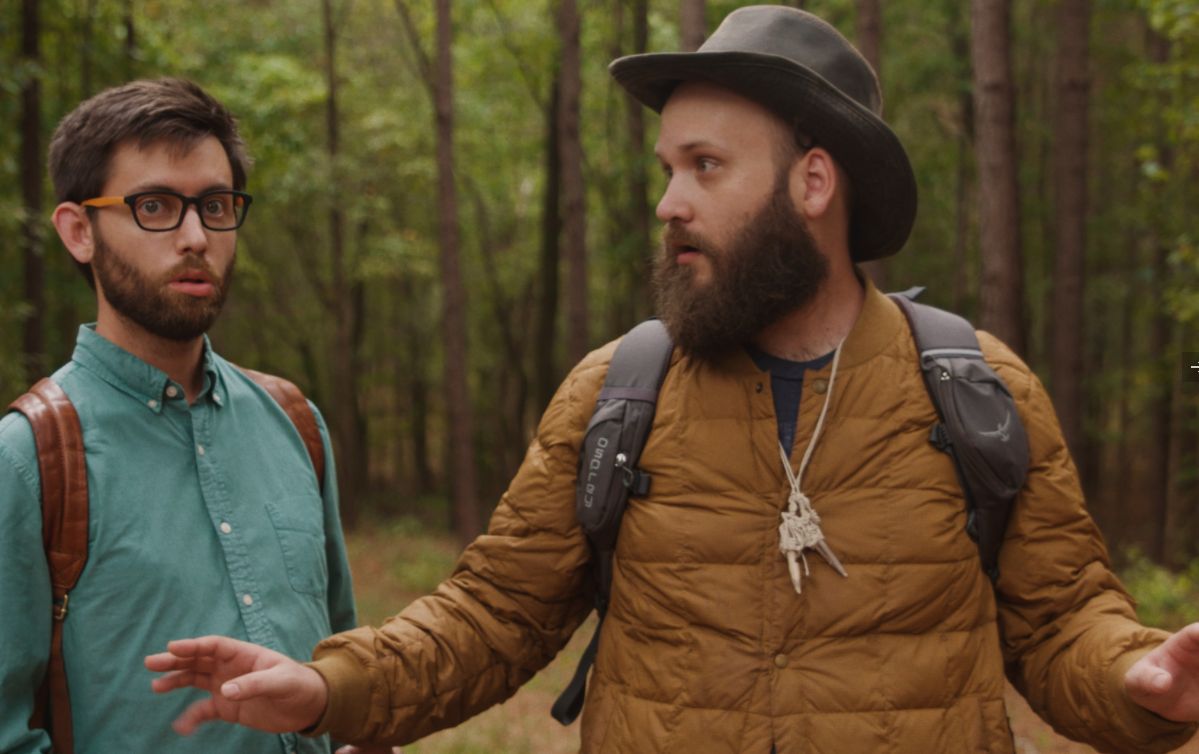
Brian (co-writer Brian Emond) is a reporter for an online news outlet (like VICE) who is longing to cover some actual news. Even when he and producer Zach (director and co-writer Zach Lamplugh) are sent to some hot war zone, it’s only so he can uncover the happening craft beer scene. So Brian’s paid his dues, which, as it turns out, doesn’t mean squat when there’s an opening on the network news side.

That slot goes to “Dirty Dolla$ign$” (Tevin Williams, hilarious) who advises Brian to “get in the shit, baby!” if he wants to move up.

The shit Brian and Zach get into starts at the Georgia Bigfoot Convention, and leads into the North Georgia foothills with YouTube Bigfoot hunter “The Cryptid Commander” (Jeffrey Stephenson). As he investigates a possible sighting, Brian tries to get the Commander to admit his Bigfoot obsession cost him the love of Jenny, and that he’s utterly full of crap.

Keeping a mockumentary tone that’s both consistent and consistently funny is not easy, and 15 Things…does stumble a bit on both counts, especially when the Blair Witch-iness of the woods takes a sudden hard left into a heroine smuggling operation.

But from clickbait to fake news to false flags, Lamplugh and Edmond do get their shots in, and some of them land with a solid LOL. Do they find the Bigfoot…or the “Bigfoot in themselves?”

If that’s the type of mocking tone that makes you giggle, there’s at least 7.5 things about this film that will have you laughing in appreciation.