By now, we can probably guess your age by how you first came to know Rita Moreno.
Singin’ in the Rain?The King and I?West Side Story? The Electric Company? The Rockford Files? Oz?Jane the Virgin?Carmen Sandiego? The One Day at a Time reboot? Even if you just got here, there’s the recent In The Heights Twitter feud and if you’re on your way, it’s almost time for West Side Story again!
The point is, Rita is among the most legendary of entertainment legends, and Just a Girl Who Decided To Go For It is a completely captivating tour through an iconic, trailblazing life.
A Puerto Rico native, Rosita Alverio emigrated to New York with her mother at age 5 – and never saw her native family again. “Rita” made her dancing debut at age 6 in a Greenwich Village nightclub, and by 16 she had landed a contract with MGM Studios.
Through countless “shut up and be sexy” roles that prompted self-loathing, to Emmy, Oscar, Grammy and Tony Awards, an abortion, a suicide attempt, marriage and family, political activism and therapy, her 90th year has found Rita to be a fulfilled, thankful survivor.
And beyond the treasure trove of archival footage, home movies and interview praises from the likes of Eva Longoria, Gloria Estefan, Morgan Freeman, and Lin-Manuel Miranda (also one of the film’s producers), director Mariem Pérez Riera finds the most resonance in the personal journey told by Rita herself.
Looking back on the obstacles she faced and the successes and failures of her life and career, Moreno displays a hard-won self-worth and an honest self-awareness, one that – as evidenced by her In The Heights second thoughts – she continues to probe.
This is not just an entertaining Hollywood story, it’s an inspiring American story and a hopeful human story. It’s just a damn good story, from someone worthy of celebrating while she’s still here.
The Hitman’s Wife’s Bodyguard is not a great movie – heck it’s barely a good movie – but it is a fun movie. And that last part means the film does have pretty great timing.
Because with so many of us returning to movie theaters for the first time in a long time, what is the majority looking for?
A good time. And this film does deliver it, even if it is just one Fat Bastard away from parody.
In case you’ve forgotten, this is a sequel to 2017’s The Hitman’s Bodyguard, and returning writer Tom O’Connor gets us up to speed via Michael Bryce’s (Ryan Reynolds) final therapy session with a doctor who can’t wait to be rid of him.
Bryce has lost his AAA bodyguard license, which is going to make it difficult to win the Bodyguard of the Year award he dreams of. Bryce has also sworn off guns, which becomes a problem once the bullets start flying and director Patrick Hughes (also back from part one) rolls out more direct head shots than a zombie apocalypse.
Bryce doesn’t let the lack of licensing stop him from guarding Sonia Kincaid (Salma Hayek), a spitfire who has no problem shooting first – from the hip or from the lip. Plus, she happens to be married to Bryce’s old nemesis Darius Kincaid (Samuel L. Jackson). So while Bryce and Darius are bickering about old grudges, Sonia and Darius argue about starting a family (don’t bother thinking about their ages – just go with it).
The dangerous games come from an evil tycoon (Antonio Banderas on a steady diet of scenery) who’s fighting back against E.U. sanctions on Greece, and from a frustrated federal agent (Frank Grillo) who decides his best bet is to work with bad guys in hopes of catching worse guys.
Hughes proves adept at quick-paced action and satisfying set pieces full of sound and fury, signifying nothing but excess. There’s plenty of globe-trotting to beautiful locales, lo-cut costume changes for Hayek and enough all around ridiculousness to make you wonder when Reynolds and Jackson are going to switch faces.
But the starring trio seems to be enjoying it enough to be in perfect sync – with each other and the level of material they’ve been handed. All three may be on auto-pilot, but their banter is an expletive-laden, rapid fire hoot that’s consistently mischievous and sometimes downright hilarious.
The Hitman’s Wife’s Bodyguard isn’t high art, but it isn’t trying to be. In the words of Bret Michaels and Sam Jackson: it ain’t nothin’ but a good time, motherf^*%$#.
Medical horror never lacks for really bad doctors: mad scientists, evil geniuses, or just people with more ambition than skill. What these particular folks can do with a scalpel, some thread, and a little imagination impresses. That is to say that it leaves an impression, often on unwilling patients. Here is our list of the best horror films about involuntary surgery.
6. The Human Centipede (First Sequence) (2009)
After a handful of middling Dutch comedies, Tom Six stumbled upon inspiration – 100% medically accurate inspiration. Yes, we mean the Human Centipede. Just the First Sequence makes the list, though.
For a lot of viewers, the Human Centipede films are needlessly gory and over-the-top with no real merit. But for some, Six is onto something. His first effort uses a very traditional horror storyline – two pretty American girls have a vehicular breakdown and find peril – and takes that plot in an unusual direction. But where most horror filmmakers would finish their work as the victims wake up and find themselves sewn together, mouth to anus, this is actually where Six almost begins.
Although the film mines something primal about being helpless in the hands of surgeons and doctors, it’s Dieter Laser and his committed, insane performance that elevates the work. That and your own unholy desire to see what happens to the newly conjoined tourists.
5. Tusk (2014)
The basic idea for this film came from one of writer/director Kevin Smith’s actual podcasts. He found online a letter from a man seeking a lodger, and read it aloud and mocked the man. But somewhere in all that, Smith found the story of a man losing his humanity.
Tusk is a comic riff on The Human Centipede. It’s also an insightful kind of stress dream, so close to home for Smith that, even with all its utter ludicrousness, it feels almost confessional.
The film’s greatest strength is a hypnotic performance by Michael Parks as the old seafarer with nefarious motives. He’s magnificent, and co-star Justin Long’s work is strongest when the two share the screen.
There is no film quite like Tusk, certainly not in Smith’s arsenal, which, I suppose, means this is not a traditional Kevin Smith Movie. And yet, there’s more Smith in this film than in anything else he’s made.
4. American Mary (2012)
Jen and Sylvia Soska have written and directed a smart, twisted tale of cosmetic surgery – both elective and involuntary.
Katharine Isabelle (Ginger Snaps) stars as med student Mary Mason, a bright and eerily dedicated future surgeon who’s having some trouble paying the bills. She falls in with an unusual crowd, develops some skills, and becomes a person you don’t want to piss off.
The Soskas’ screenplay is as savvy as they come, clean and unpretentious but informed by gender politics and changing paradigms. They also prove skilled at drawing strong performances across the board. Isabelle is masterful, performing without judgment and creating a multi-dimensional central figure. Antonio Cupo also impresses as the unexpectedly layered yet certainly creepy strip club owner.
Were it not for all those amputations and mutilations, this wouldn’t be a horror film at all. It’s a bit like a noir turned inside out, where we share the point of view of the raven-haired dame who’s nothin’ but trouble. It’s a unique and refreshing approach that pays off.
3. Excision (2012)
Outcast Pauline (a very committed AnnaLynne McCord) is a budding surgeon. She’s not much of a student, actually, but she does have an affinity for anatomy. Especially blood. Pauline really, really likes blood.
Her sister – the favorite, for good reasons, truth be told – is slowly dying. And somewhere in Pauline’s odyssey to lose her virginity, inspire her mother’s love and do the right thing, she always seems to do the wrongest possible thing.
Writer/director Richard Bates, Jr. takes an unusual course with this coming-of-age horror. I’m not sure we’ve seen it handled quite like this before, although to be fair, it’s definitely in keeping with the peculiar and beautifully realized character he and McCord have created.
2. Eyes Without a Face (1960)
The formula behind this film has been stolen and reformulated for dozens of
lurid, low-brow exploitation films since 1960. In each, there is a mad doctor
who sees his experiments as being of a higher order than the lowly lives they
ruin; the doctor is assisted by a loyal, often non-traditionally attractive
(some might say handsome) nurse; there are nubile young women who will soon be
victimized, as well as a cellar full of the already victimized. But somehow, in
this originator of that particular line of horror, the plot works seamlessly.
An awful lot of that success lies in the remarkable performances. Pierre Brasseur, as the stoic surgeon torn by guilt and weighed down by insecurities about his particular genius, brings a believable, subtle egomania to the part seldom seen in a mad scientist role.
Still, the power in the film is in the striking visuals that are the trademark of giant French filmmaker Georges Franju. His particular genius in this film gave us the elegantly haunting image of Dr. Genessier’s daughter Christiane (Edith Scob). Her graceful, waiflike presence haunts the entire film and elevates those final scenes to something wickedly sublime.
https://www.youtube.com/watch?v=1vjsU-OBBWA
1. The Skin I Live In (2011)
In 2011, the great Pedro Almodovar created something like a cross between Eyes Without a Face and Lucky McGee’s The Woman, with all the breathtaking visual imagery and homosexual overtones you can expect from an Almodovar project.
The film begs for the least amount of summarization because every slow reveal is placed so perfectly within the film, and to share it in advance is to rob you of the joy of watching. Antonio Banderas gives a lovely, restrained performance as Dr. Robert Ledgard, and Elena Anaya and Marisa Paredes are spectacular.
Not a frame is wasted, not a single visual is placed unconsciously. Dripping with symbolism, the film takes a pulpy and ridiculous storyline and twists it into something marvelous to behold. Don’t dismiss this as a medical horror film. Pay attention – not just to catch the clues as the story unfolds, but more importantly, to catch the bigger picture Almodovar is creating.
I know there’s still plenty of bad out there, but it’s summer, people are getting out in the heat, and it feels like maybe we deserve a few minutes to celebrate.
How about 143 minutes? In the Heights makes them all count, with a summer celebration practically bursting with joyful exuberance.
It’s been 13 years since the stage production won 4 Tony Awards – including Best Musical, on top of Best Original Score and Best Actor for Lin-Manuel Miranda. Since then, Miranda conquered the world with Hamilton (maybe you’ve heard it), so now what seems like a follow up is really a return to his roots.
Miranda’s aged out of the starring role, so Anthony Ramos (Hamilton, A Star Is Born) answers the bell with a breakout turn as Usnavi – the Washington Heights, New York storekeeper with a dream.
As the days until a blackout wind down and the temperature ramps up, Usnavi’s block is buzzing with welcome arrivals, planned departures, and romance in the air.
Nina (Leslie Grace) is home from Stanford with major news to break to her father Kevin (Jimmy Smits) while she reconnects with Benny (Corey Hawkins), a dispatcher at Kevin’s neighborhood car service.
For his part, Usnavi has finally scored a date with his crush Vanessa (Melissa Barrera), but it might be too late – she has her sights set on leaving the block behind with a new apartment uptown.
So while the gossip is raging at the hair salon, and the piraqua guy (Miranda) tries to compete with Mister Softee (Hamilton‘s Chris Jackson, who played Benny in the stage version) as the king of cool treats, fate intervenes. Usnavi discovers his bodega has sold a winning lottery ticket – a stroke of luck worth 96 G’s – and then the lights go out.
Director Jon M. Chu (Crazy Rich Asians) proves a worthy choice to move the project from stage to screen with magic intact. The most accomplished of directors (see Attenborough and Eastwood) have fallen hard trying to make musical numbers pop on film, but Chu gives Christopher Scott’s choreography the space to be graceful and the intimacy to be gritty.
Miranda’s music meshes irresistibly with the sounds of the street, and from swimming pools to rooftops, more than a few of Chu’s grandly-staged set pieces nearly soar off the screen. And it won’t be just fans of this show who will be giddy, as the Wicked faithful will find plenty of reason to be excited Chu is already in pre-production on that long-awaited film adaptation.
Source writer Quiara Alegría Hudes pens the screenplay here as well, with a heartfelt, character-driven ode to cultural strength and sacrifice. Bookended by Usnavi telling the story of his block to a cute group of youngsters, the tale of Washington Heights is layered with respect for immigrant families just fighting for a place to belong.
And while they may be fighting against gentrification and bigotry, the film’s heart remains unquestionably hopeful, so downright wholesome that even the lack of sweat-stained bodies in the 100-degree heat feels like part of the movie magic.
In the Heights has been saving that magic for the big screen experience, and now that it’s here it is indeed worthy of celebrating – in a theater, with a crowd.
Are we really “back to normal?” Can the American dream still be alive?
Ron Burgundy may have played that line for laughs, but when the boys in Gully give in to their rage, things couldn’t be more serious.
Or devastating.
Jesse (Kelvin Harrison, Jr.), Calvin (Jacob Lattimore) and Nicky (Charlie Plummer) are three teens in a rough L.A. neighborhood who don’t have much use for anything besides violent video games and partying, or anyone besides each other.
They skip school, do drugs, and only seem enthusiastic when they’re trashing a store or living vicariously through video violence.
In fact, through the film’s first act you’re tempted to label this as a hackneyed attempt by director Nabil Elderkin (a music video vet helming his first feature) and writer Marcus J. Guillory (a TV vet with his first screenplay credit) to blame video games for society’s ills.
But hang on and strap in, that’s far from what these filmmakers have in mind.
To say the three friends have had traumatic upbringings is being far too polite. Each has weathered a uniquely hellish situation, leaving them all on the precipice of manhood with little hope for the future.
As Nicky fights with both his mother (Amber Heard) and his pregnant girlfriend (Zoe Renee), Jesse dreams of life without his abusive father (John Corbett) and Calvin struggles with his mental health and the meds pushed on him by his mother (Robin Givens), the boys make a shattering discovery and the fuse is lit.
They begin a 48-hour rampage of wanton violence and calculated revenge, and it will not end well.
Elderkin makes sure the violence is in your face and packed with stylish grit, often blurring the line between reality and video game action. It’s an ambitious play that’s worthy even when it seems over the top, much like the contrasting tones brought by Greg (Jonathan Majors), an ex-con returning home determined to stay clean, and Mr. Christmas (Terence Howard), a homeless neighborhood philosopher.
This film is messy, angry, brutal and defiant, a primal scream that doesn’t much care if you think it’s nihilistic. Elderkin and Guillory have blazing guns of their own, and while they don’t hit every bullseye, there’s enough here to make you eager for their second act.
The world of Gully isn’t a pleasant place to be, and that’s no accident. But a confident vision and three terrific young actors leading a solid ensemble will make sure you’ll be thinking about what goes down here, even if you look away.
Which is more likely to embrace the cliches inherent in sports: interviews or movies?
The sheer number of daily opportunities pushes the scale toward the Q&A, but while we’re waiting on the next superstar baller to “take it one game at a time,” Under the Stadium Lights scores one for the big screen.
Based on the book “Brother’s Keeper” (also the movie’s original title) by Al Pickett and Chad Mitchel, the film takes us inside the 2009 high school football season with the Abilene Eagles. The bitter taste of their playoff defeat the year before fueled the players and coaches as they made another run for the Texas state playoffs.
Mitchel (played by Milo Gibson, 6th son of Mel) was not only an Abilene police officer that year, he was also the Eagles team Chaplin. Through his “safe space” program, the players were encouraged to share the tough times they were going through off the field, and to lean on their football brothers for the strength to persevere.
That’s a commendable story. But director Todd Randall and screenwriters John Collins and Hamid Torabpour tell it with no regard for human shades of grey, which is a problem.
No doubt these mostly black and brown players did have troubling patches in their young lives, but the film paints the young men as one dimensional vessels strengthened by the good word of this white man. These are high school seniors, and there’s nary a word or thought about girls, sex or anything other than remaining vigilant in their virtue.
Don’t expect even a whisper about any systemic causes for the problems at home, either. While no one would argue the value in making good life choices, this is a bootstrap fantasy, where what isn’t talked about amounts to tacit approval of blaming the needy for just not working hard enough.
Often hamstrung by preachy and obvious dialog, the the cast does very little to elevate it. Save for the welcome presence of veterans Laurence Fishburne, Noel Gugliemi and Glen Morshower in small roles, performances alternate between hyperbolic over-emoting and emotionless cardboard.
Early on, though, the football scenes are a surprise bright spot. It’s actually charming that Randall forgoes cheesy reenactments for the real game films, but when he reverses that decision in the third act, the resulting clash gives the new footage an even more sterile and pretend quality.
A big congrats to the 2009 Abilene Eagles on what must have been a great season. But with Texas high school football on its mind, “lights” in its new title and no roster spot for nuance, the movie version will have you longing for Friday Night.
This long-lost film from the legendary George A. Romero is an awkward, clumsily-assembled metaphor with a glaring lack of subtlety.
And armed with the proper context, you should probably see it anyway.
In 1973, Romero was far from a legend. He had lost the copyright to Night of the Living Dead, and he was a nearly broke filmmaker that needed work. So he was more than happy to accept a commission from right in his own hometown. Pittsburgh-based Lutheran Services wanted a film to explore societal discrimination of the elderly, and turned to the local boy who’d hit it big a few years back.
But they weren’t at all interested in the Twilight Zone treatment that Romero and first time (only time) screenwriter Wally Cook gave the subject, so they passed. Each party put the film behind them, and it sat unreleased for nearly fifty years.
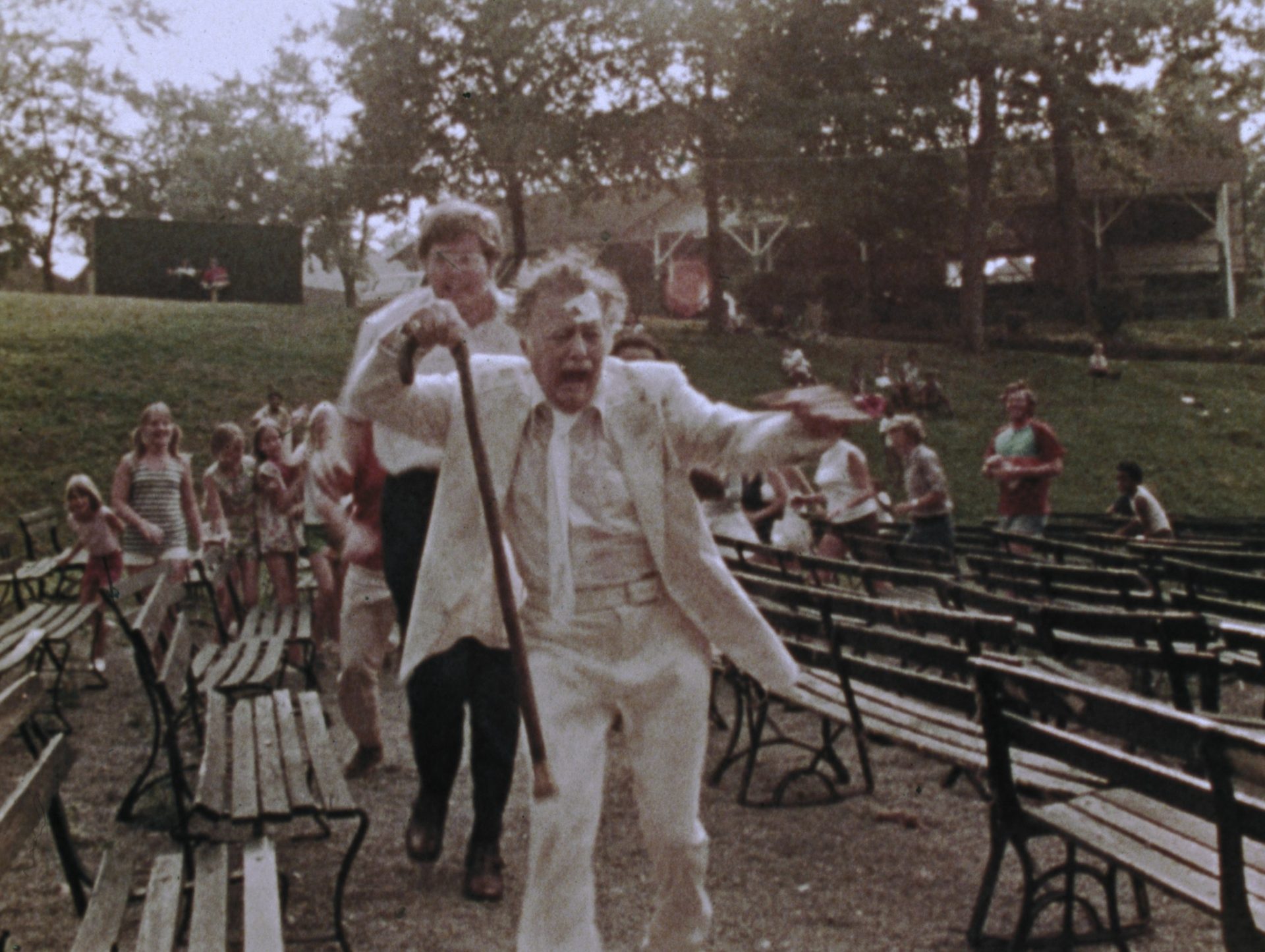
The 52-minute feature stars Lincoln Maazel (who would co-star in Romero’s classic Martin four years later) as an affable, white-suited man who greets a beaten down and disheveled version of himself in an empty waiting room. The out-of-breath Maazel advises the energetic one not to go outside.
“There’s nothing out there. You won’t like it!”
The warnings go unheeded, and the nattily-clad Maazel begins his day at the amusement park, where he is subjected to nothing but torment, ridicule and abuse.
Some of the vignettes are rooted in solid ideas. The grim reaper wandering the park and riding coasters is a striking juxtaposition, and a fortune teller’s unpleasant premonition for a couple of young lovers manages to deliver confrontational cynicism with a somewhat lighter touch.
The elderly gentleman’s metaphorical trip through the carnival of agism is flanked by footage of Maazel, as himself, explaining what we are about to see, and later, what we have seen. No doubt someone thought a late-addition prologue/epilogue would help an audience make sense of the narrative’s structureless string of abuses, but the Serling-on-steroids material is so lengthy and so at odds with the otherwise experimental nature of the core content that it only serves to make the entire film even less enjoyable.
For completists, The Amusement Park is available in select theaters and on Shudder, and merits consideration. For anyone thrilled by the idea of George A. Romero siccing amusement park horror on unsuspecting old people, be warned: you will be sorely disappointed.
Even before theaters shut down, there was no shortage of solid R-rated comedies getting woefully ignored. One of those was the wonderful Booksmart – which put a female friendship at the center of a Superbad-type coming-of-age romp.
Hulu’s Plan B takes the Booksmart model, mixes in some trusty road movie hijinx and even more sexual honesty than Blockers to concoct a teen sex comedy with plenty of smarts and sustained laughs.
South Dakota teens Lupe (Victoria Moroles) and Sunny (Kuhoo Verma) are best friends on slightly different social levels. The confident, outgoing Lupe is, ahem, “dating,” while the reserved Sunny has zero prospects and just pines for her crush to come over for a “Disney Plus and thrust.”
But then Sunny’s Mom goes out of town, so party! After Lupe’s cheery advice to “make good choices!” an impatient Sunny wants to get it over with already, leading to a very awkward bathroom hookup and an unfortunate condom accident.
Trading puke buckets and talking it over the next morning, the girls decide the best thing to do is get Sunny the morning after pill. This turns out to be a lot harder than they expect.
Moroles and Verma are both terrific, each finding distinct ways to give their characters authentic levels of the angst, curiosity, self-doubt and cautious confidence that are perpetually bouncing off teenage walls.
Once the search for Plan B involves a road trip to Rapid City, the script from Joshua Levy and Prathiksha Srinivasan delivers welcome surprises alongside inspired silliness and moments of outright hilarity (like the bit about Footloose and a doll museum).
There are some dry stretches along the way, but director Natalie Morales shows good instincts for when to pivot, and for making sure this teen sex comedy ends up speaking to some mighty serious issues.
So expect Rachel Dratch teaching abstinence by way of driver’s ed, but also young women exploring their sexuality amid an onslaught of mixed messages, double standards and threats to their freedom of choice.
Don’t let the dick jokes fool ya, there’s heart and brains here, too, and a sweet friendship illustrating the importance of unconditional love from your family, as well as the ones that feel like family.