Tag Archives: Screen Wolf

They Are Us

Waiting for the Barbarians

by George Wolf

In the forty years since J.M. Coetzee’s Waiting for the Barbarians was first published, world events have continued to re-frame its thematic relevance.

Now, the novel finally has a big screen adaptation, amid a tumultuous political climate that again makes Coetzee’s tale feel especially prescient.

In a vaguely historical era within an unnamed “Empire,” the Magistrate (Mark Rylance) governs his desert outpost population through moral conviction and a delicate harmony with the land’s indigenous peoples.

Conversely, Colonel Joll (Johnny Depp) – the soft spoken and sadistic head of state security – believes “pain is truth.” Joll arrives at the outpost to carry out random interrogations of the nomadic “barbarians” and learn the truth about an attack that he feels is imminent.

The Magistrate protests this view of the natives and the Empire’s directives, drawing the ire of Joll and later, his more overtly cruel lieutenant, officer Mandel (Robert Pattinson).

Coetzee’s debut screenplay adapts his own novel with delicate grace and an understated foreboding. But as relevant as the theme of creeping fascism remains, its bite is dulled by ambiguity and broadly-drawn metaphors.

The urge to speak more universally via an unspecified name, time and place is understandable, but it hampers the intimacy required to feel this warning in your gut.

The Oscar-winning Rylance (Bridge of Spies) almost makes up for this by himself, with a tremendous performance of quiet soul-searching. The film’s summer-to-the-following-autumn chapter headings paint the Magistrate as an obvious man for all seasons, and Rylance makes the Magistrate’s journey of fortitude and redemption feel almost biblical.

Depp and Pattinson provide worthy adversarial bookends. As Joll, Depp’s only eccentricity is a pair of sunglasses, but again he requires minimal screen time to carve an indelible figure.

Mandel is an even smaller role, but Pattinson makes him the eager realization of the ugliness Joll keeps bottled up. It’s another interesting choice for the gifted Pattinson, and another film that’s better for it.

Director Ciro Guerra utilizes exquisite cinematography from Chris Menges for a wonderful array of visuals, from beautifully expansive landscapes to artfully orchestrated interior stills. Though the film’s first act feels particularly forced, Guerra (Birds of Passage, Embrace of the Serpent) gives the remaining narrative – especially the Magistrate’s attempts at penance with the tortured Girl (Gana Bayarsaikhan) – the room to effectively breathe.

Waiting for the Barbarians is not a film that will leave you guessing. But the decades-old message remains painfully vital, and in its quietest moments of subtlety, the film gives that message sufficient power.

Do Dream It, Be It

The Secret: Dare to Dream

by George Wolf

It might be a different type of faith-based flick, but Dare to Dream most definitely earns my usual disclaimer: judging these films is less about what they are preaching, and more about how well they tell a story.

Here, the gospel is the Law of Attraction, and the storytelling is unattractively dreadful.

The Secret first arrived nearly 15 years ago as a documentary and self-help book, both written by Rhonda Byrne, and each detailing how positive thinking can directly influence your life and bring you whatever it is you visualize.

Director/co-writer Andy Tennant (Hitch, Fool’s Gold) visualizes a narrative treatment that finds Vanderbilt professor Bray Johnson (Josh Lucas) ignoring hurricane warnings and driving down to New Orleans with an important message for one Miranda Wells (Katie Holmes).

Miranda is a widow with three kids, a boyfriend (Jerry O’Connell), and character development consisting of a succession of old graphic tees. She finds Bray before he finds her, by rear-ending him in traffic. Bray’s original mission is quickly sidetracked, and soon he’s fixing Miranda’s car, the hole in her roof, and whatever else his laid-back, dimpled philosophizing can help with.

Even before this handsome stranger effortlessly fascinates the wide-eyed Wells children with an example of how magnets work, not a lick of this bears any resemblance to real life.

Paper-thin characters recite banal dialogue carrying all the depth of a pop-up greeting card. Family strife about storm damage and money trouble is only dire enough to be a manufactured setup for Holmes to give a cute sigh and wonder, “What now??” while her kids pine for a computer or a pony.

Bray’s mission is never in doubt, and the film’s ultimate resolution becomes a tidy, manipulative pinch from the Nicholas Sparks playbook, right down to the throwing of a shameless trump card.

Whether you think The Secret is nothing but entitlement masquerading as feel good drivel, or a truly uplifting approach to finding happiness, a resonant film needs an attraction beyond preaching to the converted.

Or does it? Dare to Dream doesn’t really seem interested in finding out.

Elemental, My Dear

Radioactive

by George Wolf

Honestly, I’m not digging this title, yet it somehow fits.

For the story of an intellectual giant, Radioactive seems too easy, too cheesy, and a bit dismissive. Similarly, the film itself becomes a sum of often conflicting parts, flirting with greatness while chasing too many bad pitches.

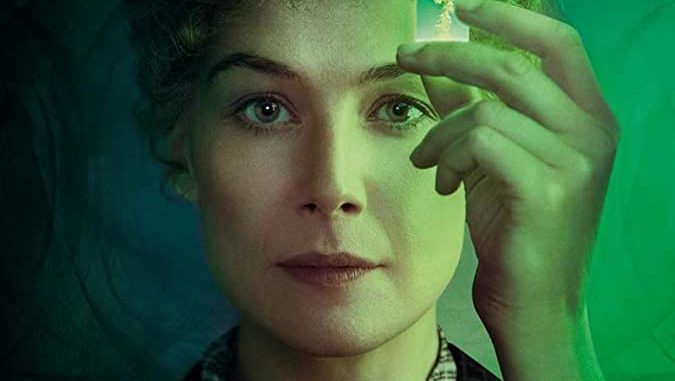
Rosamund Pike stars as Marie Sklodowska Curie, the Warsaw-born scientist who became the first woman to win the Nobel Prize, the first person to win it again and the only person to win it in two different scientific fields. Her groundbreaking work in France with husband Pierre Curie identified two new elements (polonium and radium) and the theory of radioactivity itself, leading to world-changing advancements in medicine and, of course, warfare.

Director Marjane Satrapi (Persepolis, The Voices) seems intent on honoring Curie’s spirit via the most experimental film treatment she can get away with. Animated graphics attempt to illustrate Curie’s theories on atomic movement, while tones are jarringly shifted with futuristic vignettes that glimpse the more devastating consequences of radioactivity.

Too often, Satrapi is hamstrung by screenwriter Jack Thorne’s overly broad and simplified adaptation of Lauren Redniss’s source book, which is itself a work of original art, photographs, graphics and text. Bringing such hybrid energy to the screen demands a unified vision from writer and director, but Satrapi and Thorne seem at odds whenever they try to expand their scope.

Pike is the unifier here, with an instantly engaging and fully formed portrait of a genius understandably ferocious about defending her work from being usurped or dismissed by male colleagues. Pike humanizes Curie with a mix of defiance and insecurity, frank sexuality and a fierce commitment to husband Pierre (Sam Riley, in a thoughtfully understated and effective turn).

The third act addition of Anya-Taylor Joy as the Curie’s eldest daughter Irene (who would also win a Nobel Prize in Chemistry) only cements the film as being most resonant when it is the most personal.

And it can’t go unnoticed that in these science-denying times, Curie’s story is a needed reminder of the importance of pursuing knowledge, of research and researchers.

Curie was one for ages. Radioactive does suffer from scattered elements, but ultimately turns in watchable, satisfying results.

Skin Trade

Impetigore

by George Wolf

In a remote Indonesian village, a garden of small headstones marks the effectiveness of a Shaman’s curse. Newborn after newborn dies, the one survivor growing to endure a mysterious, painful existence.

Creepy, right?

Shudder’s Impetigore scores some definite points there, which help to offset a narrative often hampered by convenience and confusion.

Maya (Tara Basro) and Dini (Marissa Anita) are best friends trying to make a go of it in the city. With no family to speak of, they scrape by with menial jobs while dreaming of a better future.

Though raised by her aunt, Maya learns of a spacious home left behind by her wealthy parents. Maya could very well lay claim to this valuable property through inheritance, so she and Dini make their way to the remote village, unaware of the curse and their place in it.

Writer/director Joko Anwar (Satan’s Slaves), an Indonesian genre veteran, seems to know he’s got some solid benchmarks here while not worrying too much about the strength of what binds them together.

Dialogue can range from awkward to WTF-worthy, amid a few convenient plot turns and one humdinger of extended curse explanation that strains coherence.

But when Anwar hits his creepy marks, Impetigore can leave one. The atmospheric isolation in the village feels authentic, and once blood begins letting, the tension is well-paced, bolstered with some satisfying visual payoffs.

There will be eyerolls, but if you’re keeping score, also enough frightful eyebrow-raising to make Impetigore a winning dive into twisted family values.

https://www.youtube.com/watch?v=2RfEwT2LI2M

Manhood

Father Soldier Son

by George Wolf

If Boyhood showed us how deeply affecting it can be to watch actors age with their character arcs, Father Soldier Son keeps it even more real.

In what amounts to a condensed version of Michael Apted’s Up documentary series, directors Leslye Davis and Catrin Einhorn follow a military family over a nearly ten year period of pain, hope and personal growth.

We first meet 13 year-old Isaac Eisch and his eight year-old brother Joey waiting for their father Brian – a third generation soldier – to come home from Afghanistan in 2011. The boys are staying with their Uncle during Brian’s tour, but are eagerly awaiting Dad’s two-week return to their Wisconsin home.

Three years later, things have changed.

Brian has lost his lower left leg to a battle wound but has gained Maria, an endlessly supportive and understanding girlfriend. As Brian deals with his anger and feelings of inadequacy, his boys are watching. Despite an earlier vow to remain unchanged by war, he has changed, and his sons are changing, too.

On the surface, this is an immersive and highly effective documentary on the commitment and sacrifice of military families. But the inescapable and important thread underneath is the complex bond of masculinity passed between fathers and sons.

Davis and Einhorn, in their feature debut, give us incredibly revealing moments with the Eisch family. From the simple joys and sweet affection to the missed opportunities and immeasurable pain, the film’s view is clear-eyed but without judgement, often speaking to themes of manhood and patriotism with a sobering honesty.

The point is a purpose in life, and how hard it can be not only to find it, but to feel like you’ve found it. We ache with this family and cheer for them, even when their choices might disappoint us.

The Water’s Not Fine

Lake of Death

by George Wolf

If your experience with Norwegian horror has you expecting Lake of Death to bring on the blondes and the folklore – you’re halfway there. The coifs check out, but writer/director Nini Bull Robsahm trades some homeland roots for flashes of decidedly American inspiration.

It’s a bit curious, since Robsahm (Amnesia) is updating the 1942 novel (and 1958 film) De dødes tjern– which is credited with kickstarting Norway’s interest in the horror genre. Clearly, a cabin in the woods can be creepy in any language.

A distracted Lillian (Iben Akerlie) brings a group of friends and one dog to a remote lakeside cabin for one more getaway before the place is sold. Her gang is ready for a good time, but Lillian is still haunted by the memory of her twin brother Bjorn, who disappeared one year earlier after taking a walk in these very same woods!

One of Lillian’s friends hosts a paranormal podcast, which is Robsahm’s device for filling everyone in on the local legend of the lake. You can get lost in its serene beauty, they say, lose touch with reality, and maybe even get the urge to kill.

Mysterious happenings, paranoia and suspicion ensue, but Robsahm sets the brew on a very slow boil, taking a full hour before we get one well developed visual fright. Lillian’s sleepwalking, hallucinations, and frequent nightmares lay down an overly familiar framework that’s peppered with music stabs and repeated name-dropping of horror classics from Evil Dead to Misery.

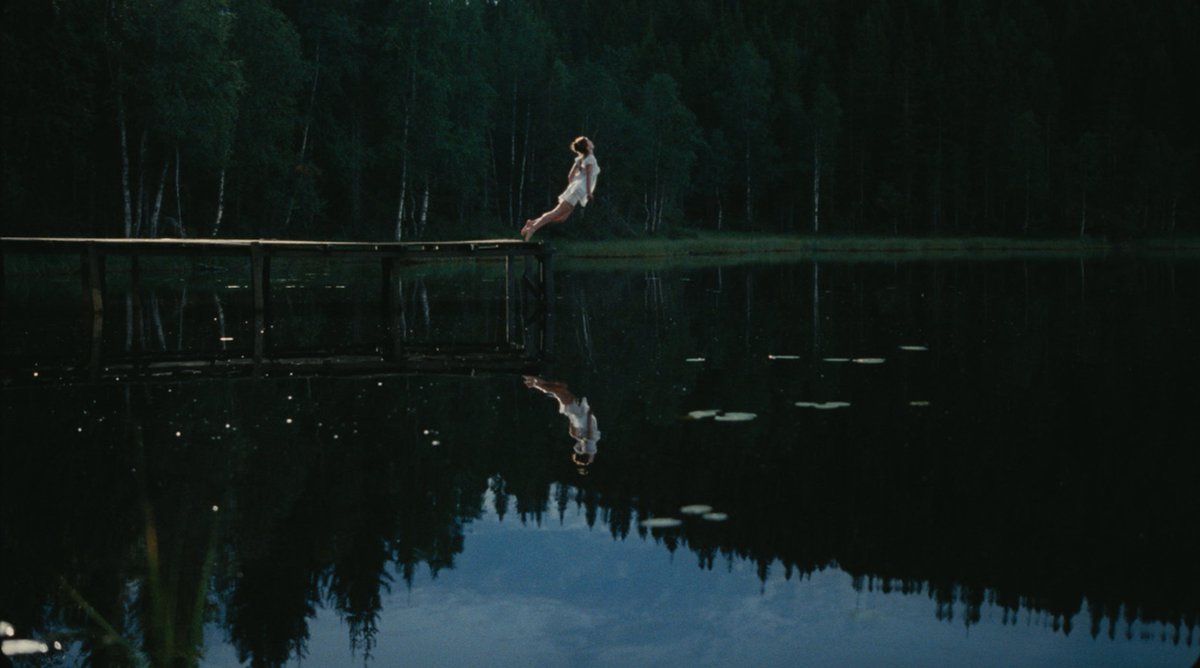
As an attempt to bridge generational horror, it’s all very commendable but little more than workmanlike. Robsahm has better success with her commitment to the lake’s spellbinding beauty, and with her repeated trust in cinematographer Axel Mustad.

Shooting in wonderfully earthy 35mm, Mustad creates a gorgeous tableau of woods and water, evoking the dreamy atmosphere required to cash the check written by the lake’s urban legend.

There may be little that surprises you in Lake of Death, but a sterling partnership between director and cameraman makes sure you have a fine souvenir from the visit.

We Are Family

Bloody Nose, Empty Pockets

by George Wolf

Similar to the hybrid reality it creates, Bloody Nose, Empty Pockets is an oddly compelling cocktail. It’s like a foul odor you step back from quickly, then find perversely comforting once you’ve had time to soak in it.

And no matter how many of the film’s most effecting moments are manufactured, there’s much authenticity to be found in the smoke-filled haze of the Roaring 20’s lounge.

“This is a place you can go when nobody else don’t want your ass.”

Sitting unceremoniously at the edge of Las Vegas, the “20s” is down to its final day. Directors Bill Ross IV and Turner Ross drop us off before noon, when grizzled regular Michael (Michael Martin) is cleaning up in the bathroom and daytime bartender Mark is hanging up some cheap decorations for the farewell party.

“What kind of party is it if an Australian guy doesn’t take his pants off?”

As drinks are poured, ashtrays are emptied and daytime TV gives way to nighttime jukebox singalongs, we get to know the parade of souls that have come to call this dive bar home.

What The Florida Project was to Disney World, Bloody Nose is to Lost Wages, eschewing tourist playgrounds for the world weariness of an existence in exile, and of outsiders no longer bothering to look in.

“You think I’m better than Fireball? I’m not!”

The Turner brothers shot their exteriors outside Vegas, but couldn’t find a suitable bar for filming until they landed in a New Orleans dive. Their cameras don’t always make it out of the frame, but the film’s mood is so encompassing you hardly care. This is a storytelling experiment left to its own ends, which end up being delightfully and desperately character-driven.

“You know how much I love you?”

As the night bartender (Shay Walker) tries to keep her teen son and his friends from smoking weed and stealing beer, we’re reminded how quickly the outside world will move on, scattering these barflies without mercy.

My friend Jason recently remarked that “bars are the only enduring sacred human places,” and these 98 minutes at the Roaring 20s are full of that sacred humanity. There may have been a few strings pulled at setup, but those tears – both theirs and yours – will feel plenty real.

“I always come to this bar…and feel like family.”