Tag Archives: Madd at the Movies

Sunglasses at Night

Dark Glasses

by Hope Madden

Giallo is the soap opera of horror, and you have to embrace that to appreciate it. Emotion and drama, tension, fear and sexuality are amped up to a ludicrous degree, with sense and sensibility tossed out the window.

Few have ever done this as well as Dario Argento. I’d argue Mario Bava, but many consider Argento the king of giallo, and with good reason – his landmark 1977 film Suspiria may be the high-water mark for the entire genre. After a decade away from filmmaking in general and longer still since his last giallo, Argento returns to form with Dark Glasses.

Passions run high and bad decisions are rampant as Diana (Ilenia Pastorelli) attempts to evade a serial killer. But wait, it’s more complicated than that! You see, she’s also blind and has sort of kidnapped this kid. It’s better if you don’t ask.

Though the score is not from Goblin, composer Arnaud Rebotini’s electronic soundtrack conjures classic giallo. Indeed, between those recognizable chimes and an early throat severing, you’d think you were watching Argento of old. But the filmmaker does have a couple new ideas in store, and marginally less misogyny onscreen.

Diana’s a harder-edged protagonist than what you find in other films from the Italian maestro. A high-end sex worker, she’s nonplussed about her line of work and disinterested in anyone else’s opinion of it. She’s a peculiar central character and Argento, who co-wrote the script with frequent collaborator Franco Ferrini (Opera, Phenomena), gives her more to do than elude victimization. She develops skills and bonds in the second act that feel reasonable and realistic, sometimes even tender. It helps ground the film in character before those characters step into a den of watersnakes and remind you that you are essentially watching a soap opera.

There are some inventive kills, gore aplenty, and loads of reminders of why Argento has developed such a boisterous following. This is by no means his best film, but it’s by no means his worst, either.

Everyone yells when they shouldn’t yell, everyone pauses when they shouldn’t pause, everyone talks when they shouldn’t talk, but who cares when the blood is this red and free-flowing?

Fright Club: Mean Girls & Bullies in Horror

Horror is about power versus vulnerability. That’s why bullies and mean girls fit so well into the genre. You always hope the vulnerable will overcome. In this genre, there’s always the real worry that evil will overcome. But somehow, bullies and mean girls never stand a chance.

There are so many great ways to spend time with these high school baddies, but here are our five favorites:

5. Sleepaway Camp (1983)

Meg (Katherine Kamhi) was no picnic, but side-ponytail Judy (Karen Fields) is an all-timer when it comes to onscreen bullies. She hates everyone, is mean to everyone, but she really detests poor Angela (Felissa Rose).

“She’s a carpenter’s dream! She’s flat as a board and needs a screw!”

Like all mean girls in horror, Judy gets what’s coming to her. Still, you have to respect that ponytail.

4. It (2017)

Man, the kids of Derry have it rough long before the circus comes to Derry. Between Henry Bowers (Nicholas Hamilton) and his powerful mullet and the girls dumping wet garbage on Beverly, nobody’s safe. The Losers Club really brings them out of the woodwork.

In fact, they save Mike Hanlon’s life, which bonds the group through the real clown show. Maybe this is what made each of these kids tough enough to withstand he real clown show.

3. Let the Right One In (2008)

Sure, we know Conny learned to be a bully from his older brother, Martin. Maybe Martin learned it from his dad or something. But Oskar’s had just about enough of it.

Unfortunately, Oskar’s not as good at defending himself as he’d like to think he is once big brother shows up. Not that he really needs to defend himself anymore. In one of the greatest bully comeuppance sequences in all horror, Eli shows Oskar what friends are for.

2. Piggy (2020)

Carlota Pereda complicates the mean girl trope in this brutal, moving, amazing Spanish horror film. Sarah is targeted by town mean girl Maca (Clauda Salas). Roci (Camille Aguilar) is almost as bad, but it’s Claudia (Irene Ferreiro) who really breaks Sarah’s heart. It wasn’t long ago, they were friends. Now Claudia is willing to taunt, humiliate, and in one instance, nearly drown “Piggy”.

Maybe that’s why Sarah does what she does when the three girls are taken. That is to say, maybe that’s why Sarah doesn’t do what she doesn’t do.

1. Carrie (1976)

What else? Is there a more tragic scene? Is there a scene that better establishes a character, a context, or horror?

De Palma films the scene in question, appropriately enough, like a tampon commercial, all cheesecloth and beautific music. And then Carrie White (Oscar-nominated Sissy Spacek) desperately claws at her classmates, believing she is dying. It’s the most authentic image of vulnerability and terror you can imagine, matched in its horror by the reaction she receives from those she seeks: laughter, mockery and contempt.

The result is the ultimate in mean girl cinema and an introduction to a nearly perfect horror film.

Screening Room: Hellraiser, Amsterdam, Lyle Lyle Crocodile, Luckiest Girl Alive, Piggy & More

Chicas Malas

Piggy (Cerdita)

by Hope Madden

Mean girls are a fixture in cinema, from Mean Girls to Carrie, Heathers to Jawbreaker to Napoleon Dynamite and countless others. Why is that? It’s because we like to see mean girls taken down.

Writer/director Carlota Pereda wants to challenge that base instinct. But first, she is going to make you hate Maca (Claudia Salas), Roci (Camille Aguilar) and Claudia (Irene Ferreiro). In one tiny Spanish town, the three girls make Sara’s (Laura Galán, remarkable) life utterly miserable. Like worse than Carrie White’s.

And though Sarah’s relationship with her mother (Carmen Machi) is a rose garden compared to the one Carrie shares with her wacko mom, things could be better. Sarah’s mom veers from unobservant to dismissive to defensive. Even when she’s trying to be helpful, that aid comes with a heaping dose of insensitivity.   

But it’s those pretty, skinny high school girls whose contempt nearly kills Sarah. In a scene that’s difficult to forget, cruelty blossoms into something brutal and horrifying as Sarah tries to take advantage of a nearly empty swimming pool.

Traumatized by the afternoon, a dazed Sara makes a choice that she will wrestle with for the balance of the film. Pereda doesn’t present a simple, single reason for what Sarah does. Or, more to the point, does not do.

In this scene and all others, the filmmaker complicates every trope, all the one-dimensional victim/hero/villain ideas this genre and others feast on. Redemption doesn’t come easily to anyone. Pereda also seamlessly blends themes and ideas from across the genre, upending expectations but never skimping on brutal, visceral horror.

Much of that horror would feel unearned were it not for substantial performances from every member of the cast. But Sarah is the most complicated character by far, and Galán performance is a reckoning. She’s utterly silent for long stretches, Sarah trying to make herself invisible. It’s in those still moments that Galán shines most fiercely.

Piggy is a tough watch, there’s no doubt. It’s also a ferocious and stunning piece of horror cinema.

Resting Witch Face

Hocus Pocus 2

by Hope Madden

Thirty years ago (more or less), Disney released a family friendly seasonal comedy that underperformed and was forgotten. Forgotten, except by every 8-year-old who watched Hocus Pocus then or would go on to rewatch it annually during spooky season.

The entertainment behemoth finally realized what it had and commissioned a sequel. Hocus Pocus 2 reunites willful witches Winnifred (Bette Midler), Sarah (Sarah Jessica Parker) and Mary (Kathy Najimy) with Salem, the town that hates them.

What is it that reawakens the evil Sanderson sisters? A somewhat convoluted storyline, actually, but it involves female empowerment and community and it’s charmingly, inoffensively told.

Halloween’s here, and with it, Becca’s (Whitney Peak) 16th birthday. She’ll celebrate this year as every year by sharing a little spookiness in the woods with her bestie, Izzy (Belissa Escobedo). It’ll be the first year that the third in their trio, Cassie (Lilia Buckingham), doesn’t join because she’s hanging out with her boyfriend. Meh!

Anyhoo, the Sandersons are accidentally conjured. Somehow the local crystals and essential oils purveyor (Sam Richardson, likable as ever) is mixed up in things. And Cassie’s dad – kindly Mayor Traske (Tony Hale) – is in mortal danger!

Director Anne Fletcher (The Proposal) hits enough nostalgic notes that adult fans of the original will feel seen. Its contemporary story allows for brand new witch-out-of-water scenarios to explore, and, of course, the sisters are always up for a musical number. But this is definitely a kids’ film.

The original was a kind of sibling to Fred Dekker and Shane Black’s 1987 family film Monster Squad. Both showed poorly at the box office and went on to become beloved seasonal fixtures. Hocus Pocus brought the sensibilities into the nineties by, for one thing, recognizing that boys can also be virgins. HP2 modernizes further.

To begin with, not every citizen of Salem is white. And though it’s impossible to entirely redeem three characters looking to eat children, at least the sequel skims the ideas of systemic misogyny. But mainly it offers campy, scrappy, bland but amiable fun.

Midler, Najimy and Parker reinhabit the old trio well enough to remind us why so many kids loved the original. Whether HP2 can strike the same chord with today’s youth is tough to tell, but at least there’s a Halloween flick everyone can watch together.

Why So Serious?

Smile

by Hope Madden and George Wolf

Man, It Follows was a great movie. It was a film that saw coming-of-age as its own type of horror, a loss of innocence that you either pass on or let kill you.

It’s a conceit that will never feel as fresh as it did then, but writer/director Parker Finn has a go with Smile.

Sosie Bacon is Dr. Rose Cotter, a therapist working in an emergency trauma unit. A woman is brought in, lashed to a gurney and screaming. Rose evaluates her in a safe space where Laura (Caitlin Stasey) can be comfortable, free. Rose listens to her paranoid, anxious story of a smiling, malevolent presence and tells Laura, as calmly as she can, that as scary as these ideas may feel, they can’t harm her.

Rose is wrong. And so begins a very borrowed and yet often powerful meditation on the nature of trauma and the state of mental health stigma.

Bacon delivers a believably brittle performance as the character who knows she’s right, even if everyone believes she’s crazy. But there’s more to this genre trope, given that Finn’s entire theme is an exploration of mental health. As a therapist and also a woman suffering from trauma, Rose can see her current situation more clearly than most.

There’s honesty, depth and empathy at work here, a 360-degree look at mental health and the systems and norms that affect people. Smile is also a clear metaphor for trauma and its insidious ripple effect.

It’s also a showcase for a fine supporting cast, and a few good, if borrowed, jump scares and freaky images. Kyle Gallner is particularly solid, and both Robin Weigert and Rob Morgan deliver traumatizing performances in small roles.

Turning something as inherently harmless as a smile into a threatening gesture carries a primal creepiness that Finn exploits pretty effectively throughout the film. Even so, the nearly two-hour running time feels bloated as Rose’s search for the origins of her curse begins to drag.

Her detective work – plus one very familiar shot – make Smile an easily recognizable marriage of It Follows and The Ring. Credit Finn for not hiding his intentions, and crafting some thought-provoking frights in the process.

Dangerous Method

Devil’s Workshop

by Hope Madden

I hate to admit this, but my first thought upon screening Devil’s Workshop was that we don’t need another low budget exorcism movie – or worse yet, another ghost hunter demonologist movie. I am pleased to report that writer/director Chris von Hoffmann’s latest horror offering is not “just another” anything.

The premise seems garden variety enough. Struggling actor Clayton (Timothy Granaderos, Who Invited Them) auditions for the part of a demonologist in a new low-budget indie. His competition, Donald (Emile Hirsch), is a social climbing douche who gets whatever he wants. To sharpen his edge for the callback, Clayton hires a real demonologist to train him for the performance.

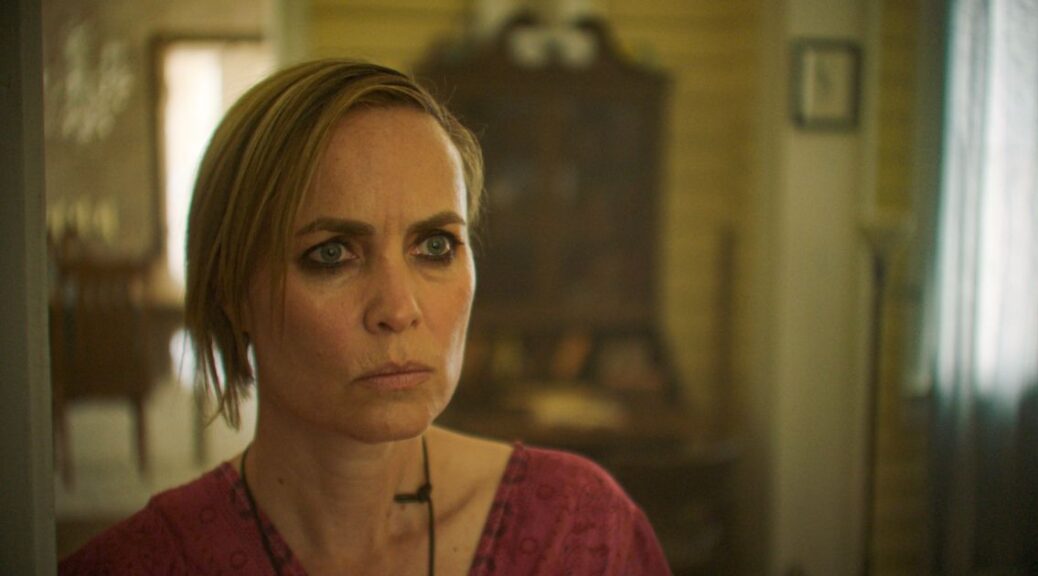
That demonologist is played by Radha Mitchell, who’s both wonderful and evidence that von Hoffman has something unusual up his sleeve.

The filmmaker cuts between earnest, insecure Clayton undertaking his eerily authentic preparation, and narcissist Donald, preparing in his own way. As von Hoffman does this, he comments on the main theme of his film: a knowing, sly analogy of the process of acting, from ridiculous to pretentious to dangerous.

What emerges is a cheeky, cynical but not hateful application of the mantras and exercises meant to break an actor down and open them up to the demons that will create a better performance.

Two things are necessary for Devil’s Workshop to pull this off: stellar acting (or the metaphor falls apart) and genuine horror (or the metaphor overwhelms the story).

The acting is stellar, beginning with Mitchell. Her giggles and offhanded terms of endearment, hand gestures and facial expressions create an elusive character. Granaderos, so impressive as the sinister partygoer in Who Invited Them, adopts a wide-eyed insecurity that suits von Hoffman’s style.

Rather than drawing our eye to the speaker, von Hoffman’s camera lingers on the listener. The choice captures Clayton’s discomfort, sometimes for a troubling length of time, creating unease.

The horror does well enough for nearly long enough. A couple of times it’s effective, but it never rises to true scares. Worse still, the payoff doesn’t land. In the end, von Hoffman’s insiders-view of the dangers in submitting entirely to a part falls just short of success.

Girl Walks NOLA Alone at Night

Mona Lisa and the Blood Moon

by Hope Madden

In 2014, filmmaker Ana Lily Amirpour made her magnificence known with the lonesome, hip, bloody black and white treasure A Girl Walks Home Alone at Night. She followed that up in 2016 with the heady dystopian nightmare The Bad Batch.

Both films busy themselves with the survival and camaraderie of outcasts. They have this in common with Amirpour’s latest, Mona Lisa and the Blood Moon.

On the surface, it may appear that the vampire fable, post-apocalyptic yarn and Big Easy thriller lack any other unifying thread. Untrue. Each is about a singular female making surprising choices across an imaginative – if sometimes bloody – adventure.

Though eventually awash in NOLA neon, Blood Moon’s opening glides hypnotically through bayou waters, the night sky reflected so perfectly in the water you can’t tell up from down.

Jeon Jong-seo (Burning) is Mona Lisa Lee. For at least a decade she’s been nonresponsive in a facility for adolescents. (Is that so? Why the straight jacket, then?) But on this very night, as the moon rises red and round over the bayou, Mona taps into a strange power and the first of many flavors emerge in this strange gumbo. It appears we’ve stumbled into the origin story of some superhero – or super villain?

Whichever, don’t get too comfortable because soon enough Amirpour’s aesthetic weaves together influences and notions from a broad and colorful menu. The next thing you know, you’re witnessing a side of Kate Hudson you wish more filmmakers had unveiled.

Mona stumbles upon the Bourbon Street stripper in a late-night hamburger joint. One quick look at Mona’s talent and Bonnie Belle has dollar signs in her eyes. It’s a performance so brash and human that it grounds an otherwise fantasy tale in the stinky glitter of New Orleans.

A welcome Craig Robinson gives the film the feel of a noir-ish mystery, while the delightful Ed Skrein steals scenes and hearts as dealer/dj Fuzz.

Once Mona befriends Bonnie’s latchkey son (Evan Whitten), sentimentality becomes a worry. No need! Amirpour offsets every sweet moment with a surprise of brutality, every bloodletting with a bit of tenderness, all of it bathed in neon and EDM. It’s a dizzying mix, but that makes three for three for this filmmaker.

Endurance Test

Blonde

by Hope Madden and George Wolf

Andrew Dominik felt like an odd choice to bring Joyce Carol Oates’s epic fictionalization of Marilyn Monroe’s life to the screen. His films up to now, though excellent, wouldn’t necessarily suggest an aptitude for a female focused biopic.

Most recently, the filmmaker’s crafted two magnificent documentaries on singer/songwriter Nick Cave. Prior to that, he made two woefully underseen Brad Pitt dramas (Killing Them Softly, The Assassination of Jesse James by the Coward Robert Ford) after his Aussie breakthrough, Chopper. Each of these films is excellent, and each of them is broodingly, tenderly, decidedly masculine.

If Dominik was an unconventional pick, Cuban performer Ana de Armas seemed a downright peculiar choice for the lead role. She’s no doubt beautiful enough to play the legendary stunner, and her work in Knives Out and Hands of Stone have shown her versatility as an actor.

And why not get a little nutty? Monroe’s story has been told more times than Dracula’s – at least seven features and TV movies have been made about Marilyn, and she’s figured prominently in countless other flicks. Can they give us something we haven’t seen?

Yep. They give us nearly 3 hours of NC-17 wallowing.

Dominik’s film, which he adapted himself from the source novel, does little more than fetishize Monroe’s suffering.

De Armas fills the role well enough. Yes, her accent takes you out of scenes from time to time, but that’s not really the trouble with the character. Monroe gets a single opportunity to stand up for herself in two hours and 46 minutes. It’s fun. It’s great to watch the character who’s been abused and misused the entire film finally feel a quick surge of pride.

This one sequence – the one moment of agency given Monroe in the film’s entire running time ­– becomes the catalyst of her downfall, of course. Prior to this moment, de Armas is asked only to hover on the verge of tears. Nearly every instant after is degradation for a character rendered nearly inhuman by broadly brushed daddy issues and mental instabilities.

While the film’s visual style is often intriguing, Dominik’s aggressive approach feels borrowed. He channels Lars von Trier with wave upon wave of punishment, then recalls Gaspar Noe through extended takes featuring shock-value POVs. And the irony of that NC-17 rating is that it’s not earned the old-fashioned way. The scene that almost certainly drew the most ire from the ratings board does not feature one second of nudity, yet lands as excess most wretched. If it all doesn’t add up to an abuse of de Armas, then it amounts to abuse of an audience.

The point of Blonde seems to be that the almost global objectification of Marilyn Monroe meant an unendurably tragic life and death. To prove the point, Dominik objectifies Marilyn Monroe to a point that is nearly unendurable.

Under the Influencer

Sissy

by Hope Madden

Horror is especially preoccupied with the doppelganger nature of social media – how you can lose yourself in the make-believe world of the “you” you present online. Co-writers/co-directors Hannah Barlow and Kane Senes dig into that duality with their Aussie horror, Sissy.

Sissy – or as she’d rather be called now that she’s a grown up, Cecilia (Aishe Dee) – feels blessed. Thanks to her 200k followers and the products she gets paid to work into her videos, she has a fulfilling life. She is loved. She is enough. She is doing her best.

Maybe she’s not really doing that well, actually. She even hides when she spies her childhood BFF at the grocery store, but Emma (Barlow, who also stars) sees her anyway. She even invites Cecilia to tonight’s big bachelorette party, and tomorrow’s drive out to the country for a weekend-long celebration!

If you’ve seen Bodies Bodies Bodies or, indeed, any horror movie, you know that second part is not going to go well for everyone. Like Halina Reijn’s gruesome comedy, Sissy plays around with genre expectations and spotlights the ins and outs of Gen Z.

Dee works wonders as a woman trying to practice what she preaches, earn from what she practices, and find fulfillment in online followers when friends IRL are less welcoming. The cast that surrounds her is universally strong, each one manipulating the sly, darkly funny script to shock and delight.

Barlow and Senes never entirely abandon the old-fashioned slasher, either. Sissy delivers starling gore FX that feel simultaneously in keeping with the black comedy and somehow too disturbing to fit. Well done!

The filmmakers tease the new terrain of a world populated with virtual personalities. Who’s the good guy? Who isn’t? Is anybody? Sissy doesn’t break new ground here, but thanks to a knowing script and a lead performance that sells itself, you’ll enjoy the show.