Every generation has its pivotal high school graduation film: Superbad, Say Anything, 10 Things I Hate About You, Grease, High School Musical 3.
I mean, not all of them can be classics. Making her feature debut behind the camera, Olivia Wilde hopes to join the ranks of the classics with her smart, funny, raunchy yet quite loving tale of two besties preparing to go their separate ways, Booksmart.
Amy (Kaitlyn Denver) and Molly (Beanie Feldstein) approach
the last day of high school with a certain earned swagger. Both have been
accepted into the Ivy League by dedicating their previous four years to little
more than study and each other.
And every other soon-to-be graduate? As Molly’s morning ritual self-help tape says, fuck them in their fucking faces.
So, this movie is very definitely R-rated, FYI. But it never loses a sweet silliness, rooting its episodic adventures in a believable bond between two true talents.
The catalyst for their one wild night? Molly realizes at the last possible minute that her classmates all seem destined for just as much post-high school greatness as she, and they also managed to have fun. They had it all, while she had only study and Amy.
And there is just one night left to rectify that wrong.
From a script penned by four (Susanna Fogel, Emily Halpern,
Sarah Haskins and Katie Silberman), Wilde spins a female-centric story without
abandoning the fun, the idiocy or the laughs you hope to find in this very
specific kind of film.
Wilde’s confident direction leans on her leads’ chemistry to drive what could otherwise be a string of sketches. Instead, taken together they provide a riot of color, laughter and misadventure that celebrates sisterhood.
She and her leads are helped immeasurably by one of the strongest casts assembled for a teen party movie. Billie Lourde (Carrie Fisher’s daughter) steals every scene she’s in. Meanwhile Skyler Gisondo and Molly Gordon are both very solid while adults Jason Sudeikis, Will Forte, Lisa Kudrow and Jessica Williams all deliver in small roles.
Some of the bits—Williams’s teacher trajectory, in particular—feel too random, an overall tone that occasionally threatens the narrative. But Wilde’s instinct to keep each situation invested more in the friendship than the sketch pays off.
There are definite missteps. For as much thoughtfulness as the film directs toward the emotional longing of its lesbian protagonist Amy, the movie’s gay male characters are exaggerated stereotypes. Disappointing.
Comparisons to Superbad are unavoidable, particularly since Feldstein’s brother Jonah Hill starred in Greg Mottola’s 2007 high water mark. And while Booksmart may not quite hit that target, Wilde’s comedy is the most fun flick to join the party since McLovin and the Lube.
Why fear the sea? The same reason to see menace in the deep, dark unknown of space or the dense and dizzying claustrophobia of the forest: because it’s really hard to see what’s in there.
That leaves us to our imagination, and when is that ever a good idea? Here, then, are some of the most imaginative ways horror filmmakers terrorized us with tales of what lies beneath.
5. Godzilla (Gojira) (1954)
Up from the depths, 30 stories high, breathing fire…you know the rest. Surely we had to have a Fifties science run amok beastie on this list, and while there was some stiff competition, nothing really bests Godzilla.
As Japan struggled to re-emerge from the 1945 bombings of Hiroshima and Nagasaki, director Ishiro Honda unleashed that dreaded kaiju—followed quickly by a tidal wave of creature features focused on scientists whose ungodly work creates global cataclysm.
Far more pointed and insightful than its American bastardization or any of the sequels or reboots to follow, the 1954 Japanese original mirrored the desperate, helpless impotence of a global population in the face of very real, apocalyptic danger. Sure, that danger breathed fire and came in a rubber suit, but history shows again and again how nature points out the folly of man.
4. Open Water (2003)
Jaws wasn’t cinema’s only powerful shark horror. In 2003, young filmmaker Chris Kentis’s first foray into terror is unerringly realistic and, therefore, deeply disturbing.
From the true events that inspired it to one unreasonably recognizable married couple, from superbly accurate dialog to actual sharks, Open Water’s greatest strength is its unsettling authenticity. Every element benefits from Chris Kentis’s control of the project. Writer, director, cinematographer and editor, Kentis clarifies his conception for this relentless film, and it is devastating.
A couple on vacation (Blanchard Ryan and Daniel Travis) books a trip on a crowded, touristy scuba boat. Once in the water, they swim off on their own – they’re really a little too accomplished to hang with the tourists. And then, when they emerge from the depths, they realize the boat is gone. It’s just empty water in every direction.
Now, sharks aren’t an immediate threat, right? I mean, tourist scuba boats don’t just drop you off in shark infested waters. But the longer you drift, the later it gets, who knows what will happen?
https://www.youtube.com/watch?v=F4fxtHQtt4Y
3. The Lure (2015)
Here’s a great Eastern European take on reimagined Eastern European fairy tales, like Norway’s Thale (2012) and Czech Republic’s Little Otik (2000).
Gold (Michalina Olszanska) and Silver (Marta Mazurek) are not your typical movie mermaids, and director Agnieszka Smoczynska’s feature debut The Lure is not your typical – well, anything.
The musical fable offers a vivid mix of fairy tale, socio-political commentary, whimsy and throat tearing. But it’s not as ill-fitting a combination as you might think.
The Little Mermaid is actually a heartbreaking story. Not Disney’s crustacean song-stravaganza, but Hans Christian Andersen’s bleak meditation on the catastrophic consequences of sacrificing who you are for someone undeserving. It’s a cautionary tale for young girls, really, and Lure writer Robert Bolesto remains true to that theme.
The biggest differences between Bolesto’s story and Andersen’s: 80s synth pop, striptease and teeth. At its heart, The Lure is a story about Poland – its self-determination and identity in the Eighties. That’s where Andersen’s work is so poignantly fitting.
https://www.youtube.com/watch?v=vxhi_3hDUPE
2. The Host (2006)
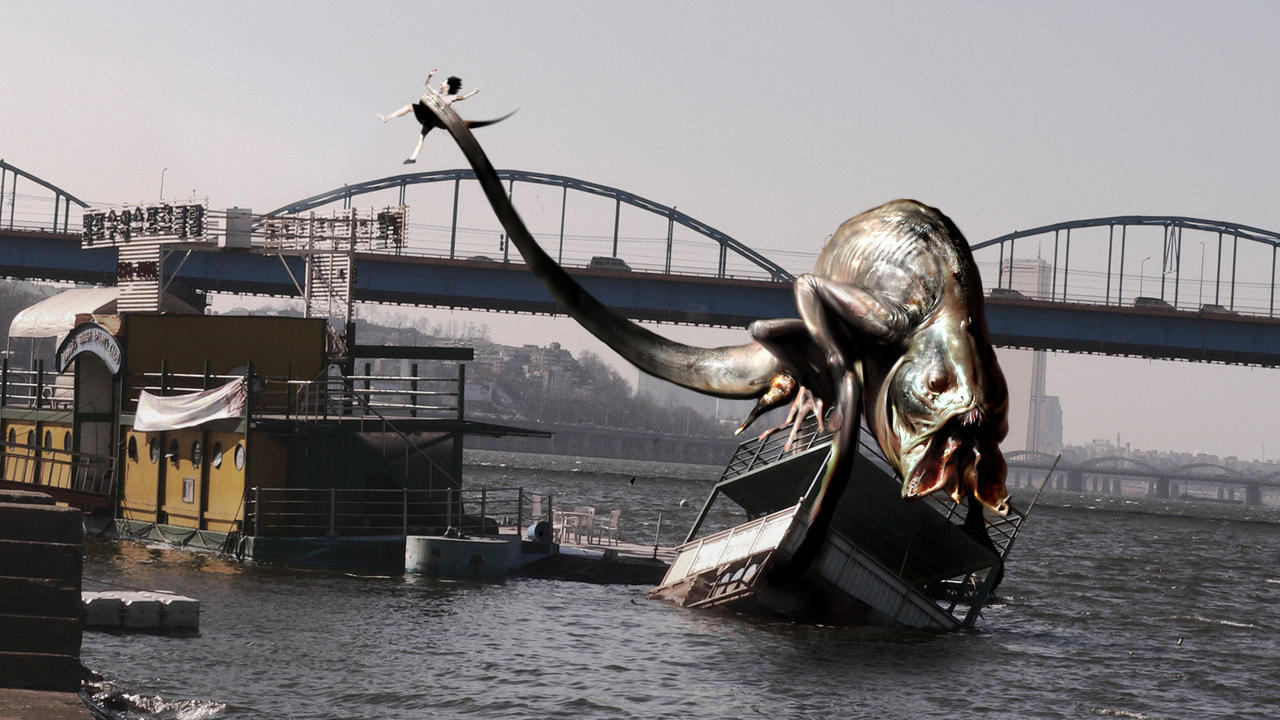
Visionary director Joon-ho Bong’s film opens in a military lab hospital in 2000. A clearly insane American doctor, repulsed by the dust coating formaldehyde bottles, orders a Korean subordinate to empty it all into the sink. Soon the contents of hundreds of bottles of formaldehyde find its way through the Korean sewer system and into the Han River. This event – allegedly based on fact – eventually leads, not surprisingly, to some pretty gamey drinking water. And also a 25 foot cross between Alien and a giant squid.
Said monster – let’s call him Steve Buscemi (the beast’s actual on-set nickname) – exits the river one bright afternoon in 2006 to run amuck in a very impressive outdoor-chaos-and-bloodshed scene. A dimwitted foodstand clerk witnesses his daughter’s abduction by the beast, and the stage is set.
What follows, rather than a military attack on a marauding Steve Buscemi, is actually one small, unhappy, bickering family’s quest to find and save the little girl. Their journey takes them to poorly organized quarantines, botched security check points, misguided military/Red Cross posts, and through Seoul’s sewer system, all leading to a climactic battle even more impressive than the earlier scene of afternoon chaos.
1. Jaws (1975)
What else – honestly?
Twentysomething Steven Spielberg’s game-changer boasts many things, among them one of the greatest threesomes in cinematic history. The interplay among the grizzled and possibly insane sea captain Quint (Robert Shaw), the wealthy young upstart marine biologist Hooper (Richard Dreyfuss) and the decent lawman/endearing everyman Brody (Roy Scheider) helps the film transcend horror to become simply a great movie.
Perhaps the first summer blockbuster, Jaws inspired the desire to be scared silly. And in doing so it outgrossed all other movies of its time. You couldn’t deny you were seeing something amazing – no clichés, all adventure and thrills and shocking confidence from a young director announcing himself as a presence.
Spielberg achieved one of those rare cinematic feats: he bettered the source material. Though Peter Benchley’s nautical novel attracted droves of fans, Spielberg streamlined the text and surpassed its climax to craft a sleek terror tale.
It’s John Williams’s iconic score; it’s Bill Butler’s camera, capturing all the majesty and the terror, but never too much of the shark; it’s Spielberg’s cinematic eye. The film’s second pivotal threesome works, together with very fine performances, to mine for a primal terror of the unknown, of the natural order of predator and prey.
Jaws is the high water mark for animal terror. Likely it always will be.
You have to tip your hat to a filmmaker who understands his
strengths and plays to them. For Chad Stahelski, I think you just have to take
the hat off entirely.
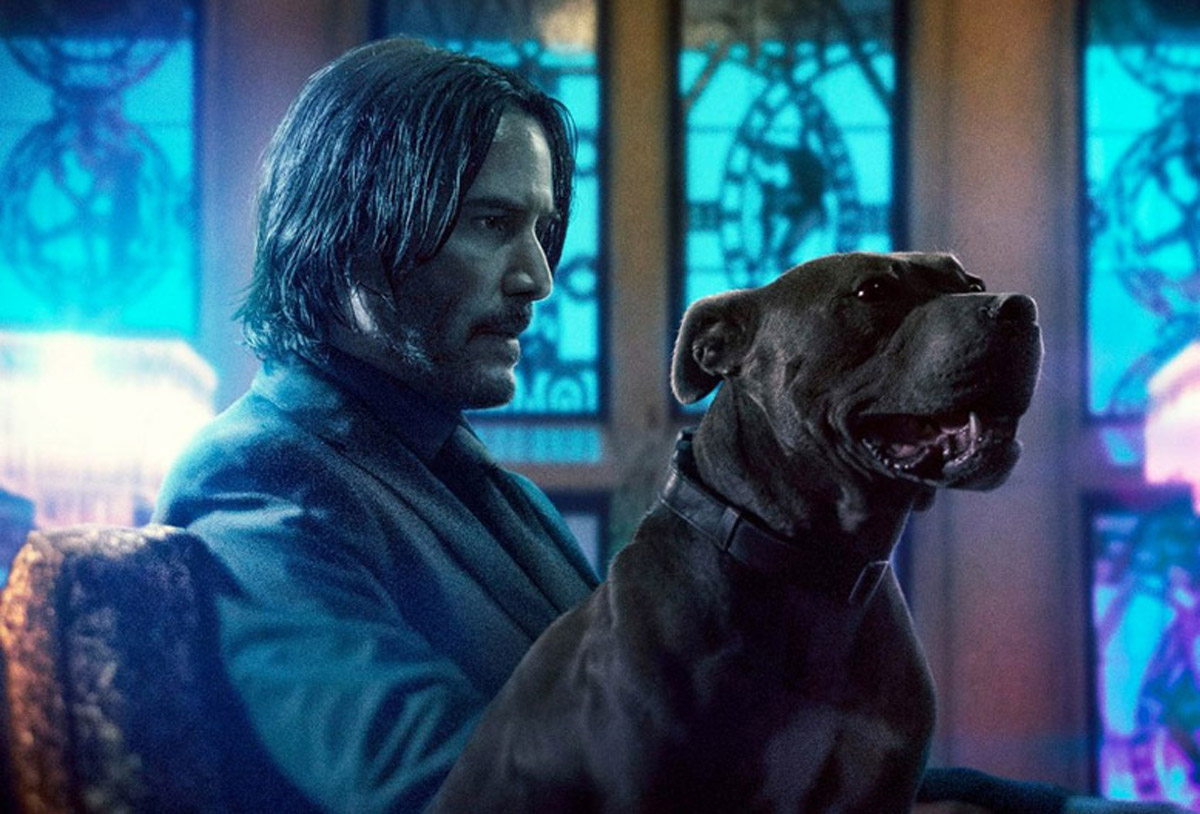
Kickboxer turned stunt man turned stunt coordinator turned helmsman of a phenomenon, Stahelski returns for his third tour with Keanu Reeves as dog-loving assassin widower John Wick for Chapter 3—Parabellum.
The great thing about chapters is that no one expects them
to tell a whole story, and since storytelling and acting are not the strongest
suits in this franchise, Stahelski wisely sharpens his focus on what is:
action.
A breathless Act 1 (with a truly inspired use of the New York Public Library) picks up the moment John Wick 2 ends, mercifully dispensing with the need for exposition. In its stead, balletic mayhem.
The plot of sorts: Wick is in trouble with the guardians of the world’s assassin guild, approximately every third human in NYC is a hired killer, and there is a $14 million bounty on his head. Where can he go? What can he do?
These are questions Stahelski and his army of writers have fun
answering with ludicrous, violent, exhausting, carnage-strewn glee.
Inside of 10 minutes it was clear that this is the best film of the trilogy.
Welcome new faces Anjelica Huston and Asia Kate Dillon cut impressive figures, though Halle Berry feels out of her depth and a clear sound stage representation of Morocco is the only clunky set piece in the movie.
Ian McShane, Lance Reddick and Laurence Fishburne return. Wisely, Stahelski lets these guys mete out most of the dialog. I’d wager Reeves utters fewer than 30 lines total.
Again, play to your strengths.
Dan Lausten’s camera ensures that you know when Reeves does
his own action, most of which is choreographed and captured in long, fluid,
serpentine shots with a lot of broken glass. Man, their easy-shatter glass
budget must have been through the roof!
The Fast and Furious franchise didn’t become tolerable until it embraced the fact that it was a superhero series, abandoning all reason and logic and just jumping cars from the 100th floor of one building to the 100th floor of another. Luckily, it didn’t take John Wick six films to take flight.
Cinema is full of lovable losers, but every so often an actor so fully inhabits a character that you can almost forget the film around him. He is no longer a disposable source of comedy or pity, but an living, breathing, bleeding human you must root for: Philip Seymour Hoffman’s Scottie in Boogie Nights, Robert De Niro’s Rupert Pupkin in The King of Comedy, Dustin Hoffman’s Ratso in Midnight Cowboy.
Marcello Fonte just leapt onto the list with his deeply flawed, deeply human and beautifully realized dog groomer Marcello in Matteo Garrone’s latest, Dogman.
Slight, fidgety and endlessly kind-hearted, Marcello loves his dogs, his daughter and the neighbors in his grey little seaside slum. Sure, he sells a little coke on the side, but he doesn’t want to cause any trouble.
Unfortunately for Marcello, the behemoth Simone (Edoardo
Pesce, utterly brilliant) is nothing if not a lumbering mountain of trouble.
After his darkly delightful 2015 fairy tale outing Tale of Tales, Garrone returns to the heavier Italian realism of Gomorrah. He hasn’t abandoned allegory, though.
Given his nation’s political history and current leanings,
it isn’t tough to draw metaphor from the tale of an unthinking bully and the
population who cows to him. (This is not a tough metaphor for Americans to
fathom, either.)
Not that it pulls attention away from Marcello. The film has
themes of the classic Western, a good man pushed to dark means to protect what
he has. But in this case, Marcello is an almost feminine presence among the
cash-for-gold shop or video game arcade owners who share his strip of town.
Marcello is liked, if not exactly respected.
Childlike is what he is, a pack animal but never the alpha.
As his story progresses, Garrone’s tight grip on the narrative and its visual
emphasis turn the film from that of an underdog’s struggle to something sadder
and grander.
As hope mixes with hopelessness, Dogman raises questions it never really answers, and ultimately feels wearily confused and disappointed by people.
It’s been 50 years since Charles Manson and his family effectively terminated the 1960s. Filmmaker Mary Harron (American Psycho) joins Daniel Farrands and Quentin Tarantino in commemorating the anniversary.
Earlier this year, Farrands unleashed the grim and quickly forgotten The Haunting of Sharon Tate, while Tarantino’s next likely cultural phenomenon, Once Upon a Time in Hollywood, promises to shine some of its spotlight on the Manson family crimes as well.
Harron’s film, Charlie Says, follows Leslie Van Houton (Hannah Murray), Susan Atkins (Marianne Rendon) and Patricia Krenwinkle (Sosie Bacon), three years after their incarceration, as they reflect on Manson’s promises and their own actions.
The aptly titled film is as concerned with the women’s brainwashing
as it is the crimes themselves, although it unfortunately provides no real
insight into either.
Harron spends about half the film in the California Women’s Correctional Facility, where the trio is taught by dedicated grad student Karlene Faith (Merritt Wever, portraying the author of the book that inspires the film).
The eerie chorus of “Charlie says…” greets nearly every
question Wever lobs at her students, which generally spurs a flashback to time
on the ranch with Charlie (Matt Smith).
Here we hit a snag, because Smith lacks the charisma, the
hatred, the ugliness or the psychotic aura to pull of Manson. He is never terrifying,
never seductive—never convincing.
In fact, most of the flock lacks the weather beaten conviction we recognize from police tapes. The period detail and tone lack degrees of authenticity as well.
Harron’s film opens strong, but it quickly loses its footing
and never really finds it again. Working from Guinevere Turner’s screenplay,
Harron brings up some interesting themes—particularly questioning the point of
breaking through to these women, knowing that puncturing their fantasies only
means their clear-eyed horror whether looking backward or forward.
But she doesn’t really land any punches. The film never
feels particularly queasying, especially enlightening or even very memorable.
I guess we still have Tarantino. Or maybe it’s just time we all moved on and stopped obsessing over what Charlie had to say.
Here’s a fun trend in recent indie filmmaking: let’s revisit
our historic “spinsters”, shall we?
Craig William Macneill gave Lizzie Borden the treatment last year with Lizzie, offering a pretty speculative and yet decidedly clear-eyed plausibility. But Madeleine Olneck has actual history to back her up.
Plumbing Harvard University Press’s stash of Emily Dickinson’s
poems and letters, Olneck suggests a different, funnier, slyer image of the
“recluse poet.”
Wild Nights with Emily plays almost like an episode of Drunk History, although no one seems to be drunk. Olneck simulcasts two parallel retellings of the life of America’s most beloved female poet, and among its most beloved poets, regardless of sex.
Wild Nights does not disregard sex, though.
One storyline—the one you’ll recognize—is dictated by Mabel
Todd (a delightful Amy Seimetz in a rare comedic performance). As she stands in
her cotton candy pink dress and hat, she regales a rapt audience with stories
of the Emily Dickinson she knew.
Well, “knew” seems to be a strong word.
Todd was, indeed, the first to publish Dickinson’s work
aside from a stray newspaper editor here and there. And why was that? Because
Dickinson was a recluse who shunned publication, as Todd defined it and history
was so quick to embrace it?
Or because Dickinson’s rule-defying work was ignored by the
literary establishment of her time and because she shunned Todd?
The offsetting narrative explores a different view of
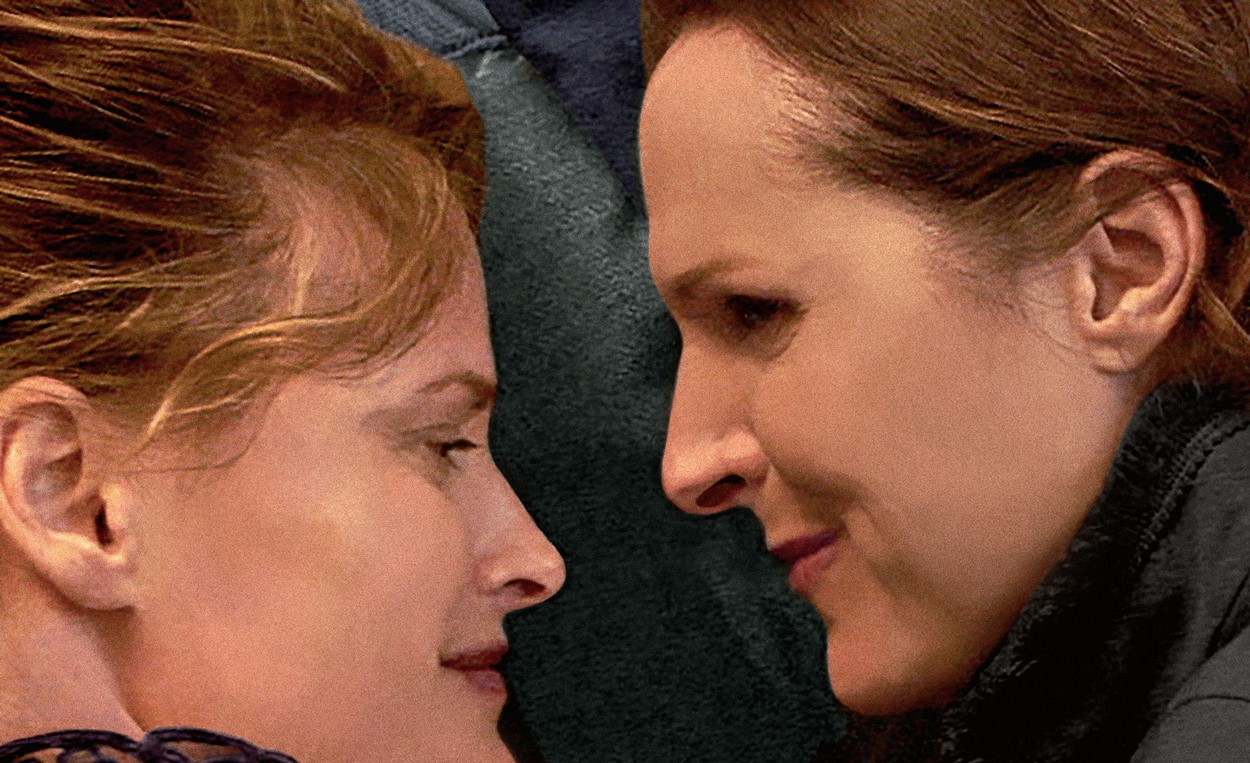
Dickinson, warmly and beautifully portrayed by Molly Shannon. Her relationship
with lifelong friend, expert reader, fierce proponent and sister-in-law, Susan
Gilbert (Susan Ziegler), fuels a poignant and funny story.
Is a likelier reading of Dickinson’s work and letters that
of a passionate, lifelong love affair with Gilbert? Olneck’s consistently
entertaining narrative certainly believes so.
This is a specifically political film, one that begs with
outrage that we reexamine the stories we’ve been told about women in
history—this one woman, in particular.
It’s also a mash note to the breathtaking originality and talent of the poet, whose words flow through the film without burdening it by self-importance or pretentiousness. No, Olneck’s audacious wit and Ziegler and Shannon’s performances—alongside spot on comic turns from Seimetz, Brett Gelman, Jackie Monahan and Kevin Seal—guarantee the film never bends toward anything remotely stuffy.
Instead, Wild Nights with Emily offers a refreshing and awfully entertaining new way of seeing an American treasure.
If you’re thinking Christopher Lee and blood-drinking, virgin-sacrificing minions planning to summon demons forth and end humankind, well, you’re not alone. But you are off the mark.
And while I’m not sure documentarian Penny Lane intended recruitment with her film Hail Satan?, it’s really hard not to find yourself rooting for this scrappy group of idealists.
Lane and her subjects trace a brief history of Satanic grotesquerie in America. From Anton Lavey’s psychedelic Church of Satan (“a rat pack carnival”) to the “Satanic Panic” of the 80s and 90s through the abominable behavior inside the Catholic Church, the film notes how the devil has been used in American popular culture.
But for TST, “Satanism” is simply a way to rework a pejorative
term used historically to mark the outsider—a group to which members certainly relate.
Lucien Greaves (a pseudonym) devoted himself to establishing The Satanic Temple as a simple societal outgrowth, a tumor, if you will, on the ass of a state of Christian theocracy he saw in our country. He doesn’t worship Satan. He doesn’t even believe in Satan.
Greaves believes in the religious pluralism promised by the US Constitution, and what better way to convince a state house to remove its ten commandments statue than to insist on the erection of an 8 foot statue of Baphomet on the same lawn? Because, as far as the laws of the US are concerned, if you can’t have one, you can’t have the other.
Lane documents the organization’s growth from theatrical
political activist cell to global network of connected communities. Her wry
delivery matches the sensibilities of the Satanists in question, but their
outrage and their unexpected sense of community fuel the film.
As Lane’s investigation uncovers, The Satanic Temple’s surprising surge in popularity owes itself not just to a citizenry troubled by a sudden swing toward theocracy. It’s also due to the organization’s ability to represents a unified voice for outcasts.
Those very people most vilified by a conservative
“Christian” point of view find acceptance here. And while there may be no better way for them to
stick it to their oppressors, this is also their opportunity to make a
difference.
If the point of a documentary is to enlighten while it entertains, few docs have succeeded on both fronts as entirely as Hail Satan? In turns frustrating, funny and provocative, it is always a clear-eyed image of America as defined by our citizen’s imperative to challenge our government to better realize the ideals of our Constitution.
What to watch this week? Well, please start with the best documentary to be released in ages, then hit on a criminally underseen music biopic. After that, the choosing gets tougher, but let us be a guide.
Horror has a love/hate relationship with hippies. I suppose most of us do. And while some of the greatest films in the genre were made by Sixties freaks George Romero, Wes Craven, Tobe Hooper and the like, most of the time hippies’ onscreen representation got wrapped up in Manson hysteria.
5. Children Shouldn’t Play with Dead Things (1972)
Full disclosure: George objects to including this film on the list. It’s not good.
But it’s not good in such a good way! Director Bob Clark (Black Christmas, A Christmas Story) and writer/co-star Alan Ormsby seem basically to be taking out their frustrations at being part of the theatrical community.
Ormsby’s Alan is a director, and he drags his troupe of hippie thespians to a lonely island once used to bury the criminally insane. He then insists—if they ever want to work with him again—that his merry band dig up a body and perform a ritual to bring him back to life.
It’s basically theater kids making fun of theater kids. Watching a group of actors being literally eaten alive by their audience is its own stoke of genius, even if the film itself is not.
4. Let’s Scare Jessica to Death (1971)
In this Age of Aquarius riff on J. Sheridan Le Fanu’s vampire novel Carmilla, the unfortunately titled Let’s Scare Jessica to Death follows a somewhat delicate woman through what amounts to either a nervous breakdown or the seduction of a female vampire.
A married couple and their organic farmer friend move into an old, abandoned house on a New England island. They find a vagrant—long haired, pretty, can play an acoustic guitar, natch—and they ask her to stay. Why not?
Deliberately paced and boasting a genuine and sympathetic performance by lead Zohra Lampert, the film’s a slow burn, a hallucinogenic smalltown horror. The creepy townies, the spooky cemetery girl, and the moody cinematography blend with Lampert’s committed performance to make this one a dusty little gem.
3. I Drink Your Blood (1970)
David Durston’s grindhouse classic (in which no one drinks anyone’s blood, regardless of what this lying trailer tells you) marks that great divide in hippie horror: those made by and about hippies and those made by opportunists seizing upon a population’s terrified fascination with the Manson Family murders.
I Drink Your Blood is the latter. We open on a group of hippie Satan worshippers who turn out to be gang rapists. They descend on a little town almost empty of inhabitants—the menfolk all having moved to live and work in the nearby mining camp. That leaves just that scrappy family working in the bakery.
But once young, vindictive Pete injects the baker’s meat pies with rabid dog blood, them no goodnicks might learn some manners.
Actually, that’s the last thing they’ll do.
This is an extremely violent film, not very well made and certainly not well acted. It has a punch, though, and several scenes are provocative enough to warrant its inclusion on this list.
2. Mandy (2018)
A hallucinogenic fever dream of social, political and pop-culture subtexts layered with good old, blood-soaked revenge, Mandy throws enough visionary strangeness on the screen to dwarf even Nicolas Cage in full freakout mode.
Red (Cage) and Mandy (Andrea Riseborough) live a secluded, lazily contented life somewhere in the Pacific Northwest.
That contentment is shattered by a radical religious sect under the spell of Jeremiah (Linus Roache), who takes a liking to Mandy when the group’s van (of course it’s a van!) passes her walking on a country road.
Horror of the late 60s and early 70s saw hippies terrorizing good, upright citizens, perpetrating cult-like nastiness. Thanks to Charles Manson, society at large saw the counterculture as an evil presence determined to befoul conventional, Christian wholesomeness.
With Mandy, it’s as if the 70s and 80s have collided, mixing and matching horror tropes and upending all conceivable suppositions. In this case, zealots consumed with only the entitlement of their white, male leader wreak havoc on good, quiet, earth-loving people. The Seventies gave us some amount of progress, civil justice and peace that the Eighties took back under the guise of decency.
1.The Texas Chainsaw Massacre (1974)
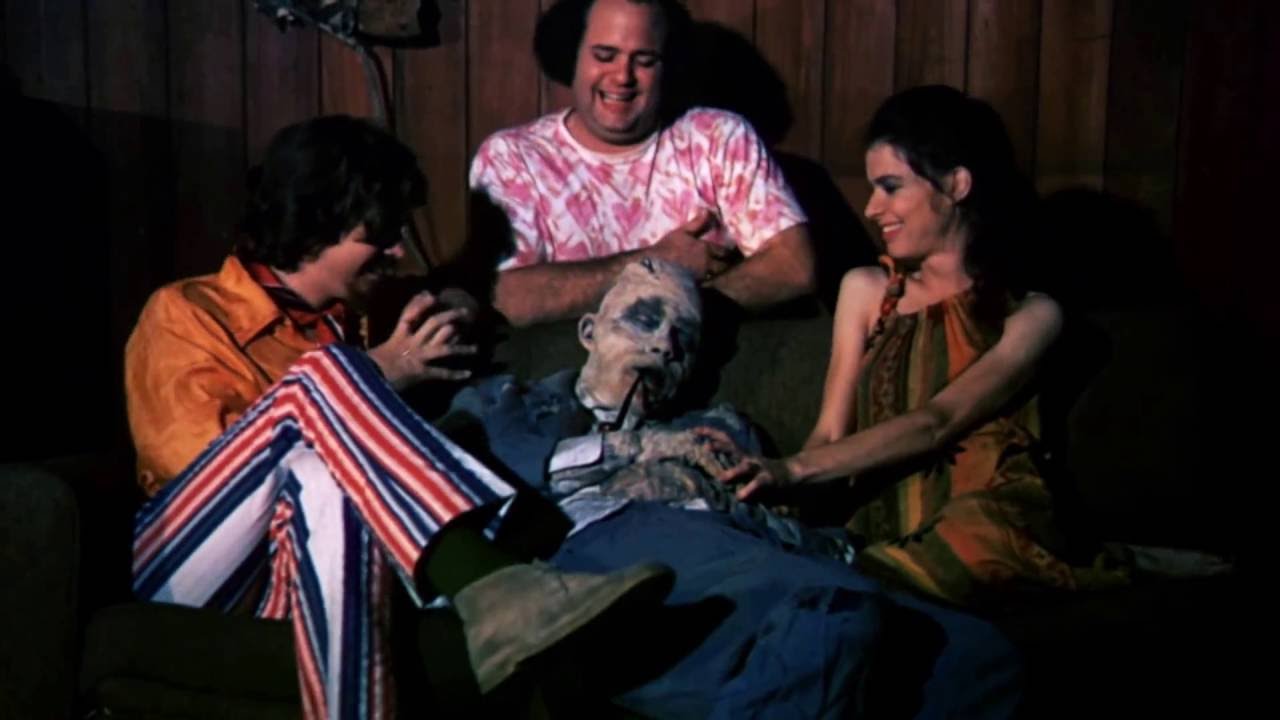
Hippie pals pile into a van and head to Texas to double check that Grammy and Gamps still rest in peace, what with these rumors of grave robbing. Along the way they talk astrology, smoke some weed, pick up a hitchhiker–it’s all in a day’s journey for a hippie.
That hitchhiker thing goes sideways. In fact, the whole trip feels like a bad idea by the time pretty Sally Hardesty and her friends make a second trip to the cemetery. Well, what’s left of them.