You know that nice lady at work who gets bronchitis every time she flies, then she coughs and hacks and spews DNA all over the office?
Let’s say you have issues with that kind of office contamination. And with office politics. And with your boss, her boss, and the way you’ve basically given up everything that makes you feel alive and happy for this stupid job you hate where germs are everywhere…
Wouldn’t it be cathartic to explode, right there, in the middle of everything, righteously and with no repercussions?
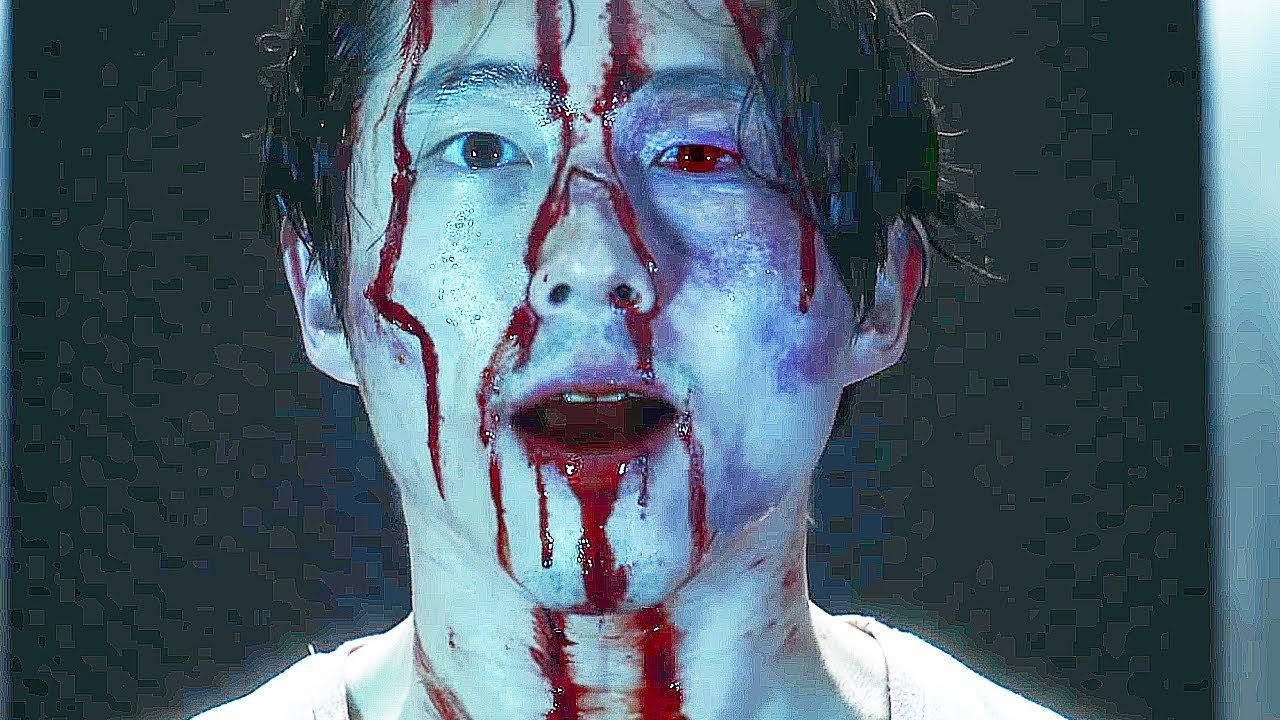
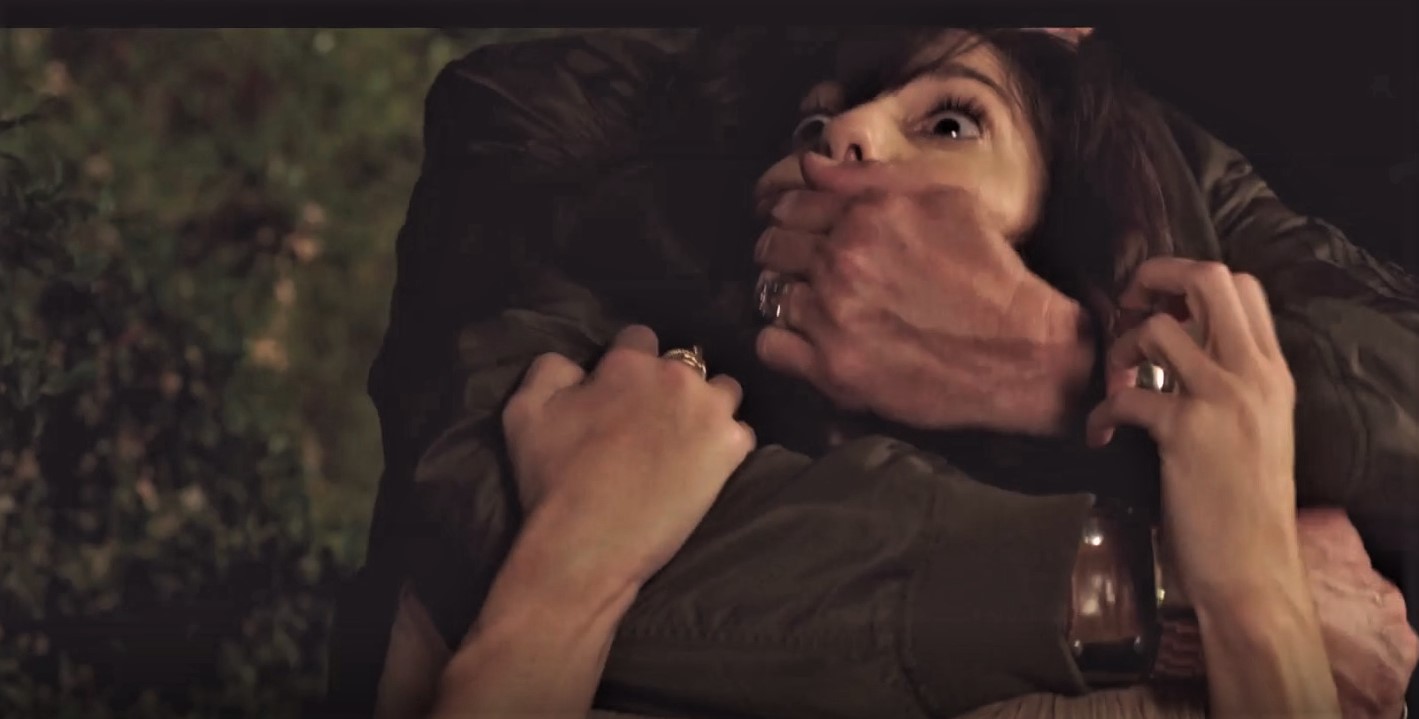
Mayhem, the new film from director Joe Lynch, is just that emotional release.
Steven Yeun (The Walking Dead) plays Derek, mid-level white-collar prick in a law office. Just mid-level, though—there’s some conscience left in him. Still, he got where he is by finding the loophole that got a broad-daylight-surrounded-by-witnesses murderer off the hook.
The murderer had a virus—the Red Eye virus—which disrupts your ability to manage your emotions. You might weep uncontrollably, masturbate during a conference call, or stab your boss in the throat with a pen.
Here’s what’s important: we like Derek, his building is contaminated, his court case set the precedent allowing public murder and mayhem while under the 8-hour-ish influence of the virus.
Let’s just quarantine this building and see what happens.
The film is an exercise in workplace catharsis, and a pretty fun one. It’s far superior to other recent attempts at office-bound carnage The Belko Experiment and Bloodsucking Bastards, partly because Lynch has a crisp sense of pace and knack for comedy.
Matias Caruso’s script doesn’t hurt. Though it never mines deeply enough for the film to resonate beyond the “I hate my job and wouldn’t mind killing my boss” level, it’s clever fun from start to finish.
Yeun makes an excellent everyman and his enjoyable performance is matched by those of many of his evil colleagues. Dallas Roberts (also The Walking Dead) is exceptional as the head of HR, also known as The Reaper.
The film is little more than an id explosion in service of workplace fantasy. It keeps a light heart despite the carnage, doesn’t dig deep and doesn’t really hold up to scrutiny. But it’s fun. Especially if you’ve ever wanted to kill your boss.
Wow, 2017 was one hell of a year in horror. We had blockbusters, people! Three horror movies broke blockbuster status, earning hundreds of millions of dollars. It—good God did that movie make some cash. What does that mean? It means more big budget, R-rated horror will be coming our way.
It was quite a year for genre-bending films like It Comes at Night, The Killing of a Sacred Deer and mother!—polarizing, amazing gems that really need to be seen.
But we’ll focus on films a little more clearly defined as horror. Thanks to Chris Hamel, President and Programmer of our beloved Gateway Film Center, for joining us to count down the best horror films of 2017.
10. Tragedy Girls
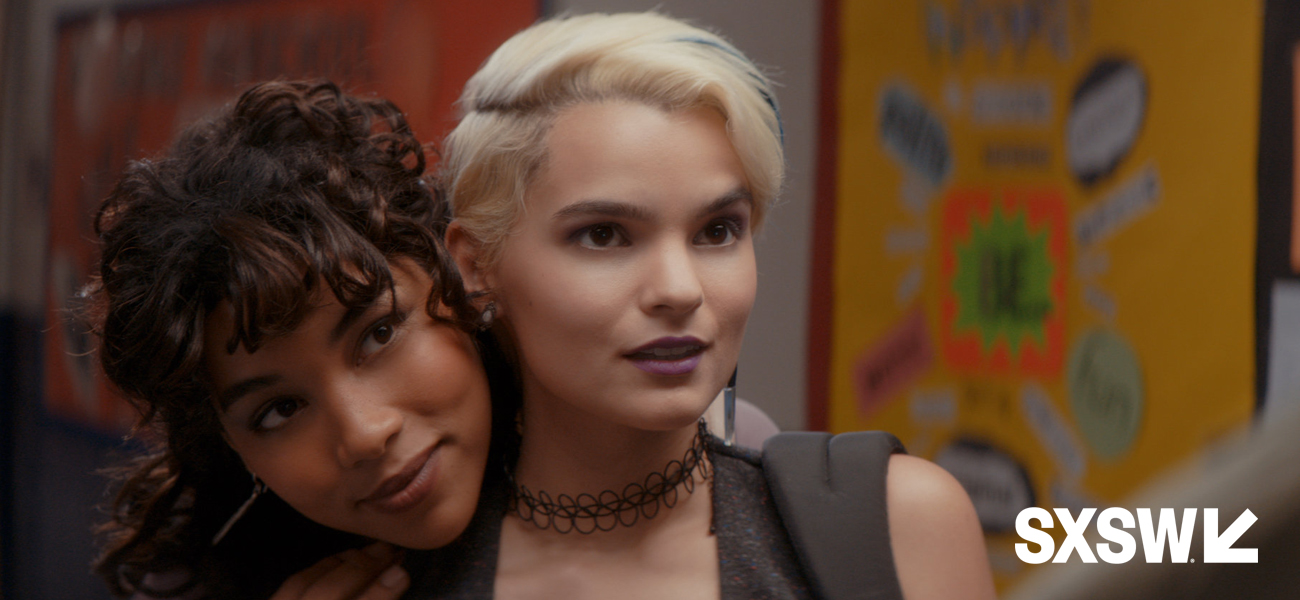
Heathers meets Scream in the savvy horror comedy that mines social media culture to truly entertaining effect, Tragedy Girls.
Tyler MacIntyre directs a screenplay he co-wrote with Chris Lee Hill and Justin Olson. The trio wade into the horror of a social media generation with more success than anything we’ve seen to date. A great deal of their success has to do with casting.
Brianna Hildebrand and Alexandra Shipp nail their characters’ natural narcissism. Is it just the expectedly shallow, self-centeredness of the teenage years, or are they sociopaths?
The film is careful not to go overboard with its commentary, though, and the final product is the better for it. MacIntyre’s affectionate, perhaps even obsessive, horror movie nods receive at least as much of his time and attention.
The result is both mean and funny. Josh Hutcherson’s small, image-lampooning part is an absolute scream proving that MacIntyre and company have pop cultural insights to spare, and proper comedic timing to boot.
9. Girl With all the Gifts
It is the top of the food chain that has the most reason to fear evolution.
Isn’t that the abiding tension in monster and superhero movie alike? The Girl with All the Gifts explores it thoughtfully and elegantly – for a zombie movie.
So, what’s the deal? A horde of “hungries,” each infected with a plant-based virus, has long since overrun the human population. Dr. Caldwell (Glenn Close), her researchers and the military are holed up while trying to derive a cure from the next generation, like Melanie (Sennia Nanua) – the offspring of those infected during pregnancy.
But much of the film’s success sits on Nanua’s narrow shoulders, and she owns it. The role requires a level of emotional nimbleness, naiveté edged with survival instinct, and command. She has that and more.
Cirector Colm McCarthy showcases his bounty of talent in a film that knows its roots but embraces the natural evolution of the genre. It’s not easy to make a zombie film that says something different.
But what Girl has to say is both surprising and inevitable.
And she says it really, really well.
8. Split
A transfixing James McAvoy is Kevin, a deeply troubled man harboring 23 distinct personalities and some increasingly chilling behavior. When he kidnaps the teenaged Casey (The Witch‘s Anya Taylor-Joy) and her two friends (Haley Lu Richardson, Jessica Suva), the girls are faced with constantly changing identities as they desperately seek an escape from their disorienting confines.
Meanwhile, one of Kevin’s personalities is making emergency appointments with his longtime therapist (Betty Buckley, nice to see you), only to show up and assure the Dr. everything is fine. She thinks otherwise, and she is right.
The split personality trope has been used to eye-rolling effect in enough films to be the perfect device for Shyamalan’s clever rope-a-dope. By often splitting the frame with intentional set designs and camera angles, or by letting full face close-ups linger one extra beat, he reinforces the psychological creepiness without any excess bloodshed that would have soiled a PG-13 rating.
Still, it all might have gone for naught without McAvoy, who manages to make Kevin a sympathetic character while deftly dancing between identities, often in the same take. He’s a wonder to watch, and the solid support from Buckley and Taylor-Joy help keep the tension simmering through speedbumps in pacing and questionable flashbacks to Casey’s childhood.
7. The Lure
Sisters Gold (Michalina Olszanska) and Silver (Marta Mazurek) are not your typical movie mermaids, and director Agnieszka Smoczynska’s feature debut The Lure is not your typical – well, anything.
The musical fable offers a vivid mix of fairy tale, socio-political commentary, whimsy and throat tearing. But it’s not as bizarre a combination as you might thing.
The Little Mermaid is actually a heartbreaking story. Not Disney’s crustacean song-stravaganza, but Hans Christian Andersen’s bleak meditation on the catastrophic consequences of sacrificing who you are for someone undeserving. It’s a cautionary tale for young girls, really, and Lure writer Robert Bolesto remains true to that theme.
But that’s really too tidy a description for a film that wriggles in disorienting directions every few minutes. There are slyly feminist observations made about objectification, but that’s never the point. Expect other lurid side turns, fetishistic explorations, dissonant musical numbers and a host of other vaguely defined sea creatures to color the fable.
https://www.youtube.com/watch?v=vxhi_3hDUPE
6. The Transfiguration
Milo likes vampire movies.
Eric Ruffin plays Milo, a friendless teen who believes he is a vampire. What he is really is a lonely child who finds solace in the romantic idea of this cursed, lone predator. But he’s committed to his misguided belief.
All this changes when Milo meets Sophie (Chloe Levine), another outsider and the only white face in Milo’s building. A profound loneliness haunts this film, and the believably awkward behavior of both Ruffin and Levine is as charming as it is heartbreaking.
The Transfiguration is a character study as much as a horror film, and the underwritten lead, slow burn and somewhat tidy resolution undercut both efforts.
Still, there’s an awful lot going for this gritty, soft-spoken new image of a teenage beast.
5. It
Clowns are fun, aren’t they?
The basic premise of It is this: little kids are afraid of everything, and that’s just good thinking.
The Derry, Maine “losers club” finds itself in 1988 in this adaptation, an era that not only brings the possibility of Part 2 much closer to present day, but it gives the pre-teen adventures a nostalgic and familiar quality.
Bill Skarsgård has the unenviable task of following a letter-perfect Tim Curry in the role of Pennywise. Those are some big clown shoes to fill, but Skarsgård is up to the challenge. His Pennywise is more theatrical, more of an exploitation of all that’s inherently macabre and grotesque about clowns.
Is he better than the original? Let’s not get nutty here, but he is great.
He and the kids really make this work. The young cast is led by the always strong Jaeden Lieberher (Midnight Special), and he’s surrounded by very strong support. Sophia Lillis charms as the shiniest gem in the losers’ club, and Finn Wolfhard (that is a name!) is a scream as the foul-mouthed class clown Richie.
The almost inexcusably cute Jackson Robert Scott is little, doomed Georgie, he of the yellow slicker.
Director Andy Muschietti shows great instinct for taking advantage of foreground, background and sound. Yes, It relies heavily on jump scares, but Muschietti’s approach to plumbing your fear has more depth than that and he manages your rising terror expertly.
4. Raw
What you’ll find in writer/director Julia Ducournau’s notorious feature debut is a thoughtful coming of age tale.
And meat.
Justine (Garance Marillier, impressive) is off to join her older sister (Ella Rumpf) at veterinary school – the very same school where their parents met. Justine may be a bit sheltered, a bit prudish to settle in immediately, but surely with her sister’s help, she’ll be fine.
Ducournau has her cagey way with the same themes that populate any coming-of-age story – pressure to conform, peer pressure generally, societal order and sexual hysteria. Here all take on a sly, macabre humor that’s both refreshing and unsettling.
In a very obvious way, Raw is a metaphor for what can and often does happen to a sheltered girl when she leaves home for college. But as Ducournau looks at those excesses committed on the cusp of adulthood, she creates opportunities to explore and comment on so many upsetting realities, and does so with absolute fidelity to her core metaphor.
She immediately joins the ranks of Jennifer Kent (Babadook) and Ana Lily Amirpour (A Girl Walks Home Alone at Night) – all recent, first time horror filmmakers whose premier features predict boundless talent.
3. The Blackcoat’s Daughter
Winter break approaches at a Catholic New England boarding school. Snow piles up outside, the buildings empty, yet Kat (Kiernan Shipka) and Rose (Lucy Boynton) remain. One has tricked her parents for an extra day with her townie boyfriend. One remains under more mysterious circumstances.
Things in writer/director Oz Perkins’s The Blackcoat’s Daughter quietly unravel from there – although quiet is not precisely the word for it. There is a stillness to the chilly, empty halls. But thanks to the filmmaker’s brother Elvis, whose disquieting score fills these empty spaces with buzzing, whispering white noise, a sinister atmosphere is born.
Perkins repays your patience and your attention. You can expect few jump scares, but this is not exactly a slow-burn of a film, either.
It behaves almost in the way a picture book does. In a good picture book, the words tell only half the story. The illustrations don’t simply mirror the text, they tell their own story as well. If there is one particular and specific talent Blackcoat’s Daughter exposes in its director, it is his ability with a visual storyline.
Pay attention when you watch this one. There are loads of sinister little clues to find.
2. Hounds of Love
Driven by a fiercely invested and touchingly deranged performance from Emma Booth, Hounds of Love makes a subtle shift from horrific torture tale to psychological character study. In 108 grueling minutes, writer/director Ben Young’s feature debut marks him as a filmmaker with confident vision and exciting potential.
It is the late 1980s in Perth, Australia, and at least one young girl has already gone missing when the grounded Vicki (Ashleigh Cummings) sneaks out her bedroom window to attend a party. This isn’t nearly as dumb a move as is accepting a ride from Evie White (Booth) and her husband John (Stephen Curry).
As the couple dance seductively and drink to celebrate, Young disturbingly conveys the weight of Vicki’s panicked realization that she is now their captive. It is just one in a series of moments where Young flexes impressive chops for visual storytelling, utilizing slo-motion, freeze frame, patient panning shots and carefully chosen soundtrack music to set the mood and advance the dreadful narrative without a spoken word.
And then, just when you might suspect his film to wallow in the grisly nature of the Whites’ plan for Vicki, Young turns to dialog sharp enough to upend your expectations, and three vivid characters are crafted in the suffocating dread of the White’s neighborhood home.
No doubt, events get brutal, but never without reminders that Young is a craftsman. Subtle additions, such as airplanes flying freely overhead to contrast with Vicki’s captivity, give Hounds of Love a steady dose of smarts, even as it’s shaking your core.
https://www.youtube.com/watch?v=UNEurXzvHqE
1. Get Out
Opening with a brilliant prologue that wraps a nice vibe of homage around the cold realities of “walking while black,” writer/director Jordan Peele uses tension, humor and a few solid frights to call out blatant prejudice, casual racism and cultural appropriation.
When white Rose (Alison Williams) takes her black boyfriend Chris (Daniel Kaluuya) home to meet the fam, she assures him race will not be a problem. How can she be sure? Because her Dad (Bradley Whitford) would have voted for Obama’s third term “if he could.” It’s the first of many B.S. alerts for Peele, and they only get more satisfying.
Rose’s family is overly polite at first, but then mom Missy (Catherine Keener) starts acting evasive and brother Jeremy (Caleb Landry Jones) gets a bit threatening, while the gardener and the maid (both black – whaaat?) appear straight outta Stepford.
Peele is clearly a horror fan, and he gives knowing winks to many genre cliches (the jump scare, the dream) while anchoring his entire film in the upending of the “final girl.” This isn’t a young white coed trying to solve a mystery and save herself, it’s a young man of color, challenging the audience to enjoy the ride but understand why switching these roles in a horror film is a social critique in itself.
Get Out is an audacious first feature for Jordan Peele, a film that never stops entertaining as it consistently pays off the bets it is unafraid to make.
Heathers meets Scream in the savvy horror comedy that mines social media culture to truly entertaining effect, Tragedy Girls.
Sadie (Brianna Hildebrand) and McKayla (Alexandra Shipp) are looking for more followers to improve their brand, and they have been doing a lot of research to make their content more compelling. The Tragedy Girls plumb their small Ohio town’s surprising death toll with more insight than the local police seem to have. Where do they get their knowledge?
Provocative.
Tyler MacIntyre directs a screenplay he co-wrote with Chris Lee Hill and Justin Olson. The trio wade into the horror of a social media generation with more success than anything we’ve seen to date. A great deal of their success has to do with casting.
Hildebrand and Shipp (both X-Men; Hildebrand was the moody Negasonic in Deadpool while Shipp plays young Storm in the franchise proper) nail their characters’ natural narcissism. Is it just the expectedly shallow, self-centeredness of the teenage years, or are they sociopaths?
Mrs. Kent (Nicky Whelan) would like to know. The spot-on teacher character offers the film’s most pointed piece of social (media) commentary when she points out the traits encouraged in a snapchat world, where shallowness and parasitic, even psychotic behavior is a plus.
The film is careful not to go overboard with its commentary, though, and the final product is the better for it. MacIntyre’s affectionate, perhaps even obsessive, horror movie nods receive at least as much of his time and attention.
The result is both mean and funny. Josh Hutcherson’s small, image-lampooning part is an absolute scream proving that MacIntyre and company have pop cultural insights to spare, and proper comedic timing to boot.
McIntrye loses his snidely meta tone briefly with a lengthy sidetrack focusing on Craig Robinson, which becomes more zany and broad than anything before it. The director can’t entirely find his footing again, as the resolution of the film gets mired a bit too much in the genre tropes.
Still, the details are priceless (she lends him a copy of Martyrs! Dig that ringtone!), the performances impress and the whole thing is a hoot.
We finally did it. We finally took a look at short compilations and horror anthologies—all sixty million of them—and found that there are many great ones. So many, in fact, that filmmaker Jeff Frumess teamed up with us so we could cover twice as many. Here are our five favorites.
5. Creepshow (1982)
Campy, gruesome and trashy like the comic books that inspired it, Creepshow benefits from two of the most impressive pedigrees in the genre world. Written for the screen by Stephen King and directed by George Romero, the grimly comedic film demands attention.
Though some of the shorts are less effective than others, the hits are strong enough to carry the effort.
Though the cake in “Father’s Day” remains maybe the movie’s most lasting image, the shorts “The Crate” and “Something to Tide You Over” offer the strongest bursts of horror.
Bridged with inspired comic book art bumpers, the film maintains a juvenile aesthetic that helps its mean spirit and humor land. It doesn’t hurt that getting to see Hal Holbrook, Leslie Nielsen, Ted Danson and Ed Harris wade into such garish and campy territory is forever fun.
4. The Signal (2007)
A transmission – a hypnotic frequency – broadcasting over TV, cell and landline telephones has driven the good folks of the city of Terminus crazy. David Bruckner, Dan Bush and Jacob Gentry created a film in three segments, or transmissions.
Transmission 1 introduces our lover heroes as well as the chaos. Can Mya (Anessa Ramsey) and Ben (Justin Welborn) remain sane, reunite and outrun the insanity?
Transmission 2 takes a deeply, darkly funny turn as we pick up on the illogical logic of a houseful of folks believing themselves not to have “the crazy.” The final transmission brings us full circle.
The movie capitalizes on the audience’s inability to know for certain who’s OK and who’s dangerous. Here’s what we do know, thanks to The Signal: duct tape is a powerful tool, bug spray is lethal, and crazy people can sure take a beating.
3. Fear(s) of the Dark (2007)
This animated French film brings nightmares almost too beautifully to life. The film showcases a glorious variety of black and white artistic style, each animating a different short that tells a tale of phobias, bad dreams and shadowy terror.
Though the styles change, there is a shadowy fluidity to most of these pieces that feels slippery and alarming. One piece about a man who finds refuge in an abandoned house emphasizes a slow-building dread while another tale about a grim-faced man and his menacing hounds generates more vibrant bouts of terror.
The program morphs from the supernatural to the cerebral, each piece filling the screen with disturbingly gorgeous sound and image.
The film as a whole has the feel of childhood nightmares. The collection digs into anxieties in a way far more subtle and sophisticated than what you’ll find in the balance of films on this list, but the lingering effect is haunting, even disturbing.
2. Three…Extremes (2004)
Three of the most promising genre directors Asia had to offer came together in 2004 to cast a grisly spell. Two—Chan-wook Park and Takashi Miike—would blossom into two of the most respected filmmakers in the world. Miike just released his 100th film. While Park may be a bit slower with his output, he’s not made a single misstep in his filmmaking career. Everything he’s ever made is required viewing.
Fruit Chan’s career may not draw as much attention, but this piece in this anthology may be the strongest. “Dumplings” offers a savvy if distasteful piece of social commentary boasting two magnificent performances and sound design destined to disturb.
Miike’s “Box” is a serpentine riddle of sideshow freaks, ghosts, destiny and twins. Beautiful, grotesque and hypnotic, it showcases the filmmaker’s knack for visual storytelling and spell casting.
Park’s “Cut” offers a cynical and bloody look at the film industry. Though it’s the least in keeping with the filmmaker’s overall canon, as a part of the series it offers bold visuals and uneasy humor.
1. Trick or Treat (2007)
Columbus native Michael Dougherty outdid himself as writer/director of this anthology of interconnected Halloween shorts. Every brief tale compels attention with sinister storytelling, the occasional wicked bit of humor and great performances, but it’s the look of the film that sets it far above the others of its ilk.
Dougherty takes the “scary” comic approach to the film—the kind you find in Creepshow and other Tales from the Crypt types—but nothing looks as macabrely gorgeous as this movie. The lighting, the color, the costumes and the way live action bleeds into the perfectly placed and articulated moments of graphic artwork—all of it creates a giddy holiday mood that benefits the film immeasurably.
Dylan Baker (returning to the uptight and evil bastard he perfected for his fearless performance in Happiness) leads a whip-smart cast that includes impressive turns from Brian Cox, Anna Pacquin, Leslie Bibb and Brett Kelly (Thurman Merman, everybody!).
And it’s all connected with that adorable menace, Sam. Perfect.
The Snowman, a Norway-set serial killer thriller, runs like a 3-hour flick that someone gutted for time without regard to sensibility, leaving a disemboweled and incoherent pile in the snow for audiences to puzzle over.
Not what I had expected.
I love director Tomas Alfredson. Well, I love his 2008 gem Let the Right One In and so, by extension, I love him. His writing team, adapting Jo Nesbø’s novel, includes the scribes behind such bits of brilliance as Drive (Hossein Amini) and Frank (Peter Straughan), and Michael Fassbender is the lead. Rock solid, that’s what that is.
And yet, The Snowman went horribly, embarrassingly, head-scratchingly wrong.
Fassbender plays Detective Harry Hole. (I swear to God, that’s his name.) He’s a blackout drunk in need of a case to straighten him out. He finds it in one misogynistic mess of a serial killer plot.
All he and his new partner Katrine (Rebecca Ferguson) know is that the killer leaves snowmen at the crime scene and has complicated issues with women. What follows is convoluted, needlessly complicated with erratic and unexplained behavior, ludicrous red herrings and a completely unexplained plot point about prescription pills.
The Snowman is not the first in Nesbø’s Harry Hole series, so a lot of “catch us up on this guy” exposition gets wedged in. From there, the writing team took a buzzsaw to Nesbø’s prose, leaving none of the connective tissue necessary to pull the many, varied and needlessly lurid details together into a sensible mystery plot.
It all leads ploddingly, frustratingly to an unearned climax heavy with needless flashbacks and convenient turns.
Everybody smokes, so it almost works as a cigarette ad, but as an actual story? No.
Fassbender, an inarguable talent, offers little to a clichéd character whose tics are predetermined—a shame because this is an actor who can dig deep when it comes to character tics. Ferguson and Charlotte Gainsbourg, as Hole’s ex, fare even worse. And an entire slew of heavy hitters gets wasted completely, including J.K. Simmons, Toby Jones and a weirdly dubbed Val Kilmer.
Alfredson films snowcapped carnage with a grotesque beauty few directors can touch, but that’s hardly reason enough to sit through this muddled mess.
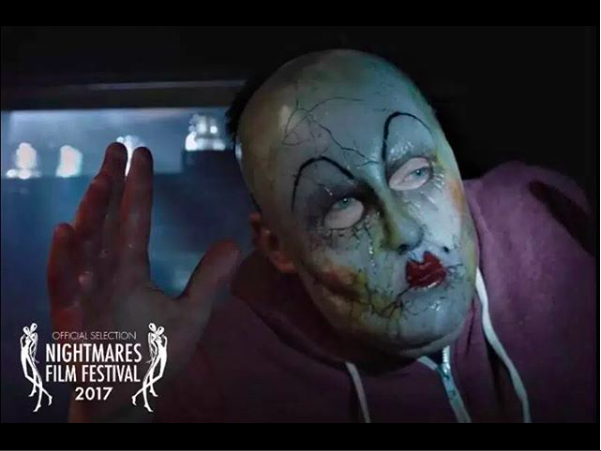
Actress Jennifer Titus has never been to a horror film festival. Hell, she’s never been to Columbus, but she’s all set to accompany her new film and enjoy Nightmares Film Festival this weekend.
Titus stars as Ashley, a serial killer’s neighbor with the skills to take care of herself in Tom Holland’s newest Rock, Paper, Dead. The film, which has garnered several festival nominations, will make its world premiere at Nightmares.
A longtime horror fan, Titus was thrilled to be offered a role in the film penned by Friday the 13th creator Victor Miller.
“My very first horror film was Friday the 13th,” she says. “Honestly, I was so honored to be reading this. And it was a page-turner. When I met Victor Miller, he was such a real, down to earth guy and such a calm, beautiful soul. And I thought, I would be honored to do this.”
Acting was not exactly her first career choice.
“When I was about 6 or 7, my grandfather asked me what I wanted to do when I grew up,” she remembers. “I said I wanted to be a professional figure skater, a doctor and a movie star. He told me, ‘Well I have no doubt you will do all three.’”
He was right.
A figure skater throughout her childhood, Titus turned professional at 18, touring the country and the world with ice shows. Eventually, she returned to school, earning a degree from UC San Diego in science and theater, then moving on to medical school.
“Toward my last year I really missed acting,” she says. “I just wasn’t getting that creative fulfillment in medical school, so when I graduated I got right back into acting.”
But her medical degree came in handy.
“I got into a situation where I was acting and they needed a doctor for an emergency,” she says. “We were actually in the jungle and there was a guy who had a bamboo stake driven into his leg underneath his muscle. I jumped right in and did field medicine surgery on the guy and I ended up saving his leg – bamboo is very toxic. When I visited him about three days later, about 30 people there to meet me and thank me. It was so rewarding I just thought to myself, I need to go back, get licensed.”
Titus returned to medicine, completed her residency, passed the board exam, got licensed and returned to acting.
“I always knew I wanted to do these things,” she laughs. “It’s not like I was confused and I was career jumping. I was just knocking them off the list.”
Titus sees a connection among the professions.
“When I was little, I was always interested in blood and guts,” she says. “Honestly, that’s one of the things I always loved about medicine. It never was scary to me or gross to me, it always fascinated me.”
Titus says her character in Rock, Paper, Dead—a black belt in karate—was the ideal role for her.
“My best friend and I, every Saturday night, would go down to the video store and rent one to two horror films. We’d get under the covers, cover our faces with pillows and squeal. That went on for years.”
“I specifically remember Nightmare on Elm Street 4: The Dream Master,” she says. “The main character was a girl that took on all the powers of her friends who were killed off by Freddy Krueger. She became just a ninja master by the end. And I thought, oh my gosh, that is just the coolest character I have ever seen in all these horror films. I thought, what a great example, finally, of a strong female who can take this guy on. And when I got this script for Rock, Paper, Dead, I thought, oh my gosh, it’s the dream master. I have to do it. It’s so cool.”
Nighmares Film Festival runs from Thursday, October 19 through Sunday, October 22.
Rock, Paper, Dead, which makes its world premiere this Saturday, October 21 at 8pm, is nominated in the categories of Best Thriller Feature and Best Screenplay Feature.
There are countless reasons the Middle East has not been a hotspot of horror film output. Chief among them may be censorship, but the truth is that many of the countries in the area have a lot more to deal with right now than making movies.
Still, horror cinema has become a blossoming industry. Film as art has always been a renegade’s opportunity to make a political statement and horror can be an inexpensive way to speak your mind. Films like Omar Khan’s 2007 Pakistani horror mash-up Devil’s Ground, though highly flawed, worked as both an homage to Western horror tropes and a comment on Pakistani life. And the 2015 film Jeruzalem filmed its first-person found-footage right in the holy city.
Here we count down the five very best of the genre coming from the region in a podcast recorded live at Gateway Film Center.
5. Rabies (2010)
(Israel)
So, weirdly enough this film has literally nothing to do with rabies. Like, at all. But, it does have a relentless nature and seriously weird attitude, mashing together serial killer, slasher and wooded horror to nice effect.
Filmmakers Navot Papushado and Aharon Keshales started their journey in film and in horror here, with a genre mishmash that mostly works.
We open in a pit. A pitiful woman is calling out from the darkness. We soon realize that she and her brother 1) have run away from something, and 2) share a dark, unseemly secret. But that’s almost beside the point.
This story introduces the serial killer who haunts the film but hardly does the most damage. When a group of lost tennis players wanders into the woods—first to help the brother, then to escape a morally questionable cop—and a good guy of a forest ranger gets mixed up in all of it, well, things take weird turns. Bloody turns.
There’s an unsettling comic element to everything and performances are uniformly excellent. It’s an ambitious effort that does not entirely satisfy, but you find yourself really pulling for some of these guys and completely forgetting about that landmine.
4. Baskin (2015)
(Turkey)
Welcome to hell! Turkish filmmaker Can Evrenol invites you to follow a 5-man police squad into the netherworld, where eye patches are all the rage, pregnancy lasts well under the traditional 40 weeks, and you don’t want to displease Daddy.
The serpentine sequencing of events evokes a dream logic that gives the film an inescapable atmosphere of dread, creepily underscored by its urgent synth score. Evrenol’s imagery is morbidly amazing. Much of it only glimpsed, most of it left unarticulated, but all of it becomes that much more disturbing for its lack of clarity.
The further along the squad gets, the more often you’ll look in horror at something off in a corner, that sneaking WTF? query developing along with your upset stomach.
The central figures in this nightmare are one eye-patch wearing helper who enjoys tossing his or her hair over one shoulder, and the breathtaking father figure played by Mehmet Cerrahoglu. There is no one quite like him.
Cerrahoglu’s remarkable presence authenticates the hellscape. Evrenol’s imaginative set design and wise lighting choices envelope Cerrahoglu, his writhing followers, and his victims in a bloody horror like little else in cinema.
3. Big Bad Wolves (2013)
(Israel)
A mixture of disturbing fairy tale and ugly reality, Israel’s Big Bad Wolves takes you places you really don’t want to go, but damn if it doesn’t keep you mesmerized every minute.
The particularly vulgar slaughter of several little girls sets events in motion. One teacher is suspected. One cop is driven. One father suffers from grief-stricken mania. It’s going to get really ugly.
Filmmakers Aharon Keshales and Navot Papushado (Rabies) implicate everyone, audience included. They create intentional parallels among the three men, pointing to the hypocrisy of the chase and making accusations all around of a taste for the intoxicating bloodlust that comes from dominating a weaker person.
Their taut and twisty script keeps surprises coming, but it’s the humor that’s most unexpected. Handled with dark, dry grace by Lior Ashkenazi (the cop) and Tzahi Grad (the father) – not to mention Doval’e Glickman (the grandfather) – this script elicits shamefaced but magnetic interest. You cannot look away, even when the blowtorch comes out. And God help you, it’s hard not to laugh now and again.
2. Under the Shadow (2016)</h2 (Iran)
Our tale is set in Tehran circa 1988, at the height of the Iran/Iraq war and just a few years into the “Cultural Revolution” that enforced fundamentalist ideologies.
Shideh (a fearless Narges Rashidi) has been banned from returning to medical school because of her pre-war political leanings. Her husband, a practicing physician, is serving his yearly medical duty with the troops. This leaves Shideh and their young daughter Dorsa (Avin Manshadi) alone in their apartment as missiles rain on Tehran.
When a dud missile plants itself in the roof of the building (shades of del Toro’s Devil’s Backbone), Dora starts talking to a secret friend. Maybe the friend would be a better mommy.
The fact that this menacing presence – a djinn, or wind spirit – takes the shape of a flapping, floating burka is no random choice. Shideh’s failure in this moment will determine her daughter’s entire future.
Anvari casts the political climate meticulously, as forces beyond Shideh’s control – some supernatural, some cultural, all dangerous – surround her.
Frazzled, impatient, judged and constrained from all sides, Shideh’s nerve is hit with this threat. And as external and internal anxieties build, she’s no longer sure what she’s seeing, what she’s thinking, or what the hell to do about it.
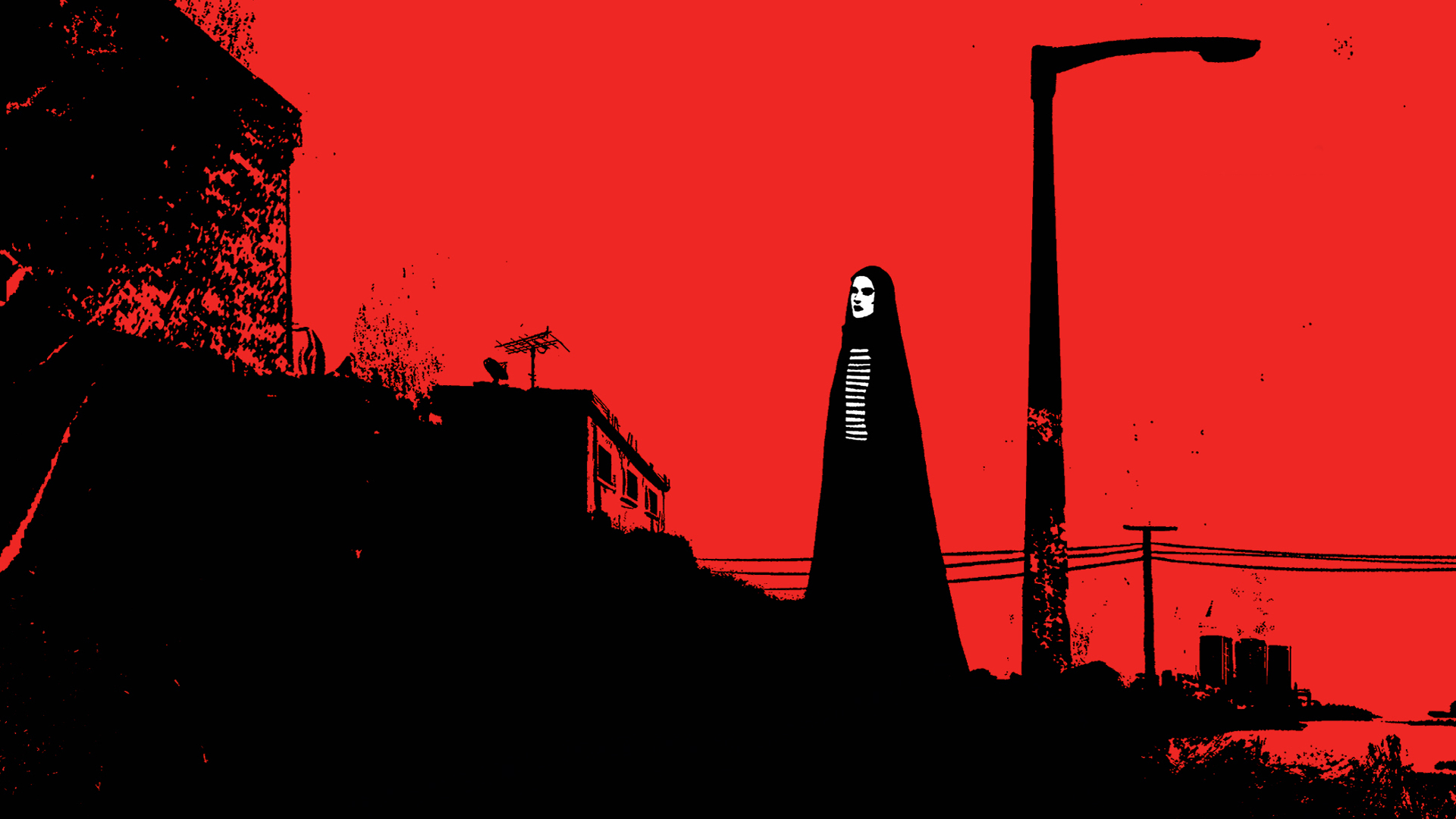
1. A Girl Walks Home Alone at Night (2014)
(Iran/US)
Writer/director Ana Lily Amirpour has made the world’s first Iranian vampire movie, and though she borrows liberally and lovingly from a wide array of inspirations, the film she’s crafted is undeniably, peculiarly her own.
Amirpour is blessed with a cinematographer in Lyle Vincent capable of translating her theme of loneliness in a dead end town, as well as the cultural influences and Eighties pop references, into a seamless, hypnotic, mesmerizingly lovely vision. The film is simply, hauntingly gorgeous.
Amirpour develops a deliberate pace that makes the film feel longer, slower than is probably necessary. The time is spent with singular individuals – a prostitute (a world-wearied and magnificent Mozhan Marno), a drug-addicted father (Marshall Manesh), a street urchin (Milad Eghbali), a pimp (Dominic Rains), and a rich girl (Rome Shadanloo). Two people weave in among these players – the handsome Arash (Arash Marandi), and a lonesome vampire (Sheila Vand).
Though these are character types more than characters outright, Amirpour and her actors don’t abandon them. Each has breath and dimensionality, their fate a question that piques sympathy.
Vand’s Girl is the constant question mark, and that – along with the eerie, sometimes playful beauty of Vincent’s camerawork – is what makes the film unshakably memorable. I promise the image of a vampire on a skateboard will stay with you.
Remember the unbelievable bounty in home entertainment last week? Well, it can’t be Christmas every day, kids. Things are a little slower this week, but making its way to DVD/BluRay is a decent horror flick and swimming to your screen for the first time is a shark attack flick that’s not nearly as bad as you think it is. Also, a 17-hour long movie about kids toys dating back to medieval times or some such bullshit.
So, there’s this one set of movies you may or may not be aware of about a guy with a William Shatner fixation just trying to get home in time for Halloween. You may have heard of it.
Here’s the thing, there are also other Halloween-themed movies you could watch this holiday if you’re so inclined. Loads of them. And while we feel like you probably know which Michael Meyers movies to skip (5 & 8), which to love (1, duh), and which to watch for the ironic enjoyment (6—we’re looking at you, Paul Rudd!), you might need some direction outside that series. So, here are our five favorite non-franchise Halloween horror movies.
5. Night of the Demons (1988)
It’s Halloween night in the late Eighties and a bunch of high school kids decides to go hang out at Angela’s party because, as the resident goth girl, “Halloween is like Christmas to Angela.”
Where’s the party? At the old, abandoned funeral parlor built over sacred land above some kind of demonic water source. Natch.
Do not be confused – Night of the Demons is not exactly recommended viewing. It’s terrible. Once you get past its dirt-cheap sets and TV-level staging, you’ll notice that the film boasts among the most stilted and cardboard dialogue of any film from the Aquanet decade.
But Angela (Amelia “Mimi” Kinkade) looks cool. Every goth chick— Fairuza Balk’s Nancy Downs from The Craft in particular—owes Angela a little respect. And professional dancer Kinkade does the demonic transformation justice. The acting is atrocious—all of it— but the film boasts a campy, nostalgic, oh-so-80s quality, and we never disagree with Bauhaus on a soundtrack.
4. Murder Party (2007)
Jeremy Saulnier is a filmmaker worth watching. Murder Party is not the near-masterpiece of Blue Ruin or Green Room, but it is a savvy, funny, fun change of pace.
Chris Sharp plays lonesome loser Christopher. Alone with his selfish cat on Halloween night, he decides to follow a whim and hit the party advertised on a flier. A “Murder Party.”
Fun!
What Saulnier pieces together could have dripped with condescending judgment, as a group of insecure art students plot to kill the poor guy as a piece of art that will impress Alexander (Sandy Barnett) enough to nab them the grant Alexander keeps lording over them.
The comedy is more self-referential and human than snide, simultaneously mocking and empathizing with the group of artists as well as their would-be victim.
Funny, tender, biting and often quite bloody and energetic, Murder Party does not suggest the style of film to come from Saulnier, but it predicts a filmmaker who knows what he’s doing.
https://www.youtube.com/watch?v=qI_DqgxNR7U
3. Ginger Snaps (2007)
Ginger and Bridget, outcasts in the wasteland of Canadian suburbia, cling to each other and reject/loathe high school (a feeling that high school in general returns).
On the evening of Ginger’s first period, she’s bitten by a werewolf. Writer Karen Walton cares not for subtlety: the curse, get it? It turns out, lycanthropy makes for a pretty vivid metaphor for puberty.
This turn of events proves especially provocative and appropriate for a film that upends many mainstay female cliches. Walton’s wickedly humorous script stays in your face with the metaphors, successfully building an entire film on clever turns of phrase, puns, and analogies, stirring up the kind of hysteria that surrounds puberty, sex, reputations, body hair, and one’s own helplessness to these very elements.
A well-timed Halloween party allows Ginger to display her new look and skills in as insightful a high school horror film as you’ll find, peppered equally with dark humor and gore.
https://www.youtube.com/watch?v=Zoa1A987A_k
2. May (2002)
Who wants a little romance? How about the tale of a wallflower, the blossom of new love, the efficient use of veterinary surgical equipment, and a good sized freezer?
Lucky McKee’s 2002 breakout is a showcase for his own talent as both writer and director, as well as his gift for casting. The entire ensemble surprises with individualized, fully realized, flawed but lovable characters, and McKee’s pacing allows each of his talented performers the room to breathe, grow, get to know each other, and develop a rapport.
More than anything, though, May is a gift from Angela Bettis to you.
May’s vulnerability is painful yet beautiful to watch, and it’s impossible not to hope that cool outsider Adam is telling the truth when he reassures her, “I like weird.”
McKee’s film pulls no punches, mining awkward moments until they’re almost unendurable and spilling plenty of blood when the time is right—on Halloween night, of course.
He deftly leads us from the sunny “anything could happen” first act through a darker, edgier coming of age middle, and finally to a carnage-laden climax that feels sad, satisfying, and somehow inevitable.
1. Trick ‘r Treat (2007)
Columbus native Michael Dougherty outdid himself as writer/director of this anthology of interconnected Halloween shorts. Every brief tale compels attention with sinister storytelling, the occasional wicked bit of humor and great performances, but it’s the look of the film that sets it far above the others of its ilk.
Dougherty takes the “scary” comic approach to the film—the kind you find in Creepshow and other Tales from the Crypt types—but nothing looks as macabrely gorgeous as this movie. The lighting, the color, the costumes and the way live action bleeds into the perfectly placed and articulated moments of graphic artwork—all of it creates a giddy holiday mood that benefits the film immeasurably.
Dylan Baker (returning to the uptight and evil bastard he perfected for his fearless performance in Happiness) leads a whip-smart cast that includes impressive turns from Brian Cox, Anna Pacquin, Leslie Bibb and Brett Kelly (Thurman Merman, everybody!).
And it’s all connected with that adorable menace, Sam. Perfect.
With a film like Friend Request, the task becomes creating fear out of something benign. In this case, how can a friend request on Facebook be scary? Director Simon Verhoeven tries to answer that question.
College student Laura (Alycia Debnam-Carey) has a perfect life. Instead of opening credits, the film begins with a montage of scenes from Laura’s Facebook page: pictures with friends, comments from her adoring 800+ Facebook friends, even hints of a love triangle. While there could be an element of not everything is as it seems on social media, the movie doesn’t tackle this. What we see is what we get.
Into this mix comes Marina (Liesl Ahlers), a shy, lonely woman in Laura’s 200-level psychology class. Because Laura is a nice person, when Marina sends her a friend request on Facebook, she accepts. Not only does she accept the request, she takes the time to try to get to know Marina. But because this is a horror movie, in less than two weeks, Laura regrets her decision.
There are a number of ways Friend Request could go, (Marina is perfect Single White Female material) but it takes a supernatural turn. After a falling out between Laura and Marina, Laura and all of her closest friends start having nightmares. Most of the dreams are comprised of jump scares. It works the first few times, but after the third or fourth one, they stop being effective.
At times the film is unintentionally funny. It’s hard to maintain a level of horror around Facebook. If the film had embraced the silliness of its premise, the audience could have been treated to a horror comedy that warns against the danger of too much screen time, but sadly, the film tries to maintain the scares beyond what is reasonable. The suspension of disbelief is often non-existent, as a slowly loading screen generally inspires more irrational rage than outright terror.
Friend Request does follow some interesting ideas, and the actors are mostly up to the task of carrying the film’s weaker elements, but too often there’s a sense that no one’s quite sure how to make Facebook scary. Perhaps if they’d shown the real ways Facebook sucks the life out of its users, they could have had a truly horrifying tale.