One of the members of Banarama has joined one of the members of Duran Duran in the cast of a new horror movie. That movie is assembled with the ideas and scenes from much better films, but young pop music fans probably haven’t seen any of ’em, so who cares?
Now, put on your mask and join us back in 2020. A similar mindset seems to propel 0.0 Mhz, a Shudder original that brings two stars of the South Korean K-Pop phenomenon to the screen.
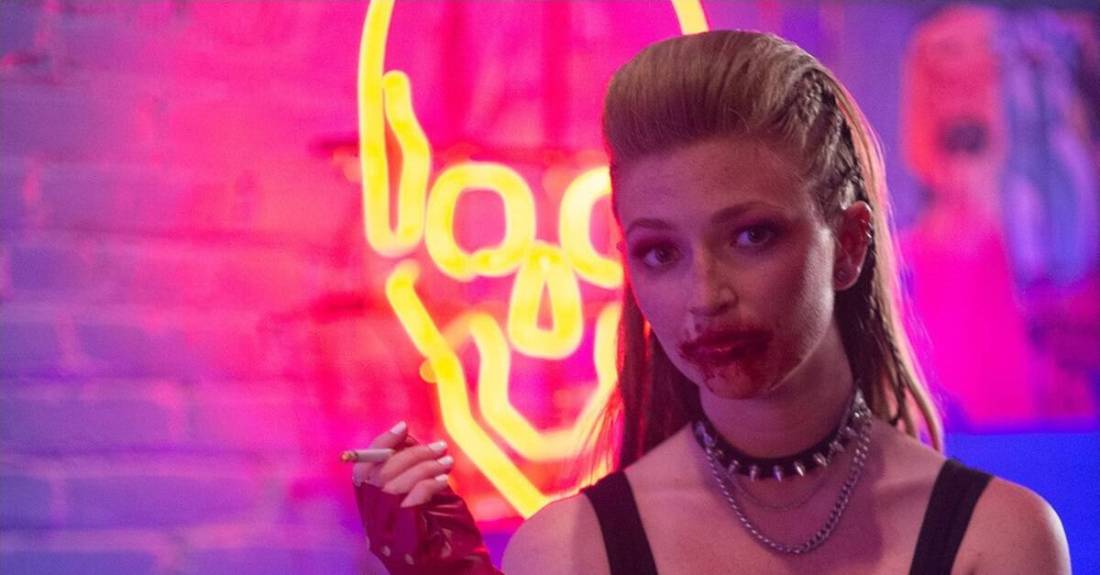
Jung Eun-ji, lead singer of the band Apink, also takes the lead here as So-hee, the newbie in a teen team of ghost-chasers known as “Club 0.0 Mhz.” See, that’s the best frequency to call ghosts (don’t argue), and So-hee’s first outing with the group is to a supposedly haunted house in the woods where the kids aim to dial up a little necromancy.
But what Sang-Yeob (Lee Sung-yeol from the band Infinite) and the rest of the gang don’t know is…their new recruit comes from a long line of dead people-seers.
The local at the general store who tells them all not to go to there is just the first in a string of heavily borrowed narrative checkpoints. Pulling from The Grudge to Elm Street to The Conjuring to The Exorcist, first time director Sun-Dong Yoo adapts Jang Jak’s popular webcomic with barely a whisper of originality or visual flair.
But 0.0 Mhz is clearly aimed a notch below anyone who has seen those films. This is strictly teenage fare, content to provide good-looking idols to swoon over and warmed-over scares for kids who want to scream but not have nightmares.
It accomplishes that, and not much else.
So when get-togethers are all good again, 0.0 Mhz will be more than ready to slumber party!
Writer/director Bryan Bertino creates an awful lot of terror beginning with that line.
A couple heads to an isolated summer home after a wedding. It was meant to be the first stop on their life together, or so we gather, but not all worked out as James (Scott Speedman) had planned. As he and what he’d hoped would be his fiancé, Kristen (Liv Tyler), sit awkwardly and dance around the issue, their very late night is interrupted by a knock and that immediately suspicious question.
Bertino beautifully crafts his first act to ratchet up suspense, with lovely wide shots that allow so much to happen quietly in a frame. This is a home invasion film with an almost unbearable slow burn.
Bertino creates an impenetrably terrifying atmosphere of not just helplessness, but sadistic game playing. The film recalls Michael Haneke’s brilliant Funny Games, as well as the French import Them, but Bertino roots the terror for his excruciating cat and mouse thriller firmly in American soil, with scratchy country blues on the turntable, freshly pressed Mormon youths on bicycles, and rusty Ford pick ups hauling folks in kids’ Halloween masks.
His image is grisly and unforgiving – part and parcel with the horror output of the early 2000s – but The Strangers is a cut above other films of its decade.
Yes, this couple makes a lot of bad decisions. Indeed, Kristen appears to be borderline mentally challenged. But in this particular situation, they probably just aren’t thinking clearly.
Frank Darabont really loves him some Stephen King, having adapted and directed the writer’s work almost exclusively for the duration of his career. While The Shawshank Redemption may be Darabont’s most fondly remembered effort, The Mist, an under-appreciated creature feature, is our vote for his best.
David Drayton (Thomas Jane) and his young son head to town for some groceries. Meanwhile, a tear in the space/time continuum (who’s to blame?!) opens a doorway to alien monsters. So Drayton, his boy, and a dozen or so other shoppers all find themselves trapped inside this glass-fronted store just waiting for rescue or death.
Marcia Gay Harden is characteristically brilliant. As the religious zealot who turns survival inside the store into something less likely than survival out with the monsters, she brings a little George Romero to this Stephen King.
In a Romero film, no matter how great the threat from the supernatural, the real monsters tend to be the rest of the humans. King does not generally go there, but he does so with The Mist and it’s what makes this one of his most effective films.
While Harden excels in a way that eclipses all other performances, the whole cast offers surprisingly restrained and emotional turns – Toby Jones is especially effective.
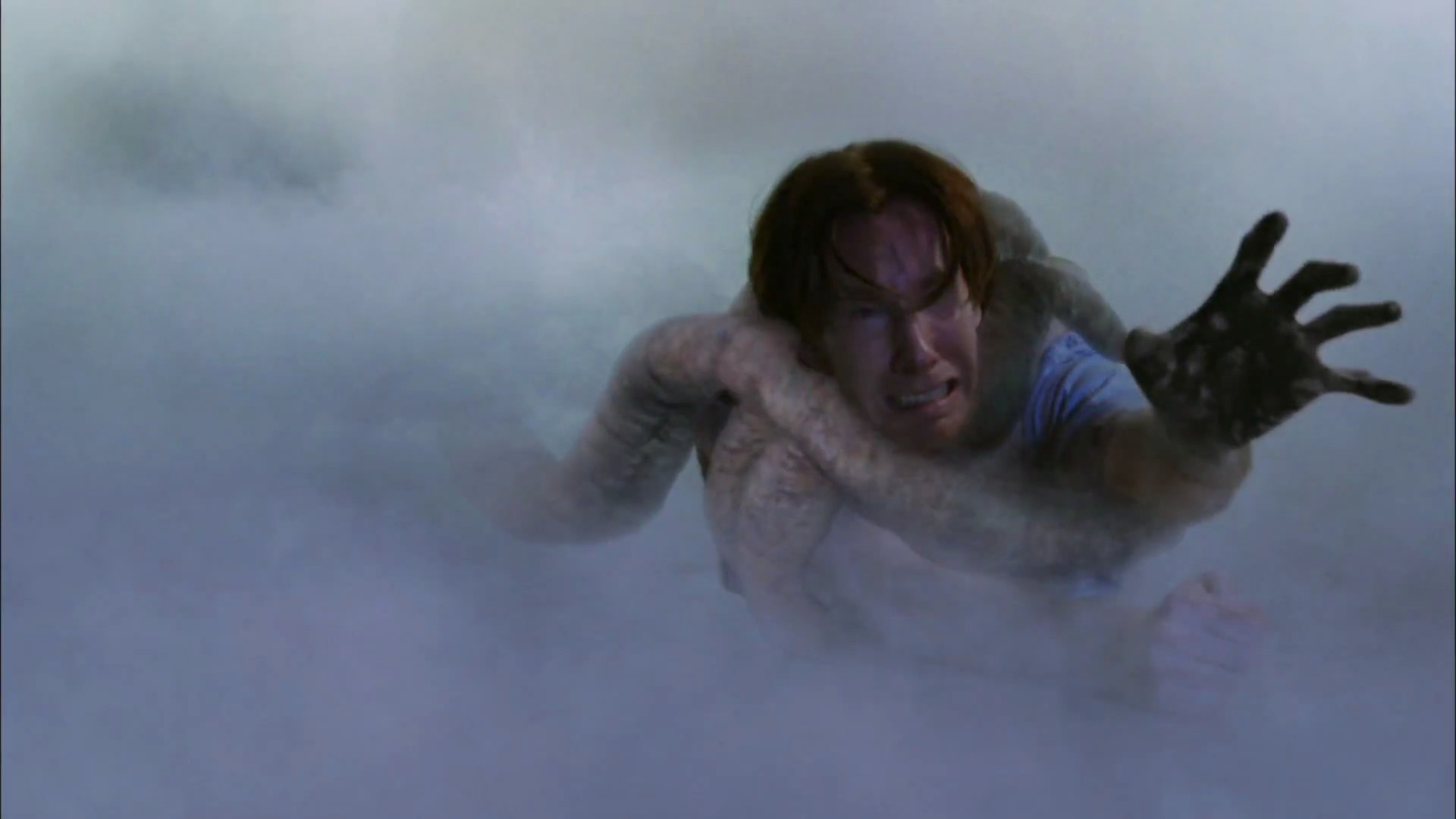
The FX look good, too, and let’s be honest, a full-on monster movie with weak FX is the lamest. The way Darabont frames the giants, in particular, gives the film a throw-back quality to the old matinee creature features. But he never gives into cheekiness or camp. The Mist is a genuinely scary film – best seen in the black and white version if you can find it.
Regardless, it’s the provocative ending that guarantees this one will sear itself into your memory. Though this is likely what kept The Mist from gaining an audience in theaters, it is a brilliant and utterly devastating scene that elevates the film from great creature feature to great film.
It’s time to get real. And by that, we mean real nasty.
There’s something not quite right about Chris Cleese (an unsettlingly cherubic Sean Bridgers), and his family’s uber-wholesomeness is clearly suspect. This becomes evident once Chris hunts down a feral woman (an awesome Pollyanna McIntosh), chains her, and invites the family to help him “civilize” her.
The film rethinks family – well, patriarchy, anyway. Notorious horror novelist and co-scripter Jack Ketchum may say things you don’t want to hear, but he says them well. And director Lucky McKee – in his most surefooted film to date – has no qualms about showing you things you don’t want to see. Like most of Ketchum’s work, The Woman is lurid and more than a bit disturbing. (Indeed, the advanced screener I watched back when the film was first released came in a vomit bag.)
Aside from an epically awful performance by Carlee Baker as the nosey teacher, the performances are not just good for the genre, but disturbingly solid. McIntosh never veers from being intimidating, terrifying even when she’s chained. Bridgers has a weird way of taking a Will Ferrell character and imbibing him with the darkest hidden nature. Even young Zach Rand, as the sadist-in-training teen Brian, nails the role perfectly.
Nothing happens in this film by accident – not even the innocent-seeming baking of cookies – nor does it ever happen solely to titillate. The Woman offers a dark and disturbing adventure that finds something unsavory in our primal nature and even worse in our quest to civilize.
Don’t even ask about what it finds in the dog pen.
The success of Shudder’s wildly informative and entertaining 2019 doc Horror Noire (still streaming – see it!) paved the way for their new 5-show doc series, Cursed Films. Each of writer/director Jay Cheel’s episodes spends 30 minutes examining one allegedly cursed horror movie production: The Exorcist, Poltergeist, The Omen, The Crow and Twilight Zone: The Movie.
Episodes 1 – 3 were made available for review, and the first thing we noticed was that each show is stronger than the last. Our hopes were highest for Ep 1: The Exorcist, but the series has a tough time finding its footing. The idea of a “cursed” production never really materializes and the episode feels padded with unrelated material.
In particular, time spent with a shyster modern day exorcist adds little to the overall theme of the program and offers limited at best entertainment value.
Poltergeist is a film more recognized for an alleged curse, so there’s a little more meat on Ep 2’s bone. Cheel opens up a handful of different, related conversations and braids them interestingly. The episode actually examines the bad luck that dogged all three films in the Poltergeist series and gets some skinny from one of the filmmakers (no, not that one).
It digs a little more at fan obsession in ways that non-Shudder audiences might mock while feeling perfectly at home with this target market. Still, the content feels light and the doc never seems to unveil much.
By Episode 3, though, Cursed Films finds its groove. The Omen offers not only more bountiful nuttiness to examine, but bigger and more interesting interview opportunities.
The big question: Why repeatedly use the single least flattering photo ever taken of Gregory Peck?
By halfway through the series, Cheel has begun to dig into the psychology of what makes a person – or the public – cling to the idea of a curse in the first place, and the psychology on display in this episode is fantastic. The random nut job guests, however, still feel like an unpleasant way to pad.
Though Episodes 4 and 5 were not available for review, the series seems to have hit its stride just as it hits two films that, while less popular than the first three in the series, suffered more profound bad luck than the first three combined.
Misery loves company, yeah? So let’s hang out with some other folks whose stir-craziness leads to even worse decision making than our own. For the first time ever (to avoid a salt-in-the-wound effect), we are sticking strictly to movies you can stream right now—which means The Lodge didn’t make it, although we do really love that movie.
6. 10 Cloverfield Lane (2016)
More
of a second cousin than a sequel to 2008’s Cloverfield, 10
Cloverfield Lane is a claustrophobic thriller. No found footage. No shaky
camera. No perturbed kaiju.
Michelle
(Mary Elizabeth Winstead) wakes from a car crash handcuffed to a pipe in a
bunker. Howard (John Goodman, top-notch as usual), may simply be saving her
from herself and the apocalypse outside. Good natured Emmett (John Gallagher
Jr.) certainly thinks so.
First-time director Dan Trachtenberg ratchets up the tension as the film progresses, finding the creepiness in even the most mundane domestic activities, as an award-worthy performance from John Goodman reminds us monsters come in many forms.
*Cheapest on YouTube, Google Play, Vudu
5. Rammbock: Berlin Undead
Why does this film work?
Michael (Michael Fruith) arrives in Berlin to visit his recently-ex
girlfriend. She’s not home. While he waits in her apartment, Berlin falls prey
to the zombipocalypse.
It’s actually the rage virus, and it’s how well Rammbock plays like the
Berlin equivalent of 28 Days Later or Quarantine that helps
it excel.
Michael finds himself trapped inside his ex’s apartment building, scheming
survival tricks with the plumber hiding out with him. The team work, strategy,
human kindness and pathos all combine with really solid acting and more than a
few well-choreographed action bits to help this film more than transcend
familiar tropes.
You love these guys. You believe in them, and the idea that they won’t make it through this is dreadful. Director/co-writer Marvin Kren, blessed with a stellar cast, works your sympathies and your nerves.
*Amazon Prime, Google Play, Vudu, iTunes
4. What Ever Happened to Baby Jane? (1962)
Bette Davis and Joan Crawford? Yes, please!
The two then-aging (just barely, if we’re honest) starlets played aging
starlets who were sisters. One (Davis’s Jane) had been a child star darling.
The other (Crawford’s Blanche) didn’t steal the limelight from her sister until
both were older, then Blanche was admired for her skill as an adult actress.
Meanwhile, Jane descended into alcoholism and madness. She also seemed a bit lax
on hygiene.
Blanche winds up wheelchair bound (How? Why? Is Jane to blame?!) and Jane’s
envy and insanity get the better of her while they’re alone in their house.
Famously, the two celebrities did not get along on set or off. Whether true
or rumor, the performances suggest a deep, authentic and frightening hatred
borne of envy that fuels the escalating tension.
Davis is at her unhinged best in a performance that earned her an Oscar nomination. Crawford pales by comparison (as the part requires), but between the hateful chemistry and the story’s sometimes surprising turns, this is a movie that ages well, even if its characters did not.
*super cheap on Amazon Prime, YouTube, Google Play
3. It Comes at Night (2017)
Deep in the woods, Paul (Joel Edgerton, solid as always),
Sarah (Carmen Ejogo) and their teenage son Travis (Kelvin Harrison, Jr.) have
established a cautious existence in the face of a worldwide plague. They have
boarded their windows, secured their doors, and enacted a very strict set of
rules for survival.
At the top of that list: do not go out at night.
Writer/director Trey Edward Shults explores the confines of the house with a
fluid camera and lush cinematography, slyly creating an effective sense of
separation between the occupants and the dangers outside. But what are those
dangers, and how much of the soul might one offer up to placate fear itself? In
asking those unsettling questions, It Comes at Night becomes a
truly chilling exploration of human frailty.
*Netflix
2. Housebound (2014)
Gerard Johnstone writes and directs, though his brightest accomplishment may
be casting because Morgana O’Reilly’s unflinching performance holds every
moment of nuttiness together with brilliance.
O’Reilly plays Kylie, a bit of a bad seed who’s been remanded to her
mother’s custody for 8 months of house arrest after a recent spate of bad luck
involving an ATM and a boyfriend who’s not too accurate with a sledge hammer.
Unfortunately, the old homestead, it seems, is haunted. Almost against her
will, she, her hilariously chatty mum (Rima Te Wiata) and her deeply endearing
probation officer (Glen-Paul Waru) try to puzzle out the murder mystery at the
heart of the haunting. Lunacy follows.
Good horror comedies are hard to come by, but Johnstone manages the tonal shifts magnificently. You’re nervous, you’re scared, you’re laughing, you’re hiding your face, you’re screaming – sometimes all at once. And everything leads up to a third act that couldn’t deliver any better.
*free on Tubi; also on iTunes
1. The Shining (1980)
It’s isolated, it’s haunted, you’re trapped, but somehow
nothing feels derivative and you’re never able to predict what happens next.
It’s Stanley Kubrick’s masterpiece rendition of Stephen King’s The Shining.
A study in atmospheric tension, Kubrick’s vision of the
Torrance family collapse at the Overlook Hotel is both visually and aurally
meticulous. It opens with that stunning helicopter shot, following Jack
Torrance’s little yellow Beetle up the mountainside, the ominous score
announcing a foreboding that the film never shakes.
The hypnotic, innocent sound of Danny Torrance’s Big Wheel against the weirdly phallic patterns of the hotel carpet tells so much – about the size of the place, about the monotony of the existence, about hidden perversity. The sound is so lulling that its abrupt ceasing becomes a signal of spookiness afoot.
Director Adam Egypt Mortimer’s stylish image of mental illness takes a kind of demonic Fight Club angle, hits some mildly homoerotic notes (like Fight Club didn’t?), and offers a quick and absorbing- if hardly new- horror show.
Co-writing with Brian DeLeeuw an adaptation of DeLeeuw’s
novel In This Way I Was Saved, Mortimer drops us mid-mom scream into an
average afternoon in the life of poor little Luke (Griffin Robert Faulkner,
painfully adorable).
As Luke wanders away from home to avoid his mother’s
psychotic episode, he witnesses the aftermath of a gruesome murder, but finds a
new friend: Daniel.
Quickly enough, Daniel is helping Luke cope with his
personal trauma, taking his mind off his problems, and maybe encouraging some
truly evil behavior.
From here Mortimer directs us to an effectively creepy doll
house (such a great prop in nearly any terrifying film or terrifying child’s
bedroom), which will become (as it does in Hereditary and The Lodge)
a fine symbol for the madness of the mind.
Mortimer’s film looks great and benefits from a trio of
strong performances.
Mary Stuart Masterson, playing Luke’s paranoid schizophrenic
mother, gives a brave and believable performance in a role that can easily be
overdone.
More importantly, Mortimer’s besties/worsties Luke and
Daniel (Miles Robbins and Patrick Schwarzenegger, respectively) create complete
characters and offer an uneasy chemistry that keeps the film intriguing.
As Luke’s life spins inevitably out of control, Daniel’s
clothing takes on a more and more Tyler Durden style, and I can get behind
that. And a certain point near Act 3, Daniel Isn’t Real takes a weird
and welcome Clive Barker turn, which is when elements stop being so stylishly
predictable and become sloppily fascinating.
The unfortunate Magical Negro trope that will not die
surfaces here. It doesn’t entirely sink the film, but it does its damndest to do
just that.
Even so, Daniel Isn’t Real is an Olympic-sized leap forward from Mortimer’s previous feature, Some Kind of Hate, the director here showcasing an unpredicted visual flair and storytelling finesse. Though his film treads some well-worn ground, the way Mortimer and team balance the supernatural and psychological push and pull creates an unnerving atmosphere.
People like to make lists. For some people, it’s a bucket list. Some like to keep track of the celebrities they are allowed to sleep with if the opportunity arises. Not me.
Years ago I put together my zombie survival team. And though I know plenty of people with varied and worthy skills, making my team mainly came down to two things. Are you smart? Are you quiet? Because it is the introverts of the world who will survive the zombie apocalypse.
Director Dominique Rocher’s unusually titled The Night Eats the World understands this.
Sam (Anders Danielsen Lie) reluctantly stops by his ex’s party to collect his things. It is a loud, raucous event and Sam is in no mood. He stands moping alone until finally he wanders into a quiet back office, locks the door to the partygoers and waits.
By morning, Sam may be the only living human left in Paris.
The majority of the film quietly follows Sam through the apartment building as he fortifies his position, spends his time, survives. It’s a pleasantly pragmatic approach to the zombie film, although it asks many of the same questions Romero asked in Dawn of the Dead.
In fact, TNETW sometimes bears an amazing resemblance to the underseen German zombie flick Rammbock: Berlin Undead. (It’s great. You should see it.)
There’s a lot going on here that’s fresh, though. Rarely is a zombie film this introspective or a horror hero this thoughtful. More than that, though, Rocher’s horror is a meditation on loneliness.
Not only is that an unusual topic for horror, it’s delivered with the kind of touching restraint that’s almost inconceivable in this genre.
Danielsen Lie, in what nearly amounts to a one-man-show, never lets you down and never feels showy. Sam is a man who is maybe too at home with the situation in a film that quietly asks, just what has to happen before a true introvert longs for human companionship?
That’s why they’ll outlast us. It’ll just be a few dozen socially uncomfortable loners skilled at closing themselves off from the chaos around them. Plus Keith Richards.
As we salute the tireless work of our great doctors and health care workers during this uneasy time, Fright Club looks at our favorite “bad doctors” in horror!
5. Herbert West, Re-Animator (1985)
Stuart Gordon’s Re-Animator reinvigorated the Frankenstein
storyline in a decade glutted with vampire films. Based, as so many
fantasy/horror films are, on the work of H. P. Lovecraft, Re-Animator
boasts a good mix of comedy and horror, some highly subversive ideas, and one
really outstanding villain.
Jeffrey Combs, with his intense gaze and pout, his ability to mix comic
timing with epic self righteousness without turning to caricature, carries the
film beginning to end. His Dr. Herbert West has developed a day-glo serum that
reanimates dead tissue, but a minor foul up with his experimentations – some
might call it murder – sees him taking his studies to the New England medical
school Miskatonic University. There he rents a room and basement laboratory
from handsome med student Dan Caine (Bruce Abbott).
They’re not just evil scientists. They’re also really bad doctors.
Re-Animator is fresh. It’s funny and shocking, and though most
performances are flat at best, those that are strong more than make up for it.
First-time director Gordon’s effort is superb. He glories in the macabre fun of
his scenes, pushing envelopes and dumping gallons of blood and gore. He
balances anxiety with comedy, mines scenes for all they have to give, and takes
you places you haven’t been.
4. Beverly and Elliot Mantle, Dead Ringers, (1988)
This film is about separation anxiety, with the effortlessly melancholy
Jeremy Irons playing a set of gynecologist twins on a downward spiral.
Writer/director David Cronenberg doesn’t consider this a horror film at all.
Truth is, because the twin brothers facing emotional and mental collapse are
gynecologists, Cronenberg is wrong.
Take, for instance, the scene with the middle aged woman in stirrups, camera
on her face, which is distorted with discomfort. Irons’s back is to the screen,
her bare foot to his left side. Clicking noises distract you as the doctor
works away. We pan right to a tray displaying the now-clearly-unstable doctor’s
set of hand-fashioned medical instruments. Yikes.
Irons is brilliant, bringing such flair and, eventually, childlike charm to
the performances you feel almost grateful. The film’s pace is slow and its
horror subtle, but the uncomfortable moments are peculiarly, artfully
Cronenberg.
2. Dr. Heiter, The Human Centipede (First Sequence) (2009)
After a handful of middling Dutch comedies, Tom Six stumbled upon inspiration – 100% medically accurate inspiration. Yes, we mean the Human Centipede. Just the First Sequence makes the list, though.
For a lot of viewers, the Human Centipede films are needlessly gory and over-the-top with no real merit. But for some, Six is onto something. His first effort uses a very traditional horror storyline – two pretty American girls have a vehicular break down and find peril – and takes that plot in an unusual direction. But where most horror filmmakers would finish their work as the victims wake up and find themselves sewn together, mouth to anus, this is actually where Six almost begins.
Although the film mines something primal about being helpless in the hands of surgeons and doctors, it’s Dieter Laser and his committed, insane performance that elevates this film. That and your own unholy desire to see what happens to the newly conjoined tourists.
2. Dr. Genessier, Eyes Without a Face (1960)
The formula behind this film has been stolen and reformulated for dozens of
lurid, low-brow exploitation films since 1960. In each, there is a mad doctor
who sees his experiments as being of a higher order than the lowly lives they
ruin; the doctor is assisted by a loyal, often non-traditionally attractive
(some might say handsome) nurse; there are nubile young women who will soon be
victimized, as well as a cellar full of the already victimized. But somehow, in
this originator of that particular line of horror, the plot works seamlessly.
An awful lot of that success lies in the remarkable performances. Pierre Brasseur, as the stoic surgeon torn by guilt and weighed down by insecurities about his particular genius, brings a believable, subtle egomania to the part seldom seen in a mad scientist role.
Still, the power in the film is in the striking visuals that are the trademark of giant French filmmaker Georges Franju. His particular genius in this film gave us the elegantly haunting image of Dr. Genessier’s daughter Christiane (Edith Scob). Her graceful, waiflike presence haunts the entire film and elevates those final scenes to something wickedly sublime.
1. Hannibal Lecter, The Silence of the Lambs (1991)
Who else but Hannibal the Cannibal?
Anthony Hopkins’s eerie calm, his measured speaking, his
superior grin give Lecter power. Everything about his performance reminds the
viewer that this man is smarter than you and he’ll use that for dangerous ends.
He’s toying with you. You’re a fly in his web – and what he will do to you hits
at our most primal fear, because we are, after all, all part of a food chain.
About a year ago, Universal Studios pulled the release of The
Hunt because of the amount of gun violence. Commendable.
Later that year, other studios released Ready
or Not—critical darling, but didn’t do great box office. Then Knives
Out, which was both a critical darling and box office giant. And, of
course, Parasite
would go on to win all the Oscars. Even documentary short.
While The Hunt does contain a goodly amount of
violence—guns, knives, hand grenades, pens, stilettos, kitchen appliances—it
also boasts the one thing that appears to be the universal key to
entertainment. It hates rich people.
Who doesn’t?!
Director Craig Zobel (Compliance), along with writers Nick Cuse and Damon Lindelof (both of TV’s Watchmen and The Leftovers), takes no prisoners as characters take a bunch of prisoners, drop them in a field somewhere and, you know, hunt them down for sport. The film gleefully skewers both the left and the right, often in ways you wouldn’t expect but should.
This is a meticulously structured horror film, the tidy
beats allowing the writers to insert surprises that play on your preconceived
notions in clever ways. Like Jordan Peele, Zobel proves a nimble manipulator of
both horror tropes and social commentary.
And casting.
I have to think Betty Gilpin was the most disappointed when
this film was shelved last year because it is her break out. No more support
work as the hot mean chick, Gilpin’s Crystal is the wrong badass to
underestimate. The performance is never showy but quirky and genuine, which
goes a long way toward increasing believability.
Zobel populates the herd with familiar faces (Emma Roberts,
Ike Barinholtz, Hilary Swank, Amy Madigan), mainly for sleight of hand. Though
most get little screen time, and each is handed a fairly one-dimensional
character, both the writing and the performances mine that gimmick for a lot.
Positioned to infuriate everyone in one scene or another, the film is brash and bracingly level headed. It’s violent AF, no doubt, but what it reflects back at us is far smarter than what you might expect. The Hunt is a darkly comedic, socially savvy, equal opportunity skewering and it is a blast.