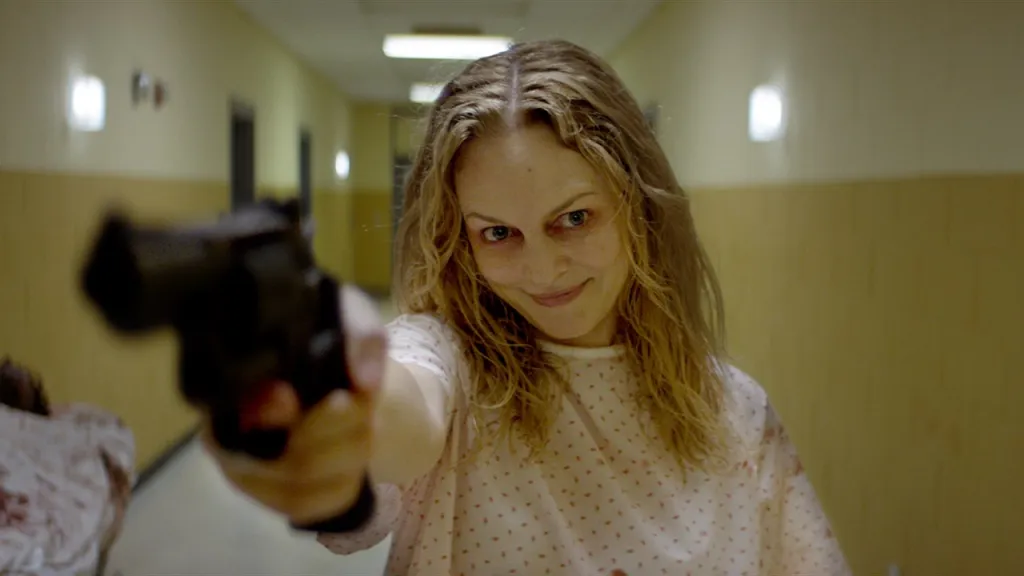
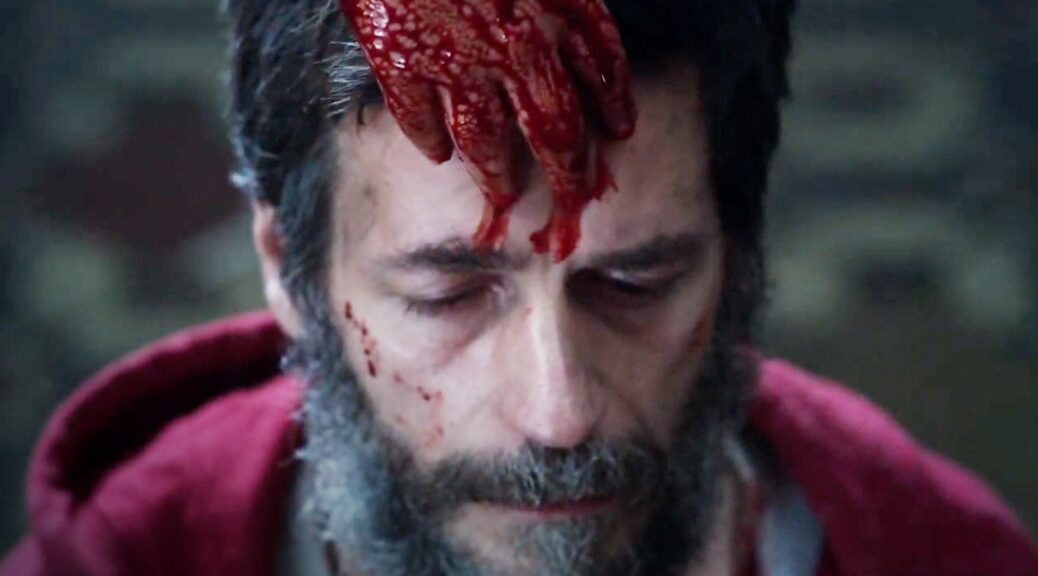
Nicolas Cage has become such a mythic figure in film culture that each new outing tends to bring questions.
Is this the unhinged “rage in the Cage?” Arthouse Cage? Mass appeal or self effacing Cage?
You can file Arcadian under “understated Cage leading a YA leaning creature feature.”
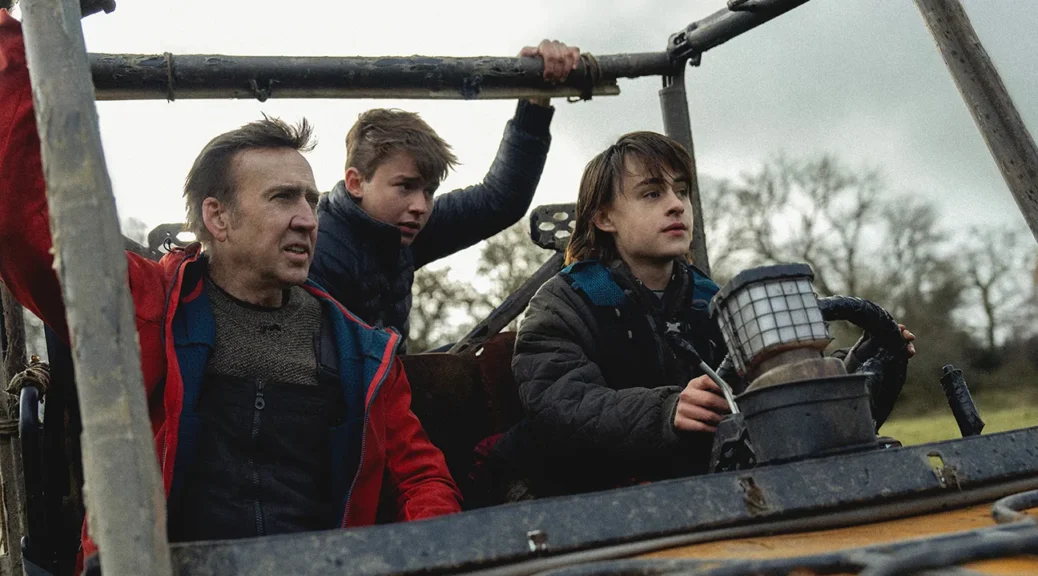
He stars as Paul, who’s living in a remote farmhouse with his twin teenage sons in a dystopian future. By day, the men follow a careful routine of security and sustenance. Because at night, there are visitors that really want to come in.
The exact details of the invasion are a little sketchy, but never elusive enough to derail our interest in the family’s survival.
Thomas (Maxwell Jenkins) is the impulsive, romantic brother, and his visits with Charlotte (Sadie Soverall) at the farm down the road have been keeping Thomas out dangerously late. His twin Joseph (Jaeden Martell) is the introspective thinker. Joseph has been studying patterns of the nightly attacks and believes the creatures have been testing, and planning.
He’s right.
Director Benjamin Brewer isn’t trying to reinvent anything here. He teams with producer-turned-screenwriter Michael Nilon for an unassuming horror thriller than benefits greatly from an impressive cast and a frightening creature design.
I don’t want to give anything away, but these bad boys have one specific trait that will get your attention right quick.
These themes aren’t new. There will be peril, bloodshed, and sacrifice as the creatures get smarter and the young begin to take on responsibilities of adulthood and cherish the things that matter. But thankfully, that familiarity doesn’t breed pandering. Brewer is also able to land some solid thrills, while the three younger co-stars provide impressive support for Cage’s elder statesman grace.
Ultimately, Arcadian doesn’t feel that much like a stereotypical “Nicolas Cage movie.” And the film is better for it.
Is there a more reliable source of terror than the spider?
Well, maybe clowns, but spiders are a close second. Australian filmmaker Kiah Roache-Turner is giddy to elicit shivers and gasps with his delightfully horrifying arachnid adventure, Sting.
Roache-Turner’s love for sci-fi horror bursts gleefully from the dollhouse-set opening credits, a scene that efficiently outlines our backstory. This snapshot playfully predicts the film, even as it homages genre classics.
The Wyrmwood director goes on to use the air ducts of an old Bronx apartment building to lay out the land, introduce us to tenants and their habits, and show our hero shimmying and crawling, all spider-like, through the building.
Who is our hero? Malcontent 12-year-old Charlotte (Alyla Browne). Her baby brother is loathsome, her parents are tedious, no one pays attention to her, her old witch of a great-aunt/land lady blames her for everything. Ugh!
But then Charlotte comes across a very cool little spider. And with so many cockroaches in Charlotte’s building, surely the newly monikered Sting will never need to look elsewhere for food!
Boy, that is lucky.
Browne channels Lulu Wilson’s Becky (maybe a little less angry). Her performance easily withstands the demands of a lead, but she does receive nice support from a variety of personalities living in the building: Nona Hazelhurt, Robyn Nevin, Danny Kim, Silvia Colloca and Jermaine Fowler.
Fiona Donovan’s production design stands out, emphasizing the film’s distinctly Joe Dante vibe. Although instead of perverting some idyllic burb, Sting ravages a storybook version of the Bronx.
But make no mistake, this movie gets nasty. The creature design and CGI are a bit campy, but the damage Sting does is convincing and pitiless. (Pet lovers be warned.)
If you missed Roache-Turner’s 2014 post-apocalyptic thrill ride Wyrmwood: Road of the Dead, definitely check it out. With that film, his fondness for Mad Max flavored a delightful riff on the zombie movie. Here he channels affection for a wide range of creature features (he really loves Alien) but still manages to create something decidedly his own.
“What is that? A llama?” says the guy at the bar, pointing to the mounted head of a rabbit with huge antlers that he actually thought was real.
“No, that’s a jackalope,” says the bartender, trying to keep a straight face. “They’re attracted to the smell of whiskey!”
“Oh…..”
That’s not a scene from Easter Bloody Easter, it’s a cherished memory from my days tending bar, and this horror comedy about a bloodthirsty jackalope is finally giving me the chance to weave it in!
It’s all just as silly as it sounds, with director/co-star Diane Foster and writer/co-star Allison Lobel setting that vibe right from a prologue that pokes fun at the well-worn horror trope of “teenage sex = death.” The two actors are much too old and their southern accents are way overdone, which is goofy and endearing. It’s only when the film forgets these roots that things get messy.
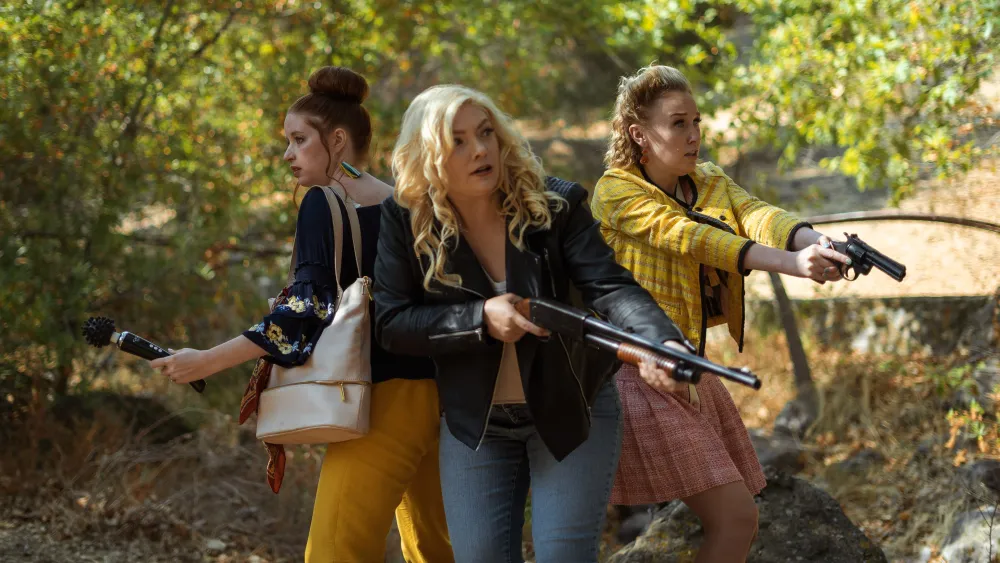
The setting is springtime in small town Texas, when everyone’s excited for the annual combination fish fry/bunny hop/egg hunt they call Easterpalooza! Check that, Jeannie (Foster) is not excited, because her husband Lance is missing! Jeannie’s best friend Carol (Kelly Grant) grabs her shotgun to join the search, and it isn’t long before the warnings from tinfoil hat-wearing Sam (Zach Kanner) begin to play out.
The urban legendary Jackalope and his army of devilish bunnies are on the loose and out for blood! So why won’t the mayor from Jaws—I mean the Sheriff—postpone Easterpalooza?
The film sends up low budget creature features, small town busybodies (with Lobel starring as the leader of the catty church ladies), conspiracy theorists and more with considerable zest. The ensemble cast, led by Grant’s strong comic timing, is all in on the gags, and the moments when fuzzy bunnies turn into maneaters are frequently hilarious.
But the absurd zaniness hits a roadblock whenever the film suddenly starts taking itself seriously. An introspective musical number hits with an especially curious thud, and the running time starts swelling enough to chip away at your patience.
When Easter Bloody Easter stays on its bloody bunny trail, though, it puts together a basket of over-the-top fun. Just be prepared to wade through some patches of grass to find all the treats.
Writer/director Barnaby Clay reimagines Hiroshi Teshigahara’s Oscar nominated 1964 classic The Woman in the Dunes as a Pacific Northwestern horror in The Seeding.
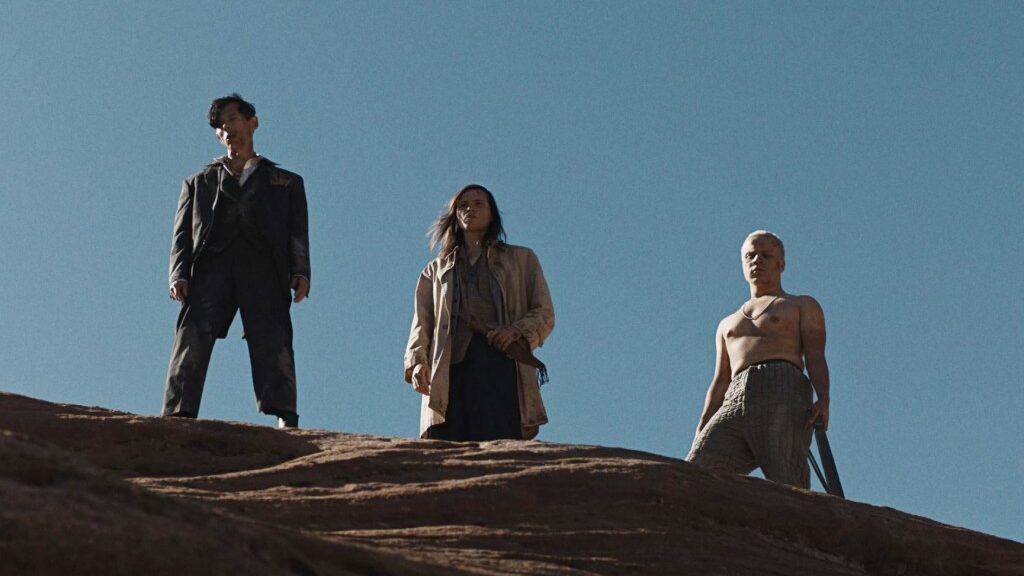
A man (Scott Haze, What Josiah Saw, Antlers) drives out to the desert for the best possible photos of a solar eclipse. He leaves his car, hikes a good way, gets the photos, and heads back to his car, but he’s sidetracked by a boy crying that he’s lost. The boy then gets the man lost. Eventually, alone and thirsty, the man climbs down a rope ladder into a gorge to ask a woman (Kate Lyn Sheil, She Dies Tomorrow) in the lone house for aid.
Next thing you know, the rope ladder is gone.
Like Teshigahara’s film, The Seeding examines the existential crisis of purposelessness and lack of freedom. But Clay’s film is definitely American in that the roots of the entrapment speak more of something monstrous and primal in the wilds of the nation’s last unconquered spaces.
This works to an extent. Haze is solid, if not particularly sympathetic, as frustration turns to terror, then to horror. Sheil’s enigmatic performance suits a character whose motivation and perspective are concealed.
The couple’s story is complicated by the taunts from a gaggle of sadistic boys roaming the rim of the gorge. Here Clay veers from Teshigahara’s path and into something closer to The Hills Have Eyes and declares the film horror. There’s also some vaguely Lovecraftian imagery, as if these feral desert dwellers worship something far older and more cosmic than this man could understand.
It sounds like an interesting meshing of ideas, but if comes off as a bit of a sloppy mess.
Clay, known primarily for directing music videos, nabs a handful of really impressive shots. And both leads benefit from a single opportunity to outright break down, which both do quite impressively.
But the film is too impatient. Clay reexamines an existential nightmare addressed many times (I’m Not Scared, John and the Hole) and turns to a mixed bag of horror tropes to limit its impact.
In 2007, Quentin Tarantino and Robert Rodriguez’s ambitious double feature homage to throwback genre pictures, Grindhouse, roared into cinemas. While the film was a commercial failure, it easily found a cult audience, thanks in no small part to the pedigree of the directors and the accompanying pitch perfect fake movie trailers contributed by Rodriguez (Machete), Edgar Wright (Don’t), Rob Zombie (Werewolf Women Of The SS), and Eli Roth (Thanksgiving). It’s taken sixteen years for the latter to be realized, but Roth’s holiday-inspired slasher has finally arrived to join the ranks of Thanksgiving horror flicks like Blood Rage and Thankskilling!
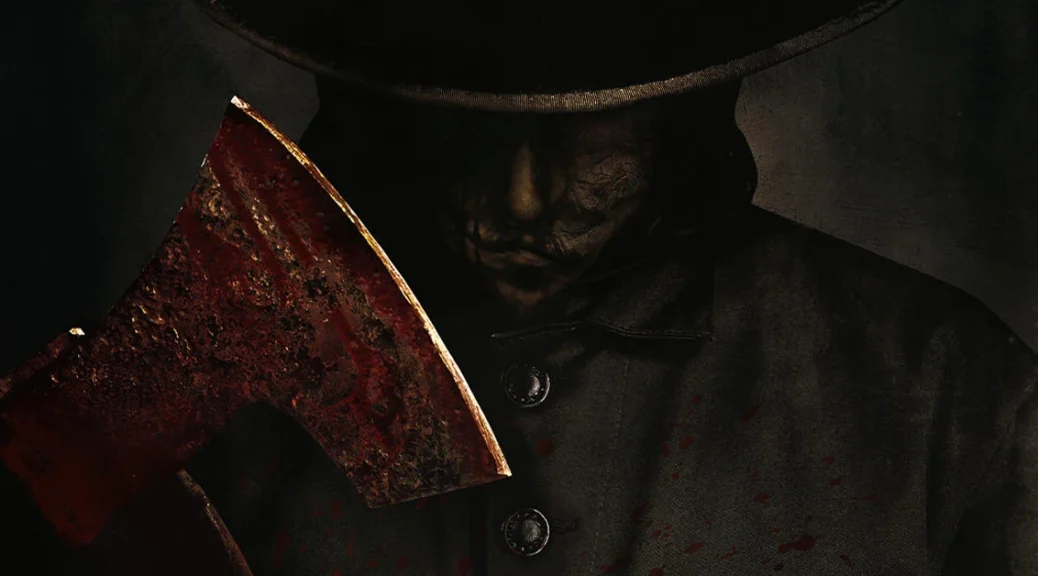
While the original Thanksgiving trailer had more in common with the sleaze and brutality of 80s slashers (like Maniac or Don’t Go In The House), Roth’s finished film falls more in line with contemporary slasher/whodunits, like the Scream films without the meta-deconstruction of horror films and tropes. The film opens with a darkly comic and brutal Black Friday massacre that mirrors the real life chaos of the annual consumer circus, and sets in motion the story that picks up one year later as a killer dressed as a pilgrim and wearing a John Carver mask begins a murderous spree of revenged slayings against the instigators of the deadly Black Friday incident.
Jessica (newcomer Nell Verlaque) is the heart of the film, leading the cast of potential young victims trying to learn who the killer is while avoiding being served up at the dinner table. A very game Patrick Dempsey (fully leaning into his native New England accent) is also along for the ride as the town sheriff working with the kids to put an end to John Carver’s deadly holiday plans. Roth and Jeff Rendell’s script offers up plenty of red herrings throughout the film, and while the killer’s identity will be fairly easy to deduce by most slasher fans, the inspired violence and set piece kills more than make up for the thin mystery of who John Carver really is. Fans of the original trailer will recognize several moments throughout the film (trampoline, anyone?), but Roth manages to shake things up enough to keep you guessing how each act of violence is gonna play out. Sprinkle in a little Rick Hoffman and just a pinch of Gina Gershon, and you’ve got a pretty good dinner!
Though the opening Black Friday scene alone makes this dish worthwhile, the bulk of the film may not measure up to the promise of the original trailer. But that will likely have more to do with the pressure of expectations of modern horror audiences and time passed, and less with the actual execution of the film itself.
Hungry for a new turkey day tradition that delivers on outlandish violence? Skip the Westminster Dog Show and enjoy a helping of Thanksgiving.
Love, exciting and new! Or, ancient and blood soaked. We’re not judging. There tends to be something wrong – lonesome, desperate, twisted, star crossed – about true love in horror. Maybe that’s what makes it so much more memorable. Here are our five favorite love stories in horror.
5. Spring (2014)
Evan (a spot-on Lou Taylor Pucci) has hit a rough patch. After nursing his ailing mother for two years, Evan finds himself in a bar fight just hours after her funeral. With grief dogging him and the cops looking to bring him in, he grabs his passport and heads to the first international location available: Italy.
It’s a wise setup, and an earnest Pucci delivers the tender, open performance the film requires. He’s matched by the mysterious Nadia Hilker as Louise, the beautiful stranger who captivates Evan.
At its core, Spring is a love story that animates the fear of commitment in a way few others do. The film’s entire aesthetic animates the idea of the natural world’s overwhelming beauty and danger. It’s a vision that’s equally suited to a sweeping romance or a monster movie, and since you’ll have a hard time determining which of those labels best fits Spring, it’s a good look.
4. Bones and All (2022)
The film follows Maren (an absorbing Taylor Russell, Waves), coming of age on the fringes of Reagan-era America. She meets and slowly falls for another outcast with similar tastes, Lee (Timothée Chalamet), and the two take to the road.
Given what the handsome young lovers have in common, you might expect a sort of meat lovers’ Badlands to follow. But Bones and All is less concerned with the carnage left in a wake than in what’s awakening in these characters themselves.
Bones and All is a tough one to categorize. I suppose it’s a horror film, a romance, and a road picture – not three labels you often find on the same movie. In Guadagnino’s hands, it’s more than that, though. He embraces the strength of the solid YA theme that you have to be who you are, no matter how ugly the world may tell you that is. You have to be you, bones and all. Finding Maren’s way to that epiphany is heartbreaking and bloody but heroic, too.
3. Border (2018)
Sometimes knowing yourself means embracing the beast within. Sometimes it means making peace with the beast without. For Tina—well, let’s just say Tina’s got a lot going on right now.
Border director/co-writer Ali Abbasi (Holy Spider) has more in mind than your typical Ugly Duckling tale, though. He mines John Ajvide Lindqvist’s (Let the Right One In) short story of outsider love and Nordic folklore for ideas of radicalization, empowerment, gender fluidity and feminine rage.
The result is a film quite unlike anything else, one offering layer upon provocative, messy layer and Abbasi feels no compulsion to tidy up. Instead, he leaves you with a lot to think through thanks to one unyieldingly original film.
2. A Girl Walks Home Alone at Night (2014)
Ana Lily Amirpour has made the world’s first Iranian vampire movie, and though she borrows liberally and lovingly from a wide array of inspirations, the film she’s crafted is undeniably, peculiarly her own.
Set in Bad Town, a city depleted of life – tidy yet nearly vacant – Girl (Sheila Vand) haunts the shadowy, lonesome fringes of civilization. One by one we get to know a pimp, a prostitute, an addict, a street urchin, and handsome Arash (Arash Mirandi).
Watching their love story play out in the gorgeously stylized, hypnotic backdrop of Amirpour’s creation is among the most lonesome and lovely ways to enjoy a good bloodletting.
1. Only Lovers Left Alive (2013)
Visionary writer/director Jim Jarmusch enlists Tom Hilddleston and Tilda Swinton as Adam and Eve (perfect!), a vampire couple rekindling their centuries-old romance against the picturesque backdrop of…Detroit.
Not since the David Bowie/Catherine Deneuve pairing in The Hunger has there been such perfectly vampiric casting. Swinton and Hiddleston, already two of the most consistently excellent actors around, deliver cooly detached, underplayed performances, wearing the world- weariness of their characters in uniquely contrasting ways.
Jarmusch, as he often does, creates a setting that is totally engrossing, full of fluid beauty and wicked humor. The film moseys toward its perfect finale, casually waxing Goth philosophic about soul mates and finding your joy.
I’m going to guess Joe Lynch is a Stuart Gordon fan.
Who isn’t?!
The Mayhem director returns to the horror genre with a Lovecraftian fable, but this is no garden variety Lovecraft. Lynch’s vibe and manner – not to mention co-writer and cast – lean closer to Gordon homage than outright cosmic horror.
Lynch loosely adapts Lovecraft’s The Thing on the Doorstep, writing with Stewart’s longtime collaborator Dennis Paoli (Re-Animator, From Beyond, Castle Freak, Dagon). Their tale shadows psychiatrist Elizabeth Derby (Heather Graham), who – against her own better instincts – takes on a new patient. Asa (Judah Lewis) believes his father is trying to steal his body.
Cleaving to science and yet inexplicably attracted to the young man, Derby fails to understand her patient’s claims until it is too late – an evil entity has moved from Asa’s father into Asa and is now threatening to take over Dr. Derby’s body.
Graham’s a bit of campy fun in a dual role – far more fun when she gets to dig into the hedonistic villain character. It’s a performance that lets the actor stretch a bit and she seems to relish the darker side of the role. Likewise, Lewis excels in particular when the sinister force inhabits meek and terrified Asa.
Of course, no Gordonesque Lovecraftian flick is complete without the glorious Barbara Crampton (Re-Animator, From Beyond, Castle Freak). Crampton’s Dani, Derby’s uptightcolleague and best friend, becomes an ideal foil for the transformed psychiatrist. Graham and Crampton vamp it up as the demon oscillates between them, which is as much fun as it sounds like it would be.
The film feels very much like a Dennis Paoli film and fans of his Gordon collaborations have reason to celebrate. But Suitable Flesh doesn’t entirely deliver on its promise of mayhem. It never quite leaps off that cliff the way Paoli films usually do and for that reason feels a tad tame.
But a game cast and a bit of 80s inspired lunacy ensure a good time is had by all. Plus, that’s a great title.
Just when you thought no one could do anything fresh with a possession movie, Terrified filmmaker Demián Rugna surprises you.
Well, fresh may not be the word. Indeed, you can almost smell this putrid tale. I mean that in the best way.
Pedro (Ezequiel Rodriguez) and his brother Jimmy (Demián Salomón) hear shots. It’s late, and the sound is far – somewhere between their land and their neighbor Ruiz’s (Luis Ziembrowski) farm. The way Rugna reveals what the brothers find, where it leads them and what it unleashes is a tale so masterfully told you almost miss the underlying character study and the blistering performance that brings it to life.
When Evil Lurks does sometimes feel familiar, its road trip to hell detouring through The Crazies, among others. But Rugna’s take on all the familiar elements feels new, in that you cannot and would not want to predict where he’s headed.
As choices are made and usually regretted, Rugna propels his heroes onward, each step, each choice, each misstep adding pressure and confusion, unveiling the character beneath even as bits of the brothers’ history organically comes to light. This is a magnificently written piece of horror, and Rugna’s expansive direction gives it an otherworldly yet dirty, earthy presence.
The entire cast is wonderful, each one cracked and poisoned just a bit. But Rodriguez sears through the celluloid with a performance so raw, frustrating and full of rage it makes you uncomfortable.
His counterpoint, Salomón’s younger, gentler brother Jimmy, infects the film with enough tenderness to make the wounds hurt. And in creating injury, Rugna is fearless. No one is safe, not even the audience.
The inexplicable ugliness – this particularly foul presence of evil – is handled with enough distance, enough elegance to make the film almost beautiful, regardless of the truly awful nature of the footage. And Rugna never lets up. Each passing minute is more difficult than the last, to the very last, which is an absolute knife to the heart.
In case Rugna’s 2017 treasure Terrified didn’t solidify his place among the greats working in the genre today, When Evil Lurks demands that recognition.
If found footage, horror anthologies and 80s nostalgia are your thing, V/H/S/85 is speaking your language. The sixth episode in the series straps on those heavy camcorders and uploads that security cam footage to remind us of all the horrors of the Reagan era.
Highlights include David Bruckner’s wraparound story, “Total Copy.” An alum of the 2012 original V/H/S and successful filmmaker behind The Ritual and the recent Hellraiser, Bruckner has a tricky assignment. The wraparound has to serve as an anchor for the balance of the short films while standing on its own. Bruckner’s tale delivers a VHS tape of security footage that’s been copied over with commercials, exercise videos, and other horrors. But the main story it tells, of an entity in lockdown being studied by researchers, is chilling, sometimes funny, and eventually pretty bloody.
Not to be outdone, Mike P. Nelson contributes two short films with one clever twist. The first, “No Wake” follows a group of campers who head out onto a lake despite posted signage forbidding it. And though things go predicably wrong for them, the actual execution (both by the director and of the characters) delivers genuine surprises, as does the twist in Nelson’s second outing, “Ambrosia” about a fundamentally bent family tradition.
“TKNOGD” (technogod), from Natasha Kermani (Lucky), is the most daring of the set, although it nearly outstays its welcome before hitting its stride. A performance artist laments the blossoming obsession with tech. The plausibility of the audience reaction is almost as much fun as the gory finale of her show.
Gigi Saul Guerrero (Satanic Hispanics, Bingo Hell) contributes a news piece gone wrong during Mexico City’s 1985 earthquake. What’s most effective is her use of the set to increase claustrophobia to high levels before bursting that tension with the bloody finale.
Scott Derrikson’s (Sinister, The Black Phone) “Dreamkill” is the most effective and imaginative of the set, plus there’s a Goth kid! Now that’s a reason to love the 80s! A police detective keeps receiving VHS tapes in the mail of murders that have not yet been committed. From the grim crime scenes to the plot twists to the almost funhouse architecture of the final acts of carnage, “Dreamkill” never lets go.
This is the strongest set of shorts in a V/H/S installment in a while. It’s fun, gory, creepy and bite sized – ideal for the season.
There have been more Exorcist movies than you might realize and almost all of them are good. One is great. One is a masterpiece.
Is it really fair to hold any of them up against the mastery of William Friedkin’s 1973 original? Well, The Exorcist: Believer flies the titular flag, and brings back Ellen Burstyn to reprise her role as Chris MacNeil, so the film isn’t exactly staying away from it. And with two more Exorcist films on the way, director and co-writer David Gordon Green is nothing if not ambitious.
Green has been here before, recently bringing Michael Myers roaring back to life with his Halloween trilogy. That project came out of the gate with strength and promise, which only made the final two installments that much more disappointing.
This opening statement brings cause for both optimism and worry.
Green’s multiple nods to Friedkin’s original start from Believer‘s opening frame, as Victor Fleming (Leslie Odom, Jr.) and his pregnant wife are traveling in Haiti. Tragedy strikes, and we move ahead thirteen years, with Victor raising Angela (Lidya Jewett from Hidden Figures and TV’s Good Girls) as a single father in Georgia.
Angela and her friend Katherine (Olivia O’Neill, in her debut) go missing after a walk in the woods, showing up three days later as very different people. Katherine’s parents (Jennifer Nettles and Norbert Leo Butz) are true Bible thumpers, and their contrast with Victor’s skepticism becomes an important thread that Green will pull to the end.
The girls’ shocking and blasphemous behavior leads Victor’s neighbor (Ann Dowd) to suggest contacting MacNeil, now a best-selling author who has devoted the last 50 years to understanding what happened to her daughter, Regan.
Odom, Jr. delivers a complex but never showy performance that anchors all the fantastical that orbits him. And it’s great to see the Oscar-winning Burstyn back in this role, but her rushed introduction here reminds you of what an effectively slow burn the original employed. Maybe today that’s a harder sell. But as good as all these performances are, you are just not as deeply invested once the fight for two souls begins.
Green does show a good feel for the callbacks, never going overboard and holding your attention with a consistently creepy mood. The girls’ makeup, demonic voices and atrocities combine for a series of solidly unnerving sequences. Nothing may come close to the shocks from the original, but really, what could? You’re not going to put another child actor through what Linda Blair endured.
Still, 1990’s Exorcist III managed two original moments that bring chills to this day, and nothing about Believer feels destined for iconic status.
The storytelling scores by mercifully limiting the Catholicism, as Green embraces the idea that every culture has a ritual for expelling evil. It’s nice to point out that the Catholics don’t hold a monopoly on exorcisms and that maybe horror fans have grown weary of priests and nuns at this point. Green removes the power from an individual faith and empowers the idea of community, where “the common thread is people.”
But while Believer brings in some welcome new ideas, it lacks the confidence to let a path reveal itself without guideposts of undue exposition. Too much of what happens in the third act is telegraphed early or explained late, even saddling the always-great Dowd with a needless, bow-tying monologue.
What made the original great? Friedkin and writer William Peter Blatty tied us all up in one man’s shame, his inability to do the right thing, and his crisis of faith just to see him sacrifice himself for an innocent. Friedkin terrified us with the most unholy image one could imagine at that time, closed us in a tiny space with this foul idea, and then released us only when one good man died for us.
The demon is again playing on shame and exploiting grief, ultimately revealing a long held secret that becomes key to the fate of both girls. And while the issue this film raises is worthy and mildly provocative, the question of where the franchise goes next is equally intriguing.
Believer spends two full hours telling the story, and it needs those 121 minutes. But Green doesn’t spend them where he should. He tells us too much, shows us too little, and doesn’t invest our time with characters so we feel for the families. There are scary moments, for sure, but this episode does not feel like a kick start to a beloved franchise or a new vision of evil. It feels like an entertaining sixth movie in a decent series.