Unfriended meets Pokemon Go in the online thrill ride Nerve.
Directors Henry Joost and Ariel Schulman like to reflect the evolution of society’s culture of technology. Their breakout 2010 “documentary” Catfish questioned the safety in online anonymity. Over their next few films these themes grew and merged with statements on privacy vs voyeurism, exhibitionism and thrill seeking in a digitally saturated world.
With Nerve, the filmmakers have wrapped these ideas around the universal truth that kids are stupid and framed it with your standard fare high school drama, achieving surprisingly entertaining results.
Within the film’s universe, Nerve is an online game of truth or dare, “minus the truth.” Participants choose to be players or watchers. Watchers choose dares, players complete them, gaining cash rewards and collecting watchers. The player with the most of both wins – or do they?
Emma Roberts is Vee, a high school senior who observes more than she participates. Definitely not a player. But when brash bestie and Nerve celebrity-wannabe Syd’s (Emily Meads) miscalculation leads to Vee’s public humiliation, she leaps outside her comfort zone and joins the game.
Kiss a boy (Dave Franco). Ride into Manhattan with him. Try on a swanky dress. Everything seems innocent – even dreamy – until it doesn’t.
Jessica Sharzer’s script, based on Jeanne Ryan’s 2012 novel, is sharp enough to keep you interested regardless of the holes in the plot, which devolves into utter ridiculousness by Act 3. Still, in a forgettable B-movie kind of way, it’s a fun ride.
It also boasts a savviness that’s too of-the-moment to remain relevant by the end of the summer, but right this second it’s both cheeky and insightful. The finger-wagging and lessons learned fit perfectly with the familiar teen angst of the genre in this glitzy cautionary tale.
A raunchy comedy that peels away all the precious nonsense associated with motherhood and isn’t afraid to get a bit nasty – this feels like a film that’s been a long time coming. It could be a welcome change of pace if done well. Unfortunately, instead we got Bad Moms.
Mila Kunis stars as an overworked, underappreciated, harshly-judged parent. Her husband’s useless, her boss is a joke, and she’s so irredeemably responsible that her life is spiraling out of control. Either that or she is such an overtly clichéd image of every potential mom complaint that no actor could possibly make her a human.
Kunis has strong comic sensibilities, as do the performers playing her two new besties, Kristen Bell and Kathryn Hahn. Hahn’s the unrepentant man- and booze-hound of a single parent, while Bell’s Kiki is the socially awkward stay-at-home mother of 4. Together they have great fun doing all the things no one wants to see their mom do – and thank God for it, because the rest of the film is worthless.
This is a world where not one father contributes. OK, maybe one – but he’s a hot widower, so there’s no mother to help out. Awwww….
The film is co-written and co-directed by Hangover franchise creators Jon Lucas and Scott Moore, but they could have seriously used an assist from Bad Moms co-star Annie Mumolo. Mumolo co-wrote 2011’s Bridesmaids, a film that was capable of producing female-centric comedy with dimension. Even men.
I’m confident that there are times when every parent feels incompetent, where every well-planned family vacation turns into fodder for your child’s first adult conversation with a therapist. Bad Moms brings up loads of great, universal points that will pick those scabs. Unfortunately, the resolution to those issues is always convenient and one-sided to the point of being offensive.
Bad Moms is trying to offend your sensibilities, but it succeeds in the wrong spots. The lengthy sight gag concerning sex with an uncircumcised penis – not offensive, just funny. The problem is the rest of the movie.
At no point in the film Bad Moms is the word “parent” used. Every problem, every responsibility, every joy and obstacle is the sole property of the mom. I’m sure it can feel that way at times, but good comedy rarely comes from such a one-dimensional premise. It certainly doesn’t do so here.
War is hell, which makes it obvious fodder for horror films. It’s kind of amazing there aren’t more that really mine the carnage and insanity of battle, but those that do it well can make social commentary while getting under the audience’s skin. The films we celebrate today do both really well, plus – monsters! Hooray!
5. The Devil’s Backbone (El espinazo del diablo) (2001)
The Devil’s Backbone unravels a spectral mystery during Spain’s civil war. The son of a fallen comrade finds himself in an isolated orphanage that has its own troubles to deal with, now that the war is coming to a close and the facility’s staff sympathized with the wrong side. That leaves few resources to help him with a bully, a sadistic handyman, or the ghost of a little boy he keeps seeing.
Backbone is a slow burn as interested in atmosphere and character development as it is in the tragedy of a generation of war orphans. This is ripe ground for a haunted tale, and writer/director Guillermo del Toro’s achievement is both contextually beautiful – war, ghost stories, religion and communism being equally incomprehensible to a pack of lonely boys – and elegantly filmed.
Plus the ghost looks awesome. Del Toro would go on to create some of cinema’s more memorable creatures, and much of that genius was predicted in the singular image of a drowned boy, bloody water droplets floating about him, his insides as vivid as his out.
Touching, political, brutal, savvy, and deeply spooky, Backbone separates del Toro from the pack of horror filmmakers and predicts his own potential as a director of substance.
4. The Crazies (1973, 2010)
We’re cheating here, but George Romero’s 1973 insanity plague flick offers much, as does its 2010 reboot by the otherwise useless Breck Eisner, so we’re combining.
Just three years after Night of the Living Dead, the master found himself interested in taking his zombiism concepts in a different direction. Romero is more literal in his thoughts on the Vietnam War in this film than in his previous efforts. Two combat veterans are at the center of the film, in which a chemical weapon is accidentally leaked into the water supply to a Pennsylvania town. Those infected go helplessly mad. Military incompetence, the needless horror of Vietnam, and the evil that men can do when ordered to do so are all central conceits in this film.
Romero may not have always had the biggest budget, best actors, or best eye for composition, but his ideas were so far ahead of their time that modern horror would not exist in its current form without him. His ideas were unique, not far-fetched, and they fed the imaginations of countless future filmmakers. You can see Romero’s ideas and images from this film repeated in 28 Days Later, Return of the living Dead, Signal, Cabin Fever, Super 8, even Rambo – and, obviously, in the remake.
Eisner’s version offers solid scares, inventive plotting, and far better performances than expected in a genre film. Both films begin by articulating humankind’s repulsion and fear of infection before introducing the greater threat – our own government. Eisner’s greatest strength is his cast. The eternally under-appreciated Timothy Olyphant and Radha Mitchell, unerringly realistic as husband and wife, carry most of the grisly weight, aided by solid support work from folks who are not afraid to be full-on nuts.
3. Jacob’s Ladder (1990)
Jacob’s Ladder is as unsettling and creepy as any movie you’ll watch. The entire 113 minutes transpires in that momentary flash between life and death, with both light and dark trying to make a claim on Jacob Singer’s soul.
Tim Robbins plays Singer with a weary sweetness that’s almost too tender and vulnerable to bear. In a blistering supporting turn, Elizabeth Pena impresses as the passionate carnal angel Jezebel. The real star here, weirdly enough, is director Adrian Lyne.
Known more for erotic thrillers, here he beautifully articulates a dreamscape that keeps you guessing. The New York of the film crawls with unseemly creatures hiding among us. Filmed as a grimy, colorless nightmare, Jacob’s Ladder creates an atmosphere of paranoia and dread.
By 1990, the Vietnam film has run its course, but with some distance from the post-Platoon glut, the “flashback” crisis that underlines Singer’s confused nightmare feels less stale. It allows the movie to work on a number of levels: as a metaphysical mystery, a supernatural thriller, and a horror film.
2. Dog Soldiers (2002)
Wry humor, impenetrable accents, a true sense of isolation, and blood by the gallon help separate Neil Marshall’s (The Descent) Dog Soldiers from legions of other wolfmen tales.
Marshall creates a familiarly tense feeling, brilliantly straddling monster movie and war movie. A platoon is dropped into an enormous forest for a military exercise. There’s a surprise attack. The remaining soldiers hunker down in an isolated cabin to mend, figure out WTF, and strategize for survival.
This is like any good genre pic where a battalion is trapped behind enemy lines – just as vivid, bloody and intense. Who’s gone soft? Who will risk what to save a buddy? How to outsmart the enemy? But the enemies this time are giant, hairy, hungry monsters. Woo hoo!
Though the rubber suits – shown fairly minimally and with some flair – do lessen the film’s horrific impact, solid writing, dark humor, and a good deal of ripping and tearing energize this blast of a lycanthropic Alamo.
1. 28 Days Later (2002)
You know you’re in trouble from the genius opening sequence: vulnerability, tension, bewilderment, rage, and blood – it launches a frantic and terrifying not-zombie film. Like zombie god George Romero, though, director Danny Boyle’s real worry is not the infected, it’s the living.
Boyle uses a lot of ideas Romero introduced, pulling loads of images from The Crazies and Day of the Dead, in particular (as well as Lyne’s Jacob’s Ladder).
The vision, the writing, and the performances all help him transcend genre trappings without abandoning the genre. Both Brendan Gleeson and Cillian Murphy are impeccable actors, and Naomie Harris is a truly convincing badass. Their performances, and the cinematic moments of real joy, make their ordeal that much more powerful.
It’s a tribute to the performances, Boyle’s direction, and writer Alex Garland’s (Ex Machina) vision that, even after a dozen or so terrifying set pieces, the most deeply unsettling scene is a quiet conversation between ragged survivor Jim (Murphy) and his alleged salvation, Major Henry West (Christopher Eccleston).
Sandwiched between his adorable vampire flick What We Do in the Shadows and his upcoming journey into the Marvel universe, Thor: Ragnarok, director Taika Waititi gets lost in the New Zealand bush.
The Kiwi filmmaker, whose career up to now has been marked with silly wit and gentle humor, offers a buddy comedy along the lines of Pixar’s Up.
Rotund Ricky Baker (Julian Dennison) finds himself deep in New Zealand nowhere with his newly appointed foster parents Bella (Ti Waita, wonderful) and Hec (Sam Neill). Bella offers and endless amount of genuine care, while Hec is quick with a grunt or a grimace. But one mishap after another projects the wrong image, and soon the lonesome boy and grumpy old man are off on an exotic adventure.
The manhunt that follows Ricky and Hec into the woods offers plenty of opportunity for sight gags, and Waititi (who adapted Barry Crump’s novel) gives the comedy an equal dose of absurdity and sweetness.
A mash note to outsiders, family and masculinity, Wilderpeople also showcases Neill’s gravelly talent in a way no film has done in years. Truth be told, were it not for the strong performances from the two leads, the film could easily have become stiflingly quirky. But Neill’s work offers more layers and authenticity than your usual grizzled coot routine, and Dennison’s confidence and timing ensure his is not the same old adorable kid looking for a dad.
No, both characters are equal parts frustrating and charming, which is why the adventure works as well as it does. There’s no wink and nod “let’s learn a lesson” backbone to their quest, just an admirably naive sense of freedom.
The supporting cast in its entirety delivers wry laughs, but the real showstoppers are Waita (who was equally enjoyable in Housebound), and Rachel House as Paula, the alarmingly tenacious social worker.
The script veers toward sentimentality once or twice too often. Like Waititi’s previous features, Wilderpeople, in the end, lacks bite. But the filmmaker possesses such an extraordinary talent for good natured, quirky comedy that it will be really something to see what he can do with a super hero, and whether his sincerely individual vision can remain intact.
There is something cathartic in watching the brazenly wrong-headed Eddie Monsoon (Jennifer Saunders) and her enabling bestie Patsy Stone (Joanna Lumley) of Absolutely Fabulous make bad decisions. This summer, they take their Bollinger, ciggies, Botox and bags of coke to the big screen. The result is Moderately Fabulous.
The British sitcom has enjoyed sporadic but popular runs on BBC since the early Nineties. Saunders – who also writes – pokes fun at celebrity culture while she and Lumley offer a master course in physical comedy, onscreen chemistry and unseemly humor.
Will the boozy duo’s quest for the swingin’ celebrity life ease as they sashay into their sixties? Of course not.
Eddie’s PR firm has fallen on hard times. Her champagne fridge is empty and her credit cards are “broken.” What she needs is one big client. Good luck! Kate Moss is between PR agents. If Eddie and Patsy can finagle a meeting at the upcoming fashion show without knocking Moss into the Thames and drowning her, setting off a social media frenzy, not to mention an all-out police manhunt, they’ll be back in the Bolly in no time.
Though the plot is almost painfully thin, padded with a veritable cameo-gasm (the highlight of which is a hilarious Jon Hamm), Saunders keeps the raucous one-liners flowing. And their wisdom is, as usual, spot on.
Tough night of boozing and pill popping? Freshen up with a little spritz of after birth.
Don’t think of family members as attachments. “They’re parasites, ticks, danglers.”
And the best advice yet: “Avoid the Jacuzzi – it’s a smoothy of old sperm.”
Yes, these are still the most delightfully horrible people in the world, and Ab Fab is at its best when it remembers this. Their generational issues are not meant to be resolved lovingly, wistful moments of regret are antithetical to their credo, and God knows no lesson should ever be learned.
Unfortunately, Saunders does not abide by these laws entirely. Director Mandie Fletcher can’t hide the threadbare script behind a runway’s worth of cameos, either. Like so many cinematic sit-com adaptations, Absolutely Fabulous would have played better on the telly. But thanks to Saunders and, in particular, the comedic genius of Lumley, you will laugh.
Writer/director Mickey Keating says his newest effort, Carnage Park, owes a debt to Sam Peckinpah and Peter Watkins – and their influence is certainly apparent, right down to the film’s title, cribbed from Watkins’s desert terror Punishment Park. Still, the film itself boils down to a poor man’s Wolf Creek as directed by Quentin Tarantino.
Actually, that sounds a lot better than it is.
It’s the California desert of 1978. Two armed men carrying a bullet wound, bag of cash and hostage flee a small town bank heist. They lose a trail of cops via a hidden, hilly dirt road.
Big mistake.
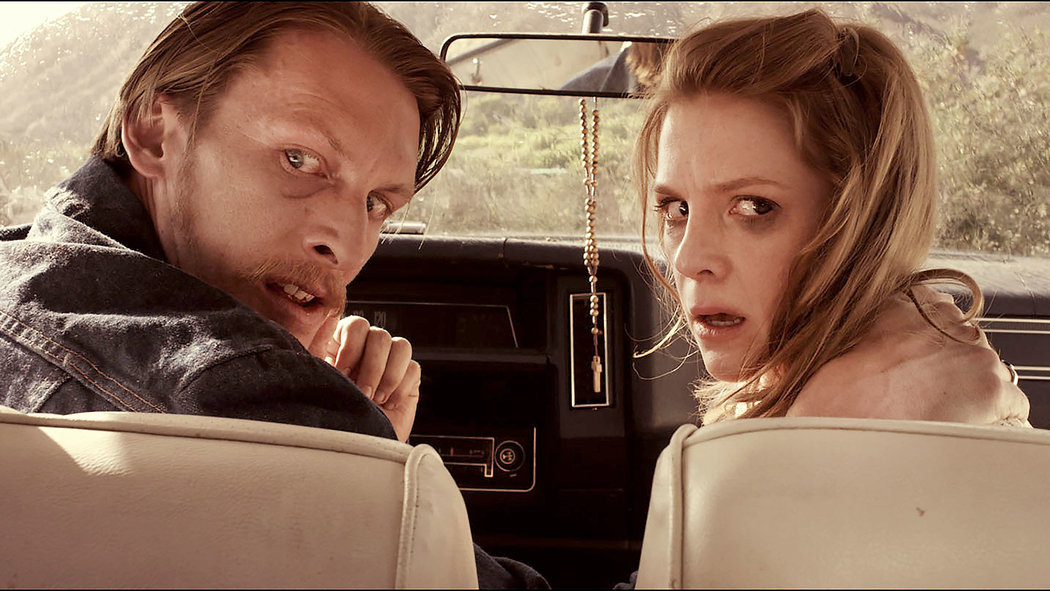
All the swagger, dusty boots and retro Seventies soundtrack in the world can’t shield Scorpion Joe (James Landry Hebert) and farm girl hostage Vivian (Ashley Bell) from the much larger danger they’ve just driven into.
Keating’s amassing quite a list and variety of indie horror films. His style is homage. Where Carnage Park aspires to the gritty look and desperate feel of the road pics of the indie American Seventies, last year’s Darling offered a stylish ode to both Kubrick and Polanski.
This approach need not feel derivative. Let’s be honest, Tarantino’s become among the most lauded and watched filmmakers of his generation by doing the exact same thing. The big difference is that QT’s take on all the cinema that has come before is filtered through his own lunatic genius, the final product becoming uniquely, fantastically his own.
There’s something more workmanlike, less inspired in what Keating does.
That’s not to say Carnage Park is an abject failure. A game cast keeps the film intriguing. Bell is deceptively savvy (aside from a few wildly idiotic mistakes, but let’s be honest, screenwriter Keating is to blame for those). Genre favorite Pat Healy chews some scenery, playing against type as the damaged Vietnam vet cliché, while Larry Fessenden (a regular and welcome contributor to Keating’s canon) shows up for a quick and gory moment or two.
But from the bleached out yellow of the scenery to nearly every set piece, Keating’s habit of lifting from other films takes on the feel of compulsion. Larceny, even: The Hills Have Eyes, Texas Chainsaw Massacre 2, Reservoir Dogs – the list is bloody, hip and endless. And tired.
Keating has proven many strengths in his few years in filmmaking, but it is time for him to develop his own style.
Since Bonnie and Clyde and probably before, cinematic lovers on a bloody rampage have been entertaining and freaking out audiences the world over. Their escapades can be as grimly beautiful as Terrence Malick’s incandescent Badlands, or as bloody as – well, as the films we celebrate today. Dangerous lovers can really build a body count, as you’ll see here. Ain’t love grand?
5. Sweeney Todd: The Demon Barber of Fleet Street (2007)
Here’s a bizarre idea for a musical: The barber upstairs kills his clients and the baker downstairs uses the bodies in her meat pies. Odd for a Broadway musical, yes, but for a Tim Burton film? That sounds a little more natural.
As in most of Burton’s best efforts, Sweeney Todd stars Johnny Depp in the title role. Depp is unmistakably fantastic – consumed, morose, twisted with vengeance – and he’s in fine voice, to boot.
Helena Bonham Carter – ever the perfect Goth girl – gives Mrs. Lovett a wicked survivor streak balanced by a tender, pining affection. The romance dream sequence is a riot, and so perfectly Burton-esque. The two actors offset each other brilliantly, while their onscreen duo deserves credit for efficiency, if nothing else.
With Burton’s help, Depp found another dark, bizarre anti-hero to showcase his considerable talent. With Depp’s help, Burton gorgeously, grotesquely realized another macabre fantasy.
4. Hellraiser (1987)
Hedonist Frank Cotton solves an ancient puzzle box, which summons the fearsome Cenobites, who literally tear Frank apart and leave his remains rotting in the floorboards of an old house. Years later, Frank’s brother Larry moves into that house with his teenage daughter Kirsty and his new wife Julia (Clare Higgins) – who, oh yeah, also happens to be Frank’s ex-lover.
A gash on Larry’s leg spills blood on the floor, which awakens the remains of Frank, who then requires more blood to complete his escape from the underworld. Julia, both repulsed and aroused by her old flame’s half-alive form, agrees to make sure more blood is soon spilled.
Though the Cenobites are the real, lasting terror in this film – and how cool were they! – the sexual chemistry between Julia and that bloody lump of Frank is never less than unsettling. Higgins makes the perfect evil stepmother while redefining the term blood lust.
3. Sightseers (2012)
From the guttural drone of the opening segment, this film announces itself as a dryly, darkly hilarious adventure. Frumpy Tina (Alice Lowe, perfection) needs a break from the smothering mum who blames her for their dog’s death. Against Mum’s wishes, Tina will take a road trip with her new beau, the equally frumpy Chris (Steve Oram, amazing).
The film is a wickedly fresh British take on a familiar theme. Oram and Lowe wrote the script, alongside director Ben Wheatley’s go-to scribe (and wife) Amy Jump. The result is so absurd and hilarious – few films have had so much fun with moral ambiguity.
Wheatley blends the dark comedy of his first film, Down Terrace, with the sense of the unexpected that elevated Kill List to create enormously entertaining homicidal madness. It helps that his cast could not be better, draining all the glamour of the road trip assassin couple trope without relying on that as a gimmick. There’s a deeply British weirdness to the proceedings, which are handled with bone-dry aplomb by all involved.
2. The Hunger (1983)
Tony Scott’s seductive vampire love story has a little bit of everything: slaughter, girl-on-girl action, ’80s synth/goth tunage, David Bowie. What more can you ask?
Actually the film’s kind of a sultry, dreamily erotic mess. Catharine Deneuve is the old world vampire Miriam, David Bowie is her lover. The two spend years – perhaps centuries – together seducing victims. But he suddenly begins aging, and she needs to find a replacement. Enter Susan Sarandon as a medical specialist in unusual blood diseases and a fine actress who’s not above smooching other girls.
Bowie and Deneuve are both so effortlessly cool and sexy that you can almost forgive them their nighttime savagery. You find out just how dangerous he is once he begins the rapid-aging process, but once you get a peek into Miriam’s attic you find that she’s been far more dangerous – to her lovers and everyone else – for a very long time.
1. Alleluia (2014)
In 2004, Belgian writer/director Fabrice Du Welz released the exquisite Calvaire, marking himself a unique artist worth watching. Ten years later he revisits the themes of that film – blind passion, bloody obsession, maddening loneliness – with his newest effort, Alleluia. Once again he enlists the help of an actor who clearly understands his vision.
Laurent Lucas plays Michel, a playboy conman who preys upon lonely women, seducing them and taking whatever cash he can get his hands on. That all changes once he makes a mark of Gloria (Lola Duenas).
Du Welz’s close camera and off angles exaggerate Lucas’s teeth, nose and height in ways that flirt with the grotesque. Likewise, the film dwells on Duenas’s bags and creases, heightening the sense of unseemliness surrounding the pair’s passion.
Duenas offers a performance of mad genius, always barely able to control the tantrum, elation, or desire in any situation. Her bursting passions often lead to carnage, but there’s a madcap love story beneath that blood spray that compels not just attention but, in a macabre way, affection. Alleluia is a film busting with desperation, jealousy, and the darkest kind of love.
What began as a project with the intended audience of two has rightly become a theatrical release because De Palma – a documentary on the polarizing filmmaker – can’t help but mesmerize.
Directors Noah Baumbach and Jake Paltrow lovingly roll camera while seasoned filmmaker Brian De Palma, now 75-years-old, walks us through his catalog. He shares anecdotes, talks candidly about successes and failures, and complains about the studio system. All of this is intriguing, but it’s the documentarians’ clear admiration for De Palma’s style, and the filmmaker’s charismatic presence as he articulates his craft, that make this film fascinating.
Baumbach and Paltrow juxtapose moments from De Palma’s films with images from other, related works – most predictably and illustratively, Hitchcock’s. While De Palma has never shied away from his obsession with Hitch, the doc allows him to expound on his both his fascination and his reasons and strategies for using the cinematic vocabulary Hitchcock created.
De Palma’s career has been scattershot at best, four decades littered with artistic peaks and valleys (Carlito’s Way versus Bonfire of the Vanities) as well as box office successes and flops (Mission: Impossible versus Casualties of War).
Movie buffs will love the candor and in-the-know stories from a man who came up with a bunch of scruffy new directors including Steven Spielberg, George Lucas, Francis Ford Coppola and Martin Scorsese. De Palma passed the script for Taxi Driver on to his buddy Marty thinking it was more up his alley; meanwhile, he and Lucas auditioned for Carrie and Star Wars simultaneously – same actors, same auditions, same time.
But for true cinefiles, it’s his talk of technique that will compel. Why the long tracking shots? When and why do split screens work? What is he looking for in a score and how does he achieve it?
There are so many other topics picked at because, love him or hate him, De Palma is a director with such a quirky, brazen style that the potential for analysis is almost unending. The one topic he seems a bit too canny about concerns criticisms that his films are preoccupied with sexual violence against women, a topic he shrugs off. And though Baumbach and Paltrow slyly pair the filmmaker’s words with an image of an 18” drill bit, shot from between a man’s legs as it penetrates his nubile victim, they do not press De Palma with follow up questions. Disappointing.
But it’s a rare misstep in a film that manages to capture so much from De Palma as a film historian, a Hollywood insider, and an iconic American director and storyteller.
“Why are you troubled,” Jesus asked, “and why do doubts arise in your hearts? Look at my hands and my feet. It is I myself. Touch me and see — for a spirit does not have flesh and bones, as you see I have.”
Biblical quotes are a common, often effective way to open a horror film. Of course, they usually come from Revelation or contain some other wrath-of-God kind of sentiment. Don’t be fooled, though, because South Korean writer/director Hong-jin Na knows where he’s doing with his third genre-bending epic, The Wailing – even if you don’t.
Though the true meaning of this quote won’t take hold until the final act, it presents many questions. Is this film supernatural? Demonic? Or, given the corporeal nature of the quote, is it rooted in the human flesh?
Yes.
That’s what makes the quote so perfect. Na meshes everything together in this bucolic horror where superstition and religion blend. The film echoes with misery, as the title suggests. The filmmaker throws every grisly thing at you – zombies, pustules, demonic possession, police procedural, multiple homicides – and yet keeps it all slippery with overt comedy.
In rural Korea, lackadaisical police sergeant Jong-gu (Do-won Kwak) is baffled by the rash of ugly homicides striking the village. And they are ugly – not only because of their brutality, but because of the boil-covered state of each perpetrator.
Some locals blame toxic mushrooms, but others say it’s the work of that solitary foreigner (Jun Kunimura) who recently moved to the outskirts of town.
Backwater beliefs, small town hysteria, mob mentality – or is it? The filmmaker toys with your preconceived notions, partly by crafting Jong-gu – with the help of the dramatically agile Kwak – into an endearingly flawed hero. A comically bumbling cop, Jong-gu’s sudden appreciation of the seriousness of the situation only amplifies tensions because he – like the audience – is in over his head. As he puzzles through clues in an attempt to save his stricken daughter (an amazing Hwan-hee Kim), Na’s feats of misdirection come to an unbearable head.
The languid pace, which makes the most of DP Kyung-pyo Hong’s gorgeous photography, may feel like needless expansion, but it serves to let images and questions settle. It lets the misery soak in a bit.
If horror films reflect the hysteria and fear of the moviegoing public, then we, as a planet, are definitely afraid of our children – or of children in general. There are countless examples of murdering, mutant, bloodthirsty, demonic youngsters. Whether they are born monsters or have been claimed by the Dark One, whether they belong to roving bands of toughs or happen to be your own evil offspring, children seem to play upon our deepest fears. So let’s celebrate that today with a count down of the scariest children ever!
6. Let The Right One In (2008)
In 2008, Sweden’s Let the Right One In emerged as an original, stylish thriller – and the best vampire flicks in years. A spooky coming of age tale populated by outcasts in the bleakest environment, the film breaks hearts and bleeds victims in equal measure. Kare Hedebrant‘s Oskar, with his blond Prince Valiant haircut, falls innocently for the odd new girl (an outstanding Linda Leandersson) in his shabby apartment complex. Reluctantly, she returns his admiration, and a sweet and bloody romance buds.
As sudden acts of violence mar the snowy landscape, Oskar and Ali grow closer, providing each other a comfort no one else can. The film offers an ominous sense of dread, bleak isolation and brazen androgyny – as well as the best swimming pool scene perhaps ever. Intriguingly, though both children tend toward violence – murder, even – you never feel anything but empathy for them. The film is moving, bloody, lovely and terrifying in equal measure.
5. The Bad Seed (1956)
The minute delicate Christine’s (Nancy Kelly) husband leaves for his 4-week assignment in DC, their way-too-perfect daughter begins to betray some scary behavior. The creepy handyman Leroy (Henry Jones) has her figured out – he knows she’s not as perfect as she pretends.
You may be tempted to abandon the film in its first reel, feeling as if you know where the it’s going. You’ll be right, but there are two big reasons to stick it out. One is that Bad Seed did it first, and did it well, considering the conservative cinematic limitations of the Fifties.
Second, because director Mervyn LeRoy’s approach – not a single vile act appears onscreen – gives the picture an air of restraint and dignity while employing the perversity of individual imaginations to ramp up the creepiness.
Enough can’t be said about Patty McCormack. There’s surprising nuance in her manipulations, and the Oscar-nominated 9-year-old handles the role with both grace and menace.
4. Them (2006)
Brisk, effective and terrifying, Them is among the most impressive horror flicks to rely on the savagery of adolescent boredom as its central conceit.
Writers/directors/Frenchmen David Moreau and Xavier Palud offer a lean, unapologetic, tightly conceived thriller that never lets up.
A French film set in Romania, Them follows Lucas and Clementine, a young couple still moving into the big rattling old house where they’ll stay while they’re working abroad. It will be a shorter trip than they’d originally planned.
What the film offers in 77 minutes is relentless suspense. I’m not sure what else you want.
Creepy noises, hooded figures, sadistic children and the chaos that entails – Them sets up a fresh and mean cat and mouse game that pulls you in immediately and leaves you unsettled.
3. The Brood (1979)
Dr. Hal Ragland – the unsettlingly sultry Oliver Reed – is a psychiatrist leading the frontier in psychoplasmics. His patients work through their pent-up rage by turning it into physical manifestations. Some folks’ rage turns into ugly little pustules, for example. Or, for wide-eyed Nola Carveth (Samantha Eggar), rage might turn into bloodthirsty, puffy coated spawn. This is Cronenberg’s reimagining of procreation, and it is characteristically foul.
Cronenberg is the king of corporeal horror, and The Brood is among the best of the filmmaker’s early, strictly genre work. Reed and Eggar both are unseemly perfection in their respective roles. Eggar uses her huge eyes to emphasize both her former loveliness and her current dangerous insanity, while Reed is just weird in that patented Oliver Reed way.
But it’s the climactic image of procreation – of motherhood and childbirth – and the way the filmmaker and his leading lady subvert that life-giving moment, turning it into something beastly, that will stick with you.
https://www.youtube.com/watch?v=RVQkJJxjdIM
2. The Omen (1976)
Gregory Peck brought impenetrable gravitas to this film, making everything seem very serious and worthwhile. This could be no ordinary horror flick – not with Atticus Finch in the lead.
Peck plays Robert Thorn, a rising politician and best friend to the President of the United States. He agrees to a delivery room switcheroo when he’s told his own son perished during childbirth, but another baby born simultaneously was orphaned. He brings home the tot, his loving wife (Lee Remick) none the wiser.
Eventually she does develop a sixth sense about the cherubic little Damien, though.
This mid-Seventies gem is gloriously over-the-top with its self-serious approach to the coming of the antichrist. Richard Donner – who would go on to direct a couple Superman movies, a bunch of Lethal Weapons, as well as the Goonies – made a name for himself as a director with this bloated and deadly serious bible thumper.
The film’s sinister elements – Mrs. Baylock, that dog, and Jerry Goldsmith’s intensely creepy (and Oscar winning) score – combine with Peck’s elegant heroism to keep the film fascinating, but all would have been for naught except for Harvey Stephens’s impish perfection as Damien.
1. The Ring (2002)
Gore Verbinski’s film achieves one of those rare feats, ranking among the scarce few Hollywood remakes that surpasses the foreign born original, Japan’s unique paranormal nightmare Ringu.
The Ring – thanks in large part to the creepy clever premise created by Koji Suzuki, who wrote the novel Ringu – is superior to its source material principally due to the imagination and edge of the fledgling director. Verbinski’s film is visually arresting, quietly atmospheric, and creepy as hell.
This is basically the story of bad mom/worse journalist Rachel (Naomi Watts) investigating the urban legend of a video tape that kills viewers exactly seven days after viewing.
The tape itself is the key. Had it held images less surreal, less Bunuel, the whole film would have collapsed. But the tape was freaky. And so were the blue-green grimaces on the dead! And that horse thing on the ferry!
And Samara.
From cherubic image of plump cheeked innocence to a mess of ghastly flesh and disjointed bones climbing out of the well and into your life, the character is brilliantly created. (It’s actually a full grown man who climbs herky-jerky out of the TV.)