Tag Archives: Hope Madden

Imitation Games

The Courier

by Hope Madden

Your regular Joe Schmo can do anything. He can save the world. He can even learn to love ballet.

Greville Wynne (Benedict Cumberbatch) was a garden variety salesman in England in 1960, right about the time a highly decorated Soviet leader and member of Khruschev’s inner circle found a clever way to announce to the right people in the West that he wanted to share intel.

Think of The Courier as England’s version of Bridge of Spies, sort of. There’s even some cast in common.

Essentially it is a solidly made if tight-lipped political thriller about an unlikely duo racing against time to save humanity.

A bit like The Imitation Game. (Again, cast in common.)

Director Dominic Cooke has had remarkable success directing the British stage. His first foray into features, 2017’s On Chesil Beach, suffered from a choice to keep the protagonists at arm’s length. The same problem hampers the effectiveness of The Courier.

Merab Ninidze does what he can to come closer. As Oleg Penkovsky, or Alex, as his friend Greville calls him, Ninidze finds opportunities for the character to surrender to his own warm nature. He gives the Russian “traitor” a tenderness and heart that brightens even the greyest scenes.

Cumberbatch is characteristically solid, his demeanor just the right mixture of vanity, insecurity and good-natured humility to make him the perfect salesman. Likewise, Jessie Buckley (Oscar-worthy in last year’s I’m Thinking of Ending Things) and Rachel Brosnahan (I’m Your Woman) provide spot-on support as Greville’s wife and CIA contact, respectively.

The true story itself is tragic, astonishing and in need of public airing. We should know that these men existed and what we owe them. But regardless of a slew of sharp performances, Cooke plays it too safe, leaving us with little to remember.

There is nothing wrong with The Courier. It’s well made and informative. Which is to say, it’s kind of a waste of a great cast and an even better story.

https://www.youtube.com/watch?v=OJZPMFenkT4

Hot Pants

Slaxx

by Hope Madden

Does anybody remember those old Shrink to fit only you 501 jeans ads? They are creepier now.

Absurdism meets consumerism in co-writer/director Elza Kephart’s bloody comedy, Slaxx.

Brightly lit and colorful CCC clothing store—offering high priced garments that are sustainably sourced without sweatshops, GMOs, or any other unsightly thing—is on shutdown to prep for the 8am onslaught as their new line of jeans finally hits the market.

It’s not just any jeans. This denim adjusts to your body and makes you look even more glorious than you already do. And these jeans fit every single figure, from 5 pounds underweight to 5 pounds overweight. It’s a dream come true.

Also, they kill you. Their zipper might bite your hand off, the legs might slip around your neck like a noose, or the waist might just slice you in two.

Kephart is not the first filmmaker to animate bloodthirsty clothing. Peter Strickland’s 2018 treasure In Fabric followed a red dress wantonly slaughtering its wearers, while Yong-gyun Kim gave us murderous shoes in 2005’s The Red Shoes. And who can forget Martin Walz’s 1996 glory Killer Condom? (Well, no, they’re not clothes, but you do wear them.)

CCCis the type of trendy clothier that uses terms like ecosystem to define different sections of the store. Kephart’s message is that this kind of establishment is as dedicated to capitalism as any other form, and therefore it enslaves those working at the store, those working for the store before product makes it to their shelves, and even those who show up in hordes to purchase those wares.

Where Romero mainly pointed fingers at the hordes mindlessly drawn to stores like CCC, Kephart sees the villains as those perpetuating clean corporate hypocrisy. Still, it’s their customers and workers she murders—by the pantload.

Profoundly typical in its structure, Slaxx still has fun with its kills and characters. Romane Denis is likeably earnest as the teen on her first night at work, while Brett Donahue’s broad stroke sycophant boss fits into the general tone of the film.

Sehar Bhojani steals every scene as the cynical Shruti, but the jeans are the real stars here. Kephart finds endlessly entertaining ways to sic them on unsuspecting wearers.

Kephart can’t overcome tonal confusion once she and co-scribe Patricia Gomez uncover the source of the jeans’ power. The filmmakers are unable to balance the serious nature of this curse with the brightly colored bloodbath of the previous 80 minutes.

But it was fun while it lasted.

Enter at Your Own Risk

Wrong Turn

by Hope Madden

Writer/director Mark P. Nelson is kind of fixated on the social rifts in America.

His 2018 film Domestics followed the aftermath of an apocalypse intentionally deployed by a ruling class looking to thin the herd. The smaller herds only fracture into groups of radicalized, violent maniacs, though, and even your white bread nuclear family types are threatened.

Which is to say, this filmmaker brings a different perspective to the inbred cannibal franchise, Wrong Turn.

Yes, big city liberals on a hiking trip run afoul of Virginia rednecks. But where Nelson varies from the script of the 2003 original is in reimagining the antagonists.

We know there’s trouble afoot from the opening scene when Matthew Modine drives into the quaint Virginia town looking for his character Scott’s missing daughter (Charlotte Vega). The lovely blonde was last seen here, along with her African American boyfriend, another heterosexual couple, and a gay couple, one of whom is Muslim.

Because apparently not one of these people has ever seen a horror movie.

The film gets into trouble early by conjuring moments from Tucker and Dale vs Evil, which is a great movie. It’s an insightful lampooning of movies just like the one Nelson is trying to make, though.

Nelson’s more successful when he borrows a bit from the likes of Green Room and The Ritual, although he plants Wrong Turn’s folkloric barbarism firmly on American soil. This is a film about America.

If you’re looking for a movie about cannibal families, you will most definitely be disappointed.

The horror is less unseemly, all of it in support of Nelson’s image of a divided America. There are some startling moments of gore, and other more harrowing ideas that suit the picture well.

Nelson takes too long getting to the point, unfortunately. The film runs just under two hours, which is at least 20 minutes too long. A trimmer runtime might have helped the film leave more of a mark. Instead, Wrong Turn is a decent if unremarkable backwoods thriller.

https://www.youtube.com/watch?v=fkoCo1bpNRs

Bad Influence

Shook

by Hope Madden

People really hate social media influencers.

I mean, somebody must love them or who is it they influence? But horror definitely does not love them. Influencers have become the go-to objects of horror in recent years, seen as the vacuous product of a narcissistic culture that doesn’t value—or even make—human connections.

Meet Mia (Daisye Tutor). The rising makeup influencer has way more followers than her two besties and her boyfriend, so they’re unhappy when she pulls out of their livestream event this Saturday to dog sit for her sister.

But being selfless is totally on brand for Mia, and another makeup influencer just died trying to protect her own dog from a canine killer. Is it guilt? Is it opportunism?

Neither. It’s a setup for the premise of Shook. Mia is home alone with Chico (the dog, who’s awfully cute). But she’s never unplugged and soon someone is playing life or death games with her.

Writer/director Jennifer Harrington’s film really begins with a plot as old as the genre. It could be the babysitter and the escaped lunatic, the point is to have a vulnerable (and acceptably stupid) young woman alone, trying to protect those in her charge from an unseen and menacing force.

So, it doesn’t start out fresh, but movies have made a go of this plot. Harrington layers in newer cliches derived from our collective, plugged-in anxieties. The result is When a Stranger Calls meets Scream meets Unfriended.

It feels exactly that derivative, a fact that doesn’t entirely sink the film. It definitely never lives up to its opening, though.

Harrington makes her most incisive comment about the performance art that is influence culture as she pans back from a glamorous, opening red carpet photo shoot to show the bleaker reality of the staged event. It’s a smart, cinematic revelation that works on two levels.

Thematically, it underscores the film’s point about the artifice of Mia’s life. As a horror movie, we’re suddenly aware that someone is watching – someone who sees all of it.

Watching Shook, you’ll find solid filmmaking followed by two acts of uninspired, sometimes idiotic, sometimes enjoyable horror.

Fright Club: Motorcycle Mayhem

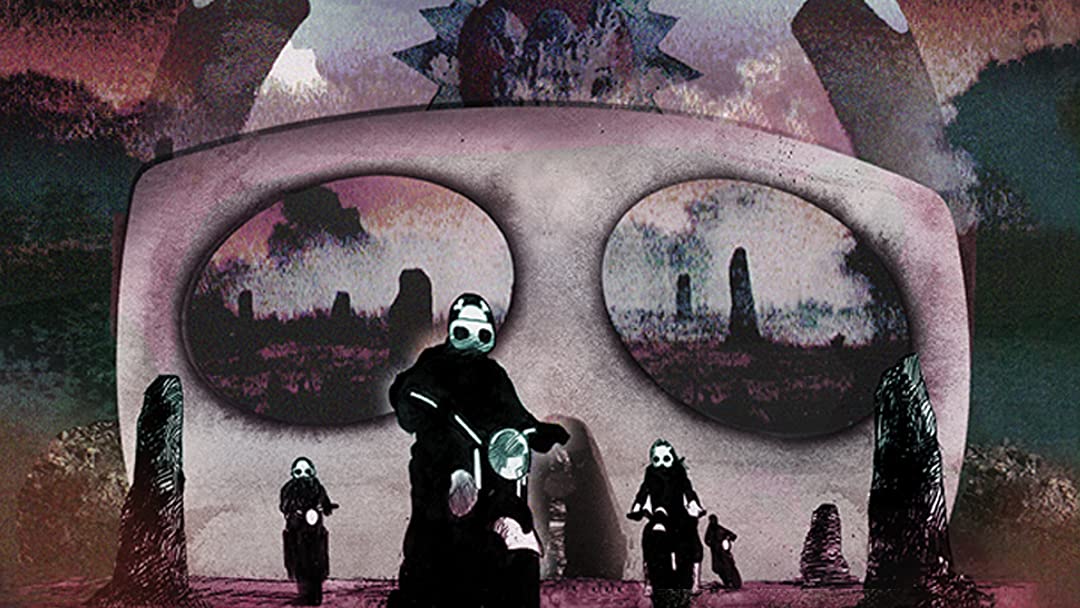
Is it ever too cold to ride? My God, yes – it is way too cold to ride. So instead, we invited our friend Jamie Ray from the Fave Five from Fans podcast to join us as we talk through our favorite chopper-themed horror flicks. Some of these are pretty bad – but so fun! – so prepare for a bumpy ride!

5. Deathmaster (1972)

Oh, there were so many terrible films that could have taken this final slot. Would it be Blood Freak? Chopper Chicks in Zombietown? Werewolves on Wheels?

So many choices!

Deathmaster gets the nod because it combines all the required elements – Satanism, hippies, and motorcycles – but it cranks it up a notch. This subgenre owes its very existence to Charles Manson, who braided those three elements together in the minds of Americans. But Deathmaster takes that one step further by creating a specifically Manson-like character—the charismatic guru Khorda – and making him a vampire.

Why is he a vampire? Maybe because they cast Robert Quarry (Count Yorga), who already had the teeth. Who knows, it comes off as utter nonsense, but it makes for a little fun variety.

4. These Are the Damned (1963)

Black leather, black leather, smash smash smash

Black leather, black leather, crash crash crash

Black leather, black leather, kill kill kill

I got that feelin’ – black leather rock

That, in a nutshell, is how dumb this movie is. And yet, like the ludicrous theme song, it’s just weird enough to stay in your head.

Oliver Reed is at his youngest, sultriest, Oliver Reediest as the street tough who chases his sister and her older American boyfriend right into some kind of underground lair where radioactive children are kept.

Suddenly you’re in what appears to be an entirely different movie. It’s like somebody sewed A Clockwork Orange and Village of the Damned together, buried them under rock, and them lobotomized the final version.

Which is kind of appealing, isn’t it?

3. Psychomania (The Death Wheelers) (1973)

More adorably sketchy Brit motorbikers in this one. Some mods wreak havoc on their bikes (because apparently drivers in England have no idea how much more vulnerable a bike is than a truck). But they crave more!

More danger! More excitement!

So they decide that if they kill themselves they can will themselves back to life and become hip zombie bikers.

The film’s appeal has a strange longevity. It’s never scary for even a moment, and it’s often outright ludicrous – if not adorable – but it does have a style and a couple of performances you can admire.

2. The Rocky Horror Picture Show (1975)

Yes, Janet. Life’s pretty cheap to that type.

Whether it’s the Transylvanians traveling dto Time Warp with the doctor and his domestics, or the arrival (and quick removal) of Eddie, motorcycles play a significant role in this treasure of a film.

It was 1975, after all, and no self-respecting edgy, dangerous film could possibly convince the world of its anti-establishment bonafides if no one rode a motorcycle. It turns out, it’s the ones who aren’t riders you need to watch out for.

1. Race with the Devil (1975)

At some point somebody decided they were tired of seeing the motorcycle riders always turning out to be Satanic hippies. Nope, not this time.

The film re-teams Peter Fonda and Warren Oates – so great together in 1971’s The Hired Hand. They’re buddies taking a top-of-the-line RV out for a spin across Texas, along with their lovely wives. They stop to camp in the middle of nowhere, the guys take their bikes out for a stretch, and next thing you know, they’re being followed by Satanists and who knows which of these backwoods locals can be trusted?

The film generates real tension in much the same way Spielberg had done four years earlier with Duel. That tension, supported by solid, gritty performances, give this one surprising punch.

Witch Seeking Craft

Earwig and the Witch

by Hope Madden

More than 30 years ago, the great Hayao Miyazaki released a charming animated adventure that shadowed a little witch-in-training and her talking cat. Kiki’s Delivery Service is more interested in children finding their way in an adult world than in magic. The film is magical nonetheless, thanks to Miyazaki’s gorgeous art.

This weekend, Studio Gibli—the house that Hayao built—releases Earwig and the Witch. It’s the same movie, really, just not nearly as good.

Earwig is left as an infant at a proud English orphanage, where she stays for years tucked in among friends who do whatever she wants and staff who do much the same. But she’s adopted one day by a witch and a demon and she’s quite harrumphy about it all.

Director Gorō Miyazaki, Hayao’s son, keeps his focus on this willful little girl who intends to be a witch-in-training no matter what her new guardians expect.

Fans of the genre will immediately take umbrage at the animation style. It’s definitely not his dad’s. Don’t expect the little (or sometimes enormous) creatures that populate the fringes of classics like Spirited Away or My Neighbor Totoro.

That’s hardly where the dissimilarities end. Earwig tosses aside the sublime 2D look of traditional Gibli for a CG animation more in keeping with Pixar’s output. But there’s no nuance, no beauty or humanity in the rendering.

Anime fans may balk, but will children care?

Probably not, which means the film would be fine if only the younger Miyazaki had his father’s (or Pixar’s) grasp on basic storytelling. While Earwig conjures specific story details from Spirited Away and Howl’s Moving Castle, it fails to deliver on any of its plot suggestions. There’s a dungeonlike workroom brimming in equal measure with magical potential and filth, a mysterious redhead, a rock band, a shrouded heritage…all of which amounts to absolutely nothing.

Nothing ties together, and by the final scene’s reveal you feel like you’re watching the cliffhanger for an episodic series that you probably won’t commit to.

Fright Club: 1, 2, or 3 Person Casts

Fuzzy math takes over as we count cast members and celebrate minimalist films that can seep into your nightmares with the help of very few performers. There are some great options, but here are our six favorites films with 1, 2, or 3 people in the cast.

Thanks Fright Clubber Michael for the topic!

6. Hard Candy (2005)

It would be two years before Elliot Paige burst into public consciousness as the hilarious and pregnant teen in Juno–still a kid getting herself into trouble, I guess. But the trouble in Hard Candy is tougher to manage.

Paige is a force of nature, playing off Patrick Wilson in a cat-and-mouse game where roles are flexible. Director David Slade keeps tensions ratcheted up to an unbearable level while Brian Nelson (who collaborated with Spade on the underappreciated vampire flick 30 Days of Night) twists the knife in a script as sharp and shady as these actors are wily and hard edged. It’s a breathless exploration of all that’s bad in the world.

5. Buried (2010)

If you’re claustrophobic, you might want to sit this one out. A tour de force meant to unveil Ryan Reynolds’s skill as an actor, Buried spends a breathless 95 minutes inside a coffin with the lanky Canadian, who’s left his quips on the surface.

Writer Chris Spalding stretches credibility as he tries to keep the crises lively, which is unfortunate because the simple story and Reynolds’s raw delivery makes this a gut-wrenching experience.

4. Creep (2014)

This true two-man show boasts dark and twisted humor, a great jump scare, and a truly exceptional mask.

Writer/director Patrick Brice plays Aaron, hapless videographer seeking work, thrills, maybe even love. He answers an ad to record Josef (Mark Duplass) at home, and then on the road. The film toys with that inner warning you hear and then choose to ignore.

Duplass has an incredible aptitude for pushing boundaries just enough to prick that inner voice but not quite enough to guarantee that you’ll head for the exit. As red flag after red flag go unheeded, Brice unveils more and more chilling detail.

3. 10 Cloverfield Lane (2016)

This one is a threesome. Well, not if Howard (a glorious John Goodman) has anything to say about it.

The feature debut from director Dan Trachtenberg toys with the idea of an alien invasion (or some kind of chemical warfare), but it keeps you snugly indoors with Howard and his guests Michelle (Mary Elizabeth Winstead) and Emmett (John Gallagher Jr.). Guess which one Howard doesn’t really want around?

The trio of performances compel your attention, even in the few down moments. This is a tight, taut thrill ride—even if it is confined to one guy’s basement.

2. Antichrist (2009)

Boy, Charlotte Gainsbourg and Willem Dafoe are a one/two punch in this one. A married couple overcoming the guilt and desperate grief of their son’s death, the two make some increasingly dreadful decisions.

Alone in their apartment, the two bodies take up much of the screen. Once we move to the cabin in the woods, the colors become deeper and darker, the atmosphere denser, and the actors appear almost tiny and insignificant inside all this throbbing, living nature. Both performances are jarring and fantastic in a movie quite unlike any other.

1. The Lighthouse (2019)

The one thing you just don’t do as you descend into madness is spill your beans.

Dafoe again, this time with Robert Pattinson as his wickie mate in one of the most fascinating examinations of power shifts in horror history. Gorgeously photographed in black and white and boasting 2019’s best sound design, The Lighthouse offers these two actors plenty to work with.

But in the end, it’s the performances that kill you. Madness!

Digging in the Dirt

The Dig

by Hope Madden

Indiana Jones made archeology look thrilling and dangerous. Director Simon Stone’s The Dig makes it look positively British.

Back in 1938, as England sat on the precipice of WWII, an informally trained excavator named Basil Brown unearthed an ancient Saxon ship in a mound around back of the widowed Edith Pretty’s land. Journalist/novelist John Preston’s aunt Margaret Piggott was part of the larger archeological crew at Sutton Hoo that would mine the site for its cultural riches. Many years later, Preston would mine that story for a novel.

Refined and marked by the proper restraint of the English, Moira Buffini’s adaptation of the source material remains keenly interested in the difference between what we unearth and what we leave buried. Stone’s film shadows two romances and the emotions they choose to excavate as well as those they do not.

Brown and Pretty are played by Ralph Fiennes and Carey Mulligan, respectively. Fiennes finds a sweetly vulnerable center to Brown’s guarded stoicism. Meanwhile Mulligan reminds us again of her limitless range, playing essentially the opposite character of her bitingly brilliant Cassandra in Promising Young Woman.

Watching the gentle dance these two impressive talents engage in as their characters come to understand one another is hypnotic. There’s rarely an excuse to miss the opportunity to see either Mulligan or Fiennes act, and their delicate chemistry here is gorgeous.

Stone flavors his film and this relationship with notes of longing and melancholy that balance the overall theme of discovery. And then a sudden development—the arrival of Basil’s amiable and thoroughly loyal wife May (Monica Dolan, irresistible)—does more to sever their tale than complicate it.

This odd second act shift – just when we’ve really begun to invest in the primary relationship – turns Mulligan and Fiennes into supporting players in their own movie. Johnny Flynn and Lily James take it from here, he the attentive young RAF man in waiting and she the spunky archeologist/unsatisfied newlywed.

Both actors are solid, as is the entire and sizable ensemble of support, but the film feels out of sorts the moment the youngsters arrive.

It’s a lopsidedness The Dig never quite recovers from. Of course, had Mulligan and Fiennes not shone quite so brightly, it may not have been a problem at all.

Nights Are Warm and the Days Are Young

Some Kind of Heaven

by Hope Madden

There is something absurd and mesmerizing about Lance Oppenheim’s documentary Some Kind of Heaven. The greens of the golf courses are insanely green, the aquas of the pools are blindingly blue/green, the synchrony of limbs or golf carts in the choreographed dances is hypnotic.

They have synchronized golf cart dances.

The Villages is nuts!

Sort of the Disneyland of retirement communities, Florida’s The Villages is a 100,000 strong city, gated and catering exclusively to elderly residents. Their town square is painted and constructed to look like a real town square – it even has a fake history that city tour guides will spin with a smile and a deep, savage tan.

This is a community of affluence ripe for satire in an era of catastrophic generational income inequality. Instead, Oppenheim finds a more melancholy and poignant inspiration. Rather than lampoon the wretched excess, the filmmaker develops character studies, unveiling something more bitter than sweet in this dessert topping of a town.

Anne and Reggie, married 47 years, began falling apart before they moved to The Villages, but his recreational drug use and attempts at spiritual awakening are taking a toll. A poignant look at loneliness inside the happiest place in old age, the recently widowed Barbara works all day and finds herself an outsider in a world full of vacant, smiling eyes.

But the true outsider is the seediest and most fascinating character of the bunch. Eighty-one-year-old Dennis cannot afford The Villages, but he’s not ashamed to scam his way in. Living in his van and preying on lonely women with money, he reminded me of the sublime Senior Love Triangle from 2020.

That comparison, though, only draws attention to the fairly superficial treatment Oppenheim gives the subjects. Dennis seemed to be an opportunity to comment on an unseemly reality seeping into this community, itself a perversion of reality.

Oppenheim’s framing and David Bolen’s cinematography create an unforgettable visual experience, preparing you for a Wes Anderson meets John Waters documentary about rich old people synchronized swimming.

Well, that’s just too high a bar. Who could live up to that? Instead, Oppenheim settles for a little razzle dazzle, a little character intrigue, and enough footage to make you wonder what the hell goes on in The Villages.

Tale from the Hood

Hunted

by Hope Madden

It’s hard to tell a new story. People have been telling stories since the beginning of people, and eventually – probably millennia ago – we realized we were just recycling the same dozen or so tales.

This week’s Shudder premiere, director Vincent Paronnaud’s Hunted, feels especially familiar. He knows that, presumably, or the woman being chased through a massive forest wouldn’t be wearing a red hooded coat.

It’s clear in every aspect of the telling of this story that the filmmaker (and a team of writers including Paronnaud, Lea Pernollet and David H. Pickering) want you to understand how familiar this is.

Indeed, Paronnaud’s tale of a man chasing a woman is so ordinary that no matter how outlandish the circumstances, onlookers barely register it as more than a moment’s blip in their day.

Hunted opens with a fairy tale, spun by fireside in a deep, dark woods, of a group of men who turn on a woman. In this ancient lore, things don’t turn out so well for the men, not because a savior steps in but because of something more primal.

And so, eons later, the aptly named Eve (Lucie Debay) is dealing with a boss who underestimates her and a husband who can’t stop calling. She goes out for a drink. That might have been the last we ever heard from Eve.

Instead, after a series of events that escalate beyond the point of realism to something bordering on the absurd, the whole damn forest hears her.

Debay’s transformation is also marked very obviously and very visually, underscoring the cartoonish nature of this particular enactment. She does a wonderful job of evolving from something in Act 1 that feels garden variety for horror into something surprising and fierce.

Arieh Worthalter equals her as the psychopath, often lensed to give him the look of an animated wolf charming villagers.

Paronnaud’s background is in animation—he co-directed Marjane Satrapi’s sublime black and white wonder Persepolis. His move to horror benefits from his visual flair. While the red coat stands out as an obvious nod (not to mention terrible camouflage), a later splash of blue feels simultaneously insane and warrior-like.  

Or a fresh coat of paint.