Tag Archives: George Wolf

Love In the Time of Breadsticks

Spin Me Round

by George Wolf

A madcap reminder that what seems too good to be true probably is, Spin Me Round finds Alison Brie and an engaging ensemble looking for love in the time of endless breadsticks.

Brie co-writes the screenplay and stars as Amber, the manager of the Bakersfield, CA branch of Tuscan Grove restaurants, an Olive Garden-type Italian chain. Single and not loving it, Amber’s luck turns when her supervisor (Lil’ Rel Howry) tells her she’s won a spot in the company’s “Exemplary Manager’s Program.” And that means a free trip to the Tuscan Grove Villa in Pisa, Italy!

Ciao, suckers, think of me when you’re rolling silverware!

Okay, so the hotel isn’t quite as nice as expected, and her fellow winning managers are a little eccentric (including the great Molly Shannon as a woman really needing the meds that were lost with her luggage), but Tuscan Grove CEO Nick Martucci (Alessandro Nivola) is here in person!

Nick’s suave and handsome, and when his assistant Cat (Aubrey Plaza, perfectly condescending but curiously underused) delivers an invite to Nick’s private yacht, it’s Amber’s head that starts swimming. Could her BFF’s (SNL’s Ego Nwodim) predictions of amore be coming true, or is this too much too soon?

Bet you can guess.

But director and co-writer Jeff Baena (The Little Hours, Horse Girl, the I Heart Huckabees screenplay) is eager to take the film off the expected rom-com path. Just when you think you’ve got it pegged, there’s wild boars, kidnapping, shady characters and plenty of suspicion.

Brie is always likable, and her wide-eyed and accommodating Amber is the perfect tour guide through this land of tonal shifts and total weirdos (including Fred Armisen, Ben Sinclair and Tim Heidecker). And while the film is never uproarious, it’s consistently amusing and never a bore.

But what’s the end game here? Pointing out how many rom-com’s find romance in sexual harassment? How day to day drudgery can easily breed unrealistic fantasy? The consistent appeal of bland comfort food?

There’s a dash of all that in Spin Me Round‘s entree. It’s light but filling, with a pleasing aftertaste. Just don’t spend too much time wondering what’s going on in the kitchen, and dig in.

Occupied!

Glorious

by George Wolf

I like to imagine the pitch meeting went something like this:

Picture it: a desperate man, trapped in a remote roadside rest stop with an ancient monster named Ghat.

Who’s playing the monster?

The voice of J.K. Simmons.

Go on.

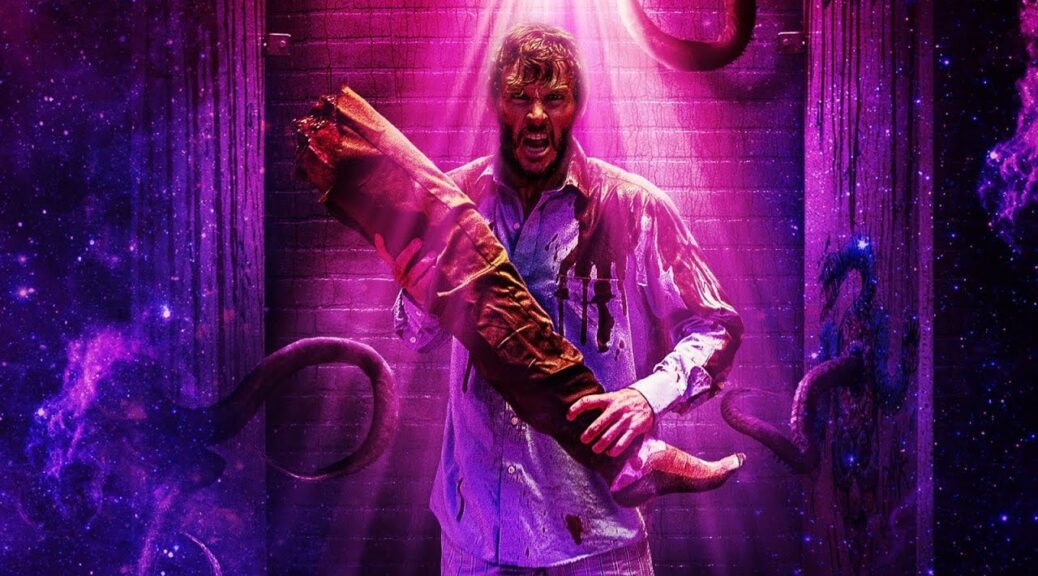
So our man’s in one stall, with the monster in the other, offering commands from behind a glory hole.

What’s it called?

Glorious.

You’re damn right it is, and Shudder wants it for August.

Well now it’s here, and while the downsized cast and location recalls a host of pandemic-era productions, director Rebekah McKendry makes the most of what she’s given. Glorious proceeds at an intriguing pace that never feels sluggish, showing us just enough of the tentacled bathroom beast to strike an effective balance between bloody Lovecraftian spectacle and doomsday humor.

True Blood‘s Ryan Kwanten is perfect as a sad, pantsless bathroom sack named Wes. Screenwriters Joshua Hull, Todd Rigney and David Ian McKendry give Wes a wisecrack-fueled arc that shifts from wallowing in the pain of losing Brenda (Sylvia Grace Crim) to bargaining with Ghat for the fate of humanity (and Simmons, of course, is priceless). While the character is never quite compelling, Kwanten settles in a notch of two below Ryan Reynolds on smartass scale, making it easy have an interest in where Wes’s trippy toilet trip ends up.

And you may catch on early to that destination, but the real test of how Glorious will hit you is how much love you have for Lovecraft. Even if it’s minimal, this is a bathroom break full of squalid, forgettable fun.

Fright Club: Killer Clothing in Horror Movies

We wanted to call this Dressed to Kill, but that would just be confusing. No, this is not about dressing the part [or about horror’s terrible history of confusing sexual orientation with psychosis]. Nope. This is about actual killer clothing.

5. The Red Shoes (2005)

In 2005, Kim Yong-gyun updated the old, horrifying Hans Christian Anderson story of vanity. Do you know that one? Spoiled girl with pretty red shoes is cursed so the shoes never stop dancing, her only relief is to have her feet cut off? Excellent children’s fare!

Like a lot of Asian horror of the time, the film follows a newly single woman and her daughter as they move into a shabby new apartment before finding a cursed object – in this case, shoes that are actually pink.

Though Sun-jai (Kim Hye-soo) brought home the discarded pair she found at the subway for herself, it’s her daughter (Park Yeon-ah) who becomes obsessed with them. Too bad they keep killing people!

There’s the obligatory sleuthing into the mysterious curse, but the filmmaker keeps you guessing, keeps the blood flowing, and comes up with a solidly creepy little gem.

4. Deerskin (2019)

What makes a good midlife crisis? What gives it swagger? Physicality? Style? Maybe a little fringe?

Deerskin.

Welcome to another bit of lunacy from filmmaker Quentin Dupieux. As he did with 2010’s Rubber (a sentient tire on a cross-country rampage), Dupieux sets up one feature-length joke.

It’s funny, though.

Deerskin is also slyly autobiographical in a way Dupieux’s other films are not. An odd duck wants to follow his vision (in this case, the obsessive love of a deerskin jacket) and make a movie. Creative partnerships and collaboration, while possibly necessary, also soil the vision and make the filmmaker feel dumb.

No one understands him!

Or maybe they do and his ruse is up.

No matter. He still has killer style.

3. Slaxx (2020)

Absurdism meets consumerism in co-writer/director Elza Kephart’s bloody comedy, Slaxx.

Sehar Bhojani steals every scene as the cynical Shruti, but the jeans are the real stars here. Kephart finds endlessly entertaining ways to sic them on unsuspecting wearers.

Where Romero mainly pointed fingers at the hordes mindlessly drawn to stores like CCC, Kephart sees the villains as those perpetuating clean corporate hypocrisy. Still, it’s their customers and workers she murders—by the pantload.

2. Clown (2014)

Sympathetic, surprising, and often very uncomfortable, Jon (Spider-Man franchise) Watts’s horror flick, though far from perfect, does an excellent job of morphing that lovable party favorite into the red-nosed freak from your nightmares.

Because clowns are terrifying.

Kent (a pitiful Andy Powers) stumbles across a vintage clown outfit in an estate property he’s fitting for resale. Perfect timing – his son’s birthday party is in an hour. What a surprise this will be, unless the suit is cursed in some way and will slowly turn Kent into a child-eating demon.

It does! Hooray!!!

https://www.youtube.com/watch?v=3iw4ZeNoTbg

1. In Fabric (2018)

My last note after watching In Fabric: “Well, that was weird.”

Weird in a good way. The film follows a red Ambassadorial Function Dress and the havoc it wreaks on its wearers.

Strickland, apparently, is about as fond of consumerism as Romero or Cronenberg. He’s also as fond of the color red as Argento. Unlike the giallo films that clearly inform Strickland’s aesthetic, here commerce, not violence itself, is the seductive, sexualized element.

Nobody blends giallo’s surrealistic seduction with dry British wit (two elements that, to be honest, should not fit together at all) like Peter Strickland. Subversive and playful while boasting a meticulous obsession with the exploitation films of the Seventies, Strickland creates vintage-futuristic fantasies that live outside of time and evoke both nostalgia and wonder.

https://www.youtube.com/watch?v=CbHsEiCchwk

Days of Future Past

My Old School

by George Wolf

Brandon Lee was a mystery wrapped in an enigma inside the body of an awkward Scottish high schooler.

Or, maybe he was something else. My Old School revisits those teenage days for a light and entertaining look at a head-scratching scammer.

Brandon’s story was set to be told in a Mid-90s movie starring Alan Cumming. That project never got off the ground, but now Cumming finally gets his chance to play the part, lip-synching Brandon’s interview audio because the real guy won’t show his face.

And why is Brandon still hiding?

Well, that’s one of the mysteries writer/director Jono McLeod hopes to unravel.

Talking to Brandon’s former classmates and often re-creating their memories through animation, McLeod introduces us to the boy his peers first knew.

In 1993, Brandon enrolled as a 16 year-old at Bearsden Academy, a secondary school in an upper class section of Glasgow. His intelligence and behavior made him a favorite of the staff, but the kids found him weird.

Getting cast as Lt. Cable in the school’s production of South Pacific changed Brandon’s social status. And soon there were friends, holidays, brushes with the law, multiple passports and…oops.

Obviously, knowing as little as possible about this case benefits how the film will hit you, but even the biggest revelations don’t land quite as hard as McLoed seems to think they will. There are no jaw-on-the-floor twists on the order of 2012’s The Imposter, but some interesting questions are raised about selective memory and a belief in Jedi mind tricks.

An animation style that recalls MTV’s “Daria” and the laugh-it-off vibe of Brandon’s old classmates only fuels the feeling that the film is a little too forgiving of its subject.

Looking back, most everyone involved now admits that they should have looked closer at Brandon Lee. Entertaining a yarn as it may be, My Old School might have been more compelling by doing the same.

Let Them Hit the Floor

Bodies Bodies Bodies

by Hope Madden & George Wolf

In a way, we’ve seen Bodies Bodies Bodies before. A group of good-looking, rich young people gathers in a remote home to imbibe and play stupid games that turn deadly. Think April Fool’s Day, Truth or Dare, Ouija.

A24’s latest horror film isn’t a straight reimagining or a satire of the sub-subgenre. It’s barely a part of the subgenre. Instead, B3 delivers an insider’s skewering of the sociology of a generation.

The result never condescends or patronizes. Not that it’s kind.

Director Halina Reijn’s clever (if slight) film roots its comedy and horror in Gen Z culture. Sophie (Amandla Stenberg, who also produces) brings her new girlfriend Bee (Maria Bakalova, Oscar nominee from Borat 2) to a rich buddy’s mansion for a hurricane party.

That buddy (Pete Davidson) and the rest of Sophie’s inner circle didn’t really expect her to show up, let alone bring a plus-one. And Bee’s more than a little out of her element with this group of spoiled rich kids.

When the weather finally hits, they decide to play a game with the lights off where one “killer” taps a player on the back, they play dead, and the one who finds them shouts “bodies bodies bodies.” Then you try to figure out the killer.

This is also the plot of the rest of the movie. Reijn and writers Sarah DeLappe and Kristen Roupenian are essentially predicting what happens when this generation finds themselves trapped without internet: Lord of the Flies.

A wicked script buoyed by smart visuals—particularly the use of lighting—emphasizes the social anxiety strangling these characters. Agatha Christie turns Agatha Bitchy as paranoia, self-absorption and toxic douchebaggery spoil the party games.

Reijn works the dark corners and vast emptiness of the estate setting for an effective undercurrent of tension as the beats and bodies keep dropping. And though the bloodletting is often offscreen, every new discovery becomes a chance to sharpen suspicions, reopen old wounds and hurl new accusations, with each partygoer struggling to navigate both offense and defense.

The compact cast sparkles with young talent, led by Stenberg and Bakalova. We essentially come to party with them, and it is the breakdown in their characters’ trust that keeps us off balance and fuels our anxieties. Davidson has fun riffing on his own bad boy image, and Shiva Baby‘s Rachel Sennot delivers the biggest smiles as the dim-witted Alice (“guys, doing a podcast is haaaaard!”).

The social commentary here is a bit tardy to be profound, and the 95-minute running time gets filled out via some repetition, but Bodies Bodies Bodies finds an entertaining sweet spot between gore and guffaws.

There’s just enough humor and horror to make the whodunnit less vital, so even solving the mystery early won’t spoil the party. The fun comes from just riding out the storm, and the film’s deliciously deadpan final line reveals that was the plan all along.

Screening Room: Bullet Train, Prey, Thirteen Lives, Luck & More

First Time Long Time

Prey

by George Wolf

Well-crafted memories of the mid-80s helped Top Gun Maverick blow up the box office this summer. And while Prey skips the big screens for a rollout on Hulu, the film is not shy about its plan for more crowd-pleasing nostalgia.

It’s also not shy about the carnage.

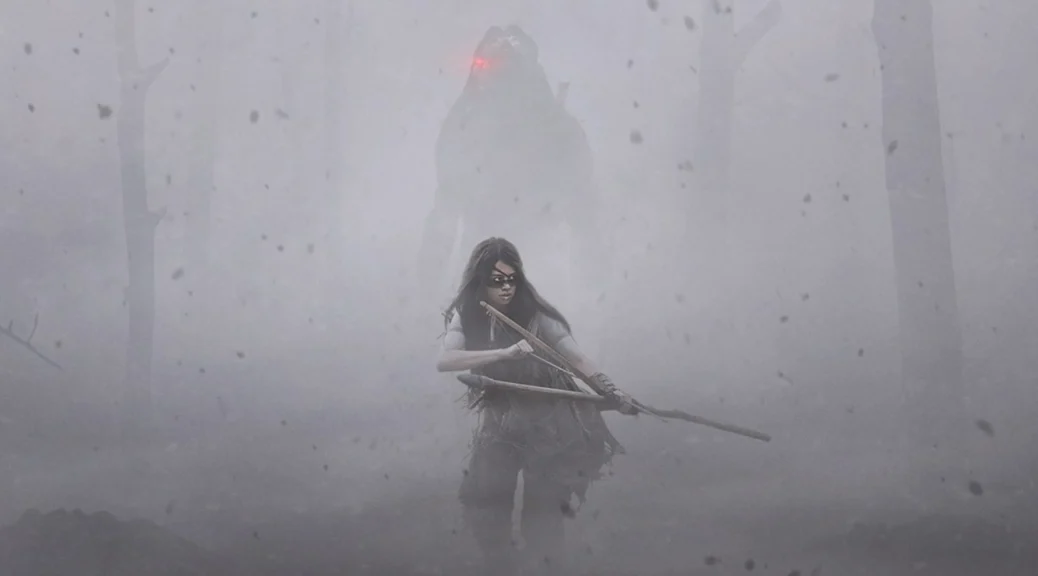
Director Dan Trachtenberg (10 Cloverfield Lane) takes the reins for installment number five in the Predator franchise, teaming with writer Patrick Aison to rewind 300 years, when a tribe of Comanche hunters suddenly found themselves among the hunted.

Naru (Amber Midthunder) thinks she has the skills to join the hunt and help provide for her tribe, but her brother Taabe (Dakota Beavers) isn’t so sure. And when Taabe has to come to Naru’s rescue in the wild, she’s urged to stand down.

But Naru has glimpsed something large and lethal in the woods, and when that something begins making bloody sport of Comanche nation, she’s eager to prove just how lethal she can be.

Midthunder (The Wheel, TV’s Legion) is a fine heroine, more than capable with the role’s physicality and Naru’s stubborn resolve. And she’s able to keep the character compelling when Aison’s character arcs and “the hunter is now the prey” themes seem hurried and obvious.

Trachtenberg compensates with a string of arresting visual set pieces. As his camera dives deep into the trees and then high above, Trachtenberg crafts the Predator’s first Earthly battlefield as a home suddenly and violently unknown to its natives, a metaphor for the Native American experience that lands with resonance.

Those well-known monster calls fuel the tension, the action is thrilling, and the blood is splattered with pride, complete with unmistakable callbacks to the original 1987 film through both movement and dialog.

And about that dialog…

Trachtenberg and producer Jhane Myers (of both Comanche and Blackfeet heritage) have clearly taken great care with the film’s cultural representation and depiction. In fact, you can choose a version of Prey that is dubbed by the cast in the Comanche language (becoming the first film to offer this option).

It’s a wise choice, because as distracting as dubbed audio can be, the English dialog in Prey is even more so. It’s not just that the Comanche characters speak English, but the phrasing and delivery is so very present day, it’s hard to stay grounded in the film’s otherwise impressive world-building.

Word is that before making the decision to dub, Trachtenberg and Myers considered filming exclusively in the Comanche language. Damn, that would have been a great action film.

Prey is a good one.

Station to Station

Bullet Train

by Hope Madden & George Wolf

It took us decades to embrace it, but Brad Pitt is really funny. We all saw those acceptance speeches, right? Burn After Reading? And he was easily the funniest thing about the Sandra Bullock/Channing Tatum romance adventure The Lost City.

But those were acceptance speeches and supporting turns. Pitt’s comedic stylings are front and center in David Leitch’s highly advertised Bullet Train.

He’s not alone. There are about 100 other people on this train, most of them for the same reason.

Hitman twins Lemon (Brian Tyree Henry) and Tangerine (Aaron Taylor-Johnson) are on a job for the mysterious Japanese gang lord known as White Death. Prince (Joey King) is a young woman with more plans for the trip than just finishing her book. Kimura (Andrew Koji) will do whatever it takes to keep his kidnapped son alive, and Wolf (Benito A Martínez Ocasio aka Bad Bunny) just wants to settle an old score with Ladybug.

Pitt would be Ladybug, an adorable code name given to him by his handler (Sandra Bullock). His first job back from sabbatical is a quick, easy one: grab a briefcase off a train and then get off that train. But there are so many other stories and bandits and snakes and whatnot, and that automatic door just keeps closing station after station before Ladybug can make his exit.

Leitch can stage action. You’ve seen Atomic Blonde, right? And since the director’s official 2017 feature debut (he gets an uncredited nod for the original John Wick), his focus has been on slight, action-heavy comedies: Deadpool 2 and Hobbs & Shaw.

His Bullet Train continues that tradition: it’s slight, action-packed, silly fun. He and screenwriter Zak Olkewicz adapt Kôtarô Isaka’s novel via a mishmash of styles, blending a spoonful of Edgar Wright with a heaping helping of Guy Ritchie and a smidge of Tarantino. It’s bloody and hyperactive with witty banter and surprise dot connecting, all trying their best to distract you from the lack of tension and bloated run time.

The cast sure seems to be having a blast with it, especially Pitt. He makes Ladybug an endearing mix of daily affirmations and lethal force (with an unusual interest in lavatory facilities).

Throw in a couple other big star cameos, and Bullet Train is a stylish concoction that never finds the right balance of hip action and self-aware absurdity. It’s clever but not really funny, full of high gloss stuck in economy class. The ride may seem fun while it lasts, just don’t expect anything memorable waiting at the destination.

Secret Chords

Hallelujah: Leonard Cohen, A Journey, A Song

by George Wolf

For longtime fans of Leonard Cohen, the continued pop culture embrace of “Hallelujah” can sometimes feel bittersweet. Other times it just makes you want to scream.

Jeff Buckley didn’t write it! It’s not a Christmas song! And for God’s sake, stop messing with the lyrics!

And even though that’s satisfying to yell when another TV talent show contestant attacks Cohen’s masterpiece with more bluster than feeling, you can’t deny you’re guilty of an equally false claim of ownership. As singer/songwriter Brandi Carlile rightly points out, by now the song “Is its own person. It has a life of its own.”

So, how’d that happen? Back in the early 80s, “Hallelujah” was DOA, buried on a Cohen album that Columbia Records dismissed outright as unworthy to release.

Alan Light first tracked the song’s ascent in his 2012 bestseller “The Holy or the Broken,” and Light serves as a consultant to co-directors Daniel Geller and Dayna Goldfine for their documentary examination. Straddling the line between biopic and expose, the film gives the uninitiated an overview of Cohen’s background while indulging veteran admirers with a deeper dive into his most acclaimed composition.

Geller and Goldfine interview fans, friends and journalists, tracking Cohen’s unique troubadour life alongside the gradual wave of “Hallelujah” cover versions. It seems only right that Bob Dylan was one of the first to recognize the song’s genius, and it’s a treat to hear his interpretation set the stage for the mainstream breakthrough that came via Jeff Buckley and Shrek (John Cale in the film, Rufus Wainwright on the soundtrack).

But the film’s strongest moments come through the intimacy of hearing from Cohen himself, and getting closer to his often tortured songwriting process (“If I knew where songs came from, I would go there more often”). We see notebook after notebook full of lyrics, while handwritten lines appear and disappear as guesses are made as to just how many verses (100? 180?) Cohen wrote for “Hallelujah” alone.

At times Geller and Goldfine lean back on biography just when the musical detective work is cooking, but A Journey, A Song ultimately connects the two with a resonant thread.

Leonard Cohen was a seeker, always striving to reconcile the primal with the spiritual. The process may have taken several years, but he wrote a song that lays that search bare with unparalleled eloquence. And though Cohen himself admitted before his death that “too many people sing it,” Geller and Goldfine are smart enough to include plenty of footage of Cohen performing the song himself, and to close with k.d. lang’s goosebump-time version that Cohen hinted was his favorite.