Screening Room: Gran Turismo, Retribution, Golda, Vacation Friends 2, Ashkal, Brightwood
by George Wolf
Retribution marks the third remake of the Spanish thriller El desconocido, just in the 8 years since the original’s release.
What is it about this bandwagon that has made it so tempting to jump aboard?
If the latest version is any indication, it’s most likely the easily digestible stakes amid a standard thriller framework that offers plenty of room for tweaks without altering the chances for purely surface-level satisfaction.
So when you’ve got such a ready-made template for an English language thrill ride, the Neeson hotline is sure to be lighting up.
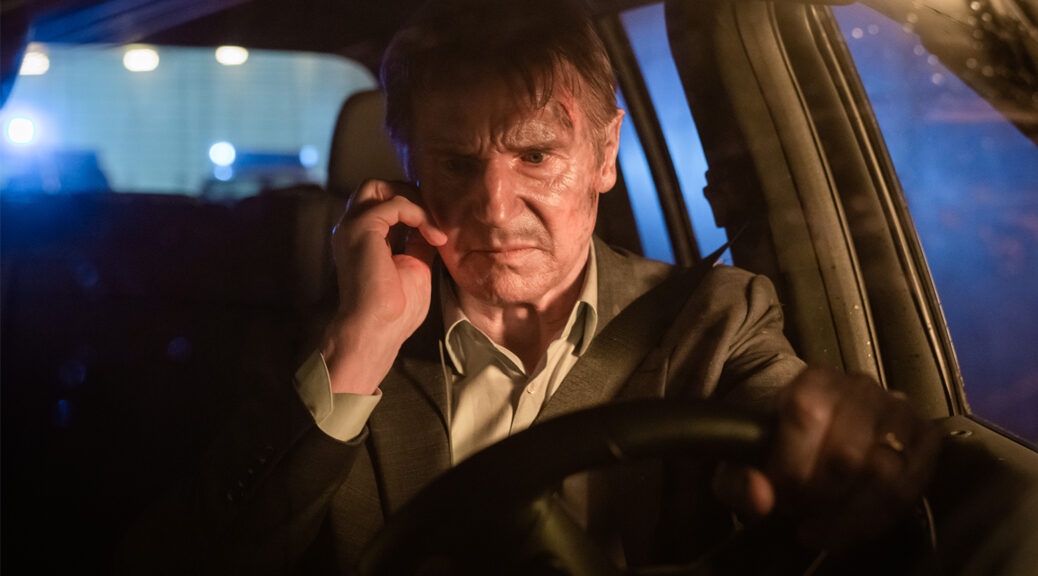
But this time, Liam plays Matt Turner, a banking executive living in Germany whose particular skills mainly involve ignoring his wife Heather (Embeth Davidtz), son Zach (The Way of Water‘s Jack Champion) and daughter Emily (Lilly Aspell, young Diana from the Wonder Woman films).
Matt picks a bad day to begrudgingly take the kids to school, because a disguised voice calls to tell Matt his car has been rigged with bombs. And the bombs have been rigged with pressure plates under the seats that will trigger those bombs if anyone gets out of the car.
So, what does the caller want? Is it just a ransom demand, or maybe revenge for some bad investment advice that wiped out a client’s life savings?
Shut up and drive!
Director Nimród Antal (Machete, Predators) tries his best to bring some style to the automobile setting, grabbing any opportunity he can for a new POV angle or mirror reflection. His instincts are understandable, but the approach often lands as just showy desperation.
Neeson’s on phone-yelling/time racing cruise control. But, the kids are good and both Matthew Modine and Noma Dumezweni (The Little Mermaid) provide strong support with limited screen time.
No one in the cast is given much chance of character development from Christopher Salmanpour’s script, but you can expect a surprise or two while he makes some promising edits to the original mystery. And though the final showdown does shake off a very Scooby-level unmasking to eventually better El desconocido, any hopes for mining something meaty from this derivative premise are erased when the film all too eagerly reverts to “Liam defends his daughter” factory settings.
Time to put this one in “park,” it’s on E.

by George Wolf
When I used to coach youth baseball, I would sometimes encourage the use of video games to teach the young ones about rules, game situations and strategy.
And then one day the Major Leagues called up one of my best players!
Nah, that would be crazy. Almost as crazy as the true story at the heart of Gran Turismo, a trope-laden but surprisingly engaging mix of product placements and underdog sports heroics.
Orlando Bloom is Danny Moore, a UK marketing exec for Nissan who worries that young people are caring less about driving cars and more about driving simulators, specifically Gran Turismo on PlayStation. So, Danny proposes a contest that would fuel excitement for real driving.
Find the 10 best “sim” racers in the world and send them to GT Academy boot camp. The academy champion will join Team Nismo and compete in actual races against seasoned pros who will hate them.
The fact that this actually happened to Jann Mardenborough (Archie Madekwe) in 2011 is mind-blowing, and director Neill Blomkamp (District 9) presents the racing action with an engaging fantasy/reality mix of burning rubber and game graphics that seems fitting.
Madekwe (Midsommar, Heart of Stone) gives Jann a sense of wounded determination that is easy to root for, but it’s David Harbour’s turn as no-nonsense driving instructor Jack Salter that consistently comes up a winner. Harbour’s chemistry with Bloom is antagonistic and amusing, while Jack and Jann eventually develop a bond of respect and affection that carries some warmth.
But getting there is a long 135-minute road, with some hazards.
Screenwriters Jason Hall, Zach Baylin and Alex Tse hamper Blomkamp’s foot-on-the-gas highlights with cliches, manufactured rivalries and the overwrought dramatics of Jann’s struggle to connect with his father (Djimon Hounsou). And while the constant instructions to Jann and his fellow drivers are a nicely organic way to keep the rest of us updated on the stakes, mounting distractions kill the buzz too often.
The hook here is a gamer earning his racing stripes, and the attempts at some Rocky-esque search for dignity aren’t strong enough to support it. But – much like Jann himself – when Gran Turismo is free to fully embrace what it is, the film can shine with a thrill of unexpected victory.

Sweden has been making freaky, introspective, gorgeous, nightmarish horror for fully 100 years. Why has it taken us so long to celebrate that? Here are our favorite Swedish horror movies.
Part power point presentation, part reenactment, Benjamin Christensen’s semi-documentary about the hysteria of witchcraft from early times through 1922 is a remarkable piece of cinema.
His thoroughness and fascinating point of view – particularly logical and liberal for 1922 – help the film keep your attention. But what makes this 100+ year old effort remain a fixture for movie buffs is its gorgeous filming. Yes, the use of camera tricks are impressive for the time, but dramatic segments often take on the look of a Renaissance painting.
Christensen’s use of light and framing sometimes surpass even contemporaries Murnau and Dreyer, and his playful depictions of Satanic orgies – That butter churn! That tongue! – never lose their charm.
What about Groundhog Day, but with unrelenting psychological dread? That’s the premise of Johannes Nyholm’s horror fable Koko-di, Koko-da, and it’s a testament to writer/director Nyholm that the film’s excruciating time loop manages to go from torturous to therapeutic.
One grieving couple’s unresolved trauma starts to literally stalk them in the shape of three carnivalesque figures, with each nightmare encounter ending the same way: some gruesome death, and then Tobias wakes up to repeat the loop all over again.
Koko-di Koko-da is not a pleasant film to watch, but it is often a beautiful one. And it lays bare the truth that there’s no escaping misery in life—that the only way to break the cycle is to confront it, pain and all.
Sometimes knowing yourself means embracing the beast within. Sometimes it means making peace with the beast without. For Tina—well, let’s just say Tina’s got a lot going on right now.
Border director/co-writer Ali Abbasi has more in mind than your typical Ugly Duckling tale, though. He mines John Ajvide Lindqvist’s (Let the Right One In) short story of outsider love and Nordic folklore for ideas of radicalization, empowerment, gender fluidity and feminine rage.
The result is a film quite unlike anything else, one offering layer upon provocative, messy layer and Abbasi feels no compulsion to tidy up. Instead, he leaves you with a lot to think through thanks to one unyieldingly original film.
In 2008, Sweden’s Let the Right One In emerged as an original, stylish thriller – and the best vampire flick in years. A spooky coming of age tale populated by outcasts in the bleakest environment, the film breaks hearts and bleeds victims in equal measure. Kare Hedebrant‘s Oskar, with his blond Prince Valiant haircut, falls innocently for the odd new girl (an outstanding Lina Leandersson) in his shabby apartment complex. Reluctantly, she returns his admiration, and a sweet and bloody romance buds.
As sudden acts of violence mar the snowy landscape, Oskar and Ali grow closer, providing each other a comfort no one else can. The film offers an ominous sense of dread, bleak isolation and brazen androgyny – as well as the best swimming pool scene perhaps ever. Intriguingly, though both children tend toward violence – murder, even – you never feel anything but empathy for them. The film is moving, bloody, lovely and terrifying in equal measure.
An atmospheric masterpiece, Ingmar Bergman’s meditation on artistic conflict and regret is a haunting experience.
Bergman favorites Max von Sydow and Liv Ullman are a married couple spending time on an isolated, windswept island. Ullman’s Alma is pregnant, and her relationship with her husband becomes strained as his time and attention become more and more consumed by visions, or demons – or maybe they’re just party people.
Von Sydow’s character is tempted with the decadence missing from the wholesome life that may be dissatisfying to him. But it’s Ullman, whose performance spills over with longing, that amplifies the heartbreak and mourning that color the entire film.
Shot in incandescent black and white, with Bergman’s characteristic eye for light and shadow, Hour of the Wolf is a glorious, hypnotic nightmare.
by George Wolf
This year’s animated features have already wowed us with spiders and turtles, so why not monkeys?
Netflix gives it a go with the latest take on a well-loved story from Chinese literature, landing scattershot moments of humor and visual flair amid a rambling narrative grasping for anything to call its own.
Our titular Monkey King (voiced by Jimmy O. Yang) is on a quest, too. After being born from a magical rock, his exuberance and ambition gets him exiled from his village for being an agent of chaos. The Immortals in Heaven insist on the rules of balance, and the little Monkey King just cannot follow them.
But Buddha himself (BD Wong) intercedes, telling the Jade Emperor (Hoon Lee) that a great destiny awaits the Monkey King. And once he is able to steal “Stick” (Nan Li), the all-powerful Grand Column of the undersea Dragon King (Bowen Yang), Monkey King sets out to vanquish 100 demons and earn his place among the highest Immortals.
The writing team of Rita Hsiao (Mulan, Toy Story 2), and Steve Bencich and Ron J. Friedman (Open Season, Brother Bear) sets effective stakes early on, but then struggles to give the tale an emotional anchor. We never really care that Monkey King is not being accepted because he doesn’t seem interested in earning it, even tossing aside the help of the earnest Lin (Jolie Haong-Rappaport), a wannabe assistant who he feels is beneath him.
Director Anthony Stacchi (Open Season, The Boxtrolls) gives the film an often frantic pace that doesn’t leave much room to breath. And when an action sequence or punch line does land, we’re quickly off to the next distraction, which is especially distracting when it’s an awkward musical number for the Dragon King that you’d swear was an A.I. re-working of The Little Mermaid’s “Poor Unfortunate Souls.”
There are pluses, including a wonderful voice cast, a vibrant, culturally rich animation pastiche and winking nods to the work of executive producer Stephen Chow (Kung Fu Hustle, Shaolin Soccer). But disjointed character arcs and muddled motivations keep the film from crafting a coherent journey. and The Monkey King can never quite escape the chaos.
by George Wolf
After a series of short films, writer/director Thomas Hardiman should have no problem getting noticed with this first feature. Medusa Deluxe is a finely constructed neo-noir mystery that is visually engaging from the opening minutes.
The setting inside a hair styling competition feels unique, full of well-drawn characters, a lively ensemble, and dialog that dances in and out of camp. But a good whodunit also needs a good reason to care who done it, with a feeling of well-earned satisfaction once the big reveal hits.
Hardiman takes us backstage as the stylists and models are prepping for the show, and reeling from the news that Mosca (John Alan Roberts), one of the favorites to win, has been found dead.
And not just dead, but scalped. Yikes.
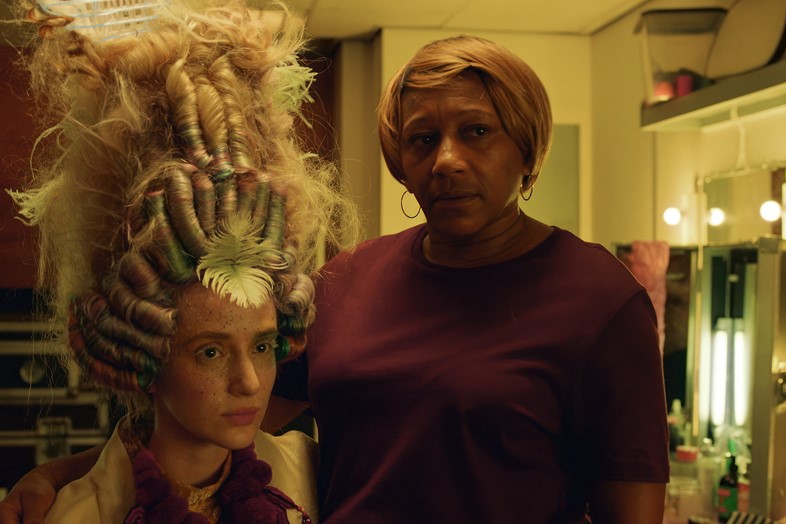
Cleve (a completely dazzling Clare Perkins) is working on a model’s multi-layered ‘do while leading the discussion about just what the hell is up and worrying about what they’ll all tell the cops. And Mosca’s husband Angel (Luke Pasqualino) still hasn’t been told, so Rene (Darrel D’Silva) is preparing to break that news, along with another secret he’s been keeping.
There’s a lot going on!
Hardiman and cinematographer Robbie Ryan stay just as busy, with a free-flowing, faux single-take approach that’s pulled off with some pretty nifty precision. And while the attention to technical craftsmanship mirrors what’s happening with the hair, you eventually start itching for more substance in this mystery.
The long, tracking shots that follow characters as they walk begin to feel excessive, and resonant moments of character building get upstaged by histrionics. As accusations about bribes and black market Propecia are thrown around, the killer’s unmasking lands as a bit anticlimactic.
There’s little doubt Hardiman has camera skills. When his storytelling catches up, watch out. For now, Medusa Deluxe is an interesting blast of hair-raising madness that could use some more volume.
by George Wolf
There are some scary implications to be found, but The Pod Generation is no horror show. In this near future world, couples – and women, specifically – willingly line up for the chance to get pregnant outside the womb.
Writer/director Sophie Barthes (Cold Souls, Madame Bovary) cooks up a smart, darkly funny and satirical look at the many faces of “progress” that still gets stuck on repeat in the third act.
Rachel (Emilia Clarke) has a well-paid gig monitoring influencers (that’s a full-time job!) at a tech firm. Her husband Alvy (Chiwetel Ejiofor) is a botanist and teacher. And from cognitive assistants to breathing bars and nature “sessions,” Rachel’s fine with all the comforts provided by technology, while Alvy is much more comfortable keeping things actually natural.
So there’s a conflict when Rachel gets an unexpected message from tech giant Pegazus. After years on the waitlist – there’s an opening at The Womb Center! Do Rachel and Alvy want to be next to grow their baby in a pod?
Alvy is plenty wary, but Linda, the Womb Center director (Rosalie Craig, terrific) is mighty persuasive. In a speech that feels like the cynical sister to America Ferrera’s truth bomb from Barbie, she wins the couple over with the reasons why women are no longer “victims of biology.”
We’ve seen films about the hidden dangers of technology for years now, but Barthes brings a slyly vital approach to the discussion, and gets a big assist from production designer Clement Price-Thomas. Everything in this world is sleek, futuristic and creepily intrusive, but just close enough to our own surroundings that we have no problem accepting it as possible (even probable).
Pair that with the excellent work from Clarke and Ejiofor, and Barthes has fertile ground to dig in. She peppers the outside with some dry, funny barbs about relationships and work life, while the meat in the middle takes on gaslighting and the slippery slope of trading control for convenience.
And yet, as big and worthy as these ideas are, you expect the pregnancy arc to end with a little more bite. There’s more than enough to keep us engaged while a desperate couple is weighing their options, but once it’s decision time, The Pod Generation doesn’t offer much beyond what we’ve known since we were amazed by the click wheel.

Who had the genius idea of counting down the best siege movies in horror? Why, it was our friend Dustin Meadows – filmmaker, actor, composer, comic and all around awesome dude. So awesome that he brought filmmaker Alison Locke (The Apology) to the club and we ranked the best bloody sieges in horror.
A horde of very nasty vampires descend upon an arctic town cut off from civilization and facing 30 solid days of night. A pod of survivors hides in an attic, careful not to make any noise or draw any attention to themselves. One old man has dementia, which generates a lot of tension in the group, since he’s hard to contain and keep quiet.
There’s no knowing whether the town has any other survivors, and some of these guys are getting itchy. Then they hear a small voice outside.
Walking and sobbing down the main drag is a little girl, crying for help. It’s as pathetic a scene as any in such a film, and it may be the first moment in the picture where you identify with the trapped, who must do the unthinkable. Because, what would you do?
As the would-be heroes in the attic begin to understand this ploy, the camera on the street pulls back to show Danny Huston and crew perched atop the nearby buildings. The sobbing tot amounts to the worm on their reel.
Creepy business!
This one represents a kind of backwards siege. Our heroes (though most of them are hardly heroic) are trapped inside the villain’s lair already and have to fight them off from there. But they only have to keep these vampires at bay until dawn.
You have everything you need for a good siege movie. A horde of baddies, a trapped group of characters whose true character will be revealed, scrappy weapons making, traitors in the midst, and the desperate hope to make it til morning.
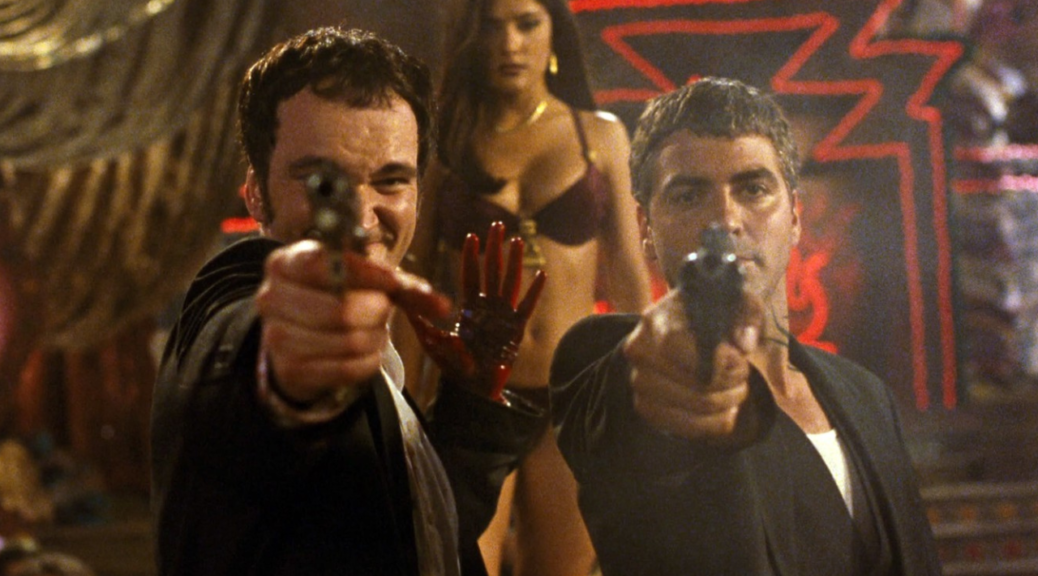
Robert Rodiguez impresses with Tarantino’s south of the border tale with an outrageous and thoroughly entertaining mixture of sex, blood and bad intentions.
Wry humor, impenetrable accents, a true sense of isolation and blood by the gallon help separate Neil Marshall’s (The Descent) Dog Soldiers from legions of other wolfmen tales.
Marshall creates a familiarly tense feeling, brilliantly straddling monster movie and war movie. A platoon is dropped into an enormous forest for a military exercise. There’s a surprise attack. The remaining soldiers hunker down in an isolated cabin to mend, figure out WTF, and strategize for survival.
This is like any good genre pic where a battalion is trapped behind enemy lines – just as vivid, bloody and intense. Who’s gone soft? Who will risk what to save a buddy? How to outsmart the enemy?
But the enemies this time are giant, hairy, hungry monsters. Woo hoo!
Young punk band the Ain’t Rights is in desperate need of a paying gig, even if it is at a rough private club for the “boots and braces” crowd (i.e. white power skinheads). Bass guitarist Pat (Anton Yelchin) eschews social media promotion for the “time and aggression” of live shows, and when he accidentally witnesses a murder in the club’s makeshift green room, Pat and his band find plenty of both.
As he did with Blue Ruin, Saulnier plunges unprepared characters into a world of casual savagery, finding out just what they have to offer in a nasty backwoods standoff. It’s a path worn by Straw Dogs, Deliverance, and plenty more, but Saulnier again shows a knack for establishing his own thoughtful thumbprint.
“Game over, man! Game over!”
That was the moment. The Marines believed they were in for a bug hunt. Ripley knew better. And now they were trapped. Surrounded.
The scene where the Marines and company see that they are outnumbered and out maneuvered by their xenomorph opponents is a jumping off moment for James Cameron. More action film than horror, Aliens still terrifies with sound design, production design, and the realization that these beasties are organized.