Screening Room: Challengers, Boy Kills World, Infested, The Beast, Humane
by George Wolf
“This is about winning the points that matter.”
Honestly, the relationship triangle at work in Challengers could probably work outside of a tennis court, but director Luca Guadagnino does wonders with the sports angle for a completely engrossing drama of intimate competition.
Anchored around a three-set challenge match between Art Donaldson (West Side Story‘s Mike Faist) and Patrick Zweig (Josh O’Connor from The Crown), the film drifts back and forth in time as it immerses us in their series of entanglements with tennis phenom Tashi Duncan (Zendaya).
Through Grand Slam victories, unrealized potential and one career-ending injury, writer Justin Kuritzkes examines how three distinct personalities push and pull throughout their young lives, and their differing views on the points that matter.
Kuritzkes is married to filmmaker Celine Song, and his script often feels like the cynical cousin of her Oscar nominated triangle drama Past Lives.
Guadagnino’s camera is a sumptuous wonder, often following the three leads like an on-court volley, and then coming in close to focus on sweat, bare skin, and the constant draw of physical contact. The tennis action itself is also intense and effective, buoyed by blistering forehands barreling down our sightline and some frenzied POV shots during the final set.
Zendaya, Faist and O’Connor deftly handle the growth of their characters from fresh-faced teens to hardened adults. All three deliver terrific, well-defined performances, and Challengers quickly becomes a film to get lost in, where you’re happy to be hanging on every break point.

by George Wolf
Boy Kills World feels like a film the gamers are going to love.
For the rest of us, it offers a hyper stylized, uber-violent riff on The Hunger Games by way of Kill Bill while it harbors Deadpool aspirations and a coy surprise waiting in act three. But while the style is never in doubt, real substance is lacking.
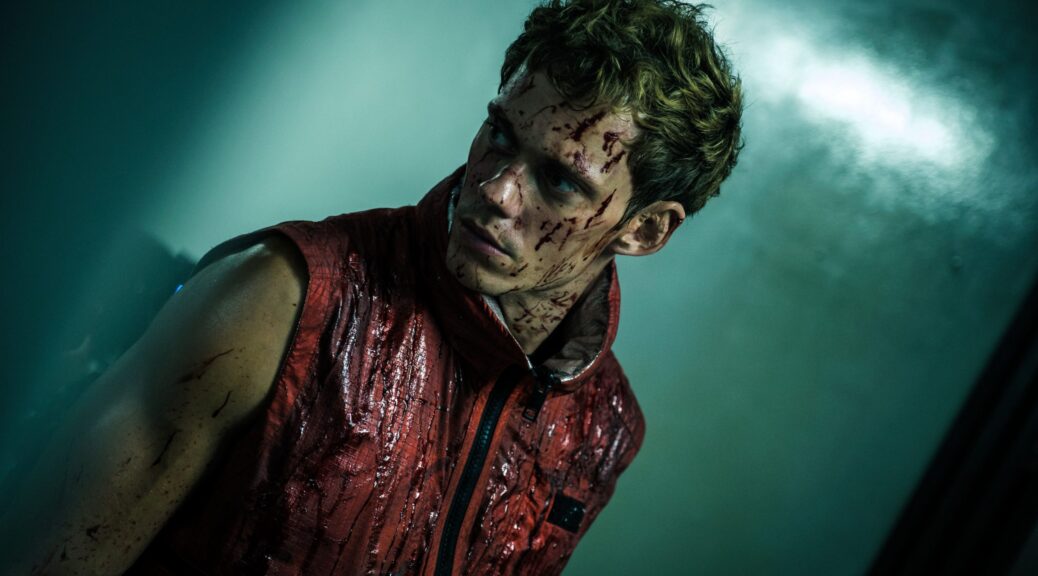
Bill Skarsgård supplies plenty of physical charisma as “Boy,” whose family was murdered years earlier during a lethal event known as “The Culling.” Once a year in this post apocalyptic landscape, enemies of ruling matriarch Hilda Van Der Koy (Famke Janssen) are rounded up and executed for sport and entertainment. Though Boy survived the assault, he was left deaf and mute, and has spent several years training with a mysterious shaman (Yayan Ruhian) until the time was right to take his revenge.
Against the shaman’s advice, Boy feels the time is now. And though he’s evolved into a singular killing machine, Boy is not alone. He has an inner voice adopted from a favorite video game (veteran voice actor H. Jon Benjamin), and a fever dream imagination that often bickers with the ghost of his rebellious little sister (Quinn Copeland).
On the eve of another Culling, Boy’s martial arts rampage of blood begins, and one of his early weapons of choice is a cheese grater.
Go on.
In his debut feature, director and co-writer Moritz Mohr skillfully captures the frenzied, level-up mayhem of video games. Cinematographer Peter Matjasko, composer Ludvig Forssell and editor Lucian Barnard help complete the gaming pastiche, while the screenplay keeps Benjamin supplied with commentary that’s consistently fueled by meta-sarcasm that never hits the master level of self-awareness.
As Boy starts up the ladder of the Van Der Koy family (Michelle Dockery, Brett Gelman, Sharlto Copley) and their Head of Security (Jessica Rothe), he falls in with a group known as the Resistance before the narrative takes its unexpected pivot.
Boy’s states of delirium have already opened the door for an unreliable narrator, so Mohr commits considerable effort (and exposition) in making sure we understand the twist.
But what we need even more is a reason to care.
Much like Hardcore Henry almost ten years ago, the film’s gaming mindset results in action that is visually exciting, but as emotionally empty as a “Play again?” reset. There’s never any motivation to get invested in the stakes, or in the attitude that often reeks of desperation hipness.
So while Boy Kills World‘s target audience may be blown away, those outside the center will find some tedium inside this finely orchestrated mayhem.
There’s no doubt you’ll find a few new uses for your cheese grater.

by George Wolf
After the completely enchanting Kumiko, the Treasure Hunter in 2014 and the whimsical Western Damsel four years later, you might not expect writer/director David Zellner to next film a year in the life of a Sasquatch family.
And Yeti did.
Sorry, but that joke is just silly enough to fit in with Sasquatch Sunset, if only the movie had any dialog at all. It doesn’t, instead letting the ‘Squatches’ grunts, screams, moans and various other bodily noises speak volumes.
Jesse Eisenberg, Riley Keough, Christophe Zajac-Denek and co-director Nathan Zellner portray the furry family underneath hair and makeup that renders the performers unrecognizable. But we have little trouble catching on to what the family is up to, which often strikes an absurdly funny tone that’s only compounded by this absurd setup that seems sprung from 1970s Saturday morning TV..
They hump, they fling poop, they get high off wild berries and act like idiots, and they are forced to confront the serious consequences of mankind’s intrusion on their habitat.
Wait, are we getting real here?
We are. As the seasons pass, harsh lessons are learned, and the Zellners layer this nutty romp with some thoughtful, touching, and yes even heartbreaking moments. It’s a small miracle that it all works, one bolstered by the fact that you really haven’t seen anything like this before, so rules seem up for grabs.
Why would you cast name actors for roles that hide their faces and don’t allow them to speak? I dunno, maybe these actors have experience marking their territory with urine.
And if you want to make heartfelt points about family bonds and the delicate balance of nature, why surround them with a barrage of bathroom humor?
Let ’em live!
What’s certain is that there is commitment evident in every choice the Zellners make, right down to the wry bombshell delivered by the final shot. So take a load off your big feet, and give Sasquatch Sunset the chance to charm you.

Once upon a time, there was nothing cooler than a mall. There was no place you would rather be. It was an oasis, a microcosm, and an excellent location for horror. In honor of the 45th anniversary of George Romero’s pinnacle of consumerist horror, we decided to pull together a list of the five most effective shopping mall horrors.
5. Chopping Mall (1986)
In 1984, Kelli Maroney found mall side horror in Night of the Comet. Like Halley’s Comet, shopping center disaster returned to Maroney just two years later.
She and some pals are planning a wild party inside Park Plaza Mall after closing. But their state-of-the-art security robots go all Robo Cop on them. Boasting a supremely 80s vibe, plus the great Barbara Crampton and a Mary Woronov/Paul Bartel sighting! Jim Wynorski’s time capsule of 80s horror might be more fun to watch now than when it was released.
4. Slaxx (2020)
Absurdism meets consumerism in co-writer/director Elza Kephart’s bloody comedy, Slaxx. CCC Clothing’s new line of denim adjusts to your body and makes you look even more glorious than you already do. And these jeans fit every single figure, from 5 pounds underweight to 5 pounds overweight. It’s a dream come true.
Sehar Bhojani steals every scene as the cynical Shruti, but the jeans are the real stars here. Kephart finds endlessly entertaining ways to sic them on unsuspecting wearers.
Where Romero mainly pointed fingers at the hordes mindlessly drawn to stores like CCC, Kephart sees the villains as those perpetuating clean corporate hypocrisy. Still, it’s their customers and workers she murders—by the pantload.
3. Fear Street: Part One – 1994 (2021)
The first episode in Leigh Janiak’s trilogy takes us to Shadyville, site of misery, trauma and unpleasantness nigh on 300 years. Not that Deena (Kiana Madeira) is buying all this “witch’s curse” BS.
Janiak’s 90s vibe is strong and her soundtrack is tight. Performances—Madeiera as well as Benjamin Flores Jr., Maya Hawke, Fred Hechinger and Gillian Jacobs—far exceed expectations for an R. L. Stine adaptation.
Part One is the best in the trilogy, but all three of Janiak’s Fear Street installments deliver fear and fun in equal portions.
2. Dawn of the Dead (2004)
Zack Snyder would go on to success with vastly overrated movies, but his one truly fine piece of filmmaking updated Romero’s Dead sequel with the high octane horror. The result may be less cerebral and political than Romero’s original, but it is a thrill ride through hell and it is not to be missed.
The flick begins strong with one of the best “things seem fine but then they don’t” openings in film. And finally! A strong female lead (Sarah Polley). Polley’s beleaguered nurse Ana leads us through the aftermath of the dawn of the dead, fleeing her rabid husband and neighbors and winding up with a rag tag team of survivors hunkered down inside a mall.
In Romero’s version, themes of capitalism, greed, and mindless consumerism run through the narrative. Snyder, though affectionate to the source material, focuses more on survival, humanity, and thrills. (He also has a wickedly clever soundtrack.) It’s more visceral and more fun. His feature is gripping, breathlessly paced, well developed and genuinely terrifying.
1. Dawn of the Dead (1978)
Romero returned to the land of the undead in ’78 with a full-color sequel to Night. Set in Philadelphia, at a news broadcast gone crazy, the film follows a news producer, her chopper pilot boyfriend, and two Philly SWAT cops ready to abandon the organized zombie fight and find peace elsewhere. The four board a helicopter, eventually landing on the roof of a mall, which they turn into their private hideaway.
Romero, make-up legend Tom Savini, and Italian horror director Dario Argento teamed up for the sequel. You feel Argento’s presence in the score and the vivid red of the gore.
Ken Foree and Scott Reiniger as the buddies from SWAT create the most effective moments, whether character-driven tension or zombie-driven action. Romero’s politics are on his sleeve with this one, and he seems to be working to build on successes of his original. He uses the “z” word, digs at Eighties consumerism, shows full-color entrails, and reminds us again that the undead may not be our biggest enemy once the zombie-tastrophe falls.
by George Wolf
Nicolas Cage has become such a mythic figure in film culture that each new outing tends to bring questions.
Is this the unhinged “rage in the Cage?” Arthouse Cage? Mass appeal or self effacing Cage?
You can file Arcadian under “understated Cage leading a YA leaning creature feature.”
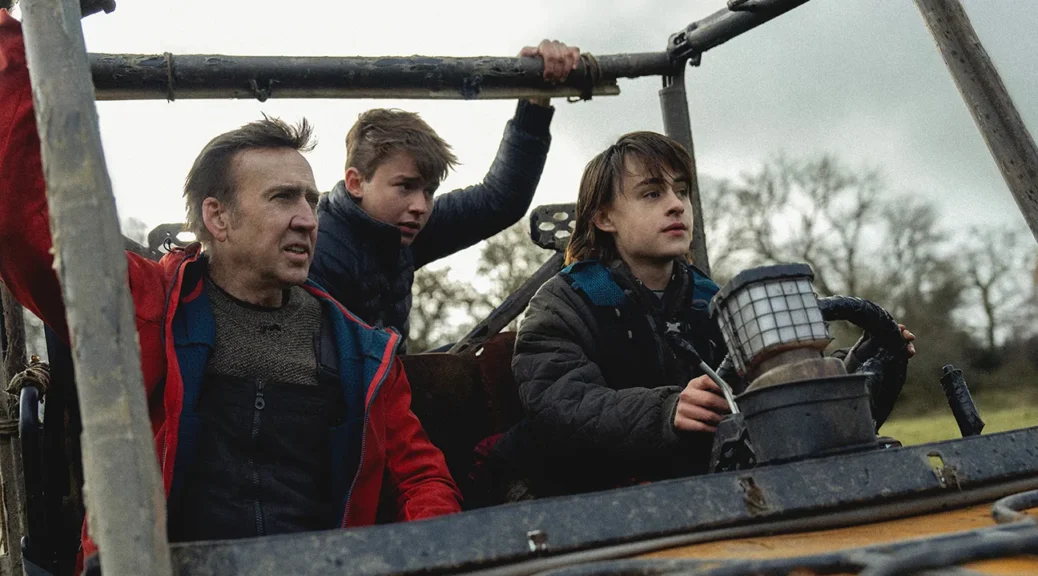
He stars as Paul, who’s living in a remote farmhouse with his twin teenage sons in a dystopian future. By day, the men follow a careful routine of security and sustenance. Because at night, there are visitors that really want to come in.
The exact details of the invasion are a little sketchy, but never elusive enough to derail our interest in the family’s survival.
Thomas (Maxwell Jenkins) is the impulsive, romantic brother, and his visits with Charlotte (Sadie Soverall) at the farm down the road have been keeping Thomas out dangerously late. His twin Joseph (Jaeden Martell) is the introspective thinker. Joseph has been studying patterns of the nightly attacks and believes the creatures have been testing, and planning.
He’s right.
Director Benjamin Brewer isn’t trying to reinvent anything here. He teams with producer-turned-screenwriter Michael Nilon for an unassuming horror thriller than benefits greatly from an impressive cast and a frightening creature design.
I don’t want to give anything away, but these bad boys have one specific trait that will get your attention right quick.
These themes aren’t new. There will be peril, bloodshed, and sacrifice as the creatures get smarter and the young begin to take on responsibilities of adulthood and cherish the things that matter. But thankfully, that familiarity doesn’t breed pandering. Brewer is also able to land some solid thrills, while the three younger co-stars provide impressive support for Cage’s elder statesman grace.
Ultimately, Arcadian doesn’t feel that much like a stereotypical “Nicolas Cage movie.” And the film is better for it.
by George Wolf
Writer/director Alex Garland gets to the point quickly in Civil War, via battle-weary photographer Lee Smith (Kirsten Dunst).
“Every time I’ve survived a war zone, I thought I was sending a warning home: don’t do this.”
“But here we are.”
Smith and her colleague Joel (Wagner Moura) are preparing for the 857-mile drive from New York to D.C. during a very active civil war in near-future America. Their press credentials may bring sympathy from some they encounter, and deadly aggression from others. The danger only intensifies when they agree to bring along elderly reporter Sammy (Stephen McKinley Henderson) and the aspiring young photojournalist Jessie (Priscilla‘s Cailee Spaeny).
The goal? A face-to-face interview with a President (Nick Offerman) who has disbanded the FBI, ordered air strikes against American citizens, and has not taken questions for over a year.
Garland (Ex Machina, Annihilation, Men) is careful not to tip his political hand. Though a couple lines of dialog give you a vague glimpse about what type of policies the President favors, we’re repeatedly told resistance is coming from the “Western Forces” led by California and Texas. The nicely subtle mix of red and blue state rebellion makes it clear the point here is not purely idealogical.
“Don’t do this.”
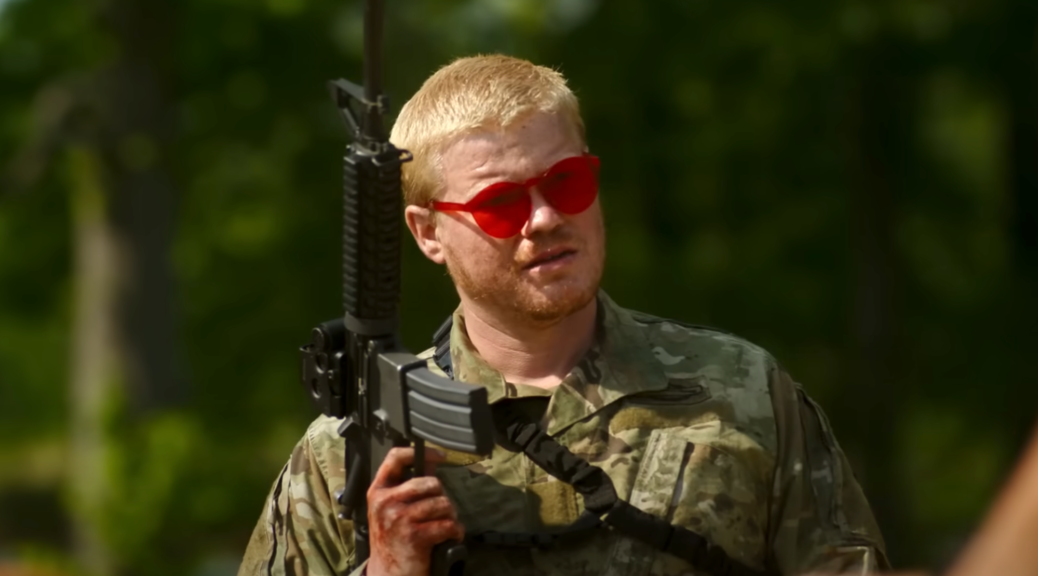
And though many a road movie has leaned on that narrative device for a flimsy connection of random ideas, Garland uses the trip to D.C. to bolster his very ambitious idea with tension-filled looks at the heartland. Through an uneasy stop for gas, the visit to a town the war forgot, a marksman’s simple rules of engagement, and a brutal citizenship test from an unforgettable Jesse Plemons, we’re immersed in a war-torn America that seems authentically terrifying.
But it’s all just a prelude to the carnage ahead.
Because once it settles in D.C., the film becomes a war movie that will batter your senses with a barrage of breathless execution.
Dunst has never been better, particularly in the moments when Lee’s stoic rationalizing can no longer come to her rescue, or ours. Garland gives us the vulnerable Jessie as a logical entry point in the early going, but as she joins Joel in feeding off the war zone rush, moralities become more complicated.
As draining as it often is, Civil War is also an exhilarating, sobering and necessary experience. Smartly written and expertly crafted, the film manages to honor the work of wartime photojournalists as it delivers a chilling vision. It’s one beyond left or right, where the slippery slope of dehumanization breeds a willingly and violently divisible America we always professed to be beneath us.