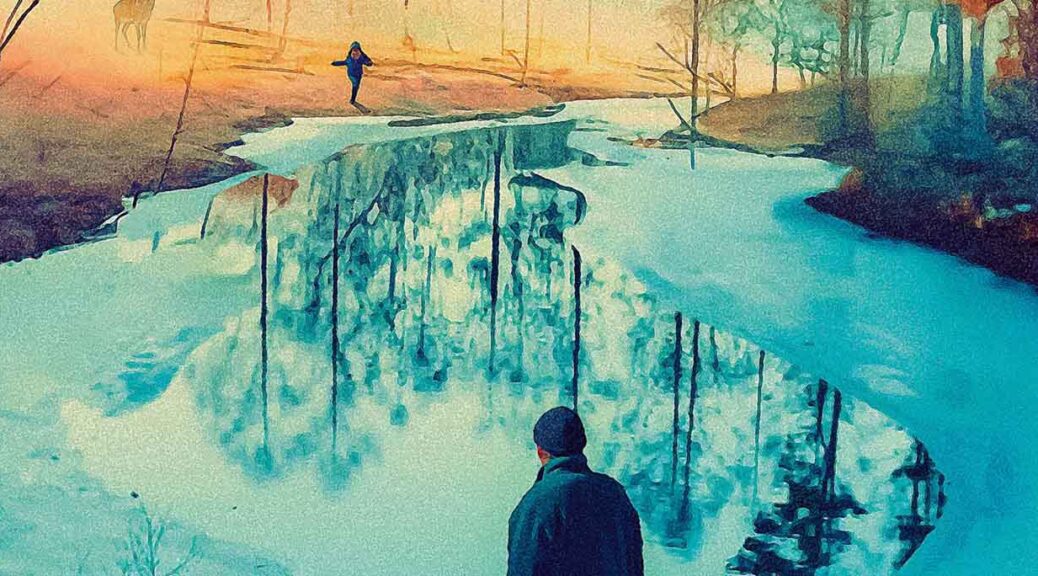
Fulfilling the promise of 2021’s We’re All Going to the World’s Fair, writer/director Jane Schoenbrun’s follow-up, I Saw the TV Glow, is a hypnotically abstract and dreamily immersive nightmare of longing.
Owen (Justice Smith) and Maddy (Brigette Lundy-Paine) meet as very introverted teens, drawn together by their love of “The Pink Opaque,” a Saturday night series on the Young Adult Network.
Maddy’s basement offers shelter from her violent stepdad, while Owen has to join her there in secret, away from the sheltering grasp of his mother (always great to see Danielle Deadwyler) and father (Fred Durst!).
Together, the teens escape into the weekly adventures of two young women (Helena Howard, Lindsey Jordan) who connect across the psychic realm to battle monsters sent by the evil Mr. Melancholy.
But then the show is cancelled, the basement TV is left in flames on the front lawn, and Maddy vanishes without a trace.
As the film wanders through the advancing years and Owen sometimes comments through the fourth wall, Schoenbrun layers Eric Yue’s cinematography and a captivating soundtrack to craft a completely transfixing pastiche of color, light, sound and shadow.
Smith (Dungeons & Dragons: Honor Among Thieves) is heartbreakingly endearing, while Lundy-Paine (Bill & Ted Face the Music) provides a revelatory turn of alienation and mystery. It’s hard to take your eyes of either one of them, with Schoenbrun often framing their stares through close-ups that become as challenging as they are inviting.
And that feels organically right. Because Schoenbrun is channelling characters who imagine life as someone else, to again emerge as a challenging and inviting filmmaker with a thrillingly original voice.
Worlds’ Fair got our attention – and A24’s. Now I Saw the TV Glow is here to get in our heads.
Since Walk Hard gave the music biopic genre a well-deserved skewering nearly 20 years ago, new entries have scored with ambitious fantasy (Rocketman), pandered with crowd-pleasing safety (Bohemian Rhapsody) and curiously turned a superstar into a one note supporting player (Elvis).
Back to Black‘s biggest drawback is a failure to commit to one vision, rightly giving Amy Winehouse agency for her own destiny, but pulling some important punches that could have deepened the impact.
Marisa Abela (Barbie‘s “Teen Talk Barbie,” TV’s Industry) is sensational as Amy, ably capturing the wounded soul and the defiant train wreck while laying down some impressive lip sync performances. Her chemistry with an equally terrific Jack O’Connell (as Blake Fielder-Civil) fuels the film’s best moments, as the tortured lovers navigate between heartsick devotion and toxic co-dependency, sometimes reminiscent of Sid and Nancy.
Biopics usually benefit from narrowing the focus, but director Sam Taylor-Johnson and writer Matt Greenhalgh reach outside the romance for a rushed look at Amy’s journey to stardom and some seemingly sanitized takes on her relationships with Dad Mitch (Eddie Marsan) and “Nan” Cynthia (Lesley Manville).
Anyone who remembers the Oscar-winning doc Amy will notice a much different treatment of Mitch Winehouse here. How much of this was required for the family blessing is unclear, but the film does benefit from a depiction of Amy that finds a balance of forgiveness and accountability.
Taylor-Johnson’s hand is steady but fairly generic, with a tendency to revisit some obvious visual metaphors. And though you end up wishing Back to Black could have confidence enough to sharpen its edge, stellar performances flesh out the sad tragedy of a gifted life spiraling out of control.
Two years ago, the magnificent Drive My Car became the first Japanese film to garner a Best Picture Oscar nomination, and earned Ryûsuke Hamaguchi well-earned noms for writing and directing.
Now, writer/director Hamaguchi rewards his wider audience with Evil Does Not Exist (Aku wa sonzai shinai), another thoughtful, gracefully intellectual tale that finds him in an even more enigmatic mood.
Takumi and his young daughter live in Mizubiki, a Japanese village near Tokyo. Father teaches daughter about the wonders of nature, and about her place in the village’s careful balance of give and take.
That balance is threatened when a big firm plans to build a ”glamping” (glamorous camping) site very close to Takumi’s own house. Two P.R. reps come to convince the villagers that the company will also be careful, but these townsfolk know manure when they smell it.
The reps try to curry favor by offering Takumi a job as caretaker of the glamping site, but the more time they spend with this pillar of the simple life, the more they start to see wisdom in his ways.
Hamaguchi delivers some salient points on ecology while showcasing his skill with probing character purpose, motivation and the different ways they interact.
At a town meeting, an older villager gently reminds the P.R. reps about the responsibilities that come with “living upstream,” and the speech becomes an eloquent metaphor that the film begins dissecting with sometimes abstract detail.
And though the one hundred six-minute running time might seem rushed for a filmmaker that has favored three, four, and even five-hour films, Hamaguchi’s storytelling here is more patient than ever. Yoshio Kitagawa’s exquisite cinematography often showcases nature’s beauty in wordless wonder, always buoyed by an Eiko Ishibashi score that is evocative and moving.
What Evil Does Not Exist doesn’t do is provide any easy answers for the dramatic choices Takumi makes once his daughter goes missing. The film ends as it begins, staring into the natural world and asking us to ponder how we best fit in.
We love him. You love him. Once considered one of the greatest actors of his generation, later deemed a nut job with unusual spending habits who would take any role, Nicolas Cage has finally set the debate to rest. He is obviously both.
Whether his masterpiece performances—Raising Arizona, Moonstruck, Wild at Heart, Leaving Las Vegas, Adaptation, Pig—or his many other great, good, mediocre and outright terrible films, Cage is a guy you can’t take your eyes off of. But what are his best horror films? Let’s dig in.
5. Renfield (2023)
They totally made a movie with a very saucy Nic Cage as Dracula. And a saucy Nic Cage is the best Nic Cage.
There’s at least one bloody toe in waters that send up rom-coms, satirize narcissistic relationships and homage a classic horror character while it’s also modernizing the themes that built him.
But experiencing Count Nicula alone is worth it. Plus, Nicholas Hoult is perfect as the put-upon sad boy with access to anti-hero superpowers and Awkwafina can wring plenty of humor from simply telling a guy named Kyle to F-off.
Renfield might be bloodier than you expect, but it’s just as much fun as you’re hoping for. Call it bloody good fun.
4. Grindhouse (2007)
Quentin Tarantino and Robert Rodriguez deserved more eyeballs when they released their giddy mash note to low rent B-horror features. Both films were great, but what was really inspired were the fake trailers they wedged between the two features.
One of the best trailers, and possibly the fest film Rob Zombie ever made, was this gem that looks like a realistic evolution of an old Sybil Danning film. (Danning herself co-stars as one of the She-Devils of Belzac). The chef’s kiss is Cage, cackling maniacally over the end of the clip as Fu Manchu.
3. Mom and Dad (2017)
I brought you into this world, I can take you out of it.
It’s a joke, of course, an idle threat. Right?
Maybe so, but deep down, it does speak to the unspeakable tumult of emotions and desires that come with parenting. Wisely, a humorous tumult is exactly the approach writer/director Brian Taylor brings to his horror comedy Mom and Dad.
So why do you want to see it? Because of the unhinged Nicolas Cage. Not just any Nic Cage—the kind who can convincingly sing the Hokey Pokey while demolishing furniture with a sledge hammer.
This is one of those Nic Cage roles: Face/Off meets Wild at Heart meets Vampire’s Kiss. He’s weird, he’s explosive and he is clearly enjoying himself.
2. Vampire’s Kiss (1988)
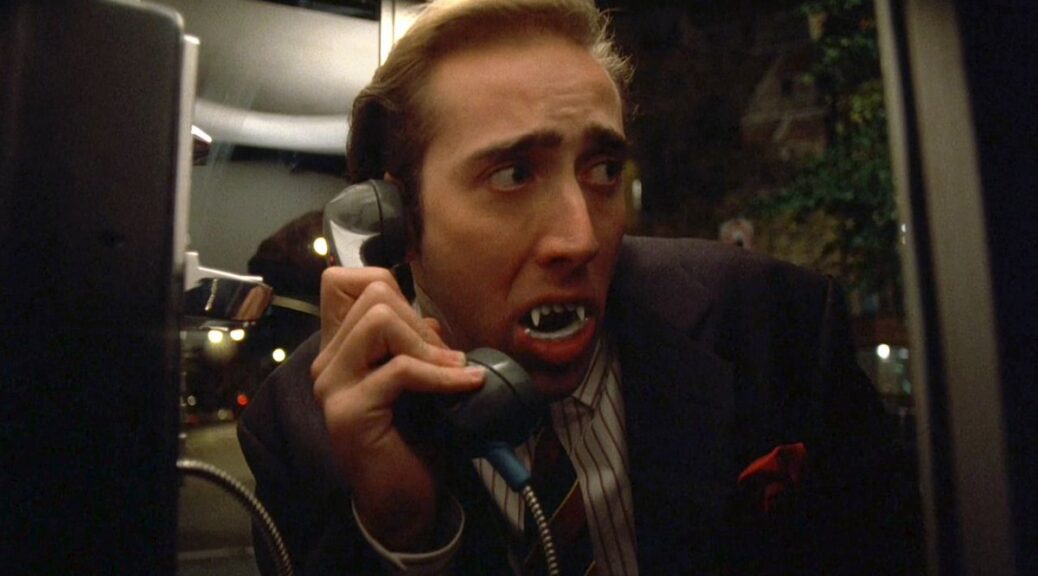
Sure, Nicolas Cage is a whore, a has-been, and his wigs embarrass us all. But back before The Rock (the film that turned him), Cage was always willing to behave in a strangely effeminate manner, and perhaps even eat a bug. He made some great movies that way.
Peter Lowe (pronounced with such relish by Cage) believes he’s been bitten by a vampire (Jennifer Beals) during a one night stand. It turns out, he’s actually just insane. The bite becomes his excuse to indulge his self-obsessed, soulless, predatory nature for the balance of the running time.
Cage gives a masterful comic performance in Vampire’s Kiss as a narcissistic literary editor who descends into madness. The actor is hilarious, demented, his physical performance outstanding. The way he uses his gangly mess of limbs and hulking shoulders inspires darkly, campy comic awe. And the plastic teeth are awesome.
Peter may believe he abuses his wholesome editorial assistant Alva (Maria Conchita Alonso) with sinister panache because he’s slowly turning into a demon, but we know better.
1. Mandy (2018)
Writer/director Panos Cosmatos’s hallucinogenic fever dream of social, political and pop-culture subtexts layered with good old, blood-soaked revenge, Mandy throws enough visionary strangeness on the screen to dwarf even Nicolas Cage in full freakout mode.
Not just Nic, either. Andrea Riseborough, cannibal bikers on LSD, The Chemist, and a religious sex cult led by a terrible folk singer. Plus a sword, an axe, a lot of blood, and did I mention the LSD?
Like Cosmatos’s 2010 debut Beyond the Black Rainbow, Mandy is both formally daring and wildly borrowed. While Black Rainbow, also set in 1983, shines with the antiseptic aesthetic of Cronenberg or Kubrick, Mandy feels more like something snatched from a Dio album cover.
For a film called The Dry 2, Force of Nature is often soaking wet. And that’s pretty indicative of a movie that seems intent on working against itself.
Writer/director Robert Connolly and star Eric Bana return from 2020’s The Dry, again adapting a Jane Harper source novel about an Australian federal agent on a case that stirs up painful memories. The first one dealt with a drought, so The Dry. This one occurs in the middle of a nasty storm, but it’s a sequel, so The Dry 2.
Let’s move on.
Bana is agent Aaron Falk, who teams with partner Carmen (Jacqueline McKenzie) to find a missing woman named Alice (Anna Torv).
Alice had gone hiking in a mountain range with four co-workers, but the team building exercise went awry. When rescuers finally reached the women, Alice could not be found.
So what really happened in those woods? It’s a simple but effective setup, and the film is gripping only when it sticks to pulling on that thread.
But Connolly also indulges time-shifting layers about Alice’s work as an undercover corporate whistleblower, about these very same woods being the scene of a notorious serial killer’s crimes, and about a traumatic event from Falk’s childhood that also occurred here.
That’s a busy day, mate.
And The Dry 2 is a busy film, albeit a very well-crafted one.
Bana and the supporting cast (including Robin McLeavy, Deborra-Lee Furness, and Richard Roxburgh) are first rate, cinematographer Andrew Commis provides some lush and often rain-soaked majesty, and each piece of the puzzle sports some fine edges.
But together, those pieces push and pull against each simultaneously, always undercutting the tension before it really gets its hooks in.
Boy, Jerry Seinfeld knows how to get clicks before a new movie drop, doesn’t he?
In case you missed his recent impression of Grandpa Simpson yelling at a cloud, Seinfeld has taken his talents from the stifling confines of sitcoms to Netflix for Unfrosted, his debut as a feature director.
Also writing the script with regular contributors from both Seinfeld and Bee Movie, Jerry returns to the familiar ground of cereal for a silly and star-studded riff on the 1960s space race.
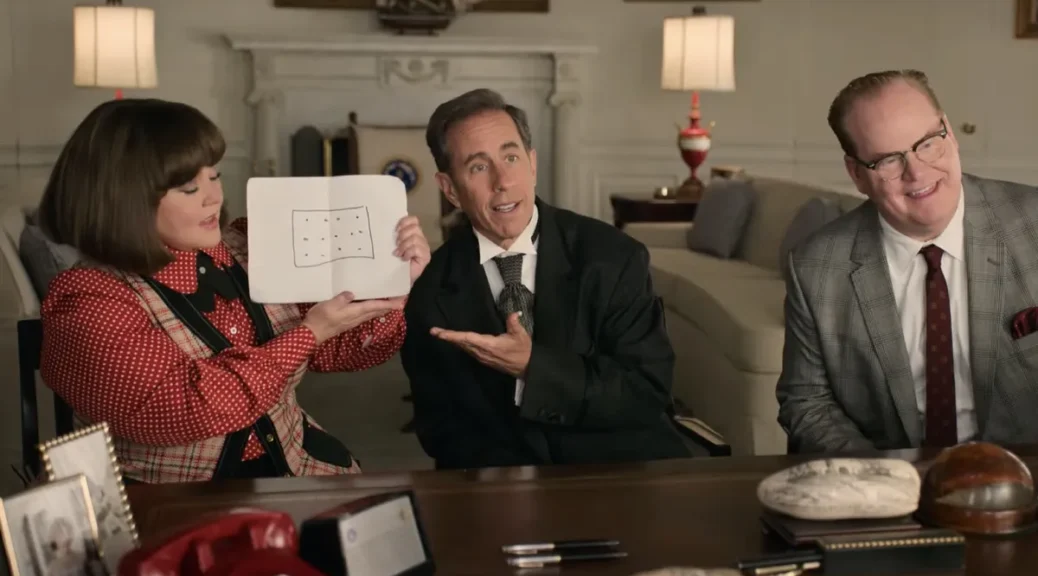
Jerry plays Bob Cabana, top exec at Kellogg’s during their reign as the kings of breakfast. But Bob and his boss Edsel Kellogg III (Jim Gaffigan) are worried about what Marjorie Post (Amy Schumer) and her crew are suddenly cooking up: a breakfast pastry.
As quickly as Jerry can say “xanthan gum!” exactly like “Newman!,” Bob is back together with old partner Donna Stankowski (Melissa McCarthy) for a mission to launch their own handheld breakfast innovation (“Fruit Magoos”? “Heat ’em and Eat Ums?”) before Post can.
Some snappy production design adds to the inspired concept of this Battle Creek, Michigan battleground, which takes off on a Forrest Gump-like history lesson littered with famous faces and absurd antics.
One of the best is Hugh Grant playing Thurl Ravenscroft (voice of Tony the Tiger) as a snobbish master thespian ready to lead his fellow mascots in revolt. But there’s also Christian Slater and Peter Dinklage as members of an “organized milk” syndicate, a group of Taste Pilots that includes Chef Boyardee (Bobby Moynihan) and Jack LaLanne (James Marsden), and a visit from two very well-known TV characters that is better left unspoiled.
And somehow, a couple of dumpster-diving pre teens (Bailey Sheetz and Eleanor Sweeney) nearly steal the whole show.
The Boomer-centric nuttiness comes fast and furious (yes, that is Toucan Sam singing “Ave Maria” at a funeral with Full Cereal honors), and, as you might guess, not all of it lands.
As an actor, Jerry’s still playing Jerry. And as a director, he seems most comfortable with sitcom pacing that’s well-suited for streaming. But Jerry takes a rule that Seinfeld perfected – surround your star with a group of more memorable characters – and pops it in a toaster set to ten. What doesn’t work is quickly erased by another absurd opportunity, and then wrapped with a full song-and-dance finale.
I wouldn’t call it well-rounded, healthy or even balanced, but Unfrosted is eventually able to serve up just enough real laughs for a satisfying plate of silly.
Resting somewhere between personal memoir and an episode of ESPN’s 30 for 30, In the Company of Kings is buoyed by undeniable layers of passion and gratitude.
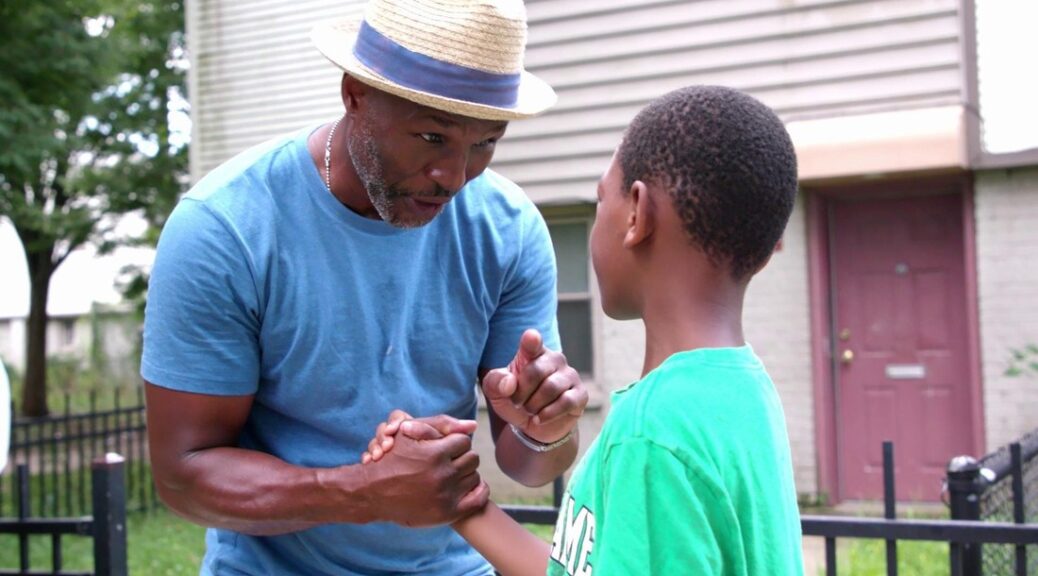
In a brisk 70 minutes, director Steve Read and producer/narrator Robert Douglas reveal the inspiration they have taken from legends of boxing, while putting the spotlight on 8 boxers with very personal stories of struggle, sacrifice and success.
Drawn by the lure of the fight game, Douglas tells of his move from Liverpool to a hardscrabble section of North Philadelphia. Feeling a kinship with those desperate to make it out, Douglas waxes poetic about his love for the men who found their ticket in the ring, with some impressively framed camerawork dotting the gritty landscape.
From legends such as Larry Holmes, Bernard Hopkins and Ernie Shavers to current prospect Tyhler Williams, the film delivers first person accounts of life in the fight game, sparked by intimate details of poverty, racism, hustle, crime and punishment.
Unsurprisingly, Muhammed Ali is the biggest obsession here. But though the filmmakers pay homage to the Greatest through time spent with promoters Don King and Bob Arum and manager Gene Kilroy, these segments only feed the scattershot nature of the film’s focus.
The passion of Read and Douglas is never in doubt, and while that passion sometimes threatens to run the film off the rails, it’s also provides the glue that keeps the film’s heart intact.
By that quick final bell, In the Company of Kings makes clear that it just wants to say ‘thank you’ for the fight, and the courage. More casual sports fans may not be moved, but those with a love of boxing—especially during the 70s and 80s—will take a few hits to the feels.
Muse and madness, art and commerce duke it out in a slew of films that mine the depths of the artistic nature. We welcome author LCW Allingham, whose dark novella Muse looks at the darker side of art, to join us as we use a little fuzzy math to share our favorite horror movies about artists.
6. Devil’s Candy (2015)
Ethan Embry plays Jesse Hellman, struggling metalhead painter who, with his wife and pre-teen daughter, just bought a bargain of a house out in the Texas sticks. Why so cheap? Amityville shit.
Jesse’s a metalhead and a painter and writer/director Sean Byrne (The Loved Ones) mines the dark artist nature for all its worth in a film that benefits from a rockin soundtrack, and a slew of good performances (shout at the devil to Pruitt Taylor Vince).
A convoluted storyline that mixes supernatural with serial killer is a bit of a drawback. But clocking in at under 90 minutes, Devil’s Candy is a tight little rocker. The lyrics are familiar, but the riffs still kick ass.
5. House of Wax (1953)
An update of the 1933 Mystery of the Wax Museum and precursor to Wax Works (and, of course, the 2005 loose remake), this Vincent Price classic tells a campy fun tale that also resembles a lot of Price’s other films.
An elegant artist turned disfigured madman, Price’s Henry Jarrod creates masterful wax figures of historical horrors. But there’s a secret behind the realistic look!
Yes, you totally know what that secret is, but that diminishes the fun of this film not one tiny bit. Price is fun, Carolyn Jones is a hoot, Charles Bronson’s a wild piece of casting. And the whole bit of insanity boils down to the fact that an artist who wants to earn a living has to sacrifice their integrity.
4. A Bucket of Blood (1959)
Roger Corman’s riff on House of Wax sets this dark comedy in LA’s beanik community of the late Fifties. Dick Miller’s perfect as a dimwitted janitor who accidentally becomes the next big thing by turning a cat, then a police officer, then other people he kills into sculptures.
The more he makes, the more famous he becomes, and the more he rationalizes the murders. Corman’s tone is cynical but fun, working from Charles B. Griffith, who’d also write Corman’s Little Shop of Horrors. It’s a weird little gem of a film.
3. Stopmotion (2024)
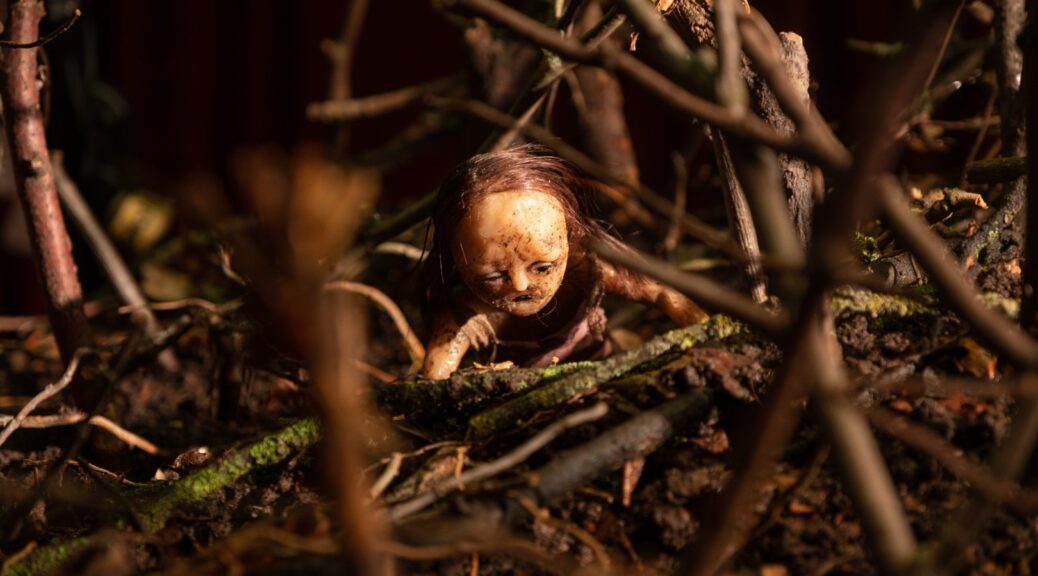
There will be moments when you’re watching Robert Morgan’s macabre vision Stopmotion that you’ll think you see the twists as they’re coming. That’s a trick. Morgan, writing with Robin King, assumes you’ll catch the handful of common horror twists, but he knows that you won’t predict the real story unfolding.
Aisling Franciosi (The Nightingale) is Ella. She’d like to make her own stop-motion animated film, but instead she’s helping her mom finish hers. Ella’s domineering mother Suzanne (Stella Gonet, very stern) is a legend in the field, and she makes Ella feel as if she has no stories of her own to tell.
Stopmotion delivers a trippy, uncomfortable, and deeply felt tale of a struggling artist. This is a descent into madness horror of sorts, but it’s also the story of an artist coming to a realization about what scares her most.
2. Mandy (2018)
Writer/director Panos Cosmatos’s hallucinogenic fever dream of social, political and pop-culture subtexts layered with good old, blood-soaked revenge, Mandy throws enough visionary strangeness on the screen to dwarf even Nicolas Cage in full freakout mode.
Like Cosmatos’s 2010 debut Beyond the Black Rainbow, Mandy is both formally daring and wildly borrowed. While Black Rainbow, also set in 1983, shines with the antiseptic aesthetic of Cronenberg or Kubrick, Mandy feels more like something snatched from a Dio album cover.
When his artist girlfriend Mandy (Andrea Riseborough) is kidnapped and killed by a cult, Red (Cage) enacts a bloody quest for revenge.
Or is it all the story Mandy’s painting?
Either way, it is as badass as it can be.
1. Candyman (2021)
For Nia DaCosta’s sequel to the 1992 classic, we go back to Chicago’s now-gentrified Cabrini Green housing project with up-and-coming artist Anthony McCoy (Yahya Abdul-Mateen II), whose works have taken a very dark turn since he learned of the Candyman legend from laundromat manager William Burke (Colman Domingo).
DaCosta’s savvy storytelling is angry without being self-righteous. Great horror often holds a mirror to society, and DaCosta works mirrors into nearly every single scene in the film. Her grasp of the visual here is stunning—macabre, horrifying, and elegant. She takes cues from the art world her tale populates, unveiling truly artful bloodletting and framing sequences with grotesque but undeniable beauty. It’s hard to believe this is only her second feature.
By the time a brilliant coda of sadly familiar shadow puppet stories runs alongside the closing credits, there’s more than enough reason for horror fans to rejoice and…#telleveryone.