Tag Archives: George Wolf

We Got Blisters Yes We Do

Backspot

by George Wolf

Yes, Backspot is a film about the drama surrounding members of an all-star cheerleading squad. But 2-4-6-8, you will no doubt appreciate a mindset that aims higher than a standard Young Adult pandering.

Riley (Devery Jacobs) and her girlfriend Amanda (Kudakwashe Rutendo) both cheer for their high school squad in Cananda. Riley hides serious anxiety behind her outward confidence, but she jumps at the chance to try out for the Thunderhawks, an elite team run by the no-nonsense Eileen McNamara (Evan Rachel Wood).

Assistant coach Devon (Thomas Antony Olajide, bringing some expert level attitude) lays down the law on day one: “Don’t sing that song, Come On Eileen.”

Okay, then.

Riley, Amanda and their friend Rachel (Noa DiBerto) make the cut, and with the championships looming in just two weeks, the girls are immediately thrown into an intense training regimen that will test their physical and mental limitations.

Director and co-writer D.W. Waterson expands her 2017 short as a mix of Whiplash, Personal Best and Bring It On. With writing that’s often smart and performances that are reliably authentic, Backspot urges you to respect the athleticism, commitment and battered feet of these competitors, while not shrinking from the problematic aspects of the competition culture.

Jacobs, returning from the short film, is terrific. Riley isn’t a shy YA teen just waiting for her specialness to be seen; she’s a real world young woman driven to succeed while trying to navigate the expectations at home, on the mat, and in her relationship with Amanda.

Wood digs into her gum-chewing taskmaster role with understandable relish. Because while Eileen delivers one of the film’s most pointed messages (“the world is not kind to weak people, especially people like us”), she’s not held up as an infallible beacon of integrity.

These shades of grey are welcome, and they help Waterson overcome a reliance on shaky cam closeups or moments when certain actions come with consequences that seem a bit too tidy. Bonus points for Amanda’s Ohio State sweatshirt.

And as the championship cheer action comes to a close, you may hit the showers thinking you’ve just seen a sports movie, a queer anthem or a coming-of-age dramedy, and you wouldn’t be wrong.

Which means there’s plenty right about Backspot.

Part of Your World

Ezra

by George Wolf

“The word ‘autism’ comes from the Greek ‘in your own world’. I don’t want him in his own world. I want him in this world.”

That heartfelt line in Ezra is going to hit home for many parents and caregivers, and it serves as the emotional core of a film that carves out some truly touching moments from a well-worn structure.

New Yorker Max (Bobby Cannavale) is a struggling standup comic who is co-parenting his autistic son Ezra (newcomer William A. Fitzgerald) with ex-wife Jenna (Rose Byrne). Max lives with his father, Stan (Robert De Niro), a former chef who’s now a doorman, and the two trade frequent barbs while Max and Jenna weigh the question of whether Ezra would be better off attending a special needs school.

Max can be an impulsive hothead, and when he misunderstands a conversation between Jenna and her boyfriend (Tony Goldwyn, who also directs), it leads to a series of unfortunate events and a three month restraining order.

And it takes a fraction of that for Max to break it because…road trip!

Max has landed an invite to do the Jimmy Kimmel show in L.A., so he and Ezra head cross-country while Jenna, Stan and numerous authorities try to track them down.

En route to the west, Max stops off to see an old girlfriend (Vera Farmiga) and his brother Nick (Rainn Wilson), which only adds to the stellar ensemble that elevates Tony Spiridakis’s script when it defaults to spoon-feeding and obvious sentimentality.

It’s great to see Cannavale again dig into a role that can showcase his range. Too often relegated to mustache-twirling cartoonish villains, Cannavale displays the talent that can make Max sympathetic, even when he’s a maddening mess.

Byrne delivers her usual, chemistry-filled excellence; De Niro scores with some crusty affection and understated humor (including a priceless ongoing gag about cookware); and the charming Fitzgerald ensures that the film’s big heart is consistently in the right place.

That place is here in our world, one filled with neurodivergent people of all manner and mannerisms. It’s a welcome message that Ezra delivers warmly, even if it’s a little too comfortable with convention.

On the Road Again

Furiosa: A Mad Max Saga

by Hope Madden and George Wolf

From the dust and the waste of the Mad Max Saga has sprung many a fascinating supporting player: The Humungus, Auntie Entity, Immortan Joe. Only one commands an origin story. That look. That arm. That name: Furiosa!

George Miller follows up his epic action masterpiece Fury Road with a look at what made our girl tick, what turns of event turned her into the baddest of all badasses.

Writing again with Nick Lathouris, who co-write Fury Road, Miller invests more time in plotting than usual, creating a 15-year odyssey rather than a breathless and breakneck few day adventure.

Young Furiosa (Alyla Browne, Sting) is taken from the storied Green Place by scavengers, eventually landing in the care of vainglorious leader of the marauders, Dr. Dementus (Chris Hemsworth, creating a fascinating mix of loquacious pretension, reckless machismo and prosthetic nose). It’s the first stop of many on the savvy, silent one’s wearying journey toward fulfilling the two promises: the one she made her mother to return, and the sacred oath all in the Green Place make to keep the location forever secret.

Years pass, and Anya-Taylor Joy straps on the arm and the attitude for this prequel, her arc a suitable evolution from scrappy kid to determined adult to the undeniable warrior Charlize Theron perfected in the last go-round.

Miller remains as true to his vision of the wasteland as he was back in ’79’s original Mad Max, but there is a depth to the storytelling here that sets it apart. We’ve had four films to see what turned Max Rockatansky mad, made him what he is. Now Miller lays out a single story that serves as both a thrilling prelude to Fury Road and a rich origin story in its own right.

Plot does not take a front seat to action, though, so strap in for more glorious road wars.

Again wielding his patented punch-in closeups like a heavy metal power chord, Miller keeps a palpable sense of frenzied motion. War rigs take to the barren terrain while all manner of air and ground assaults constantly threaten from every direction. Miller and cinematographer Simon Duggan craft a wonderfully rich visual playground, while Fury Road editors Eliot Knapman and Margaret Sixel (Miller’s wife) return to make sure this trip feels equally immersive.

The very nature of this installment’s origin story removes the chance for the kind of singular narrative mission that helped elevate Fury Road to all-time great action heights. But anyone who took that ride knew there had to be a helluva story behind that buzz cut and metal arm.

There is, and Furiosa brings it right up to where the last journey began, in an often spectacular fashion that demands nothing less than the big screen.

California Dream

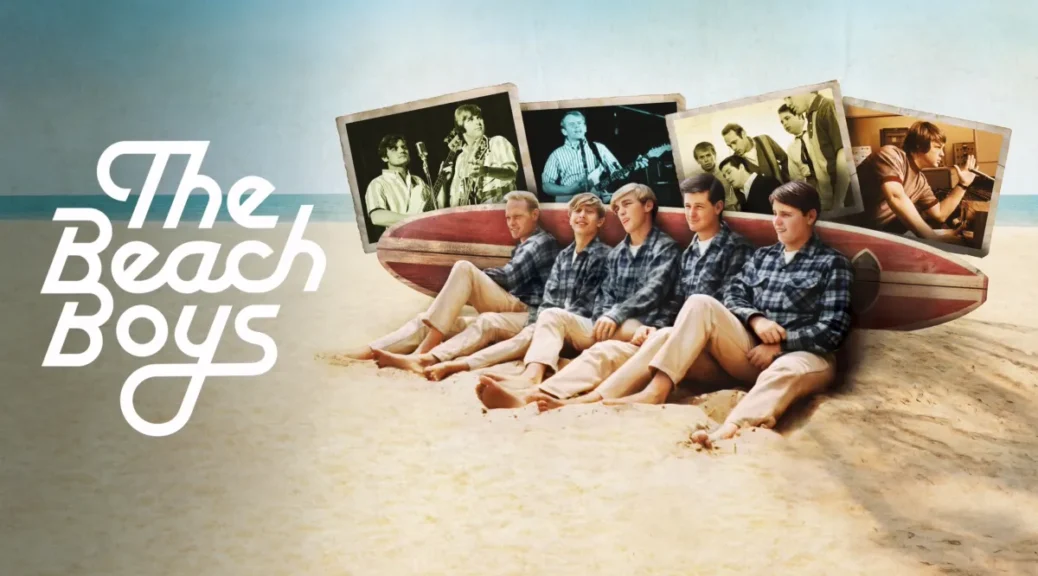
The Beach Boys

by George Wolf

Only one of The Beach Boys even knew how to surf. They had a fateful encounter with Charles Manson. Glen Campbell was a member for a short time.

Casual fans may hear some surprising new stories in Disney’s The Beach Boys, while longtime devotees will get a respectful and well-crafted overview that favors family over friction.

That family legacy started with California brothers Brian, Dennis, and Carl Wilson, cousin Mike Love and friend Al Jardine in the late 1950s. Neighbor David Marks joined for the first four albums before domineering family patriarch Murry Wilson forced him out. Campbell was the first to become a touring replacement while Brian stayed home to work his magic in the studio. When Campbell’s solo career took off, Bruce Johnston stepped in “for two weeks” and never left.

Directors Frank Marshall (From the Earth to the Moon, Jazz Fest: A New Orleans Story) and Thom Zimny (various Springsteen docs and videos) weave interviews old and new, archival footage and iconic music into a compelling pop culture tapestry.

Major sources of conflict in the band’s history – Murry’s bullying, Brian’s mental health and Mike Love’s ego – are addressed but not stressed. Instead, the film spotlights the importance of each individual contribution, and how they blended for a sound that can never be duplicated.

Music historians and contemporaries such as Don Was, Lindsey Buckingham and Janelle Monáe discuss how that sound defined a “California dream” that called to them and countless others. We see a creative rivalry with the Beatles, and how the cultural revolution of the late Sixties favored the Fab Four, while the Beach Boys popularity waned until 1974’s “Endless Summer” compilation hit #1 and reignited demand.

But much like a scaled-down version of Peter Jackson’s Get Back, The Beach Boys gleans insight from going into the studio, starting with Brian’s description of how his early obsession with the Four Freshmen led to building his vision of what the Beach Boys could do. Rare audio snippets of Brian producing are layered between interviews with legendary “Wrecking Crew” studio musicians such as Hal Blaine and Carol Kaye detailing how they came to realize Brian’s genius.

Then, an older but matter-of-fact Brian sits at a studio console, proudly isolating tracks to reveal the separate pieces of beauty required to create a wonder like “God Only Knows.” Joyous.

And that’s really the simple message The Beach Boys wants to leave us with, culminated by a tender and tearful surfside reunion. Strip away the infighting, the lawsuits, the drug use and the drama, and you find family, each member an integral part of finding that perfect, indelible harmony.

Screening Room: IF, Back to Black, The Strangers: Chapter 1, I Saw the TV Glow, Evil Does Not Exist & More

TV Guide

I Saw the TV Glow

by George Wolf

Fulfilling the promise of 2021’s We’re All Going to the World’s Fair, writer/director Jane Schoenbrun’s follow-up, I Saw the TV Glow, is a hypnotically abstract and dreamily immersive nightmare of longing.

Owen (Justice Smith) and Maddy (Brigette Lundy-Paine) meet as very introverted teens, drawn together by their love of “The Pink Opaque,” a Saturday night series on the Young Adult Network.

Maddy’s basement offers shelter from her violent stepdad, while Owen has to join her there in secret, away from the sheltering grasp of his mother (always great to see Danielle Deadwyler) and father (Fred Durst!).

Together, the teens escape into the weekly adventures of two young women (Helena Howard, Lindsey Jordan) who connect across the psychic realm to battle monsters sent by the evil Mr. Melancholy.

But then the show is cancelled, the basement TV is left in flames on the front lawn, and Maddy vanishes without a trace.

As the film wanders through the advancing years and Owen sometimes comments through the fourth wall, Schoenbrun layers Eric Yue’s cinematography and a captivating soundtrack to craft a completely transfixing pastiche of color, light, sound and shadow.

Smith (Dungeons & Dragons: Honor Among Thieves) is heartbreakingly endearing, while Lundy-Paine (Bill & Ted Face the Music) provides a revelatory turn of alienation and mystery. It’s hard to take your eyes of either one of them, with Schoenbrun often framing their stares through close-ups that become as challenging as they are inviting.

And that feels organically right. Because Schoenbrun is channelling characters who imagine life as someone else, to again emerge as a challenging and inviting filmmaker with a thrillingly original voice.

Worlds’ Fair got our attention – and A24’s. Now I Saw the TV Glow is here to get in our heads.

Torch Song Tragedy

Back to Black

by George Wolf

Since Walk Hard gave the music biopic genre a well-deserved skewering nearly 20 years ago, new entries have scored with ambitious fantasy (Rocketman), pandered with crowd-pleasing safety (Bohemian Rhapsody) and curiously turned a superstar into a one note supporting player (Elvis).

Back to Black‘s biggest drawback is a failure to commit to one vision, rightly giving Amy Winehouse agency for her own destiny, but pulling some important punches that could have deepened the impact.

Marisa Abela (Barbie‘s “Teen Talk Barbie,” TV’s Industry) is sensational as Amy, ably capturing the wounded soul and the defiant train wreck while laying down some impressive lip sync performances. Her chemistry with an equally terrific Jack O’Connell (as Blake Fielder-Civil) fuels the film’s best moments, as the tortured lovers navigate between heartsick devotion and toxic co-dependency, sometimes reminiscent of Sid and Nancy.

Biopics usually benefit from narrowing the focus, but director Sam Taylor-Johnson and writer Matt Greenhalgh reach outside the romance for a rushed look at Amy’s journey to stardom and some seemingly sanitized takes on her relationships with Dad Mitch (Eddie Marsan) and “Nan” Cynthia (Lesley Manville).

Anyone who remembers the Oscar-winning doc Amy will notice a much different treatment of Mitch Winehouse here. How much of this was required for the family blessing is unclear, but the film does benefit from a depiction of Amy that finds a balance of forgiveness and accountability.

Taylor-Johnson’s hand is steady but fairly generic, with a tendency to revisit some obvious visual metaphors. And though you end up wishing Back to Black could have confidence enough to sharpen its edge, stellar performances flesh out the sad tragedy of a gifted life spiraling out of control.

Nature Boy

Evil Does Not Exist

by George Wolf

Two years ago, the magnificent Drive My Car became the first Japanese film to garner a Best Picture Oscar nomination, and earned Ryûsuke Hamaguchi well-earned noms for writing and directing.

Now, writer/director Hamaguchi rewards his wider audience with Evil Does Not Exist (Aku wa sonzai shinai), another thoughtful, gracefully intellectual tale that finds him in an even more enigmatic mood.

Takumi and his young daughter live in Mizubiki, a Japanese village near Tokyo. Father teaches daughter about the wonders of nature, and about her place in the village’s careful balance of give and take.

That balance is threatened when a big firm plans to build a ”glamping” (glamorous camping) site very close to Takumi’s own house. Two P.R. reps come to convince the villagers that the company will also be careful, but these townsfolk know manure when they smell it.

The reps try to curry favor by offering Takumi a job as caretaker of the glamping site, but the more time they spend with this pillar of the simple life, the more they start to see wisdom in his ways.

Hamaguchi delivers some salient points on ecology while showcasing his skill with probing character purpose, motivation and the different ways they interact.

At a town meeting, an older villager gently reminds the P.R. reps about the responsibilities that come with “living upstream,” and the speech becomes an eloquent metaphor that the film begins dissecting with sometimes abstract detail.

And though the one hundred six-minute running time might seem rushed for a filmmaker that has favored three, four, and even five-hour films, Hamaguchi’s storytelling here is more patient than ever. Yoshio Kitagawa’s exquisite cinematography often showcases nature’s beauty in wordless wonder, always buoyed by an Eiko Ishibashi score that is evocative and moving.

What Evil Does Not Exist doesn’t do is provide any easy answers for the dramatic choices Takumi makes once his daughter goes missing. The film ends as it begins, staring into the natural world and asking us to ponder how we best fit in.

Fright Club: Best Nicolas Cage Horror Movies

We love him. You love him. Once considered one of the greatest actors of his generation, later deemed a nut job with unusual spending habits who would take any role, Nicolas Cage has finally set the debate to rest. He is obviously both.

Whether his masterpiece performances—Raising Arizona, Moonstruck, Wild at Heart, Leaving Las Vegas, Adaptation, Pig—or his many other great, good, mediocre and outright terrible films, Cage is a guy you can’t take your eyes off of. But what are his best horror films? Let’s dig in.

5. Renfield (2023)

They totally made a movie with a very saucy Nic Cage as Dracula. And a saucy Nic Cage is the best Nic Cage.

There’s at least one bloody toe in waters that send up rom-coms, satirize narcissistic relationships and homage a classic horror character while it’s also modernizing the themes that built him.

But experiencing Count Nicula alone is worth it. Plus, Nicholas Hoult is perfect as the put-upon sad boy with access to anti-hero superpowers and Awkwafina can wring plenty of humor from simply telling a guy named Kyle to F-off.

Renfield might be bloodier than you expect, but it’s just as much fun as you’re hoping for. Call it bloody good fun.

4. Grindhouse (2007)

Quentin Tarantino and Robert Rodriguez deserved more eyeballs when they released their giddy mash note to low rent B-horror features. Both films were great, but what was really inspired were the fake trailers they wedged between the two features.

One of the best trailers, and possibly the fest film Rob Zombie ever made, was this gem that looks like a realistic evolution of an old Sybil Danning film. (Danning herself co-stars as one of the She-Devils of Belzac). The chef’s kiss is Cage, cackling maniacally over the end of the clip as Fu Manchu.

3. Mom and Dad (2017)

I brought you into this world, I can take you out of it.

It’s a joke, of course, an idle threat. Right?

Maybe so, but deep down, it does speak to the unspeakable tumult of emotions and desires that come with parenting. Wisely, a humorous tumult is exactly the approach writer/director Brian Taylor  brings to his horror comedy Mom and Dad.

So why do you want to see it? Because of the unhinged Nicolas Cage. Not just any Nic Cage—the kind who can convincingly sing the Hokey Pokey while demolishing furniture with a sledge hammer.

This is one of those Nic Cage roles: Face/Off meets Wild at Heart meets Vampire’s Kiss. He’s weird, he’s explosive and he is clearly enjoying himself.

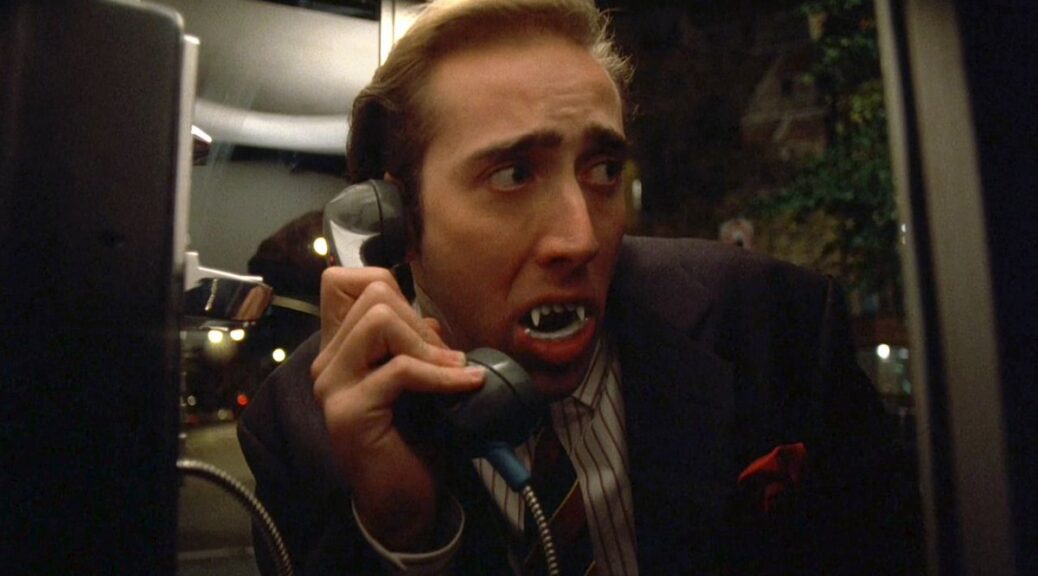
2. Vampire’s Kiss (1988)

Sure, Nicolas Cage is a whore, a has-been, and his wigs embarrass us all. But back before The Rock (the film that turned him), Cage was always willing to behave in a strangely effeminate manner, and perhaps even eat a bug. He made some great movies that way.

Peter Lowe (pronounced with such relish by Cage) believes he’s been bitten by a vampire (Jennifer Beals) during a one night stand. It turns out, he’s actually just insane. The bite becomes his excuse to indulge his self-obsessed, soulless, predatory nature for the balance of the running time.

Cage gives a masterful comic performance in Vampire’s Kiss as a narcissistic literary editor who descends into madness. The actor is hilarious, demented, his physical performance outstanding. The way he uses his gangly mess of limbs and hulking shoulders inspires darkly, campy comic awe. And the plastic teeth are awesome.

Peter may believe he abuses his wholesome editorial assistant Alva (Maria Conchita Alonso) with sinister panache because he’s slowly turning into a demon, but we know better.

1. Mandy (2018)

Writer/director Panos Cosmatos’s hallucinogenic fever dream of social, political and pop-culture subtexts layered with good old, blood-soaked revenge, Mandy throws enough visionary strangeness on the screen to dwarf even Nicolas Cage in full freakout mode.

Not just Nic, either. Andrea Riseborough, cannibal bikers on LSD, The Chemist, and a religious sex cult led by a terrible folk singer. Plus a sword, an axe, a lot of blood, and did I mention the LSD?

Like Cosmatos’s 2010 debut Beyond the Black RainbowMandy is both formally daring and wildly borrowed. While Black Rainbow, also set in 1983, shines with the antiseptic aesthetic of Cronenberg or Kubrick, Mandy feels more like something snatched from a Dio album cover.