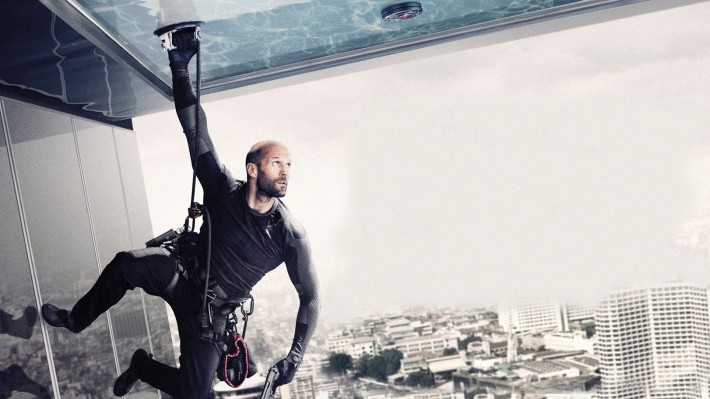
Mechanic: Resurrection revisits the by-the-numbers Statham character Arthur Bishop. Back in 2011, Statham reprised the role first held by Charles Bronson in a middling-to-fair remake of The Mechanic. That film inexplicably merited a sequel that was not direct-to-home-viewing. Why that is confounds us.
Get nervous Gods of Egypt and London has Fallen – Mechanic: Resurrection wants that “worst film of the year” award, and it is not above soiling itself with incompetence to get it.
“WHO SENT YOU??!!”
Bishop faked his own death years back so he could escape his pointless existence as an assassin, but an old enemy has tracked him down. And brought henchmen! And kidnapped master thespian Jessica Alba! Damn this confining shirt!
“WHERE’S CAINE?!!”
Statham removes his shirt no fewer than 8 times in the film’s 99-minute running time. That’s almost once every ten minutes. The man is 49, so good for him, and for that core audience he’s built over a career of shirtless man-on-man action.
“PLAYTIME’S OVER!!”
Alba’s character development is more nuanced. She keeps her shirt on, but it’s always clingy and sometimes…even wet.
Remember how great Statham was in last year’s Spy? His turn as Rick Ford, uber-macho super agent, was hilarious specifically because it was sending up ludicrous movies just like Mechanic: Resurrection.
Bishop criss-crosses the globe with nary a toothbrush, yet at a moment’s notice he has access to countless bomb-making chemicals, ammunition, kick ass scuba equipment and multiple expensive watches. Then, before Bishop has to dive into shark-infested waters, the film is careful to show him applying a shark repellent lotion (patent pending), just to keep it real. Come on, by that point we’re expecting any sharks to have lasers on their heads on a direct order from Dr. Evil.
The sad thing is, this movie could have been saved. Make a few edits, give it a new score, call it Spy 2: Ford Gets His Own Movie, and you’ve got comedy gold. As is, this film is so bad John Travolta is jealous.
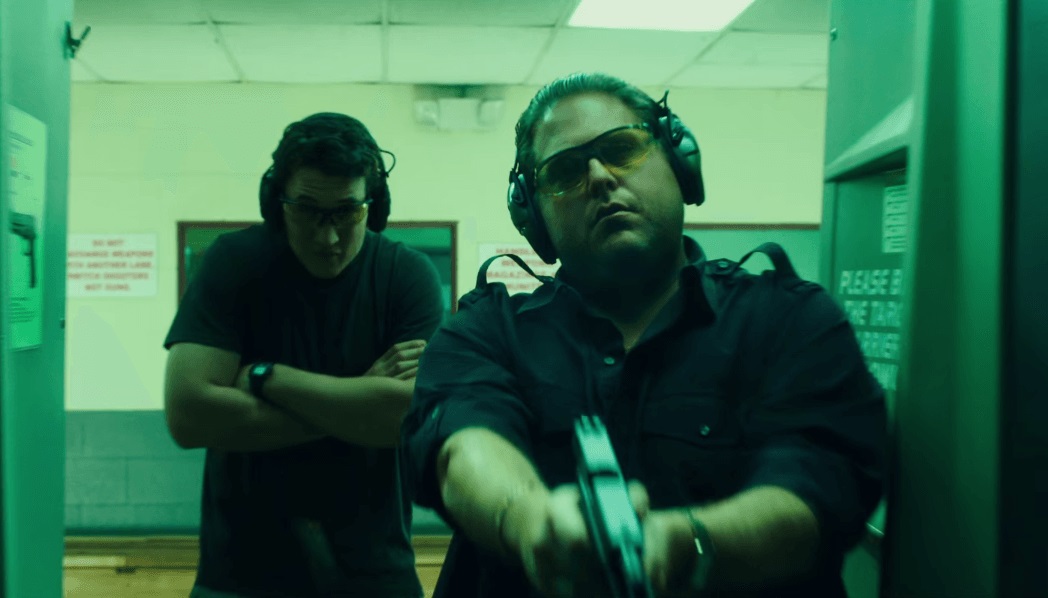
War Dogs starts with a guy in the trunk of a car and works backward, ending two hours later over the sound of Leonard Cohen’s “Everybody Knows.” Though both devices are tactical errors, what’s between them is a fairly effective take on true, undeniably American events.
David Packouz (Miles Teller) was a struggling twenty-something massage therapist in Miami when he re-connected with childhood friend Efraim Diveroli (Jonah Hill). Together, they grew Diveroli’s modest gun selling business into a 300 million dollar contract with the Pentagon to arm our allies in Afghanistan.
As Diveroli is quick to point out, “It’s not about being pro-war, it’s about being pro-money.”
Director/co-writer Todd Phillips, expanding a resume built on comedies such as The Hangover trilogy and Old School, brings a suitable zest to the insanity of this guns-to-riches tale, but falters when the time comes to move beyond his filmmaking comfort zone.
With The Big Short just last year, Adam McKay brought comedic sensibilities to the complexities behind financial corruption, dissecting a scandal with humor, insight, and most importantly, a constant undercurrent of outrage that War Dogs is missing.
It does feature a fantastic performance from Hill, and if you still doubt his acting chops after two Oscar nominations, that’s a YP. Hill is magnetic, making Diveroli a darkly charming sociopath who effortlessly becomes whomever his latest mark wants him to be. Don’t be surprised if nomination number three comes calling in a few months.
Teller is fine, if a bit underwhelming next to Hill, while Ana de Armas is asked to do little more than hold a baby in the embarrassingly cliched role of Packouz’s wife.
Phillips does serve up some hearty laughs and effective set pieces while telling this incredible tale, but too much of the journey feels like a testosterone-fueled romp that’s more about respect for the boys’ brazen ambition than the sad truths it revealed. It’s not that Phillips doesn’t want to dig deeper, he’s just not sure how to do it on his own terms.
More than anything, War Dogs is a film that constantly reminds you of other films. The Hangover vibe is rampant, from the guy in the trunk to the effective cameo by Bradley Cooper, but there are also shots lifted right from Scarface and Rain Man, plus stylistic nods to multiple Scorsese titles, especially Wolf of Wall Street.
That film, like The Big Short, carried a healthy dose of cynicism to dig at the wages of excess. War Dogs doesn’t, and closing with one of the most brilliantly cynical songs ever written only makes that fact more obvious.
It’s clear Phillips knows how to make us laugh. War Dogs is his uncertain step toward making us think, too.
Horror movie remakes are legion – most of them needless, many of them abominations, one or two really work out well. The Ring – that’s a great one. Let Me In – OK, we will! But today, rather than crucify the sub-par remakes, what we really want to do is to remind you of the bloody good original you may have missed, or maybe saw years back and need to check out again. Here is our list of horror movies where you should skip the remake and seek out the original.
5. Diabolique (1955 v 1996
Henri-Georges Clouzot’s twisty psychological thriller with horror-ific undertones is crafty, spooky, jumpy and wonderful. Jeremiah Chechik’s 1996 remake capitalizes on the popularity of a post-Basic Instinct Sharon Stone and the moviegoing public’s spotty memory. If a film relies on a twist ending to work, why remake that film? You have to ask whether the film still works if the ending is apparent all the while. In all honesty, with the atmosphere of brittle dread Clouzot created, the answer could well be yes – although that bathtub scene is far scarier when you don’t know it’s coming. But Chechik – whose National Lampoon’s Christmas Vacation hardly suggested he had instinct for tense, potentially supernatural horror – was not up to the task. Flat. Uninspired. Spook-less. Boo.
4. The Wicker Man (1973 v 2006)
Oh my God. What the hell?! The once-promising Neil LaBute and the once-talented Nic Cage turn that saucily blasphemous ’73 gem on Summerisle into an embarrassing battle of the sexes. In the early Seventies, Robin Hardy created a film that fed on the period’s hippie versus straight hysteria, and he did it with insight, humor, and super creepy animal masks. LaBute, characteristically, turns that primary conflict into male versus female, sucking all the irreverent humor from the story as he does. And he pulls his punch with the ending – so what on earth is the purpose of this?!!!
3. The Haunting (1963 v 1999)
Well, here’s another one that just pisses us off. In ’63, Robert Wise (West Side Story, The Sound of Music – yeah, that one) took Shirley Jackson’s beloved haunted house novel to the big screen. True to the source material, The Haunting relied so entirely upon your own imagination that it garnered a G rating and still scared hell out of you. In 1999, Jan de Bont abandoned nuance entirely, embraced vulgar displays of literalism and wasted a cast that was actually perfect for each role. In somebody else’s adaptation, Catherine Zeta-Jones would have made the perfect Theo and Owen Wilson a delightful Luke, but the achingly missed opportunity is Lily Taylor. There is no better option to play Jackson’s repressed heroine Nell – Taylor couldn’t be a more perfect choice – and a blind de Bont understood his talent even less well than he understood Jackson’s novel.
2. Oldboy (2003 v 2013)
No surprise here. We honestly feel a bit bruised for poor Spike Lee, who endured so much Hollywood interference with his reboot of Chan-wook Park’s near-perfect Korean original that a decent product was out of the question. And yet, this abomination was released on an unsuspecting – or worse, optimistic – movie going world. And it sucked! Just sucked outright!! Gone were all the glorious bits of subversive genius, every punch pulled, every shock diluted. Park’s dizzying action sequences – ditched. And this seriously badass cast – Josh Brolin, Elizabeth Olsen, Samuel Jackson – wasted, while Sharlto Copley embarrasses himself. Awful!
1. Martyrs (2008 v 2015)
Pascal Laugier’s diabolical masterpiece Martyrs is a merciless film. It’s also one of the most impeccably written, directed and acted films in horror history. Co-directors and brothers Kevin and Michael Goetz underperform with their 2015 remake – pulled punches, heavy handed explanations, and a general lack of spine mark their work. The questions here resemble the same conundrum of remaking Oldboy – if you lack the guts to do the film justice, why do it at all? Why choose such a bold effort if your whole goal is to water it down?
Just a few months after a triumphant re-imagining of The Jungle Book, Disney heads back to the vault to give Pete’s Dragon a similar live action/animation reboot…with less magical results.
Much has changed from the 1977 cartoon, starting with the surprisingly tragic depiction of how a very young Pete becomes an orphan. Losing his parents in isolated woodlands deep in the Pacific Northwest, Pete is promptly befriended by the very dragon whose legend has been passed down for decades in local song and story.
Pete will call his dragon “Elliot.”
Well, we’re told it’s a dragon, but here he or she is more like a big, green dog with wings. Look at it chasing its tail and fetching a stick!
Six years later, park ranger Grace (Bryce Dallas Howard) encounters an injured Pete (Oakes Fegley) in the forest and takes him home, where stories of a dragon best friend intrigue Grace’s father Meacham (Robert Redford), who may have his own history with Elliot. These stories also catch the attention of local meanypants Gavin (Karl Urban), who quickly assembles a hunting parting with an aim to “put himself on the map” by bagging a giant green trophy.
Director/co-writer David Lowery makes a monster-sized pivot from the poetic desperation of his Ain’t Them Bodies Saints, and while Pete’s Dragon is rife with gentle sweetness, it’s lacking in both depth and wonder.
After the bracing prologue, characters and situations are broadly drawn, as if to never challenge any viewer older than Pete himself. It’s a curious approach for a PG-rated film, and the less than subtle, too often sappy treatment undercuts later attempts to resonate on a more metaphorical level.
Does Pete’s desire to stay with Elliot represent that wish to escape adult responsibilities and hold tight to childhood wonders? Maybe, but that Neverland remains out of sight.
We do get perfectly acceptable, albeit generically feel good lessons on the importance of family, and that’s fine. But despite those wings, Pete’s Dragon never quite soars.
Who’d have guessed that deep inside the most notorious genre in film beats the heart of a dancer? Well, we guessed. You can’t hide your sensitive soul from us! We are here to admire your dancer’s heart and your boogie shoes as we count down the 5 best dance scenes in horror movies!
5. Prom Night (1980)
Saturday Night Fever meets Carrie in this high school slasher that’s utterly preoccupied with disco and Jamie Lee Curtis’s boobs. Who isn’t?! See it for the super-colossal dance-off. Go Jamie Lee and Jamie Lee’s thumbs, go! Is that Leslie Nielsen? Who brought all that glitter? And who’s the killer? Is it the pervy janitor? The disfigured escaped mental patient? The vindictive ex and her hoodlum new boyfriend? It all builds to a bloodbath on prom night, so just go with it and boogie down!
4. Night of the Demons (1988)
Do not be confused – Night of the Demons is not exactly recommended viewing. It’s terrible. Once you get past its dirt-cheap sets and TV-level staging, you’ll notice that Night of the Demons boasts among the most stilted and cardboard dialogue of any film from the Aquanet decade. But Angela (Amelia “Mimi” Kinkade) looks cool. Every goth chick – Fairuza Balk’s Nancy Downs from The Craft in particular – owes Angela a little respect. And professional dancer Kinkade does the demonic transformation justice. The acting is atrocious – all of it – but the film boasts a campy, nostalgic, oh-so-80s quality, and we never disagree with Bauhaus on a soundtrack.
https://www.youtube.com/watch?v=-m7hogVm2B8
3. Return of the Living Dead (1985)
The film has a lot to boast about. 1) It’s the first film to have zombies moan for braaaaiiiinnnnssss. 2) It’s a funny and clever twist on Romero’s foundation. 3) Eighties scream queen Linnea Quigley dons a ridiculous Eighties punk ‘do to dance nearly naked in a cemetery. Artistry among the headstones. So that’s the point today – wearing nothing but legwarmers and a wistful gaze, Quigley makes the film truly memorable.
https://www.youtube.com/watch?v=HwwpXN_CeSk
2. Calvaire (2004)
This is a weird film from the opening credits, but it takes a sharp turn toward seriously bizarre inside the local pub. As soon as those first piano keys slam and tinkle and those first boots stomp, slide and try to keep time, a whole new narrative takes shape. Things becomes clear in a way that you just don’t want them to, and we know that poor, poor Marc (Laurent Lucas) should not hope the townsfolk will be his salvation.
https://www.youtube.com/watch?v=1owrlQlLExY
1. The Silence of the Lambs (1991)
Oh, Jame Gumm. Even after 30 years, your transformation to the tune of the Q Lazzarus song Goodbye Horses is still equal parts compelling and repellant. Ted Levine evolves from hulking, inarticulate caveman to slinking sex pot – sure, a sexpot with another woman’s scalp atop his head, but he’s doing his best! And let’s be honest, you forget all about that other scalp once you witness the Buffalo Bill Skin It Back.
Today we salute a man whose career teems with ideas that have been both universal and wildly ahead of their time. There may be no horror filmmaker who’s had more of an influence on his genre than George Romero, whose political leanings and social commentary have given his inventive monster movies the relevance to stand the test of time. A great line, an original idea, and a fantastic pair of glasses – George A. Romero has it all. Here are our five favorites:
5. Creepshow (1982)
By the early Eighties, Romero – who’d basically created the zombie genre – was ready to tackle something slightly different. For Creepshow he teamed up with another genre godfather, Stephen King, who wrote the screenplay (most of which was adapted from his own short stories) and even co-starred.
A series of shorts pulled from the pages of a disgruntled boy’s comic book, Creepshow boasts the wicked humor, juvenile preoccupations and inclination toward comeuppance that mark scary comics. Linked, short form horror had certainly been done previously, but Romero brought a visual sense of the artistry and an affection for the mean-spirited humor that most other films lacked.
He also had a hell of a cast, with appearances by genre favorites Tom Atkins and Adrienne Barbeau as well as King and heavy hitters from outside horror Ed Harris, Ted Danson, Leslie Nielsen and Hal Holbrook.
They lend a bit of class to some fairly bloodthirsty pieces that find a dim-witted farmer covered in alien foliage, a disabused husband taking advantage of a newly found monster-in-a-box, a cuckolded husband whose revenge plot takes a supernatural turn, plus bugs! Loads of them!
4. The Crazies (1973)
In ’73, Romero used a lot of the same themes from his zombie masterpiece – a genre he’d more or less just created himself – but changed the beast slightly. When military blunder leads to a chemical weapon mishap in a small Pennsylvania town, infected inhabitants go insane. You still end up with a mindless horde capable of anything as well as the fear of contamination, but the fun difference is the unpredictability.
The premise is so ripe: people infected go hopelessly mad. Every version of madness is different. How does each victim behave? Romero didn’t mine this often enough because for him, the real terror was in the government’s behavior. Still, his most provocative ideas here tend to be invested in the varying madness.
Other familiar themes arise as well. Military incompetence, the needless horror of Vietnam, and the evil that men can do when ordered to do so are all central conceits in this film. Indeed, Romero seemed more interested in social commentary than in horror this time around, but once again, his ideas were ahead of their time.
3. Martin (1977)
Martin (John Amplas) is a lonely young man who believes he’s a vampire. He may be – the film is somewhat ambivalent about it, which is one of the movie’s great strengths. He daydreams in black and white of cloaks, fangs and mobs carrying pitchforks.
Or are those memories? Does Martin’s uncle hate him because Martin, as he claims, is really in his Eighties, as his uncle would surely know? Romero has fun balancing these ideas, tugging between twisted but sympathetic serial killer and twisted by sympathetic undead.
Romero’s understated film is more of a character study than any of his other works, and Amplas is up to the task. Quietly unnerving and entirely sympathetic, you can’t help but root for Martin even as he behaves monstrously. It’s a bit like rooting for Norman Bates. Sure, he’s a bad guy, but you don’t want him to get into any trouble!
The film’s a generational culture clash wrapped in a lyrical fantasy, but quietly so. It’s touching, gory at times, often quite tense, and really well made. That, and it’s all so fabulously Seventies!
https://www.youtube.com/watch?v=NNIGTSdKPl0
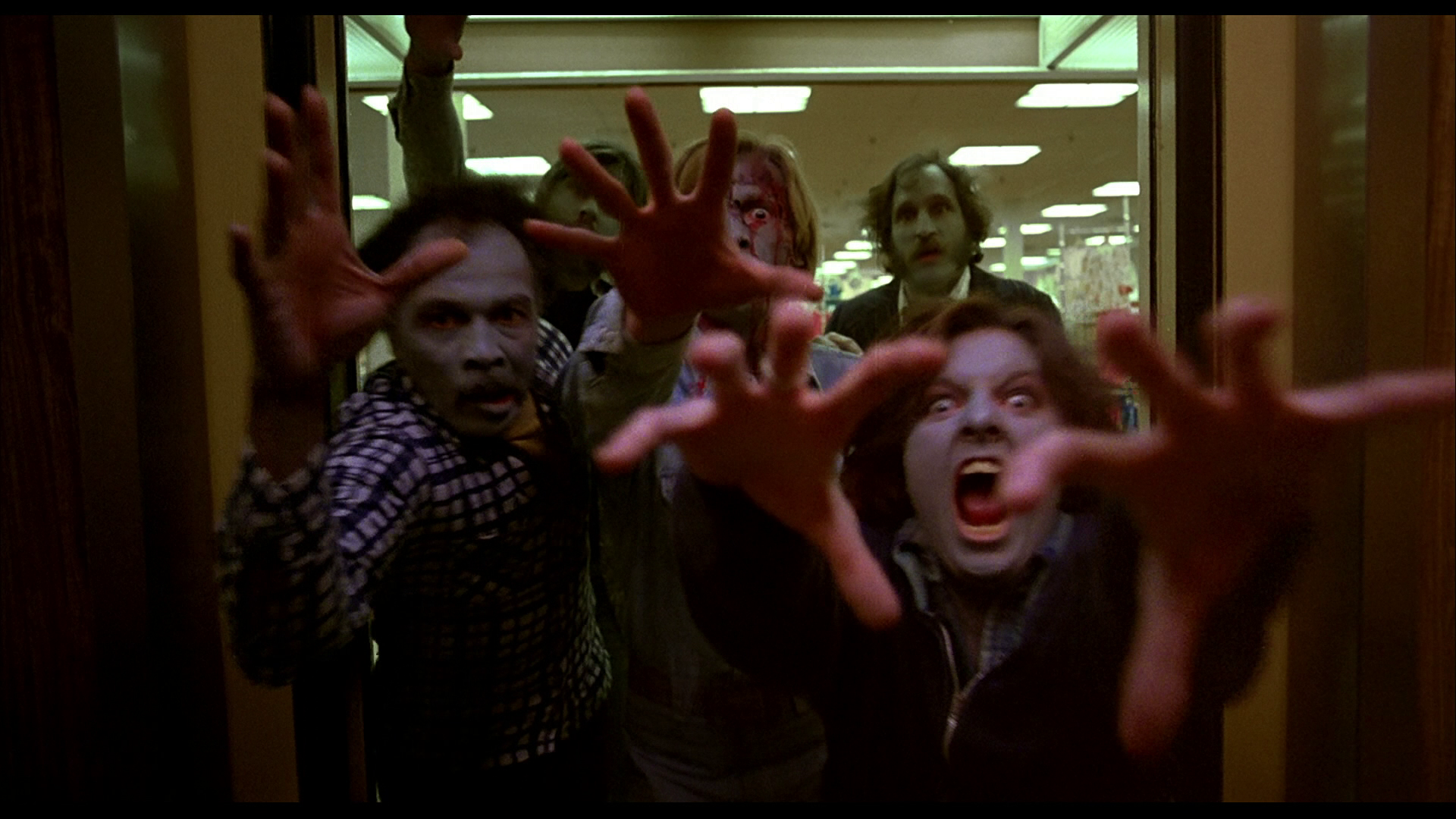
2. Dawn of the Dead (1978)
Romero returned to the land of the undead in ’78 with a full-color sequel to Night. Set in Philadelphia, at a news broadcast gone crazy, the film follows a news producer, her chopper pilot boyfriend, and two Philly SWAT cops ready to abandon the organized zombie fight and find peace elsewhere. The four board a helicopter, eventually landing on the roof of a mall, which they turn into their private hideaway.
Romero, make-up legend Tom Savini, and Italian horror director Dario Argento teamed up for the sequel. You feel Argento’s presence in the score and the vivid red of the gore.
Ken Foree and Scott Reiniger as the buddies from SWAT create the most effective moments, whether character-driven tension or zombie-driven action. Romero’s politics are on his sleeve with this one, and he seems to be working to build on successes of his original. He uses the “z” word, digs at Eighties consumerism, shows full-color entrails, and reminds us again that the undead may not be our biggest enemy once the zombie-tastrophe falls.
1. Night of the Living Dead (1968)
From the brightly lit opening cemetery sequence to the paranoid power struggle in the house to the devastating closing montage, Night of the Living Dead teems with the racial, sexual and political tensions of its time. An unsettlingly relevant George A. Romero knew how to push societal panic buttons.
“The scene can best be described as mayhem.”
As the first film of its kind, the lasting impact of this picture on horror cinema is hard to overstate. Romero’s inventive imagination created the genre and the monster from the ground up.
They’re dead.
They’re back.
They’re hungry for human flesh.
Their bite infects the bitten.
The bitten will eventually bite.
Aim for the head.
Romero made a narrative choice that would mark the genre and certainly the filmmaker’s entire career: the mindless monsters outside are not the biggest problem. The shrill sense of confinement, the danger of one inmate turning on another, and the unthinkable transformation going on in the cellar build to a startling climax – one that utterly upends expectations – followed by the kind of absolutely genius ending that guarantees the film’s eternal position in the annals of horror cinema.
If you’ve got some asses that need kicking, Christmas comes early this year. Jason Bourne is back, with a sack full of fuzzy memories and furious fists.
Star Matt Damon and director/co-writer Paul Greengrass return to the franchise after nearly ten years, trading some of the emotional depth of the previous films for a stab at new relevancy and two of the most effective action sequences of the entire series.
Since we left him at the end of Ultimatum, Bourne has basically been wandering the Earth like a violent Caine, grabbing cash in back alley fights across the globe. Old friend Nicky Parsons (Julia Stiles) tracks Bourne down to deliver more clues about his past, with CIA director Robert Dewey (Tommy Lee Jones), cyber division chief Heather Lee (Alicia Vikander) and the agency’s favorite assassin (Vincent Cassel) close behind.
Bourne’s search for his identity gave us a connection to the character that is now largely gone, and this film is anchored instead with what it calls “the great question of our time:” personal rights vs. public safety. Dewey’s new black ops program promises total cyber surveillance of the populace, even as he’s reminded that “computer privacy is freedom – you should think about defending it.”
Timely? You bet, but this layer isn’t explored as deeply as it could be, even as Bourne catches up with a whistleblower who is “worse than Snowden.” As it moves on to the next fistfight, the film sometimes feels like its running in place, content to feed the formula without a large chunk of the human element that drove it.
Still, this director/star tandem can run pretty well.
Damon’s brooding-yet-vulnerable intensity makes Bourne an effective anti-hero who’s easy to root for, and Greengrass is still a master of shaky cam tension. An early sniper showdown delivers sharp, hold-your-breath action, and the climactic car chase through the packed streets of Vegas is over-the-top spectacular, with a well-placed sign for self-parking becoming the exhale-inducing coup de grace.
It’s repetitive in spots, a bit ridiculous in others and slightly overlong, but Jason Bourne reclaims its legacy with a keen eye toward landing one last thrill before the theme park of summer shuts down.
War is hell, which makes it obvious fodder for horror films. It’s kind of amazing there aren’t more that really mine the carnage and insanity of battle, but those that do it well can make social commentary while getting under the audience’s skin. The films we celebrate today do both really well, plus – monsters! Hooray!
5. The Devil’s Backbone (El espinazo del diablo) (2001)
The Devil’s Backbone unravels a spectral mystery during Spain’s civil war. The son of a fallen comrade finds himself in an isolated orphanage that has its own troubles to deal with, now that the war is coming to a close and the facility’s staff sympathized with the wrong side. That leaves few resources to help him with a bully, a sadistic handyman, or the ghost of a little boy he keeps seeing.
Backbone is a slow burn as interested in atmosphere and character development as it is in the tragedy of a generation of war orphans. This is ripe ground for a haunted tale, and writer/director Guillermo del Toro’s achievement is both contextually beautiful – war, ghost stories, religion and communism being equally incomprehensible to a pack of lonely boys – and elegantly filmed.
Plus the ghost looks awesome. Del Toro would go on to create some of cinema’s more memorable creatures, and much of that genius was predicted in the singular image of a drowned boy, bloody water droplets floating about him, his insides as vivid as his out.
Touching, political, brutal, savvy, and deeply spooky, Backbone separates del Toro from the pack of horror filmmakers and predicts his own potential as a director of substance.
4. The Crazies (1973, 2010)
We’re cheating here, but George Romero’s 1973 insanity plague flick offers much, as does its 2010 reboot by the otherwise useless Breck Eisner, so we’re combining.
Just three years after Night of the Living Dead, the master found himself interested in taking his zombiism concepts in a different direction. Romero is more literal in his thoughts on the Vietnam War in this film than in his previous efforts. Two combat veterans are at the center of the film, in which a chemical weapon is accidentally leaked into the water supply to a Pennsylvania town. Those infected go helplessly mad. Military incompetence, the needless horror of Vietnam, and the evil that men can do when ordered to do so are all central conceits in this film.
Romero may not have always had the biggest budget, best actors, or best eye for composition, but his ideas were so far ahead of their time that modern horror would not exist in its current form without him. His ideas were unique, not far-fetched, and they fed the imaginations of countless future filmmakers. You can see Romero’s ideas and images from this film repeated in 28 Days Later, Return of the living Dead, Signal, Cabin Fever, Super 8, even Rambo – and, obviously, in the remake.
Eisner’s version offers solid scares, inventive plotting, and far better performances than expected in a genre film. Both films begin by articulating humankind’s repulsion and fear of infection before introducing the greater threat – our own government. Eisner’s greatest strength is his cast. The eternally under-appreciated Timothy Olyphant and Radha Mitchell, unerringly realistic as husband and wife, carry most of the grisly weight, aided by solid support work from folks who are not afraid to be full-on nuts.
3. Jacob’s Ladder (1990)
Jacob’s Ladder is as unsettling and creepy as any movie you’ll watch. The entire 113 minutes transpires in that momentary flash between life and death, with both light and dark trying to make a claim on Jacob Singer’s soul.
Tim Robbins plays Singer with a weary sweetness that’s almost too tender and vulnerable to bear. In a blistering supporting turn, Elizabeth Pena impresses as the passionate carnal angel Jezebel. The real star here, weirdly enough, is director Adrian Lyne.
Known more for erotic thrillers, here he beautifully articulates a dreamscape that keeps you guessing. The New York of the film crawls with unseemly creatures hiding among us. Filmed as a grimy, colorless nightmare, Jacob’s Ladder creates an atmosphere of paranoia and dread.
By 1990, the Vietnam film has run its course, but with some distance from the post-Platoon glut, the “flashback” crisis that underlines Singer’s confused nightmare feels less stale. It allows the movie to work on a number of levels: as a metaphysical mystery, a supernatural thriller, and a horror film.
2. Dog Soldiers (2002)
Wry humor, impenetrable accents, a true sense of isolation, and blood by the gallon help separate Neil Marshall’s (The Descent) Dog Soldiers from legions of other wolfmen tales.
Marshall creates a familiarly tense feeling, brilliantly straddling monster movie and war movie. A platoon is dropped into an enormous forest for a military exercise. There’s a surprise attack. The remaining soldiers hunker down in an isolated cabin to mend, figure out WTF, and strategize for survival.
This is like any good genre pic where a battalion is trapped behind enemy lines – just as vivid, bloody and intense. Who’s gone soft? Who will risk what to save a buddy? How to outsmart the enemy? But the enemies this time are giant, hairy, hungry monsters. Woo hoo!
Though the rubber suits – shown fairly minimally and with some flair – do lessen the film’s horrific impact, solid writing, dark humor, and a good deal of ripping and tearing energize this blast of a lycanthropic Alamo.
1. 28 Days Later (2002)
You know you’re in trouble from the genius opening sequence: vulnerability, tension, bewilderment, rage, and blood – it launches a frantic and terrifying not-zombie film. Like zombie god George Romero, though, director Danny Boyle’s real worry is not the infected, it’s the living.
Boyle uses a lot of ideas Romero introduced, pulling loads of images from The Crazies and Day of the Dead, in particular (as well as Lyne’s Jacob’s Ladder).
The vision, the writing, and the performances all help him transcend genre trappings without abandoning the genre. Both Brendan Gleeson and Cillian Murphy are impeccable actors, and Naomie Harris is a truly convincing badass. Their performances, and the cinematic moments of real joy, make their ordeal that much more powerful.
It’s a tribute to the performances, Boyle’s direction, and writer Alex Garland’s (Ex Machina) vision that, even after a dozen or so terrifying set pieces, the most deeply unsettling scene is a quiet conversation between ragged survivor Jim (Murphy) and his alleged salvation, Major Henry West (Christopher Eccleston).
Since Bonnie and Clyde and probably before, cinematic lovers on a bloody rampage have been entertaining and freaking out audiences the world over. Their escapades can be as grimly beautiful as Terrence Malick’s incandescent Badlands, or as bloody as – well, as the films we celebrate today. Dangerous lovers can really build a body count, as you’ll see here. Ain’t love grand?
5. Sweeney Todd: The Demon Barber of Fleet Street (2007)
Here’s a bizarre idea for a musical: The barber upstairs kills his clients and the baker downstairs uses the bodies in her meat pies. Odd for a Broadway musical, yes, but for a Tim Burton film? That sounds a little more natural.
As in most of Burton’s best efforts, Sweeney Todd stars Johnny Depp in the title role. Depp is unmistakably fantastic – consumed, morose, twisted with vengeance – and he’s in fine voice, to boot.
Helena Bonham Carter – ever the perfect Goth girl – gives Mrs. Lovett a wicked survivor streak balanced by a tender, pining affection. The romance dream sequence is a riot, and so perfectly Burton-esque. The two actors offset each other brilliantly, while their onscreen duo deserves credit for efficiency, if nothing else.
With Burton’s help, Depp found another dark, bizarre anti-hero to showcase his considerable talent. With Depp’s help, Burton gorgeously, grotesquely realized another macabre fantasy.
4. Hellraiser (1987)
Hedonist Frank Cotton solves an ancient puzzle box, which summons the fearsome Cenobites, who literally tear Frank apart and leave his remains rotting in the floorboards of an old house. Years later, Frank’s brother Larry moves into that house with his teenage daughter Kirsty and his new wife Julia (Clare Higgins) – who, oh yeah, also happens to be Frank’s ex-lover.
A gash on Larry’s leg spills blood on the floor, which awakens the remains of Frank, who then requires more blood to complete his escape from the underworld. Julia, both repulsed and aroused by her old flame’s half-alive form, agrees to make sure more blood is soon spilled.
Though the Cenobites are the real, lasting terror in this film – and how cool were they! – the sexual chemistry between Julia and that bloody lump of Frank is never less than unsettling. Higgins makes the perfect evil stepmother while redefining the term blood lust.
3. Sightseers (2012)
From the guttural drone of the opening segment, this film announces itself as a dryly, darkly hilarious adventure. Frumpy Tina (Alice Lowe, perfection) needs a break from the smothering mum who blames her for their dog’s death. Against Mum’s wishes, Tina will take a road trip with her new beau, the equally frumpy Chris (Steve Oram, amazing).
The film is a wickedly fresh British take on a familiar theme. Oram and Lowe wrote the script, alongside director Ben Wheatley’s go-to scribe (and wife) Amy Jump. The result is so absurd and hilarious – few films have had so much fun with moral ambiguity.
Wheatley blends the dark comedy of his first film, Down Terrace, with the sense of the unexpected that elevated Kill List to create enormously entertaining homicidal madness. It helps that his cast could not be better, draining all the glamour of the road trip assassin couple trope without relying on that as a gimmick. There’s a deeply British weirdness to the proceedings, which are handled with bone-dry aplomb by all involved.
2. The Hunger (1983)
Tony Scott’s seductive vampire love story has a little bit of everything: slaughter, girl-on-girl action, ’80s synth/goth tunage, David Bowie. What more can you ask?
Actually the film’s kind of a sultry, dreamily erotic mess. Catharine Deneuve is the old world vampire Miriam, David Bowie is her lover. The two spend years – perhaps centuries – together seducing victims. But he suddenly begins aging, and she needs to find a replacement. Enter Susan Sarandon as a medical specialist in unusual blood diseases and a fine actress who’s not above smooching other girls.
Bowie and Deneuve are both so effortlessly cool and sexy that you can almost forgive them their nighttime savagery. You find out just how dangerous he is once he begins the rapid-aging process, but once you get a peek into Miriam’s attic you find that she’s been far more dangerous – to her lovers and everyone else – for a very long time.
1. Alleluia (2014)
In 2004, Belgian writer/director Fabrice Du Welz released the exquisite Calvaire, marking himself a unique artist worth watching. Ten years later he revisits the themes of that film – blind passion, bloody obsession, maddening loneliness – with his newest effort, Alleluia. Once again he enlists the help of an actor who clearly understands his vision.
Laurent Lucas plays Michel, a playboy conman who preys upon lonely women, seducing them and taking whatever cash he can get his hands on. That all changes once he makes a mark of Gloria (Lola Duenas).
Du Welz’s close camera and off angles exaggerate Lucas’s teeth, nose and height in ways that flirt with the grotesque. Likewise, the film dwells on Duenas’s bags and creases, heightening the sense of unseemliness surrounding the pair’s passion.
Duenas offers a performance of mad genius, always barely able to control the tantrum, elation, or desire in any situation. Her bursting passions often lead to carnage, but there’s a madcap love story beneath that blood spray that compels not just attention but, in a macabre way, affection. Alleluia is a film busting with desperation, jealousy, and the darkest kind of love.
Just weeks ago, Dan Aykroyd set the trollosphere into a stage 5 tizzy when he dared to suggest the new Ghostbusters just might be scarier – and funnier – than his 1984 version.
He’s not really wrong.
Simmer down, I’m not saying this new one is a better. It doesn’t match the freshness or overall attitude of the original that, when combined with generational nostalgia and Bill Murray’s ascension to beloved icon, has propelled the film to a slightly more lofty pop culture perch than it deserves.
But, the 2016 GB’s do battle more frightening ghosts and do deliver a solid amount of laughs.
Erin Gilbert (Kristen Wiig) is chasing tenure at Columbia University, and trying to forget her days chasing ghosts. A report of a local haunting reconnects Erin with old partner Abby Yates (Melissa McCarthy) and her new tech wizard Jillian Holtzman (a scene-stealing Kate McKinnon). The trio gets a close encounter of the slimy kind, brings the feisty Patty Tolan (Leslie Jones) on board, and sets up shop in modest digs above a Chinese restaurant, which somehow still doesn’t help them get lunch any faster (delivery guy: “I have bad knees.”)
Director/co-writer Paul Feig gives each actor both the material and the space to carve out distinct characters, and it isn’t long before casting that smelled like a gimmick feels not only inspired, but perhaps the most sensible way to reboot such a classic team.
Giving the ladies an air-headed piece of beefcake named Kevin for a secretary (Chris Hemsworth, having a charming bit of fun with his own image) isn’t a bad move either. The comic benefits are obvious, but it’s also one of the devices the film leans on to throw subtle shade at the misogynistic vitriol that’s been spewing since the female leads were announced.
Stars from the ’84 film make effective and well-placed cameos (extra points for the clever way the late Harold Ramis is included), but eventually the amount of homage feels excessive for a film blazing its own trail. A similar penchant for excess bleeds into the finale, as our heroes face off against a number of spectacular ghouls in a fireworks-laden battle, but can’t wrap it up before an unnecessary serving of schmaltz creeps in.
McCarthy and director/co-writer Paul Feig again prove to be a reliable comedic team, but can’t quite match the sustained hilarity of Bridesmaids or Spy, which is actually a bit ironic. Similar expectations dogged Ramis and Murray after the successes of Caddyshack and Stripes, but initial concerns about their ghost-chasing epic got vaporized in a New York minute.
Can the new look GB’s repeat? They’re off to a solid start, and be sure to stay through the credits for a clue about who they ain’t gonna be afraid of next.