H&G talk through their most anticipated film of the summer, Hereditary, along with Ocean’s 8, Hotel Artemis, First Reformed, Mary Shelley, On Chesil Beach and what’s what this week in home entertainment.
Listen in HERE.
H&G talk through their most anticipated film of the summer, Hereditary, along with Ocean’s 8, Hotel Artemis, First Reformed, Mary Shelley, On Chesil Beach and what’s what this week in home entertainment.
Listen in HERE.
by Hope Madden and George Wolf
Grief and guilt color every somber, shadowy frame of writer/director Ari Aster’s unbelievably assured feature film debut, Hereditary.
The Graham family is maybe less grief-stricken over the loss of Grandma than you might expect. Daughter Annie (Toni Collette) delivers a eulogy that admits her mother was difficult, secretive. Her oldest son Peter (Alex Wolff) seems nonplussed by it all. He’s probably stoned, though.
Supportive but exhausted husband Steve (Gabriel Byrne) is almost relieved, but the loss does bother the Graham’s socially isolated younger daughter, Charlie (Millie Shapiro, in one of the more chilling performances this year).
With just a handful of mannerisms, one melodic clucking noise, and a few seemingly throwaway lines, Aster and his magnificent cast quickly establish what will become nuanced, layered human characters, all of them scarred and battered by family.
The eulogy caps a striking film opening, where serpentine camera movement intertwines the Graham family with the intricate miniatures Annie creates inside their grand, secluded house. What we see suggests a scaled-down world of its own, lifelike but lifeless.
Art and life imitate each other to macabre degrees while family members strain to behave in the manner that feels human, seems connected, or might be normal. What is said and what stays hidden, what’s festering in the attic and in the unspoken tensions within the family, it’s all part of a horrific atmosphere meticulously crafted to unnerve you.
If horror fare such as The VVitch or It Comes at Night is not your bag, then you probably don’t care for the slow, detailed burn that A24 studio regularly serves. For those that do, hooray! Here’s another “adult” horror film, one that invests more in character development than in jump scares (though there are a few, including one so jarring it awakens the potential of the device).
Aster takes advantage of a remarkably committed cast to explore family dysfunction of the most insidious type. Whether his supernatural twisting and turning amount to metaphor or fact hardly matters with performances this unnerving and visual storytelling this hypnotic.
Applause to cinematographer Pawel Pogorzelski for turning this intricately designed home into a foreboding character all its own. Like Rosemary’s Baby, The Shining, The Haunting, The Others and any number of brilliant genre hauntings, Hereditary uses its surroundings to create a space where the most mundane moments take on a diabolical chill.
The family dynamic at work here is gut-punch authentic. Collette anchors the film with a performance full of grief, insecurity, bitterness and terror. It’s another in a string of award-worthy turns, and the support she gets from the ensemble, including a game Ann Dowd, elevates the tension in every intricately detailed frame.
You will have been quietly unnerved, startled from your seat, and then unsettled by the time the supernatural elements overtake the story. The peppering of hardline genre tropes in act 3 may feel like a cop out, but Aster’s interplay with the differing family members is too careful for such an easy summation.
The web of mental states, understandable suspicions and direct bloodlines layer the brutally effective fable, and Aster wields these weapons with stealthy precision. His work here is so smartly embedded that Hereditary continually tempts potential non-believers to dismiss where it leads as something you’ve seen before.
Don’t. You haven’t.

by Hope Madden and George Wolf
More than 15 years ago, Steven Soderbergh recast the Rat Pack, pointing out a set of Hollywood A-listers led by George Clooney who were as stylish and cool as Sinatra and the fellas.
Three films later (four, if you count Soderbergh’s hillbilly version Logan Lucky, and you should) and the Ocean family is drawn once again to the big payoff.
This time it’s Danny Ocean’s sister Deb (Sandra Bullock). A life of crime runs in the family, it seems. Fresh from incarceration, Deb is looking to execute the con she’s been fine tuning over the last 5 years in lockdown.
What Debbie needs is a team, and she knows what kind.
“A ‘him’ gets noticed. A ‘her’ gets ignored.”
That’s a line well-placed and well-played, and though the film seems awfully familiar from the jump, that’s not necessarily a bad thing. The music bumpers, throwback scene segues, strategy meetings and comfortable pacing set the cool vibe, and Ocean’s 8 is cheeky enough in its outright impersonation of the previous installments to shrug off feeling derivative. Instead, it comes off as second class, which may be more disappointing.
Though director Gary Ross (The Hunger Games) can crib the style—his cast (including Cate Blanchett, Sarah Paulson, Helena Bonham Carter, Mindy Kaling, Rihanna and a spunky Awkwafina) can’t generate the same chemistry. No one does a bad job, far from it, but Ocean’s 8 lacks the overlapping dialogue and easy rapport of earlier efforts. They have the talent, they just don’t have the material.
Anne Hathaway is the real thief in this caper, stealing every scene with a fun and funny send-up of the Hollywood diva persona (including her own). James Corden, popping in as a fraud expert investigating the theft of a multi-million dollar Cartier necklace during the Met Gala, brightens up the third act as well with his fresh perspective and savvy delivery.
Otherwise, the side characters are neither as meaty or as interesting as in previous franchise efforts. Surprisingly it’s Blanchett who disappoints most. Too dialed down, her Lou lacks the color and definition to be effective as Debbie’s second banana, and Blanchett’s casual greatness feels wasted.
The best of the Ocean’s films rely on sharp characterizations and sharper sleight of hand. You believe you’re watching the con unfold only to find that …whaat?….the real heist was somewhere you weren’t looking. It is you who’s been conned.
While 8 follows that formula it succeeds only to a degree, its script simply not crisp enough to charm you into buying all in. The con itself is not believably intricate and Ross, who co-wrote the screenplay with Olivia Milch, cops out in act three with heavy exposition.
But hey, heist movies are fun, and movies with this much star power are fun. Ergo, Ocean’s 8 is a fun time at the movies.
Glitzy, forgettable fun.

An abundance of stay-cool-indoors options this week in home entertainment. If you missed the spectacular Thoroughbreds, now is your chance to remedy that. If you believed the trash talk about A Wrinkle in Time, you can undo that nonsense now, too. The rest—meh—but Hurricane Heist at least delivers what it promises.
Click the film title for the full review.

https://www.youtube.com/watch?v=UhZ56rcWwRQ

Thanks to S.A. Bradley of Hellbent for Horror for joining us to finish out our look at the best endings in horror movie history. A tough list to finalize, for sure, this one hits on some of the most brutal and memorable parting shots on film.
Ben Wheatley’s diabolical 2011 indie slides from grim Brit crime thriller into something far more sinister.
Hitman Jay (a volcanic Neil Maskell) is wary to take another job after the botched Kiev assignment, but his bank account is empty and his wife Shel (an also eruptive MyAnna Buring) has become vocally impatient about carrying the financial load. But this new gig proves to be seriously weird.
The final act offers something simultaneously fitting and surprising. Wheatley’s climax recalls a couple of other horror films, but what he does with the elements is utterly and bewilderingly his own.
If there’s one thing a successful Stephen King adaptation needs, it’s a writer/director who knows how to end a story. For all of King’s many strengths, ending his tale is no a strong suit.
Frank Darabont has certainly proven to have a knack for King’s source material, having helmed among the most successful and beloved films based on King’s books. But with The Mist, he outdid himself.
Thomas Jane plays a writer who, along with his young son, finds himself trapped in a grocery store when an opening in the space/time continuum allows giant, bloodthirsty creatures into New England. What begins as a wonderful creature feature turns into a terrifying Lord of the Flies before setting us up with a gut punch of utter, devastating perfection in a horror film ending.
https://www.youtube.com/watch?v=ktqNNsVJhUE
Another excellent King adaptation, Brian De Palma’s Carrie streamlines King’s sprawling ending to focus our attention where it will do the most damage.
And yes, the entirety of Act 3 is magnificent, but De Palma started something with those final, lingering images. He goes back to the cheese-cloth fuzziness of the earliest moments of the film as Sue Snell (this is really all your fault, Sue Snell!) glows with goodness and self-sacrifice. Only she truly loved poor, misunderstood Carrie.
Sue carries white flowers to the unholy ground where Carrie White lies.
And BLAM! De Palma has invented a new and forever mimicked horror movie ending.
Holy shit. This film is a brilliant and brutal test of endurance.
Writer/director Pascal Laugier’s mystifying sense of misdirection shares the aching, dysfunctional love of two best friends as one descends into madness. But that is not the point.
A couple of abrupt story turns later and we learn the point of the film and the film’s title. That’s about the time we meet Mademoiselle (Cahterine Begin, perfect).
And after ninety minutes of dread and terror, the climax Pascal and Mademoiselle have in store for you may not be satisfying, but it is perfect.
From the brightly lit opening cemetery sequence to the paranoid power struggle in the house to the devastating closing montage, Night of the Living Dead teems with the racial, sexual and political tensions of its time. An unsettlingly relevant George A. Romero knew how to push societal panic buttons.
As the first film of its kind, the lasting impact of this picture on horror cinema is hard to overstate. His inventive imagination created the genre and the monster from the ground up.
Still, the shrill sense of confinement, the danger of one inmate turning on another, and the unthinkable transformation going on in the cellar build to a startling climax – one that utterly upends expectations – followed by the kind of absolutely genius ending that guarantees the film’s eternal position in the annals of horror cinema.
https://www.youtube.com/watch?v=X6IDNqHuHmE
Welcome back to The Screening Room! This week we tackle the true-life tale Adrift, the surprising Tom-Hardy-&-David-Cronenberg-esque Upgrade, plus Let the Sunshine In, The Rider and what’s new in home entertainment.
Listen to the full podcast HERE.
by George Wolf
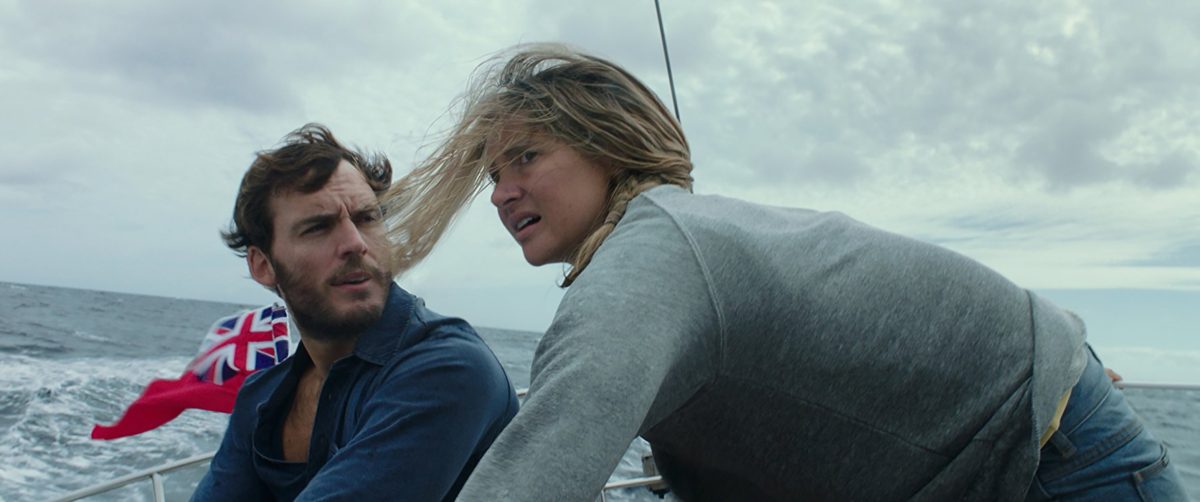
Opening with an extended take that efficiently moves us from confusion to desperation, director Baltasar Kormakur sets the gripping stakes of Adrift with scant dialog. His closing is equally effective, showcasing a touching humanity with nuance, and hardly a spoken word.
The journey in between is literally harrowing but cinematically uneven, a sometimes gritty testament to survival that is too often satisfied with the path more traveled.
Adapted from a memoir by Tami Oldham (Ashcraft), the film recounts her incredible ordeal surviving over month at sea in the aftermath of 1983’s Hurricane Raymond.
Oldham was traveling the world through odd jobs in exotic locales when she met fiancee Richard Sharp during a stay in Tahiti. Englishman Sharp, an experienced sailor, docked his own vessel and accepted a lucrative offer to sail a friend’s 44-foot yacht back to San Diego.
Oldham, a San Diego native with limited sailing knowledge, came aboard.
Shailene Woodley, also earning a producer credit on the film, stars as Oldham, instantly establishing an important and authentic chemistry with Sam Clafin as Sharp. The nautical metaphors (with Oldham drifting though life until Sharp becomes her anchor) may be hard to miss, but they go down easy through the talents of the lead actors.
A true life adventure such as this brings some inherent challenges to the big screen, and Kormakur meets them with understandably familiar narrative choices.
The time alone at sea is layered with flashbacks to how Tami and Richard’s bond was formed, both deepening our connection to them and breaking up the lonely stretches at sea through crowd-pleasing fun and romance.
As the situation grows more desperate, pleasing flirts with pandering, and Kormakur weakens the emotional impact with some unnecessary spoon-feeding.
When the couple sails into the teeth of the hurricane, it bites hard, giving Kormakur (Everest, 2 Guns, Contraband) the chance to flash his action flair via a breathtaking storm sequence.
The film’s tale is truly compelling, and it does deliver satisfying stretches while staying cautious of any narrative risks that might seem disrespectful.
Even at its most dangerous, Adrift feels ironically safe.
One big and underseen film for you to grab with both hands this week. Annihilation is brilliant, terrifying and entirely satisfying. Watch it!
Click the film title for the full review.
This week we tackle the hotly anticipated Solo: A Star Wars Story and work through the best and worst of what’s available this week in home entertainment.
Listen to the full podcast HERE.
by Hope Madden and George Wolf
Are Han and Chewie your favorite characters from the Star Wars franchise? And if not, why not?
They were the cool kids in a galaxy of nerds, and if any single Star Wars offshoot deserves the edgy, thought-provoking, dare-we-even-say dangerous treatment, it’s the origin story of this duo.
And nothing spells danger more than director Ron Howard.
Actually, most everything does, but Howard does manage to steer Solo in satisfactory, though not quite thrilling, directions.
The film catches the scent of a young street rat, in love and in need of a ticket out of his home planet. Complications arise, friends are lost, found and lost again, there’s gambling, smuggling and risk-taking and a future legend finally getting his wings – plus a big, furry co-pilot.
Aldren Ehrenreich makes for a fine young Han. He mixes enough of Harrison Ford’s mannerisms (and the scar on his chin – nice touch) with an unvarnished naivete that suits the effort. He’s more than matched by Donald Glover, whose Lando is a smooooth amalgamation of Billy Dee Williams, youthful swagger and some sweet capes.
Fun new characters, including a rebellious droid who steals the show, round out a rag-tag group of misfits to root for. Woody Harrelson cuts exactly the right figure to be the mentor Han needs, while Paul Bettany’s brand of slippery villain (Josh Brolin busy?) offers an excellent foil.
Howard famously picked up the Solo mantle after executive producers canned Phil Lord and Christopher Miller, the charming rogues behind The LEGO Movie, 21 Jump Street and Cloudy with a Chance of Meatballs.
He’s working from a script by the father and son team of Jonathan and Lawrence Kasdan. Kasdan the Elder, of course, penned Force Awakens, Empire Strikes Back and Return of the Jedi.
All of which sounds perfectly calculated and terribly risk-free. And it is, but it’s also a lot of fun. The imagery (speeders, desolate planets, weapons, casinos) looks simultaneously retro and futuristic, beat up but cutting edge. And there are plenty of warm nods to Han and Chewie’s future that will bring a knowing smile while honoring our long investment in these characters.
So what’s missing? The rogue spirit that let Han steal scenes in A New Hope so easily.
It’s a film that takes no chances, which feels ill-at-ease with who Han is as a character. After a couple of installments in the Star Wars saga that were unafraid to make dangerous decisions, chart new courses and stir up the fanboys, this one just feels too safe.
Solo‘s got plenty of space, just not enough balls.