Ever feel like you’ve been here before? This week we celebrate that spooky feeling with some of the best horror movies to take advantage of time loop nuttiness.
5. Haunter (2013)
Nicolas Vincenzo (Cube) starts off with the standard Groundhog Day premise—surly teen Lisa (Abigail Breslin) wakes up to the walkie talkie sound of her brother playing hidden treasure with an imaginary friend. It’s not Sonny & Cher, but it’s not that far off.
But Vincenzo (working from Brian King’s screenplay) starts bending the time loop structure, blending it with a more recognizable horror trope and subverting expectations. Breslin delivers a solid performance, and Pontypool’s Stephan McHattie’s outstanding as the devilish Pale Man. Plus, excellent support work from Siouxsie Sioux’s big face on Lisa’s tee shirt!
The film does kind of collapse on itself by the third act as it gets all Frequency (or Lake House or Don’t Let Go) on us, but for a good chunk of time Haunter delivers.
4. Happy Death Day (2017)
Tree (Jessica Rothe) wakes up on her birthday in some rando’s dorm room with no memory of the night before, a raging hangover and an attitude. She’s murdered that night by a knife-wielding marauder in a plastic baby mask, only to wake up back in that same dorm room under that same They Live poster.
It doesn’t take too many déjà vu mornings before Tree decides there is a mystery to solve here and just like that, we’re off in Phil Connors territory: reliving the same day again and again gives you the chance to become a better person, right?
Director Christopher Landon (Scout’s Guide to the Zombie Apocalypse) wisely mines Scott Lobdell’s screenplay for laughs. Rothe boasts strong comic timing and a gift for physical comedy, a skill that transitions nicely to the demands of being repeatedly victimized by a slasher.
3. The Endless (2017)
There is something very clever about the way Justin Benson and Aaron Moorehead’s movies sneak up on you. Always creepy, still they defy genre expectations even as they play with them.
Camp Arcadia offers the rustic backdrop for their latest, The Endless. A clever bit of SciFi misdirection, the film follows two brothers as they return to the cult they’d escaped a decade earlier.
It is this story and the pair’s storytelling skill that continues to impress. Their looping timelines provide fertile ground for clever turns that fans of the filmmakers will find delightful, but the uninitiated will appreciate as well.
2. Timecrimes (2007)
This one is nutty, and absolutely required viewing for anyone with an interest in space/time continuum conundrums.
Writer/director/co-star Nacho Vigalondo (Colossal) mocks our desire for control and our fear of the doppelganger with a very quick and dirty trip through time. So much can go wrong when you travel just one hour backward. The less you know going in, the better.
An always clever experiment in science fiction, horror and irony, Timecrimes is a spare, unique and wild ride.
1. Resolution (2012)
Not exactly a traditional time loop horror, Resolution plays with the concept of time in ways that are baffling and eerie.
Michael (Chris Cilella) is lured to a remote cabin, hoping to save his friend Chris (Vinny Curan) from himself. Chris will detox whether he wants to or not, then Michael will wash his hands of this situation and start again with his wife and unborn baby.
But Michael is in for more than he bargained, and not only because Chris has no interest in detoxing. Directors Aaron Moorhead and Justin Benson (working from Benson’s screenplay) begin with a fascinating and bizarre group of characters and a solid story, layering on bizarre notions of time, horror and storytelling in ways that are simultaneously familiar and wildly unique. The result is funny, tense, and terrifying.
It’s time! The year has come to its end and we need to sift through all the glorious horror 2019 had to offer and put it in some kind of order. Four of the most promising names in horror— Peele, Eggers, Kent and Aster—join some bold newcomers including Jennifer Reeder, Issa Lopez, Lane and Ruckus Skye to lead a pack of unforgettable horrors.
Truth is, there were an awful lot of great films that we had to leave off this list. But that just means the actual list is that strong. Here you go:
10. Ready or Not
At midnight on Grace (Samara Weaving) and Alex’s (Mark O’Brien) wedding night, everyone assembles in the Le Domas family game room: Mom and Dad (Andie MacDowell and Henry Czerny), Aunt Helene (Nicky Guardagni), other siblings and in-laws. It’s a ritual. Just one quick game of hide and seek. What could go wrong?
The inky black comedy plays like a game of Clue gone mad
with arterial spray, the film’s comic moments coinciding most often with the
accidental slaughter of servants.
The filmmakers take advantage of Weaving’s grit and comic timing, skipping from one bloody comic set up to the next. The plot and the chase move quickly enough to keep you from dwelling on the shorthand character development, the errant plot hole and the occasional convenience. It’s fun, it’s funny, and it’s a bloody mess.
9. Climax
Hey, club kids, it’s a Gaspar Noe dance party!
Noe’s usual reliance on extended takes, stationary cameras and overhead shots makes the dance sequences utterly intoxicating, the performers’ energy creating exciting visual beauty and a palpable exuberance for their art. These seductive odes to dance are interspersed with sometimes graphically sexual conversations between the dancers, sharpening character edges and laying down an interpersonal framework that will soon be turned on its head.
What spurred this sea change, and who is to blame? Noe turns that mystery into a greater conversation about the opportunity of birth, the impossibility of life and the extraordinary experience of death, and as is his wont, batters your senses while doing it.
8. Reckoning
Welcome to Reckoning, Lane and Ruckus Skye’s lyrical backwoods epic, grounded in a lived-in world most of us never knew existed. One of the most tightly written thrillers in recent memory, Reckoning peoples the hills of Appalachia with true characters, not a forgettable villain or cliched rube among them. The sense of danger is palpable and Danielle Deadwyler’s commitment to communicating her character’s low key tenacity is a thing of beauty.
Reckoning remains true to these fascinating souls, reveling in the well-worn but idiosyncratic nature of their individual relationships—a tone matched by sly performances across the board. And just when you think you’ve settled into a scene or a relationship, Reckoning shocks you with a turn of events that is equal parts surprising and inevitable.
It’s a stunning film, and a rare gem that treats Appalachians not as clichés, but certainly not as people to be messed with.
7. One Cut of the Dead
For about 37 minutes, you may feel like Shin’ichirô Ueda’s One Cut of the Dead delivers, cleverly enough, on a very familiar promise.
One Cut opens as a micro-budget zombie movie, which soon reveals itself to be a film within a film when real zombies show up on set. As the bullying egomaniac director continues filming, ecstatic over the authenticity, Ueda appears to deconstruct cinema.
And though that may sound intriguing on the surface, the
truth is that what transpires after that 37 minute mark officially defines Ueda
as an inventive, gleeful master of chaos and lover of the magic of nuts and
bolts filmmaking.
6. Knives and Skin
Falling somewhere between David Lynch and Anna Biller in the under-charted area where the boldly surreal meets the colorfully feminist, writer/director Jennifer Reeder’s Knives and Skin offers a hypnotic look at Midwestern high school life.
Knives and Skin’s pulpy noir package lets Reeder explore what it means to navigate the world as a female. As tempting as it is to pigeonhole the film as Lynchian, Reeder’s metaphors, while fluid and eccentric, are far more pointed than anything you’ll find in Twin Peaks.
And everyone sings impossibly appropriate Eighties alt hits acapella. Even the dead.
5. The Nightingale
The Nightingale is as expansive and epic a film as Kent’s incandescent feature debut The Babadook was claustrophobic and internal. In it she follows Clare (Aisling Franciosi), an Irish convict sentenced to service in the UK’s territory in Tasmania.
What happens to Clare at the hands of Leftenant Hawkins (Sam Claflin), the British officer to whom she is in service, is as brutal and horrifying as anything you’re likely to see onscreen this year. It’s the catalyst for a revenge picture, but The Nightingale is far more than just that.
Kent’s fury fuels her film, but does not overtake it. She never stoops to sentimentality or sloppy caricature. She doesn’t need to. Her clear-eyed take on this especially ugly slice of history finds more power in authenticity than in drama.
4. Tigers Are Not Afraid
Lopez’s fable of children and war brandishes the same themes as Guillermo del Toro’s masterpiece Pan’s Labyrinth, but grounds the magic with a rugged street style.
Tigers follows Estrella, a child studying fairy tales—or, she was until her school is temporarily closed due to the stray bullets that make it unsafe for students. As Estrella and her classmates hide beneath desks to avoid gunfire, her teacher hands her three broken pieces of chalk and tells her these are her three wishes.
But wishes never turn out the way you want them to.
3. The Lighthouse
Director/co-writer Robert Eggers follows The Witch, his incandescent 2015 feature debut, with another painstakingly crafted, moody period piece. The Lighthouse strands you, along with two wickies (Willem Dafoe, Robert Pattinson), on the unforgiving island home of one lonely 1890s New England lighthouse.
For everything Eggers brings to bear, from the Bergmanesque lighting and spiritual undertones to the haunting score to the scrupulous set design to images suitable for framing in a maritime museum – not to mention the script itself – The Lighthouse works because of two breathtaking performances.
This is thrilling cinema. Let it in, and it will consume you to the point of nearly missing the deft gothic storytelling at work. The film is other-worldly, surreal, meticulous and consistently creepy.
2. Midsommar
In Midsommar, we are as desperate to claw our way out of this soul-crushing grief as Dani (Florence Pugh). Mainly to avoid being alone, Dani insinuates herself into her anthropology student boyfriend Christian’s (Jack Reynor) trip to rural Sweden with his buds.
Little does she know they are all headed straight for a modern riff on The Wicker Man.
Like a Bergman inspired homage to bad breakups, this terror is deeply-rooted in the psyche, always taking less care to scare you than to keep you unsettled and on edge.
1. Us
From a Santa Cruz carnival to a hall of mirrors to a wall of rabbits in cages—setting each to its own insidious sound, whether the whistle of Itsy Bitsy Spider or Gregorian chanting— writer/director Jordan Peele draws on moods and images from horror’s collective unconscious and blends them into something hypnotic and almost primal.
Loosely based on an old episode of Twilight Zone, Us is a tale full of tension and fright, told with precision and a moral center not as easily identifiable as Get Out‘s brilliant takedown of “post racial America.”
While it’s fun to be scared stiff, scared smart is even better, a fact Jordan Peele has clearly known for years.
One of the most fun facts in acting is that most of the greats, even the truly greats, started off in horror. And, apparently, they all co-starred at one point or another with Keanu Reeves, whose Oscar is apparently still forthcoming. Today we look at some horror films with casts dripping with future gold.
5. Constantine (2005)
Two Oscars plus three nominations. Not for Constantine,
obviously, but that’s the hardware and would-be hardware shared among the cast
of this one.
We have no explanation for this, but Keanu Reeves shows up
three times in this countdown, regardless of the fact that he’s never been
nominated for an Oscar.
No!
Francis Lawrence (of the many Hunger Games fame) made his directorial debut with this big screen take on the comic Hellblazer. Reeves mumbles his way through the lead role of John Constantine. Destined to hell because of an early-life suicide attempt and cursed with the ability to see demons and angels in their true form, Constantine battles on behalf of the light in the hopes of regaining favor and avoiding his eternal fate.
Tilda Swinton plays the angel Gabriel! Peter Storemare plays
Satan! I don’t know what else you need to convince you to waste two hours, but
Rachel Weisz also plays twins, Pruitt Taylor Vince plays a priest, Djimon
Hounsou plays a witch doctor, and there’s absolutely no reason any one of these
people said yes to this job. Glorious!
4. Bram Stoker’s Dracula (1992)
OK, well Coppola alone has five outright Oscars and one
Thalberg Memorial Award, as well as nine additional nominations. Add to that
Oldman’s win and nomination, Hopkins’s win and three nominations, Ryder’s two
nominations and Richard E. Grant’s nom and you have to just wonder why this
movie doesn’t work better.
Overheated, overperformed and somehow undeniably watchable,
Francis Ford Coppola’s take on Stoker’s classic vampire tale is a train wreck.
Keanu Reeves is awful. Winona Ryder is awful. Anthony
Hopkins is so over the top as to be borderline hilarious. And yet, Coppola
somehow matches that ridiculous volume and pitch with a writhing, carnal
atmosphere – almost an oversaturated Hammer horror, all heaving breasts and
slippery satin.
At the heart of the film is a glorious Gary Oldman, who is
particularly memorable as the almost goofily macabre pre-London Dracula. Tom
Waits makes an impression as Renfield, Richard E. Grant offers a nicely wearied
turn as the asylum’s keeper, Dr. Seward, and the lovely Sadie Frost joins a slew
of nubile vampire women to keep the film simmering. It’s a sloppy stew, but it
is just so tasty.
3. The Gift (2000)
Blanchett has two, Swank has two, Simmons has one, writer
Billy Bob Thornton has one plus, including Danny Elfman and Greg Kinnear,
there’s another 11 Oscar nominations for this cast and crew. And yet…
Thornton co-writes this supernatural backwoods thriller,
allegedly about experiences his mother had as a clairvoyant. Sam Raimi, who’d
just directed Thornton to an Oscar nomination with A Simple Plan, directs a
star-heavy cast: Cate Blanchette, Keanu Reeves, JK Simmons, Gary Cole, Hilary Swank, Giovanni Ribisi, Katie Holmes
and Greg Kinnear.
Blanchette is a small town Georgia fortune teller (though
she doesn’t like that label). Recently widowed and raising three young boys,
she’s the picture of vulnerability and Blanchette is, of course, excellent.
This is one of Reeves’s stronger performances, too, as the violent rube
suspected of murdering a lovely young missing person (Holmes).
Ribisi does the best by the film, which is a fun if
predictable little spook show. Raimi can’t quite find his tone, and humorless
horror is definitely not the filmmaker’s strong suit. Still, the cast is just
about enough to make the film really shine.
2. Zombieland (2009)
Emma Stone, Woody Harrelson, Jesse Eisenberg, Abigail
Breslin and Bill Murray each have at least one Oscar nomination; Stone’s also
won one. And in a lovely change of pace, the movie they made together kicks all
manner of ass.
Hilarious, scary, action-packed, clever and, when necessary,
touching, Zombieland ranks as one of the most fun zombie movies ever made. How
much of that is due to Rhett Reese and Paul Wernick’s spot-on screenplay?
Loads. How much credit goes to director Ruben Fleischer? Well, he did stage
that utterly fantastic theme park kiosk shootout of death, didn’t he?
But let’s be honest, the chemistry among the four leads,
their comic timing and simple, undeniable talent is what raises this film to
the highest of genre heights.
https://www.youtube.com/watch?v=p9gNJpJyYiA
1. American Psycho (2000)
Truth be told, Christian Bale should have won the Oscar for
this iconic slice of perfection. He did not, but he did win for The Fighter,
with three nominations in quick succession after that. Reese Witherspoon has
one win, one nom and Jared Leto has one win. Meanwhile, Chloe Sevigny has one
nomination to Willem Dafoe’s four.
It this film better than all of those? Hell yes. These fantastic
actors mingle in a giddy hatchet to the head of the abiding culture of the
Eighties. American Psycho represents the sleekest, most
confident black comedy – perhaps ever. Writer/director Mary Harron’s send
up of the soulless Reagan era is breathtakingly handled, from the set
decoration to the soundtrack, but the film works as well as a horror picture as
it does a comedy.
As solid as this cast is, and top to bottom it is perfect,
every performance is eclipsed by the lunatic genius of Bale’s work. Volatile,
soulless, misogynistic and insane, yet somehow he also draws some empathy. It
is wild, brilliant work that marked a talent preparing for big things.
There is something terrifying about being in a strange land, especially if the language is not your own. There are so many great horror flicks that take advantage of that sense of isolation and confusion that we needed a second list of stuff that didn’t make the final cut but that you should check out anyway: And Soon the Darkness (1970), Road Games (2015), Transsiberian (2008), Hostel (2005) and Hostel: Part II (2007), The Human Centipede: First Sequence (2009) and, in particular, the double shot of Spanish horror Who Can Kill a Child? (1976) and its 2012 remake, Come Out and Play.
What’s better? Here you go:
5. Suspiria (1977)
Italian director Dario Argento is in the business of colorfully dispatching nubile young women. In Suspiria, his strongest film, American ballerina Suzy Bannion (Jessica Harper) moves to Germany to join a dance academy, but the other dancers are catty and the school is staffed with freaks. Plus, women keep disappearing and dying.
As Suzy undertakes an investigation of sorts, she discovers that the school is a front for a coven of witches. But Argento’s best film isn’t known for its plot, it’s become famous because of the visually disturbing and weirdly gorgeous imagery. Suspiria is a twisted fairy tale of sorts, saturating every image with detail and deep colors, oversized arches and doorways that dwarf the actors. Even the bizarre dubbing Argento favored in his earlier films works to feed the film’s effectively surreal quality.
4. Ils (Them) (2006)
Brisk, effective and terrifying, Them is among the most impressive horror flicks to rely on the savagery of adolescent boredom as its central conceit.
Writers/directors David Moreau and Xavier Palud offer a lean, unapologetic, tightly conceived thriller that never lets up.
Set in Romania, Them follows Lucas and Clementine, a young couple still moving into the big rattling old house where they’ll stay while they’re working abroad. It will be a shorter trip than they’d originally planned.
What the film offers in 77 minutes is relentless suspense. I’m not sure what else you want.
Creepy noises, hooded figures, sadistic children and the chaos that entails – Them sets up a fresh and mean cat and mouse game that pulls you in immediately and leaves you unsettled.
3. An American Werewolf in London (1981)
Director John Landis blends horror, humor and a little romance with cutting edge (at the time) special effects to tell the tale of a handsome American tourist David (David Naughton) doomed to turn into a Pepper – I mean a werewolf – at the next full moon.
Two American college kids (Naughton and Griffin Dunne), riding in the back of a pickup full of sheep, backpacking across the moors, talk about girls and look for a place to duck out of the rain.
Aah, a pub – The Slaughtered Lamb – that’ll do!
The scene in the pub is awesome, as is the scene that follows, where the boys are stalked across the foggy moors. Creepy foreboding leading to real terror, this first act grabs you and the stage is set for a sly and scary escapade. The wolf looks cool, the sound design is fantastically horrifying, and Landis’s brightly subversive humor has never had a better showcase.
2. The Descent (2005)
A bunch of buddies head to the States for a spelunking adventure.
Writer/director Neil Marshall begins his film with an emotionally jolting shock, quickly followed by some awfully unsettling cave crawling and squeezing and generally hyperventilating, before turning dizzyingly panicky before snapping a bone right in two.
And then we find out there are monsters.
Long before the first drop of blood is drawn by the monsters – which are surprisingly well conceived and tremendously creepy – the audience has already been wrung out emotionally.
The grislier the film gets, the more primal the tone becomes, eventually taking on a tenor as much like a war movie as a horror film. This is not surprising from the director that unleashed Dog Soldiers – a gory, fun werewolf adventure. But Marshall’s second attempt is far scarier. For full-on horror, this is one hell of a monster movie.
1. Midsommar (2019)
In Midsommar, we are as desperate to claw our way out of this soul-crushing grief as Dani (Florence Pugh). Mainly to avoid being alone, Dani insinuates herself into her anthropology student boyfriend Christian’s (Jack Reynor) trip to rural Sweden with his buds.
Little does she know they are all headed straight for a modern riff on The Wicker Man.
Like a Bergman inspired homage to bad breakups, this terror is deeply-rooted in the psyche, always taking less care to scare you than to keep you unsettled and on edge.
Who doesn’t love bonus content? Well, hopefully you do because here it is! We had the chance to talk with Elvira, and we dug into the most vital of topics: How cool is Pee-wee, what’s her go-to Halloween costume, and why did she have to call riot police?
Those answers and more in our special bonus Fright Club!
Whether used to terrorize us or to break our hearts, dogs add something powerful to a horror movie. Unless it’s Zoltan: Dog of Dracula, because nothing, not even the most gorgeous dog, could save that piece of poo. But these dogs, these dogs are keepers.
6. The Woman (2011)
Maybe you haven’t seen Lucky McKee’s amazing, disturbing 2011 feminist horror The Woman? Get on it! But just in case, we’re going to avoid any spoilers, which means leaving you kind of wondering why this film made the list of best dogs in horror. Suffice it to say, the dogs are mentioned throughout but meeting them … well, please see this movie.
5. Cujo (1983)
A New England couple, struggling to stay afloat as a family, has some car trouble. This naturally leads to a rabid St. Bernard adventure.
Though the film contains many faults, once Donna (Dee Wallace) and her asthmatic son (pre-Who’s the Boss Danny Pintauro) find themselves trapped in their broken down Pinto (What? Those seem like such reliable cars!) with a rabid dog (bigger than the car) attacking, the film ratchets up the tensions and rewards you for your patience.
Profoundly claustrophobic and surprisingly tense, benefitting immeasurably by Wallace’s full commitment to the role, the film traps us in the heat inside that Pinto and quickly makes up for the entire rest of the picture.
4. The Omen (1976)
Billie F. Whitelaw, ladies and gentlemen. Her performance as little Damien’s new nanny really took things up a notch, didn’t they? Instantly, not only was Mummy (Lee Remick) unnecessary, but Daddy (Gregory Peck) found himself in a battle for Alpha—a battle that begins over a dog.
There are actually quite a number of great, terrifying dogs in The Omen, Richard Donner’s iconic Seventies horror. The dogs in the cemetery, the bones in the casket—what, exactly, was Damien’s mother, anyway? But Mrs. Baylock’s Hound of Hell—that’s when the unflappable Robert Thorn realized there may be things to fear inside his home.
3. I Am Legend (2007)
Yes, there are scary dogs in horror movies, but more often than not horror filmmakers use dogs to break our hearts. Oh, sure, kill all the people you want, but once we hear that off-screen whimper, we’re bawling.
Tell us Sam’s death in I Am Legend didn’t gut you. No? Well, stay away from us you sociopath.
Horror has done us some damage in the way they treat dogs: Jaws, Raw, Snowtown, The Babadook, It Comes at Night, Greta, Audition, The Hills H ave Eyes, The Wailing, Hounds of Love. But we not only loved Sam, we recognized Robert Neville’s (Will Smith) aloneness, his vulnerability to grief and madness, because of Sam. That dog is the only reason this movie works.
2. The Voices (2014)
Director Marjane Satrapi’s follow up to her brilliant animated Persepolis is a sweet, moving, very black comedy about why medicine is not always the best medicine.
Ryan Reynolds is Jerry. As Jerry sees it, his house is a cool pad above a nifty bowling alley, his job is the best, his co-workers really like him, and his positive disposition makes it easy for him to get along. Jerry’s kindly dog Bosco (also Ryan Reynolds) agrees.
But Mr. Whiskers (evil cat, also Reynolds) thinks Jerry is a cold blooded killer. And though Mr. Whiskers is OK with that, Jerry doesn’t want to believe it. So he should definitely not take his pills.
1. The Thing (1982)
Who’s a good boy?!
OK, not the new rescue dog on MacReady’s team. What a gorgeous boy he is, though. A perfect specimen, adaptable to Antarctica’s hostile climate, bred to survive. He makes those beard-tastic humans look positively vulnerable.
We homaged another topic! Thanks Paul for talking us into doing a podcast on vehicles in horror. So many to choose from!
5. Twilight Zone: The Movie (1983)
We don’t want to leave out airplanes—that terrifying vehicle
of the sky, the tight metal tube of death hurtling you thousands of feet above
ground to a somewhat likely death. Here were our thoughts:
Red Eye
Final Destination
Quarantine 2
Snakes on a Plane
We landed (ha! Get it?) with John Lithgow on George Miller’s visceral, claustrophobic segment of Twilight Zone: The Movie, “Nightmare at 20,000 Feet.” Lithgow’s John Valentine’s so much more posh, more vulnerable, more priggish than scene-chewing Shatner of the 1963 TV episode. He’s hard to root for, but that thing on the wing—slimy, aware, goading—he’s reason enough to stay on the ground.
4. Christine (1983)
Obviously we needed to include a film about a killer car. Our
options:
Death Proof
The Hearse
The Car
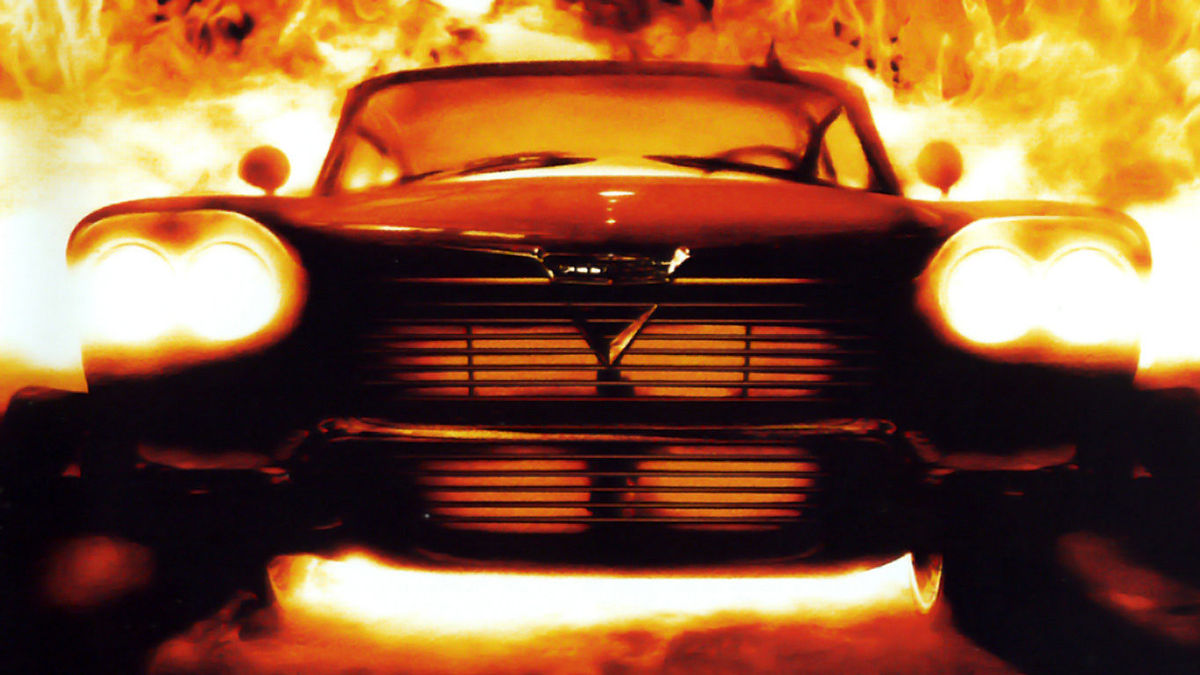
A diabolical beauty seduces a young outcast, killing anyone
who infuriates her. A fondness for Fifties culture, a solid performance from Keith
Gordon, and John Carpenter’s thumbprints make this Stephen King adaptation a goofy
bit of fun.
3. Road Games (2015)
We also wanted at least one car chase movie, and there were
a lot of great possibilities:
Jeepers Creepers
Duel
Joy Ride
Road Games (the 1981 Stacy Keach/Jamie Lee Curtis one)
Race with the Devil
That’s a good looking crop of movies!
We liked Abner Pastoll’s Road Games for the list because not enough people have
seen it, it keeps you guessing from beginning to end, and, like you, we love Barbara
Crampton.
2. Transsiberian (2008)
It turns out, an awful lot of great or bizarre or awful-but-endlessly-watchable
horror has been made aboard a train. We narrowed down our list to:
Creep
Midnight Meat Train
Terror Train (a George Wolf favorite)
Beyond the Door III (Amok Train – which I think is really set aboard a boat)
Night Train to Terror (insane, just insane)
Horror Express
And somehow
we wound up choosing a thriller more than horror, and you’re asking yourself why.
Because Transsiberian is a nailbiter from writer/director Brad Anderson
(Session 9, The Machinist), it’s clearly a superior film than the
rest of those on this list, and we want you to watch it. Woody Harrelson,
totally unaware that his wife (Emily Mortimer) is unsatisfied in their
relationship, keeps introducing her to the wrongest possible people on this
train. Where is his head? Goes scary, wild, tense places.
1. Train to Busan (2016)
We are always, always interested when a filmmaker can take the zombie genre in a new direction. Very often, that direction is fun, funny, political—but not necessarily scary. Co-writer/director Sang-ho Yeon combines the claustrophobia of Snakes on a Plane with the family drama of Host, then trusts young Su-An Kim to shoulder the responsibility of keeping us breathlessly involved. It works. Sometimes funny, sometimes shocking, always exciting and at least once a heart breaker, Train to Busan succeeds on every front.
A perversion of childhood innocence in an attempt to create anxiety and fear—that, basically, is the definition of carnivals, circuses, theme parks. Maybe that’s why the amusement park and its inhabitants make for such excellent horror movie fodder. Let’s discuss.
5. Zombieland (2009)
Writers Rhett Reese and Paul Wernick (Deadpool) take the
tried-and-true zombiepocalypse premise and sprint with it in totally new and
awesome directions. An insane cast helps: Woody Harrelson, Jesse Eisenberg,
Emma Stone, Abigail Breslin, Bill Murray. That’s eight Oscar nominations and
one win, that’s what that is. Plus, I cannot imagine a better cameo in a film
than Murray’s in this one.
I give you, a trip to a loud and well-lit amusement park is not a
recommendation Max Brooks would make during the zombiepocalypse. Still, you’ve
got to admit it’s a gloriously filmed piece of action horror cinema.
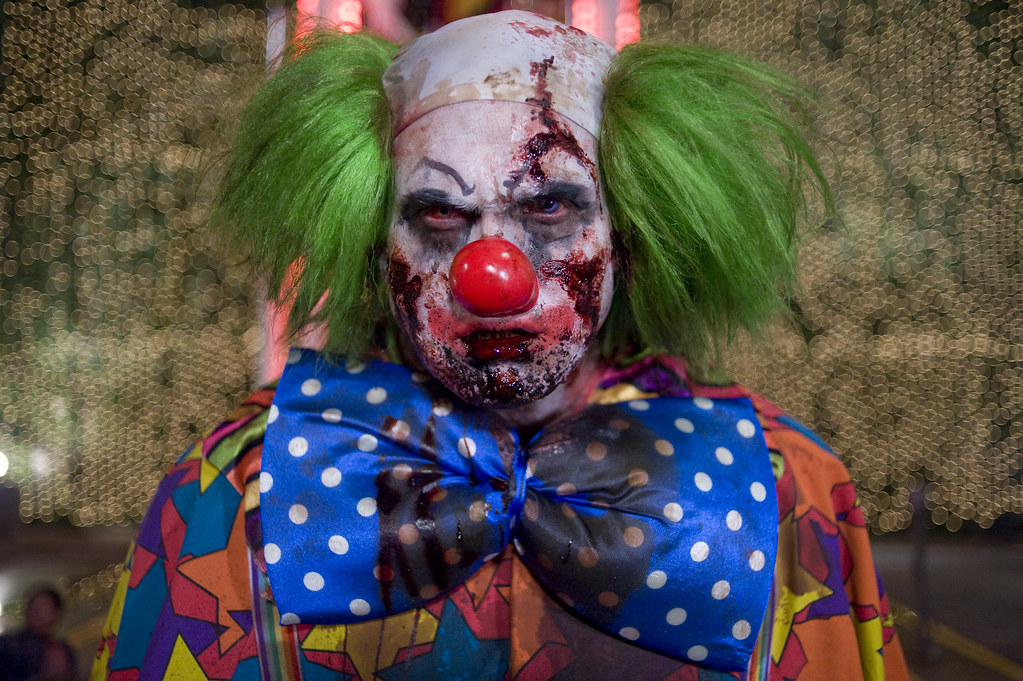
Between the sisters trapped on a ride slowly lowering them toward hungry mouths (good thinking on those boots, ladies!), Columbus’s rule breaking heroism with that effing clown, and the all-time great Tallahassee shoot out, director Ruben Fleischer directs the hell out of the amusement park portion of this movie.
4. It (2017)
Clowns are fun, aren’t they?
The basic premise of It is this: Little kids are afraid of
everything, and that’s just good thinking.
Bill Skarsgård has the unenviable task of following a letter-perfect Tim
Curry in the role of Pennywise. Those are some big clown shoes to fill, but
Skarsgård is up to the challenge. His Pennywise is more theatrical, more of an
exploitation of all that’s inherently macabre and grotesque about clowns.
Is he better than the original? Let’s not get nutty here, but he is great.
Director Andy Muschietti shows great instinct for taking advantage of foreground, background and sound. Yes, It relies heavily on jump scares, but Muschietti’s approach to plumbing your fear has more depth than that and he manages your rising terror expertly.
3. The Last Circus (2010)
Who’s in the mood for something weird?
Unhinged Spanish filmmaker Alex de la Iglesia returns to form with The
Last Circus, a breathtakingly bizarre look at a Big Top love triangle set
in Franco’s Spain.
Describing the story in much detail would risk giving away too many of the
astonishing images. A boy loses his performer father to conscription in Spain’s
civil war, and decades later, with Franco’s reign’s end in sight, he follows in
pop’s clown-sized footsteps and joins the circus. There he falls for another
clown’s woman, and stuff gets nutty.
Like Tarantino, Igelsia pulls together ideas and images from across cinema
and blends them into something uniquely his own, crafting a film that’s
somewhat familiar, but never, ever predictable.
The Last Circus boasts more than brilliantly wrong-minded direction and stunningly macabre imagery – though of these things it certainly boasts. Within that bloody and perverse chaos are some of the more touching performances to be found onscreen.
2. Us (2019)
From a Santa Cruz carnival to a hall of mirrors to a wall of rabbits in cages, writer/director Jordan Peele draws on moods and images from horror’s collective unconscious and blends them into something hypnotic and almost primal.
But Us is far more than a riff on some old favorites. It’s as if Alice’s Adventures in Wonderland turned into a plague on humanity.
And it all starts innocently enough with a family outing to the carnival—an environment that has always been a perversion of innocence, a macabre funhouse mirror of the playthings and past times of children. Peele takes advantage, using this stage to create an even wilder and more bewildering look at who we are.
1. Freaks (1932)
Short and sweet, like most of its performers, Tod Browning’s controversial
film Freaks is one of those movies you will never forget. Populated
almost entirely by unusual actors – midgets, amputees, the physically deformed,
and an honest to god set of conjoined twins (Daisy and Violet Hilton) – Freaks
makes you wonder whether you should be watching it at all.
This, of course, is an underlying tension in most horror films, but with Freaks,
it’s right up front. Is what Browning does with the film empathetic or
exploitative, or both? And, of course, am I a bad person for watching this
film?
Well, that’s not for us to say. We suspect you may be a bad person, perhaps
even a serial killer. Or maybe that’s us. What we can tell you for sure is that
the film is unsettling, and the final, rainy act of vengeance is truly creepy
to watch.
There is something primally terrifying in the idea of missing persons – losing someone or being lost. Where are they and what is happening to them? No mater which side of that question you are on, the imagination conjures terrifying images.
Listen to the full podcast, including a special interview with Hounds of Love director Ben Young.
5. The Poughkeepsie Tapes (2007)
John Erick Dowdle’s film is a difficult one to watch. It contains enough elements of found footage to achieve realism, enough police procedural to provide structure, and enough grim imagination to give you nightmares.
Edward Carver (Ben Messmer) is a particularly theatrical serial killer, and the film, which takes you into the police academy classroom, asks you to watch his evolution from impetuous brute to unerring craftsman. This evolution we witness mainly through a library of videotapes he’s left behind—along with poor Cheryl Dempsey (Stacy Chbosky)—for the police to find.
Cheryl is Carver’s masterpiece, the one victim he did not kill but instead reformed as his protégé. It’s easily the most unsettling element in a film that manages to shake you without really showing you anything.
4. Berlin Syndrome (2017)
Aussie photographer Clare (Teresa Palmer, better than she’s ever been) is looking for some life experience. She backpacks across Europe, landing for a brief stay in Berlin where she hopes to make a human connection. Handsome Berliner Andi (Max Riemelt) offers exactly the kind of mysterious allure she wants and they fall into a night of passion.
What follows is an incredible combination of horror and emotional dysfunction, deftly maneuvered by both cast mates and director Cate Shortland. The mental and emotional olympics Palmer goes through from the beginning of the film to the end showcase her instincts for nuanced and unsentimental performance. Clare is smart, but emotionally open and free with her own vulnerability. The way Palmer inhabits these characteristics is as authentic as it is awkward.
Even more uncomfortable is the shifting relationship, the neediness and resilience, the dependency and independence. It’s honest in a way that is profoundly moving and endlessly uncomfortable. Riemelt matches Palmer’s vulnerability with his own insecurity and emotional about-faces. The two together are an unnerving onscreen pairing.
3. The Vanishing (Spoorloos) (1988)
Back in ’88, filmmaker George Sluizer and novelist Tim Krabbe adapted his novel about curiosity killing a cat. The result is a spare, grim mystery that works the nerves.
An unnervingly convincing Bernar-Pierre Donnadieu takes us through the steps, the embarrassing trial and error, of executing on his plan. His Raymond is a simple person, really, and one fully aware of who he is: a psychopath and a claustrophobe.
Three years ago, Raymond abducted Saskia (Johanna ter Steege) and her boyfriend Rex (Gene Bervoets) has gone a bit mad with the the mystery of what happened to her. So mad, in fact, that when Raymond offers to clue him in as long as he’s willing to suffer the same fate, Rex bites. Do not make the mistake of watching Sluizer’s neutered 1993 American remake.
https://www.youtube.com/watch?v=fcA10H-85×4&t=36s
2. The Blair Witch Project (1999)
Blair Witch may not date especially well, but it scared the hell out of a lot of people back in the day. This is the kind of forest adventure that I assume happens all the time: you go in, but no matter how you try to get out – follow a stream, use a map, follow the stars – you just keep crossing the same goddamn log.
One of several truly genius ideas behind Blair Witch is that filmmakers Daniel Myrick and Eduardo Sanchez made the audience believe that the film they were watching was nothing more than the unearthed footage left behind by three disappeared young people. Between that and the wise use of online marketing (then in its infancy) buoyed this minimalistic, naturalistic home movie about three bickering buddies who venture into the Maryland woods to document the urban legend of The Blair Witch. Twig dolls, late night noises, jumpy cameras, unknown actors and not much else blended into an honestly frightening flick that played upon primal fears.
1. Hounds of Love (2018)
Driven by a fiercely invested and touchingly deranged performance from Emma Booth, Hounds of Love makes a subtle shift from horrific torture tale to psychological character study. In 108 grueling minutes, writer/director Ben Young’s feature debut marks him as a filmmaker with confident vision and exciting potential.
It is the late 1980s in Perth, Australia, and at least one young girl has already gone missing when the grounded Vicki (Ashleigh Cummings) sneaks out her bedroom window to attend a party. This isn’t nearly as dumb a move as is accepting a ride from Evie White (Booth) and her husband John (Stephen Curry).
As the couple dance seductively and drink to celebrate, Young disturbingly conveys the weight of Vicki’s panicked realization that she is now their captive. It is just one in a series of moments where Young flexes impressive chops for visual storytelling, utilizing slo-motion, freeze frame, patient panning shots and carefully chosen soundtrack music to set the mood and advance the dreadful narrative without a spoken word.
Viscosity! That’s the name of the game today, and it’s a messy, messy game to play.
Today we slip and slide through the sloppiest movies we could find as we count down the most inspired use of body fluids in horror. The whole mess is recorded live at Gateway Film Center, so please listen.
And don’t forget to bring a towel!
5) Don’t Breathe (2016)
Fede Alvarez’s magnificent home invasion horror made this list, beating out the projectile vomit of The Exorcist, the melting bums of Street Trash, the medical what-not of Re-Animator and the viscosity of other films. How did it do it? It was not because of volume.
It’s really just the one scene.
The one with a turkey baster.
The one with the single hair.
Ew.
4) Dead Alive (1992)
The list doesn’t exist without Peter Jackson, let’s be honest. Any old horror director can work with blood. Jackson certainly can. That party scene? The arterial spray poor Lionel Cosgrove causes with his lawnmower is truly a site to behold.
But what Jackson can do with pus and a bowl of custard? Chef’s kiss right there.
3) We Are the Flesh (2016)
Emiliano Rocha Minter loves him some taboos. No one bursts through taboos like him – well, Takashi Miike, maybe.
He also really loves body fluids. We mean all the body fluids. His 2016 social commentary swims them all. All all all.
Taboos and body fluids. Sloppy!
2) Evil Dead (2013)
Peter Jackson’s Dead Alive held the record for most blood in a film – 1000 gallons – until 2013.
It’s a record Sam Raimi’s earlier Evil Dead franchise efforts had once held, but Fede Alvarez (making his second appearance on this list!) drenched all records when he poured out 50,000 gallons of fake blood in a single scene.
Allegedly It Chapter 2 tops that, but I don’t know how you out-soak a torrential downpour of blood.
Gozu (2003)
Who’s not afraid of taboos? Well, the great and prolific Takashi Miike has no fear of body fluids, either. Hell, Ichi the Killer’s title screen is done in semen and one of Audition’s most memorable moments sees a multiple amputee eating his mistress’s vomit.
But with Gozu, Miike’s not holding back: blood, urine, semen, lactation, pus and other discharges I’m not sure how to even categorize. Gozu is an inspired, viscous mess.